7 Top Medical Billing Companies for Practices

The best choice depends on specialty, desired software integration, outsourcing scope, and contract model. For many independent practices, Happy Billing is the strongest fit because it combines specialty-focused RCM with EHR-compatible operations and documented clean-claim and A/R targets, while this roundup compares seven viable options rather than naming one universal winner.
The right billing partner protects more than claims. It protects cash flow, keeps denial rates from drifting up, and shortens days in A/R, which is where practices feel leakage first.
That matters in a fragmented market. One industry source says the top four U.S. medical billing firms together accounted for less than 10% of industry revenue in 2023, while the U.S. medical billing services market was estimated to grow at a 3.4% CAGR from 2019 to 2024 industry source. Buyers don't win by picking the biggest logo, they win by matching specialty complexity, denial workflow, and system fit.
We've seen this play out in practice owners' budgets. A 2024 survey reported that 61% of billing companies increased operations and staffing spend over the prior two years, and 53% were writing off more patient debt as lost than before the pandemic Tebra survey. That's why vendor selection can't stop at a feature list. You need a partner that can defend revenue, not just process claims.
For specialty groups, the biggest mistakes usually come from workflow mismatch. Anesthesia, behavioral health, cardiology, orthopedics, and pediatrics all carry different denial patterns, prior authorization traps, and modifier rules, so the best partner is the one that proves it can handle your specialty's financial pain points. If you're comparing options in a high-stakes specialty, start with the relevant page for your workflow, such as anesthesiology billing support and a free revenue audit to see where leakage is hiding.
1. Happy Billing
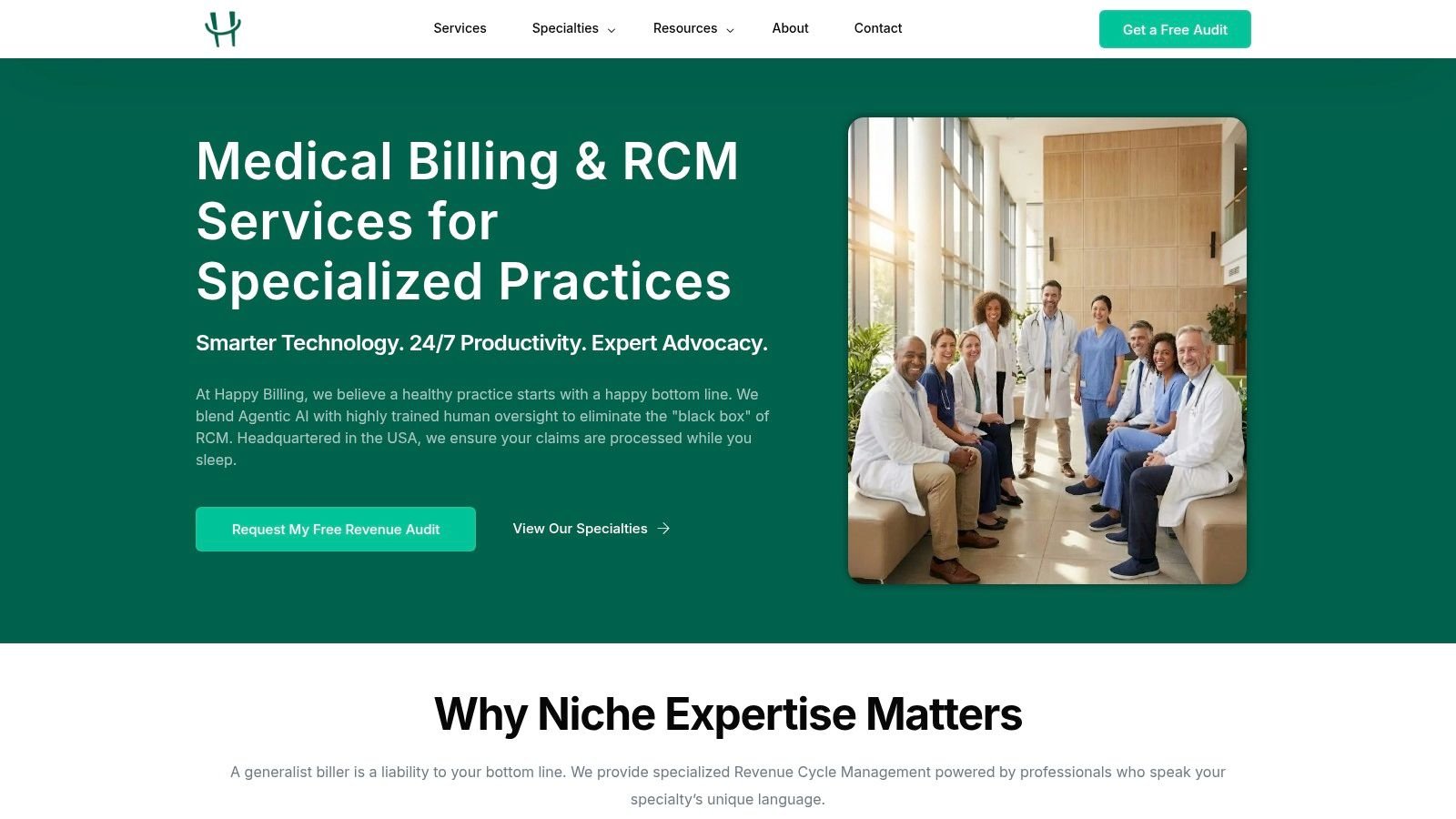
Happy Billing is the best first call for practices that want specialty-specific RCM without ripping out their existing stack. It operates inside your current EHR, which means your team doesn't have to absorb a migration project just to fix collections. For a practice owner, that difference matters because software changeovers can stall cash while the billing team is still learning the new workflow.
The value proposition is operational, not cosmetic. Happy Billing says it delivers 98%+ first-pass clean claims and keeps days in A/R under 35, while handling full-cycle RCM from patient registration through final payment posting. That's the kind of target that directly affects month-end liquidity, especially when denials are already costing you time and staff attention. The company also offers denial recovery, credentialing, and old A/R recovery, which is useful if your current team is strong at front-end intake but weak at back-end escalation.
Practical rule: If a vendor can't show you where denials are caught, who owns appeals, and how old A/R is chased, they're selling activity, not accountability.
Happy Billing's strongest edge is specialty fit. It tailors workflows for anesthesiology, mental and behavioral health, cardiology, orthopedics, and pediatrics, which is exactly where generalist billers tend to miss money. Anesthesia base units, modifiers, and concurrency are not the same as behavioral health authorization management or orthopedic global-period tracking, and the wrong workflow turns into preventable write-offs. The company also emphasizes HIPAA-first security, bank-level encryption, and strict PHI protections, which should be a standard requirement for any outsourced RCM relationship.
Its proof points matter because they're operational, not vague. Happy Billing publishes a case study about plugging a $32M revenue leak, and Dr. Mirza of Anesthesia Associates reported a rise to a 98% clean claim rate and a 15% increase in monthly collections after switching. Public pricing isn't listed, so you need to use the company's outsource medical billing cost guide and free audit process to judge ROI in your own practice, not guess from a fee sheet.
2. athenahealth
athenahealth is a strong option for practices that want an integrated software-and-services stack and are comfortable paying through collections. Its athenaOne Revenue Cycle Services bundle sits inside a broader platform that includes EHR, practice management, and patient engagement, so the commercial appeal is simplicity. If your office is dealing with disconnected tools, one vendor can reduce handoffs and shorten the list of people you need to chase when a claim stalls.
The pricing model is the main trade-off. athenahealth's revenue-cycle services are tied to a percent-of-collections structure, which can be attractive for smaller groups that want lower upfront friction but becomes expensive as revenue grows. Practice owners should ask whether the pricing scales with performance or grows with volume. For a high-producing specialty, that distinction affects margin more than almost any feature in the demo.
Its advantage is the network effect. athenahealth uses a large payer rules engine and AI-assisted billing workflows, so it can catch some errors before submission and keep teams aligned with payer updates. That matters for practices that do not have internal staff to monitor every rule change. For buyers comparing integrated software-plus-services models, a useful reference point is medical practice cloud solutions, especially if they are weighing how much of the stack should sit with one vendor.
The limitation is scope. Some tasks still remain the client's responsibility, so the contract has to be read carefully. If you are a physician owner comparing outsourcing options, ask which denials are worked by athenahealth staff, what stays in-house, and how much manual follow-up your own team will still need.
The internal fit question is straightforward. If you want embedded software plus services, athenahealth belongs on the shortlist. If you want a more specialty-tuned operator with clearer accountability for denials and A/R, compare it against a managed RCM partner before you sign.
3. CareCloud
CareCloud is a strong option for practices that want billing tied closely to their practice management and EHR environment. That one-vendor structure can reduce the usual friction between software, coding, and collections teams. For independent owners, fewer handoffs usually mean fewer excuses when revenue slips.
It's especially relevant for specialty groups that need a platform-aware billing operation. CareCloud supports specialty-specific teams, including cardiology and orthopedics, and its managed billing service covers the full claim lifecycle, payment posting, denial workflows, and performance reporting. That makes it a practical choice for practices that want visibility without building a large internal operations layer.
Commercial lens: The more your billing partner can connect claim status, payment posting, and denial response inside one reporting view, the easier it is to spot leakage before it becomes old A/R.
The pricing model is the main caution. CareCloud typically uses a collections-based structure, and that means the total cost depends on volume and service scope. The upside is alignment, because the vendor gets paid as revenue is collected. The downside is that practice owners can underestimate long-term cost if they only compare headline percentages.
That's why contract clarity matters more than brand familiarity. Ask what's included, what counts as an extra charge, and how specialty support is staffed when the claim queue gets messy. RCM for physician practices is a useful benchmark for what a practice-level engagement should spell out before you commit.
CareCloud belongs in the conversation for groups that want integrated reporting and specialty-tuned workflows, especially if the office prefers one platform over multiple vendors. It's less compelling if you need very tight specialty coaching on the most complicated claims or if you want a service model that feels more bespoke.
4. Coronis Health
Coronis Health makes the most sense for anesthesia-heavy and hospital-based groups that need deep specialty knowledge instead of broad ambulatory coverage. That specialization matters because anesthesia billing is not a generic claims exercise. It's a mix of documentation accuracy, subsidy strategy, contract pressure, and patient support that can affect margin on every case.
The company's strength is domain depth. Coronis offers end-to-end anesthesia RCM, analytics, consulting, subsidy analysis, and contract strategy, which gives practice leaders more than just claim submission support. When a group is under-reimbursed or trapped in a payer contract that no longer reflects case mix, that extra strategic layer can be worth more than a low billing percentage.
The trade-off is focus. Coronis's brand presence is most clearly anchored in anesthesia, so practices outside that lane should verify fit carefully before signing. A cardiology or orthopedics group might like the consulting posture, but it should still confirm how much specialty-specific coding depth is assigned to the account.
The best use case is simple. If your practice needs a partner that understands the financial structure of anesthesia and hospital-based billing, Coronis deserves a close look. If you're trying to solve broad multi-specialty revenue leakage with one operating model, you may want a partner with more visibly balanced specialty coverage.
For a specialty buyer, that distinction changes the question set. Don't just ask whether Coronis can “handle billing.” Ask how it manages anesthesia-specific claim paths, who owns escalation, and how it supports contract analysis when payer reimbursement no longer matches operating reality. If your group is evaluating oncology billing parallel to a hospital-based specialty stack, oncology billing services is a helpful comparison point for the kind of complexity specialty RCM should address.
5. Medusind
Medusind fits practices that want specialty billing support without replacing their current practice management system. Its PMS-agnostic model reduces migration risk, and that matters because a system change can slow collections before it improves them. For a physician owner, the practical gain is simple, current workflows stay in place while the billing work moves to a dedicated team.
The service model is broad. Medusind covers eligibility, benefit analysis, authorizations, coding, claims, denials, and patient billing, which gives it full-cycle capability. It also has specialty programs in anesthesia and behavioral health, two areas where authorization and utilization review can drive a large share of preventable leakage. The company's scale is significant too, with 4,000+ employees and 30,000+ providers served, which signals that it can support larger or more complex organizations Medusind.
Financially, the strongest signal is front-end control. Behavioral health practices often lose revenue when authorization tracking slips, and anesthesia groups can suffer when eligibility checks are not tight enough before the case. Medusind's value appears to sit upstream, where one missed approval or benefit detail can turn into a denial that takes weeks to unwind. That is the kind of operational weakness practice owners should test before they sign.
The procurement side still needs discipline. Pricing and SLAs are not publicly listed, so the contract should spell out account coverage, escalation, and response timing. A practical review starts with a medical billing company hiring checklist, because a large vendor can still underdeliver if the service team is spread too thin or ownership is unclear.
Practices that want to keep the current EHR should evaluate Medusind. Groups that need public pricing or a highly boutique relationship may find the setup more opaque than they want.
6. GeBBS Healthcare Solutions
GeBBS is the strongest fit for practices that want a scalable RCM partner with modular outsourcing options. That matters if you don't need a full takeover but do need help with coding, charge capture, A/R follow-up, or denial management. Many physician groups want that middle ground, not an all-or-nothing switch.
The company's value is process depth. GeBBS offers a full RCM stack, analytics, automation, and value-based care support, along with flexible engagement models that can be expanded as volume changes. For a practice owner, that means you can start with targeted functions and then widen the scope if the financial case holds up. That flexibility is useful when leadership wants proof before handing over more control.
The main trade-off is vendor scale. Large vendors are often efficient, but they can also feel less boutique than a specialty-focused firm. That doesn't make them wrong for your practice, only more dependent on contract detail. You'll want specialty-specific oversight, named KPI ownership, and a clear escalation path in writing.
Operator insight: If you only buy coding support, ask who owns denial follow-up after the coder hands off the file. Gaps in ownership are where old A/R gets created.
GeBBS belongs on a list of serious contenders because it can support partial or full outsourcing, which is useful when your internal team is already under strain. The question is whether your practice wants broad process horsepower or a closer specialty partnership. If the answer is horsepower, GeBBS is worth evaluating.
For buyers comparing service depth versus software dependence, the practical test is whether the engagement protects revenue without adding more internal coordination work. If the answer is yes, the model can fit. If you still need to manage everything manually, the value proposition weakens quickly.
7. Health Prime Including Legacy AdvantEdge
Health Prime is a practical choice for hospital-based, mixed-setting, and multi-specialty groups that need broader specialty coverage with enterprise reporting. The integration of legacy AdvantEdge capabilities added depth in hospital-based specialties, which matters for groups that straddle ambulatory and facility-linked billing. For practice leaders, the appeal is not just coverage, but visibility across the revenue cycle.
Its specialty spread is useful. Health Prime supports anesthesia, orthopedics, cardiology, hospitalist, and behavioral health programs, so it can handle practices with a more complicated mix of procedural and cognitive work. That makes it a better fit for groups that need reporting consistency across several service lines rather than a narrow boutique focus.
The financial advantage is dashboarding. Enterprise analytics and executive reporting help owners see whether denial work, claim status, and collection behavior are moving in the right direction. That kind of visibility matters if you're trying to manage margin across multiple providers or locations.
The caution is transition risk. Because the AdvantEdge capability was integrated into a larger platform, the practice should confirm service-model alignment and transition plans before moving forward. Any post-acquisition environment can look attractive in a proposal and still create surprises in implementation. Ask who owns training, who owns escalation, and how quickly the team can resolve account issues once the contract is live.
Health Prime belongs on the shortlist for practices that want broad specialty support with a stronger analytics orientation. It's less of a fit if you need customized, specialty-by-specialty revenue protection with public pricing. The more complex the practice, the more important it becomes to test whether the operating model matches reality rather than marketing.
Top 7 Medical Billing Companies Comparison
| Provider | Implementation complexity | Resource requirements | Expected outcomes | Ideal use cases | Key advantages |
|---|---|---|---|---|---|
| Happy Billing | Low, operates inside existing EHR, no migrations | Agentic AI + human audit teams, 24/7 global back office | 98%+ first-pass clean claims, <35 days A/R, faster collections | Specialty, high-stakes practices wanting fast cash flow and denial prevention | Specialty-tailored workflows, AI+human audit, 24/7 turnaround, HIPAA-first security |
| athenahealth (athenaOne RCS) | Moderate, best with athenaOne platform adoption | Software-enabled RCM, large payer rules engine, vendor-managed updates | Streamlined workflows, reduced admin overhead, fewer pre-submission errors | Practices wanting an integrated EHR/PM/RCM stack and revenue-share pricing | Tight software+services integration, extensive payer rules, turnkey delivery |
| CareCloud | Moderate, requires CareCloud platform integration | Platform-based teams, specialty playbooks, revenue-share model | Reduced hand-offs, specialty-tuned workflows, transparent reporting | Practices seeking one-vendor platform and managed RCM | One-vendor model, specialty playbooks, consolidated reporting |
| Coronis Health | Low–Moderate, full-cycle RCM with specialty focus | Deep anesthesia teams, consulting, contract/subsidy strategy | Improved anesthesia-specific financial performance and contract outcomes | Anesthesia and hospital-based groups, multi-specialty practices needing niche depth | Anesthesia domain leadership, specialty analytics, consulting services |
| Medusind | Low, PMS-agnostic delivery fits into existing systems | Large operational teams, authorization/benefit verification expertise | Specialty billing without migration, published throughput metrics | Practices wanting PMS-agnostic specialty RCM (behavioral health, anesthesia) | PMS-agnostic model, strong authorization workflows, large-scale experience |
| GeBBS Healthcare Solutions | Flexible, modular or full outsourcing options | Scalable process-driven teams, analytics, GenAI-assisted tools | Scalable RCM, improved coding/denial workflows, modular delivery | Organizations needing rapid scale or selective outsourcing of RCM functions | Flexible engagement models, strong automation/analytics, documented processes |
| Health Prime (incl. AdvantEdge) | Moderate, integrated specialty programs, post-acquisition alignment | Specialty RCM teams, enterprise BI and dashboards | Specialty-tuned claim management, enterprise reporting and visibility | Hospital-based or mixed-setting groups needing enterprise analytics | Specialty programs for perioperative care, executive dashboards, expanded capabilities |
Turn the Shortlist Into a Safer Contract
The fastest way to choose among top medical billing companies is to compare the contract, not the brochure. Start with specialty fit, EHR or PM compatibility, services included, denial ownership, authorization support, reporting cadence, clean-claim and A/R targets, security controls, implementation responsibilities, pricing basis, termination terms, and reference checks. Those are the variables that decide whether the vendor improves cash flow or just adds a new layer of overhead.
For specialty practices, the questions have to get more specific. Anesthesia groups should ask how the vendor handles base units, modifiers, and concurrency. Mental health practices should ask who owns authorization workflows and how repeat visits are protected from avoidable denials. Cardiology groups should press for answers on modifier 26, technical versus professional billing, diagnostic imaging rules, and payer-specific bundling edits. Orthopedics should ask about global periods and multiple procedure reductions. Pediatrics should ask how the vendor manages payer variation and visit-level workflow across age-based coverage rules.
The benchmark context helps you separate good from acceptable. In 2026, the national median net collection rate sits at 83% to 89%, while top performers target 93% or higher, with clean claim rates of 95%+ and first-pass denial rates under 5% comparative industry source. The same benchmark source cites median A/R of 40 to 50 days versus under 30 days for top performers, so any vendor that won't commit to real reporting targets is asking you to buy hope, not performance.
Here's the buying checklist I'd use in a physician office. Define your baseline revenue metrics before the sales call. Request a sample dashboard. Identify exclusions in writing. Validate escalation paths. Review SLA language carefully. Calculate total cost under growth scenarios. Ask for relevant case studies in your specialty. Then compare how each vendor handles old A/R, denial prevention, and payer follow-up before you sign anything.
The right partner is the one that can prove better cash flow, lower denial leakage, and real accountability for your specialty, not the one with the slickest demo. If you want that proof before changing vendors, ask for a free audit and compare the findings against your current A/R, denial patterns, and collections trend.
How do medical billing companies usually charge?
Most vendors use a collections-based, subscription, or quote-based model, and the cost depends on what services are included, what's excluded, and whether specialty work or denial recovery is extra. The safest move is to calculate total cost against your current collections and growth expectations, not just the headline rate.
Do I have to change my EHR to outsource billing?
No, not always. Some partners work inside your existing EHR or PM system, while others want you inside their platform, so compatibility should be one of your first deal-breakers if migration risk matters to your practice.
Which KPIs should I insist on in the contract?
Ask for clean claim rate, first-pass denial rate, days in A/R, denial ownership, reporting cadence, and appeal turnaround. If the vendor won't commit to measurable outcomes, you won't have much power when performance slips.
How fast can a vendor work down old A/R?
That depends on the age, quality, and volume of the file, plus how much payer follow-up the vendor owns. Ask for a specific recovery plan, a sample dashboard, and a clear escalation path before you assume the backlog will move quickly.
If you want a specialty-focused RCM partner that works inside your existing EHR, targets cleaner claims, and keeps A/R from drifting, visit Happy Billing and request a free audit. We'll help you see where the revenue leakage is coming from and whether your current billing setup is protecting the cash your practice has already earned.