Outsource Medical Billing Services: Pros & Cons Guide

Yes, you should outsource medical billing services if your practice is fighting denials, carrying old A/R, or relying on one overextended biller to keep cash moving. If your current billing model is slowing collections, the issue isn't control. It's revenue leakage.
Most practice owners reading this are in a familiar spot. Charges are going out, but money is arriving late. Claims need rework. Your team says the payer is the problem. The payer says the documentation is the problem. Meanwhile, your denial rate, aging A/R, and staff overhead are determining your take-home profit. For an independent practice owner, billing isn't a back-office task. It's your margin.
When we audit a practice, we don't start with abstract advice. We look at three numbers first: denial rate, clean claim rate, and days in A/R. If those are off, you don't have a staffing issue or a software issue. You have a cash flow issue. In specialties like anesthesia, cardiology, orthopedics, and mental health, that problem gets expensive fast because modifier use, authorization rules, time-based coding, and payer edits create more places to lose collectible revenue.
What Outsourcing Medical Billing Actually Entails
Outsourcing medical billing means hiring a specialized revenue cycle team to handle part or all of your billing workflow instead of carrying that entire burden with internal staff. For a practice owner, that's a business decision to replace fixed overhead with a variable operating model tied to collections and execution.
The appeal is straightforward. You stop funding every salary, retraining cycle, software headache, and coverage gap yourself. In return, you get a team whose job is to submit claims correctly, work denials hard, and keep A/R from stalling. That shift is one reason the global medical billing outsourcing market is projected to grow from USD 18.20 billion in 2025 to USD 50.47 billion by 2034, at a CAGR of 12.05%.
It's not just claim filing
Some vendors only transmit claims. That's not enough for most independent groups. If you're going to outsource medical billing services, the useful version is full-cycle RCM.
That usually includes:
- Charge capture review: catching missing details before they turn into rejections.
- Claim scrubbing and submission: identifying front-end errors tied to CPT selection, diagnosis linkage, NCCI edits, and modifier use.
- Payment posting and reconciliation: making sure posted dollars match expected reimbursement.
- Denial management: reworking CARC and RARC issues instead of letting them age.
- A/R follow-up: pursuing unpaid balances before timely filing and appeal windows close.
- Patient balance support: handling statements and follow-up without creating unnecessary friction.
If your vendor only does one or two of those, you haven't outsourced the revenue cycle. You've outsourced data entry.
Practical rule: If the partner can't tell you who owns denial follow-up, underpayment recovery, and old A/R cleanup, you're not looking at a real RCM relationship.
What this changes for the owner
The biggest misunderstanding is that outsourcing means giving up control. Good outsourcing does the opposite. It gives you visibility into the metrics that matter, especially days in A/R and first-pass performance, while removing dependence on one internal employee's capacity.
That matters more in specialty billing than most owners realize. An anesthesia group can't afford sloppy handling of base units, time units, or concurrency modifiers. A mental health clinic can't treat authorization tracking for CPT 90837 like an afterthought. A cardiology group loses money fast if documentation and billing don't line up on imaging, interventional procedures, and modifier usage.
CMS rules, payer edits, and AAPC coding standards don't care whether your biller is in your office or outside it. They only care whether the claim is right.
For a broader view of what that operating model looks like in practice, review this breakdown of outsourced revenue cycle management. And if you're evaluating vendors beyond billing, the same discipline applies when you find a partner for pentest outsourcing. You don't buy a service category. You buy process quality, reporting, accountability, and risk control.
The Undeniable Financial Case for Outsourcing
If your billing operation underperforms, the financial damage shows up in missed collections, higher cost-to-collect, and slower cash velocity. This isn't philosophical. It's arithmetic.
Here's the visual summary many owners need before they start asking harder questions:
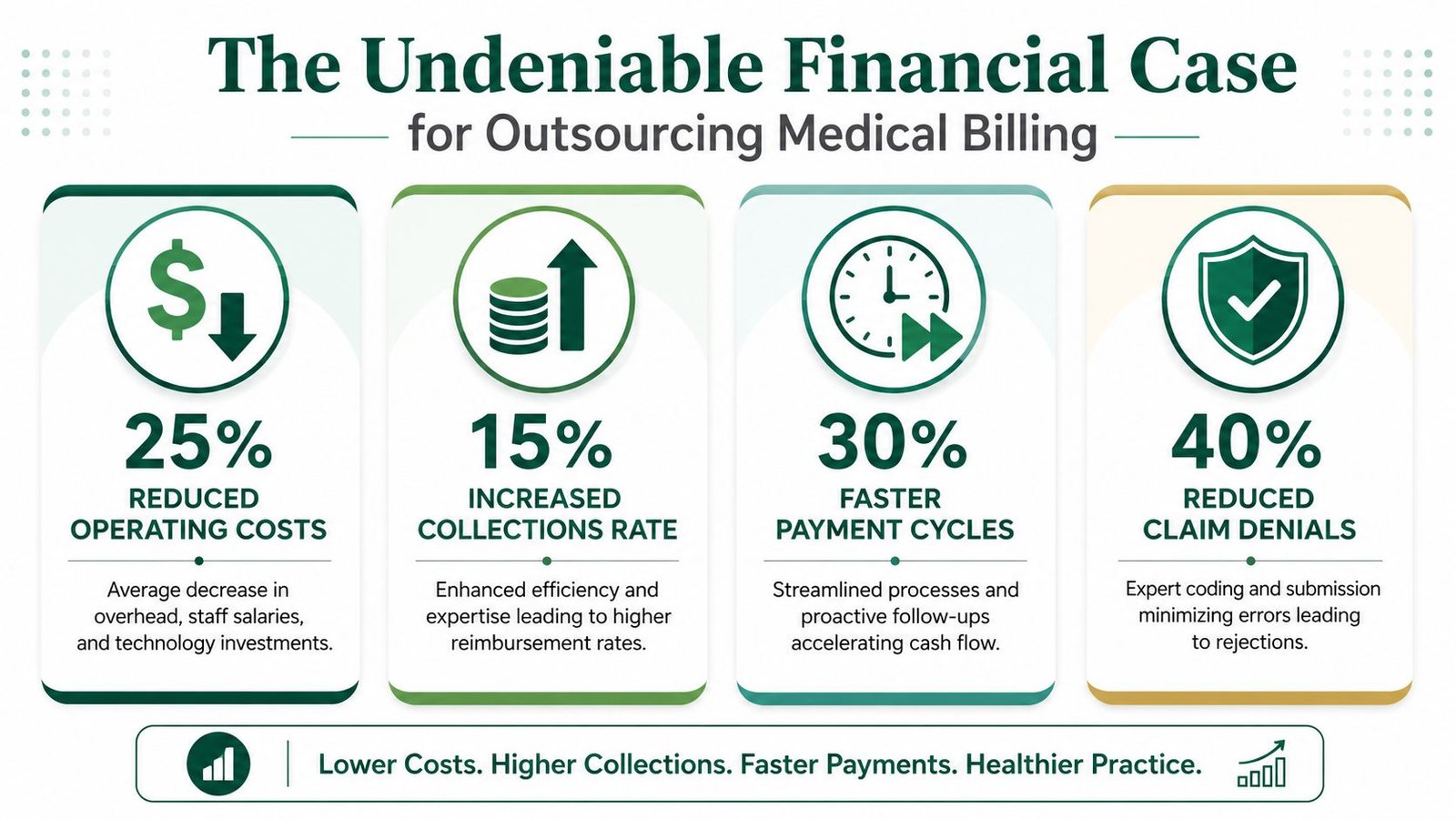
The cleanest comparison comes from denial and clean claim performance. In-house billing teams typically average denial rates of 12–18% and clean claim rates of 78–84%, whereas specialized outsourcers maintain denial rates under 5% and clean claim rates of 95–98%. For a $2M practice, that performance gap can represent a $200,000–$300,000 annual revenue loss.
That should reset the conversation. The true question isn't “What does outsourcing cost?” The true question is “What is underperformance already costing you?”
The cost-to-collect problem owners miss
A surprising number of practices still compare an outsourced fee to one employee's salary and stop there. That's bad math. You have to compare full internal cost against actual collection performance.
One benchmark puts that gap in plain terms. MGMA data cited here says in-house billing costs an average of 13.7% of collections, while outsourcing to a specialized partner reduces this cost to 5.4%. The same source states specialist providers consistently achieve clean claim rates above 95%, compared with the typical 85–90% average achieved by in-house teams.
That's why weak in-house billing hurts twice. You pay more to run it, then you collect less from it.
Denials are not a billing inconvenience
Denials are a cash impairment event. If your team is treating them like normal operational noise, your practice is absorbing losses as if they were unavoidable.
The pressure is getting worse. In 2024, national initial claim denial rates rose to 11.81%, a 2.4% year-over-year increase. For a practice billing $2 million annually, that denial rate translates to approximately $236,000 in lost revenue if not aggressively recovered.
A denial problem usually has one of four roots:
- Front-end registration failures: wrong demographics, payer data, or eligibility assumptions.
- Coding and modifier mistakes: especially on claims involving modifiers like 25, 59, or specialty-specific anesthesia concurrency modifiers.
- Documentation gaps: medical necessity support isn't there when the payer asks.
- Slow appeals: collectible claims age out because no one owns them.
A practice can survive a high fee. It won't survive a billing process that normalizes preventable denials.
Cash moves faster when follow-up has real ownership
Strong outsourcing firms don't just submit claims. They chase the money with discipline. That's why top-tier benchmarks matter. Industry benchmarks for outsourced services include a first-pass acceptance rate over 95%, less than 30 days in A/R, and less than 10% of bills aged over 120 days in A/R.
Those aren't vanity metrics. They tell you whether claims are clean, whether follow-up is timely, and whether old balances are turning into write-offs.
If you're trying to reduce manual drag inside the revenue cycle, it also helps to see how other teams automate billing support processes around repetitive follow-up and communication. Automation doesn't replace accountability. It gives accountable teams more throughput.
For owners comparing internal spend to outsourced economics, this guide on medical billing costs is a useful reality check.
Managing the Real Risks of Handing Over Your Billing
Outsourcing can improve collections, but it can also create a mess if you choose the wrong partner. The risks are real. PHI exposure, poor patient communication, black-box reporting, and bad contract terms can hurt a practice just as fast as bad billing performance.
The answer isn't to avoid outsourcing. The answer is to vet the relationship like you're protecting an income-producing asset. Because you are.
Security and HIPAA risk
Every owner should ask blunt questions about how a vendor handles PHI. If the answers are vague, stop the conversation.
Ask how they control access, how they encrypt data, how they monitor user activity, and how they handle incident response. Ask whether they work inside your current EHR or require awkward exports and side systems. CMS compliance expectations and HIPAA obligations don't relax because a third party is involved.
Here's the practical standard we use. If a vendor can't explain its safeguards in plain language, it probably won't protect your data well under pressure.
Loss of control and visibility
This is the fear physicians bring up most often. They don't want to wake up and discover their billing partner is sitting on claims while they receive polished monthly excuses.
That risk is avoidable if you require transparent reporting and review cadence from day one.
Look for:
- Dashboard access: you should be able to see denials, A/R aging, payment trends, and unresolved issues without waiting for a custom report.
- Named accountability: one person should own your account.
- Structured performance reviews: recurring calls tied to metrics, payer issues, and action items.
- Workflow clarity: who submits, who appeals, who posts, who follows up, who escalates.
If your vendor reports activity instead of outcomes, you've already lost control.
A useful parallel appears in Pebb's insights on vendor lock-in. The problem isn't just switching costs. It's loss of influence when a vendor controls the workflow, the data, and the reporting logic.
Patient experience and brand damage
A billing partner also touches your patient relationships. Bad statements, sloppy call handling, or aggressive balance collection can create unnecessary complaints and reputational damage.
That matters even more in mental health and high-touch specialty practices, where trust affects retention and referrals.
Ask to review:
- Patient statement samples
- Call handling standards
- Escalation rules for disputes
- Language around financial responsibility
- Coordination with your front desk on payer or coverage questions
You also need clean exit terms. If a vendor underperforms, you should be able to leave without a hostage negotiation over your own data and claim history. This review of medical billing company red flags is a smart checklist before you sign anything.
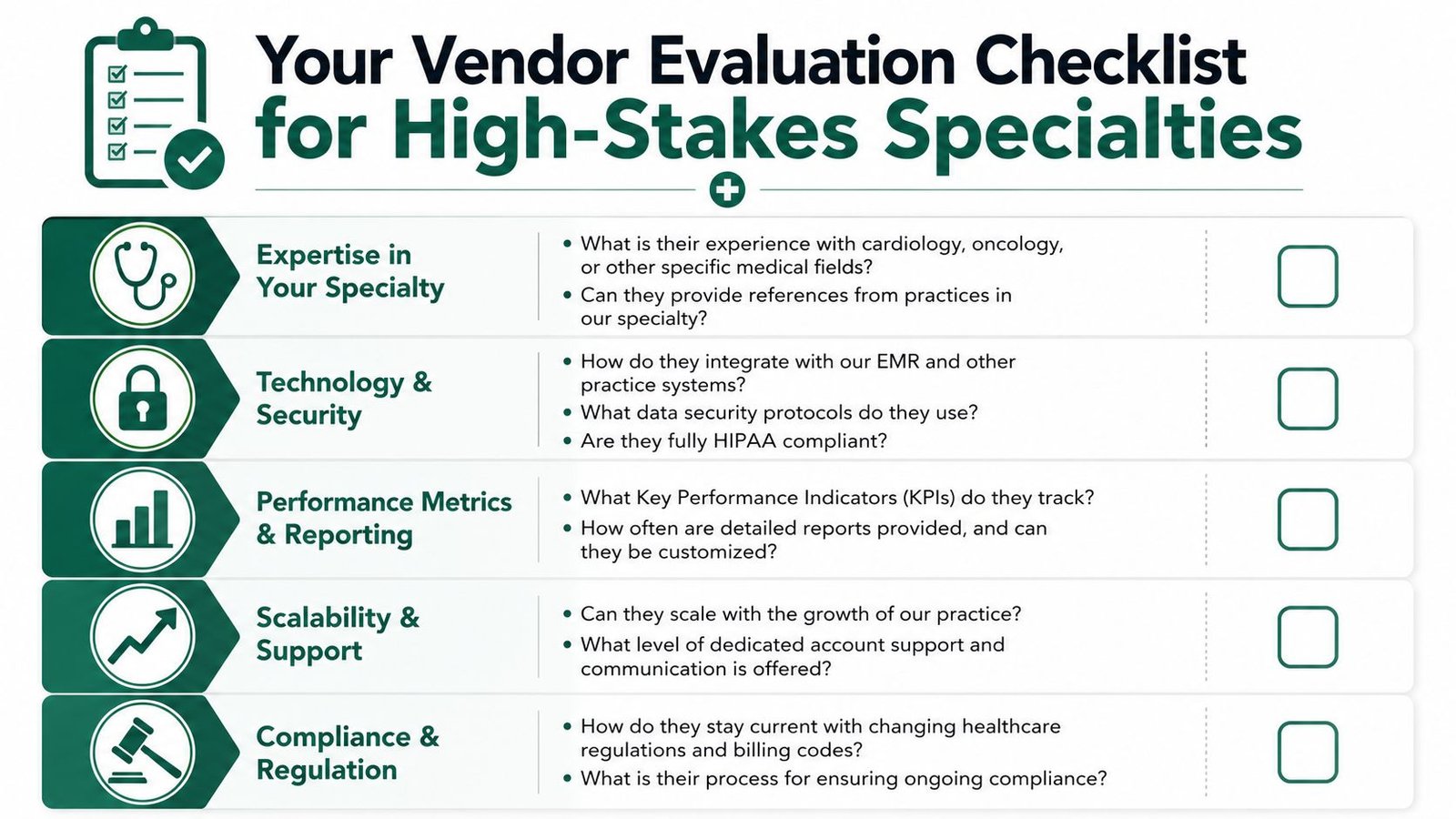
Your Vendor Evaluation Checklist for High-Stakes Specialties
A specialty practice can lose six figures with a vendor that looks competent in a demo and weakens collections in production. Cardiology breaks on modifier and edit discipline. Anesthesia breaks on time, units, and concurrency. Mental health breaks on authorizations, telehealth rules, and documentation follow-up. Evaluate billing companies by specialty economics, not by presentation quality.
A strong vendor should discuss first-pass acceptance, denial rate, days in A/R, aged A/R, underpayment recovery, and patient balance resolution without reading from a script. Fee structure matters too, but only after the operating model is clear. A low percentage fee with poor denial follow-up is more expensive than a higher fee tied to clean claims and faster cash.
Here is the framework I use when auditing vendors for high-stakes practices.
Cardiology questions that expose real competence
Cardiology revenue fails fast under generic billing. Stress tests, echoes, cath lab procedures, device checks, and imaging all carry payer-specific edits that punish sloppy charge review.
Ask these questions:
- How do you apply modifier 26 and TC across diagnostic studies, and who audits split-bill accuracy?
- What is your process for reviewing interventional cases before claim release?
- How do you catch medical necessity mismatches between the diagnosis, op note, and procedure code set?
- How do you handle NCCI edits, multiple procedure reductions, and payer-specific bundling rules?
- What do your cardiology denial categories look like over the last 90 days?
A vendor with real cardiology depth will answer with workflow, edit logic, and examples of recovered revenue. A weak vendor will give you generic claims management language.
Anesthesia questions owners should ask first
Anesthesia billing has very little tolerance for imprecision. Missed minutes, wrong modifiers, or bad concurrency logic reduce reimbursement immediately and create refund exposure later.
Use questions like these:
- How do you validate ASA crosswalk selection against the anesthesia record and final procedure documentation?
- Who checks base units, time units, physical status modifiers, and qualifying circumstances before submission?
- What is your process for medical direction versus medical supervision disputes?
- How do you review claims with AA, QK, QX, QY, and QZ modifiers before they leave the system?
- What payer edits do you monitor for concurrency and documentation mismatch denials?
Ask for a sample exception workflow, not a verbal promise. In anesthesia, preprocessing discipline drives collections.
In anesthesia, one bad rule in claim prep can reduce payment across hundreds of cases before anyone catches the pattern.
Mental health and behavioral health questions that matter
Behavioral health billing fails upstream. The problem usually starts before the claim is filed, at scheduling, benefits verification, authorization tracking, or documentation timing.
Ask directly:
- How do you track visit authorizations, extensions, and retro requests for high-frequency therapy?
- What is your process for CPT 90837 denials, including medical necessity and frequency-limit appeals?
- How do you verify payer rules for telehealth, place of service, and clinician type before billing?
- Who follows up when a payer requests records or additional documentation?
- How do you prevent claims from being submitted after an authorization expires or a visit cap is reached?
Mental health owners should pay close attention to patient communication standards too. Billing errors in this specialty do not just slow cash. They trigger complaints, cancellations, and referral loss.
Questions that apply to every specialty
Specialty knowledge is only half the decision. You also need proof that the vendor can run the account with financial discipline.
| Evaluation area | What to ask | Why it matters financially |
|---|---|---|
| Reporting | What KPIs do you deliver each month, and do they include denial rate, net collection rate, days in A/R, aged A/R, and underpayment recovery? | You need trend visibility before cash drops |
| Coding oversight | Who reviews coding exceptions and payer edit trends by specialty? | Coding drift increases denials and missed revenue |
| Denials and underpayments | Who owns appeals, corrected claims, and payer underpayment follow-up? | Unworked denials become write-offs |
| System workflow | Do you bill inside our EHR and PM, or through your own platform? | Extra handoffs create delays and posting mistakes |
| Enrollment coordination | How are payer enrollment issues escalated when claims suspend or reject? | Enrollment failures stop valid claims from paying |
| Patient billing | Can we review statements, call scripts, and balance-resolution workflows? | Poor patient billing raises complaints and slows self-pay collections |
| Staffing model | Who is assigned to our account, and what happens if that person leaves? | Turnover without backup coverage causes performance drops |
| Exit access | How fast do we get full claim history, work queues, and reporting if we terminate? | Bad exit terms trap you in a weak relationship |
Score each vendor by specialty fit, operating discipline, and reporting quality. Do not let them hide behind a blended client roster. A company may be strong in family medicine and weak in cardiology, strong in anesthesia and weak in behavioral health. Those distinctions decide whether your margin improves or erodes.
Before interviews, keep this list of questions to ask a medical billing company before hiring beside your notes. If your practice spans multiple specialties, review the relevant specialty billing pages so your scorecard reflects the revenue risks in your actual payer and procedure mix.
Implementation Roadmap and Contract Guardrails
A good billing relationship can still fail during transition if implementation is sloppy. The danger isn't just disruption. It's silent disruption. Claims may keep moving while enrollment gaps, workflow confusion, and documentation mismatches start choking reimbursement a few weeks later.
You need a phased rollout and a contract that protects your advantage.
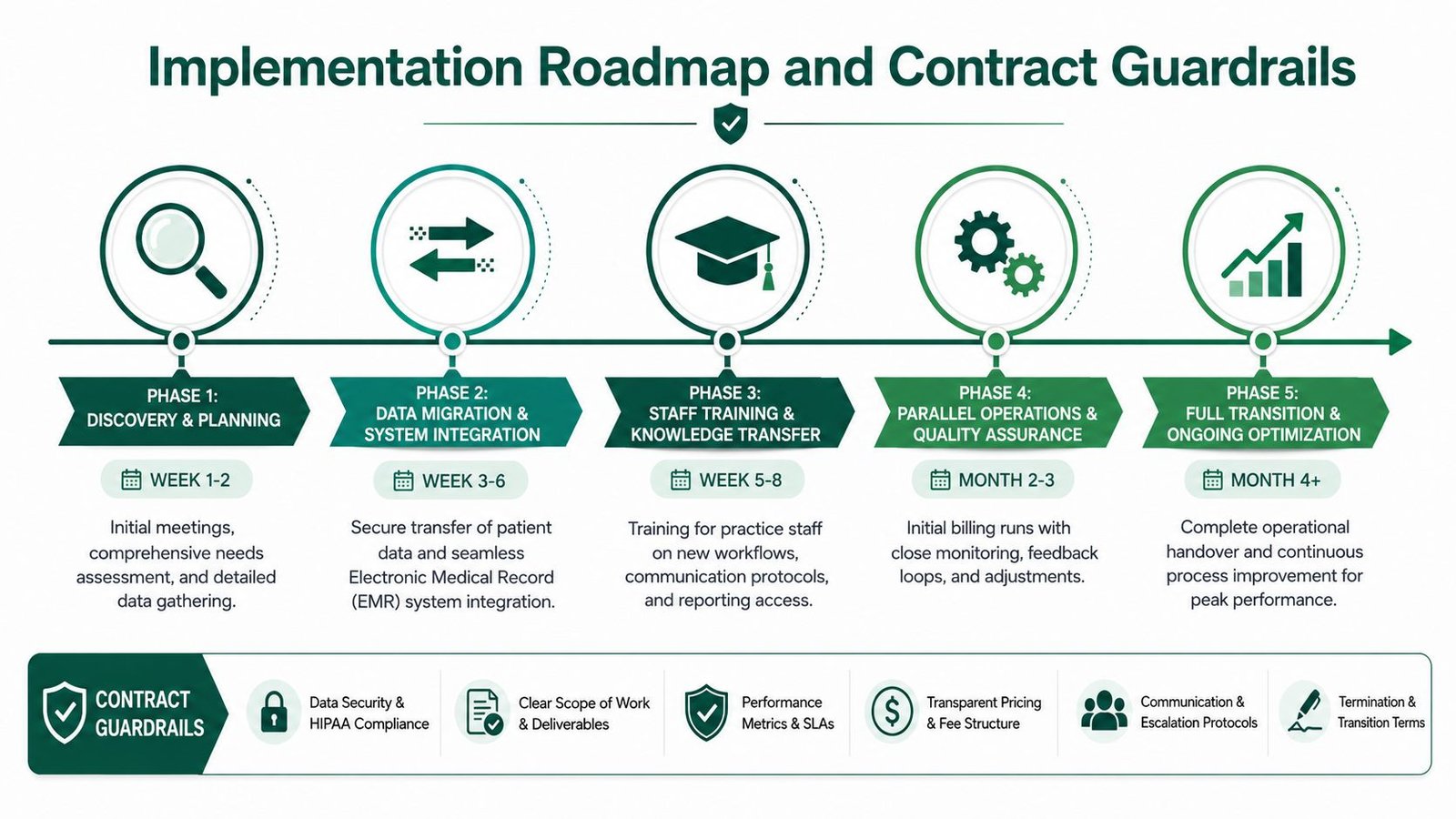
Phase sequence that protects cash flow
A disciplined implementation usually follows this order:
Discovery and workflow analysis
The vendor should map your current process from scheduling through payment posting. That includes front-end registration, charge capture, coding review, payer edits, denial queues, and old A/R responsibility.System integration and access setup
Many transitions go sideways during this phase. User roles, clearinghouse setup, payer portal access, and handoff rules have to be clear. If credentialing or enrollment is still incomplete, fix that before go-live. This planning resource on the credentialing timeline for a new practice gives owners a realistic sense of how enrollment timing affects billing readiness.Go-live with close audit control
Don't just flip the switch and hope for the best. Review initial submissions, rejections, and posting patterns aggressively. Early claim batches will reveal whether the workflow is properly aligned.Optimization after live claims start paying
At this stage, payer-specific patterns become obvious. You'll see where front-end intake is causing denials, where coding needs refinement, and where old A/R needs a separate recovery track.
What owners should insist on before launch
We've seen transitions work best when the owner or administrator requires three things in writing:
- A named implementation lead
- A defined issue-escalation path
- A post-go-live review cadence tied to metrics
Without those, everyone blames the transition when collections soften.
A transition should not depend on goodwill. It should depend on documented ownership, deadlines, and visible metrics.
Contract terms that deserve hard scrutiny
The fee structure matters, but weak legal and operational terms do more damage than a slightly higher rate.
Review these guardrails carefully:
Pricing model
Is it a percentage of collections, a per-claim fee, or a hybrid? Make sure the scope is explicit. If denial work, patient billing, or old A/R follow-up sits outside the fee, your “cheap” contract isn't cheap.Term length and termination rights
Long automatic renewals usually benefit the vendor, not the practice. You want practical exit rights if performance slips.Data ownership
Your claims data, reports, payer correspondence, and work queues should remain accessible to you. No exceptions.Service level expectations
The contract should define response times, reporting expectations, and review frequency. If the vendor refuses performance language, that's a warning sign.Transition-out support
Ask exactly what happens if you leave. How quickly do you get reports, claim history, payer notes, and outstanding A/R detail?
Red flags that signal future pain
Not every bad contract looks bad at first glance. Watch for these patterns:
- Broad promises with no reporting detail
- Unclear responsibility for denied and aged claims
- Extra charges for routine items
- No documented communication standard
- Heavy dependence on one account manager with no backup coverage
Outsourcing should reduce operational fragility, not repackage it.
Calculating True ROI from a Billing Partnership
Owners often ask for ROI and then calculate it too narrowly. They compare an outsourcing fee to payroll and stop there. That misses the actual financial drivers. The right model looks at recovered revenue, lower denial drag, faster reimbursement, reduced rework, and less internal overhead.
This comparison graphic helps frame the issue:
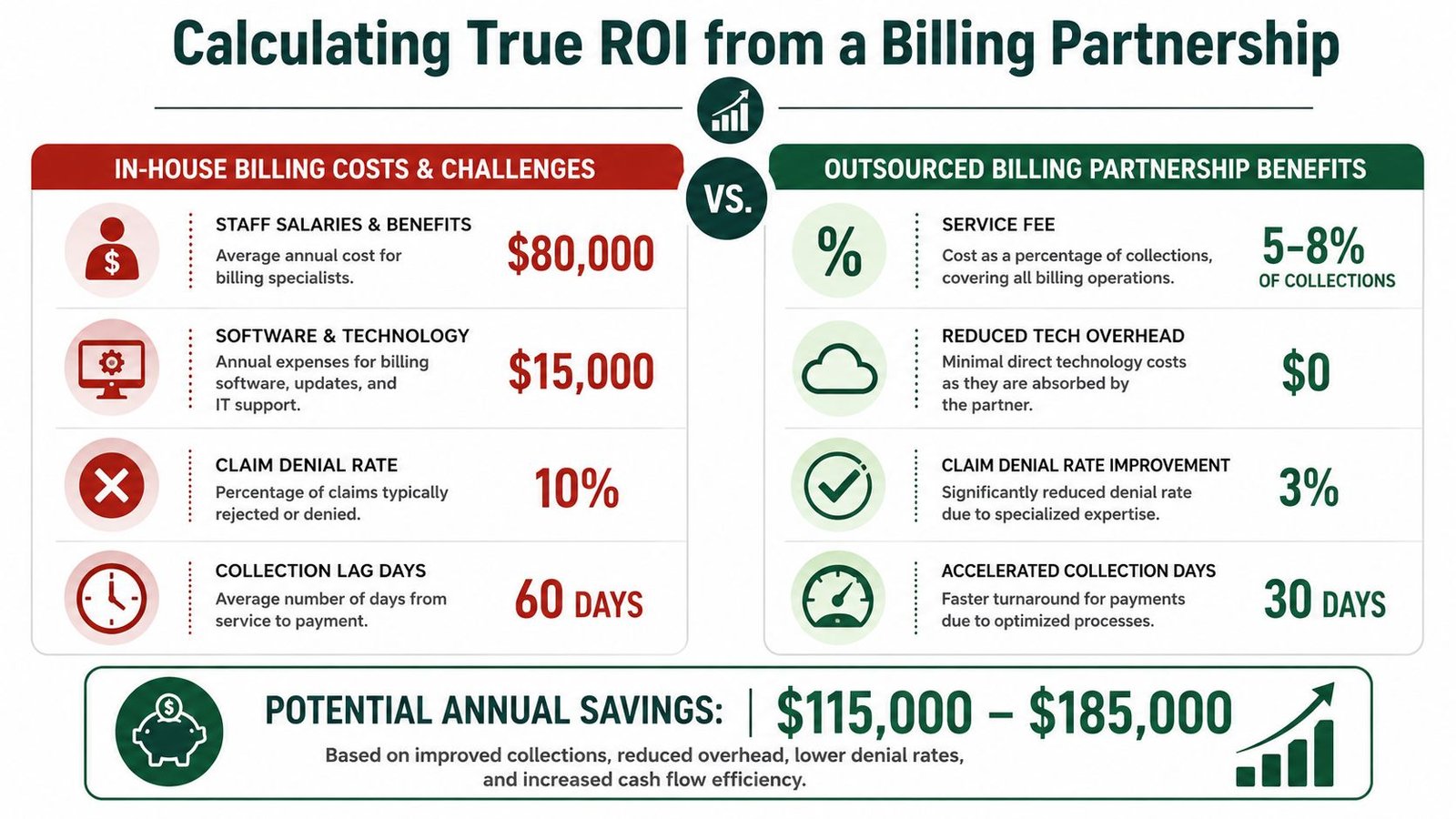
One benchmark gives owners a useful starting point. Outsourcing typically costs 3–9% of collections, while hidden in-house costs like salaries, software, and training are often higher. For complex specialties, net cost savings from reduced denials and stronger efficiency can reach 30–50% compared to an underperforming internal team.
Practice A with high denials
This is the easier ROI case to prove. The practice is collecting, but too many claims break on the first pass and too much staff time goes into rework.
In our experience, owners should calculate ROI across four lines:
- Current denial-related write-offs
- Staff time spent on resubmissions and appeals
- Cash tied up in aging A/R
- Collection lift from cleaner first-pass execution
If your specialty involves frequent modifier decisions, payer edits, or auth-sensitive services, the return usually comes from prevention first. Cleaner claims mean fewer touched claims. Fewer touched claims mean lower labor drag and faster money.
For practices comparing partners, we prefer a model that prioritizes AI plus human audits because front-end claim quality determines almost everything downstream. A team that can sustain a 98%+ first-pass clean claim rate changes the economics quickly by shrinking avoidable denials before they ever hit a payer queue.
Practice B with slow cash flow
Some practices don't have catastrophic denial rates. They have slow operational velocity. Charges sit. Follow-up lags. Payer responses aren't worked fast enough. The money eventually arrives, but too late to support healthy operations.
Here, ROI comes from accelerated movement:
| ROI driver | What to examine | Why it matters |
|---|---|---|
| Charge lag | How long after date of service are claims going out? | Delayed submission delays everything else |
| Follow-up speed | How quickly are unpaid claims touched again? | Slow follow-up stretches A/R |
| Aging mix | How much of A/R is drifting into old buckets? | Older balances are harder to recover |
| Team coverage | Is follow-up dependent on office hours and one shift? | Limited coverage slows collections |
A 24/7 follow-the-sun model is materially better for this kind of practice because it increases turnaround and follow-up consistency. The result owners should care about is simple: days in A/R under 35. That doesn't just look good on a dashboard. It improves cash velocity and reduces the need to finance operational delays with owner stress.
The best billing partnership doesn't just lower errors. It changes how fast earned revenue reaches your bank account.
The ROI test that matters
If you're evaluating whether to outsource medical billing services, don't ask for promises. Ask for a baseline audit and a financial model tied to your own denial rate, A/R aging, payer mix, and specialty complexity.
Your Questions on Outsourcing Answered
Should I outsource if my current biller has been with me for years
Longevity isn't the right metric. Performance is. If denials are rising, A/R is aging, or one employee carries too much operational risk, loyalty shouldn't override financial reality. Keep strong people where they add value, but don't confuse familiarity with an efficient revenue cycle.
Will an outsourced billing company work inside my current EHR
The better ones should. If a vendor wants to force a disruptive migration just to onboard your account, ask why. Most owners are better served by a partner that can operate inside the existing EHR and practice management workflow with clear access controls and reporting.
What if I already have a billing company and they're underperforming
Audit them before you replace them. Pull denial trends, first-pass performance, payer aging, and unresolved old A/R. If they can't explain misses clearly or fix them quickly, move on. A bad incumbent usually costs more than the disruption of replacing them.
How long does it take to know whether the switch is working
You should see early signs fast. Submission quality, rejection patterns, follow-up discipline, and reporting quality become visible early in the relationship. The right test isn't whether the vendor sounds organized. It's whether your cash flow becomes more predictable and your A/R starts moving in the right direction.
If you want a hard look at where your revenue is leaking, Happy Billing offers a practical path forward. Start with a free billing audit to review denial patterns, A/R drag, and specialty-specific billing risks without guessing.