Medical Billing Outsourcing Services: Guide for Practice

Medical billing outsourcing services are when a medical practice hands its revenue cycle work to a specialized third-party team, and the reason is simple: faster cash flow, fewer denials, and less money trapped in A/R. That shift is no longer fringe. The global market reached USD 19.32 billion in 2025 and is projected to reach USD 58.90 billion by 2035, which tells you practices are moving away from expensive in-house billing because financial pressure leaves little room for avoidable leakage.
If you're reading this, you're probably living the same pattern we see all the time. Claims are going out, but too many come back denied, staff keep touching the same accounts over and over, and A/R aging is stretching longer than it should. That isn't just an administrative headache. It hits owner compensation, hiring plans, partner distributions, and your ability to invest in growth.
A billing problem becomes a business problem the moment your denial rate rises or your days in A/R drift upward. If a claim sits, your cash sits. If staff resubmit preventable denials all week, you're paying payroll to recover revenue you should've collected correctly the first time.
What Are Medical Billing Outsourcing Services
Medical billing outsourcing services mean partnering with an outside team to handle the revenue cycle tasks that determine whether you get paid cleanly and on time. That includes charge entry, claim creation, payer submission, payment posting, denial follow-up, A/R work, and often patient billing support. In practice, it means your front desk, providers, and administrators stop carrying the full burden of billing operations internally.
Most practice owners don't start by asking for outsourcing. They start by asking why collections feel harder than they should. A physician sees a full schedule, but deposits don't match production. An administrator keeps hiring billing staff, yet old balances keep stacking up. The problem is rarely effort. It's usually process discipline, payer-specific knowledge, and lack of bandwidth.
The broader market confirms this shift. The medical billing outsourcing market analysis from Precedence Research states that the global market reached USD 19.32 billion in 2025 and is projected to hit USD 58.90 billion by 2035, with North America holding 48% of the market in 2025. That matters because it reflects a clear operating decision by providers: keep expensive billing in-house and absorb leakage, or move the work to specialists built to protect cash flow.
What a practice is really buying
You're not buying a vendor. You're buying revenue discipline.
A competent outsourced partner should own these operational pressure points:
- Front-end claim accuracy: Insurance verification, demographic accuracy, and clean charge capture before the claim leaves your system.
- Payer rule management: Modifier logic, prior authorization tracking, filing deadlines, and documentation checks that vary by payer.
- Back-end collection pressure: Follow-up on unpaid claims, appeals, and aged A/R before balances become write-offs.
- Reporting that matters: Visibility into denial trends, lagging payers, and where revenue is leaking.
Practical rule: If your internal team spends more time reworking claims than preventing denials, your billing model is backwards.
For a fuller breakdown of how the broader revenue cycle works, see this guide to revenue cycle management.
Why this model keeps gaining ground
Independent practices don't have the margin for billing drift. A small error at the front end can turn into delayed reimbursement, appeal work, or a silent write-off. Outsourcing works when it moves expertise closer to the problem. Instead of one overwhelmed in-house biller trying to manage every payer and specialty nuance, you get a process built around throughput, audit discipline, and accountability.
That matters even more in specialties where the wrong modifier or missing authorization doesn't just delay payment. It kills it.
The Financial Case for Outsourcing Your Billing
Outsourcing billing makes sense when it produces more cash, faster, with less rework. That's the standard. Not convenience. Not headcount relief. Financial performance.
The biggest mistake I see practice owners make is judging billing by cost per claim or payroll expense alone. That's too narrow. Billing should be judged by what it recovers, what it prevents from leaking, and how quickly it converts encounters into cash.
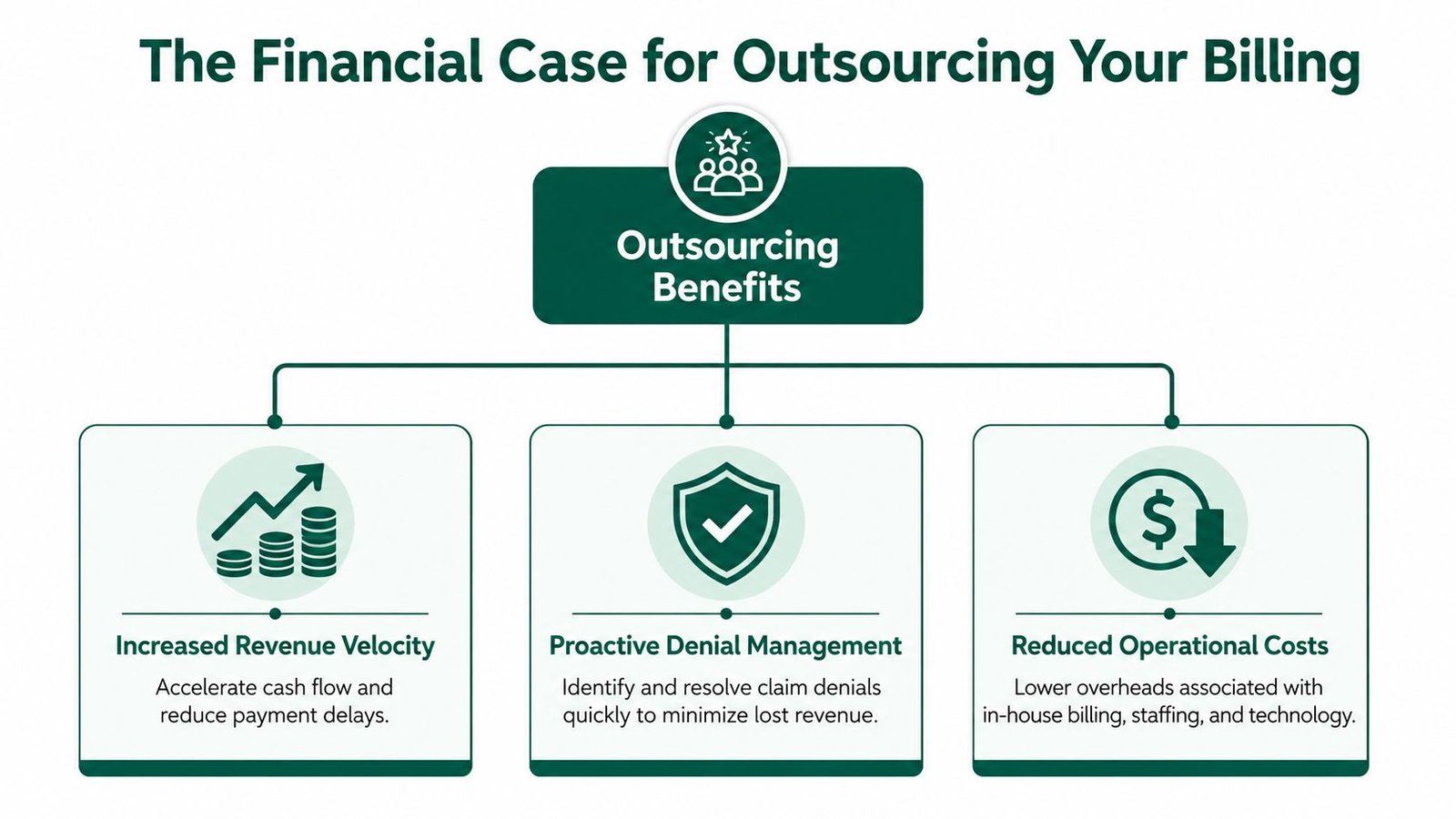
Faster payments start with cleaner claims
The cleanest financial argument is simple. The more claims you get right the first time, the less labor you waste chasing money that should already be in your bank account.
According to this review of outsourced medical billing performance, specialist outsourcing providers consistently achieve clean claim rates above 95%, compared with the typical 85% to 90% in-house average. The same source notes that for a practice processing $100 million in annual claims, a 5% reduction in denial rates can translate to $5 million in additional recovered revenue.
That is why I push owners to stop treating billing as overhead. In many practices, billing is a direct revenue recovery function.
Denials are expensive before you even lose the claim
A denied claim costs you twice. First in delayed reimbursement. Then again in staff time.
When a front-desk team misses eligibility, when a provider documents poorly against medical necessity, or when your biller sends a cardiology claim without the right modifier logic, you create avoidable rework. That labor doesn't grow the practice. It just repairs preventable damage.
A few common examples:
- Cardiology: A diagnostic cath such as CPT 93458 can trigger payer scrutiny if documentation, diagnosis support, or modifier use is weak. That doesn't just delay a payment. It creates follow-up work and puts the balance at risk.
- Anesthesia: Time units, base units, and modifiers such as QK must line up with documentation and concurrency rules. If they don't, reimbursement can be reduced or denied.
- E/M services: Modifier 25 is valid when documentation supports a significant, separately identifiable E/M on the same day as a procedure. Used loosely, it invites denials and audits.
The cheapest billing operation is often the one losing you the most money.
The real trade-off isn't salary versus vendor fee
The trade-off is internal fixed cost versus external revenue performance.
If you're comparing an in-house team against medical billing outsourcing services, use these questions:
| Financial question | What matters |
|---|---|
| Are claims paid on first submission? | Clean claim performance determines cash velocity |
| Are denials worked aggressively? | Old denials become silent write-offs |
| Is leadership getting usable reporting? | You need visibility into payer and code-level leakage |
| Does billing scale with growth? | New providers shouldn't break your collections process |
If you want a practical framework for evaluating pricing and cost structure, review this breakdown of what outsourced medical billing costs.
A billing partner should pay for itself through tighter execution. If it doesn't improve collections, denial control, and A/R behavior, it's not a solution. It's just outsourced chaos.
Navigating Compliance Risks and Security
Most owners hesitate at the same point. You're willing to hand over billing work, but you don't want to hand over risk. That's the right instinct.
A billing partner touches protected health information, payer communications, remittance data, and patient balances. If security is weak, your revenue cycle becomes a compliance exposure. If security is disciplined, outsourcing can impose more control than a loose in-house setup where too many people have broad access and nobody audits it consistently.
What to require from a billing partner
HIPAA compliance isn't a marketing line. It should show up in how the vendor operates every day.
Ask for specifics:
- Access controls: Who can see PHI, by role, and how access is revoked.
- Encryption standards: Data should be protected in transit and at rest.
- Audit discipline: You want documented access logs, incident response procedures, and regular internal reviews.
- Workforce controls: Background checks, security training, and restricted workstation practices matter.
- Business associate agreement: If they won't handle this cleanly, stop the conversation.
CMS billing rules and payer policies also require clean operational discipline. Modifier misuse, unsupported medical necessity, and sloppy patient responsibility workflows can create compliance trouble long before anyone says the word audit.
HIPAA compliance is the floor, not the ceiling
A serious vendor should work like security is part of revenue protection. Because it is.
If staff share logins, download files casually, or work outside controlled workflows, errors spread. Appeals get mishandled. Patient communications go off script. Sensitive data ends up in the wrong place. The same loose operations that create privacy risk also create billing mistakes.
If a vendor can't explain who accesses your data, how they monitor it, and how they contain mistakes, don't trust them with your claims.
The same is true for patient billing and disclosure rules. Surprise billing exposure, estimate workflows, and patient-facing balances need careful handling. This overview of No Surprises Act compliance is a useful reference when you're evaluating whether a partner understands the patient financial side of compliance, not just claim submission.
What good security looks like operationally
You don't need a vendor with polished buzzwords. You need one with boring discipline.
Look for vendors that can clearly describe:
- How they secure system access inside your existing EHR.
- How they separate duties across posting, claim edits, and A/R follow-up.
- How they escalate compliance issues tied to payer edits or documentation gaps.
- How they control patient communication so billing questions don't become complaint issues.
Security should feel structured, documented, and auditable. If it's vague, it's weak.
Why Specialty-Specific Billing Expertise Matters
General billing knowledge isn't enough for specialty medicine. That's where practices lose revenue they never trace back to billing.
A generic biller can submit claims. A specialty-focused team understands where reimbursement breaks. That difference matters because a specialty denial often isn't a simple typo. It's a documentation mismatch, a modifier error, a time-unit issue, or a payer rule failure that requires someone who already knows the pattern.
The recovery side is just as important. According to this medical billing outsourcing guide, roughly 65% of all denied claims are never corrected and resubmitted, while specialized outsourcing services achieve 75% to 85% denial recovery rates compared with 45% to 60% for internal teams. If your denials aren't being recovered, you're not just running an inefficient back office. You're writing off earned revenue by default.
Anesthesia is a unit and modifier business
In anesthesiology, owners often underestimate how much revenue depends on exact execution. Base units alone don't protect reimbursement. Time documentation, medical direction rules, concurrency, and modifiers such as QK all shape payment.
If the anesthesia record doesn't support the billed time, or if concurrency isn't handled correctly, the claim can be reduced or denied. That means your physicians did the work, but the practice still waits or loses payment because billing didn't align with the record.
Cardiology gets punished for sloppy detail
Cardiology is where generic billing teams get exposed fast. A claim for CPT 93458 isn't just a code on a form. It sits inside a web of documentation requirements, diagnosis support, and modifier decisions tied to payer policy and National Correct Coding Initiative edits.
A practice owner doesn't need to memorize every edit. But you do need to know this: if your biller doesn't understand interventional and diagnostic cardiology logic, you will see preventable denials, delayed cash, and underpaid claims that nobody escalates correctly.
For practices comparing specialties, these specialty-specific billing services show why the workflow for cardiology, anesthesia, behavioral health, and orthopedics can't be treated as interchangeable.
Behavioral health lives or dies on authorization control
Mental health practices face a different leak. The clinical work is often documented well enough, but reimbursement falls apart when authorization requirements, visit limits, and payer-specific rules aren't tracked tightly.
Codes such as 90837 or 90791 can run into trouble when authorization or payer frequency rules aren't managed before the visit and before the claim. In-house teams often notice the issue only after the denial posts. By then, you're in recovery mode instead of prevention mode.
Specialty billing isn't a premium feature. It's the difference between collecting earned revenue and funding avoidable write-offs.
The more specialized your procedures, the more dangerous "good enough" billing becomes.
Integrating an Outsourced Service with Your EHR
Most owners worry that outsourcing means a messy system change. It usually doesn't. A competent partner works inside your current EHR and practice management workflow, which is exactly how disruption stays low.
The handoff should feel controlled. You shouldn't be rebuilding your billing operation from scratch or asking physicians to learn a new clinical system just because the back office changed.
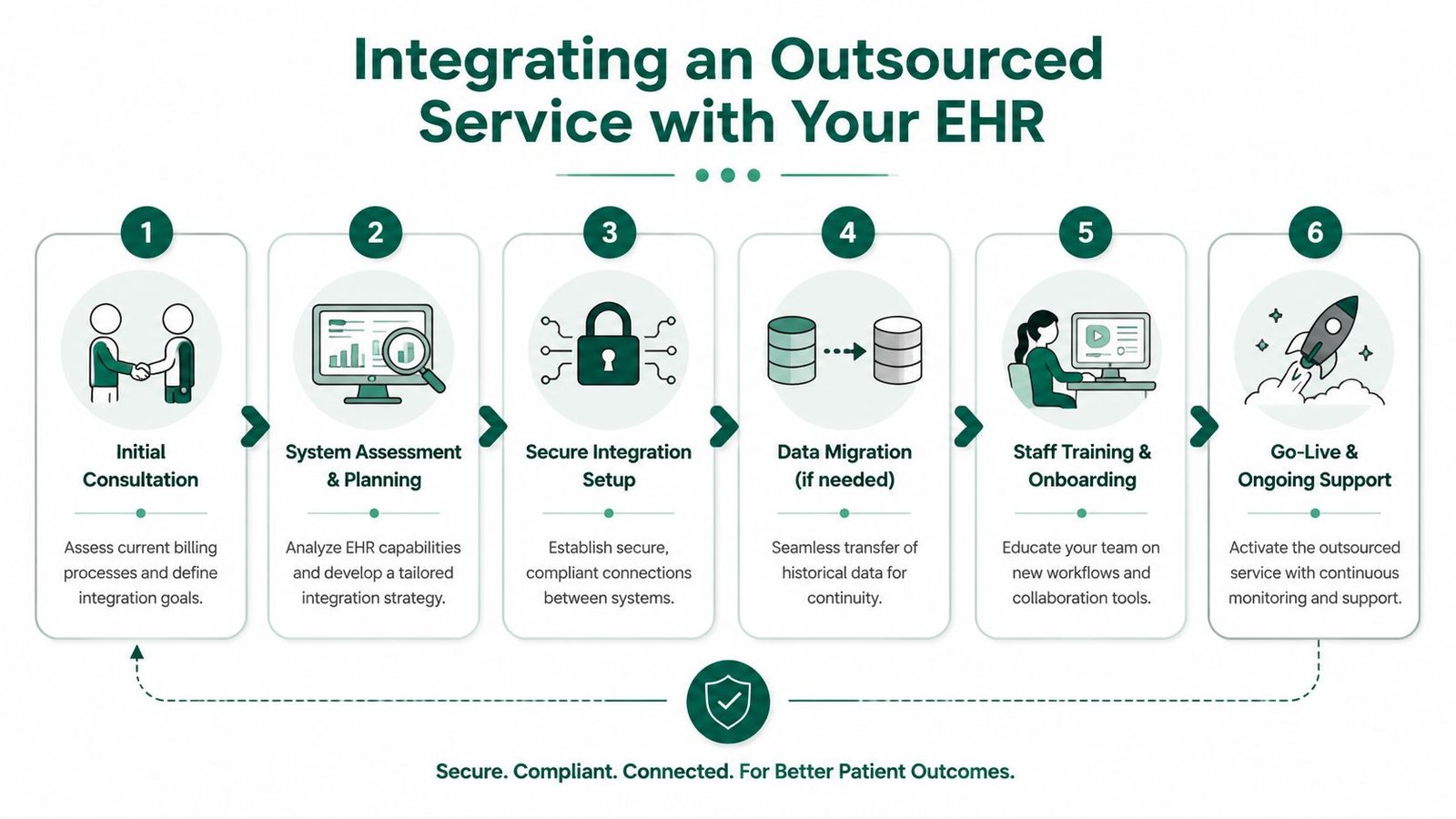
What the implementation should look like
A solid onboarding process usually follows a phased path:
Discovery and workflow review
The vendor studies your current intake, charge entry, claim edits, payment posting, and A/R habits. During this review, recurring leaks become evident.Access and security setup
The team gets controlled access to your EHR, clearinghouse, and payer portals. Permissions should be role-based and documented.Rules and responsibility mapping
Everyone should know who handles eligibility, coding review, denials, patient statements, and escalations.Go-live with close monitoring
Early claim batches require active review, allowing strong partners to catch workflow gaps before they become recurring errors.
What you should not accept
You shouldn't accept vague onboarding, unclear ownership, or a vendor that tells you to "just send claims over and we'll handle it." That is how handoffs fail.
Ask practical questions:
- Which EHRs and PM systems do they already work in?
- Who owns payer enrollment and portal access?
- How are charge lag and claim lag monitored?
- How are denials routed back to documentation or front-end staff?
For a practical look at workflow alignment, this guide to integrating revenue cycle management is worth reviewing.
A smooth transition isn't about software. It's about defining who does what before the first outsourced claim is submitted.
If the integration plan is crisp, physicians keep documenting, staff keep scheduling, and the billing engine gets better without operational drama.
Key Performance Indicators to Track Success
If you outsource billing and don't track the right KPIs, you're outsourcing blind. The metrics should tell you whether cash is moving faster, denials are dropping, and old balances are shrinking. If they don't, the reporting is decoration.
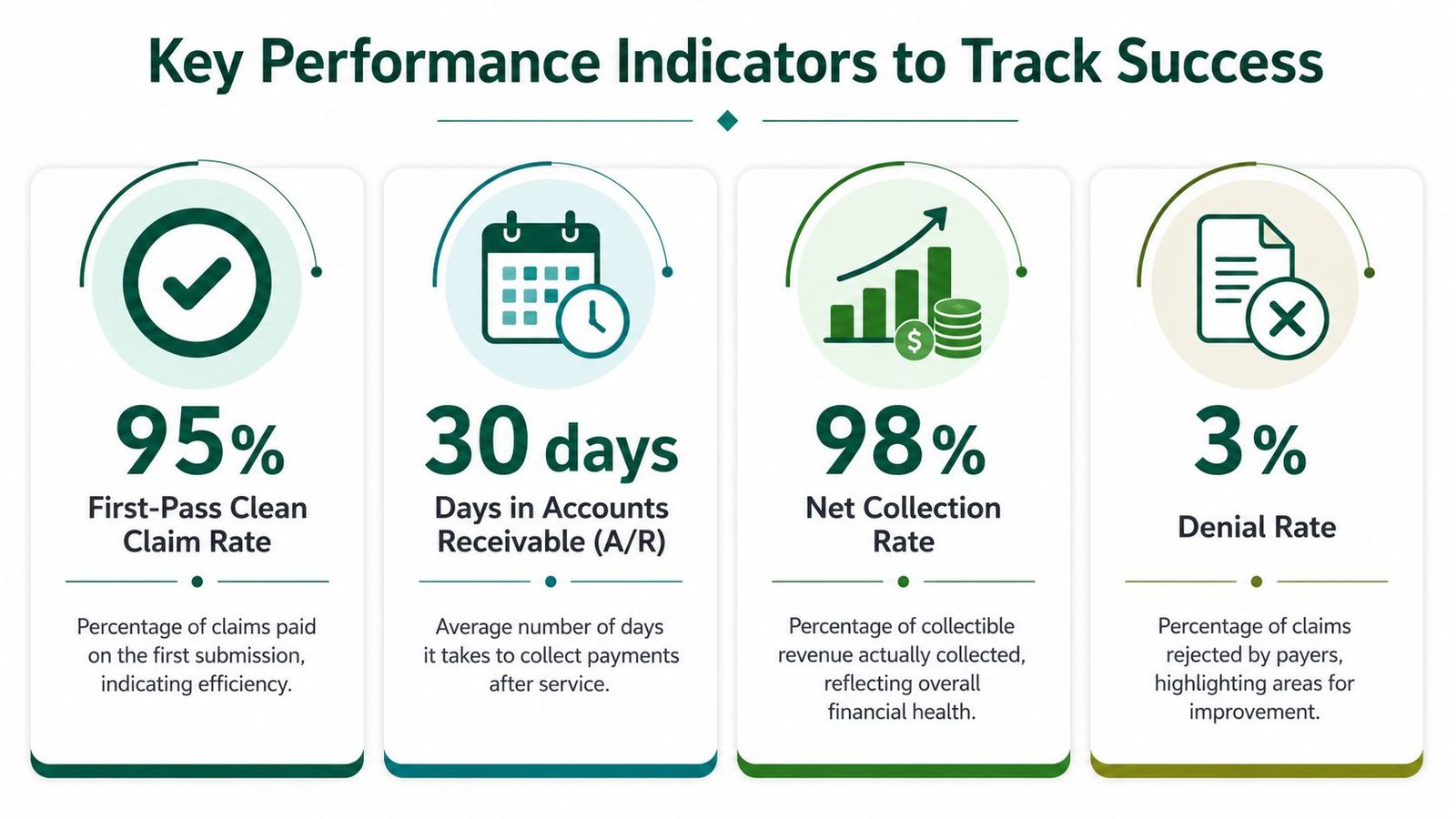
The four numbers that deserve owner attention
I focus on four indicators because they reveal where the revenue cycle is strong and where it's bleeding.
| KPI | What it tells you | Why it matters financially |
|---|---|---|
| First-pass clean claim rate | How often claims go out correctly the first time | Higher clean claims mean less rework and faster cash |
| Days in A/R | How long money sits uncollected | Slower A/R creates cash strain and owner anxiety |
| Denial rate | How many claims payers reject | More denials mean more labor and more leakage |
| Net collection rate | How much collectible revenue you actually collect | This reveals whether earned revenue is being captured |
The visual benchmark many owners care about is simple. They want claims paid cleanly, A/R moving quickly, denials contained, and net collections staying tight. If one of those slips, the others usually follow.
A/R aging tells you whether the business is tightening or drifting
Old A/R is where weak billing hides. A practice can look busy and still have a sick revenue cycle if too much money sits unresolved after the easy collection window has passed.
According to this analysis of A/R outsourcing performance, accounts older than 90 days have risen to 37% of total receivables for many practices, while a healthy benchmark is 18% to 22%. The same source reports that dedicated outsourcing services can produce a 42% reduction in A/R over 90 days and a 38% increase in denial recoveries.
That should get your attention. Old balances aren't harmless. They become harder to collect, harder to appeal, and easier for staff to write off mentally before they write them off financially.
The benchmark I care about most
For owner oversight, I like one hard operating question: are you keeping days in A/R under 35?
If the answer is no, drill down fast. Usually the cause sits in one of three places:
- Front-end leakage: Eligibility, authorization, or demographic errors
- Coding and claim quality issues: Modifiers, documentation support, payer edits
- Back-end neglect: Denials not appealed fast enough, or A/R follow-up lacking urgency
If you want a tighter dashboard for internal review meetings, this guide on medical billing KPIs to track is a strong starting point.
You don't need twenty metrics. You need a few that expose delay, leakage, and collection discipline.
Your Vendor Selection Checklist
A bad billing vendor does not just waste time. It leaks revenue in places owners rarely see until cash tightens, such as missed anesthesia unit calculations, cardiology claims filed without the right modifier logic, and denials that sit untouched until the appeal window closes.
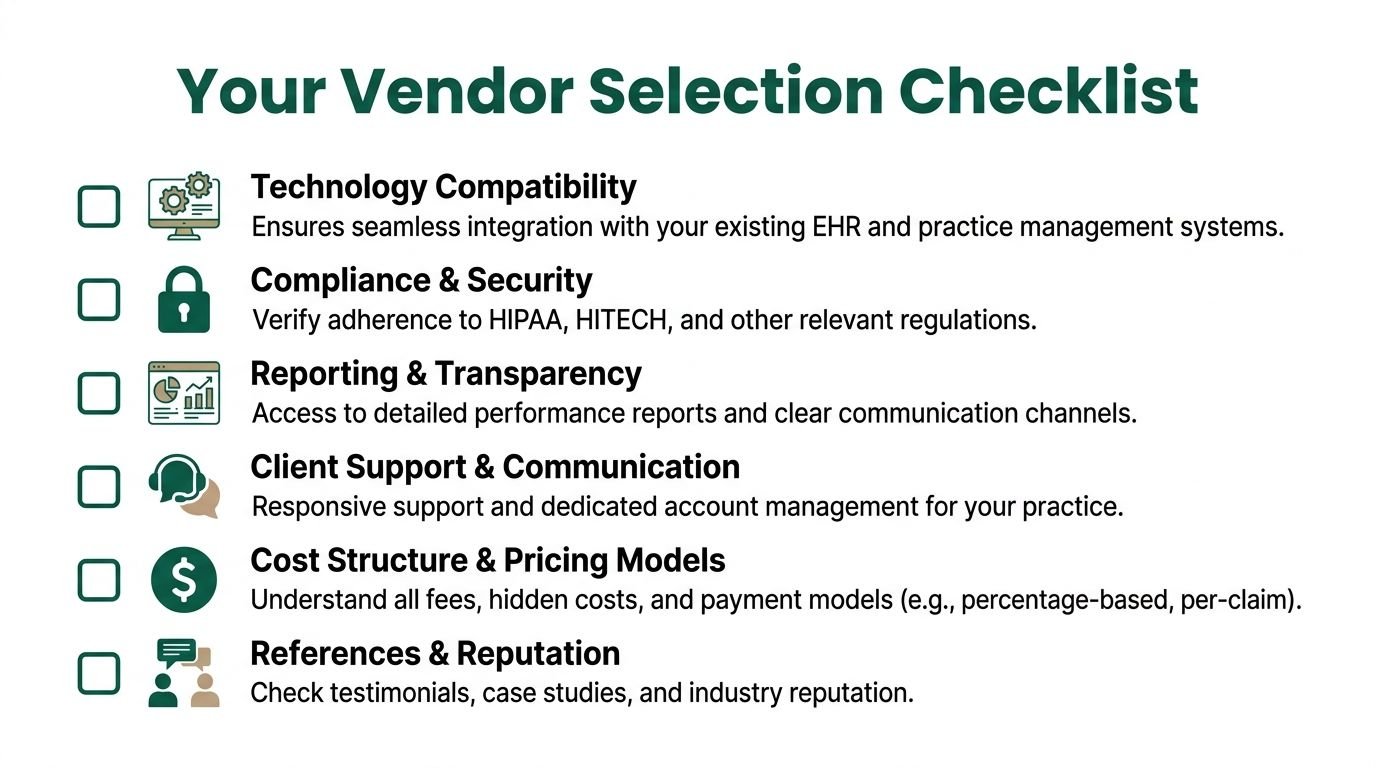
What to verify before you sign
Start with one question. How does this vendor stop revenue loss in my specialty?
If the answer stays generic, walk away.
The industry claim denial data highlighted here shows the initial claim denial rate has climbed to nearly 12.4%, and practices lose over $28 to $32 per denied claim in rework costs alone. The same source says structured outsourced RCM can achieve 30% to 40% denial rate reductions within two quarters.
That is the financial filter. You are not hiring a vendor to answer emails and post payments. You are hiring a team to prevent denials, recover underpayments, and tighten net collections.
The checklist I use with owners
- Specialty-specific competence: Ask for live examples from your specialty. An anesthesia-focused team should explain time capture, base units, and medical direction modifiers such as QK without hesitation. A cardiology-capable team should speak clearly about coding and modifier logic around procedures such as 93458 and common edit issues tied to 25 and 59.
- Claim edit discipline: Ask what they review before submission. You want specifics on modifier validation, NCCI edits, authorization checks, documentation gaps, and payer-specific rules that cause preventable denials.
- Denial ownership: Ask who works denials, how fast they touch them, and how they feed root-cause fixes back to scheduling, coding, and charge entry. If they only resubmit claims without correcting the source of the error, the leak stays open.
- EHR fit: Confirm that they can work effectively in your current system and explain how they handle charge flow, task routing, and status visibility. Forced workflow changes usually create new errors before they solve old ones.
- Reporting that ties to cash: Require reporting on clean claim rate, denial categories, days in A/R, net collection behavior, and underpayment trends. If reports do not help you find where money is getting stuck, they are decoration.
- Security and access controls: Ask for clear details on PHI access, user roles, audit trails, and business associate agreement terms. You need operational clarity, not a vague statement that they take compliance seriously.
- Escalation and accountability: Get the meeting cadence, named contacts, response expectations, and issue escalation path in writing. Revenue problems age fast.
Red flags that should end the conversation
Some vendors sell polish. You need control.
Avoid vendors that:
- Hide pricing or blur the line between base fees and extra charges for coding review, credentialing support, old A/R, or appeals.
- Avoid specialty detail and rely on broad claims about serving every specialty equally well.
- Report activity instead of outcomes. Posted payments and call counts do not tell you whether cash improved.
- Lack a transition plan with clear ownership for charge entry, denial follow-up, patient balance questions, and payer communication.
- Use account managers as a buffer between you and the people fixing claim problems.
Operator's view: The right vendor should explain exactly how they will recover money your current process is missing, then show you who owns each step. If they cannot do that in the sales process, they will not do it after you sign.
Frequently Asked Questions
What is the typical ROI for outsourcing medical billing?
ROI shows up first in cleaner claims, less staff rework, and faster collections. I don't judge ROI by vendor fee alone. I judge it by whether denial volume falls, old A/R shrinks, and leadership sees stronger net cash behavior within the early operating cycle. If your current team is missing payer edits, mishandling modifiers, or letting denials age, outsourcing can recover revenue that was already earned but poorly managed.
Can I outsource only part of my billing, like A/R recovery?
Yes, and in some practices that's the smartest place to start. If your front-end is stable but old balances are growing, partial outsourcing for A/R follow-up and denial recovery can make sense. The key is role clarity. Your internal staff and external team must have clean ownership lines, especially around posting, appeals, and patient balance questions. Partial outsourcing fails when both sides assume the other side owns the problem.
How does an outsourced team handle communication with our patients about billing?
That depends on the model, but it should be scripted, documented, and consistent with your practice standards. The best teams don't create friction with patients. They clarify balances, explain insurance processing, and route sensitive issues appropriately. Owners should ask who answers billing calls, how statements are managed, and when patient complaints escalate back to the practice. Patient communication is part of revenue cycle performance because confusion slows payment.
How do I know whether my current billing operation is the real problem?
Look at the operational symptoms. Rising denials, increasing aged A/R, repeated modifier issues, delayed payment posting, and unclear reporting usually mean the billing model is underperforming. If your physicians are productive but cash doesn't track with production, the problem is rarely just volume. It's usually execution.
If you want a clear answer on where your practice is losing money, start with Happy Billing. We review denial patterns, A/R aging, specialty-specific billing errors, and workflow gaps inside your current system so you can see what needs fixing before you commit to a change. The simplest next step is to request a free billing audit and get an objective view of your revenue cycle.