Billing for Pain Management Services: Complete Guide

Medicare's payment for chronic pain management changed on January 1, 2023, when CMS began paying separately for CPM services. The main codes, G3002 for the first 30 minutes and G3003 for each additional 15 minutes, created a distinct monthly billing pathway, with a 2025 reimbursement summary reporting national average payments of about $80.22 and $29.44, respectively (NACHC's CPM reimbursement guidance). For a practice owner, that means billing for pain management services is no longer just a matter of selecting a procedure code. Coding, authorization, frequency tracking, documentation, and claim reconciliation now determine whether completed clinical work becomes cash or aged A/R.
The most expensive failures happen when those controls collide. A correct CPT code can still deny if the authorization covers a different level, the modifier contradicts laterality, or the patient has exceeded a payer's frequency limit. The right response is a financial-risk framework that identifies leakage before the claim reaches adjudication, then determines whether the practice can repair the process internally or needs specialized RCM support.
Why Pain Management Billing Is Becoming a Revenue Risk
Medicare paid more than $2 billion for interventional pain management services in 2007, and improper payments affected roughly $45 million of allowed transforaminal injection services. The Medicare comparative billing report also recorded a nearly 150% increase in Medicare physician payments for these services from 2003 to 2007, representing about 11% of all Medicare physician payments for them (AAPM&R's Medicare pain-management billing report).
Those figures are historical, but they show why pain billing creates financial exposure. High-value procedures, repeat treatment, payer utilization controls, and documentation requirements can all affect one claim. A missing diagnosis detail, unsupported level, incorrect modifier, or weak medical-necessity narrative can delay payment, create rework, or increase audit risk. Owners see the operational cost through higher denial volume, slower cash conversion, and growing A/R.
The leakage starts before claim submission
Authorization deserves owner-level oversight. Cosentus reported that Medicare Advantage denial rates for pain-management procedures rose from 5.9% in 2023 to 7.4% in 2025, while prior-authorization denials across all payers rose 31% year over year in 2026 (Cosentus' pain-management authorization analysis). A separate report identified 62320–62327, 64625, and 63650–63688 among high-scrutiny CPT families and also reported the Medicare Advantage denial figures (Medical Billers and Coders' prior-authorization report).
A missing authorization can keep a claim out of normal adjudication, delay treatment, and force staff into appeals after the service is complete. The practice has already paid physician, facility, and administrative costs. Collection then depends on whether staff can prove that the authorization, documentation, code, and performed service matched.
Track risk by payer and procedure
A blended denial rate hides the process failure. Review denials by:
- Procedure family: epidural, facet, nerve block, RFA, implant, or CPM.
- Payer and plan: traditional Medicare, Medicare Advantage, and commercial products may use different workflows.
- Reason code: authorization, medical necessity, frequency, bundling, modifier, eligibility, or documentation.
- Workflow owner: scheduling, clinical documentation, coding, charge capture, or follow-up.
Owner's view: A total denial count shows what happened. Segmentation by payer, procedure, and reason shows what to repair, and whether the practice can manage that repair internally or needs specialized RCM support.
High-Value CPT Codes That Drive Pain Practice Revenue
The safest way to manage high-value CPT families is to connect each code to the operative note, medical-necessity record, authorization, and payer policy before submission. Don't assume that a code family automatically supports every level, side, imaging service, or repeat intervention.
CMS identifies facet-intervention codes 64490, 64491, 64492, 64493, 64494, and 64495 as services reported by anatomic level. Its guidance also distinguishes unilateral and bilateral reporting, which makes the pain management CPT code reference useful only when paired with the applicable Medicare coverage article or payer policy.
Procedure families require different controls
Epidural and nerve-root injections commonly use 62320–62327. The practice should verify the spinal region, approach, imaging requirements, diagnosis support, and payer authorization before the procedure. A code selected from the wrong regional family can produce a denial even when the clinical service itself was appropriate. CMS guidance also establishes specific rules for certain injection codes, including whether bilateral or laterality modifiers are permitted, so the encoder and charge master shouldn't apply a blanket modifier rule (CMS injection coding guidance).
Facet interventions use 64490–64495, with the code family distinguishing cervical or thoracic levels from lumbar or sacral levels and primary from add-on levels. Documentation must support each reported level and the requested diagnostic or therapeutic purpose. Medicare's facet article states that a unilateral or bilateral intervention at any level is reported as one unit of the primary code, not multiple units because both sides were treated (CMS facet-joint billing guidance).
Radiofrequency procedures use families such as 64635–64636. The financial risk isn't limited to choosing the procedure code. The record should establish the diagnostic pathway, prior block results where required by the payer, targeted anatomy, and medical necessity for the ablation. If the diagnostic history is absent or inconsistent, the claim may fail even when the procedure note is detailed.
Use a claim-level review before release
| CPT Code | Procedure Description | Average Reimbursement | Common Billing Error |
|---|---|---|---|
| 62320–62327 | Cervical, thoracic, lumbar, or sacral epidural and related injection services | Varies by code and payer | Region, approach, authorization, or imaging mismatch |
| 64490–64495 | Facet joint or medial branch intervention by level | Varies by code and payer | Incorrect level, unit, or laterality reporting |
| 64635–64636 | Radiofrequency ablation by primary and additional level | Varies by code and payer | Missing diagnostic-block support or unsupported level |
| 64450–64454 | Peripheral nerve block services | Varies by code and payer | Bundling, anatomy, or repeat-service documentation gap |
| G3002 and G3003 | Monthly chronic pain management, time based | About $80.22 and $29.44 national averages in a 2025 summary | Missing time, consent, care plan, or overlapping care-management billing |
For CPM, the note must show a detailed care plan, pain assessment, medication review, patient consent, and total time spent on pain-related services. Medicare also bars G3002/G3003 from being billed in the same month as 99490/99491 for the same patient (chronic pain billing guidance). That monthly exclusivity check belongs in the claim scrubber, not in an after-the-fact denial queue.
Modifier Rules That Make or Break Your Claims
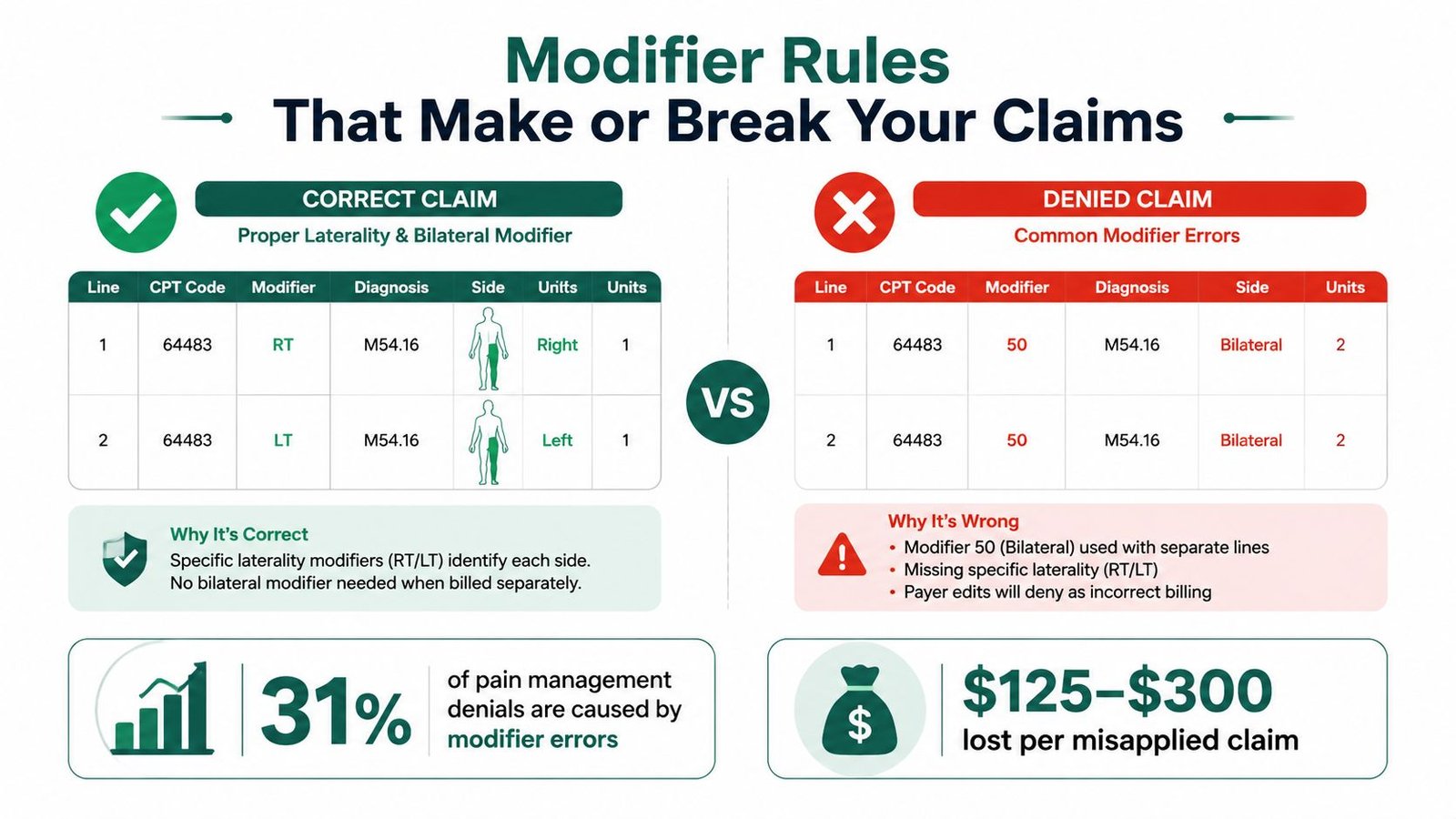
Modifier logic is a direct revenue-control issue. A laterality error can turn a payable procedure into a rejected claim, while an inappropriate distinct-service modifier can create an audit vulnerability. The correct modifier depends on the code, anatomy, payer, and whether the service is separate.
Facet procedures need precise laterality
For Medicare facet interventions, report a bilateral same-level service with one unit of the primary code and modifier 50. Report a unilateral service with RT or LT. Do not attach modifier 50 and RT or LT to the same service line. CMS's facet guidance makes that distinction explicit (CMS facet intervention article).
Consider a bilateral lumbar facet intervention at the same level. The claim should reflect the primary code once with modifier 50, assuming the payer follows the Medicare rule. Reporting two units without the appropriate bilateral logic, or adding both 50 and a laterality modifier, can create a denial or underpayment. In a high-volume practice, repeated errors of this kind distort expected reimbursement and make contract performance look worse than it is.
Don't generalize modifier rules across code families
CMS guidance for codes 62310, 62311, 62318, and 62319 states that these codes have a bilateral surgery indicator of 0, so modifier 50 and LT or RT shouldn't be used for those services. The same guidance separately states that bilateral nerve-root injection should use modifier 50, while unilateral injection uses LT or RT. That split is exactly why a universal “bilateral procedure” rule fails.
Modifier 59 should also be reserved for a distinct procedural service supported by separate anatomy, encounter circumstances, or procedural work. It isn't a shortcut for bypassing an edit. Modifier 51 addresses multiple procedures, while modifier 59 addresses distinctness. A practice that uses 59 to force payment may trade a short-term release for future audit risk. The modifier 25 coding resource can help frame same-day E/M questions, but the note still must show a significant, separately identifiable service when the payer requires it.
Build modifiers into the pre-bill edit
A reliable edit checks:
- Laterality: Does the note identify right, left, or bilateral treatment consistently?
- Unit logic: Does the code require one unit for a bilateral same-level service?
- Code-specific indicator: Is modifier 50 allowed for this code family?
- Distinctness: Does modifier 59 reflect separate work rather than a bundling workaround?
- E/M separation: Does modifier 25 have documentation support?
- Repeat service: If modifier 76 is considered, does the payer recognize the repeat-procedure circumstance?
The practice shouldn't wait for a payer to explain a modifier error through a denial code. A charge-level edit is cheaper than rework after submission.
Prior Authorization Workflows That Prevent Denials
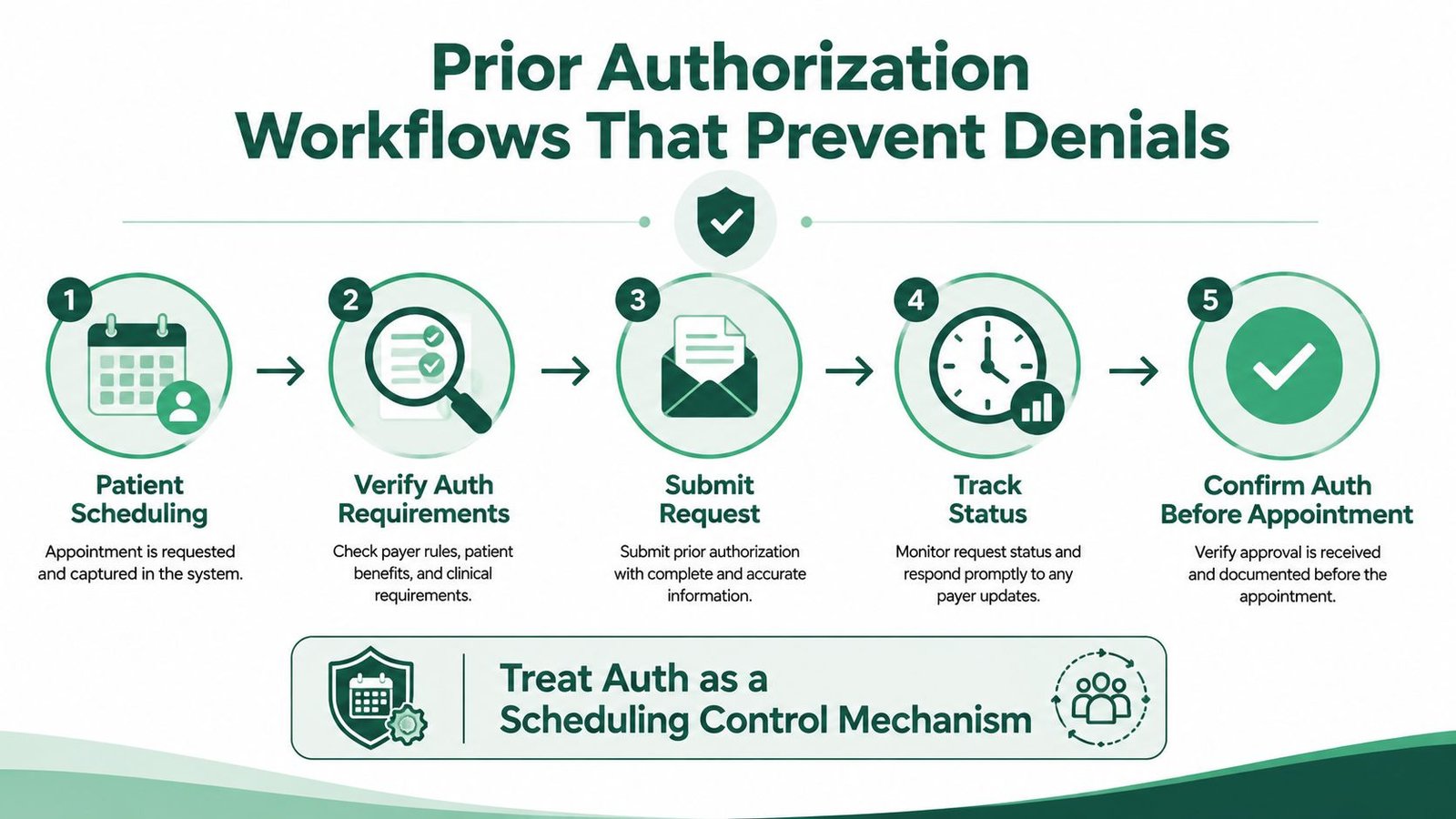
Prior authorization should function as a scheduling control mechanism, not a reactive paperwork queue. If staff schedule first and investigate authorization later, the practice may perform a service that was never approved, was approved under the wrong code, or falls outside the approved date range.
A pain-specific source reports rising Medicare Advantage denial rates and notes that original Medicare has begun adding pre-payment review for some pain procedures through WiSeR (Cosentus' WiSeR and prior-authorization discussion). That shifts the operational question from “Who will appeal this?” to “What prevents this appointment from being scheduled without a verified approval?”
Put the hard stop before the appointment
A workable workflow has five controls:
- Verify requirements: Confirm the exact plan, benefit, procedure, site, ordering provider, and whether authorization is required.
- Submit a complete request: Match the CPT family, diagnosis, region, laterality, level, and clinical documentation.
- Track the decision: Record submission confirmation, status, requests for information, approval number, and validity dates.
- Reconcile approval to scheduling: Confirm that the authorization covers the provider, facility, service, date range, units, and anatomy.
- Reconcile again to the claim: Compare the completed procedure and operative note with the authorization before release.
The common failure is treating approval as payment assurance. Eligibility can change, the service can differ from the approved request, or the claim can contain a coding error. Authorization protects revenue only when the practice links it to scheduling, clinical documentation, coding, and claim submission.
For physician owners, the dashboard should show authorization-related cancellations, pending cases, expired approvals, requests for additional information, and claims denied after an approval was obtained. Those categories identify whether the bottleneck sits in intake, clinical notes, payer follow-up, scheduling, or billing.
Frequency Limits and Bundling Rules That Trigger Denials
Frequency and bundling rules create the most persistent leakage because they're often maintained in separate places. The EHR template may contain one rule, the authorization tracker another, and the payer policy a third. A procedure can therefore be correctly coded in isolation and still fail because the patient's treatment history, same-day services, or payer-specific limit makes the claim nonpayable.
Treat the claim as a connected record
For repeat procedures, the record should support the clinical reason for repeating treatment, identify the prior service and outcome where relevant, and show that the requested service remains medically necessary. A 2026 coding guide identifies bilateral modifier errors, frequency-limit violations, and outdated templates as common denial drivers. Another source notes that trigger point injections may be limited to three sessions in a rolling 12-month period, while some commercial carriers deny three sessions within 90 days at the same site unless medical necessity is documented (Medical Billers and Coders' frequency and bundling guidance).
Those are not universal rules for every payer. They're examples of why the practice needs a payer-specific policy table rather than a generic frequency assumption.
| Procedure Type | Typical Frequency Limit | Bundling Rule | Denial Risk if Violated | Compliant Coding Practice |
|---|---|---|---|---|
| Trigger point injections | May be limited by payer, site, and rolling window | Repeat services require medical-necessity support | Full denial or appeal workload | Track site, date, prior response, and payer rule |
| Facet interventions | Anatomic and payer-specific limits may apply | Bilateral same-level reporting follows code and payer logic | Rejection, downpayment, or audit exposure | Validate level, unit, laterality, and authorization |
| Epidural or nerve-root injections | Policy and diagnosis dependent | Code, approach, region, and imaging must align | Medical-necessity or coding denial | Match note, order, authorization, and claim |
| Same-day E/M with procedure | Depends on distinct service rules | E/M may bundle unless separately identifiable | E/M line denial | Use modifier 25 only with supporting documentation |
| CPM and chronic care management | Monthly service exclusivity applies | G3002/G3003 cannot overlap with 99490/99491 for the same patient and month | Overlapping-billing denial | Run a monthly patient-level exclusivity edit |
Modifier 59 should never serve as a frequency-limit bypass. Use the modifier 59 billing guidance to structure the review, then verify the payer's own policy and the clinical record.
Use a three-question release decision
Before submitting a repeat or bundled claim, ask:
- Was the service authorized for this patient, anatomy, provider, site, and date?
- Does the patient remain within the payer's applicable frequency and level limits?
- Does the documentation support each billed service as medically necessary and separately reportable?
If any answer is uncertain, hold the claim for resolution. A short pre-bill delay is preferable to a denial that consumes follow-up time and obscures the true A/R picture.
When to Fix Your Billing Versus Outsource RCM
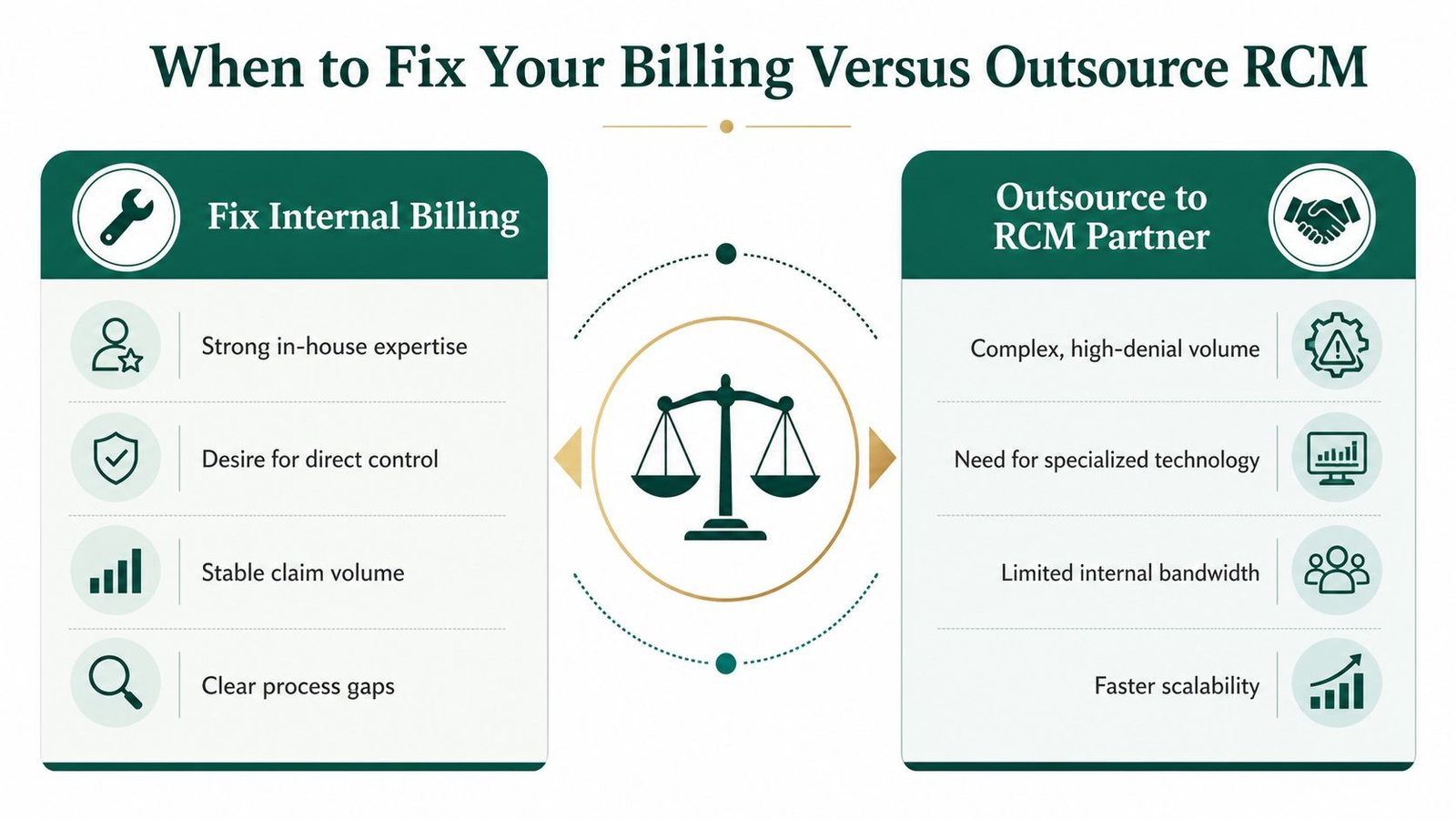
The decision isn't whether internal billing is better than outsourcing. The decision is whether the current operating model can produce accurate, timely, measurable results without diverting physician and administrative attention from the practice.
Start with trend data. If denials are persistent, A/R is aging, authorization failures recur, and the same modifier or frequency errors appear across providers, the problem is systemic. A practice with strong internal expertise and stable controls may need targeted training or charge-master updates. A practice with complex interventional volume and weak visibility may need a specialized RCM partner.
Fix internally when the controls are fixable
Internal repair makes sense when leadership can identify the denial root cause, assign ownership, and sustain the change. That usually requires:
- Specialty knowledge: Staff understand the relevant CPT families, Medicare articles, payer edits, and documentation standards.
- Reliable reporting: The practice can segment denials by payer, procedure, modifier, and reason.
- Operational capacity: Someone owns authorization reconciliation, coding audits, appeal follow-up, and policy updates.
- Clinical participation: Physicians will correct templates and documentation patterns that create avoidable denials.
- Manageable variation: The practice isn't overwhelmed by multiple locations, plans, facilities, and procedure pathways.
Training can correct an isolated error. It won't correct a workflow where no one knows whether an authorization matches the final claim.
Outsource when complexity exceeds management bandwidth
Outsourcing becomes more compelling when the practice has recurring denial patterns, aging A/R, inconsistent authorization tracking, or difficulty retaining specialty-trained staff. The vendor should demonstrate payer-specific expertise, transparent reporting, pre-submission edits, and experience with the exact services the practice performs.
Ask prospective partners to show:
- Denial trends by CPT family, payer, and root cause.
- How they reconcile authorization approvals to completed procedures and claims.
- Their process for facet laterality, bilateral reporting, CPM exclusivity, and frequency tracking.
- Who performs coding audits and how findings reach physicians.
- How quickly unresolved A/R is escalated and measured.
- Whether reporting shows procedure-level underpayment, not only total collections.
The internal versus outsourced medical billing comparison is most useful when applied to your own data. Compare the cost of staff, training, technology, turnover, and delayed collections against the cost of a partner that can take ownership of the full revenue cycle.
Decision rule: Keep billing internal when you can control it. Outsource when you're paying for the same preventable errors month after month and lack the infrastructure to remove them.
Frequently Asked Questions About Pain Management Billing
Can we bill an E/M visit on the same day as an injection?
Sometimes, but not automatically. The E/M service must be significant and separately identifiable, and the documentation must support why it went beyond the work inherent in the procedure. Modifier 25 may be appropriate when the payer's rules and the note support it, but adding the modifier to every same-day visit is a denial strategy, not a compliance strategy.
Review the denied E/M lines, compare them with the procedure notes, and identify whether the problem is documentation, payer bundling, or inappropriate reporting. Correct templates and physician documentation first, then appeal only claims with defensible support.
What happens when a payer changes authorization requirements during a treatment plan?
An existing treatment plan doesn't guarantee that later services remain authorized. The practice should monitor payer-policy changes, verify requirements before each scheduled service, and document the authorization number, approved code, validity period, provider, facility, and anatomical details.
If the payer changes its process and retroactively disputes completed services, separate administrative denials from medical-necessity disputes. Reconcile every affected claim to the policy in effect, approval record, clinical note, and billed service before deciding whether to correct, appeal, or write off.
How do we recover revenue from chronic undercoding of multi-level facet procedures?
Begin with a retrospective audit of procedure notes, claims, payer rules, and remittance data. For Medicare, confirm the primary and add-on level logic, one-unit bilateral reporting, and RT or LT requirements before correcting any claim. CMS maintains separate coverage and billing articles for facet interventions, and the applicable article can be searched by CPT or HCPCS code and state (CMS facet coverage article A58405).
Recovery depends on timely filing, payer correction rules, documentation support, and whether the original claim can be adjusted. Put the corrected logic into the charge capture workflow so the practice doesn't recover old leakage while continuing to undercode new procedures.
If these patterns resemble your A/R aging, the cost of inaction can exceed the cost of retraining staff or engaging a specialized pain-management RCM partner within 90 days. Start with a focused audit, quantify the recurring leakage, and make the internal-versus-outsourced decision from evidence rather than instinct.
Happy Billing combines full-cycle RCM, denial management, authorization controls, and human auditing for complex pain-management claims, working within your existing EHR. Visit Happy Billing to request a focused revenue-cycle review and identify where coding, authorization, frequency, or A/R processes are leaving revenue behind.