Top 7 Medical Billing Companies in Houston (2026 Guide)

Houston has 162 medical billing services out of 726 statewide, so the market is crowded, and the best fit is rarely the biggest name. The right company should help you lower A/R days, tighten denial follow-up, and protect net collections, not just answer the phone.
Choosing among the medical billing companies in Houston is a revenue decision, not a vendor search. In a market where billing errors can cost practices 15% to 18% of annual revenue, efficiency matters as much as price, especially if your specialty sees frequent denials or payer disputes (Houston billing benchmarks). We've seen practices waste months with a generic shop when they really needed specialty-specific appeal work, cleaner modifier use, or stronger authorization handling. If you want a broader outsourcing lens alongside billing, our healthtech engineering partner perspective is useful, but this guide stays focused on what practice owners should compare inside Houston's crowded RCM market.
Beyond the Houston metro, our statewide guide to medical billing services in Texas covers the Texas Prompt Pay Act deadlines (30-day electronic / 45-day paper), BCBS Texas / TMHP / UHC payer landscape, and the 4–9% pricing benchmarks that apply to independent practices across the state.
1. Avika Billing Solutions
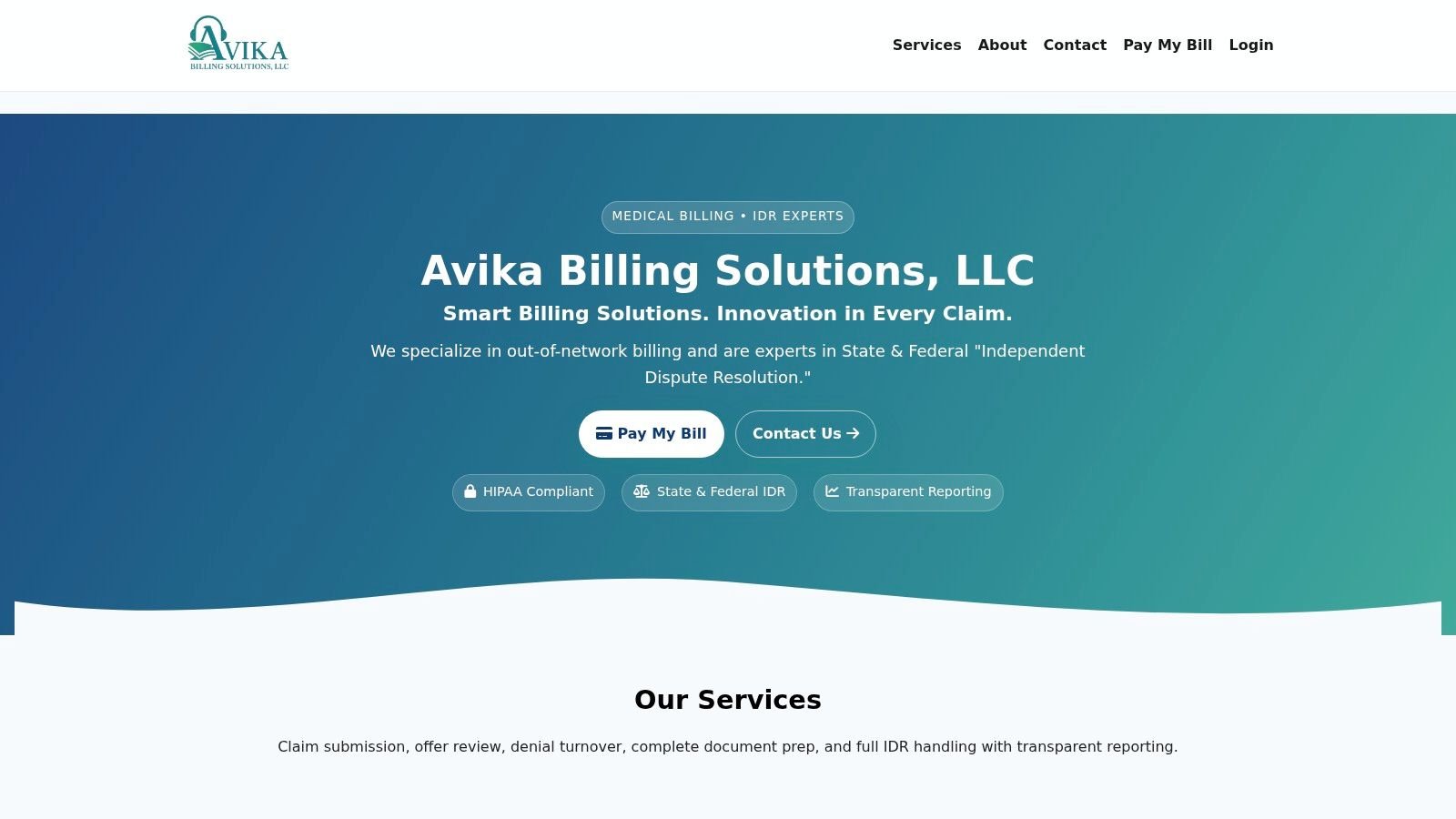
Avika Billing Solutions stands out for practices that live in the gray zone between standard in-network billing and harder reimbursement disputes. Its Houston roots matter less than its specialty angle, especially if your claims regularly run into No Surprises Act issues or Texas Independent Dispute Resolution cases. That kind of workload can affect recoveries in ways a general billing shop usually won't handle well.
The practical value is in denial overturn strategy and appeals discipline. If your team already knows how to submit claims but keeps losing money on payer friction, Avika's model is the one that aligns with the problem you have.
Practical rule: choose this kind of partner when lost revenue comes from disputed claims, not just from delayed posting.
The trade-off is scope. A low out-of-network volume practice may not need deep IDR support every week, and you should expect to ask hard questions about turnaround, escalation logic, and what happens after an appeal is filed. Public pricing is also thin, so owners should compare the operational lift, not just the sales pitch.
For practices trying to estimate outsourcing economics before they commit, the cost of outsourcing medical billing is the right context for this type of decision. If you run a specialty that faces frequent payer disputes, Avika is worth a close look, but only if your denial profile justifies that level of sophistication.
2. ARCS, Anesthesia Revenue Cycle Solutions

ARCS is built for anesthesia and pain groups, and that specialization changes the evaluation immediately. A firm that understands units, concurrency, and modifiers can protect revenue that a generalist often leaves on the table. For anesthesia practices, that detail affects more than clean claims, it affects whether the billed work matches the actual service mix.
The company's physician ownership and U.S.-based call center also matter operationally. In a specialty where schedulers, front office teams, and billing staff need to talk quickly, fewer handoffs usually means fewer gaps in the revenue cycle.
Why specialization matters here
Anesthesia billing is not just claim submission. It's the difference between a partner that can read the workflow around blocks, cases, and modifier sequencing, and one that processes forms. That distinction matters when your collections depend on precision rather than volume.
We recommend this kind of provider when the practice's pain point is specialty complexity, not administrative clutter. If you're running an anesthesia or interventional pain group, the anesthesia medical billing services page is a good benchmark for what a specialist should understand before you sign.
ARCS is a poor fit for primary care or broad multi-specialty groups, and that's not a weakness so much as a design choice. Niche vendors win when the specialty is demanding and lose appeal when the practice mix is too broad for one workflow model.
3. Texas RCM

Texas RCM is the straightforward local option for owners who want a Houston-based partner with a U.S.-staffed team. That matters when you're trying to shorten the back-and-forth between billing, credentialing, and payer enrollment, because local service tends to make accountability easier to manage. For smaller and mid-sized practices, that can be more valuable than an oversized platform with layers of support.
Its appeal is practical, not flashy. Monthly management reporting gives owners visibility, and credentialing support can help shorten the wait between contract setup and first claims submission. Those are the kinds of operational gaps that delay cash flow when no one owns them well.
Local billing support is only useful if it improves payer-facing execution. A Houston office doesn't help unless the team also handles credentialing and denial follow-up cleanly.
Texas RCM is likely a better fit for practices that want a relationship-driven vendor and don't need enterprise-style infrastructure. The limitation is that public benchmarks are limited, so you'll need to test how they report A/R, denial aging, and coding exceptions before relying on them for growth.
If you want to compare the fit against a Houston-focused vendor framework, the medical billing company Houston resource is a useful reference point. Texas RCM makes the most sense where local service and credentialing support are the priority, not aggressive automation or specialty depth claims.
4. RoundTable Medical Consultants
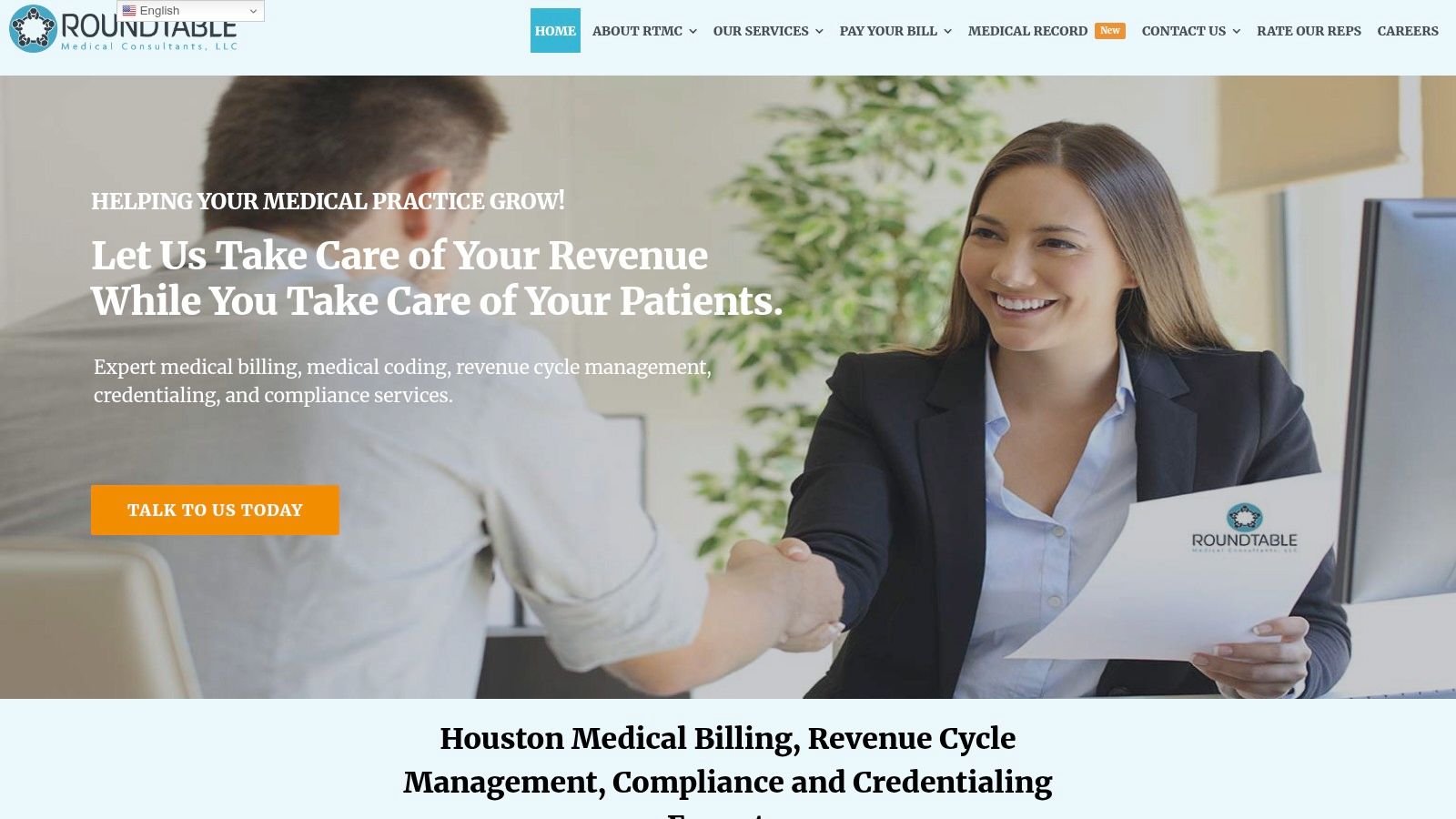
A practice owner looking at RoundTable Medical Consultants usually wants one answer first, does the vendor reduce friction across billing, credentialing, and compliance, or does it just bundle services on paper? RTMC positions itself as a Houston-based partner for full-service billing, practice management, credentialing, and HIPAA compliance, according to public directories and vendor listings. That matters because revenue leakage rarely comes from one isolated problem. It usually comes from handoffs between front office, payer follow-up, and denial work.
The operational value is in the mix of services, not the label. If the same team can manage claims, credentialing, and patient communication, a practice may see fewer dropped tasks and fewer delays between contract setup and first clean claims. The downside is that broad service menus can hide weak execution in a few key areas, so owners still need to test the vendor on actual outcomes, not just scope.
A 24-hour call center also changes the financial equation. For practices with patient balances, late-arriving authorizations, or recurring follow-up work, after-hours contact can reduce account aging and keep more balances moving. It does not matter much if the calls are answered politely but never translate into collections, so the ultimate test is whether the service lowers A/R days and improves follow-through on unresolved accounts.
What to verify before contracting
- A/R targets: Ask for the baseline, the reporting method, and how they define progress.
- Call-center scope: Confirm whether it handles patient-pay, payer follow-up, or both.
- Vertical fit: Validate support for freestanding ERs, urgent care, or private practice workflows.
- Contract language: Read the service terms closely, including termination conditions and what is included. The questions to ask a medical billing company before hiring can help frame that review.
RoundTable makes the most sense for an owner who wants fewer vendors and a broader operating model in one place. The risk is overpaying for promised coverage that does not show up in denial rates, aging buckets, or net collections. Use a structured review, and do not sign until the vendor can explain how its work changes those numbers in practice.
5. MediBill RCM LLC
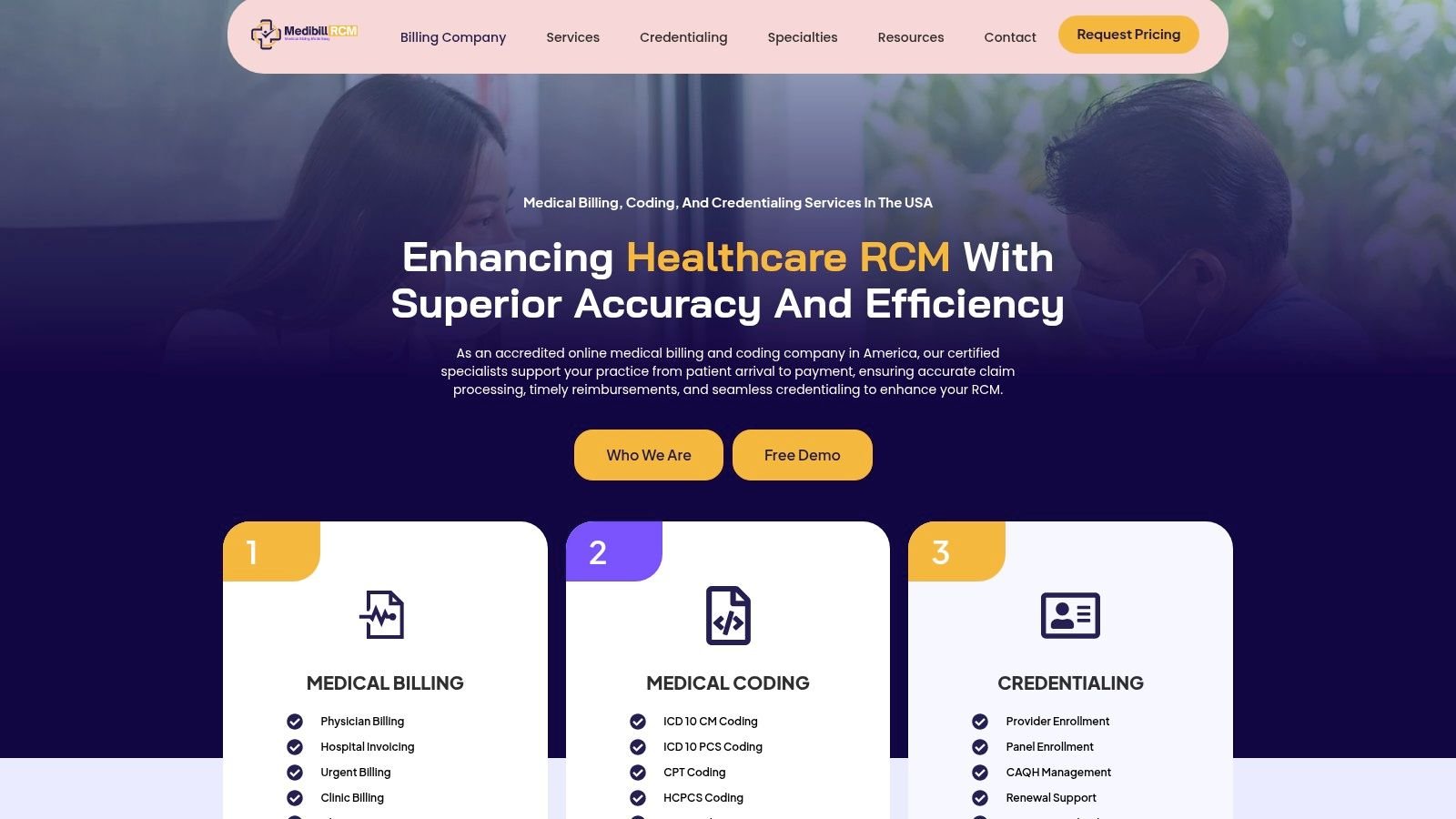
MediBill RCM LLC leans into price sensitivity, and that makes it attractive to owners who need basic full-cycle coverage without a heavy implementation lift. Its public marketing points to billing, coding, and credentialing, plus platform familiarity across common PM and EHR setups. For small practices, that can reduce the friction that often kills outsourcing decisions before they start.
The main issue is scope. A “from 3.99%” message tells you something about positioning, but it doesn't tell you what's included, what gets billed separately, or how much manual work remains in-house. That's the part owners should press on before they compare it against a more hands-on RCM partner.
Cost-sensitive does not mean low-risk
A lower percentage can still be expensive if denials stay high or if follow-up work still lands on your staff. Owners should ask whether the vendor handles eligibility, appeal generation, and payer follow-up, or whether it mainly submits claims and posts payments. The difference is operational, but the financial result shows up in A/R days.
This is the kind of vendor that can work well for straightforward collections environments, independent practices, and smaller clinics with predictable claims. It becomes less compelling when specialty complexity rises or when leadership wants stronger accountability around reporting. Use the questions to ask a medical billing company before hiring as your checklist before you compare rates.
6. Integrity RCM
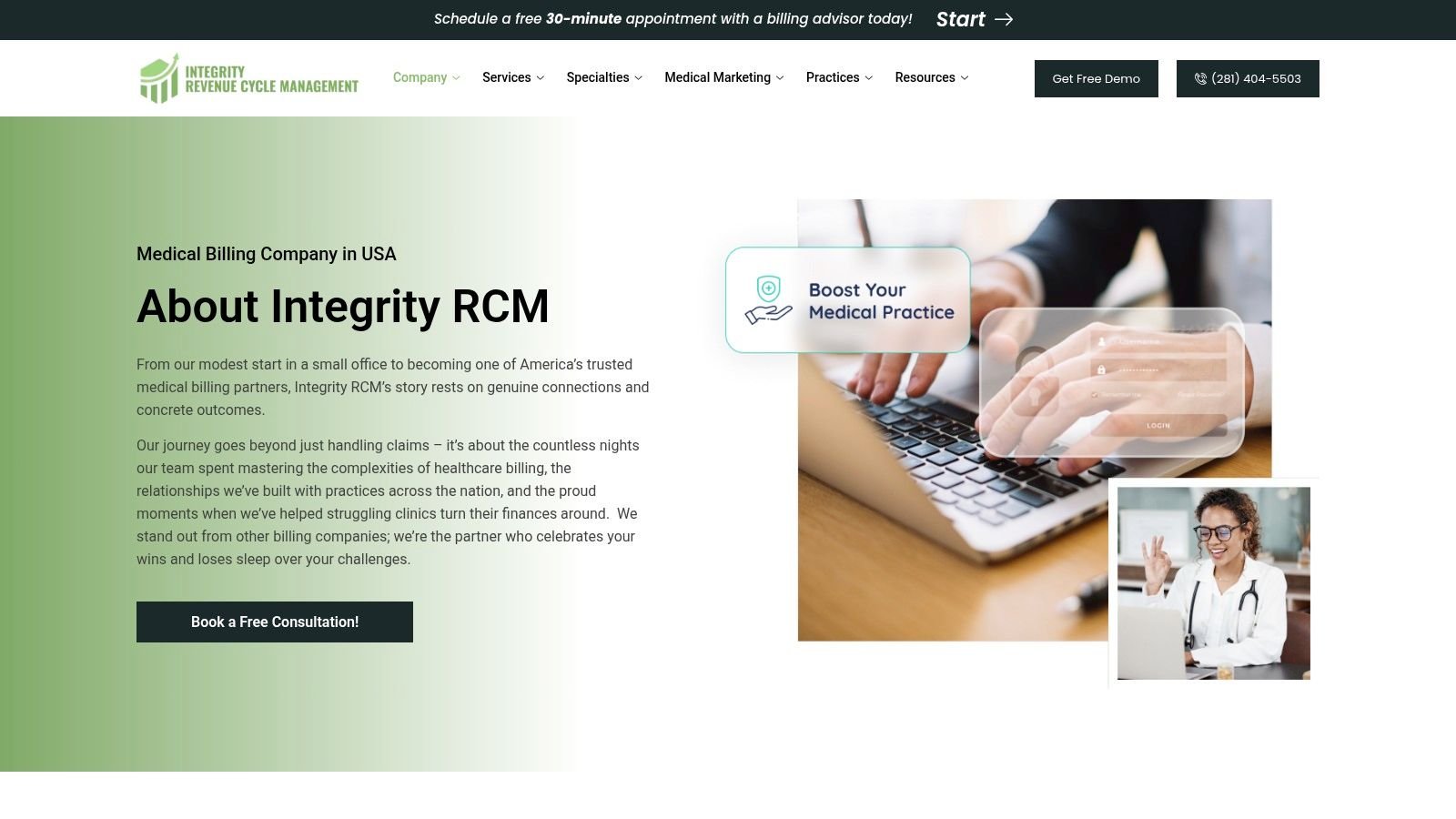
Integrity RCM fits practices that want to avoid a disruptive EHR migration while still tightening revenue cycle control. Working inside the client's current EHR lowers change-management risk, and that matters because billing transitions often fail when staff have to relearn workflows while claims are still moving. For owners, less disruption usually means less revenue leakage during the handoff and less pressure on A/R days.
The company also highlights analytics, 24/7 support, and a broad specialty footprint. That support model helps when eligibility issues, denials, and patient communication cannot wait for business hours. It is a better fit for practices that do not want to build a large internal billing department but still need clear visibility into cycle performance, denial trends, and follow-up work.
Practical rule: if a vendor cannot work in your current EHR, the hidden cost is usually higher than the quoted rate.
The caution is verification. Any vendor-reported uplift or retention claim should be measured against your own baseline, because practices vary too much for generic promises to mean much. If the team cannot show how it handles charge entry, appeals, and A/R work inside your system, the relationship will likely add support burden instead of reducing it.
Integrity RCM is best judged on workflow fit, not brand language. For owners comparing operational risk, the medical billing company red flags page helps separate sales language from service depth.
7. MediSync RCM
MediSync RCM is aimed at owners who want billing support plus operational coverage around the edges, including front-office and back-office staffing. That can be useful when the problem is not just claim submission, but the fact that calls, insurance verification, and records management are overwhelming the team. For small and mid-sized practices, that broader menu can stabilize the cycle without forcing a full internal rebuild.
The value proposition is simple. If a practice is short on administrative bandwidth, staffing support can matter as much as pure billing execution. In that setting, a vendor that can handle patient communication and records management may reduce the amount of unpaid work your office staff is doing every day.
Where this model fits best
MediSync's appeal is strongest when leadership wants one vendor to cover several low-to-mid complexity tasks. It's weaker when the practice needs specialty-specific billing depth or strong public benchmarks, because those details are not easy to verify online. Owners should treat that as a signal to ask for references, sample reporting, and specialty experience before comparing it against more focused RCM firms.
This is a sensible option for practices that need operational relief more than a dramatic redesign of billing workflows. If you're deciding whether to outsource or fix the current process, a free billing audit can show where the losses are before you commit to any vendor relationship.
Top 7 Houston Medical Billing Companies Comparison
| Provider | Implementation complexity | Resource requirements | Expected outcomes | Ideal use cases | Key advantages |
|---|---|---|---|---|---|
| Avika Billing Solutions | Moderate–high (IDR/arbitration workflows) | Detailed documentation, experienced appeals/IDR staff | Higher recoveries for out-of-network and complex payer disputes | Out-of-network specialists, practices with frequent denials and NSA/TDI issues | NSA/TDI IDR expertise, analytics-driven denial overturn strategies |
| ARCS, Anesthesia Revenue Cycle Solutions | Low–moderate (specialty workflow integration) | Anesthesia-specific coding knowledge, U.S. call center coordination | Improved anesthesia unit capture and revenue visibility | Anesthesiology and interventional pain groups | Physician-owned, real-time specialty analytics and KPIs |
| Texas RCM | Low–moderate (standard onboarding plus credentialing) | Local U.S. team, certified professional coders, credentialing support | Consistent claims submission and faster time-to-first-claim | Texas-based clinics seeking a local partner | Local presence, facility/plan credentialing, monthly reporting |
| RoundTable Medical Consultants (RTMC) | Moderate (full-service + 24/7 call center integration) | Broad vendor coordination, continuous patient-pay processes | A/R reduction and higher collection potential (vendor metrics) | Freestanding ERs, urgent care, multi-outpatient practices | Broad service set, 24/7 call center for patient-pay and satisfaction |
| MediBill RCM LLC | Low (basic full-cycle billing onboarding) | Platform-agnostic EHR/PM integration, cost-sensitive setup | Low-cost full-cycle coverage; outcomes vary and require validation | Independent practices, clinics, small hospitals seeking low-cost option | Platform flexibility, promotional pricing entry points |
| Integrity RCM | Low–moderate (works inside existing EHRs) | EHR integration without migration, analytics and 24/7 support | Reduced change-management friction, continuous follow-up support | Practices wanting to retain existing EHRs across many specialties | EHR-agnostic approach, 24/7 support, multi-specialty coverage |
| MediSync RCM | Moderate (billing plus staffing/records management) | Front/back-office staffing coordination, insurance verification systems | Improved operational capacity and administrative throughput | Small/mid-sized practices needing staffing and end-to-end admin support | Staffing add-ons, insurance verification, nationwide service from Houston base |
The Decision Checklist How to Hire Your Next RCM Partner
Evaluating medical billing companies in Houston requires a structured approach. Before signing a contract, get clear on four things, specialty alignment, technology and reporting, pricing model, and performance guarantees. If your group handles orthopedics, for example, the billing partner must understand modifier 59 and the payer logic behind it, not just recognize the code.
Specialty alignment is where many vendors overpromise. A company can say it supports multiple specialties, but that does not mean it understands modifier patterns, global periods, authorization bottlenecks, or payer-specific workflows for your line of business. The buyer should ask how the vendor handles the exact CPT, modifier, and denial scenarios that affect reimbursement in your specialty.
Technology and reporting matter just as much. The vendor should be able to work in your current EHR, report on the KPIs that affect cash flow, and show how often leadership sees A/R aging and denial trends. If the dashboard only arrives monthly, owners usually learn about problems after they've already hit collections.
Pricing also needs scrutiny. Many Houston firms sell a percentage-of-collections model, while others price by project or minimum engagement. Compare what's included, what triggers add-on fees, and whether the vendor's incentives align with your goal of lower denial rates and faster cash.
Ask for the contract language that defines first-pass clean claims, denial ownership, and A/R follow-up. If the definitions are vague, the relationship will be vague too.
The next step is to see what a specialist finds in your current billing process. We recommend a no-obligation review of your A/R, denial patterns, and claim workflow before you choose a vendor, because that baseline tells you whether the problem is staffing, coding, credentialing, or payer friction. If you're also thinking about compliance and automation at the system level, the CISO guide to HIPAA automation is a useful companion read.
Happy Billing helps practices find where revenue is leaking inside the existing billing workflow, then fixes denial management, credentialing, A/R recovery, and specialty-specific RCM without forcing an EHR change. If you want a practical comparison against the medical billing companies in Houston listed here, visit Happy Billing and request a review of your current billing performance.