Why Payers Underpay Complete Claims: AI Claim Edits, Delay Tactics and What Independent Practices Can Do About IT
A claim can pass every submission check and still come back short. The HHS Office of Inspector General found Medicare Advantage payment denials that met both Medicare coverage rules and plan billing rules. Automated edits, repricing logic, authorization mismatches and adjudication errors all reduce what a payer releases, even when the clinical documentation is complete.
Happy Billing is a medical billing company headquartered in Texas that recovers out-of-network underpayments and serves New York practices.
Every short-paid line lowers net collections per visit, and most never reach a denial report because the payer marks the claim paid while the practice absorbs the difference. In our experience, the first step is sorting each short-pay before anyone appeals or resubmits: correct payment, correctable error, contractual underpayment and appealable decision each take a different fix.
Why Complete Claims Still Pay Less Than Expected
Submission completeness and payment accuracy are different controls. A claim can contain every required field and still receive an incorrect allowance. Conversely, complete documentation doesn't automatically make every billed service separately payable under the applicable contract.
CMS estimated $28.83 billion in Medicare Fee-for-Service improper payments, including $9.62 billion for Part B providers, in its fiscal year 2025 improper-payments fact sheet. These findings concern documentation, medical necessity, coding and payment requirements. They aren't a measurement of payer underpayments, but they demonstrate why submission alone isn't proof of payment accuracy.
The owner-level fix is classification before action. Determine whether the payment is correct, the claim contains an error, the payer violated payment terms or the decision requires a clinical appeal.
Collections require a different kind of oversight
Our recommendation is to treat collections, not data entry, as the hard part. That's a practical judgment about the work required to resolve payment disputes, not a published statistic about the last one to two years.
A clean-claim dashboard answers whether claims passed submission checks. It doesn't establish whether the practice received everything the payer owed. Owners need both views.
Require your billing team to distinguish:
- Preventable defects, such as missing authorization evidence or unsupported units.
- Payer adjudication issues, such as an unexplained reduction below the applicable allowance.
- Payment posting issues, where the deposit, patient responsibility and adjustments haven't been reconciled correctly.
Don't approve a write-off merely because an account has been touched repeatedly. Require a documented reason, the applicable payment rule and a clear next action.
Book a free 30-minute call with a billing specialist to discuss where your collections are getting stuck.
US practices only.
Six Ways Payers Pay Less on a Clean-Looking Claim
| Mechanism | What the remittance shows | Money at risk | First check |
|---|---|---|---|
| Automated bundling or multiple-procedure edit | Secondary service reduced or treated as included | Contract allowance minus the reduction on affected lines | Compare each line with the contracted fee schedule and reduction rules |
| Repricer or allowed-amount reduction | Lower allowance, sometimes accompanied by a repricer network label | Gap between the applicable payment terms and allowance | Confirm the repricer and the agreement authorizing the reduction |
| Expected-units or modifier policy | Units reduced or a service line adjusted | Unpaid units or lines that may recur by payer | Compare the payer policy with the documented service |
| Global surgical package edit | Visit or related service treated as included in surgery | Separate reimbursement, if the service qualifies | Verify the surgical date, global period and applicable exceptions |
| Authorization or referral mismatch | Claim pended or denied for no matching authorization | Entire claim and recovery time | Reconcile approved dates, units, provider and service |
| Unexplained short-pay | Payment below expectation without a clear explanation | Difference between expected and remitted amounts | Request adjudication detail and escalate unresolved discrepancies |
Identify the rule before challenging the result
Bundling and multiple-procedure reductions aren't interchangeable. Modifier 51 can be relevant to multiple-procedure payment policies, but its presence doesn't establish that every reduction is correct. The financial question is whether the payer applied the right policy to the right service.
Repricing is a separate payment pathway. MultiPlan, Zelis and Data iSight/Claritev may appear in an allowed-amount dispute, but a repricer label alone doesn't establish contractual authority. Our comparison of how Aetna, Cigna and UnitedHealthcare reprice out-of-network claims helps owners distinguish the insurer from the entity calculating an allowance.
Unit and modifier policies can reduce payment without challenging the physician's documentation. Global-package rules can likewise make a documented postoperative service nonpayable separately. In both cases, investigate the governing rule before blaming the practice or disputing the payer.
Authorization mismatches require a different check: was the service approved for the provider, location and dates involved? An unexplained short-pay requires the payer's calculation, not another unsupported submission.
Yellow.ai's discussion of automating insurance claims workflows provides useful context for understanding workflow automation. It isn't evidence that a particular insurer used AI on a particular claim.
Before anyone decides what to do, place the applicable contract rate, allowed amount and remittance explanation side by side. For out-of-network claims without a negotiated rate, establish the relevant payment basis instead of treating billed charges as the amount owed.
Telling Correctable Errors From Real Underpayments
Paid less is not the same as paid wrong.
A short payment needs a disposition, not an automatic appeal. We recommend assigning every reviewed claim to a defined category with an owner and supporting evidence.
The four dispositions
Correct payment. The payer applied the applicable payment terms correctly, including legitimate reductions and patient responsibility. Close the review with the calculation attached. An aggressive appeal won't create reimbursement the practice isn't entitled to receive.
Correctable claim error. The original submission didn't accurately represent the supported service or required billing information. Use the payer's authorized correction process within the applicable deadline. Preserve the clinical record, and never upcode, alter documentation or make misleading submissions to obtain a higher payment.
Contractual underpayment. The payer paid below the applicable contracted allowance or imposed a reduction the agreement doesn't authorize. Route the dispute to the designated payment-dispute channel or provider relations with the fee schedule, contract language and calculation. A medical-necessity letter won't resolve a disagreement about contract arithmetic.
Appealable coverage or medical-necessity decision. The payer disputes coverage or clinical necessity. Use the formal appeal pathway with relevant records, authorization evidence and the policy supporting payment. Some payment disputes also have formal appeal requirements, so follow the actual contract rather than assuming provider relations replaces an appeal.
Audit the service line, not just the claim total
Compare each remittance line against:
- Payment terms, including the effective fee schedule and permitted reductions.
- Service details, including supported units and applicable modifier policies.
- Payment relationships, including bundling, multiple-procedure and global-period rules.
- Authorization terms, including the approved service, provider and dates.
The Becker's summary of the AMA physician prior-authorization survey describes physician concern about payer AI. Concern doesn't identify which individual reductions are improper. A line-level audit does.
Consider a hypothetical physician group whose payer reduces every visit paired with a procedure. The queue resembles a collection of unrelated denials. If review establishes that the reductions violate the agreement, the group can pursue a consolidated contract escalation rather than send repetitive clinical appeals.
For allowed-amount disputes, our physical therapy underpayment recovery guide explains the owner-level recovery approach. When an outside repricer sets the allowance, the out-of-network repricing tools guide addresses that additional layer.
An opaque clean-claim score can reproduce payer logic without testing whether that logic matches your agreement. Use the denial-code reference for practice owners to interpret the explanation, but keep human review and contract verification as the final control.
How Delay Tactics Run Out Your Appeal Clock
Consider a hypothetical orthopedic practice whose claims remain pended while the office answers successive information requests. Staff document each response but don't calendar the original appeal deadline. By the time someone requests a formal review, the practice may have lost a recovery pathway despite responding diligently.
Activity isn't deadline protection. A payer representative's request to wait doesn't necessarily preserve the practice's rights.

A reconsideration isn't always an appeal
Under CMS Medicare reopening guidance, requesting a reopening doesn't extend the appeal deadline, a refusal to reopen doesn't extend the original timeframe, and adjustments generally can't add an omitted item or service after the initial timely-filing period.
A revised determination following reopening can create new appeal rights. That's different from assuming the reopening request itself stopped the original clock.
Commercial plans use their own terminology and contractual procedures. Informal reconsideration, corrected-claim review and formal appeal may be separate processes. Get written confirmation of the route being used and the deadline that applies.
Assign a deadline ledger
Require the recovery queue to record:
- Original determination date, supported by the actual notice or remittance.
- Appeal deadline, with the governing payer provision attached.
- Reopening or reconsideration request date, including acknowledgment and reference number.
- Remittance date, with every subsequent payment or adjustment linked.
- Dollars at stake, calculated from the applicable payment terms.
Add a named owner, next action and proof of delivery. A note saying “called payer” doesn't establish what was submitted or whether the correct department received it.
Pends, unanswered authorization requests and repeated reconsideration cycles create financial risk whether they reflect deliberate delay, administrative failure or a legitimate request for evidence. Don't infer intent from aging alone. Establish what the payer needs while independently protecting the deadline.
Our payer-specific out-of-network appeal-deadline guide helps frame that review. Use the denial-management workflow for ownership and prioritization, and the denied-claim appeal guide for assembling the submission.
Deadline protection: File a supported appeal as soon as it's clearly required. Don't wait for an informal payer response if waiting could forfeit the formal remedy.
An unanswered request isn't a resolution. A medical-necessity denial isn't necessarily the end of recovery either. What matters is whether the practice uses the available remedy while it remains available.
Benchmarking Paid Against Expected Across Payers
- Pull remittances weekly. Include adjustments, reversals and supplemental payments, not just initial deposits.
- Compare paid with expected. Calculate the applicable allowance using the fee schedule, supported units and payment rules, then separate payer responsibility from patient responsibility.
- Group discrepancies. Segment by payer, plan product, code family and place of service.
- Test whether the pattern repeats. Review multiple payment batches and a representative service period. Don't postpone action on claims nearing deadlines while assembling a broader sample.
- Escalate recurring payer-side reductions. Send provider relations a claim sample, the disputed calculation and the governing contract provision.
- Log the escalation. Record the date, named contact, case reference, promised response and next action.

Separate payment variance from payment delay
A correct allowance paid late and an incorrect allowance paid promptly are different problems. Don't combine them into a single collection-performance figure.
The CMS clean-claim payment guidance establishes a 30-day Medicare clean-claim payment or adjudication ceiling, measured beginning the day after contractor receipt, and requires interest on payable clean claims not paid within that period. Commercial contracts may establish different deadlines.
Track payer receipt, not merely clearinghouse transmission. A claim beyond its applicable payment window needs investigation into its acceptance, pending information, unresolved edits and payment status.
| Metric | What it reveals | Review cadence |
|---|---|---|
| Clean-claim rate | Front-end defects the practice can prevent | Weekly |
| Underpayment variance by payer | Gap between expected and actual payer payment | Monthly |
| Denial reason mix | Recurring edits and authorization problems | Weekly |
| Appeal yield | Whether disputes produce recoveries and which payers respond | Monthly |
| Days from service to final payment | End-to-end cash delay, alongside a separate payer-receipt deadline tracker | Monthly |
Make reconciliation explainable
Your system should show why it matched a payment to a claim and why it flagged an exception. Loopfour's explanation of matching logic and exception handling is useful context for evaluating that reconciliation design.
For out-of-network work, don't substitute an unsupported expected allowance for a negotiated fee schedule. Our explanation of usual and customary rates for out-of-network providers addresses why the payment basis needs separate scrutiny.
At the monthly owner meeting, ask which payer changed, how large the unexplained gap is and whether escalation produced a correction. Require recovered payments to be posted and reconciled before calling an issue resolved.
At renewal, seek explicit clean-claim payment terms, appeal windows and a named dispute-escalation path. A negotiated remedy is more useful than a general promise of prompt payment.
Deciding Whether to Keep Recovery In-House or Hand It Off
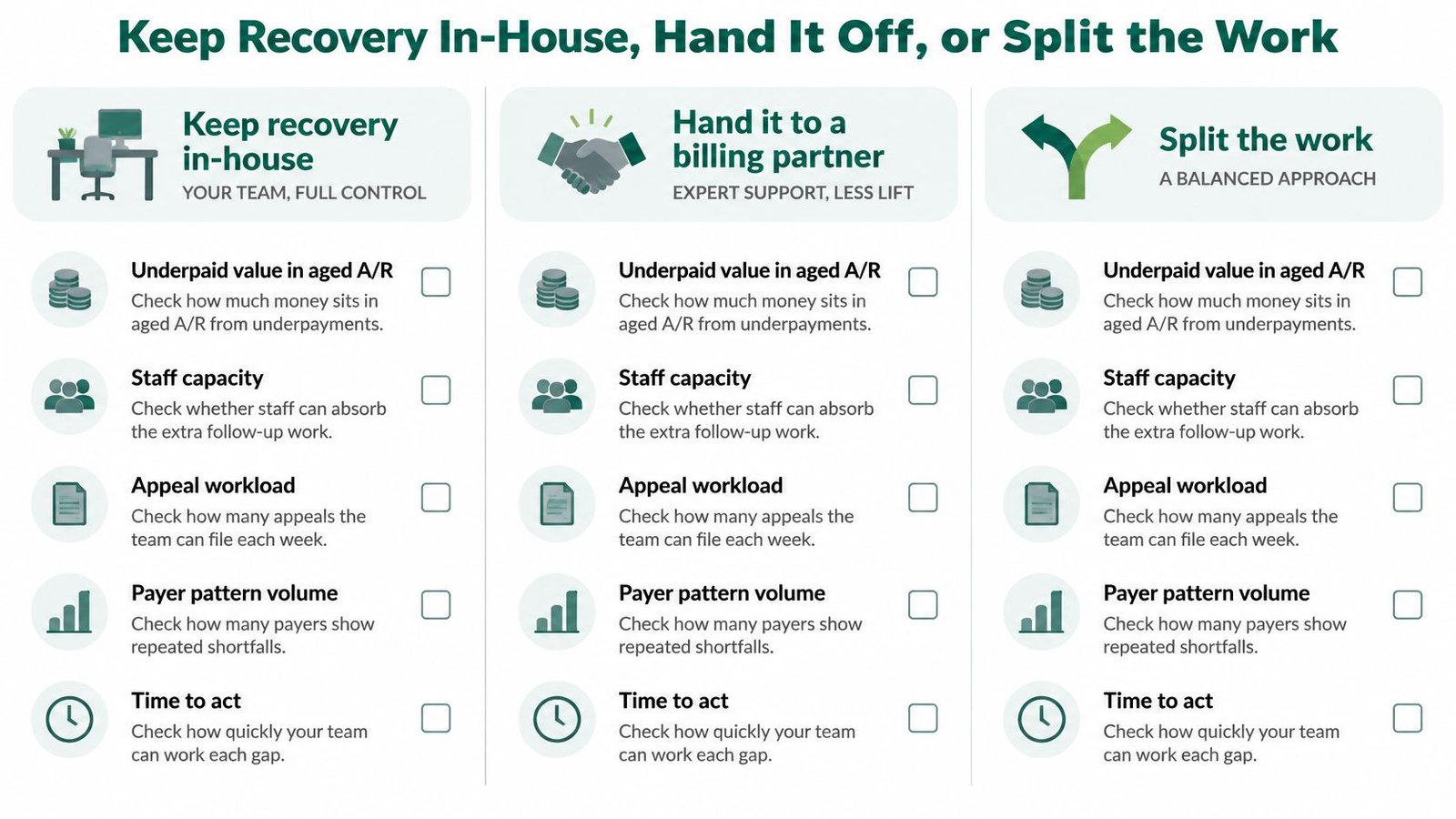
The decision turns on classification before headcount. If your team can sort each short-pay into correct payment, correctable error, contractual underpayment or appealable decision, and then advance it before the deadline, recovery can stay in-house. If variances pile up unexplained while routine billing consumes every hour, the work needs a different owner.
Keep recovery in-house when your team can explain the variance, preserve the deadline and complete the next action. Hand it off when unresolved value and deadline exposure exceed that capacity. Splitting the work is often sensible when routine submission runs well but contract disputes and aged underpayments sit untouched.
Check capacity against the actual workload
- Unresolved value: Identify underpayments inside aged A/R, separate from patient balances.
- Staff availability: Measure hours spent on appeals, authorization follow-up and payer calls, not just claims submitted.
- Deadline ownership: Confirm every disputed determination has a named responsible person and a due date on the calendar.
- Classification ability: Ask the team to explain why a sample underpayment needs correction, appeal or contract escalation. If the honest answer is resubmission and hope, that is your signal.
- Specialty complexity: Assess exposure to anesthesia units, imaging policies, modifiers and surgical global periods.
The AMA survey of 1,000 practicing physicians found an average of 43 prior authorizations per physician weekly, consuming more than 12 hours of physician and staff time. Owners shouldn't assume existing employees can absorb recovery work because they already handle billing.
One more test matters. A variance that recurs with the same payer under the same edit points to a contract or policy problem. Chasing it claim by claim treats a pattern as a series of accidents, and the pattern is where the recoverable value sits.
Choose the scope, not just the vendor
Happy Billing, headquartered in Texas, runs end-to-end billing and recovers underpaid out-of-network claims, and it can also work alongside your existing biller on recovery alone. Our denial management team investigates every rejected claim, identifies the root cause and appeals until the claim is paid in full. Certified RCM Specialists act as advocates when a denial is unfair, and our team audits historical claims to identify and recover under-reimbursed amounts.
Use the in-house versus outsourced recovery comparison to define which responsibilities stay internal and which move. The outsourcing cost guide supports the broader staffing decision, while our specialties index helps assess specialty fit.
Hand off the backlog when your team can't classify and advance it promptly without missing deadlines. Keep ownership of reporting, settlement authority and write-off approval whichever model you choose.
Book a free 30-minute call to decide whether full-cycle billing or targeted recovery fits your practice.
US practices only.
Owner Questions About Underpaid Claims Answered
Is payer AI causing most of our underpayments?
You can't establish that from remittance patterns alone. Automated edits can create recurring reductions, but the useful finding is whether the payer's calculation conflicts with the applicable rule or agreement, not whether someone labels the process AI.
How do we know whether an underpayment is worth appealing?
Consider recoverable value, evidence, deadline and the remedy the payer requires. Clinical denials need clinical support; contract disputes need payment terms and calculations, with formal appeal protection where the agreement requires it.
How far back can we still recover an underpaid claim?
The payer contract, filing rules and dispute deadlines determine that. Preserve the earliest applicable deadline, and don't assume an informal review creates additional recovery time.
Should we keep underpayment recovery in-house?
Keep it internal if someone owns the work and can demonstrate timely, supported resolutions. If routine submission consumes all available capacity, a specialist can handle recovery alongside your existing biller rather than replace the whole operation.
What should our billing partner report to us?
Ask for expected versus paid amounts, unresolved value, deadline exposure and documented recoveries by payer. Submission volume and clean-claim performance matter, but neither establishes that the practice collected the correct reimbursement.
Happy Billing helps independent practices investigate short payments, challenge unfair denials and recover under-reimbursed claims without requiring a complete billing handoff. Visit Happy Billing to discuss your payer patterns, current recovery backlog and who should own the next action.