Chiropractic Out-of-Network Underpayment Recovery in New Jersey

Recovering chiropractic out-of-network underpayments in New Jersey usually requires moving beyond standard payer appeals and using the state's DOBI arbitration framework, with strict 30-day negotiation and 18-month filing windows. The practice owner's first job is to determine whether the reduction reflects a valid plan limit, a repricer's allowed amount, or a methodology error, because each path affects A/R, denial rates, and recoverable revenue differently.
A paid claim can still be an underpaid claim. Cigna, Horizon, and Aetna may appear to have processed a chiropractic service correctly while the allowed amount reflects a fee schedule, plan design, or repricing methodology the practice never accepted. That distinction matters more than the EOB's payment status. If your team posts every payment as final, the leakage becomes part of the practice's expected yield and pushes unresolved balances into older A/R.
The most useful first step is a line-item review of chiropractic CPT codes, payer contracts, remittance explanations, and the calculation behind each reduction. A chiropractic medical billing services workflow should treat underpayment review as a revenue-cycle function, not as an occasional appeal project. Owners who want an outside view can start with a free out-of-network underpayment analysis focused on paid claims rather than only denials.
The Hidden Revenue Leak in Chiropractic Out-of-Network Claims
A paid chiropractic claim can still conceal a significant revenue loss. The payer sends an EOB, the payment posts, and the account appears closed. Yet a reduction on 98940, 98941, 98942, 97140, or 97530 may leave a meaningful gap between the practice's expected reimbursement and the allowed amount.
Aggressive repricer algorithms make the gap harder to identify. Data iSight and similar repricing arrangements can produce a reduced out-of-network value without clearly showing the calculation on the remittance advice. The claim then requires two separate reviews: Was the service covered and processed correctly, and was the allowed amount calculated under the applicable contract or plan rule?
Practical rule: A paid claim isn't necessarily a correctly paid claim.
Cigna and Aetna have faced New Jersey litigation over alleged chiropractic underpayment practices involving repricing. The Reuters coverage of the New Jersey chiropractor underpayment litigation reported that a federal judge allowed New Jersey chiropractors' underpayment lawsuit against those carriers to proceed. That ruling does not establish that every reduced claim is unlawful. It does show why recurring repricer patterns deserve a methodology review rather than a routine medical-necessity appeal.
Why generic appeals underperform
A generic appeal usually argues that the service was medically necessary and supported by documentation. That approach may address a denial, but it does not explain why 98940 was repriced below the practice's expected out-of-network amount or why 97140 was bundled, reduced, or handled differently from the plan terms.
A stronger file identifies:
- The exact line item: CPT code, units, diagnosis pointers, place of service, and payment.
- The reduction reason: EOB language, remark codes, repricer references, or contract provisions.
- The expected basis: Applicable plan language, a provider agreement, a state rule, or the documented reimbursement methodology.
- The recurring pattern: Similar reductions across claims, dates of service, or members.
New Jersey DOBI arbitration rules make the record and the calendar important. Horizon's public guidance describes a process requiring the plan to pay or issue an excessive-charge notice within 20 days, followed by a 30-day negotiation period and possible arbitration when final offers differ by more than $1,000. A practice should preserve the EOB, repricer detail, claim history, and correspondence before those deadlines become a problem.
A chiropractic medical billing services workflow should route repeated reductions to an underpayment queue, not treat them as routine posting outcomes. Where payer conduct appears systematic, a documented pattern can also support a complaint to the appropriate New Jersey professional board, creating regulatory pressure alongside the DOBI process. The complete revenue cycle management guide explains why payment posting, denial handling, and A/R follow-up must operate as one connected process.
Calculating the True Cost of Repricer Reductions
The financial analysis should begin with the difference between the amount the payer allowed and the amount the practice can support under the applicable reimbursement basis. Don't start with the total billed charge alone. A high charge doesn't prove that the payer owes the full difference, particularly when a plan contains a specific chiropractic cap or when the patient balance is restricted by state or federal protections.
New Jersey state plan materials provide a clear example of why plan identification matters. For that state plan, out-of-network chiropractic reimbursement is capped at the lesser of $35 per visit or 75% of the in-network cost per visit. The same materials describe a different basis for other out-of-network services, 175% of CMS, which means a practice can't automatically apply a general out-of-network benchmark to chiropractic care. The New Jersey state plan summary should be read alongside the member's actual plan documents.
Separate a valid cap from an opaque repricing result
A valid cap is a plan-rule question. A repricer reduction is a methodology question. Those issues can coexist, but they shouldn't be blended into one appeal.
Use this sequence:
- Identify the plan type. Confirm whether the member is in a fully insured New Jersey plan, a self-funded arrangement, an auto or PIP-style claim, or another product with different rules.
- Read the reimbursement provision. Look for chiropractic-specific language, out-of-network definitions, fee schedules, and limits.
- Match the EOB to the contract. Determine whether the payer used the stated plan formula or substituted a repriced amount.
- Compare like claims. Review the same CPT code, service context, and payer product across the practice's A/R.
- Calculate the line-item variance. Track expected allowed amount minus actual allowed amount, then separate collectible payer variance from any amount that cannot be billed to the patient.
The requested example of a CPT 98941 claim for a major commercial payer in a Northern New Jersey metro ZIP code compared with Fair Health's 80th percentile can't be stated with a numeric result from the verified record. No billed charge, payer allowed amount, ZIP-specific Fair Health value, or 80th-percentile figure was provided. Adding those values would create a fabricated case. The correct operational response is to obtain the practice's Fair Health benchmark for the relevant New Jersey ZIP and preserve the source with the claim file.
| CPT Code | Billed Charge | Repricer Allowed | Fair Health 80th %ile | Revenue Leakage |
|---|---|---|---|---|
| 98941 | Practice-specific | EOB-specific | ZIP-specific benchmark required | Billed or supported expected amount minus actual allowed amount |
That table is still useful because it forces the owner to collect the missing inputs rather than rely on an invented benchmark. A repricer tool comparison can help explain how different vendors calculate or present allowed amounts, but the practice must validate any result against the member's plan. A related guide to out-of-network medical bill repricing tools can support that review.
The question isn't simply whether the claim was paid. It's whether the payer used the reimbursement method the plan and contract actually permit.
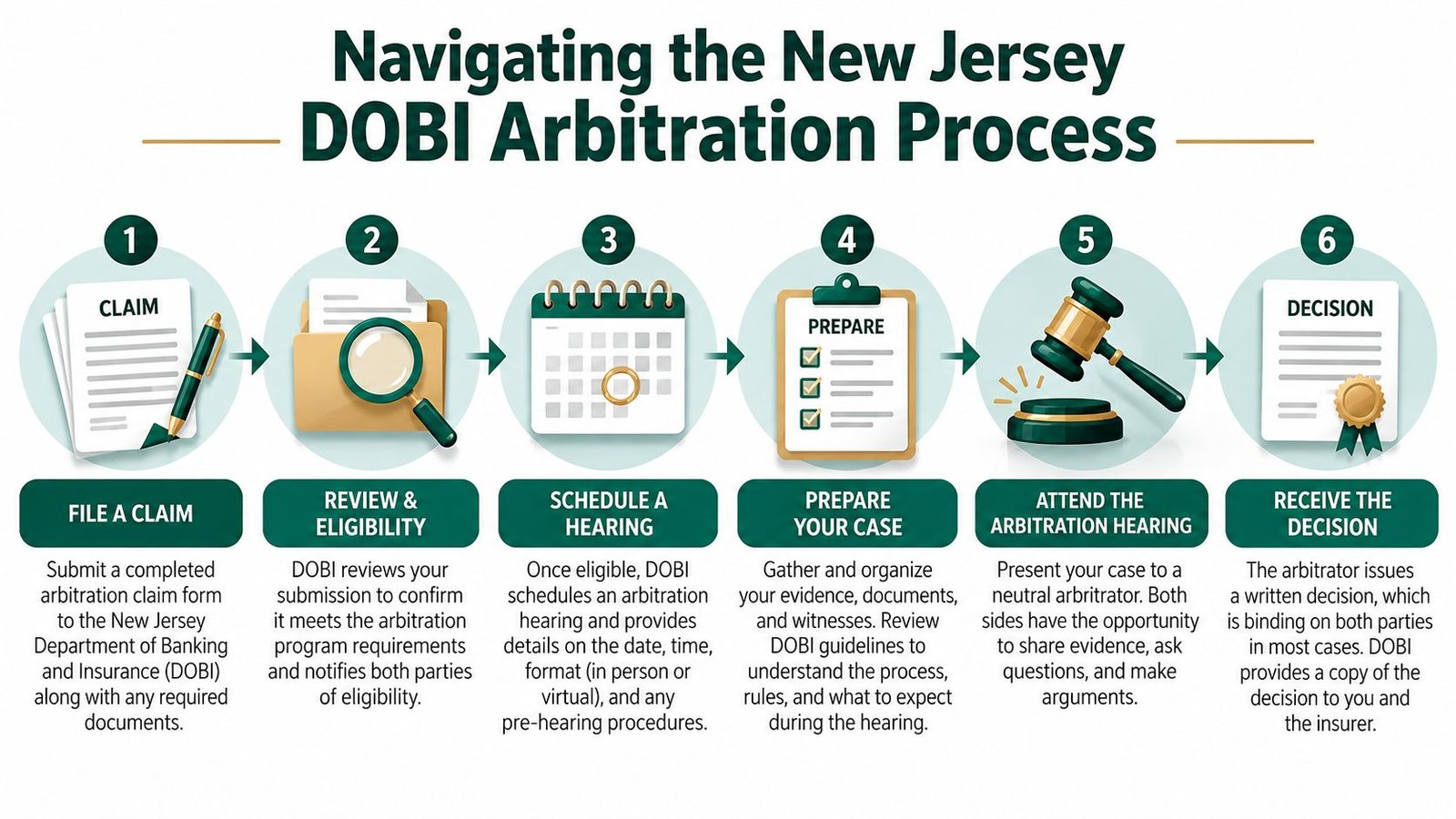
Navigating the New Jersey DOBI Arbitration Process
New Jersey's out-of-network framework gives providers, carriers, and, in some situations, covered persons a formal route to address reimbursement disputes. The process is deadline-driven. A practice that waits for ordinary correspondence to resolve a recurring reduction can lose its standing before the file reaches the appropriate forum.
The core workflow starts with the payment or notice, moves through negotiation, and then proceeds to arbitration when the dispute remains unresolved and the claim qualifies. New Jersey rules require a 30-day negotiation period before either side may initiate arbitration. For self-funded plans that don't opt in, an unresolved dispute can proceed to binding arbitration if it remains unresolved within 60 days after the bill is sent. New Jersey DOBI's out-of-network arbitration bulletin sets out the relevant framework and filing restrictions.
Build the file before the deadline
Horizon's guidance states that the plan must pay or issue an excessive-charge notice within 20 days. If the parties cannot resolve the matter during the required negotiation window, arbitration may become the practical escalation route when the applicable conditions are met. Horizon also identifies a $1,000 difference between final offers as relevant to possible arbitration.
The practice's file should contain:
- The original claim: Include the submitted claim and all relevant line items.
- Payment evidence: Preserve the EOB or remittance advice showing the allowed amount and reduction reason.
- A precise appeal statement: Identify the specific CPT line, disputed amount, and basis for challenging the calculation.
- Contract evidence: Attach relevant plan language, provider agreement provisions, and reimbursement schedules.
- A/R documentation: Include overpayment requests, account notices, and payment history when they help establish the dispute.
- Timeline records: Record the first payment date, negotiation communications, notices, and filing deadline.
New Jersey's provider appeal form specifically contemplates appeals involving an unexpected contract or plan payment rate, incorrect code treatment, or documentation requests that conflict with claims-handling rules. It also asks for the claim, EOB or remittance advice, disputed line items, A/R notices, and relevant contract provisions. The New Jersey provider appeal form provides a practical checklist for assembling a defensible submission.
Know the recovery record
DOBI arbitration data shows that providers won 6,199 cases, representing 66% of issued awards, while carriers won 3,143 cases, representing 34%. The DOBI arbitration data report doesn't guarantee an outcome for an individual chiropractic claim, but it demonstrates that provider-side arbitration has produced substantial recoveries and shouldn't be dismissed as a theoretical remedy.
New Jersey also requires providers to submit reimbursement requests within 18 months of the first payment on the claim and prohibits seeking more than one reimbursement for the same underpaid claim. Treat that first-payment date as a control point in the practice management system, not as a detail to locate after an appeal has already stalled.
For operational support, a guide to filing a New Jersey DOBI complaint for underpaid out-of-network claims can help distinguish a regulatory complaint from a reimbursement arbitration file. They aren't interchangeable responses.
Advanced Appeal Tactics and State Board Leverage
The best chiropractic appeals are specific enough to test the payer's reasoning. A medical-necessity narrative alone rarely challenges an allowed-amount reduction. The practice should show how the diagnosis, treated region, CPT selection, documentation, and reimbursement rule fit together, then identify the precise point where the payer's calculation diverges.
One useful reopening tactic is a DX-pointing swap. For a claim involving 98940, 98941, or 98942, review whether the diagnosis pointers accurately correspond to the spinal regions documented in the treatment record. If the original claim pointed diagnoses broadly or inconsistently, a corrected submission can align each treated region with the supporting diagnosis. This isn't a license to alter the clinical record. The diagnosis must reflect the provider's actual assessment and treatment, and the corrected claim must remain consistent with the note.
Use the right pressure for the right defect
A diagnosis-pointer correction may address a coding or claim-submission problem. It won't, by itself, prove that a repricer used an impermissible allowed amount. For that dispute, the file should focus on the payer's methodology, plan terms, repricer language, and comparable adjudication results.
The New Jersey chiropractic board can be part of a broader escalation strategy when the practice believes a payer's conduct raises a professional or regulatory concern. The board isn't a substitute for DOBI arbitration, contract enforcement, or legal advice, and a complaint shouldn't be used as a negotiating threat without a supportable factual record. The useful role is to document conduct that may affect chiropractic claims handling or the profession's regulatory environment while DOBI addresses the reimbursement pathway.
A practical escalation sequence looks like this:
- Correct the claim first: Fix supported diagnosis pointing, region reporting, modifier use, or documentation gaps.
- Challenge the payment method: Ask the payer to identify the plan provision and repricing basis used for the disputed line.
- Preserve the pattern: Group materially similar reductions without submitting duplicate reimbursement requests.
- Escalate the forum: Use DOBI procedures when the claim qualifies, and obtain counsel for contract, ERISA, or federal litigation questions.
- Use board channels carefully: Report a documented regulatory concern separately from the financial demand.
Data iSight reductions deserve their own evidence trail. A Data iSight underpayment appeal guide for out-of-network providers can help structure that review, but the payer's actual plan terms and remittance information control the claim-specific argument.
The distinction between fully insured and self-funded coverage is critical. New Jersey's arbitration framework may apply differently when a self-funded plan hasn't opted in, and ERISA-related limits can affect available remedies. A practice owner shouldn't send every disputed claim to the same channel.
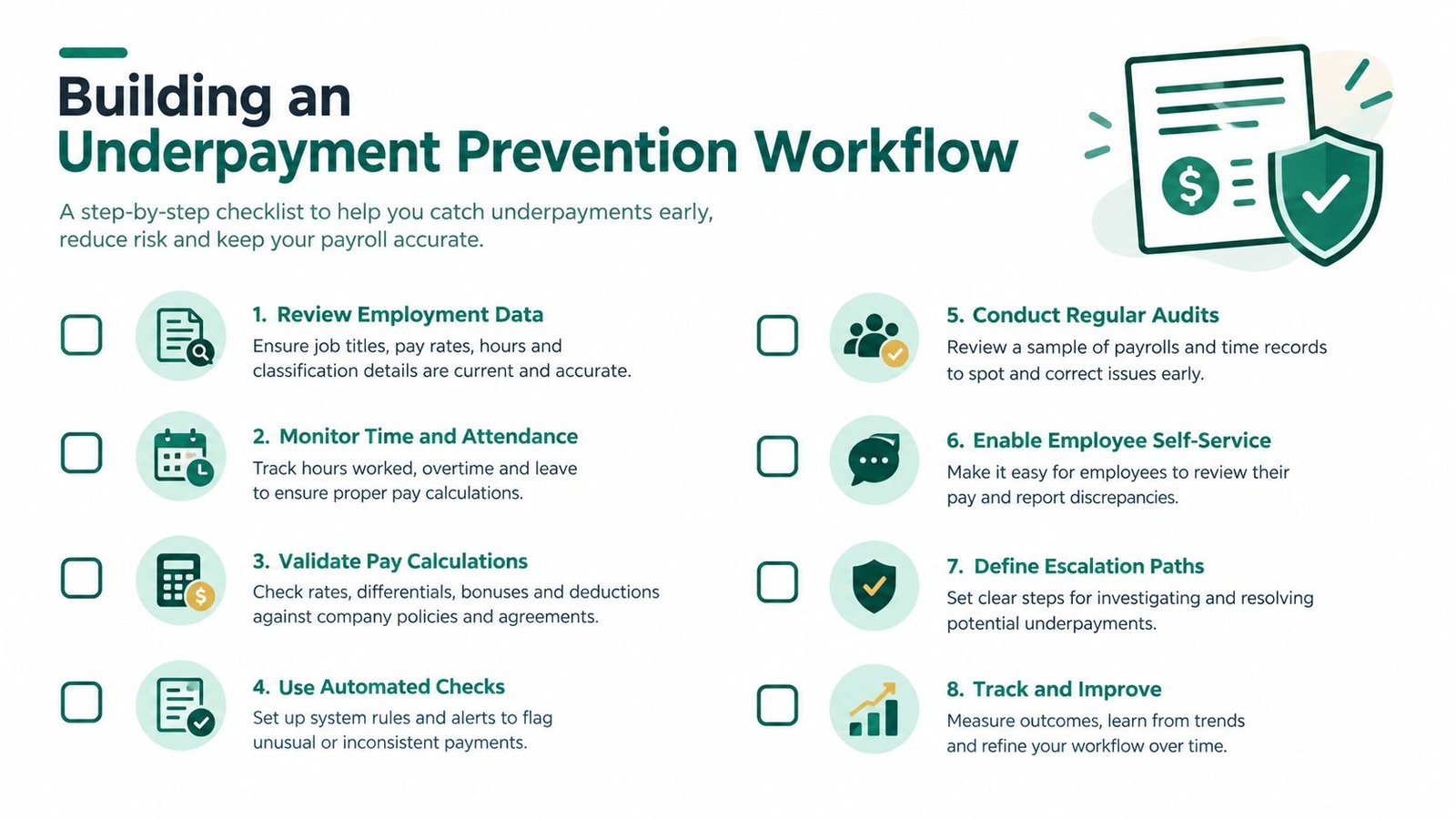
Building an Underpayment Prevention Workflow
A prevention workflow should expose repricer behavior before it becomes a recurring revenue loss. For a New Jersey chiropractic practice, that means connecting benefit verification, documentation, coding, payment posting, and escalation in one record. Before accepting an out-of-network case, document the member's benefits, reimbursement limits, plan type, authorization requirements, and patient-billing restrictions. The owner then has a defensible payment expectation before the claim reaches the payer.
Set clear ownership at each point:
- At scheduling: Verify out-of-network benefits and identify whether the plan is fully insured or self-funded.
- Before treatment: Provide the estimate or disclosure required for the circumstances, retain the patient communication, and separate patient obligations from payer responsibility. A good-faith-estimate guide for medical practices can help staff apply those disclosure duties correctly.
- During documentation: Ensure the note supports the treated regions, diagnosis, CPT selection, and separately reported services such as 97140 or 97530.
- At claim submission: Check region counts, modifiers, diagnosis pointers, units, and payer-specific edits. Repricer algorithms often target chiropractic CPT combinations and regional reporting, so small inconsistencies can create a repeatable reduction pattern.
- At posting: Compare the allowed amount with the expected plan or contract methodology. Do not treat an EOB as proof that the payment is correct.
- At follow-up: Record the first-payment date, notice date, negotiation deadline, and the next action.
The No Surprises Act and good-faith-estimate requirements do not resolve every chiropractic underpayment. Their application depends on the service, setting, coverage, and patient circumstances. Keep patient-disclosure compliance separate from provider reimbursement recovery, while preserving records that may support a later payer dispute.
Decide what belongs in-house
An internal team can manage routine eligibility checks and clean claims. Methodology disputes call for contract interpretation, line-item review, deadline control, payer correspondence, and judgment about New Jersey DOBI procedures or state board channels. Assigning those tasks internally may save vendor fees, but an aging underpayment queue can cost more when staff prioritize charge entry and ordinary denials.
A secure contract system for healthcare keeps payer agreements, amendments, fee schedules, and reimbursement terms available during claim review. Without organized records, staff may recognize a low payment but lack the evidence to challenge the repricer's calculation.
Use a recovery queue with fields for CPT, payer, plan type, first-payment date, reduction reason, expected methodology, disputed amount, negotiation status, and next action. Track repeated reductions by payer and code, then decide whether the pattern warrants internal review, DOBI action, or a separate state board referral concerning documented conduct. Practices assessing their exposure can request a free out-of-network underpayment analysis before rebuilding the process internally or assigning it to a specialized RCM partner.
Frequently Asked Questions
Should a chiropractic practice pursue arbitration or a lawsuit first?
Start by classifying the claim and reviewing the plan, contract, and payment history. New Jersey's framework provides negotiation and arbitration routes for qualifying disputes, while a lawsuit may involve contract terms, federal questions, or allegations about repricing methodology. The 2021 federal case involving New Jersey chiropractors, Cigna, and Aetna shows that litigation can remain available in some circumstances, but it isn't a reason to bypass the state process automatically.
How do self-funded plans affect DOBI arbitration eligibility?
A self-funded plan that doesn't opt in may follow a different path. Under New Jersey's framework, an unresolved dispute for such a plan can proceed to binding arbitration after 60 days from the bill date, subject to the applicable requirements. Confirm the plan's status before filing, because ERISA-related limits and payer contracts can affect the available remedy.
What should the practice submit with an underpayment appeal?
Submit the claim, EOB or remittance advice, a line-item statement identifying the disputed service, relevant A/R notices, and the contract or plan provisions supporting the expected payment. For chiropractic claims, add the treatment note, region-specific diagnosis support, corrected claim information when applicable, and the payer's repricing explanation. Specificity is more persuasive than a general assertion that reimbursement is unfair.
Is outsourcing underpayment recovery worth the cost?
It can be, particularly when the practice has recurring reductions across multiple payers and no reliable deadline or methodology queue. Compare the cost of outside support with the recoverable variance, staff time, missed filing windows, and A/R aging. A vendor should be able to explain how it identifies claims, avoids duplicate reimbursement requests, documents payer methodology, and escalates qualifying disputes.
Happy Billing helps chiropractic practices review out-of-network payments, organize underpayment evidence, manage payer appeals, and pursue New Jersey recovery workflows without treating paid claims as automatically correct. Visit Happy Billing to evaluate your chiropractic A/R and request a focused review of potential underpayments.