How to Reopen a Deposited Underpaid Claim Tactical Guide
Most practices treat a deposited underpaid claim like closed revenue, and that's how cash leaks for months. The better move is to treat it as a recoverable asset, because the right reopening path can still pull money back into A/R without turning the file into a duplicate mess.
For a practice owner, this matters because every stale underpayment sits in your ledger, distorts your denial rate, and drags days in A/R longer than they should be. The practical playbook is simple: verify the variance, choose reopening or correction, package the proof, submit through the right payer channel, and track the recovery until the remittance lands. If you want the broader operational context, revenue management for B2B is useful background, and Happy Billing's claim denial management resource fits the same recovery mindset.
The Underpaid Deposit Most Practices Never Reopen
The first mistake is treating a paid claim as finished. A deposited underpayment is still a live receivable when the payer paid less than contract or used the wrong pricing logic, and that gap keeps draining cash even when the deposit looks close enough.
Practical rule: If the payment does not match the contract, the claim is not closed just because the bank deposit cleared.
A senior RCM team should start with a variance screen, not a blanket appeal. Pull the billed amount, the paid amount, the allowed amount, the contract or fee schedule, and the remittance remark codes, then decide whether reopening, a corrected claim, or a formal appeal path fits the situation. That choice matters because Medicare-style reopenings and standard appeals run on different clocks, and contractors state that reopening does not extend the appeal deadline.
The workflow that brings money back is straightforward. Identify the underpayment, verify the contract math, attach the supporting record, submit through the payer's accepted channel, and document the claim number so the payer does not misclassify it as a duplicate. Many billing vendors stop at the point where the deposit lands and no one wants to disturb a file marked “paid.”
For practice owners, claim denial management guidance is operationally relevant. The point is recovery discipline, not theory. The three maneuvers below are the ones most billing companies leave on the table, and they can recover underpayments without creating avoidable payer scrutiny when they are executed correctly.
If you want the broader operational context, revenue management for B2B is useful background.
Losing money to out-of-network repricing?
We will compare a sample of your out-of-network claims against a fair benchmark and show you what is recoverable, claim by claim. Get a free underpayment analysis →
Which Deposited Claims Are Eligible for Reopening
Not every underpaid deposit should be reopened. The easy targets are claims where the payer's allowance was wrong, the benefit path was misread, or the original submission can be corrected without changing the underlying clinical truth. Commercial out-of-network claims are usually the cleanest fit because the dispute often sits in the allowed amount, contract language, or benefit calculation rather than in medical necessity.
Medicare secondary claims can also be viable when the primary EOB data was keyed incorrectly or the coordination-of-benefits sequence needs correction. Workers' compensation claims are another useful lane when the carrier applied the wrong fee schedule or mishandled a jurisdictional rule. By contrast, Medicare primary claims are usually much harder to reopen once they're paid, because the fee schedule payment itself is generally final unless you have a true appeal basis or a contractor-recognized reopening ground.
Fast Eligibility Filter
Use this triage before you spend staff time on dead claims:
- Commercial out-of-network: Often reopenable when the payer underpaid relative to the contract or usual benefit method.
- Medicare secondary: Often reopenable when the primary payer data, COB sequence, or remittance details were misapplied.
- Workers' compensation: Often reopenable when the carrier used the wrong schedule or missed an adjustment rule.
- Medicare primary: Usually not a reopening target unless you have a recognized correction basis or appeal issue.
- Patient-pay only arrangements: Usually not a reopening play.
- Claims outside timely filing: Usually dead unless the payer contract or jurisdiction gives you a narrow exception.
A quick way to think about it is this, if the payer's error is about pricing, sequencing, or allowance, you may have a reopening lane. If the claim is fully adjudicated correctly and you wish the payment were higher, you usually don't. The claim has to live inside the payer's correction corridor, not just inside your frustration.
| Deposited Claim Eligibility by Payer Class | Reopen Eligible? | Common Reopen Trigger | Disqualifier |
|---|---|---|---|
| Commercial OON | Often yes | Allowed amount dispute, contract misread, benefit issue | Timely filing missed, correct adjudication |
| Medicare secondary | Sometimes | Primary EOB miskeyed, COB sequence correction | Final adjudication with no correction basis |
| Workers comp | Sometimes | Wrong fee schedule, jurisdictional adjustment issue | Expired dispute window |
| Medicare primary | Rarely | Limited reopening or appeal grounds | Routine underpayment after final payment |
| Patient-pay only | Usually no | None in the usual payer sense | No payer allowance dispute |
For a payer-facing reference on EOB reading, how to read an explanation of benefits is the right internal checkpoint. The operator's job is to filter out the junk fast and keep only the claims that still have legal or contractual oxygen.
The DX-Pointer Swap Tactic for Compliance-Safe Resubmission
The diagnosis-pointer swap works when the medical record supports a better pointer order than the one originally used. The same CPT and the same ICD set stay in play, but the pointer sequence changes so the claim aligns with the documentation and the payer's pricing logic. Done correctly, it's a corrected claim, not a fabricated new service.
Take an orthopedic example. Suppose CPT 27447 was billed with M17.11 as the first pointer and paid at a lower unilateral interpretation, but the operative note supports M17.0 because bilateral disease was documented and addressed in the record. If the chart really supports the bilateral diagnosis, the issue is not upcoding. The issue is that the original pointer order failed to reflect the documented condition that drives the higher payable pathway.
How to submit it without duplicate trouble
The cleanest approach is to send the corrected claim as a replacement, not as a fresh bill. Use the payer's corrected-claim or reopening workflow, mark the frequency code 7, and keep the original claim number visible so the payer can match the record. Many clearinghouse rejections happen because the biller sends a new claim ID without tying it back to the original remittance.
Submit the corrected claim as a factual correction, not a billing rewrite.
A practical packet usually includes the voided original line item, the revised CMS-1500 with the new pointer order, and the operative note excerpt that justifies the change. In box 64, include the original claim number and ICN when the payer accepts that structure, and add a short narrative such as “reopening, corrected diagnosis pointer per documentation review.” That language signals correction, not duplicate billing.
For a form layout reference, this completed CMS-1500 example helps staff see where the payer expects the revised information to land. The actual win here is not just getting paid again; it is getting the payer to process the corrected line on its merits instead of auto-denying it as a duplicate.
The Fee Schedule Bump That Forces a Higher Reimbursement
A fee schedule bump is the right move when the payer paid from the wrong contracted value or a stale allowance schedule. The mistake is usually mechanical. Someone loaded an outdated schedule, capped the billed charge too aggressively, or priced the service against the wrong allowance table. In those cases, the claim can often be reworked so the payer issues a fresh EOB based on the correct contract amount.
Start by comparing the amount paid against the active fee schedule. If the original claim was billed at a lower charge than the payer's current allowance logic can support, correct the billed amount and attach the fee schedule excerpt or contract page that shows the proper allowance. A simple example is an office visit billed as 99214 where the payer paid $78.42 but the current Horizon BCBS NJ fee schedule lists $112.50, leaving a $34.08 variance. Use that math to frame the correction, not as a complaint, but as a contract reconciliation.
What the corrected submission needs
The claim should be sent in a form the payer will treat as a corrected or reopened item, not a duplicate. That means the revised CMS-1500 reflects the accurate charge, the payer-specific fee schedule is attached, and the claim note explains the variance plainly. If the portal allows narrative comments, keep them short and factual, because long explanations usually create more reading friction than help.
The goal is to trigger a fresh EOB cycle. Once the payer accepts the corrected billing path, the additional payment should follow the contract calculation rather than the stale amount that landed in the bank earlier. In practice, practices recover money they assumed was lost because the first deposit looked final.
For billing teams, the important distinction is that you're not re-litigating the service itself. You're correcting the reimbursement basis. That distinction keeps the file in the contract lane, which is exactly where many underpayments can be fixed without a full appeal stack.
Payer-By-Payer Timely Filing and Reopening Windows
Deadline management is where most reopening attempts fail. Different payers anchor the clock to different events, and if your team doesn't track the trigger correctly, you lose the right to correct the underpayment even when the math is obvious. Medicare guidance makes this especially clear, since reopenings and appeals are separate tracks and the reopening request does not pause the appeal deadline.
The practical rule is to log three dates immediately, the date of service, the date of the EOB or remittance, and the date of payment. Some payers care about the original EOB, some care about the service date, and Medicare contractor guidance often keys reopening to the remittance advice date or the initial determination date. If your staff uses one universal clock for every payer, you're going to miss money.
| Timely Filing and Reopening Windows by Major Payer | Timely Filing Limit | Reopening Window | Clock Starts From |
|---|---|---|---|
| Horizon BCBS | 180 days standard, 14 months for good cause | Payer-specific correction path | Usually service date or EOB, depending on policy |
| Cigna | 12 months from original EOB | Contract or claim correction path | Original EOB |
| UnitedHealthcare | 90 days initial, 180 days with proof of original timely filing | Payer correction path | Service date or original timely filing proof |
| Aetna | 180 days | Contract correction path | Usually service date |
| Medicare | Appeal due 120 days from RA, reopening generally within 1 year, revised decisions can extend to 4 years for good cause | 1 year generally, 4 years in good cause or limited correction cases | RA date or initial determination date |
| Medicaid by state | Usually 180 to 365 days | State-specific | State-defined trigger |
| TRICARE | 1 year | Plan-specific correction path | Service date |
| Workers comp by jurisdiction | Varies, often 1 to 2 years | Jurisdiction-specific | Varies by state or carrier |
The state and payer rules can be unforgiving, but the good news is they're usually knowable. Horizon, Cigna, and Medicare are the types of payers where a practice can still recover money if someone catches the underpayment before the window closes. Once the clock expires, the claim may still be morally underpaid, but operationally it's dead.
For a practical reminder on one common payer's limit structure, UnitedHealthcare timely filing limits are worth keeping in your workflow binder. The owner-level takeaway is simple, deadline discipline is part of collections, not an admin afterthought.
Documentation Package That Survives Payer Review
A reopened underpaid claim needs proof that can survive a skeptical payer reviewer, not just a billing note that says “please reprocess.” The strongest submission package is tight, readable, and built around the payer's own logic. If the package is thin, the payer either denies it again or sends it into a correction loop that burns staff time.
The four documents that matter
- Variance calculation worksheet. Show the original billed amount, the amount paid, the contractual allowed amount, and the delta. If the payer contract defines the formula, cite that formula in the worksheet so the reviewer can see exactly how the number was derived.
- Active fee schedule or contract page. This is the proof that the underpayment exists. Without it, the submission looks like an opinion.
- Medical record excerpt. Use the operative note, encounter note, or imaging report that supports the original service level, diagnosis, or payer-specific correction.
- Corrected claim form. Mark it according to the payer's corrected-claim or reopening format, with the right frequency code or condition code where required.
Practical rule: If the math, contract page, and chart excerpt don't all agree, the payer will usually side with the cleanest version of the file.
Portal routing matters too. Put the contract and variance worksheet in the attachment tab when the payer supports attachments, and use the claim notes field for a short statement that tells the reviewer what changed. If the denial code is CO-45, CO-97, or PR-204, your attachment set should make the underpayment obvious without forcing the payer to reconstruct the story from scratch.
This is also where a specialized RCM partner can help if your team lacks bandwidth. Happy Billing, for example, works inside existing EHR workflows and handles denial recovery and underpayment collection as part of broader RCM operations, which is useful when you need correction packets built consistently rather than ad hoc. The point is not who touches the file, it's whether the file lands complete.
Compliance Risks and KPIs to Prevent Future Underpayments
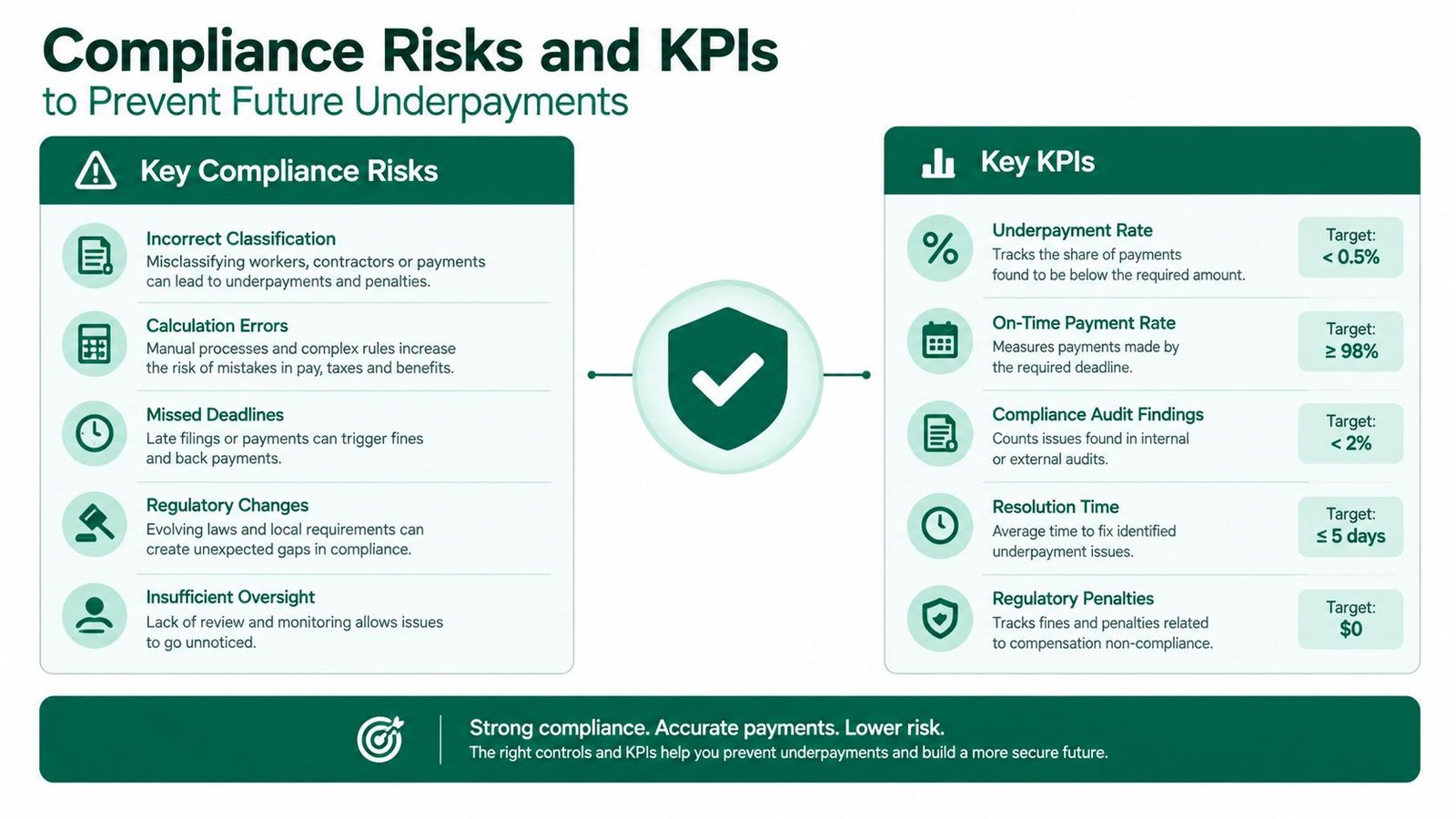
The compliance line is simple. An isolated, well-documented correction is recovery. A repeatable rebilling pattern that ignores chart support is a red flag. If a practice files the same kind of corrected claim because the payer misapplied a schedule or pointer, that's one thing. If staff start cycling modifier changes or diagnosis swaps across every denial just to chase a better number, the file starts to look like intent rather than correction.
The line owners should enforce
The easiest rule is to tie every reopened dollar to a contract clause or a coding rule, not to habit. If you can't point to the clause, the schedule, or the chart support, stop the submission and audit it. That's how you keep tactical recovery from drifting into systematic overcorrection.
For operational control, watch the weekly indicators that show whether underpayments are being prevented or merely chased after the fact. A good governance framework, like the one discussed in the HelpWithMetrics governance framework, is useful when you want the numbers to drive decisions instead of intuition.
Use this internal KPI page as your bench standard, medical billing KPIs to track, and keep the following in front of the team:
- Contractual allowable variance per payer: Keep it under tight control, and investigate any recurring drift.
- Days from EOB to variance flag: The faster the flag, the more underpayments still sit inside the recovery window.
- Reopen submission acceptance rate: If the payer is rejecting the packets, the workflow is broken.
- Overturned appeal dollars as a share of net revenue: This shows whether the team is converting disputes into cash.
- Clean claim rate on the front end: If the front end is weak, the back end will always be busy.
Owners should also watch where the errors cluster, by CPT, by payer, and by employee. If one pattern keeps showing up, stop the line, audit the root cause, and fix the workflow before the next remittance cycle repeats the same loss. That's how you keep a reopen strategy from becoming an endless cleanup project.
If you want a team that treats deposited underpayments as recoverable revenue instead of closed loss, Happy Billing can review the claims, match them to the contract, and build the correction path around your specialty's payer rules. We help practices recover money that should have been paid the first time, and we do it inside the systems you already use.
Losing money to out-of-network repricing?
Send us a sample of your out-of-network claims. We compare each allowed amount against a fair benchmark, flag which claims are still appealable, and estimate what is recoverable. BAA signed before we see any data. Get a free underpayment analysis →