How to File a NJ DOBI Complaint for Underpaid Out-of-Network Claims
Quick answer: 3-step process: (1) exhaust the payer internal appeal, (2) file at NJ DOBI online complaint portal with a documented Fair Health-benchmarked underpayment claim, (3) wait 30-45 days for payer response. New Jersey's carrier complaint process is a practical way to push back when an out-of-network claim has been underpaid, especially after the payer has already said no and your A/R is sitting idle.
For a practice owner, this is not a consumer nuisance form. It's a revenue recovery lever. Underpaid out-of-network claims become extended A/R, delayed physician compensation, and avoidable write-offs when billing teams stop at the first denial instead of forcing a second review through DOBI's regulatory channel.
The hidden value is that the complaint changes the payer's incentives. Once the claim is framed as a documented underpayment against New Jersey's out-of-network protections, the carrier has to explain its repricing and its handling of the claim, not just shrug at an appeal letter. We've seen too many practices let high-value claims die in the queue because their billing service never knew how to build a complaint that DOBI could use. If your team needs a benchmark for whether the leakage is real, start with a free revenue audit and compare your out-of-network underpayments against the carrier's own explanation of benefits.
Independent owners also miss a tactical outsourcing question. A complaint package takes the same discipline as tight denial work, and that's why teams that use virtual legal assistants companies often do better on document gathering than practices that rely on a stretched front office. The process is administrative, but the payoff is strategic, because one properly built complaint can force a payer to revisit a pattern instead of treating your claim as an isolated inconvenience.
The Strategic Advantage of NJ DOBI Complaints
DOBI matters because it gives providers a formal route to challenge out-of-network reimbursement disputes after the payer's internal appeal path runs out. At that point, the complaint stops being a courtesy letter and becomes a pressure point. For an independent practice, that distinction matters when a single underpaid claim sits in A/R for months while staff keep recycling the same denial language.
Practical rule: if the internal appeal has already failed, stop emailing the payer and build a clean underpayment record for DOBI. The file has to show the gap clearly, with enough detail to force a real review.
That is why the process gets ignored. Many billing services treat a denial letter like the end of the road, but the regulatory path starts there. The carrier still has to operate within New Jersey's out-of-network rules, and DOBI gives the practice another route when the payer's handling looks less like a routine adjustment and more like a pattern of underpayment.
Practically, owners should focus on dollars trapped in A/R, not on paper chasing. An underpaid out-of-network anesthesiology case, a cardiology interpretation, or a specialty surgical claim can take far longer to unwind than a standard in-network denial because the payer often relies on repricing logic that the front office never inspects closely. If your team handles complex specialties, a specialty-aware billing workflow matters, and our specialty billing resources show how practices in higher-complexity fields approach these disputes differently.
The complaint also builds a paper trail the payer cannot keep brushing aside. DOBI tracks complaints, investigates when appropriate, and can refer matters to the right licensing or regulatory body. That matters because the goal is collection behavior, not noise. A claim that looked unrecoverable inside the payer portal can become collectible once the complaint reframes it as a regulated out-of-network payment dispute.
Understanding DOBI Authority and Statutory Timelines
New Jersey's Out-of-Network Consumer Protection, Transparency, Cost Containment and Accountability Act gives DOBI a formal path for involuntary and inadvertent out-of-network disputes, including binding arbitration when the gap between final offers is more than $1,000 (statute). For a practice owner, that is the point of filing. It turns an underpaid claim from a routine payer dispute into a regulated reimbursement issue with deadlines, notice rules, and consequences if the carrier mishandles the file.
The timing matters because carriers work under a short clock. The statute requires the carrier to decide within 20 days of receiving the claim whether it views the charge as excessive, and it must notify the provider within that same 20-day window (statute). If the dispute continues, a request for binding arbitration may be filed with DOBI within 30 days of the provider's final offer, and the arbitrator must issue a decision within 30 days after the request is filed (statute). Those dates matter because they show when a payer is merely slow, when it has missed its obligations, and when escalation is justified.
The arbitration threshold changes the strategy. If the gap between final offers is at least $1,000, either side can start binding arbitration by filing with DOBI (statute). That is why small-looking underpayments can still justify pressure. One claim may not feel worth the fight, but a pattern of repricing across multiple claims can move a practice from write-off mode into a regulatory dispute that deserves attention.
DOBI's own guidance points in the same direction. It says covered persons and providers should report attempts to bill above in-network cost-sharing, and it explains that DOBI can investigate complaints and refer matters to the right licensing agency or regulator (DOBI guidance). For a practice, that matters because the complaint is not just a consumer gripe. It is a formal record that can force a payer to confront a payment pattern it may otherwise keep burying in its portal.
For specialty groups, the complaint process lands differently when the claim involves complex procedures, multiple codes, or repeated repricing. Our NJ out-of-network billing guide for practices is a useful internal reference for that reason.
Assembling the Forensic Evidence Package
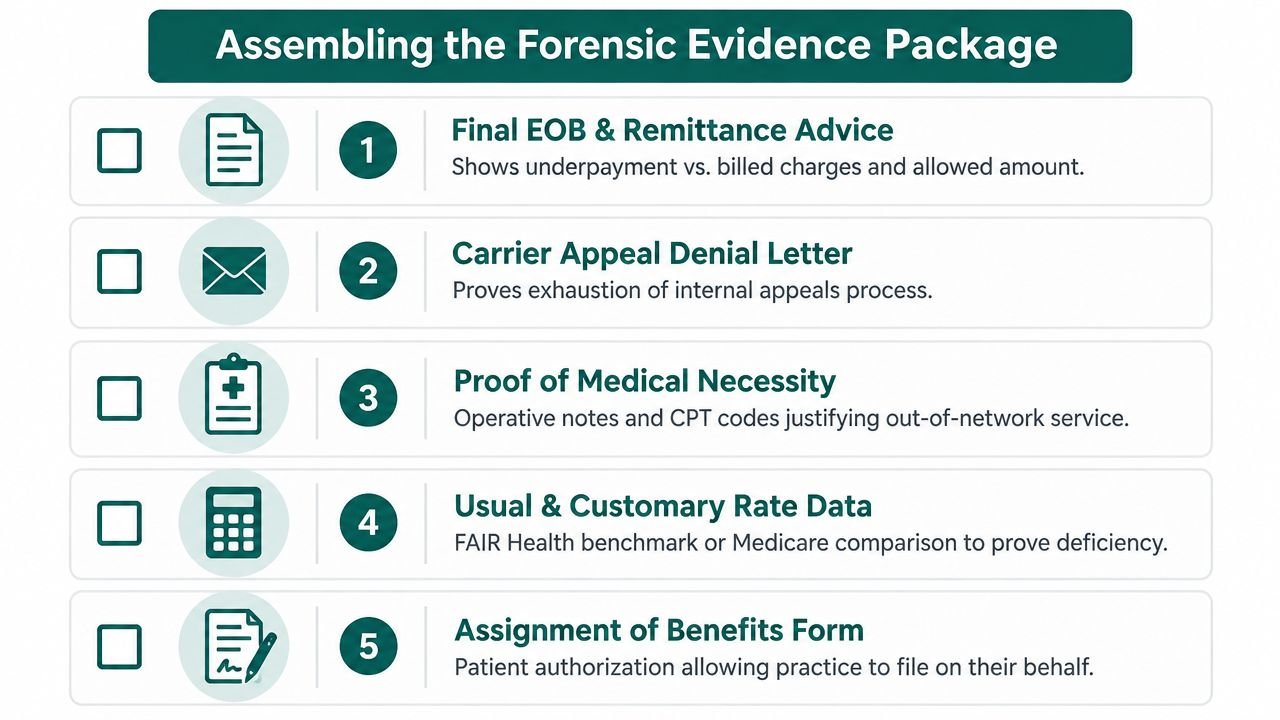
A DOBI complaint works only when the file proves the underpayment, not when it merely complains about it. General EOBs help, but they rarely carry enough weight on their own. The carrier needs to see a clear mismatch between what was billed, what was allowed, and why the practice believes the allowed amount is below the reasonable benchmark for that market.
The strongest package starts with the final EOB and remittance advice, because that is the carrier's own statement of how it processed the claim. Then add the appeal denial letter, because DOBI wants to know the payer's internal process was already used and rejected. After that, include the medical necessity documentation, such as operative notes, procedure reports, and any supporting records that show the level of service was appropriate.
The complaint gets stronger when the documents tell one story without gaps. If the EOB, denial letter, and chart notes don't line up, the payer can slow the file down by saying the problem is incomplete, not underpaid.
The most important proof in a reimbursement dispute is the benchmark. That means pulling Fair Health fee schedule data for the relevant ZIP code and comparing the claim against the out-of-network standard that applies in that market. If the claim was repriced through a tool such as Data iSight or Zelis, include the repricing result and show why the payment lands below the benchmark you've documented. The point is not to attack the vendor by name, it's to show DOBI that the carrier's payment logic produced a number that doesn't match the evidence.
Historical payment proofs matter too. If other carriers paid the same CPT code at materially different levels for the same practice, same region, and same type of service, those records help show the claim wasn't an ordinary low-dollar allowance. Keep the comparison tight, same CPT, same date range where possible, same specialty context, and no cherry-picking. The cleaner the comparison, the harder it is for the payer to dismiss the complaint as anecdotal.
For owners who want a practical explanation of what the payer's paper trail should look like, our EOB reading guide is a useful internal reference. It helps teams separate a true underpayment from a routine contractual adjustment, which is exactly where most complaint packages go wrong.
A missing document can stall the file before it starts. New Jersey DOBI says every request for assistance or inquiry must include the company name or agent name, the policy or certificate number, supporting documentation, and a brief description of the problem, and it may also ask for the ID card, policy declarations page, nonrenewal notice, premium increase notice, and claim denial (DOBI consumer page). For a practice, that means the complaint should read like a clean case file, not like a frustrated note.
Executing the Filing Process and Avoiding Rejection
A DOBI complaint only creates pressure if the file gets past intake. In practice, incomplete submissions slow the matter before anyone looks at the underpayment logic. Start with the Department's complaint channel, then make sure the carrier name, policy or certificate number, claim number, date of service, billed amount, allowed amount, and denial or underpayment reason all match the claim file exactly.
The cleanest filing reads like a case package, not a grievance. Include a short narrative that shows the payer had already been given a chance to reconsider through its own appeal process, and attach the claim record that supports the dispute. If the complaint involves a managed-care product, DOBI's managed-care form also calls for the form to be printed or typed in full, signed and dated, and mailed to the Office of Managed Care at PO Box 475, Trenton, NJ 08625-0475 (managed-care form).
The most common rejection points are mechanical.
- Missing policy identifiers: Without the policy or certificate number, DOBI has to sort out the account before it can assess the complaint.
- Thin documentation: An EOB by itself rarely shows the full payment story. Add the denial notice and the supporting billing records.
- No appeal exhaustion: If the file does not show the payer already had an internal chance to correct the payment, the complaint looks premature.
- No billing narrative: State plainly whether the issue is underpayment, balance billing, or a surprise-billing problem, so DOBI knows what it is reviewing.
For teams still working through the payer's denial stage, our insurance appeal process reference is a useful internal guide. The DOBI complaint carries more weight after the carrier has already seen the appeal and still failed to correct the claim.
A tighter filing also makes follow-up easier. With the right identifiers in place, your billing manager can track whether DOBI has opened the case, whether the carrier has responded, and whether the file is moving toward resolution instead of sitting in intake.
Managing Timelines and Escalation Options
Once the complaint is in DOBI's hands, the work shifts to follow-through. Track the carrier's response, the regulator's next move, and whether the payer changes its payment behavior after the case is opened. In practice, that filing can force a reconsideration, especially when the underpayment came from repricing logic instead of a real coverage dispute.
Stay disciplined when the carrier sends a partial bump. A slightly higher payment is not a clean resolution if it still falls short of the evidence package you submitted. The goal is to get the claim to a defensible reimbursement level, not to accept the first adjustment that makes the complaint go away.
The filing volume is not what gets attention. DOBI's reporting shows relatively low complaint counts in recent years, which means many underpaid claims never make it into a formal process. That is exactly why a practice with clean documentation can put pressure on a payer that expected the file to stay buried.
If the DOBI route does not close the balance, the next move depends on the claim type and the amount still at issue. For protected out-of-network disputes with a qualifying gap, binding arbitration remains available under the No Surprises Act framework, and our IDR process reference is a useful guide for deciding when that path fits. For smaller balances, small claims court may be the more practical recovery tool if the numbers justify the time. Broader carrier conduct can also justify escalation to the state insurance commissioner or the appropriate regulator when the pattern, not just one claim, is driving leakage.
The point is simple. The first complaint is about correcting one underpayment, but the follow-through protects the account receivable. If the payer keeps underpaying the same claim class, the single EOB is no longer the issue.
Frequently Asked Questions About DOBI Complaints
Can we file a DOBI complaint if the patient hasn't paid their deductible?
Yes, but the complaint should still focus on the underpayment mechanics, not on patient collection. If the claim is protected by New Jersey's out-of-network rules, the issue is whether the carrier honored the proper processing and reimbursement path, and whether the provider was improperly pushed below the allowed in-network liability framework.
Does filing a DOBI complaint hurt our credentialing status with the carrier?
Filing a legitimate complaint should not be treated like a credentialing threat, because you're using a state process designed for reimbursement disputes. In real-world payer relationships, though, the larger risk is sloppy documentation. If your file is incomplete or inconsistent, the complaint can stall and the payer can keep the issue alive in A/R longer than it should.
Should we use DOBI, arbitration, or small claims first?
Use the route that matches the claim and the evidence. Start with the internal appeal, then use DOBI when the underpayment remains unresolved, and use arbitration when the statutory threshold is met and the payment gap justifies it. Small claims is usually a backup for lower balances where the recovery cost is manageable.
When should we outsource this appeals workflow?
Outsource when the claim volume, coding complexity, or payer pushback is too high for a generalist team to document properly. Practices that handle specialty services often need a tighter evidence package than a standard appeal can support, and that's where a disciplined RCM partner becomes more valuable than another general billing service. For a broader owner-level perspective on claims management, claims help for CFOs and owners is a useful external comparison point.
What makes a DOBI complaint more persuasive than a normal appeal letter?
A complaint becomes persuasive when it reads like a forensic file. The best submissions tie the EOB, denial letter, medical necessity records, and benchmark data together so DOBI can see the underpayment without guessing.
If you want a team that treats underpaid out-of-network claims like recoverable revenue instead of routine noise, Happy Billing can help you build the evidence, pressure the payer, and protect your A/R. We work inside your existing workflow, so you can keep the focus on cash flow, denial prevention, and getting the right claims out of limbo faster.