Physical Therapy Underpayment Recovery Guide for Practice Owners
Most PT practices are bleeding recoverable commercial underpayments, and the fastest fixes are contract-rate variance audits, Data iSight's 14-day appeal windows, and NJ DOBI complaints. Medicare's 2026 changes make the broader point clear, too, because threshold tracking and modifier discipline now directly shape whether money gets held, delayed, or denied (CMS therapy services guidance).
Quick answer:
- Run contract-rate variance audits first, because line-item underpayments hide in plain sight when allowed amounts don't match the payer's own repricing logic.
- Hit Data iSight files inside the 14-day limit to appeal, or use a resubmit-to-reset-EOB tactic when the payer portal locks the first response into place.
- Escalate fully insured plans through NJ DOBI when the payer stalls, because a formal complaint often forces the response that appeals never got.
If you own an independent PT clinic, you do not have a “small billing issue.” You have a margin leak. Out-of-network repricing through MultiPlan, Zelis, and related repricing layers can make a visit look paid while trimming the allowed amount, and missed response windows turn that trim into final payment. That's how owners end up saying, “we're losing too much,” while the A/R team is still trying to clear obvious denials.
Underpayment recovery is not back-office housekeeping. It's a revenue control function, and if you ignore it, you're subsidizing payers every quarter while your staff chases claims that should've been paid correctly the first time.
Why Most PT Practices Are Quietly Losing Five Figures a Month
In audits of 90-day commercial PT remits, owners often expect 2-3% variance and find 8-12% on timed codes. That gap is not noise. It is repeatable leakage, and it usually shows up first in out-of-network commercial claims where repricing vendors sit between the clinic and the payer.
The mistake is treating every short pay like a one-off appeal. Start by identifying where the money is leaking, then sort the problem into three buckets: contract-rate variance, payer repricing, or workflow failure. Once you do that, the same line items keep surfacing, and the pattern becomes obvious. The key question is which codes are being shaved on every remit.
Practical rule: If your team only notices underpayments when a claim hits zero balance, you are already late. Compare expected reimbursement to actual reimbursement before the month closes.
Commercial payer stacks make this worse. A plan can route the claim through MultiPlan, Zelis, or another repricing layer, apply a silent haircut, and leave your staff chasing the mismatch after the appeal window is already running. That is why the claim may look paid while the allowed amount is still wrong. The portal shows a clean remit, the ledger shows less cash, and nobody owns the gap.
The financial hit is bigger than the line item. Every underpaid claim slows collections, stretches A/R, and burns staff time that should go to clean submissions and recovery. Owners who ignore this end up subsidizing the payer's pricing logic with their own margin.
Medicare makes the same point in a different way. CMS finalized a 3.26% increase to the 2026 conversion factor, but the American Physical Therapy Association said it translated into only a 1.75% average reimbursement increase for physical therapists overall (CMS therapy services guidance). Headline rate changes do not pay the bills by themselves. Payer behavior can erase the gain before it reaches the bank.
Out-of-network commercial PT works the same way. If you do not build a recovery system, the payer's pricing logic becomes your profit model.
Scoping the Leakage Before You Write a Single Appeal
Start with the claims that can move cash fast. Out-of-network commercial PT, high-frequency timed codes like 97110, 97140, 97530, and evaluation codes 97161 through 97164 are the lines to inspect first. Small variances on those codes repeat across dozens or hundreds of visits, and that repetition turns a modest short pay into real leakage.
Pull 90 to 180 days of claims, not just the current week. Most underpayments surface after the original remit cycle, so a forward-only review misses the damage already sitting in A/R. Reconcile the ERA or EOB against the contract, line by line, until you know the allowed amount the payer should have paid.
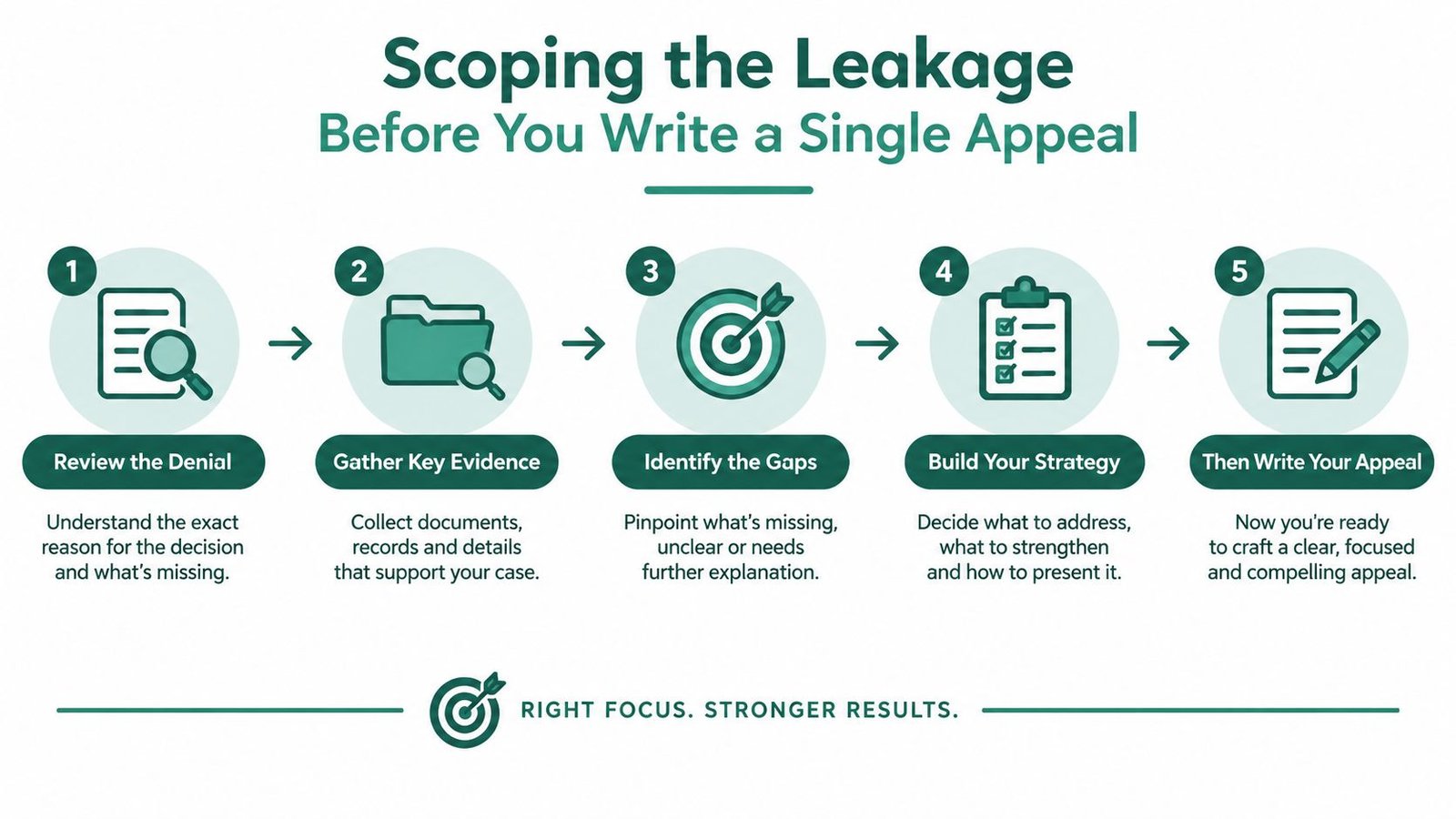
Build the queue by payer and date of service, not alphabetically and not by whoever touched the account last. That keeps the work tied to exposure, which stops staff from spending time on low-value variances that will never reverse. Sort the queue into three buckets, underpaid line items, zero-balance anomalies, and repeat denial patterns.
Queue discipline matters more than appeal volume. A short list of high-dollar variances is worth more than a thousand noise items that never survive payer review.
Run the same discipline through your audit process. Happy Billing's medical billing audit checklist for practice owners is a practical way to keep the review focused on real variance instead of spreadsheet clutter.
Readiness checklist before any appeal goes out
- Expected amount verified: Confirm the contract or repricing rule that should have driven the payment.
- Line-level variance flagged: Record the exact short-pay amount, not just the claim total.
- Modifier review completed: Check whether the denial or reduction came from a modifier issue.
- Timeliness confirmed: Make sure the appeal window is still open before staff invests time.
- Recovery owner assigned: Put one person on follow-up so the claim does not disappear into general A/R.
The Three Underpayment Mechanics Hiding in Commercial PT Claims
The biggest mistake owners make is treating every underpayment like the same problem. In commercial PT, three mechanics keep repeating, and each one needs a different recovery move.
Out-of-network repricing
MultiPlan or Zelis style repricing cuts the allowed amount without the clinic fully seeing how the reduction was calculated. The payer may label it processing, but from your side it looks like a silent haircut on services that should have paid more. That is the “in the past it would be $300 now $100” problem owners keep seeing when they compare old and new remits.
The dollar hit shows up most clearly on repeated timed codes and eval lines. Short pays on 97110 can be modest per visit but brutal across a full episode, while initial evaluations can get clipped hard enough to make the intake lose margin. If the repricing pattern repeats, the dispute belongs in contract review, not just appeals.
Data iSight appeal windows
Some payer portals, including Data iSight, enforce a 14-day limit to appeal. If the appeal window closes, the payer can treat the short pay as final even when the amount was wrong. That is a documented portal rule, not a staff preference, so the follow-up process needs a hard alert system.
The clean workaround is the resubmit-to-reset-EOB bypass. Void the original claim when that is the cleaner route, wait for the original EOB to fall off the deductible or processing trail, then resubmit as a clean claim so the payer has to reprocess against the correct effective date. Use that carefully and document the logic, because it is a workflow move, not a guessing game.
For practical timed-unit handling, see the 8-minute rule billing guide. Unit logic and payer edits often feed the same underpayment pattern.
Duplicate-denial traps
Duplicate denials often appear when the same ICD/CPT pairing gets flagged across adjacent dates, even though the documentation supports separate encounters. In those cases, the DX-pointing swap can clear the issue. Keep the same diagnosis set and CPT, then change the diagnosis pointer order when the medical record supports a different primary link.
That small change can move the claim out of the duplicate pattern and into proper adjudication. The value is real because one missed reprocessing can ripple across an episode and leave multiple visits underpaid or unpaid.
| Underpayment Mechanics and Dollar Impact by CPT | |||
|---|---|---|---|
| Mechanic | Affected CPTs | Avg $ Leakage | Recovery Window |
| Out-of-network repricing | 97110, 97140, 97530, evals | Variable by visit, often repeated across an episode | Best recovered before contract deadlines and appeal cutoffs |
| Data iSight window pressure | High-volume commercial PT claims | Small per claim, large in aggregate | 14 days to appeal |
| Duplicate-denial trap | Adjacent-date timed services | Can stack across multiple visits | Immediate correction and resubmission |
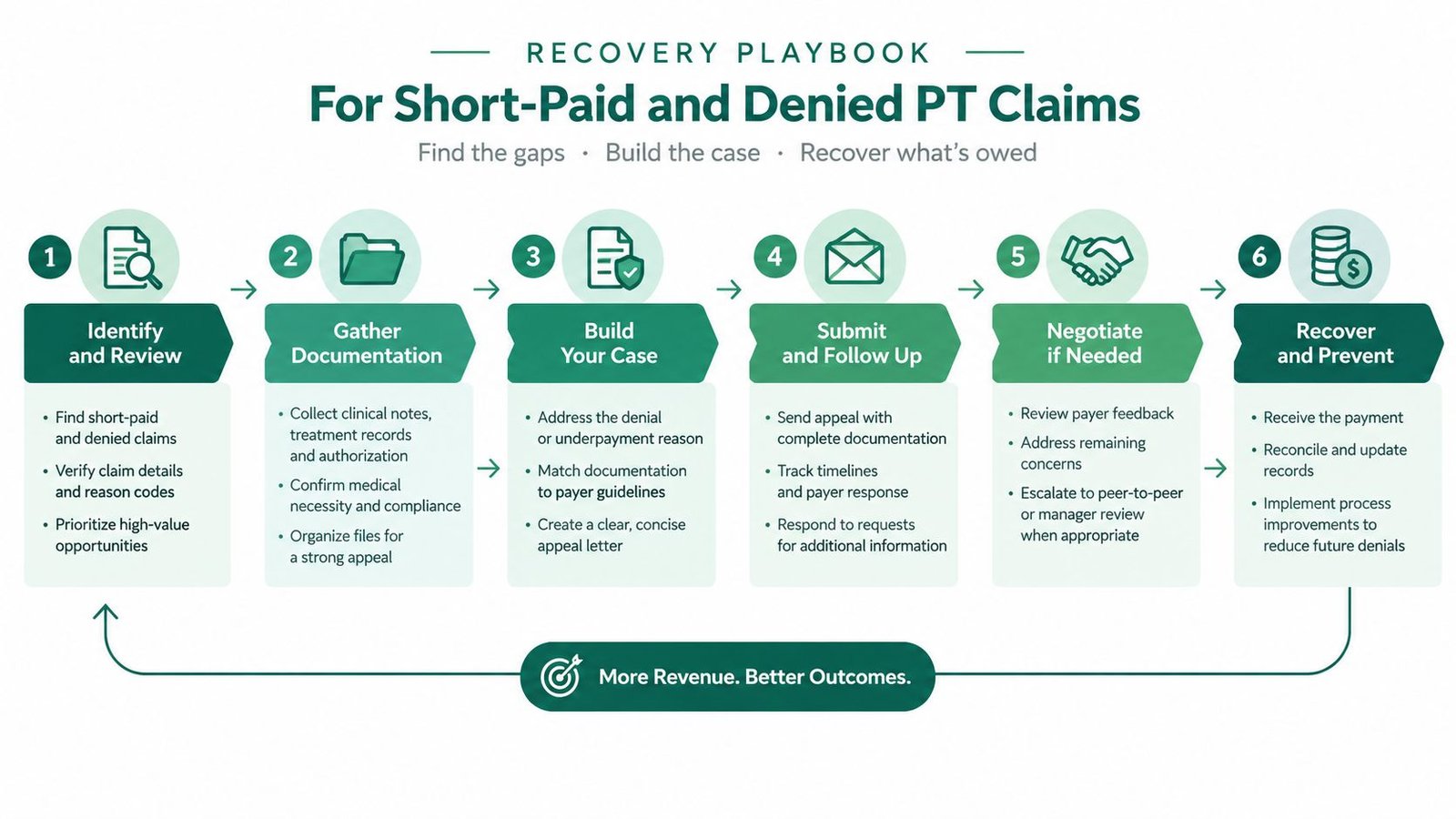
Recovery Playbook for Short-Paid and Denied PT Claims
Recovery starts with the line-item math. On a short-paid claim, calculate the difference by CPT and date of service, then compare the allowed amount against the contract rate or repricing expectation before anyone drafts an appeal. The goal is simple, prove the payer owes more.
Build the appeal around proof, not frustration
Use the claim header, the contract clause or payer rule, an allowed-amount worksheet, and the medical necessity excerpt that supports the service. If the claim sits with UnitedHealthcare, Oxford, or UMR, open the appeal with the 14-day Data iSight response window when that portal controls the response cycle. That keeps the timer visible and cuts off the delay excuse.
Write the appeal like an auditor will read it. Short. Specific. No filler. When staff say they need to “sift through the data and come up with a letter,” they are wasting time. Clean math and contract language win far more often than emotional prose.
Use the bypass tools when the claim is stuck
The resubmit-to-reset-EOB tactic works when the original processing trail locked in the short pay and the deductible sequence is muddy. A clean void and resubmit can force a fresh adjudication path, which is often the difference between a dead balance and a corrected payment. The DX-pointing swap fits denials tied to diagnosis sequencing, not service necessity.
For duplicate or adjacent-date denials, the same CPT and diagnosis set can still process differently if the diagnosis pointer order better matches the chart. That is especially useful on 97110, 97140, and 97530 when the record supports multiple billable services and the payer compressed them into one bucket.
Track recoveries like an operator
Treat recovery as a repeatable workflow, not a one-off rescue. Assign one owner, one queue, one follow-up date, and one rule for escalation.
If your team needs a tighter handoff between short-pay review and formal appeal work, the medical billing denial management guide is a useful reference.
Escalation Paths When Appeals Stall
Appeals should not sit on a desk for weeks. Once a payer ignores a clean dispute, escalation stops being a courtesy and starts protecting cash. Use the pressure tier that matches the plan type, the clock, and the amount still unpaid.
For a stalled commercial file, send a certified demand letter that cites the contract, the exact short-pay amount, and the dates of service. Keep it tight. The payer should see a clear choice: pay the claim or explain the reduction in writing. That approach moves files that would otherwise die in review.
If the plan is fully insured and the payer is dragging its feet in New Jersey, file a Department of Banking and Insurance complaint. Use that route when the plan keeps refusing obvious reimbursement fixes, especially where the repricing pattern looks systematic. If the plan is ERISA self-funded, shift to the federal Department of Labor complaint path instead.
A payer can stall one appeal. It cannot ignore external complaints forever.
When the same shortfall keeps showing up through MultiPlan or Zelis repricing, stop treating it like a one-off. That pattern points to a contract problem, not a staff problem. At that point, you need to review payer strategy and push for renegotiation if the reimbursement keeps forcing your team to say, “we're losing too much.”
The medical bill negotiation services guide by Happy Billing is useful when your team needs a clean template for moving from appeal to escalation without spending weeks in dead-end back-and-forth.
In-House Recovery Versus Outsourced RCM
Most owners overestimate what an internal team can recover and underestimate the drag on daily operations. Once front desk and billing leads are already buried in claims work, underpayment recovery turns into another unfinished task.
| In-House vs. Outsourced PT Underpayment Recovery | ||
|---|---|---|
| Metric | In-House Recovery | Outsourced RCM |
| Cost per claim recovered | Usually lower direct spend, but higher internal labor burden | Higher vendor fee, but less staff time inside the practice |
| Time to close | Slower when follow-up competes with daily billing | Faster when the work is scoped and tracked by a dedicated team |
| Staff time impact | Heavy, especially without a dedicated denial owner | Minimal internal time once the case is handed off |
| Recovery profile | Manual and dependent on consistent follow-up | Structured, appeal-driven, and variance-focused |
Use a simple rule of thumb. If underpayment leakage is large enough that your team keeps missing appeals, if you have no dedicated denial staff, or if one payer such as UnitedHealthcare, Anthem, or Cigna keeps creating repeated contract-rate gaps, outsource the work. That is the point where in-house recovery stops being a fix and starts becoming a distraction.
Owners often resist another vendor because they want to keep control. Then the same claims sit unresolved, deadlines pass, and the team says the practice has too much administrative work. That is not a staffing issue. It is a process failure.
If you want a specialty partner, the market includes firms like Coronis Health, BMS Practice Solutions, and MD Clarity. Do not hand PT underpayment recovery to a generic medical RCM shop that does not understand timed codes, visit patterns, or how 97110 and 97530 get shorted in the commercial world.
If you are deciding whether your current team can realistically carry the work, the in-house versus outsourced medical billing guide is worth reading. It helps you compare internal control against the cost of keeping recovery inside the practice.
Stopping the Bleed and Booking the Audit
Stop treating underpayments like random noise. If the same payer keeps shorting the same code set, the problem is not a one-off denial, it is a repeatable reimbursement leak. Fix the controls once, then audit against them every week.

Lock in the controls that actually matter
- Modifier discipline: Use GP on outpatient PT claims when the service is under the PT plan of care. CMS requires a discipline modifier to show the plan of care, as noted in CMS transmittal R4440CP.
- Timed-service protection: Apply 59 only when the service is distinct, and use the right X{EPSU} alternative when the payer accepts it. Wrong modifier use can bury an otherwise payable line, as covered in modifier 59 guidance.
- Threshold tracking: Watch the 2026 KX modifier threshold of $2,480 and the $3,000 targeted medical review threshold so claims do not drift into avoidable scrutiny. Keep the reference set current with CMS therapy services guidance and the 2026 billing update summary.
- Weekly variance scans: Compare ERA to the fee schedule every week. Flag any allowed amount that falls below expectation before the window to correct it closes.
- Cadence: Run a Monday variance review and a Friday denial huddle. That keeps recovery on the calendar instead of buried under patient calls and auth work.
For a clean framework on audit discipline outside PT, the guide by Jumpstart Partners is a useful reminder that good controls start with clean comparison, not guesswork.
The owner takeaway is blunt. If the team cannot explain why a claim was underpaid, it will not stop the next one. If the team can explain it but does nothing, the practice is choosing leakage.
Book a free 30-day underpayment audit when you want a ranked view of your top three commercial payers, a variance report, a recoverable-dollar estimate, and a prioritized appeal queue. That gives you a concrete recovery map before more money slips through the cracks.