No Surprises Act Penalties for Providers What to Know
Providers can face up to $10,000 per violation for improper balance billing under the No Surprises Act, and HHS can waive that penalty only if the provider didn't knowingly violate the rule, couldn't reasonably have known, and corrects the bill within 30 days with repayment plus interest when applicable. That's not just a compliance issue, it's a revenue leak that can hit denial rate, A/R days, and cash flow fast.
If you own a practice, the question isn't whether the law exists. It's whether your billing workflow can catch these errors before they turn into fines, disputes, and avoidable write-offs. A single out-of-network mistake can create a chain reaction, first-pass cleanup slows, denials stack up, and your team spends more time fixing preventable claims instead of collecting cleanly. If your current RCM setup can't support that speed, a targeted compliance audit is cheaper than learning the hard way.
Introduction
No Surprises Act penalties for providers are real cash exposure, not theoretical legal noise. For balance-billing violations, the federal framework allows HHS to impose civil monetary penalties of up to $10,000 per violation, with a narrow waiver path tied to lack of knowledge and a fast correction window (HHS law summary).
That matters because the penalty is only part of the hit. A weak surprise-billing workflow also feeds denial cleanup, slows A/R, and pulls staff into rework that should never have happened. If your front end misses network status, or your back end fails to flag an emergency or ancillary service before the bill goes out, you are not just risking a fine, you are delaying collections on every affected encounter.
I have seen practice owners underestimate how fast this spreads. One defective bill is a compliance problem. A repeating pattern becomes an operational leak, and revenue cycle teams end up spending their day on corrections instead of recovery. Treat this as a revenue-protection issue first.
A solid No Surprises Act compliance workflow (No Surprises Act compliance workflow) should catch out-of-network billing, emergency services, and disputed patient estimates before any claim leaves your system.
For practices deciding whether to fix RCM internally or outsource, that line matters. If your team cannot verify network status, hold risky claims, and document patient notices with discipline, you are leaving the door open to penalties and avoidable cash friction. Specialty groups with complicated payer rules, including anesthesiology, cardiology, orthopedics, and behavioral health, feel that pressure fast.
How No Surprises Act Penalties Work for Providers
The penalty structure is blunt. Under the No Surprises Act, a provider or facility that improperly balance bills a patient can face a civil monetary penalty of up to $10,000 per violation (Congressional Research Service summary). That matters because enforcement is tied to each violation, not to an overall compliance grade.
The waiver path is narrow. HHS can waive the penalty if the provider did not knowingly violate the rule, could not reasonably have known, and withdraws the bill and reimburses the patient or plan within 30 days, plus interest when applicable (HHS presentation). The rule favors fast correction, clean documentation, and early detection. Slow cleanup costs money.
A single bad claim is a fixable error. A repeat workflow failure becomes an A/R drag, because the same miss can show up across multiple encounters and multiply exposure. That is why revenue cycle leaders should treat this as a collections issue as much as a compliance issue. Every prohibited charge that gets out the door can trigger penalties, extra dispute work, and denial follow-up that pulls staff away from clean claims.
The fastest way to protect cash is to stop the bad bill before it leaves the system.
Why the 30-day window changes everything
That 30-day correction window works like a hard internal deadline. Once the bill is issued, the clock starts, and delayed remediation can turn a fixable claim into a regulatory problem (AHA summary). For a busy practice, the control point is the front-end eligibility check and the post-bill audit that catches exceptions quickly.
The broader federal enforcement framework also sits on the Public Health Service Act, where related penalties have historically been tied to civil monetary penalties and inflation adjustments. A Congressional Research Service summary described a maximum of $162 per day for each affected individual under that framework at the time of the report, while later policy proposals showed lawmakers were still revisiting penalty levels.
Bottom line: if your team cannot identify the bad claim within days, you lose the waiver advantage and start leaking revenue.
Federal Versus State Enforcement and Who Holds the Risk
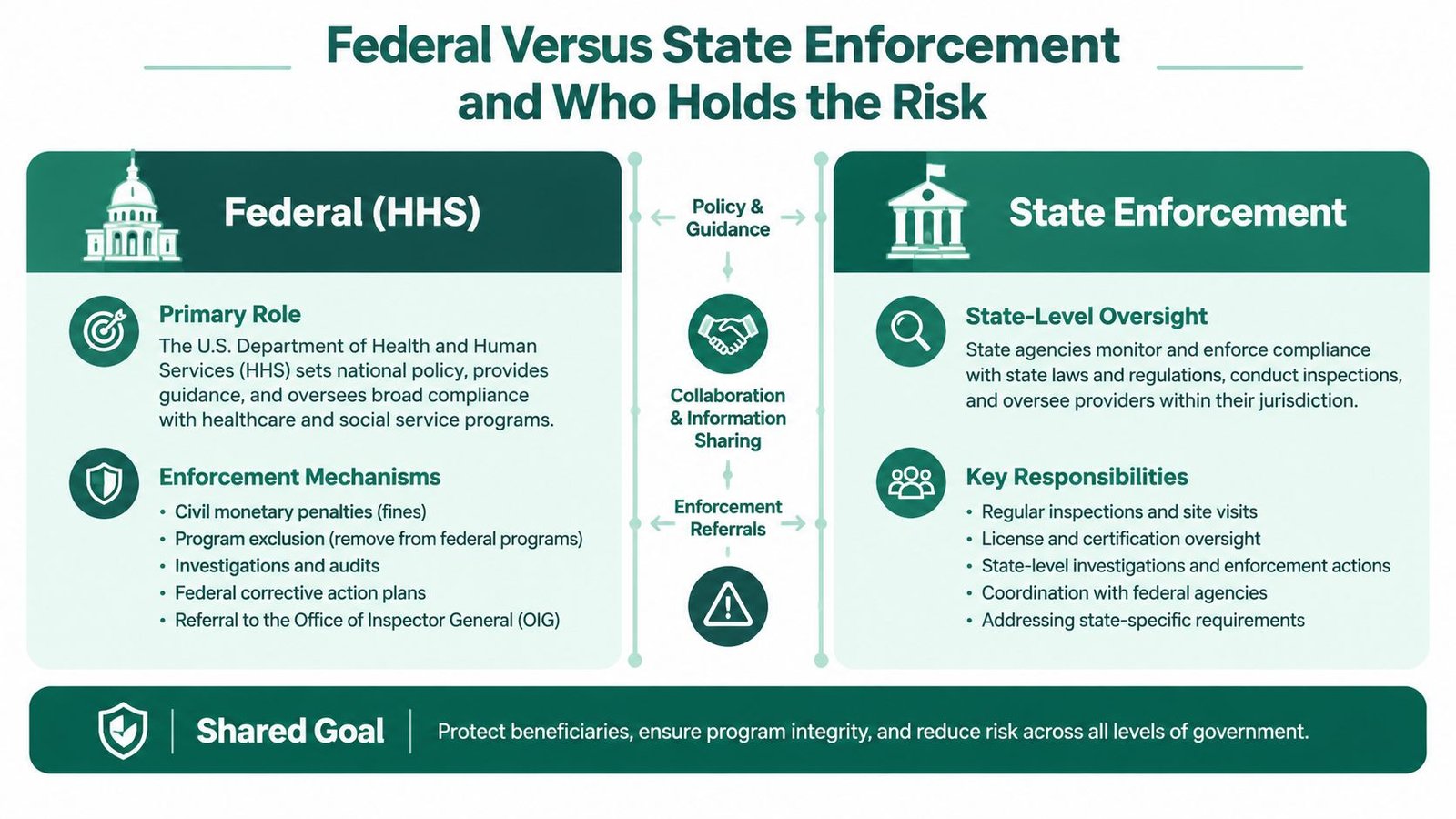
Federal enforcement is the main pressure point under the No Surprises Act, and practice owners should treat it as a revenue protection issue, not a legal abstraction. HHS carries the primary provider-facing penalty authority, while state enforcement still matters for groups that bill across multiple jurisdictions. The practical risk is simple, a workflow miss in one location can turn into penalties, dispute work, and slower A/R everywhere.
A weak billing process does not stay contained. If your team lets the wrong claim out the door, you are not just inviting a compliance review, you are adding correction work, possible IDR exposure, and denial follow-up that drags cash collection.
What that means for multi-state groups
Multi-location groups need one policy engine with local rules layered in, not a patchwork of site-by-site habits. When intake, scheduling, or billing staff use the wrong network logic at one site, the error can spread across the whole brand. I have seen practices assume a state issue was just a payer issue, then find the problem sitting in their own workflow.
The enforcement picture also has a federal backbone that is not guesswork. The older PHSA penalty structure shows that noncompliance has long been tied to civil monetary penalties, and lawmakers have kept pressure on the exposure level as the market changed (CRS). That should focus your attention on controls, not legal theory.
State-by-state questions are still operational questions. If you want a practical starting point for Texas, this Texas-focused NSA resource is useful for seeing how the rule pressure shows up in day-to-day billing work.
Here is the decision set for a busy practice:
- Who audits first? Federal complaints and state channels can both force work.
- Who owns remediation? Your billing lead, compliance lead, or outside vendor needs one response path.
- Where does cash get trapped? A/R slows when the team cannot fix claims fast and document the correction cleanly.
If your staff cannot answer those questions, you are carrying avoidable revenue risk.
Common Violations That Trigger Penalties and Revenue Loss
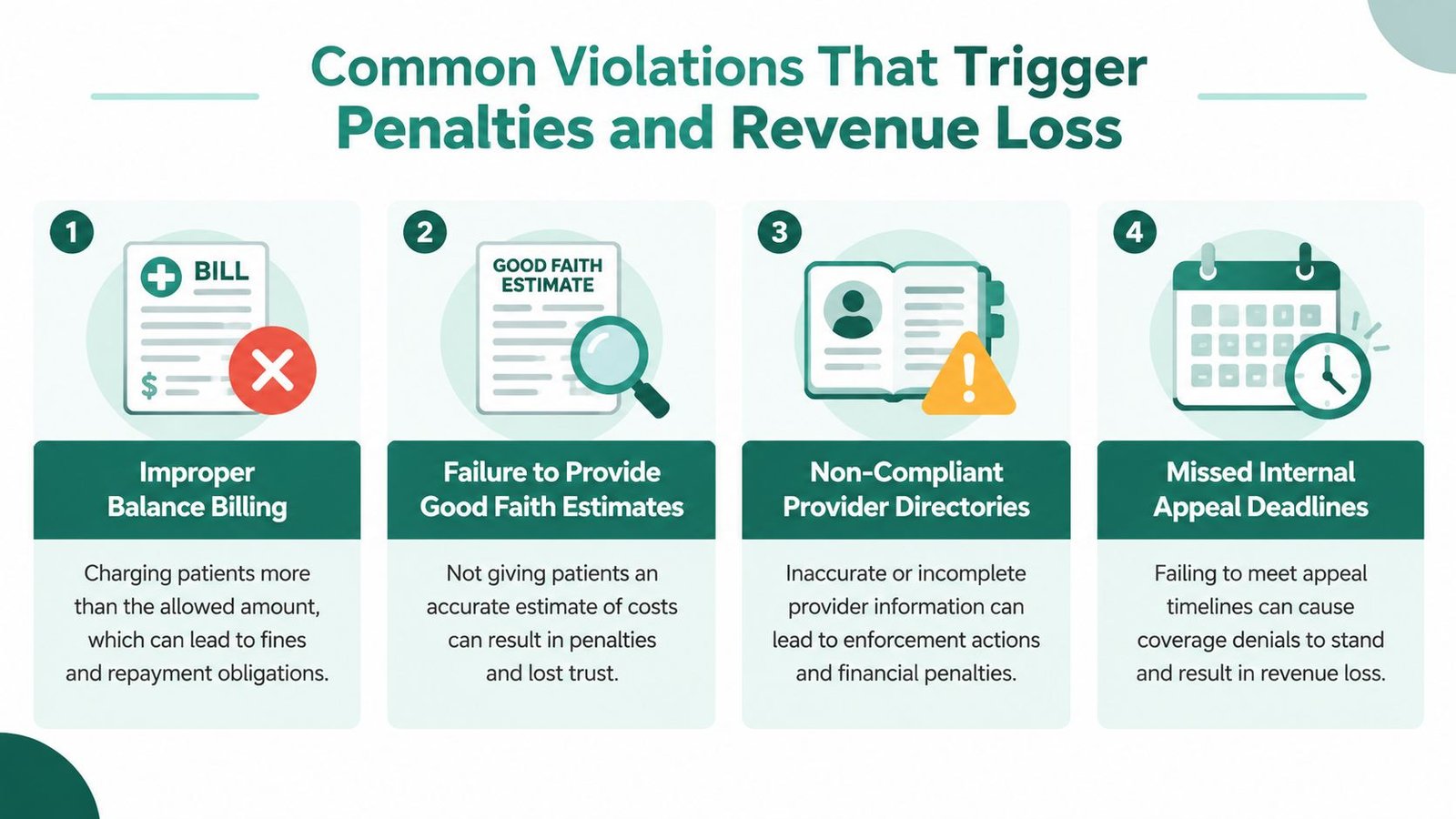
The highest-risk failures are operational, not academic. A routine workflow miss can turn into a penalty, then into slow cash, because the claim was built, billed, and never stopped in time. The control point is usually the same, front-end eligibility and network-status verification.
Balance billing that should never have left the system
Emergency services are the classic trap, especially when they are billed with codes in the emergency E/M family like 99281 to 99285. Ancillary services at in-network facilities create another risk layer, because the location does not override the rule. If your team misses that distinction, the practice faces repayment, dispute work, and avoidable revenue leakage. For a practical refresher, review the balance-billing rules under the No Surprises Act.
Modifiers and specialty-specific exposure
Specialties with mixed professional and facility logic have more room for error. Anesthesia claims, for example, often involve 00100 to 01999 and modifiers such as QK, QY, and AA, so the billing team has to know who did what, where, and under which coverage rules. Cardiology imaging and other procedural specialties can also get tangled in payer-specific network and authorization rules, so a generic billing script is not enough. Review your own patterns on the specialties page.
If your staff can't explain why a claim is in-network, out-of-network, or disputed in one sentence, the payer may get the final say on your reimbursement.
Notices, consent, and estimate failures
Missing or defective patient notices and consent create another problem. For uninsured or self-pay patients, a bad good-faith estimate does not just irritate the patient. It can trigger a dispute path that burns staff time and adds documentary exposure. CMS materials say providers and facilities may need to participate in a patient-provider dispute resolution process when billed charges exceed a good-faith estimate (CMS overview).
That is why documentation quality matters so much. If your estimate, notice, or consent is not audit-ready, you are vulnerable twice. First, the claim is harder to defend. Second, the same weakness that made the billing error possible also makes it harder to prove you deserve waiver treatment.
Real Examples and What Dispute Outcomes Cost Providers
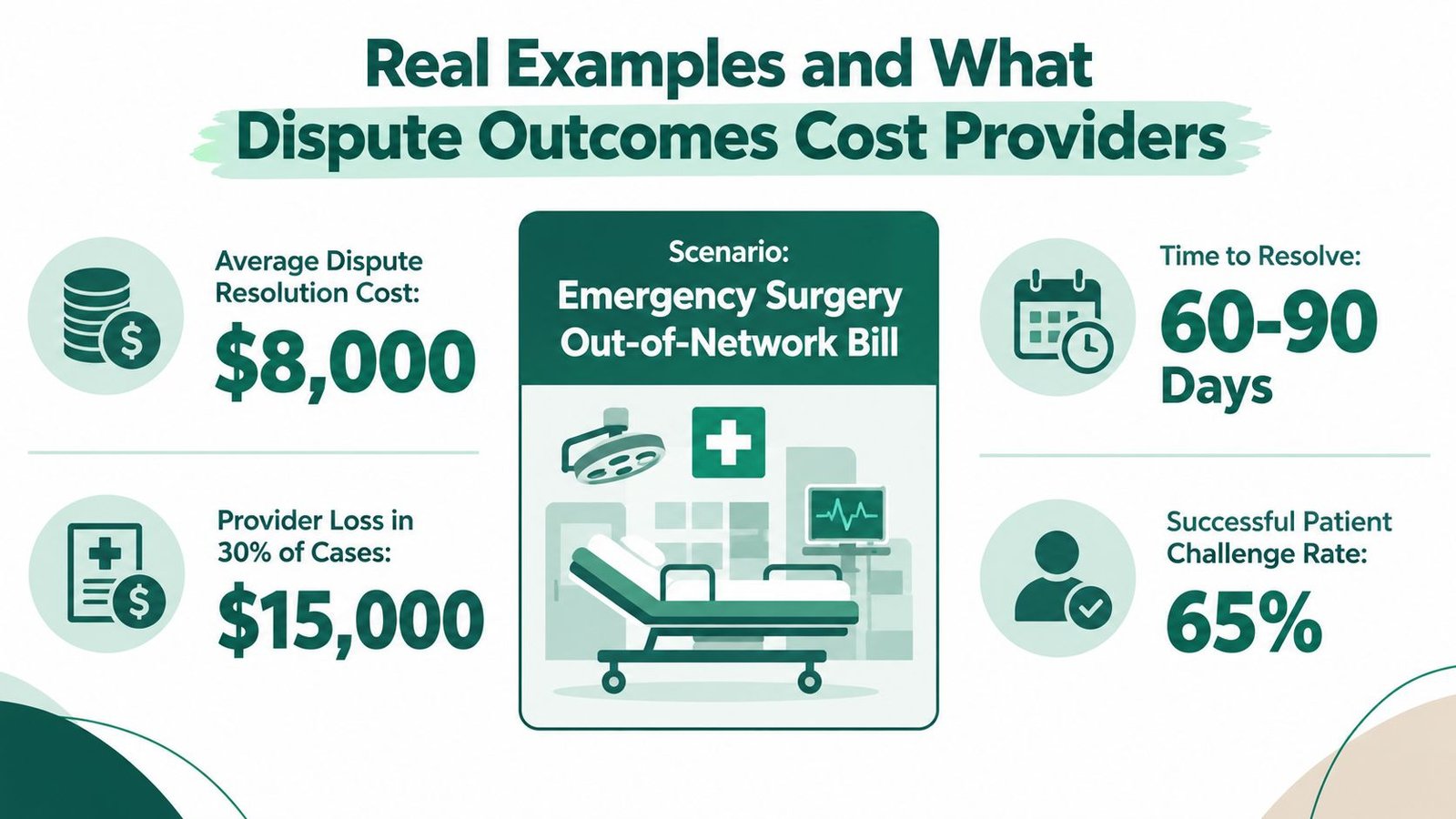
A dispute is not just a paperwork problem. It pulls your team off billing, delays cash, and turns a payable encounter into aging A/R. That matters because every extra day in dispute handling is a day your revenue cycle is not moving.
The federal IDR process now carries a real cash cost for providers. For disputes initiated on or after January 22, 2024, the administrative fee is $115 per party per dispute, up from $50, and certified IDR entity fees range from $200 to $840 for single determinations and $268 to $1,173 for batched determinations (AHA fee update). If you handle multiple claims at once, those fees can chew through margin fast, before staff time even enters the picture. For the mechanics of the process, review the IDR process under the No Surprises Act.
When the process itself eats the margin
CMS-linked reporting cited in 2026 showed nearly 1.2 million disputes in the first half of 2025, almost 40% more than the prior six months, while arbitrators processed more than 1.3 million disputes and reduced the backlog (Health Care Dive coverage). That volume tells you the system is already crowded. Providers are spending time and money inside a process that can slow collections even when the underlying claim is not large.
The patient-provider dispute resolution process has its own fee. CMS set a $25 administrative fee beginning in 2022, paid by the non-prevailing party, and said it was designed not to burden uninsured or self-pay individuals (CMS fee document). The fee itself is small. The actual cost is the work behind it, gathering records, defending the estimate, and tracking the case to the end.
A practical way to think about it
A clean claim gets paid and moves. A disputed claim costs you in three places, document retrieval, staff rework, and delayed cash. If the same file also shows a compliance miss, you add penalty exposure on top of the revenue drag.
Winning a dispute does not mean you won financially. If your team spent hours to recover a modest claim, the margin story can still be ugly.
High-volume specialties feel this first. One weak workflow spreads across encounters, and the mix of IDR fees, patient-provider dispute fees, and slower cash conversion starts to look like a revenue protection problem, not an isolated exception.
Documentation Billing Audits and Controls That Prevent Fines
Good documentation protects revenue. It keeps clean claims moving, gives you an advantage in a dispute, and shortens the time it takes to fix a bad bill before it drags down A/R. If your records are weak, you are paying for the mistake twice, once in rework and again in delayed cash.
The controls that matter most
- Timestamp every good-faith estimate: Save the estimate, the date, the delivery method, and the charge logic behind it. If a dispute shows up later, you need a record of what the patient received.
- Archive notices and consent together: Keep patient notice, consent, and related billing authorizations in one auditable workflow so staff can pull the file without searching across systems.
- Validate payer and network status early: Decide whether the claim is in-network or out-of-network before submission, not after denial.
- Hold risky claims before submission: Emergency services, ancillary services at in-network facilities, and estimate-sensitive encounters need claim-hold logic.
- Run post-bill audit flags: Catch out-of-network charges, modifier mismatches, and missing notice elements before they become repeat exposure.
CMS guidance makes the point plainly, your billing system has to preserve auditable good-faith estimates, timestamped patient notices, and charge comparisons so the file can defend the claim if it gets challenged. That is the operational standard owners should care about. Weak documentation creates friction, slows collections, and raises enforcement exposure. See the CMS overview for the federal framework, then build your workflow around it.
A practical good-faith estimate template and requirements resource is useful if your team needs a cleaner way to structure the paperwork before the claim leaves your office.
What I'd audit every month
I would review a sample of surprise-billing-sensitive encounters every month and ask three questions. Did the team verify network status? Did they archive the patient notice or estimate correctly? Did anyone correct the bill inside the correction window?
If the answer is no too often, the problem is not the law. The problem is your process.
The For Healthcare page on PDFWix is worth bookmarking if your team needs a broader view of document workflow and digital file handling in compliance-heavy operations.
Your Compliance Checklist and Next Steps to Protect Revenue
Revenue leakage starts when billing controls are loose. A single missed verification, missing notice, or late correction can turn into repeated exposure, denied claims, and avoidable collection drag.
Owners need a short operating checklist, not another policy binder. Assign one person to each step and hold the team to the timeline.
- Verify network status at scheduling: Make it the default, not a rescue step.
- Standardize good-faith estimates: Use one workflow, one archive path, one review standard.
- Build a 30-day correction SLA: If a bad bill goes out, the fix has to move immediately.
- Train front office and billing together: Notices, consent, and payer rules fail when teams work in silos.
- Run monthly surprise-billing audits: Sample risky claims and check for repeats.
Those controls protect cash flow because they cut rework before it reaches A/R. They also make it easier to defend a file if enforcement or a patient dispute shows up later.
If you want a clear place to start, use the For Healthcare page on PDFWix for document workflow and digital file handling in compliance-heavy operations. I've seen teams lose far more money to sloppy routing than to the original billing mistake.
If you're still unsure whether your team can enforce this consistently, get a compliance review. A practice owner does not need more theory. You need to know where cash is leaking and how many errors are sitting in A/R.
FAQ
Does outsourcing RCM reduce No Surprises Act penalty risk?
It can, if the vendor has real controls for network verification, estimate documentation, and rapid correction. Outsourcing without process discipline just moves the problem somewhere else.
What should we do with old A/R that may include violations?
Review it by encounter type, network status, and notice history. If the file can't support the bill, treating it as collectible without review is a mistake.
Do small practices face the same exposure as large groups?
Yes, the penalty framework applies per violation. Smaller groups usually feel the cash impact faster because they have less room to absorb rework and fee leakage.
What's the fastest way to lower risk without overhauling everything?
Start with scheduling verification, claim holds for risky encounters, and a 30-day correction workflow. Those three controls stop the most expensive errors first.
If you want a second set of eyes on your workflow, Happy Billing can help you find where surprise-billing exposure is slowing collections and inflating avoidable risk. We'll look at the gaps, map the revenue impact, and show you what to fix first.