7 Third Party Medical Billing Companies for 2026
The best third party medical billing company depends on your specialty, your EHR strategy, and how much control you want to keep over billing. For physician owners, the key question is which vendor protects revenue, lowers denial rates, and shortens A/R days without creating security or contract risk.
The market is large for a reason. U.S. medical billing outsourcing has been estimated at $6.95 billion in 2025 and projected to reach $17.69 billion by 2033 (Mordor Intelligence), while another estimate places roughly 7,000 medical billing companies in the U.S. (Market Research Future). That fragmentation gives practices real power, but only if they compare vendors on measurable outcomes, not sales decks.
For specialty groups, the best fit is usually the vendor that works inside your current workflow instead of forcing a platform change. For practices that want to keep their existing EHR, Happy Billing's specialty-focused RCM is the strongest fit in this group. If you want a baseline before you outsource, use the free revenue audit to see where claims are leaking before you commit.
1. Happy Billing
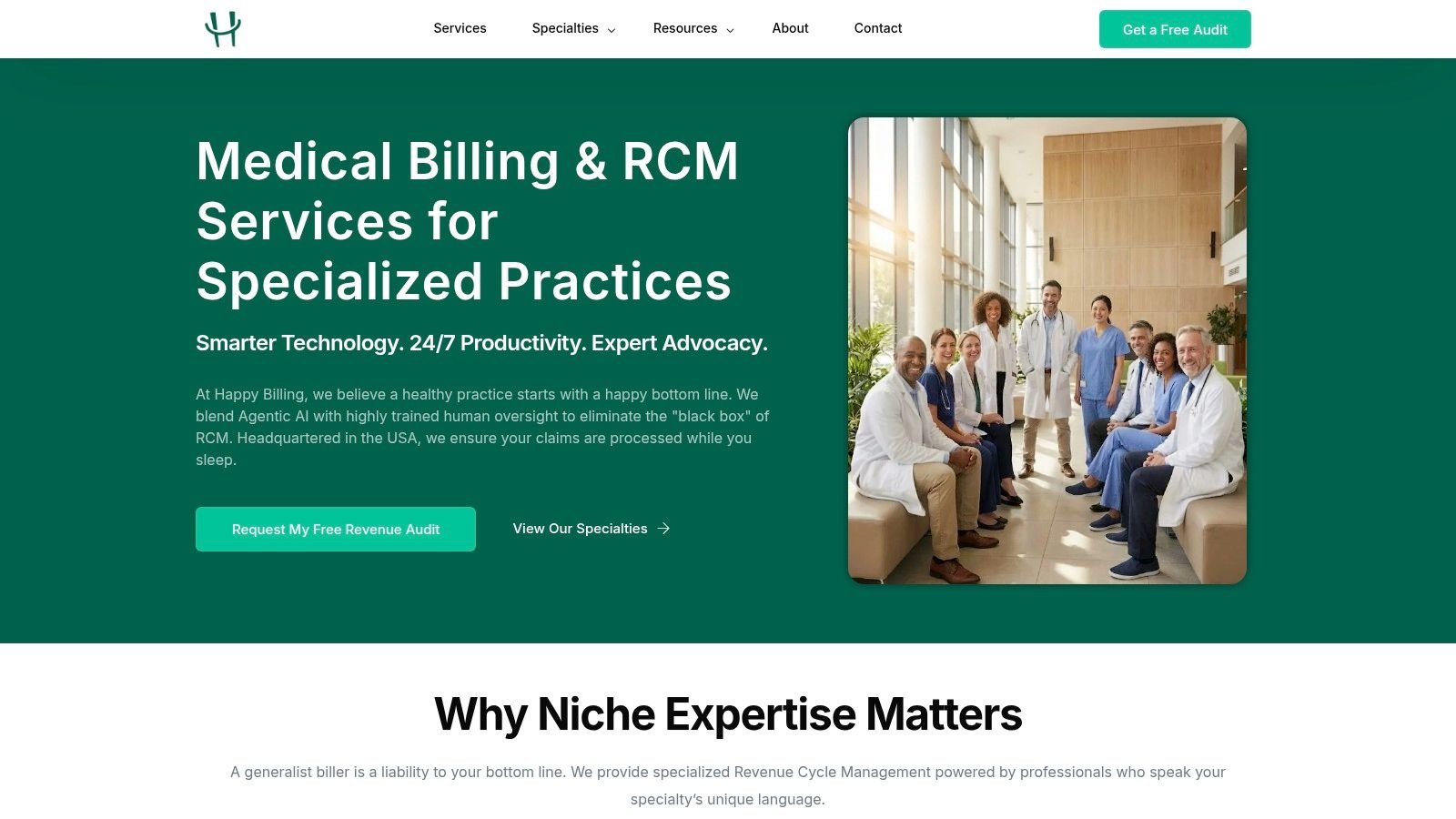
Happy Billing is the clearest choice for specialty practices that want stronger collections without tearing up their current EHR stack. We have seen that the practices most likely to benefit are the ones with complex coding, heavy denial exposure, or constant payer friction, because that is where a vendor's discipline shows up in the bank account.
Best fit by practice profile
If you run anesthesiology, behavioral health, cardiology, orthopedics, pediatrics, or another workflow-heavy specialty, Happy Billing is built for the details that make claims fail. Its specialty pages reflect that focus, and the company positions itself around AAPC-aligned coding, denial prevention, credentialing, old A/R recovery, and dashboard visibility through your existing system. That matters because a billing partner that understands modifiers, authorization flows, and specialty-specific claim patterns helps protect revenue before the claim gets stuck.
The operational model is a significant advantage. Happy Billing says it works inside your current EHR without data migrations, and its service description emphasizes a 98%+ first-pass clean claim rate and days in A/R under 35. Those are the kinds of outcomes owners should care about, because every prevented denial shortens the collection cycle and reduces rework.
Practical rule: if your billing vendor wants a platform migration before it can show value, the implementation burden is probably too high for a practice that needs cash flow relief now.
A few features make the offer stronger for owners who want accountability, not promises. Happy Billing cites 24/7 follow-the-sun processing, HIPAA-first security, bank-level encryption, and real-time transparency through secure dashboards. It also offers a free revenue audit, which is exactly the right first step when you want proof before a contract.
What it does best financially
The company's model is built to reduce leakage upstream, not just chase rejections downstream. That is the right approach for practices that care about denial rates, payer turnaround, and the hidden drag caused by slow follow-up.
- Revenue protection: specialty-aware workflows help reduce under-coding and avoidable denials.
- Cash acceleration: faster claim handling supports lower A/R days.
- Lower implementation friction: no EHR migration means less downtime and less staff retraining.
- Better oversight: real-time reporting makes KPI accountability visible.
Happy Billing also stands out because it is not trying to be a generic billing shop. It is a specialty RCM partner, which is exactly what physician owners should want when the margin is tight and the coding is complex.
2. Zotec Partners
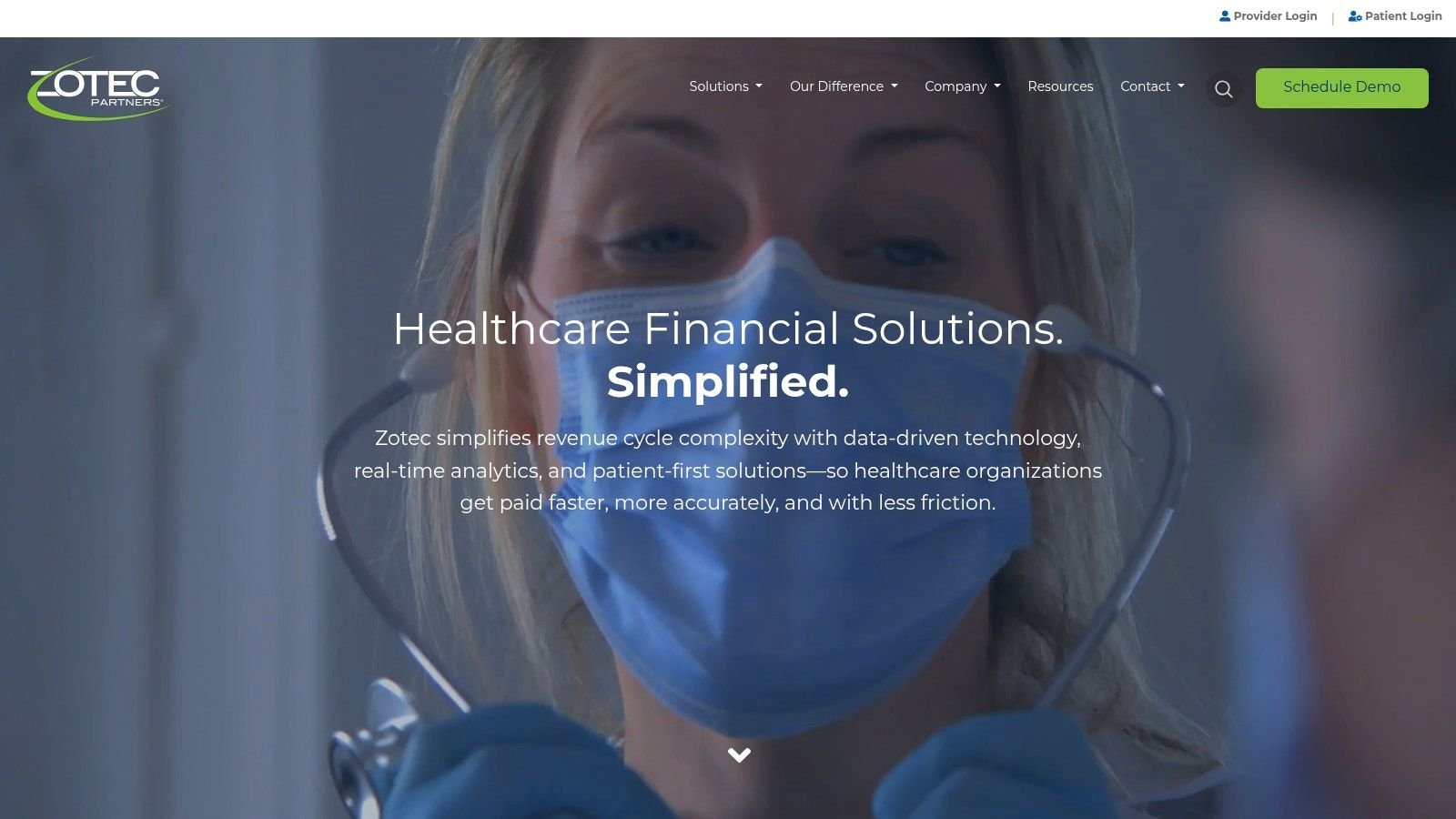
Zotec Partners fits anesthesia and radiology groups that need deep specialty handling and strong documentation support. If your practice lives in the OR, the imaging suite, or both, this is the kind of vendor that can match workflow complexity better than a generalist.
Where Zotec makes sense
The strongest case for Zotec is specialty alignment. Its service mix includes radiology- and anesthesia-trained AI coding, real-time documentation feedback, direct-to-payer submission, and denial prevention specifically designed for imaging workflows. That combination matters because facility-heavy specialties lose money fast when documentation gaps are not caught early.
For owners, the main benefit is tighter control over technical claims work. A vendor that understands anesthesia and radiology economics can reduce the back-and-forth that burns staff time and pushes balances deeper into aging. Zotec also emphasizes analytics and patient-financial tools, which can help leadership see where collections are stalling.
I'd put Zotec high on the list for:
- Anesthesia groups with high concurrency complexity.
- Radiology practices that need contract intelligence and denial follow-up.
- Imaging-heavy organizations that want performance visibility tied to specialty metrics.
The trade-off is straightforward. Zotec is not the most natural fit for primary care-heavy or broad mixed-specialty groups. Its orientation is strong, but that strength is also its constraint. Pricing is not public, so owners should expect a custom engagement and a real onboarding conversation before making a decision.
A specialty RCM firm should be judged on whether it lowers rework in your highest-value workflows, not on how polished the sales demo looks.
If you want to compare it against a specialty-first partner with a different operating model, Happy Billing's medical billing company comparison guide is a useful reference point for the questions that matter in physician decision-making.
3. Ventra Health
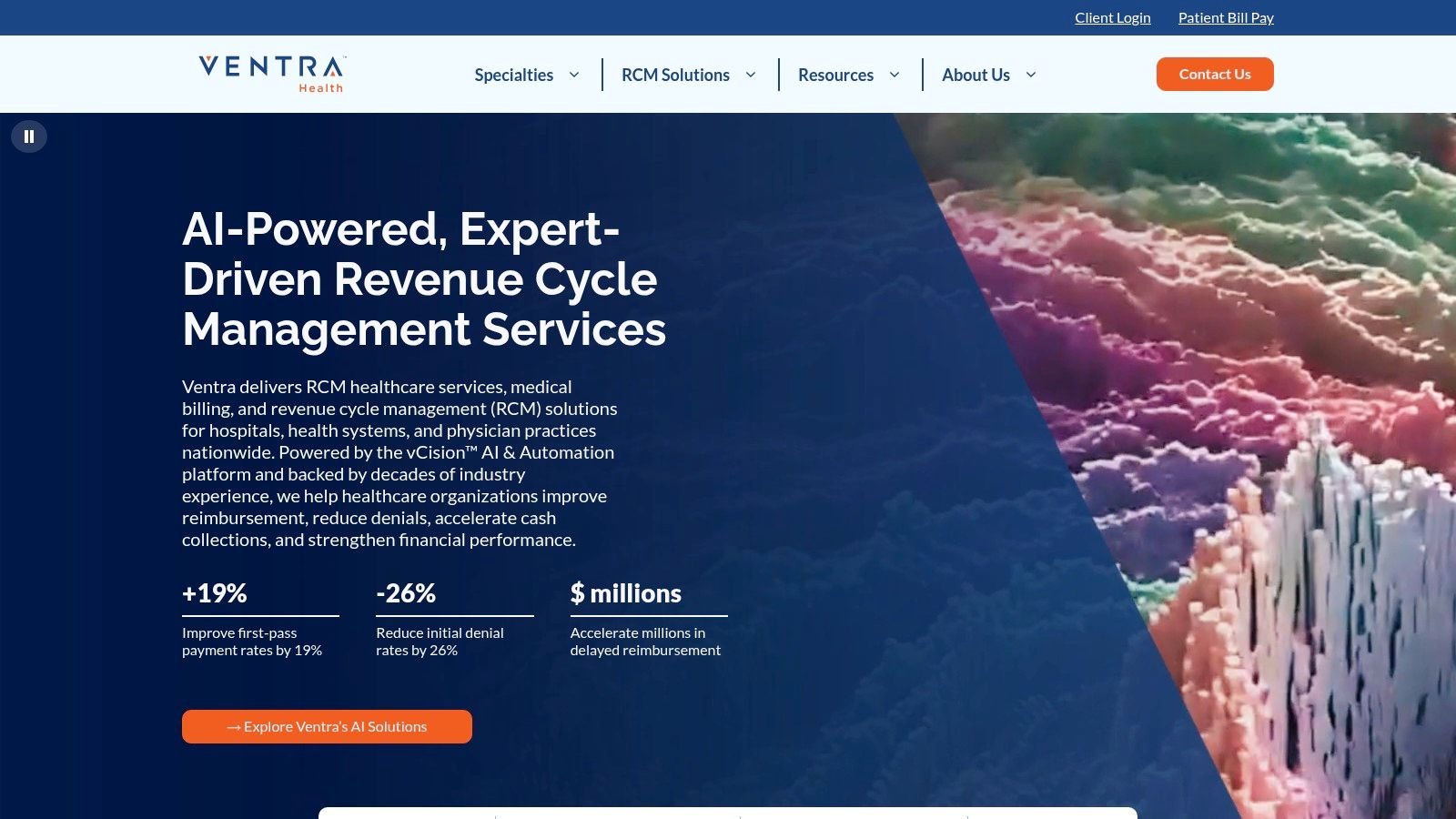
Ventra Health is built for facility-based specialties, and that focus shows in the way it packages RCM. If your organization spans anesthesia, emergency medicine, hospital medicine, or radiology, Ventra is the kind of vendor that can handle scale without asking your team to rebuild its operating model.
Who should look closely at Ventra
This is a strong option for organizations that want more than claim submission. Ventra combines specialty billers and coders with AI platforms such as vCision and vSight, plus client education and success programs. That matters because owners don't just need throughput, they need a vendor that can explain where financial leakage is happening and what is being done about it.
The best fit is clear. Ventra works well for:
- Facility-based groups with complex coding paths.
- Emergency and anesthesia practices that need deep specialty support.
- Radiology organizations that want analytics and resolution speed visibility.
Ventra's emphasis on measurable KPI reporting is important for physician leaders who want to hold someone accountable. When a vendor shows you net collection performance, aging trends, and resolution speed in a usable dashboard, it becomes much harder for underperformance to hide in the noise.
The trade-off is equally clear. Facility-based orientation is not ideal for small office-based or primary care practices that want lighter-touch outsourced billing. Pricing is custom, and the company is set up more like an enterprise partner than a plug-in service. That means the implementation burden may be heavier than a smaller group wants to absorb.
If you're comparing vendors on financial accountability, push Ventra on how its dashboards translate into action. Reporting is useful only when it drives fewer denials, faster follow-up, and tighter A/R control. If the metrics don't change behavior, they're just decoration.
4. Coronis Health
Coronis Health is a broad physician-group RCM provider, and that breadth is what makes it attractive to multi-specialty buyers. If you need one vendor to cover behavioral health, orthopedics, cardiology, anesthesia, and other physician workflows, Coronis is built for that kind of mixed environment.
Where Coronis is strongest
Its core offering is full-cycle RCM, including coding, billing, A/R follow-up, denials management, analytics, credentialing, and reporting portals. That is useful for owners who want a single operational layer instead of stitching together separate vendors for claim submission, denial work, and enrollment.
Coronis is a particularly practical option for groups that need specialty-aligned teams but don't want to narrow the search to one narrow discipline. Its footprint and integrations make it a reasonable fit for physician practices that value coverage across different service lines.
The upside is breadth.
The downside is variability.
Because Coronis operates at scale and has grown through acquisitions, service quality can depend on the local delivery team and the exact scope of the engagement. That does not make it a bad option, but it does mean owners need to demand clarity on staffing, escalation, and reporting cadence before signing.
If you want a vendor that can reduce denials across multiple specialties, Coronis deserves a hard look. If you want a partner that lives and breathes a single niche, a more specialty-native firm may be better. For a practice owner, the money question is simple. Will the vendor's operating model shorten the collection cycle, or will it add layers between your staff and the people touching your claims?
For a practical due-diligence framework, see the questions to ask before hiring a billing company.
5. R1 RCM
R1 RCM is the enterprise choice in this list. It serves hospitals, health systems, and physician groups with end-to-end revenue cycle services, so the right buyer is usually a larger organization that wants transformation, not just claim follow-up.
Where R1 fits and where it doesn't
R1 is strongest when scale and complexity are the problem. Its service stack includes patient access, coding, billing, denials management, underpayment recovery, and advisory work. That makes sense for multi-site organizations that want one partner to work across front-end and back-end revenue cycle issues.
For larger groups, the appeal is sophistication. R1's ambulatory RCM is EHR-agnostic at scale, which is valuable when your practice has already made major technology investments and doesn't want to rip out existing systems. It also has industry recognition in ambulatory RCM, which gives decision-makers a useful signal, even though the operational performance is the ultimate test.
That said, this is not the right first call for smaller physician groups looking for simplicity. Pricing is custom, the engagements are enterprise-oriented, and there have been publicized security and privacy incidents, so due diligence has to be strict. If you are evaluating R1, ask hard questions about safeguards, incident response, data access, and subcontractor controls.
Practical rule: the larger the vendor, the more you need contract language that defines reporting, ownership of old A/R, and termination support in writing.
If your group is large enough to need enterprise coordination, R1 belongs on the shortlist. If you want a faster, specialty-focused engagement with less implementation weight, a more focused vendor is the better financial choice. For physician practices specifically, Happy Billing's RCM resource for physician practices is a better fit for understanding what to demand from a vendor before you sign.
6. athenahealth
athenahealth is the clear choice for practices willing to adopt an integrated ecosystem. If your leadership wants one vendor for EHR, practice management, clearinghouse functions, and billing, athenaOne is designed for that kind of consolidation.
The right use case for athenaOne
athenahealth's billing is not really a bolt-on outsourced service. It is part of a bundled workflow that includes the EHR, PM, and RCM stack. That can be a good financial move if your current technology is fragmented and your staff is already wasting time moving information between systems.
Its strongest features are the network rules engine, AI-native automations, centralized dashboards, and support for coding assistance and appeals. That setup can help standardize claim handling and make performance more visible across the network. For owners who want one vendor relationship instead of multiple contracts, that convenience has real value.
The trade-off is just as important. If you want to stay on your current EHR, athenahealth is usually the wrong answer. The cost of adopting a platform ecosystem can be bigger than the value of the billing service itself, especially if your practice has already built staff habits and workflows around another system.
This is also where contract economics matter. Percentage-of-collections pricing can feel increasingly expensive as revenue grows, even if the platform is efficient. Owners should compare that model against the expected lift in clean claims, denial control, and administrative savings before agreeing to a switch.
If you want to keep your current EHR and avoid a major operational reset, use this comparison of in-house versus outsourced billing as a reality check before you move to a bundled platform.
7. CareCloud
CareCloud is a practical option for small-to-mid-size physician groups that want outsourced billing with live visibility. If your team needs help with charge capture, claim submission, denial workflows, and payment posting, but you still want to see what's happening in real time, CareCloud fits that profile well.
Why smaller groups evaluate CareCloud
The main attraction is operational visibility. CareCloud gives practices access to claim queues and status tracking, which helps leadership see where delays are happening instead of waiting for a monthly report. That transparency matters because billing performance is often lost in silence until cash flow starts slipping.
CareCloud also gives groups flexibility. It can bundle PM and EHR services or integrate with existing systems, which gives buyers a few different deployment paths. For a practice that wants to outsource but doesn't want to commit to a full platform replacement, that flexibility is useful.
The upside is especially strong for organizations that need a more affordable-feeling operating model. CareCloud is commonly positioned as a fit for smaller groups, and its collections-based structure can be competitive in the market. The downside is that outcomes depend heavily on data hygiene, scope, and implementation discipline.
That last point matters. Billing vendors don't create clean data for you, they work with what you give them. If your charge capture is inconsistent or your front-end registration process is weak, even a good outsourced team will struggle to deliver a clean financial result.
For practices that want to modernize workflows, Happy Billing's revenue-cycle automation resource is worth reading before any switch. Automation only helps when the handoff from clinical documentation to billing is tight.
Top 7 Third-Party Medical Billing Companies Comparison
| Vendor | Implementation complexity | Resource requirements | Expected outcomes | Ideal use cases | Key advantages |
|---|---|---|---|---|---|
| Happy Billing | Low–Moderate, integrates into existing EHR; onboarding coordination | Modest, minimal IT, staff coordination; free revenue audit | 98%+ first‑pass clean claims; A/R <35 days; faster cash flow | Specialty medical practices (anesthesia, cardiology, behavioral health, orthopedics) | Agentic AI + human auditors; 24/7 processing; HIPAA‑level security; specialty workflows |
| Zotec Partners | Moderate, integrates with dictation and specialty workflows | Moderate, specialty AI setup; analytics and training | Improved coding accuracy; fewer denials for imaging/OR workflows | Radiology and anesthesia groups; imaging/OR‑heavy practices | Radiology/anesthesia AI coding; direct‑to‑payer submission; specialty analytics |
| Ventra Health | Moderate–High, facility integrations and onboarding | Higher, facility billing teams, AI platforms (vCision/vSight), client success | Measurable KPI improvements (net collections, A/R aging, resolution speed) | Facility‑based specialties (anesthesia, emergency medicine, radiology) | Facility specialty expertise; AI revenue intelligence; KPI reporting and education |
| Coronis Health | Moderate, full‑cycle RCM with standard EHR/PM integrations | Moderate, specialty‑aligned teams, analytics portal, credentialing support | Denial reduction and revenue lift; broad specialty coverage | Multi‑specialty physician groups including behavioral/mental health | Full‑cycle RCM; broad specialty support; national footprint |
| R1 RCM | High, enterprise‑level implementation and change management | High, multi‑site teams, advisory services, extensive tech resources | Comprehensive revenue cycle transformation at scale; improved access and collections | Hospitals, health systems, large multi‑site organizations | Scale and sophistication; end‑to‑end services; industry recognition |
| athenahealth (athenaOne RCM) | High if migrating EHR; smoother when using athenaOne ecosystem | Moderate–High, requires adopting athenaOne, training and onboarding | Integrated EHR+RCM workflows; cleaner claims via network rules and automations | Practices willing to adopt athena's EHR/PM/RCM suite | Single‑vendor integration; AI automations; centralized dashboards and network rules |
| CareCloud | Low–Moderate, flexible bundling or integration with existing systems | Moderate, small‑to‑mid practice resources; optional PM/EHR bundle | Improved collections; real‑time claim queue and status visibility | Small‑to‑mid physician groups seeking outsourced RCM | Flexible packaging (bundle or integrate); live claim tracking; competitive collections pricing |
Choose the Partner That Owns Your Financial Outcome
The right selection process is simple. Start with specialty and EHR constraints, then demand comparable pricing and implementation scope from every vendor you evaluate. A good billing partner should tell you exactly how it will affect clean claims, denial rate, net collection rate, and A/R aging, because those are the metrics that change practice economics.
Before you sign, make the vendor prove the basics. Ask for specialty coding depth, payer-rule handling, credentialing support, reporting cadence, HIPAA safeguards, staffing model, escalation paths, termination assistance, data access, and any performance guarantees they're willing to put in writing. If the vendor can't explain how old A/R will be handled during transition, that's a contract risk, not a minor detail.
Use the demo to pressure-test operations, not just software. Ask who works the denials, how often reports are reviewed, what happens when a payer rule changes, how quickly an issue escalates, and whether the team will work inside your current EHR or force a migration. If the answer is vague, the vendor is asking you to absorb implementation risk that should belong to them.
The cleanest transition sequence is staged. Build an A/R inventory first, validate claims in parallel, confirm payer and provider enrollment status, hand off denials in a controlled way, and review KPIs every week until the workflow stabilizes. That sequencing protects revenue while you switch, which is the only reason to outsource in the first place.
Owners should also remember the warning from benchmark and industry data. The average denial environment is still costly, with claim denial benchmarks around 8% and sub-5% framed as a stronger target (MedPrecision Billing), but outsourcing is not automatically a fix. One AcademyHealth abstract reported that outsourcing revenue-cycle functions did not improve hospitals' financial performance or reduce bad debt on average (AcademyHealth). That means vendor selection has to be disciplined.
If your practice needs a partner that keeps accountability visible and protects specialty revenue, start with Happy Billing, compare it against the specialty and enterprise options above, and choose the one that can prove better cash flow without disrupting your operations. For a broader operational lens on healthcare bookkeeping support, tie billing decisions to the rest of your financial workflow before you commit.
How much does third-party medical billing usually cost for a practice owner?
The answer depends on specialty, claim volume, and what services are included. The safest move is to compare pricing against scope, reporting, denial work, and old A/R ownership, because a cheap quote can hide expensive gaps.
Can I change billing vendors without migrating my EHR?
Yes, if the vendor is built to work inside your current system. That's the lower-risk path for most physician groups, and it avoids the operational drag that comes with a platform switch.
Which KPIs should I require in the contract?
At minimum, require clean claims, denial rate, net collection rate, A/R aging, and reporting cadence. Those are the numbers that tell you whether the vendor is protecting revenue or just processing volume.
How long should a billing transition take?
A proper transition should be staged, with an A/R inventory, parallel validation, enrollment checks, denial handoff, and weekly KPI reviews. If a vendor tries to rush past those steps, your practice absorbs the risk.
Happy Billing helps specialty practices keep their current EHR, tighten denial control, and see financial performance clearly without a disruptive migration. If you want a billing partner that focuses on clean claims, faster cash flow, and accountable RCM operations, visit Happy Billing and request a free revenue audit.