National Medical Billing Services: 2026 Buying Guide
You need national medical billing services when billing has become a cash-flow problem, not just an admin task. If denials are creeping up, A/R days are stretching, or your team is spending too much time on follow-up, the question isn't whether billing matters, it's whether your current setup can keep up with payer rules, modifiers, and credentialing pressure.
For a multi-location practice, the pain usually shows up as frozen receivables, missed payer follow-up, and claims that are technically correct clinically but still fail at the transaction level. That's why the decision cuts straight to revenue, denial rate, and how long money sits in accounts receivable before it lands in the bank.
What National Medical Billing Services Actually Do for Your Practice
A practice owner usually notices the problem in the worst way, cash that should have been collected weeks ago is still sitting in aging buckets, and the team can't tell whether the issue is coding, eligibility, authorization, or a payer rule. National medical billing services are built to handle that whole chain, from claim creation through remittance and denial work, across multiple states and payer rules.
For an independent group, that matters because billing is no longer just typing CPT codes into a system. It's full-cycle RCM with standardized workflows, integration into the EHR or practice management stack, payer-specific edits, and enough operational depth to keep claims moving when one office, one payer, or one specialty starts to wobble. The U.S. medical billing services market is not small or niche, it's estimated at $4.3 billion in 2026 with 1,364 businesses operating in the sector, and IBISWorld notes a -2.5% CAGR from 2019 to 2024 IBISWorld medical billing services snapshot. That fragmentation is the point, because a lot of firms can bill, but far fewer can do it consistently across a national footprint.
Practical rule: if a vendor can't explain how it handles claim edits, remittance posting, denial appeals, and payer follow-up without hand-waving, it's not a real RCM partner.
What changes when billing goes national
A local biller often knows one geography and a handful of payers well. An in-house team knows your practice, but it usually lives inside your staffing limits and your software stack. A national partner should bring a wider operating model, deeper specialty coverage, and process discipline that doesn't depend on one employee knowing where every claim got stuck.
That doesn't automatically make it better. It just means the job changes from “submit claims” to manage variability at scale, which is where many practices either stabilize cash flow or create a new layer of hidden complexity. If you want a broader breakdown of why practices outsource in the first place, the overview at Happy Billing's outsourcing guide is a useful companion.
The question is not whether national billing sounds bigger. It's whether that scale reduces denials, improves turnaround, and keeps your specialty from getting flattened into a generic workflow.
National vs Local vs In-House Billing: Key Trade-Offs
The biggest mistake practice owners make is assuming “national” means automatically better. It doesn't. The right model depends on claim volume, specialty complexity, staffing tolerance, and how much denial risk you can absorb before cash flow starts to hurt.
| Billing Model | Clean Claim Rate | Days in A/R | Denial Rate | Best For |
|---|---|---|---|---|
| National medical billing services | Typically strongest when the vendor has specialty depth and payer discipline | Usually lowest when reporting is mature | Usually lowest when denial workflows are explicit | Multi-location groups, complex specialties, payer-heavy mixes |
| Local billing company | Can be strong on responsiveness, but consistency varies | Often moderate | Can improve when payer mix is limited | Smaller practices that value direct access and local familiarity |
| In-house billing team | Can perform well with strong leadership, but depends heavily on staff quality and training | Often unstable when staffing is thin | Often rises when follow-up is inconsistent | Practices with enough volume to justify dedicated roles |
These ranges are not promises. Each model breaks in a different place. National partners often struggle when they push one workflow across payers that do not follow the same state-by-state rules. Local firms can start to strain when volume outgrows their staff or their payer knowledge stays too narrow. In-house teams can stall when one person becomes the gatekeeper for eligibility, charge entry, posting, appeals, and follow-up.
That trade-off shows up quickly in audit work. I have seen strong national vendors miss state-specific modifier rules, deny clean claims because their edits were too generic, and post remittances in a way that made appeal trends hard to trace. A practice owner may hear “standardized process,” but standardization only helps if the process is built to respect payer variation and is auditable when something goes wrong.
Where each model makes sense
National billing can make sense when your payer mix is messy, your specialties are high-touch, or your internal team is already buried. It also helps when you need the same workflow across several locations and do not want each office inventing its own version of revenue cycle management. The upside is consistency. The risk is that a national workflow can flatten specialty details unless the vendor is disciplined about charge review, coding edits, and payer rules.
Local billing still makes sense when the business is relationship-driven and the practice wants a close feedback loop. In-house can make sense if you have enough volume to support trained staff, manager oversight, and specialty-specific training without stretching people thin. The honest question is whether the practice can sustain the people and systems needed to keep the work moving every day. A small team can do strong work, but only if the staffing and supervision match the workload.
If you are comparing those options right now, this in-house versus outsourced billing comparison is worth reviewing before you commit to a new structure.
A good billing model is the one that your practice can operate every day, not the one that looks smartest in a vendor demo.
How to Evaluate and Select a National Billing Partner
The right vendor conversation is never, “Do you do billing for practices like ours?” It's, “Show me what happens when claims touch state-specific payer rules, modifiers, eligibility edits, and denials.” If a partner can't answer that with specifics, it probably won't protect your revenue when the workload gets messy.
What to demand in the demo
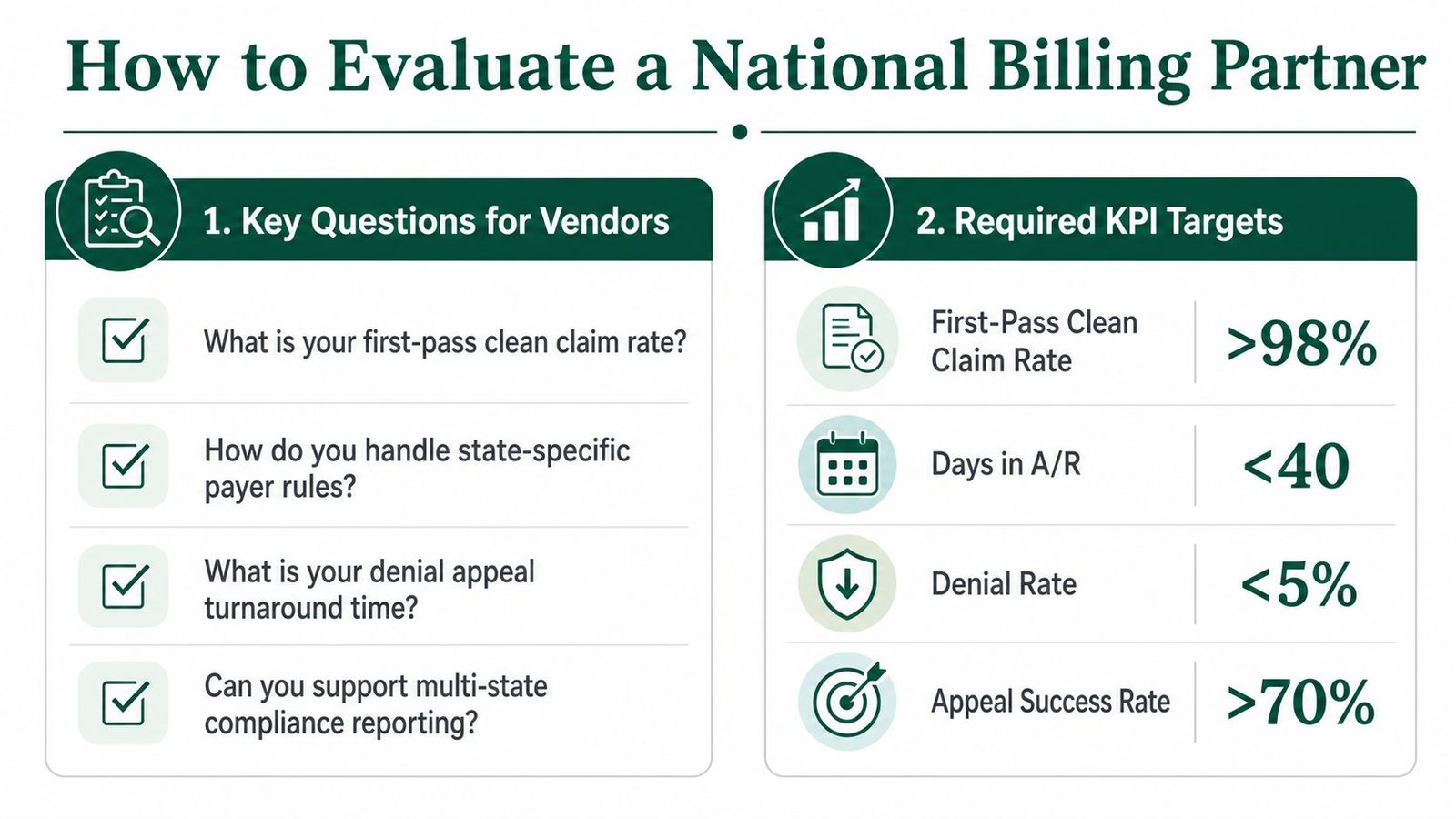
Start with KPI targets. Ask for a 98%+ first-pass clean claim rate, under 35 days in A/R, and a denial reversal rate above 70%. Then ask how those numbers are measured, which payers are included, and whether the vendor can show specialty-matched results instead of blended averages.
Use the demo to force operational transparency:
- Ask about payer variation: How do you handle state-specific payer rules, prior authorization requirements, and modifier edits when the same specialty bills in multiple states?
- Ask about integration: Which EHRs and clearinghouses do you already support, and how do claims move from charge entry to remittance without manual rekeying?
- Ask about reporting: Can we see real-time dashboards for clean claims, denials, aging, and appeal status, or do we wait for a monthly summary?
- Ask about staffing: Who owns U.S. leadership, who handles follow-the-sun coverage, and how are specialty-trained coders supervised?
You can also use these questions for choosing a billing company as a vendor checklist before reference calls.
Red flags that should slow you down
Watch for vague service level language, generic specialty claims, and pricing that's hard to map to actual work. If a vendor won't describe denial management workflows in plain language, that's a warning sign. So is reluctance to share references from accounts that resemble your payer mix, not just your specialty.
The best vendors talk comfortably about what goes wrong, not just what goes right. They should be able to explain who reviews claims, how exceptions get escalated, and what happens when a payer rejects something that looked clean on submission. If they can't discuss that in detail, they're selling capacity, not control.
Specialty-Specific Billing Complexities You Cannot Ignore
The same vendor can be excellent for one specialty and weak for another. That's why a national billing partner has to prove specialty depth, not just broad coverage. A claim can be clinically valid and still leak revenue if the billing logic behind it is off.
Anesthesiology and mental health need different controls
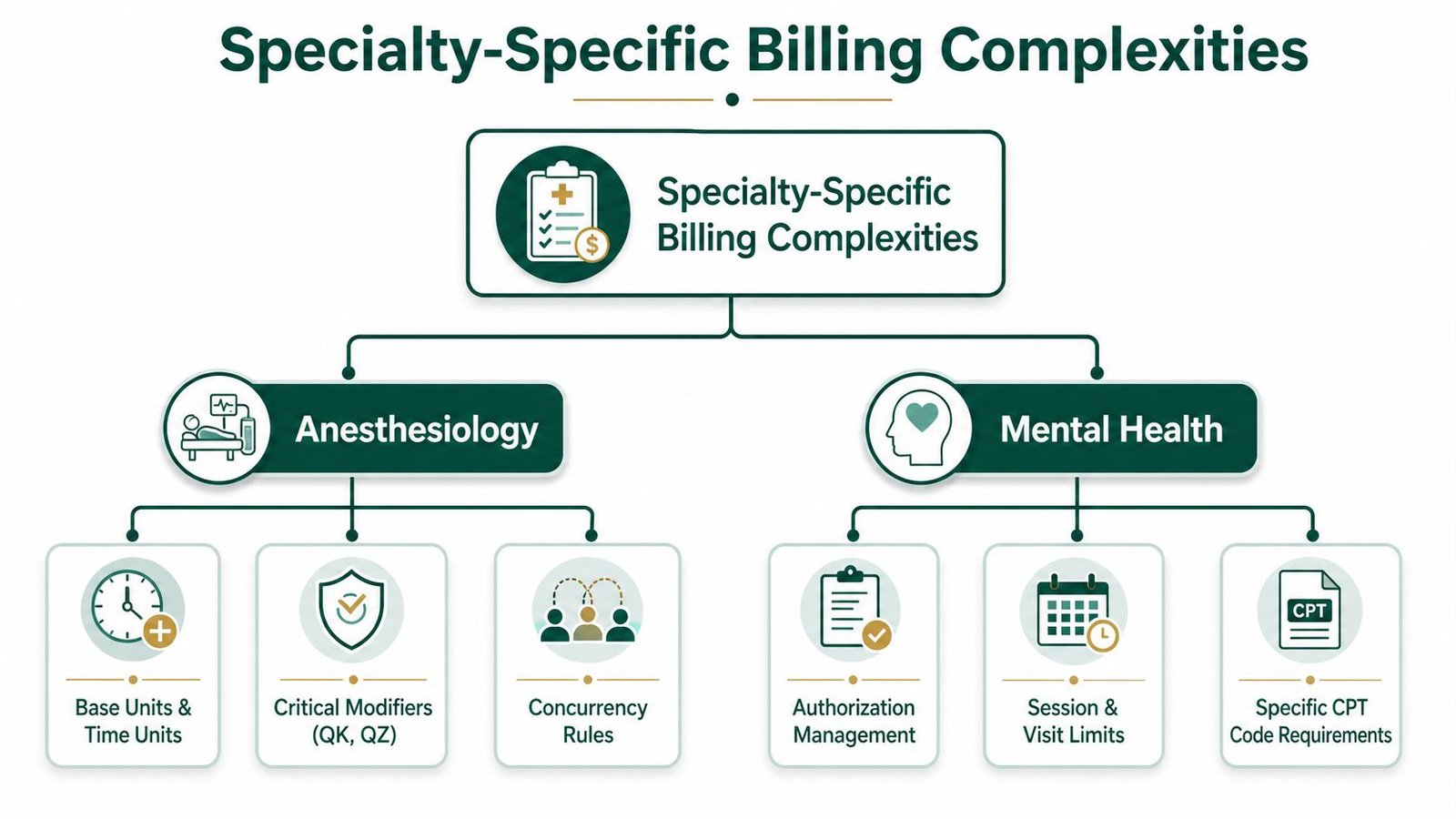
Anesthesiology lives and dies on base units, time units, and modifiers like QK and QZ. If one 15-minute increment is missed or misposted across a high-volume schedule, the revenue loss compounds quickly, because the billing mistake sits inside the claim structure itself. Concurrency rules also matter, because a partner that can't map staffing and case overlap cleanly is going to create avoidable denials.
Mental health is a different game. The practice owner is dealing with authorization management, session limits, and CPT selection that has to match payer expectations, especially for 90834 and 90837. If the billing workflow misses auth timing or pushes a claim without the right visit context, cash gets delayed even when the clinical work was legitimate.
For a deeper specialty view, the cardiology billing resource is a good reference point when you're comparing vendors across procedural complexity. Cardiology adds its own layers through diagnostic imaging bundling, interventional coding, and the modifier 26/TC split, which can make a billing partner look competent on paper and still weak in production.
Orthopedics and pediatrics punish generic workflows
Orthopedics is where global periods and multiple procedure reductions turn sloppy billing into real leakage. Modifiers 59 and XS are not academic details, they're the difference between a separately payable service and a denied or bundled claim. If the vendor doesn't understand post-op logic, the practice owner ends up paying for rework and lost collections.
Pediatrics has its own traps, especially well-child visits, vaccine administration, and EPSDT-related requirements. A national partner that treats those claims like routine office visits will miss money and create cleanup work for the front office. This is also where documentation discipline matters on the security side, because the billing vendor's process has to fit current compliance expectations. For a practical outside look at security testing in regulated workflows, the 2026 HIPAA testing rules are a useful reminder that weak systems create more than just billing risk.
Financial reality: specialty billing errors don't just trigger denials, they create downstream staff time, slower cash conversion, and more appeals work for every corrected claim.
The Hidden Risks of National Scale Payer Variation and AI Auditability
National scale sounds comforting until a practice owner asks how the vendor handles one payer in one state versus another payer across the border. That's where generic promises usually break. Prior authorization rules, documentation expectations, and state-level administrative friction don't disappear just because the billing company has a larger footprint.
Why broad coverage can still miss local rules
CMS notes that prior authorization remains a major workflow burden in Medicare Advantage, and the American Hospital Association has repeatedly pointed to administrative complexity and denials as a major reimbursement problem. The practical lesson for practice owners is simple, a national partner has to prove payer-by-payer competence, not just national reach. If it can't show how it adapts to state-by-state variation, it's still operating like a generic vendor with a bigger map.
That matters more now because automation is rising, but payer rule churn isn't slowing down. A centralized workflow can be efficient and still miss a local rule that changes the denial pattern for one location or one specialty. The billing partner should be able to explain where it localizes edits, how it tracks payer exceptions, and when humans override automation.
AI can help, but only with auditability
AI-assisted billing can speed up claim prep and denial work, but it can also create hidden risk if nobody can explain why a claim was coded or scrubbed a certain way. Concern isn't automation itself, it's opaque automation. If a vendor can't show human-in-the-loop review, specialty-specific edits, audit trails, and appeal outcomes, the practice owner is accepting black-box billing.
CMS enforcement and payer audits make documentation accuracy more important than ever. That's especially true in high-stakes specialties where undercoding can leave money on the table and overcoding can create compliance exposure. The safer model is one where AI flags exceptions, people review the edge cases, and every adjustment is traceable.
The best question to ask isn't whether AI is used. It's whether the vendor can prove that AI lowers leakage without making the record harder to defend later.
Pricing Models, Contract Terms, and Migration Checklist
Billing pricing can look simple until you compare it against your collections pattern and service expectations. Percentage-of-collections models align incentives, but they can get expensive if your practice has a high-volume, high-collections base. Per-claim pricing looks tidy, but it can hide extra costs when denial work, appeals, or patient follow-up fall outside the base fee. Hybrid models can work, but only if the contract spells out exactly what's included.
What to negotiate before you sign
Use the contract to protect the practice, not just to get started quickly. Ask for SLA penalties, a clear termination clause, explicit data ownership, and written transition support so you're not trapped if performance slips. Security should be spelled out too, including HIPAA handling, PHI controls, and bank-level encryption rather than vague “secure platform” language.
The best contracts also define reporting cadence. If you only get a monthly summary, you're blind when denials spike or posting slows. You want a cadence that lets you see whether the partner is improving reimbursement mechanics, not just closing tickets.
A clean migration checklist
- Extract the data first. Make sure historical A/R, open claims, denial logs, and patient balances are exportable before transition work starts.
- Transfer credentialing and enrollment details. If the new partner is handling payer enrollment support, confirm who owns updates and follow-up.
- Update payer records. Billing entities, remittance destinations, and provider details need to match the current operating structure.
- Run parallel billing. Keep the old and new workflows overlapping long enough to catch mapping errors before they hit cash flow.
- Validate go-live claims. Check clearinghouse acceptance, remittance posting, and denial routing before assuming the system is stable.
Outsourcing demand is still projected to expand rapidly, with Grand View Research estimating the U.S. medical billing outsourcing market at $5.7 billion in 2023 and projecting a 11.78% CAGR from 2024 to 2030 industry reporting on the outsourcing market. That growth is one reason to be careful. More vendors are selling billing, but the contract still determines whether you're buying control or just handing over the problem.
If you're comparing costs against current leakage, this pricing and outsourcing cost resource is a useful starting point before you switch.
Frequently Asked Questions About National Medical Billing Services
How do I know if my practice is big enough to outsource billing
If your team is already spending too much time on claim follow-up, denials, or payer calls, you're big enough to consider outsourcing. The trigger is not size alone, it's whether billing complexity is pulling physicians and managers away from revenue-generating work.
What happens to my existing A/R when I switch billing partners
Your old A/R doesn't disappear, it has to be migrated, reconciled, and worked cleanly. The practice owner should ask who owns aged balances, how open denials will be split, and whether the new partner will take over follow-up without losing claim history.
Can a national billing company handle my state's specific payer rules
It can, but only if it proves it. Ask for examples of payer-by-payer workflows, not just specialty references, because state-level variation is where generic national scale often falls short.
How do I measure whether my billing partner is actually improving performance
Track first-pass clean claim rate, days in A/R, denial reversal performance, and how quickly open balances move. If those numbers don't improve, or they improve without transparency, the vendor may be shifting work instead of fixing it.
Happy Billing helps practices manage full-cycle RCM, denial work, credentialing, and A/R recovery inside the existing EHR, which is exactly what matters when national billing has to handle specialty rules without adding more friction. If you want a second set of eyes on denials, payer variation, or how your current billing setup is affecting cash flow, visit Happy Billing and ask for a free review of your current RCM performance.