Best Medical Billing Companies for Mental Health Practices in 2026
The best medical billing companies for mental health practices combine specialty-specific coding expertise with robust denial management and authorization tracking to maximize your practice's revenue. For most independent practice owners, the right partner is one that not only files claims but actively reduces your denial rate, shrinks A/R days, and accelerates cash flow.
Mental health billing is uniquely complex; missed prior authorizations for services like psychotherapy (CPT 90837) or incorrect use of telehealth modifiers can lead to immediate denials and a spike in your days in A/R. In our experience, practices often lose 10-15% of their potential revenue to these preventable billing errors. A specialized partner can capture that lost income. Ensuring all aspects of your practice's operations are HIPAA compliant is also paramount, which includes everything from billing transmissions to your documentation process. Some practices even use a HIPAA safe dictation app to secure their clinical notes before they ever reach the billing stage.
This guide reviews the top services that can help you capture that lost income. We'll compare them on their ability to handle the specific financial challenges of a modern mental health practice, providing direct links and honest assessments to help you make a confident decision.
1. Happy Billing
Happy Billing stands out as one of the best medical billing companies for mental health practices by combining agentic AI technology with experienced human auditors to achieve exceptional financial results. This hybrid approach delivers a reported 98%+ first-pass clean claim rate and keeps days in A/R under 35, directly accelerating cash flow for behavioral health clinics. Its specialized expertise in mental health billing means they adeptly manage complex prior authorizations, telehealth modifiers (like 95 and GT), and the specific coding nuances required by payers for services like psychotherapy (90832, 90834, 90837) and crisis intervention (90839).
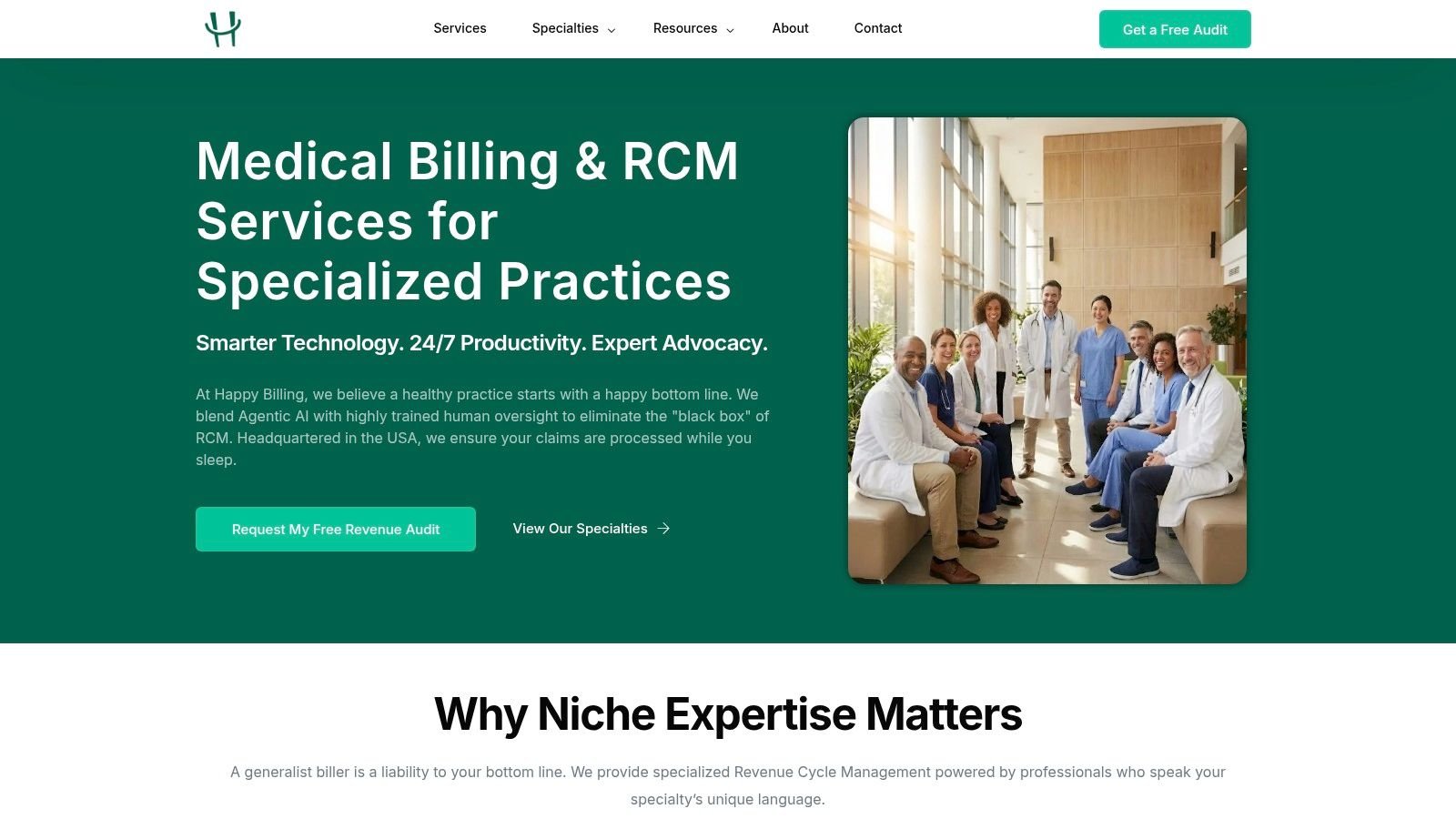
A key advantage for busy practice owners is that the team works directly inside your existing EHR. This eliminates disruptive software migrations and long learning curves, allowing for faster onboarding and minimal workflow changes for your staff. In our experience, this is critical for maintaining practice continuity while upgrading your revenue cycle management. Their service is full-cycle, covering everything from patient registration and eligibility checks to aggressive denial appeals and old A/R recovery.
Key Strengths & Use Cases
Happy Billing’s model is built for practices that cannot afford revenue leakage from common mental health billing errors. For instance, they focus on preventing denials related to incorrect place of service codes for telehealth or missing pre-authorizations for intensive outpatient programs. Their 24/7 follow-the-sun coverage, which pairs U.S. leadership with a global back office, ensures claims are worked around the clock, preventing delays that stall payments.
- Specialty Expertise: Deep knowledge of mental and behavioral health billing rules, including add-on codes and session time requirements.
- Financial Performance: A focus on speed and accuracy drives higher monthly collections and shrinks A/R days.
- No EHR Migration: Operates within your current system for a seamless transition.
- Security & Compliance: All processes are HIPAA-first, with bank-level encryption and AAPC-aligned coding standards.
Pricing & Access
Pricing is not publicly listed, as services are customized to each practice's needs, specialty, and claim volume. To get a precise quote and ROI projection, practices can start with a free revenue audit. This analysis helps identify specific areas of revenue leakage and demonstrates the potential financial uplift. The hybrid global back-office model may be a consideration for practices requiring an exclusively onshore team.
Visit Website: https://happybilling.co
2. TheraThink
TheraThink offers a dedicated insurance billing service specifically designed for licensed mental health professionals and group practices. It distinguishes itself by integrating with your existing EHR, eliminating the need for a disruptive data migration. This makes it one of the best medical billing companies for mental health practices seeking a less intrusive outsourcing solution.
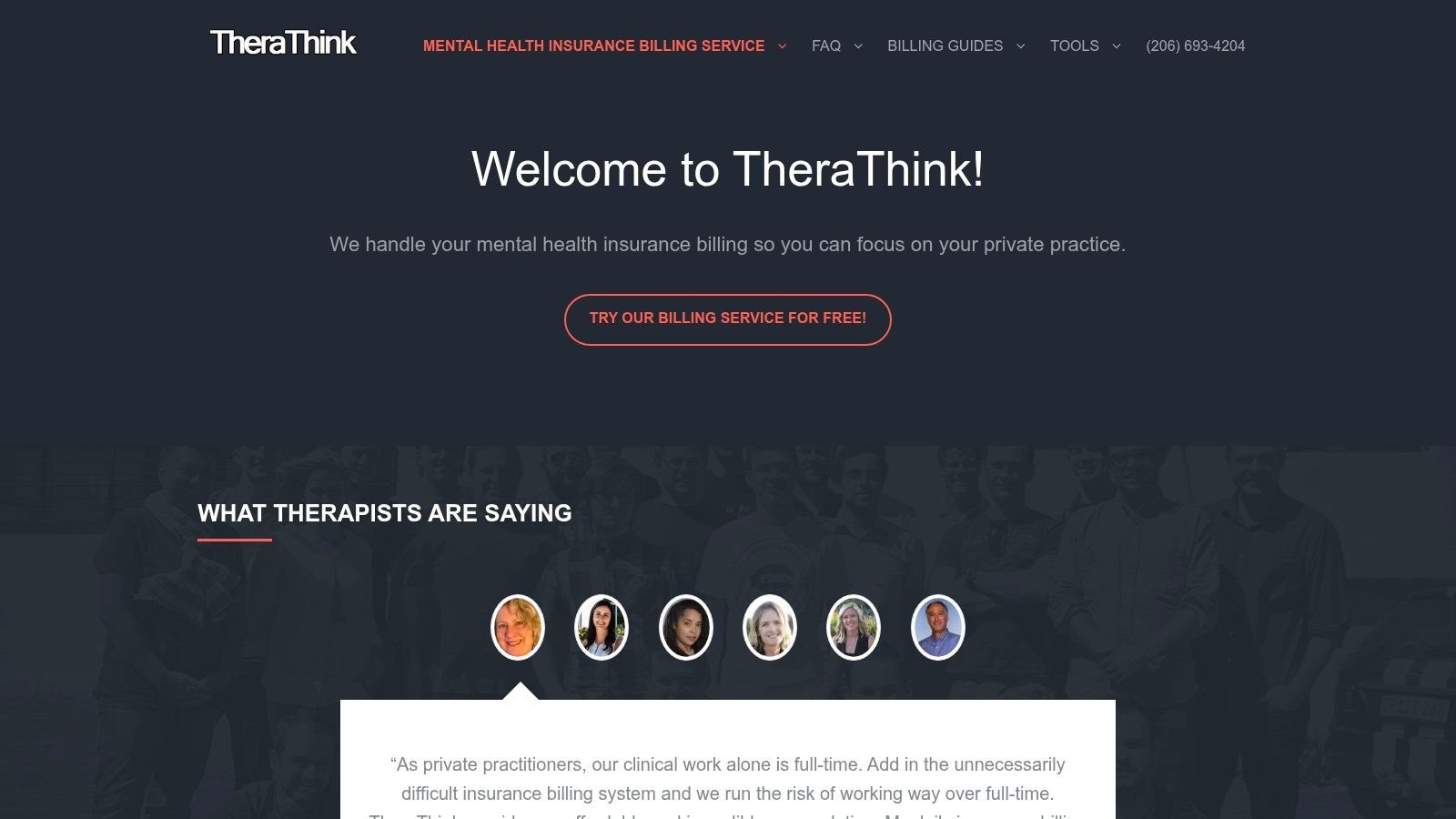
The platform focuses purely on the revenue cycle, handling everything from eligibility checks and daily claim filing to denial management and appeals. Its pricing model is a key advantage: TheraThink charges a percentage of the allowed amount only after a claim has been successfully paid by the insurer. This performance-based fee structure ensures their goals are directly aligned with your practice's revenue goals.
Standout Features & Considerations
TheraThink's commitment to working alongside your current systems is a significant draw for practices hesitant to overhaul their established workflows. This approach is a core component of many modern mental health billing solutions.
Pros:
- Transparent Pricing: Charges only on paid claims, with no startup or per-claim submission fees.
- EHR Agnostic: Works with your existing Electronic Health Record, avoiding complex system changes.
- Flexible Terms: Offers a month-to-month contract structure.
Cons:
- No Patient Collections: The service does not act as a collections agency for patient-owed balances.
- Clearinghouse Fee: A pass-through clearinghouse fee applies per NPI/TIN combination.
- Credentialing is Extra: Credentialing services are offered but at an additional, fixed per-payer rate.
Website: https://therathink.com
3. Practice Solutions, LLC
Practice Solutions, LLC provides a U.S.-based insurance billing service created specifically for mental health private practices. Beyond just managing claims, the firm also offers practice audits and educational resources, making it one of the best medical billing companies for mental health practices that want to strengthen their internal processes while outsourcing. This dual focus on service and education helps practice owners reduce future revenue leakage.
The company's core offering is a full-service billing solution that covers claim submission, payer follow-up, and denial management. A standout feature is their "practice health check," which assesses your revenue cycle to identify and plug financial holes. This hands-on, consultative approach is supported by a dedicated specialist assigned to your account, ensuring you have a direct point of contact.
Standout Features & Considerations
Practice Solutions' focus on both service and education is a significant advantage for owners who want to understand and improve their revenue cycle over the long term. It's crucial to prepare a list of questions to ask a medical billing company during your initial consultation to ensure their model aligns with your growth strategy.
Pros:
- Mental Health Focus: Services are built around private practice workflows for therapists and counselors.
- Educational Component: Offers resources and audits to empower practice owners.
- Dedicated Support: Provides direct access to a U.S.-based, assigned billing specialist.
Cons:
- Opaque Pricing: Pricing is not available publicly and requires a consultation call.
- Smaller Scale: As a smaller firm, it may lack the extensive enterprise EHR integrations of larger vendors.
- Service Focus: Primarily a service provider, not an all-in-one software platform.
Website: https://www.practicesol.com
4. Hansei Solutions
Hansei Solutions operates exclusively as a revenue cycle management partner for behavioral health organizations, with a strong focus on mental health and substance use treatment facilities. It provides an end-to-end service suite, making it one of the best medical billing companies for mental health practices that are larger or operate across multiple states. Hansei's approach is deeply rooted in data, using its vast claims dataset for benchmarking and analytics to drive revenue.
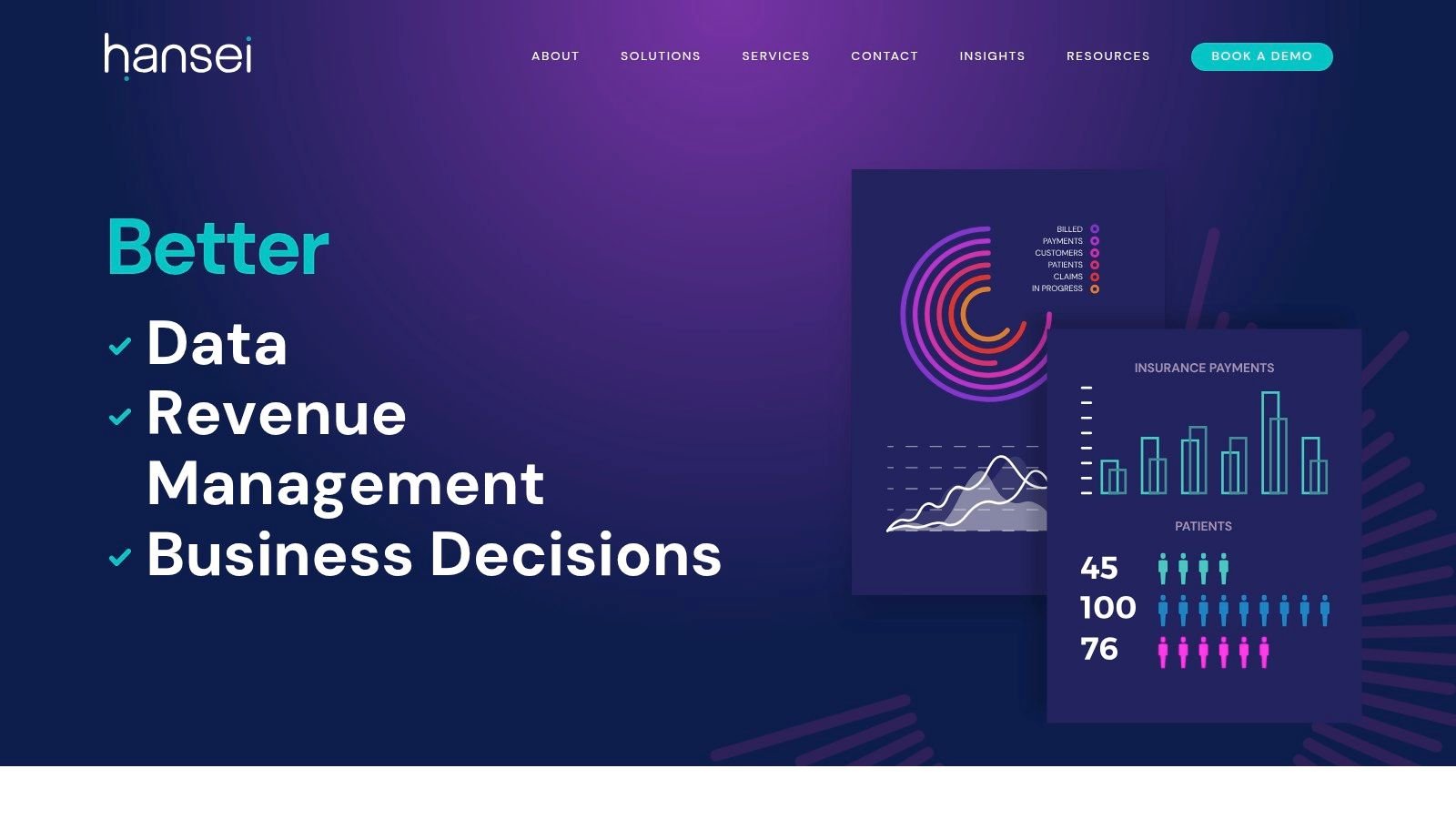
The company manages the entire financial workflow, from verification of benefits (VOB) and utilization review to billing, denial management, and accounts receivable. This comprehensive service is designed to handle the complexities of thousands of different payer plans and behavioral health programs. By managing intricate authorization and billing rules, Hansei aims to maximize collections and reduce A/R days for its facility-level clients.
Standout Features & Considerations
Hansei's deep specialization in high-acuity behavioral health gives them an edge in managing complex billing for different levels of care, from residential treatment to intensive outpatient programs. Their data-driven analytics provide valuable insights that can inform contracting and operational decisions.
Pros:
- Deep Specialization: Expertise in mental health and substance use disorder (SUD) billing, including all levels of care.
- Data-Driven Insights: Uses a large proprietary dataset for benchmarking and performance analytics.
- Proven Scale: Publishes strong metrics for key performance indicators like VOB turnaround times.
Cons:
- Facility-Oriented: Services may be more robust than what a solo practitioner or small group practice requires.
- Custom Pricing: Engagement details and pricing are not publicly available and require a custom quote.
- Full-Service Model: May not be suitable for practices seeking to outsource only a small portion of their RCM.
Website: https://hanseisolutions.com
5. Integrity Billing
Integrity Billing specializes in revenue cycle management for behavioral health and addiction treatment centers. The company provides a full suite of services, from initial verification of benefits (VOB) and credentialing to claim submission and aggressive denial management. This makes it one of the best medical billing companies for mental health practices that need a high-touch, specialized partner to manage the entire revenue lifecycle, particularly for complex substance use disorder (SUD) claims.
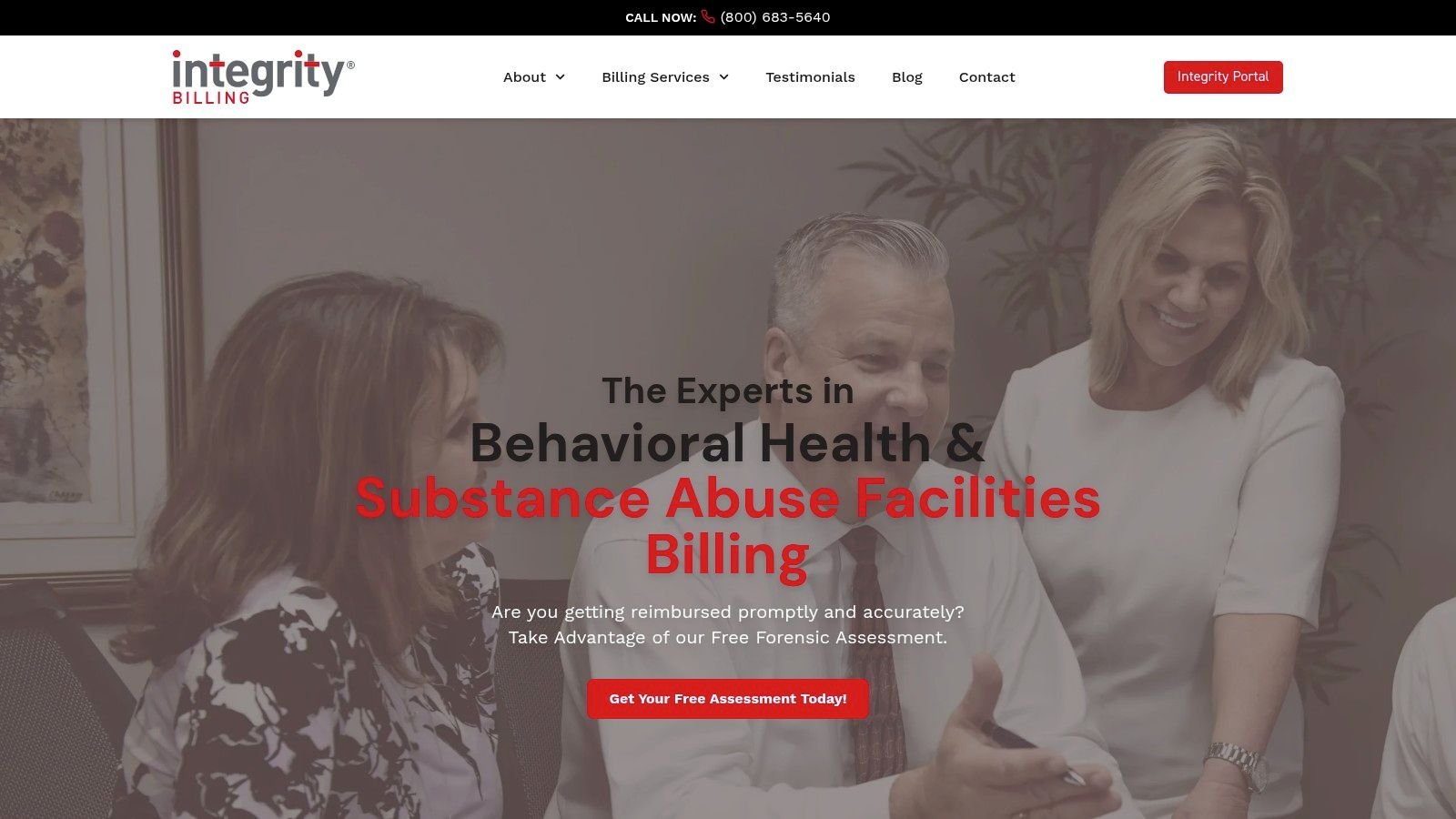
A key offering is its proprietary i-bot platform for VOB and reporting, designed to provide faster insights into coverage. Integrity Billing also performs forensic assessments to diagnose sources of revenue leakage within a practice's current billing process. Their focus on denial reduction and improving collection rates is a significant advantage for practices struggling with accounts receivable and payer pushback on higher-level-of-care claims. This hands-on approach aims to directly impact your bottom line.
Standout Features & Considerations
Integrity Billing's deep expertise in the niche areas of behavioral health and addiction treatment is its main draw. They understand the specific coding, authorization, and contracting challenges that general billing services often miss, which is critical for maximizing reimbursement.
Pros:
- Specialty Depth: Strong focus on behavioral health and SUD billing complexities.
- Denial Management: Emphasis on denial reduction and improving collection rates.
- Advisory Services: Offers forensic assessments to identify and fix revenue leaks.
Cons:
- Self-Reported Metrics: Performance data is self-reported, so practices should request case studies and service-level agreements (SLAs).
- Opaque Pricing: Pricing is not publicly available and is typically a percentage-based fee with potential add-ons for specific services.
Website: https://integritybillingco.com
6. DENmaar
DENmaar offers a unified operating system for behavioral health, combining an EHR with revenue cycle management and credentialing services. This integrated approach is particularly strong for practices dealing with complex compliance, such as those that heavily rely on Medicaid. For this reason, it can be one of the best medical billing companies for mental health practices that need operational and billing workflows aligned under a single vendor to reduce denial risks.
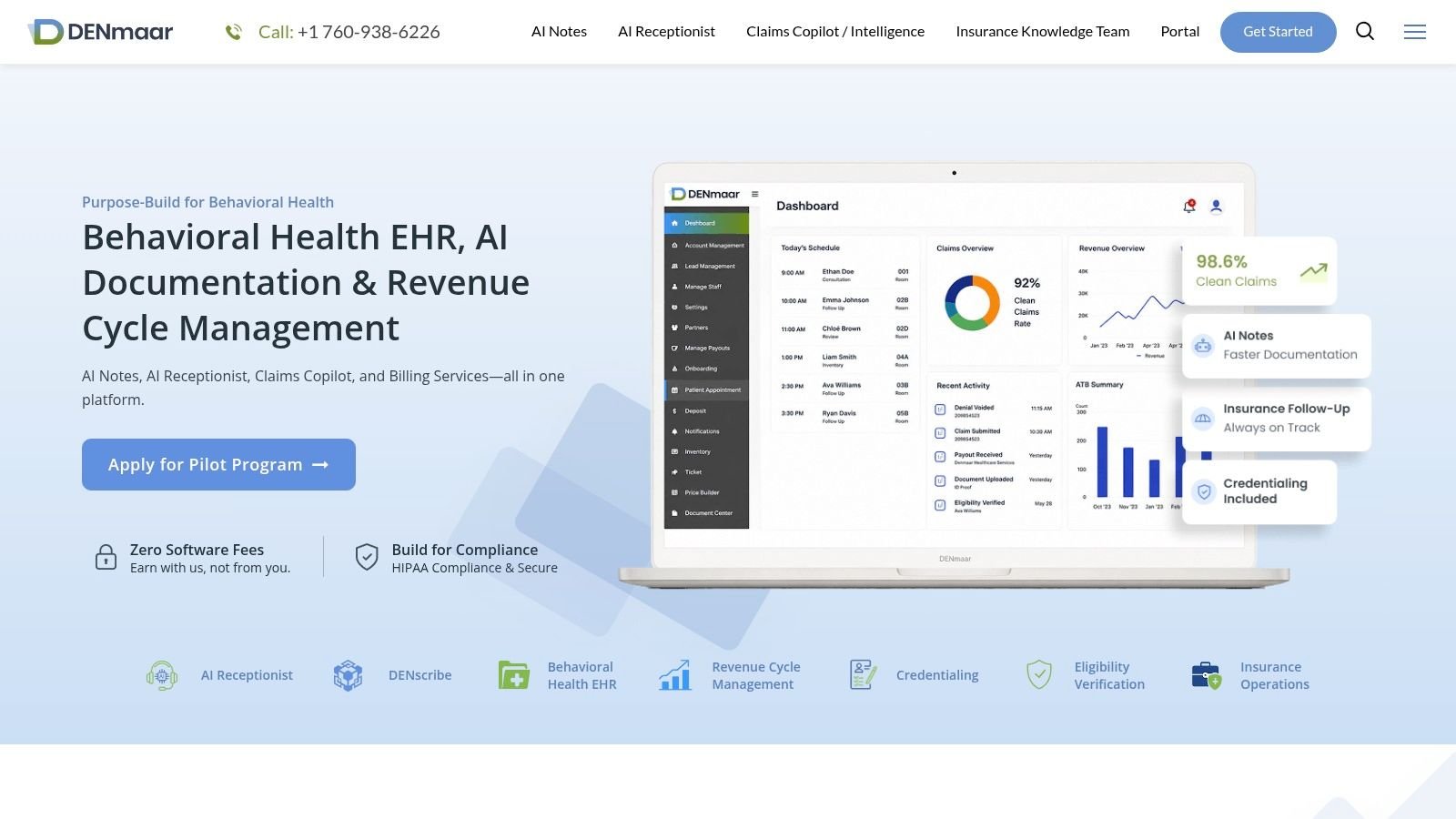
The platform supports a wide range of care models, including IOP/PHP, SUD, ACT, residential, and community mental health. Its main advantage is the rules-driven engine that checks for authorization and documentation requirements before claim submission, specifically targeting common Medicaid denial reasons. This built-in compliance guardrail helps protect practice revenue by catching preventable errors that lead to costly rejections and payment delays.
Standout Features & Considerations
DENmaar’s all-in-one model is designed for practice owners wanting to minimize vendor juggling and enforce compliance directly within their primary software. The system includes built-in telehealth and scheduling, aiming to cover the complete patient and billing lifecycle.
Pros:
- Single Vendor: Consolidates EHR, billing, and credentialing into one platform.
- Medicaid Focused: Includes built-in workflows and guardrails to meet Medicaid program requirements, reducing denials.
- Integrated Operations: Telehealth and scheduling are part of the core platform.
Cons:
- Platform Lock-in: Credentialing services may require using the DENmaar platform for group practices.
- Workflow Change: Adopting the system requires migrating to DENmaar’s EHR, which can be a significant operational shift.
Website: https://denmaar.com
7. Valant RCM
Valant is a behavioral health-specific EHR that offers optional managed Revenue Cycle Management (RCM) services. It earns its place as one of the best medical billing companies for mental health practices by offering a dedicated billing team that is fully integrated with its own software. This setup is ideal for outpatient mental health groups that are scaling beyond the capacity of their in-house billing teams and want to avoid system fragmentation.
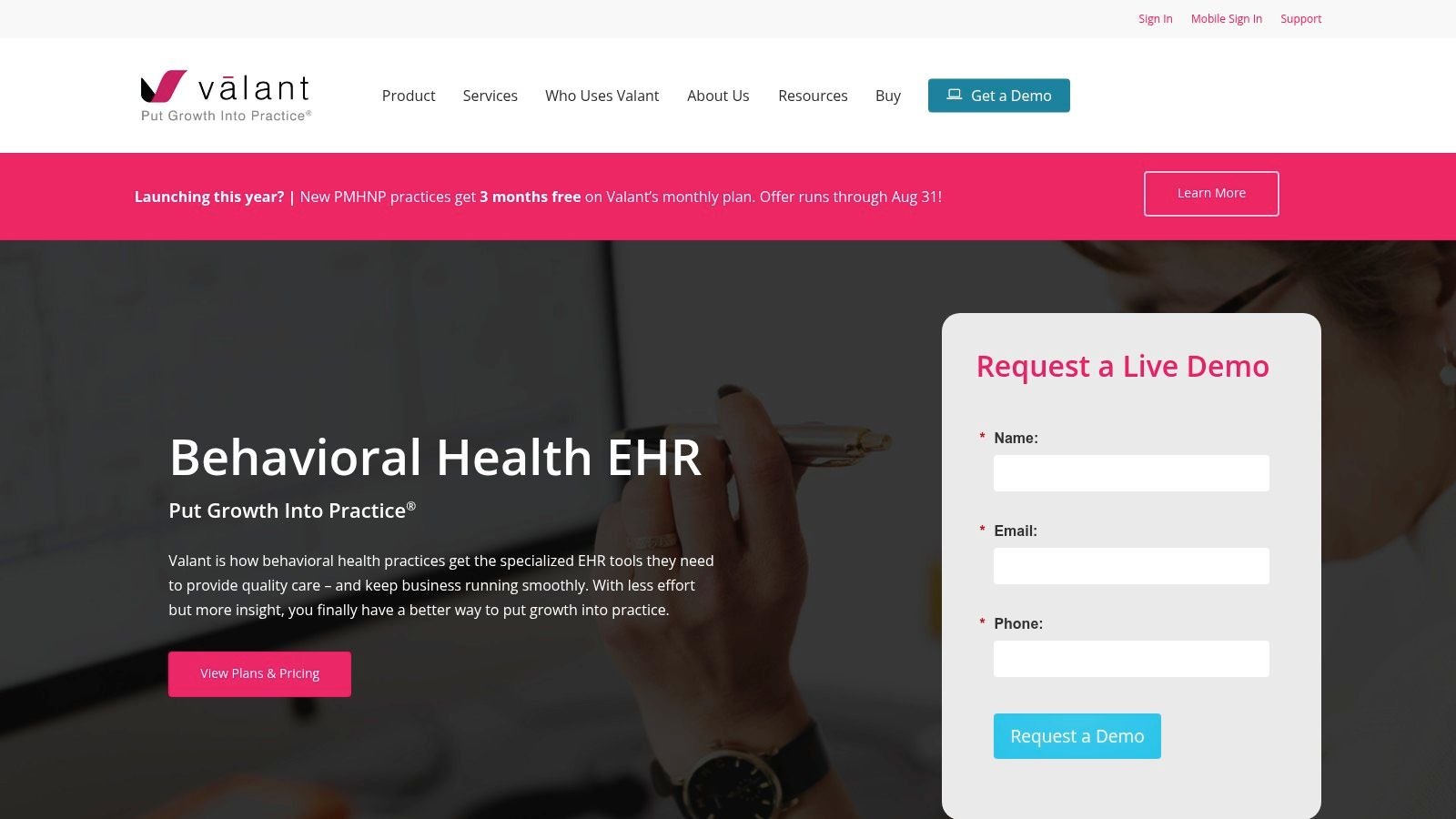
The service is designed to stabilize cash flow, manage denials, and streamline patient statements, all within a familiar platform. Because the RCM team works directly inside the Valant EHR, duplicate data entry and the associated errors are significantly reduced. This is particularly beneficial for managing complex billing scenarios, such as those common in telehealth billing for mental health, where accurate place-of-service codes and modifiers are critical for payment.
Standout Features & Considerations
The tight integration between the software and the service is Valant’s main draw. The RCM services are structured via a Billing Services Addendum that clearly defines fee calculations, providing a degree of transparency for practices committed to their ecosystem.
Pros:
- Tight EHR/RCM Integration: Purpose-built for behavioral health, reducing system conflicts.
- Reduces Data Entry: Minimizes duplicate work and potential errors between systems.
- Specialized Team: The billing team is focused exclusively on behavioral health finance.
Cons:
- EHR Dependent: Accessing the full benefits generally requires using the Valant EHR.
- Pricing Not Public: Final rates are only provided via a custom quote.
- Less Flexibility: This all-in-one model can be less flexible than EHR-agnostic services.
Website: https://www.valant.io
8. CodeMax Medical Billing
CodeMax Medical Billing provides a technology-backed revenue cycle management service that includes a dedicated focus on behavioral health. Their model pairs billing specialists with proprietary in-house software, aiming to manage the entire financial workflow from claim creation to final payment posting. This integrated approach makes them one of the best medical billing companies for mental health practices that prefer a single vendor for both service and software.

The company handles the complete claims lifecycle, including submission, payment reconciliation, and aggressive follow-up on denials. By owning their RCM software, CodeMax can offer detailed reporting and potentially more adaptable workflows for different behavioral health settings, from solo practitioners to larger group clinics. Service and pricing details are only available through a custom quote, which allows them to tailor a package to your practice's specific needs and volume.
Standout Features & Considerations
CodeMax's main draw is its unified service and technology platform. Having the RCM software and the billing team under one roof can prevent the communication gaps that sometimes occur when using separate vendors for your EHR and billing service.
Pros:
- Integrated Platform: The combination of proprietary software and service is handled by a single vendor.
- Adaptable Service: Processes can be adjusted for various behavioral health practice sizes and structures.
- End-to-End RCM: Offers a complete service covering the entire revenue cycle from start to finish.
Cons:
- Quote-Based Pricing: Pricing transparency is limited, as costs are only provided after a consultation.
- Limited Public Metrics: Specific performance data for behavioral health billing is not readily available.
Website: https://codemaxmb.com
9. Behavioral Health RCM Solutions (BHRCMS)
Behavioral Health RCM Solutions (BHRCMS) offers a focused service for behavioral health agencies nationwide, emphasizing deep expertise in the specialty's unique documentation and payer rules. The firm provides end-to-end revenue cycle management, which makes it one of the best medical billing companies for mental health practices that require a partner with true specialty fluency rather than a generalist billing service. Their approach is built on understanding the specific challenges of behavioral health coding and reimbursement.
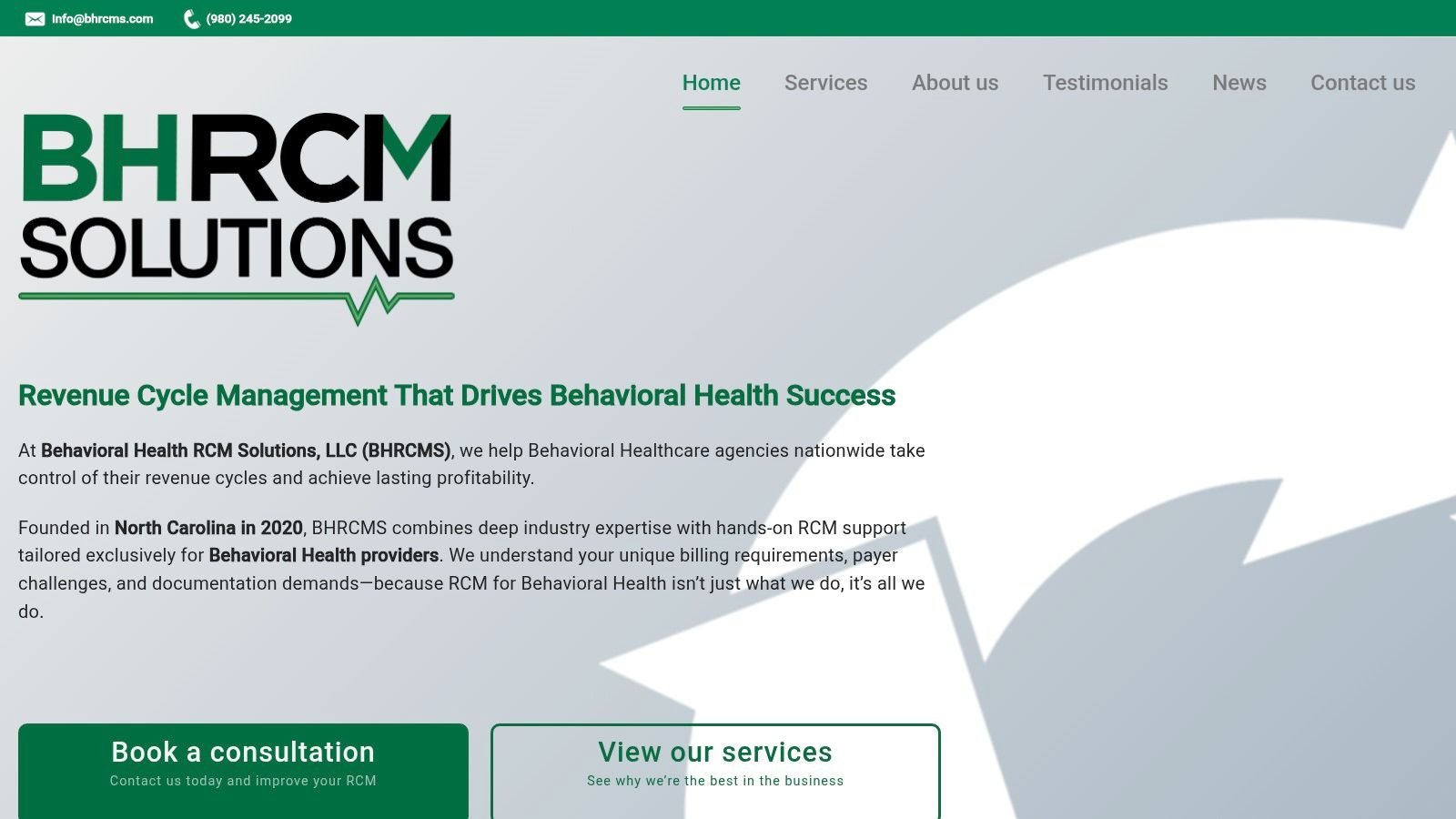
The company's key value proposition is its exclusive concentration on behavioral health. This ensures they are proficient with the complex authorization requirements and payer-specific guidelines that frequently lead to denials in mental health. Their nationwide support model is designed to handle the varied reimbursement landscapes across different states and insurers. This specialized knowledge is a critical factor in successful medical billing for mental health, where generic billing processes often fail.
Standout Features & Considerations
BHRCMS positions itself as an expert partner for agencies struggling with the nuances of mental health billing. Their singular focus means they are constantly dealing with the same payers and procedural codes your practice uses, building a repository of knowledge that can accelerate reimbursement and reduce A/R days.
Pros:
- Behavioral-Health-Only Focus: Provides strong alignment with the specific payer challenges and authorization hurdles common in mental health.
- Specialty Fluency: Well-suited for agencies and group practices that need a billing partner with deep expertise in behavioral health codes and rules.
Cons:
- Limited Operational Detail: The company's website is light on specific operational workflows; prospective clients should request case studies and service level agreements (SLAs).
- No Public Pricing: Pricing details are not posted online, requiring a direct scoping call to get a proposal.
Website: https://bhrcms.com
10. Capture RCM
Capture RCM offers end-to-end revenue cycle management services with a distinct focus on the behavioral health sector. Their approach combines specialized billing with compliance and operational support, positioning them as one of the best medical billing companies for mental health practices that need assistance beyond simple claim submission. This service is designed to keep practices running smoothly by managing denials, A/R follow-up, and regulatory adherence.
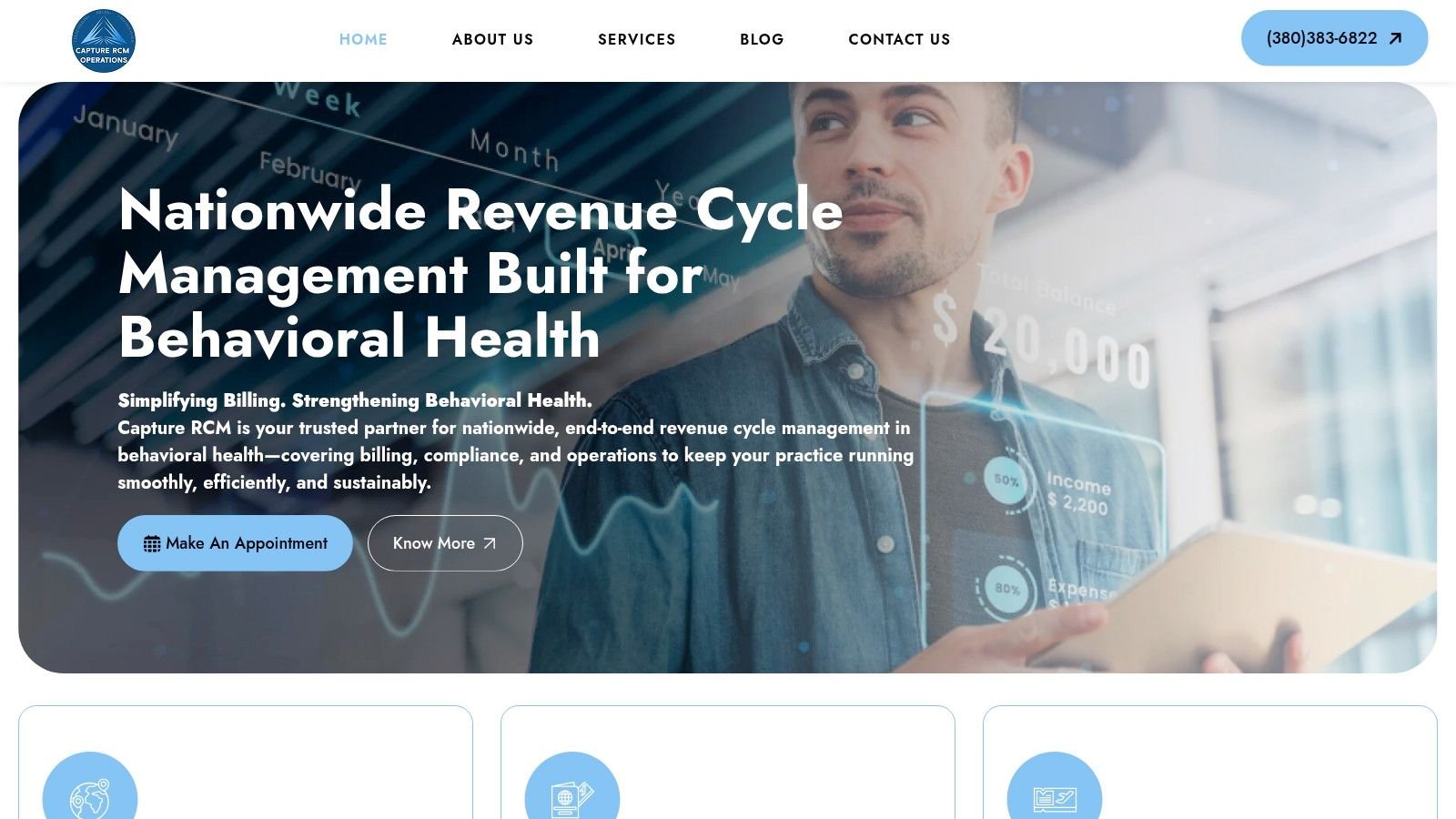
The company’s model is built on full revenue cycle outsourcing, making it a potential fit for practice owners wanting to offload their entire billing department. By integrating compliance support, Capture RCM helps providers navigate the complex rules governing behavioral health, which can be a significant advantage for practices looking to scale while minimizing risk.
Standout Features & Considerations
Capture RCM's value proposition is its blend of billing expertise and broader operational guidance specifically for mental health providers. This can be particularly beneficial for group practices facing complex administrative challenges.
Pros:
- Behavioral Health Specialization: Deep focus on billing, compliance, and operations for mental health.
- Broad Operational Support: Goes beyond claims to assist with the business side of a practice.
- Denial Management Focus: Proactive denial prevention and aggressive A/R follow-up are central to their service.
Cons:
- Limited Public Pricing: Pricing and specific service tiers are not publicly disclosed and require a consultation.
- Unknown Practice Size Minimums: It is unclear if they are a fit for solo practitioners versus larger group practices.
Website: https://capturercmoperations.com
11. Ease Health
Ease Health brings a modern approach to revenue cycle management by combining proprietary AI with a U.S.-based billing team. This hybrid model is specifically tailored to the complexities of behavioral health, with its AI trained on millions of claims to identify denial patterns and optimize submissions. This makes it one of the best medical billing companies for mental health practices that want advanced technology paired with human expertise.
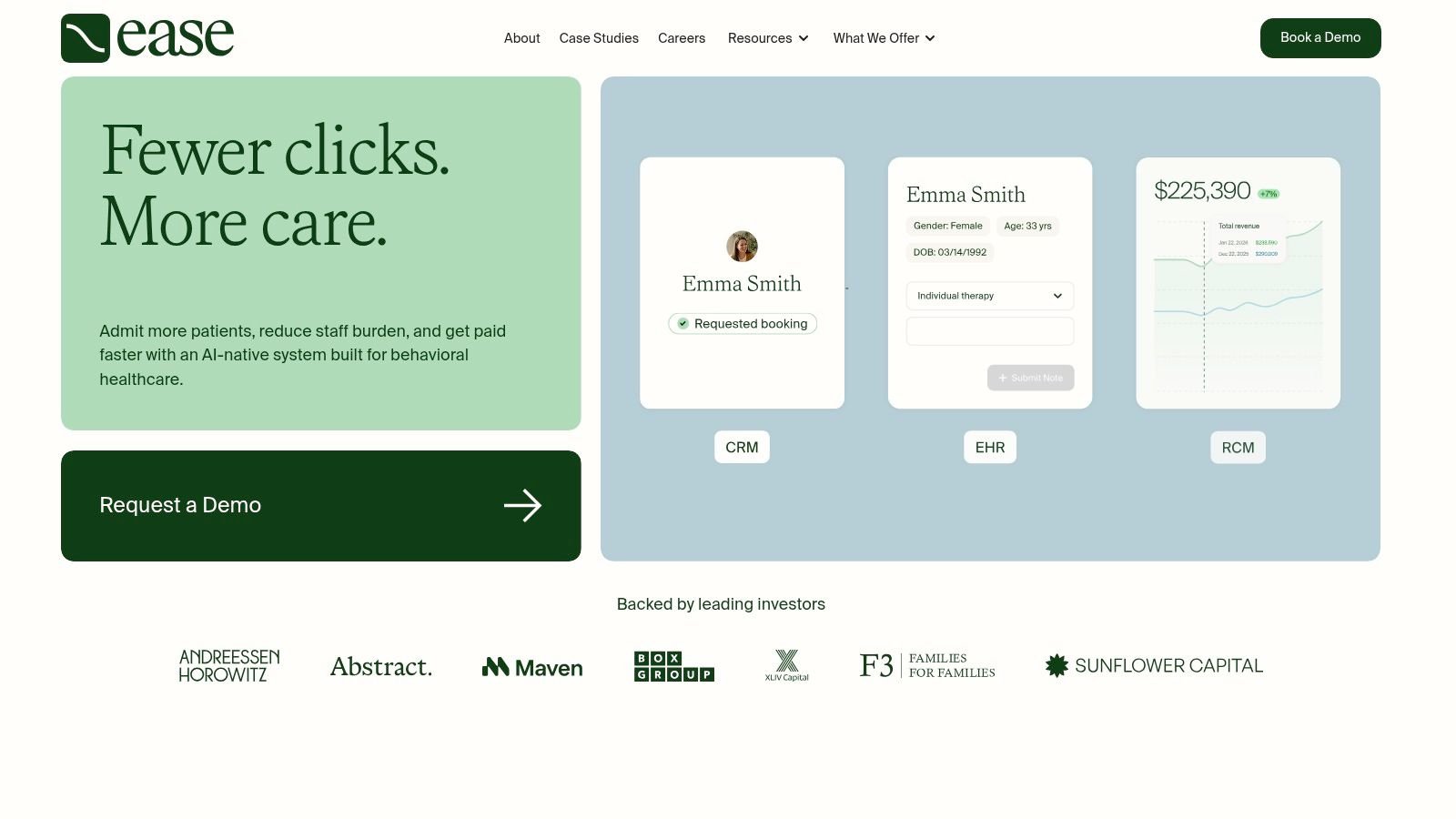
The company provides a full-scope service that covers every critical touchpoint of the revenue cycle. This includes eligibility verification, prior authorization management, credentialing, daily claims filing, denial management, and payment posting. The goal is to create faster, cleaner claims that reduce avoidable denials and accelerate your practice's cash flow.
Standout Features & Considerations
Ease Health’s AI-assisted RCM is designed to give practices a competitive edge by getting ahead of payer rejections before they happen. Their human team handles the nuances and manual interventions that AI cannot, ensuring a complete and effective billing process.
Pros:
- Modern AI+Human Model: Aims for faster claim processing and fewer avoidable denials by blending technology with expert oversight.
- Comprehensive Scope: Includes critical services like authorization management and credentialing as part of the package.
- Behavioral Health Focus: The entire system, including the AI, is specifically designed for mental health billing challenges.
Cons:
- Newer Brand: As a more recent entrant, practices should request specific behavioral health client references and measurable SLAs.
- Custom Pricing: Pricing is not publicly available and requires direct engagement for a custom quote.
Website: https://easehealth.com
12. Darga RCM
Darga RCM positions itself as a specialized revenue cycle management partner for behavioral health providers, with a strong focus on responsiveness and denial reduction. The company specifically targets practices frustrated with their previous billing services, offering troubleshooting and audit services to identify and fix revenue leakage. This makes it one of the best medical billing companies for mental health practices looking to correct course after a poor outsourcing experience.
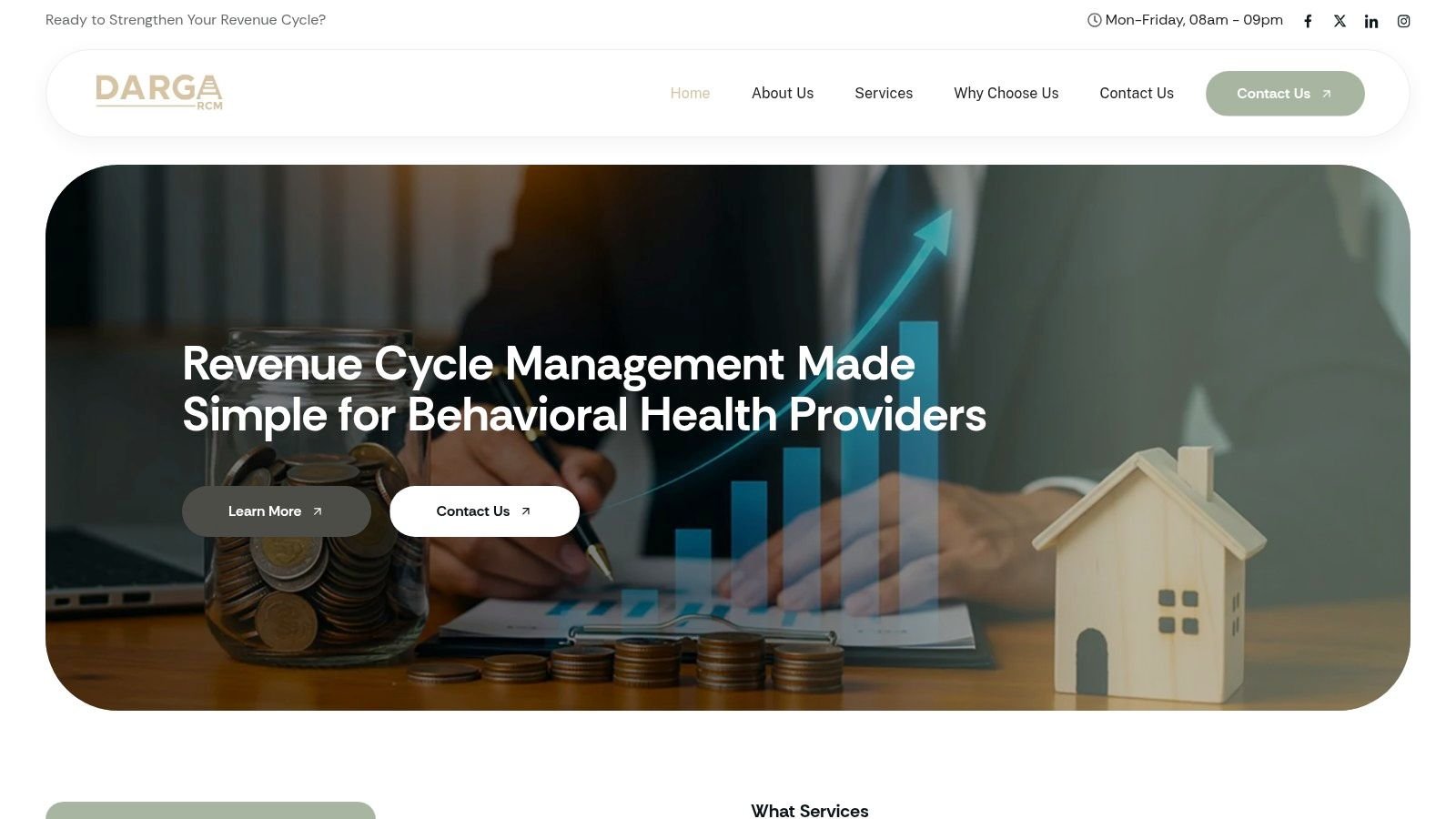
The firm offers end-to-end billing and follow-up, emphasizing a hands-on approach to denial turnaround and transparent communication. Its 'fix-it' orientation is designed for practices that have seen their accounts receivable climb and their clean claim rates drop. By focusing on the root causes of billing issues, Darga RCM aims to build a more stable and predictable revenue cycle for its clients.
Standout Features & Considerations
Darga RCM’s value proposition is centered on being a more attentive and effective partner than a practice’s prior biller. This problem-solving approach can be particularly beneficial for providers struggling with authorization-related denials or complex coordination of benefits scenarios that larger, less specialized billers might neglect.
Pros:
- Responsiveness Focus: Built to provide a high level of transparency and support.
- Troubleshooting Orientation: Offers practice reviews and audits to correct issues inherited from previous billers.
- Behavioral Health Specialization: Deep expertise in the unique coding and authorization needs of mental health.
Cons:
- Undeclared Pricing: Pricing is not publicly available and requires a discovery call for a custom quote.
- Smaller Scale: As a younger company, practices should validate its capacity for handling large group practices or complex multi-site programs.
Website: https://dargarcm.com
Top 12 Medical Billing Companies for Mental Health — Comparison
| Vendor | Target audience | Core services | Key differentiator | Pricing model |
|---|---|---|---|---|
| Happy Billing | High‑stakes medical & specialty practices (anesthesia, cardiology, behavioral health) | Full‑cycle RCM, denial mgmt, credentialing, A/R recovery; works inside existing EHR | Agentic AI + human auditors; 98%+ first‑pass clean claims; 24/7 follow‑the‑sun; HIPAA & bank‑level encryption | Custom pricing; free revenue audit; no public rates |
| TheraThink | Licensed mental‑health clinicians & group practices | Daily claims filing, eligibility checks, denials/appeals, optional credentialing | Charges only on paid claims; transparent percent of allowed; EHR‑friendly | Percentage of allowed on paid claims; no startup fees; clearinghouse pass‑through |
| Practice Solutions, LLC | Mental‑health private practices | Full‑service billing, practice health checks, education & training | U.S.-based assigned specialist; education to reduce future leakage | Custom quote after consult; pricing not public |
| Hansei Solutions | Behavioral‑health facilities & multi‑state programs | End‑to‑end RCM, VOB, utilization review, analytics & benchmarking | Large behavioral‑health claims dataset; data‑driven benchmarking | Custom pricing; engagement‑based |
| Integrity Billing | Behavioral health & addiction‑treatment providers | VOB, billing/coding, collections, appeals, i‑bot reporting, forensic assessments | Proprietary i‑bot VOB/reporting; forensic revenue audits | Typically percentage‑based with scoped add‑ons; custom quote |
| DENmaar | Medicaid‑focused behavioral health programs (IOP/PHP, SUD) | Integrated EHR + billing/RCM, auths, documentation checks, telehealth | Single‑platform operations; Medicaid rule guardrails to reduce denials | Platform‑dependent pricing; may require DENmaar EHR |
| Valant RCM | Outpatient behavioral‑health groups using Valant EHR | Managed RCM integrated with Valant, denial mgmt, financial reporting | Tight EHR‑RCM integration; purpose‑built workflows | Quote‑based; usually requires Valant EHR |
| CodeMax Medical Billing | Providers seeking tech‑enabled RCM | End‑to‑end billing, payment posting, proprietary RCM software | Vendor‑owned unified tooling and reporting | Custom quotes; pricing on request |
| Behavioral Health RCM Solutions (BHRCMS) | Behavioral‑health agencies nationwide | End‑to‑end RCM, documentation & payer‑rule expertise, reporting | Behavioral‑health–only specialization | Custom pricing; scoping call required |
| Capture RCM | Behavioral‑health practices needing ops & compliance help | Full RCM, denial prevention, compliance & ops support | Operational support beyond claims; compliance focus | Custom quote; scope‑dependent |
| Ease Health | Behavioral‑health providers seeking AI + on‑shore support | AI‑assisted RCM with U.S. billing team, elig/auths, credentialing | AI+human model trained on behavioral claims; U.S. team | Custom pricing; newer vendor—references advised |
| Darga RCM | Practices needing fast response and "fix‑it" services | End‑to‑end billing, denials turnaround, practice audits | Emphasis on responsiveness and remediation for troubled RCMs | Custom quote after discovery |
Choosing the Right Mental Health Billing Partner for Your Practice
Selecting a partner to manage your practice’s revenue cycle is one of the most critical financial decisions you will make. The difference between a subpar billing service and one of the best medical billing companies for mental health practices can translate into tens or even hundreds of thousands of dollars in annual revenue, a lower denial rate, and fewer A/R days. As we've explored, the right partner understands the specific challenges of behavioral health billing, from managing complex prior authorizations to correctly applying telehealth modifiers and navigating unique payer rules.
The companies we've profiled, including TheraThink, Hansei Solutions, and DENmaar, each offer specialized approaches to mental health RCM. Your choice will ultimately depend on your practice's size, specific pain points, and growth objectives. A smaller, growing practice might prioritize a vendor with flexible, scalable pricing, while a larger clinic struggling with a high denial rate may need a partner with deep payer relationships and proven expertise in appealing wrongfully denied claims.
Key Takeaways for Your Practice
Before making a final decision, distill your evaluation down to these core factors:
- Authorization Expertise: Does the company have a dedicated process for securing, tracking, and verifying prior authorizations? In our experience, authorization failures are the number one cause of preventable denials in mental health.
- Coding Proficiency: Your billing partner must be fluent in behavioral health CPT codes (e.g., 90837 for psychotherapy, 99404 for MAT) and the correct use of modifiers like 95 or GT for telehealth services. Ask for specific examples of how they've corrected coding errors for other practices.
- Payer Relationships: An experienced billing company has established contacts within major insurance networks like Aetna, Cigna, and Blue Cross Blue Shield. These relationships are invaluable for resolving complex claim issues and expediting payments.
- Transparent Reporting: You should have on-demand access to key performance indicators (KPIs) like your net collection rate, days in A/R, and denial trends. Vague or infrequent reporting is a significant red flag.
Your Next Steps
The path forward involves a structured evaluation. Start by shortlisting 2-3 companies from this list that seem to align with your needs. Prepare a list of targeted questions based on your practice’s specific RCM challenges. Are you struggling with out-of-network billing? Is your front desk failing to collect patient responsibility? Use these pain points to guide your discovery calls.
Request a detailed proposal and, if possible, a complimentary analysis of your current billing data. This will provide concrete evidence of how a potential partner can improve your financial performance. By grounding your decision in data and a clear understanding of what separates average RCM from specialized, expert-driven service, you can confidently choose a partner that will protect and grow your practice's revenue for years to come.
At Happy Billing, we combine deep expertise in mental health billing with transparent, data-driven processes to help practices thrive. If you're tired of seeing your hard-earned revenue lost to preventable denials and authorization errors, we invite you to request a free billing audit to see exactly where your revenue is leaking and how we can fix it.
What is the average cost of a mental health billing service?
Most specialized mental health billing services charge a percentage of collections, typically ranging from 5% to 9%. This fee is based on the revenue they successfully recover for your practice, which aligns their incentives with yours. Some may charge flat per-claim fees or have additional costs for services like credentialing or software, so it's critical to understand the full pricing structure before signing an agreement.
How can outsourcing billing improve my practice's revenue?
Outsourcing to an expert can significantly increase your revenue by reducing your denial rate and shortening your A/R cycle. Specialists in mental health billing prevent common errors, such as incorrect CPT/modifier combinations (e.g., billing 90837 without required pre-authorization), and aggressively follow up on underpayments. In our experience, this can recover 10-15% of revenue that was previously lost to billing errors or unworked denials.
Can a billing company help with prior authorizations?
Yes, and they should. Managing prior authorizations is a critical function of the best medical billing companies for mental health practices. Authorization missteps are a leading cause of high-value denials, especially for ongoing psychotherapy or intensive outpatient programs. A strong billing partner will have a dedicated process for tracking, submitting, and confirming authorizations before services are rendered, directly protecting your practice's revenue.