Top Medical Billing Services for Small Practices Near Me

You notice the problem on a Tuesday afternoon. Clinic is full, the schedule is tight, and your bank deposits still do not match the work your physicians already did. Your front desk says claims are pending. Your biller says follow-up is underway. Your aging report says something else.
Searching for medical billing services for small practices near me usually starts at that exact point. Cash is slowing down, denials are showing up too often, and nobody can give you a clean answer on what will hit the bank this month. That is not an administrative nuisance. It is a revenue control failure.
Proximity does not fix that. Accountability does.
A billing company should win your business by proving performance, not by sharing your ZIP code. If a local vendor cannot show you their average denial rate, first-pass acceptance rate, days in A/R, and collection rate by specialty, keep looking. If a national firm can show clean reporting, disciplined follow-up, and consistent payer results inside your EHR, they deserve a hard look.
Small practices get burned when they shop for comfort instead of evidence. A polished sales rep, a nearby office, or vague promises about “handling everything” do not protect cash flow. Clear operating standards do. You want a partner that can explain how they prevent denials before claims go out, how they work aged balances by payer class, and how they report results to you every month in plain English.
Documentation is part of that standard. Weak notes create coding errors, medical necessity problems, and preventable payer requests. If your practice is also focused on improving medical documentation, that should connect directly to cleaner claims and fewer rework cycles, not sit in a separate workflow with no billing oversight.
Before you compare vendors, get familiar with the key cost drivers behind billing operations and collections in this medical billing cost breakdown for physician practices. Then judge every option, local or not, by one standard. Can they prove they collect your money faster, with fewer denials and less noise?
The True Cost of a Troubled Revenue Cycle
Monday starts with a full clinic. By Thursday, your manager is chasing unpaid claims from two months ago, your front desk is fielding patient balance complaints, and payroll is coming due before several large payer checks have cleared. That is not a billing inconvenience. It is a cash flow problem that limits hiring, equipment purchases, and owner income.
Small practices get into trouble when they treat revenue cycle problems as back-office noise. The cost shows up in slower deposits, rising A/R, repeated denials, and staff time wasted on claims that should have been clean the first time. A billing service near you does not fix that by itself. A billing service that can prove low denial rates, fast claim submission, disciplined follow-up, and clean reporting does.
Outsourcing can absolutely cost less than carrying billing in-house, but the larger issue is financial control. If your current process creates preventable denials or lets old balances sit untouched, you are already paying for poor billing through delayed cash and write-offs. If you want a clearer picture of what drives those expenses, review this breakdown of medical billing costs for physician practices.
Billing errors turn into operating losses
One denied echocardiography claim tied to CPT 93306 is not an isolated miss. It can mean a prior auth problem, weak medical necessity support, missing documentation, or payer-specific edit logic that nobody caught before submission. In orthopedics, poor modifier handling around modifier 25, modifier 59, or laterality can create the same result. More rework. More staff time. Slower payment.
That is where owners lose money unnoticed.
Every preventable denial adds days in A/R. Every day in A/R increases pressure on payroll, vendor payments, and physician compensation. If your billing partner cannot show you how they prevent front-end edits, work denials by root cause, and push down old A/R by payer, they are not managing revenue. They are reacting to damage after it happens.
Practical rule: If physicians are documenting appropriately and cash is still arriving late, the problem is usually claim quality, follow-up discipline, or payer-specific billing execution.
Documentation quality matters more than many physician-owners want to admit. Weak notes create coding errors, medical necessity denials, and avoidable requests for records. Practices often reduce downstream rework by improving medical documentation at the point of care, especially in specialties where procedural detail determines whether a claim pays or stalls.
Proximity is not the standard
The right question is not whether the billing company is local. The right question is whether they can collect your money faster with fewer errors.
Plenty of nearby firms still run loose follow-up, weak denial management, and vague monthly reporting. Plenty of national firms do the same. The firms worth hiring can prove performance with numbers you can verify inside your own system. If they cannot speak clearly about denial rate, first-pass acceptance, days in A/R, net collection rate, and aging over 90 days, keep looking.
Step Zero Your Internal Billing Performance Audit
A physician-owner starts shopping for a billing company after cash gets tight. That is backwards. Audit your own operation first, or you will walk into vendor calls without the numbers needed to challenge vague promises on collections, denials, and follow-up.
Your baseline decides whether a new billing partner is fixing a real problem or inheriting one.
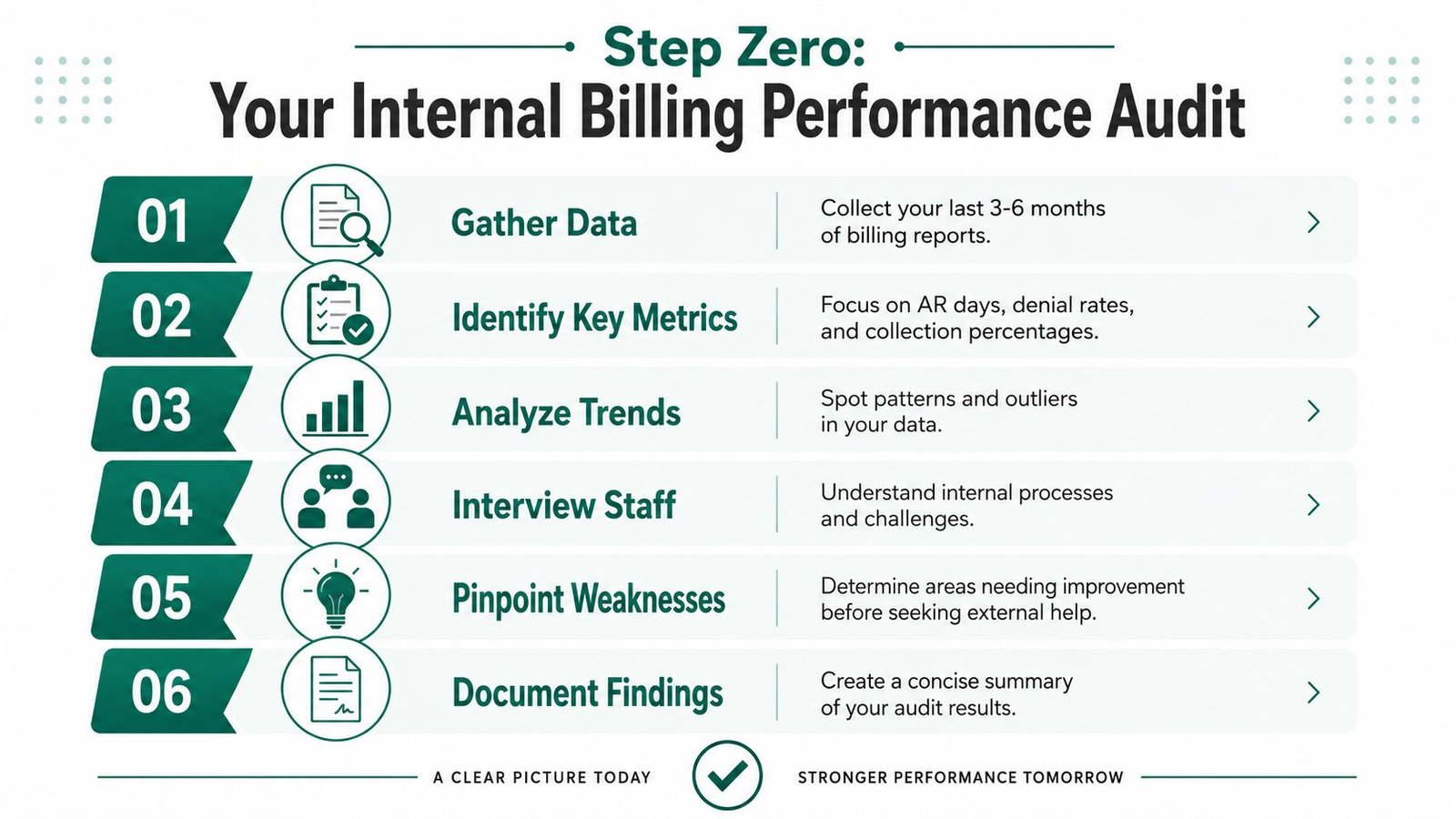
Start with 90 days of claims, payment posting, denial activity, and aging. That is enough to expose whether your bottleneck sits at charge entry, coding, claim edits, eligibility, authorization, payment posting, or payer follow-up. You do not need a polished dashboard. You need a scorecard that shows where cash is slowing down and why.
Pull these reports first
Ask your office manager, biller, or EHR admin for these exports:
- A/R aging by payer and provider: Break it into current, 31 to 60, 61 to 90, and over 90 days so you can see where receivables are stalling.
- Initial denial report with denial reasons: Totals are useless without root causes.
- Charge lag and claim submission timing: Slow claim creation delays every dollar behind it.
- Top CPT codes by volume and dollars: This shows where small process errors create large financial losses.
- Credit balance and write-off activity: These expose posting errors, refund risk, and weak adjustment controls.
If your team needs a formal review process, use this framework for medical billing audit services for practices.
Audit what matters
Three areas should drive your search for any billing service, local or national.
First, clean claim performance. If claims leave your system with eligibility errors, missing modifiers, weak diagnosis linkage, or authorization gaps, you are paying staff to create rework.
Second, days in A/R and aging over 90 days. These show how quickly work turns into cash and whether follow-up is disciplined or neglected.
Third, top denial reasons by payer. Denials only become useful management data when you can trace them to a payer rule, a workflow failure, or a coding habit inside your practice.
Run denial reports by payer, location, and rendering provider. "Authorization missing" from one commercial plan points to a workflow fix. The same denial across several payers points to a front-desk training problem.
Tie denials to real specialty losses
A denial category is not the problem. The dollars attached to it are.
In cardiology, repeated denials on CPT 93306 often point to authorization failures, diagnosis mismatch, or weak documentation support. In orthopedics, missed modifier 59 or modifier 25 use can turn a payable encounter into avoidable appeal work. In mental health, recurring claims break down when staff miss authorization renewals or session limits. In anesthesiology, concurrency and modifier errors reduce payment on high-value cases that should have paid cleanly.
That is why specialty experience matters. If you want to test whether a billing company understands your service mix, compare its background against the specialty workflows shown on these medical billing specialty pages.
Build a one-page scorecard
Keep it tight. One page is enough if it includes:
- Current A/R status by aging bucket
- Clean claim performance
- Largest denial categories by payer
- Top payer pain points
- Highest-value CPT codes
- EHR, staffing, and workflow constraints
Bring that scorecard to every vendor conversation. Top billing companies will use it to explain exactly how they would cut denials, reduce old A/R, and speed up cash. Weak ones will stay generic, because they do not know how to manage a revenue cycle at the metric level.
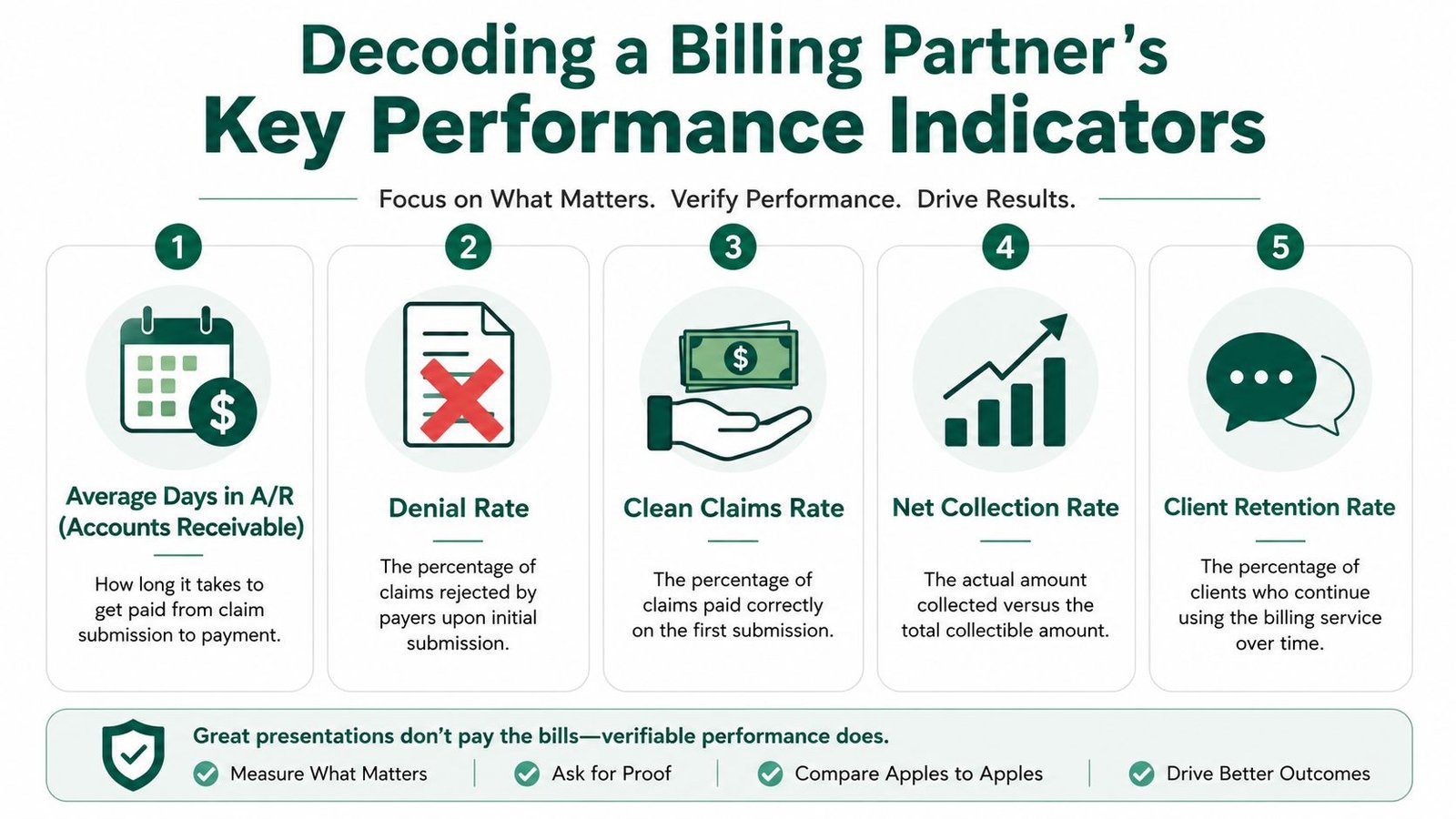
Decoding a Billing Partner's Key Performance Indicators
Your biller says collections are up. Meanwhile, your A/R keeps aging, staff keep answering patient balance complaints, and you are still waiting on money from visits completed two months ago. That is how small practices get misled. Vendor evaluation starts with hard operating numbers, not a local office address and not a polished sales pitch.
The KPIs that actually predict cash performance
Start with Days in A/R. If a billing company cannot tell you its target range for your specialty and payer mix, stop the conversation. Healthy A/R moves fast. Slow A/R ties up payroll, owner draws, and growth plans.
Next, ask for the vendor's initial denial rate. Top operators prevent denials before the claim leaves the system. Weak ones talk about how good they are at appeals. That is the wrong brag. You want a partner that keeps denial volume low in the first place.
Then review first-pass acceptance and claim accuracy. These numbers tell you whether the team catches eligibility errors, authorization gaps, coding mistakes, modifier issues, and payer edits before submission. If first-pass performance is weak, your cash will be noisy every month.
A 2026 small-practice RCM benchmark analysis and performance review found that healthy Days in A/R typically fall in the 30 to 40 day range, stronger billing services often stay under 35, average initial denial rates for small practices run around 12% to 15%, better partners keep denials below 5%, and high-performing teams post about 99% claim accuracy, roughly 95% first-pass acceptance, and collection cycles near 36 days, with old A/R above 90 days becoming dangerous once it exceeds 13.5% of receivables and working capital pressure rising sharply past 50 days in A/R, according to this 2026 small-practice medical billing benchmark analysis.
That is the standard. Hold every vendor to it.
What strong reporting looks like
Ask for a real monthly dashboard, not a sample packed with vanity totals. It should show trend lines, accountability, and action.
Look for these fields:
- Days in A/R by month
- Initial denial rate by payer
- First-pass acceptance rate
- A/R aging buckets, especially over 90 days
- Top denial reasons by dollars, not just claim count
- Follow-up status on unpaid claims
- Turnaround time from charge entry to claim submission
If the report does not identify who owns unresolved claims and what happens next, it is not management reporting. It is decoration.
The metric owners ignore until cash gets tight
Watch A/R over 90 days every single month.
This number exposes whether the billing company is collecting or just posting payments on the easy claims. Old A/R is where weak follow-up, poor payer escalation, and bad documentation habits show up. Once those balances get stale, your odds of full recovery drop fast.
Ask one direct question: What percentage of total A/R is over 90 days, and who is assigned to work it each week?
A serious billing partner answers with process. They name the follow-up cadence, payer escalation path, appeal ownership, and write-off review rules. A weak one says they "stay on top of it."
Use a monthly checklist so these conversations stay grounded in numbers. This guide to medical billing KPIs to track each month gives you the right scorecard.
Proximity does not guarantee performance. Verified KPI discipline does.
Comparing Pricing Models Security and EHR Integration
A vendor can look strong on performance and still be the wrong fit. Pricing structure, security habits, and EHR compatibility decide whether the relationship works in practice.
Too many owners buy on percentage alone. That's shortsighted. Cheap billing that creates submission delays, poor visibility, or migration headaches gets expensive fast.
Medical Billing Pricing Models Compared
| Factor | Percentage of Collections | Flat Fee Per Claim |
|---|---|---|
| Best fit | Practices that want aligned incentives and full-cycle support | Practices with stable internal oversight and predictable claim flow |
| Owner upside | Vendor only wins when you collect | Easier budgeting in some environments |
| Owner risk | Terms can get vague if exclusions aren't defined | Vendor may focus on volume, not claim quality |
| Questions to ask | What counts as collected revenue, and what services are included? | Who handles denials, appeals, resubmissions, and old A/R? |
| Where practices get burned | Hidden carve-outs for credentialing, enrollment, or legacy A/R | Separate fees for follow-up work that should've been included |
For many small practices, percentage-based pricing works better because it aligns the billing partner with actual cash collection. But only if the contract clearly defines what's included. If you're paying a percentage and still getting separate invoices for cleanup, appeals, or payer enrollment, the deal is weak.
Security isn't a checkbox
Every billing company says it's HIPAA compliant. Ask what that means operationally.
You want clear controls around PHI access, secure user permissions, encrypted data handling, and disciplined document workflows. Ask whether staff work inside your system or export files into detached side processes. Ask how they handle remits, EOBs, appeal documents, and payer correspondence. If their answer sounds improvised, it probably is.
CMS requirements, payer audits, and record requests all expose sloppy workflows. A secure billing vendor should make it easy to trace what was submitted, who touched it, and where supporting documentation lives.
EHR integration decides how painful this gets
In our experience, forcing a practice to switch EHRs just to use a billing vendor is usually a bad sign. The disruption hits scheduling, charting, charge capture, and physician patience all at once.
A better partner works inside your existing ecosystem unless there's a compelling reason not to. That means understanding your current EHR, your PM setup, your charge entry process, and your document flow before anyone talks about migration.
Owner test: Ask the vendor to describe how they would work inside your current EHR, your current payer mix, and your current charge workflow. If they answer generically, they haven't done this enough.
If you want a practical framework for evaluating workflows and system fit, review this guide to technology for revenue cycle management.
The Interview Questions That Uncover the Truth
Most practices get fooled. They ask soft questions and get polished answers.
Don't ask a billing company whether they're experienced. Ask them to prove they operate at a high level. Many local firms sell proximity, but many don't publish enforceable service standards. Top-tier vendors do. According to this review of small-practice billing vendors and SLA expectations, many local billing companies promote proximity but fail to publish SLA-backed guarantees, while top-tier vendors commit to 95% to 98% first-pass clean claim rates.

Ask for evidence, not reassurance
Use questions that force operational answers:
- Show me a sample KPI report: Ask for an anonymized dashboard with clean claim trends, denial categories, and A/R aging.
- What is your SLA-backed first-pass target: Then ask what happens if they miss it.
- Who owns denials by category: You want names, roles, and escalation paths.
- How do you handle payer-specific edits before submission: Listen for real workflow detail.
- What is your approach to older A/R: If they dodge this, they probably don't have a disciplined recovery process.
- How often do we meet, and what exactly will you review: Vague communication leads to vague performance.
A useful model for structuring vendor review is AuditReady's guide to due diligence. The point isn't to copy a procurement checklist. It's to ask questions that expose weak controls before you sign a contract.
Use specialty-specific questions
Generic questions produce generic answers. Ask about the billing problems your specialty lives with.
For cardiology:
- How do you prevent denials tied to CPT 93306 and similar diagnostic claims when authorization or diagnosis support is payer-sensitive?
For orthopedics:
- How do you handle modifier 25, modifier 59, global period edits, and multiple procedure logic so we aren't appealing work that should've paid clean?
For mental health:
- Describe your process for tracking multi-session authorizations and managing retroactive payer denials.
For anesthesiology:
- How do you audit units, modifiers, concurrency, and documentation support before claim submission?
Those questions matter because payer rules aren't abstract. They determine whether high-value encounters pay on the first pass or get trapped in a denial queue.
The answer you want to hear
A strong operator answers with process. Not confidence.
They should explain intake, pre-submission review, payer rule maintenance, denial root-cause analysis, and how they communicate trends back to your practice. They should also be comfortable with uncomfortable questions.
If a sales rep gets defensive when you ask for SLA language, sample reports, or underperformance remedies, that's not a relationship problem. That's your warning.
If you want a sharper interview checklist, use these questions to ask a medical billing company before hiring.
Onboarding Checklists and Contract Red Flags
Your billing handoff starts the day revenue gets exposed.
A sloppy transition creates the exact problems you are trying to solve. Claims sit unsubmitted. Portal access is incomplete. Legacy A/R gets mixed into current production. Thirty days later, the vendor blames setup, your staff blames the vendor, and your cash drops while everyone argues about whose queue owns the work.
Strong onboarding is disciplined, documented, and tied to deadlines. As noted earlier, competent firms can transition quickly when the practice provides clean access, payer details, and enrollment records. What matters more than speed is control. You need a written onboarding plan that shows who owns each task, what gets validated before go-live, and how performance will be reviewed in the first 90 days.
What clean onboarding looks like
Ask for the onboarding checklist before you sign, not after. It should cover:
- System access mapping: Named users, permission levels, payer portals, clearinghouse access, EHR, PM system, and bank lockbox or ERA setup.
- Data validation: Active payer tables, provider enrollments, fee schedules, claim edits, place-of-service settings, and insurance order rules.
- Legacy A/R separation: Old balances handled in a separate workflow so current claim performance is visible from day one.
- Charge and coding workflow rules: Who posts charges, who reviews edits, when claims drop, and what holds a claim from submission.
- Go-live review cadence: Weekly operating reviews early, then monthly KPI reviews with denial trends, first-pass resolution rate, and A/R aging by bucket.
Get this in writing.
If your team still collects forms, payer letters, and access requests through scattered email chains, fix that before go-live. A structured process for automating vendor document collection reduces missed paperwork, credentialing delays, and access mistakes that stall billing in week one.
Contract clauses that deserve scrutiny
Read the agreement like someone protecting a seven-figure revenue stream.
The weak contracts all fail in the same places. They stay vague where the vendor wants flexibility and specific where they want to bill you more. That is not an accident.
Watch for:
- Auto-renewal traps: Short cancellation windows, notice requirements buried in legal language, or renewal terms that lock you in before you have enough performance data.
- Weak data ownership terms: Your practice should retain access to reports, work queues, payer correspondence, ERA files, EOB images, and historical billing data at all times.
- Undefined scope: If denial management, patient statements, coding review, credentialing support, or old A/R follow-up are missing or fuzzy, expect extra fees and finger-pointing.
- No service-level remedies: If they miss turnaround times, reporting deadlines, or denial targets, the contract should spell out escalation steps and termination rights.
- Conversion penalties: Fees for exporting data, transferring payer enrollments, or handing back work queues are a sign you may have trouble leaving.
Clear contract language names the services, reporting schedule, implementation responsibilities, system access, data rights, fees, and exit process.
If a vendor resists that level of clarity, do not call it a minor legal issue. Call it what it is: a preview of how they will operate once your claims are in their hands.
Frequently Asked Questions About Outsourcing Medical Billing
Should I hire a local medical billing company or a national one
Choose the company that proves outcomes. A nearby office doesn't lower your denial rate by itself. If a local firm can't show disciplined reporting, specialty fluency, and enforceable service standards, proximity is irrelevant.
What's the first sign my practice should outsource billing
Look at cash friction, not staff effort. If claims are slow to leave, denials are recurring, or A/R keeps aging despite constant internal work, your current setup isn't protecting revenue.
Can an outside billing company work inside my current EHR
They should be able to. In our experience, the best partnerships adapt to your current operational environment instead of forcing a disruptive system change unless there's a clear strategic reason to migrate.
How do I know whether a billing company understands my specialty
Ask specialty-specific questions tied to your high-value CPT codes, modifier risk, and payer headaches. If they can't talk comfortably about issues like cardiology imaging denials, orthopedic global edits, mental health authorization tracking, or anesthesiology concurrency, they aren't ready for your practice.
If this article exposed gaps in your current RCM, the next move is simple. Get an outside review before you sign with anyone or keep tolerating weak billing performance. A free billing audit for your practice can show where your denial risk, A/R drag, and workflow leaks sit.
If you want a billing partner that operates inside your existing systems, understands specialty-specific reimbursement pressure, and stays accountable to real performance metrics, Happy Billing is built for that standard. We help independent practices reduce denial leakage, accelerate cash flow, and keep revenue moving with disciplined execution instead of vague promises.