The Guide to Outsourced Medical Billing Services in 2026

Yes, outsourcing your medical billing is one of the most effective ways for an independent practice owner to increase revenue, lower denial rates, and accelerate cash flow. Partnering with an expert team that specializes in your field turns a complex administrative burden into a powerful financial asset. Within the first 90 days of making the switch, our clients typically see a significant drop in A/R days and a measurable increase in their net collection rate, directly improving the practice's financial health.
Outsourcing your billing is less about hiring a vendor and more about bringing a dedicated financial expert onto your team—one whose entire job is to maximize your revenue and get you paid for the care you provide.
What Outsourcing Your Billing Truly Means for Your Revenue
For a physician-owner, outsourcing medical billing means taking a critical, but non-clinical, function and placing it in the hands of specialists whose sole focus is financial performance. They don't just send out claims; they manage the entire financial lifecycle of every patient encounter to maximize your collections. This comprehensive approach is often called Revenue Cycle Management (RCM), and mastering it is the key to unlocking your practice's true revenue potential. For a full breakdown, check out our guide on what is revenue cycle management.
This partnership fundamentally changes how you view billing. Instead of being a frustrating administrative cost, it becomes a powerful tool for driving revenue. In our experience, combining expert oversight with smart analytics can push a practice's clean claim rate above 98%, a metric that has an immediate and direct impact on your cash flow by drastically reducing A/R days.
A Shift from Overhead to Investment
So, what does this look like for your practice? A good outsourced partner takes complete ownership of the financial side of patient care, driving revenue that might otherwise be lost.
Their responsibilities include:
- Proactive Denial Prevention: Catching and correcting potential errors before a claim ever goes to the payer. For example, ensuring a claim for a subsequent hospital visit (CPT 99231-99233) has the correct supporting documentation to avoid a common Medicare denial.
- Expert Coding and Compliance: Applying the right CPT, ICD-10, and specialty-specific modifiers (like modifier 59 for distinct procedures in orthopedics) to avoid costly mistakes that directly impact your reimbursement.
- Aggressive A/R Follow-Up: Systematically pursuing unpaid claims and never letting aged accounts sit there. This is where most in-house teams fall short and where a dedicated partner recovers significant revenue.
- Navigating Payer Rules: Staying on top of the constantly shifting policies from CMS, Medicaid, and dozens of commercial insurers that can delay or deny payment.
At the heart of this process is a sophisticated medical billing system, which these specialized firms use to manage the complex operations that would otherwise drain your own team's resources.
In-House vs. Outsourced Billing Core Financial Metrics
The numbers tell a clear story. When you compare the typical financial performance of a practice managing its own billing versus one that has outsourced, the advantages for your bottom line become obvious.
| Metric | Typical In-House Performance | Typical Outsourced Performance |
|---|---|---|
| Average Days in A/R | 40-55 days | 25-40 days |
| Claim Denial Rate | 5%-10% | Below 2% |
| Collection Rate | 85%-95% of collectible revenue | 96%-99% of collectible revenue |
| Administrative Costs | Salaries, benefits, training, software | A percentage of collections |
As you can see, outsourcing isn't just about administrative relief; it’s about fundamentally improving your practice's financial health and putting more money back into your pocket.
The data consistently shows that outsourcing delivers tangible results. On average, practices that make the switch see their days in accounts receivable (A/R) drop by about 15 days. They also slash billing error rates from a typical 7% all the way down to under 2%. This directly translates to fewer denials, faster payments, and more predictable cash flow, freeing you up to focus on what matters most: your patients.
How Outsourcing Directly Impacts Your Practice's Finances
Outsourcing medical billing has an immediate and direct impact on your practice's revenue, cash flow, and overhead costs. Instead of being a sunk cost center, your billing function transforms into a dynamic revenue engine managed by experts who are financially incentivized to maximize your collections. We have seen this transformation time and again; practices that partner with an expert team see a measurable improvement in net revenue, a lower denial rate, and a significant reduction in A/R days within the first 90 days.
The core idea is simple. We only succeed if you do. Our billing model is based on a percentage of your collections, which means we’re motivated to chase down every single dollar you’ve earned.
The Financial Logic of Outsourcing
Think about your current in-house billing team. You're paying fixed costs no matter what: salaries, benefits, expensive software licenses, and the constant need for training to keep up with changing payer rules and CMS guidelines.
An expert outsourced team flips that model on its head. Instead of fixed overhead, you have a variable cost, typically ranging from 4-9% of your net collections. You're paying for actual results, not just hours worked. This directly links our performance to your practice's financial health.
This chart breaks down the financial outcomes of both approaches.
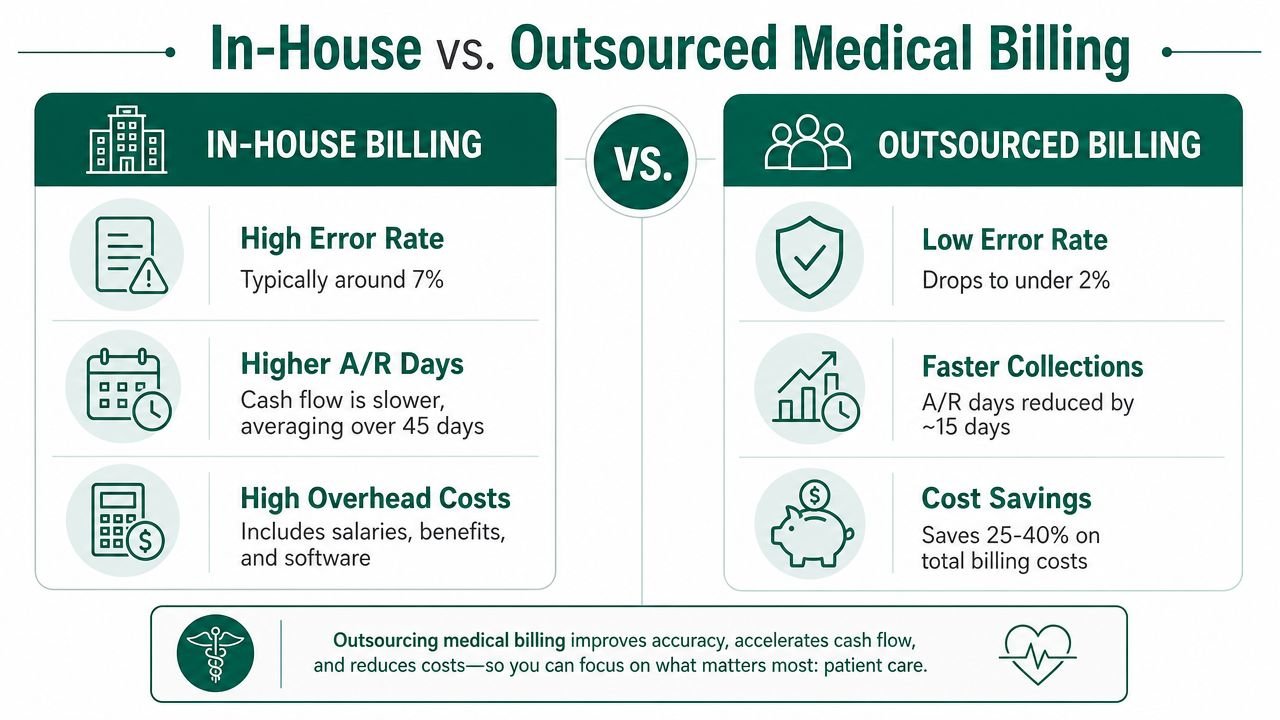
As you can see, outsourcing is designed to cut down on costly errors and get cash in the door faster, all while making your expenses more predictable.
From Generalities to Specific Gains
It's one thing to talk about percentages, but what does this look like in real dollars for your practice?
Imagine a busy cardiology practice. A small 5% drop in claim denials for a common procedure like a transthoracic echocardiogram (CPT 93306) could easily mean tens of thousands of dollars in recovered revenue every year. In our experience, it's not uncommon to improve a practice's overall collection rate by up to 20%. We achieve this by aggressively pursuing aged A/R and using our expertise to stop denials before they even happen.
Industry data backs this up. On average, practices that outsource see their total revenue collection jump by 15-25%. A huge part of this comes from a drastic reduction in claim errors—dropping from an average of 7% for in-house teams to under 2% with an expert partner. Fewer errors mean fewer denials and much faster payments.
The Immediate Impact on Cash Flow
One of the first things our clients notice is the effect on their working capital. It's common for a practice's average days in accounts receivable (A/R) to be 45 or more. We consistently get that number down to under 35 days.
Getting paid weeks sooner gives you incredible financial flexibility for things like upgrading equipment, giving your staff well-deserved bonuses, or even expanding your practice. Properly managing your billing is one of the most powerful strategies to boost your cash flow and secure your practice’s financial future.
Want to see what this would look like for your specific practice? For a detailed breakdown of the numbers, check out our guide on the cost of outsourcing medical billing. A great first step is to see how much revenue you're currently leaving on the table with a free audit of your current billing performance.
Why Specialty-Specific Billing Expertise Matters
Yes, specialty-specific billing expertise is the single most critical factor in protecting your practice’s bottom line. Would you send a patient needing complex heart surgery to a general practitioner? Of course not. Yet, that's exactly what many practice owners do with their revenue cycle when they choose a generic billing service, leaving significant money on the table.
This specialized knowledge has an immediate impact on your cash flow. We have seen firsthand how an anesthesiology biller who doesn't grasp the formula for base units, time units, and qualifying circumstance modifiers can cost a practice 15-20% of its revenue on a single case. A simple mistake, like misusing a QK modifier (medical direction of two, three, or four concurrent anesthesia procedures) instead of a QY (medical direction of one resident), has a major financial impact that generic billers miss time and time again.

Financial Nuances by Specialty
Different specialties have completely different revenue drivers and common denial traps. A true billing partner doesn't just push claims out the door; they anticipate these challenges and build a workflow designed to prevent them from ever happening, protecting your revenue.
Mental Health: For a practice providing regular psychotherapy sessions (like CPT 90837), proactive authorization management is everything. We've seen countless claims denied simply because authorizations weren't secured ahead of time or tracked correctly. An expert gets out in front of this, preventing those revenue leaks that erode your bottom line.
Orthopedics: This is a notoriously complex field, often involving Modifier 59 for distinct procedures performed on the same day. One wrong move and you’re looking at an automatic denial from payers. It's also vital to correctly manage the 90-day global period for major surgeries to ensure you capture all separately billable post-op visits, a common source of lost revenue.
A billing partner who understands the difference between a global surgical package and a separately billable E/M visit with modifier 24 (unrelated E/M service during a post-op period) can recover thousands of dollars per month for an orthopedic practice. This isn't just about coding; it's about understanding the financial story of each patient encounter to maximize what you've earned.
The Value of a Focused Partner
Ultimately, this expertise ensures your claims aren’t just submitted, but paid correctly on the first pass. This is how you lower denial rates, shorten your accounts receivable days, and boost your net collection rate. For example, our deep dive into cardiology medical billing services shows how we navigate the unique payer rules for diagnostic imaging and interventional procedures.
An expert partner speaks your language. They understand your procedures, your pain points, and your financial goals. Before you commit to any provider of outsourced medical billing services, make sure they can prove they have this level of specific knowledge for your specialty, like orthopedics.
How to Choose the Right Medical Billing Partner
The right medical billing partner is one that demonstrates deep expertise in your specialty, offers complete transparency through data, and can seamlessly integrate with your existing practice management system. Choosing the right partner is a critical financial decision for your practice; getting it right leads to healthier cash flow, while getting it wrong can create an even bigger financial mess. Your first question should always be about their ability to work within your current EHR to avoid a costly and disruptive data migration.
A smooth integration isn't just a "nice-to-have"—it's essential for preventing operational chaos and keeping revenue flowing during the transition.
Getting Under the Hood: Key Performance and Security Questions
Once you’ve confirmed technological compatibility, it’s time to dig into the performance metrics that actually impact your bottom line. Don't settle for vague promises of "great results." Demand hard numbers that reflect their ability to improve your revenue.
- What is your first-pass clean claim rate? This single number tells you almost everything you need to know about a company's competence. Anything below 95% should be a major red flag; for context, at Happy Billing, we consistently maintain a rate of over 98%, a standard set by the AAPC for high-performing billers.
- How do you handle denials? You’re looking for a proactive strategy, not just a reactive cleanup crew. A true expert partner doesn’t just resubmit denied claims; they dig in to find the root cause and implement system-wide fixes to prevent that denial from ever happening again, protecting your future revenue.
- What are your security protocols? Your partner will be handling a massive amount of protected health information (PHI). They absolutely must be fully HIPAA compliant and use robust security measures, like bank-level encryption, to protect your practice and your patients from a devastating data breach.
A billing partner who is truly confident in their abilities will welcome these tough questions. They should be ready and willing to show you detailed analytics on key performance indicators (KPIs) like their denial rate, days in A/R, and net collection rate. If they hesitate, walk away.
Demand Proof of Performance in Your Specialty
Finally, you need to insist on seeing proof that they can deliver results for a practice just like yours. A generic testimonial from a family practice doctor won't cut it if you run a cardiology clinic.
Ask for case studies or, even better, references from practices in your specific specialty. This is especially vital for complex fields with unique coding challenges, like anesthesiology, cardiology, or orthopedics. They need to demonstrate that they understand the unique billing hurdles you face every single day.
Making this decision with confidence requires you to be armed with the right information. We've compiled a complete list of questions to ask a medical billing company before hiring to ensure you find a genuine partner, not just another vendor.
What to Expect When Onboarding: A Transition Without the Chaos
The onboarding process should be a carefully managed, phased transition designed to be seamless for your practice and staff, with a primary goal of keeping your revenue stable and even improving it from day one. One of the biggest anxieties we see from practice owners is the fear of disruption, stalled payments, and a cash flow nightmare. A well-executed transition avoids this pain by mapping out a clear plan and establishing immediate financial wins.
A good partner will guide you through this process, ensuring you feel more in control of your finances, not less.
System Integration and Workflow Alignment
First things first, we securely connect to your existing EHR. This is a crucial point: you should never have to go through a painful data migration or force your team to learn a brand-new system. A true partner works within the environment you’ve already built, minimizing disruption from day one. We use secure, HIPAA-compliant connections to get the access we need without getting in the way of your clinical work.
At the same time, we get to work mapping out your current billing processes. We look at everything—from patient intake and eligibility checks to how you handle charge entry and payment posting. This deep dive lets us spot opportunities for immediate improvement and align our workflow with yours for a smooth handoff.
A Strategic Takeover of Your Accounts Receivable
While we're getting integrated, we also launch a strategic plan to tackle your existing accounts receivable. This isn't a passive takeover; it’s an active strategy to get cash in the door for you, fast. We triage your outstanding claims by value and age, immediately going after the high-dollar, recently aged claims that have the best odds of a quick recovery.
This A/R initiative is where you should feel the first real impact. In our experience, resolving even a small slice of that aged A/R provides an immediate cash infusion that proves the value of the new partnership. It can even fund the transition itself, turning a moment of anxiety into a clear financial victory.
Throughout this entire process, you'll have a dedicated account manager acting as your single point of contact. They’re there to coordinate every step, answer your questions, and make sure you’re always in the loop.
This structured onboarding takes the mystery out of making a switch. The right partner ensures your cash flow stays stable—and often improves—right from the very beginning. The best way to see how this could work for your practice is to get a clear, data-driven picture of where you stand. You can start by requesting a free audit of your current billing performance.
Keeping Your Outsourced Biller Accountable: The Metrics That Matter
You must keep an outsourced biller accountable by regularly monitoring key performance indicators (KPIs) that directly impact your practice's revenue and cash flow. Any legitimate billing partner will provide a transparent reporting dashboard that gives you this information at a glance, allowing you to manage their performance, not their process. Handing over your billing isn't a "set it and forget it" decision.
This kind of data-driven oversight is why the market for outsourced medical billing is growing so quickly. It was valued at around $11.7 billion in 2022 and is expected to climb at a rate of 12.6% per year through 2030. With North America's market share hitting 55.12% in 2025, it’s clear that more and more practice owners are turning to outside experts to manage the complexities of the revenue cycle and boost their bottom line.

Your Monthly KPI Checklist
Your monthly reports should spell out these four metrics in no uncertain terms. Together, they create a clear snapshot of your partner’s effectiveness and its direct impact on your cash flow. For a more detailed breakdown, we have an in-depth guide on the top medical billing KPIs to track.
- Net Collection Rate (NCR): This is the ultimate report card. It shows you the percentage of collectible revenue your partner is actually bringing in the door. You should be looking for a rate of 97% or higher.
- Days in Accounts Receivable (A/R): This number tells you the average time it takes to get paid after providing a service. A top-tier partner will work to keep this figure under 35 days.
- First-Pass Resolution Rate (FPRR): Also known as the clean claim rate, this shows you how many of your claims get paid correctly on the very first try. A strong billing team will consistently hit 98% or higher.
- Denial Rate: This metric tracks the percentage of claims that get bounced back by payers. Your goal is to see this number dip below 4%.
In our experience, a good partner doesn't just hand you a report with these numbers. They analyze them. If a certain payer suddenly starts denying claims more frequently, your partner should be the one to spot the pattern, figure out why it's happening, and come to you with a plan to fix it before it turns into a major revenue leak.
That’s the difference between a simple vendor and a genuine strategic partner. This proactive management is how you ensure your outsourced medical billing services are delivering real, measurable value to your practice.
How much do outsourced medical billing services cost?
Most experienced billing companies charge a percentage of the revenue they successfully collect for you, which usually lands somewhere between 4% and 9%. This performance-based model is ideal for a practice owner because it means our financial goals are perfectly aligned with yours; we don't get paid unless you get paid. When you compare this to the fixed, hard costs of an in-house team—salaries, benefits, software, and constant training—many practices find that outsourcing not only reduces their total billing overhead but also boosts their net revenue through higher collection rates.
Will I lose control over my practice's finances by outsourcing?
It’s a common and completely valid concern, but the reality is that with the right partner, you gain more control, not less. Instead of managing the daily grind of billing staff and processes, you manage the performance of an expert team through transparent data. We provide 24/7 access to financial dashboards and real-time reports showing your most critical metrics—A/R days, denial rates, and collection velocity. This allows you to step back from the weeds and make high-level strategic decisions based on accurate, up-to-the-minute data, giving you a much firmer grip on your practice's financial health.
What if my practice has unique billing requirements?
Every specialty has a unique financial fingerprint, and a generic, one-size-fits-all biller will inevitably fail to capture all your earned revenue. Understanding the specific coding and reimbursement complexities of a specialty like anesthesiology or cardiology is absolutely essential for getting paid correctly and on time. That's why we begin every partnership by digging deep into your practice's specific payer mix, common procedures, and historical denial patterns to build a custom workflow from the ground up. This is the only way to ensure we are positioned to maximize your collections. A free, no-obligation audit is the best way to see how we would tackle the specific revenue challenges and opportunities within your practice.