Geriatrics Medical Billing Services: Maximize Revenue In
If your geriatric claims are piling up in review, getting denied after discharge follow-up, or sitting in A/R longer than they should, the problem usually isn't volume. It's complexity. Geriatrics medical billing services exist to protect revenue in exactly that environment, where Medicare rules, Medicare Advantage variation, cognitive workups, and care management codes can turn clinically appropriate work into missed reimbursement.
That matters to your bottom line immediately. A geriatric practice can deliver excellent care and still lose margin if claims are coded correctly but documented poorly, filed under the wrong payer logic, or submitted without the timing support required for services like TCM, CCM, or Advance Care Planning. We've seen practices assume they have a staffing problem when they have a specialty RCM problem.
What Are Geriatrics Medical Billing Services
A common pattern looks like this. A practice owner notices that office visits are mostly paying, but higher-value geriatric services keep getting delayed, downgraded, or kicked back for documentation. Staff spend their time reworking claims instead of preventing errors upstream. Cash flow gets tighter even though the schedule stays full.
That's where geriatrics medical billing services differ from general billing support. They're specialized revenue cycle workflows built around elderly patient care, where claim success depends on more than basic charge entry. The service has to account for Medicare-driven rules, secondary coverage coordination, time-based billing, medical necessity narratives, and payer-specific edits that are far less forgiving in geriatric medicine.
In 2020, nearly 4 million adults aged 65 and older carried approximately $53.8 billion in unpaid medical bills, and the Consumer Financial Protection Bureau found inaccurate billing was the leading cause of these unpaid bills going to collections for Medicare beneficiaries. For a practice owner, that's not just a patient-financial issue. It's proof that billing accuracy in senior care has real downstream consequences.
What the service actually covers
Specialized geriatric billing usually includes:
- Eligibility and coordination review for Medicare, Medicare Advantage, and secondary plans
- Charge capture for high-risk services such as CCM, TCM, cognitive assessment, and Advance Care Planning
- Documentation review against payer rules before submission, not after denial
- Denial prevention and appeal handling tied to medical necessity, modifiers, and timing requirements
- A/R follow-up by claim type and payer behavior, not generic aging buckets
A useful primer for physicians who want to understand the division of labor inside RCM is this guide on what medical billers do in practice operations.
Practical rule: In geriatrics, “billing” isn't just posting charges. It's validating whether the chart supports the revenue before the claim ever leaves your system.
Practices that also use connected digital operations tools often benefit from vendors that understand healthcare workflows beyond billing alone. This overview of supporting digital health companies is useful if you're evaluating the broader tech stack around your revenue cycle.
Why general billing workflows break in geriatrics
Generalist teams tend to work reactively. They submit, wait, then appeal. That's expensive in a geriatric setting because the claim often fails for reasons that can't be repaired cleanly after the fact, such as missed contact windows, incomplete time documentation, or weak support for medical necessity.
A specialty-focused process flips that. It audits the note, confirms the payer rule, and checks whether the code selected will survive adjudication. For a busy owner, that's the difference between stable collections and a monthly surprise in your aging report.
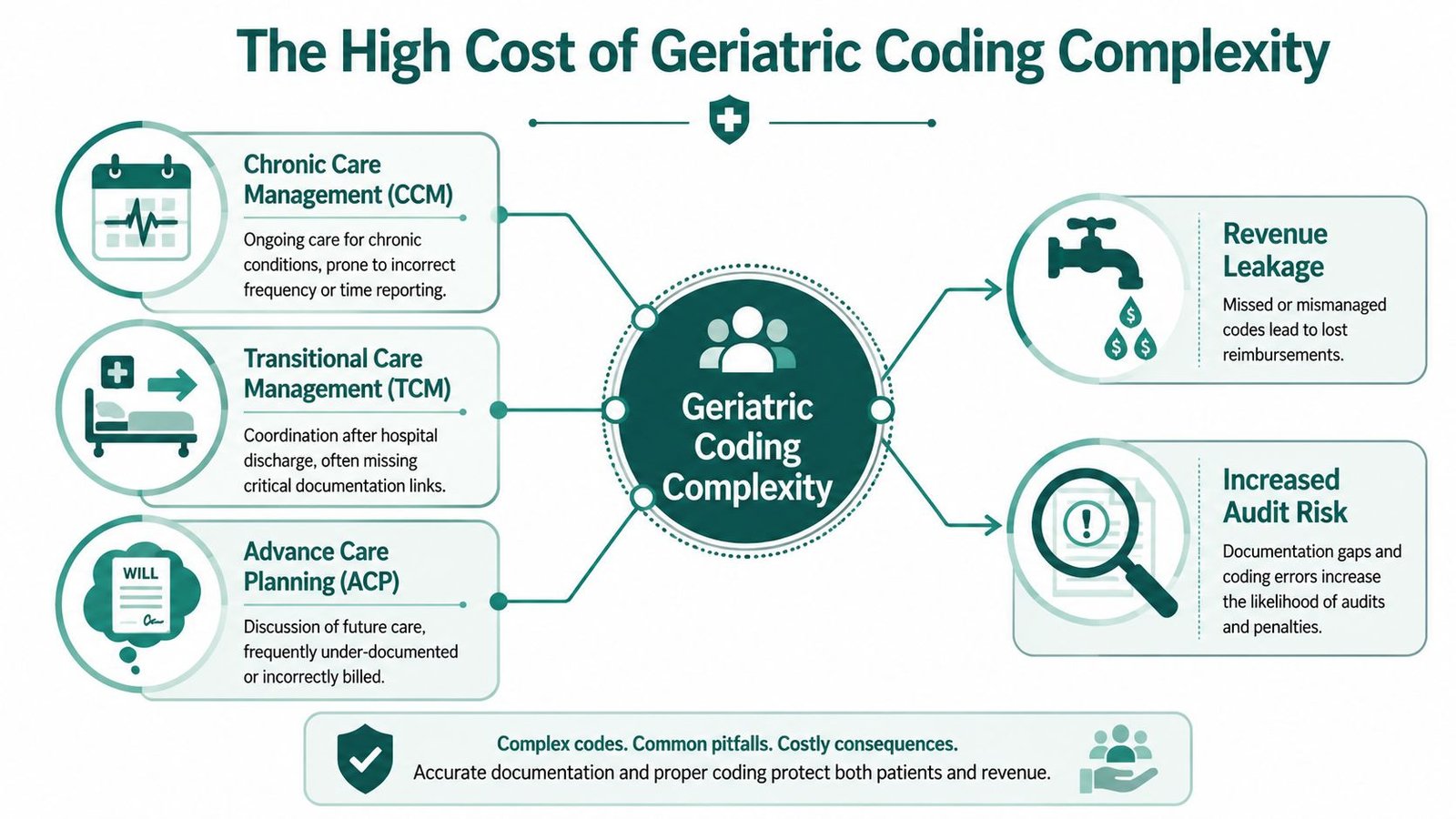
The High Cost of Geriatric Coding Complexity
The most expensive geriatric billing mistakes usually happen on services that require the most physician work outside a standard office visit. That's why the financial opportunity isn't in shaving seconds off routine claims. It's in capturing the codes many practices either underuse or mishandle.
CCM turns recurring care into recurring revenue
Chronic Care Management is a business test as much as a compliance test. If your physicians and care team are already managing multiple chronic conditions between visits, but your process doesn't consistently support CPT 99490 and related care-management workflows, you're doing reimbursable work without collecting for it.
The issue usually isn't that the service wasn't provided. It's that the monthly workflow failed to prove it. Time wasn't tracked cleanly, consent wasn't documented properly, or the chart didn't support the care-plan activity in a way the payer would accept.
For a practice owner, that creates a familiar frustration. Labor costs are real every month. Revenue capture becomes optional only because the billing process is weak.
TCM is unforgiving when operational timing slips
Transitional Care Management is one of the clearest examples of revenue forfeiture caused by process failure. CPT 99495 and CPT 99496 can represent legitimate reimbursement for post-discharge coordination, but only if your team documents the required outreach and follow-up within the payer's window.
If that contact window is missed, you don't usually get a second chance. The patient was still seen. The staff still did the work. But the practice loses the claim because the operational sequence broke.
That's why TCM shouldn't sit in a generic billing queue. It needs a tracked workflow tied to discharge notifications, outreach ownership, visit scheduling, and chart completion.
Missed TCM timing doesn't create a coding problem. It creates a revenue loss event.
Cognitive assessment is where underbilling hides
Cognitive work is often under-reimbursed because practices aren't sure whether to bill based on time, complexity, or both. That uncertainty is expensive. A 2024 National Health Policy Institute study found that 41% of practices underbill cognitive assessments due to unclear guidance on whether to bill by time or complexity, leading to an estimated $15M annual revenue loss in mid-sized geriatric clinics, as discussed in this Geripal review of medical billing and coding in geriatrics.
For many groups, that confusion affects CPT 99483 first. The service is clinically substantial, but if the documentation doesn't clearly support the assessment and care plan, physicians often default to a lower-level E/M mindset and leave money on the table.
A practical walkthrough of these kinds of specialty-specific claim challenges appears in this explanation of medical billing complexities in high-variation specialties.
Where owners should focus first
If you're reviewing geriatric billing performance, start with the services that have the biggest mismatch between effort and payment risk:
| Service area | Financial risk if mishandled | What usually goes wrong |
|---|---|---|
| CCM | Monthly recurring revenue is missed | Time, consent, and care-plan support are inconsistent |
| TCM | Entire claim can be forfeited | Outreach timing or follow-up workflow breaks |
| Cognitive assessment | Intensive work gets underbilled | Teams hesitate between time-based and complexity-based logic |
| ACP | Billable physician time gets downgraded | Face-to-face time isn't documented correctly |
The core mistake is treating these as coding details. They're margin drivers.
Navigating Payer Rules for Medicare and Medicare Advantage
A correctly coded claim can still fail if it violates the payer's policy. That distinction matters more in geriatrics than many owners expect, because the same service may be clinically appropriate, charted thoroughly, and still denied under a Medicare Advantage plan that applies edits differently from traditional Medicare.
Start with CMS rules, then test plan-specific variation
For Advance Care Planning, CPT 99497, CMS is explicit. It's strictly time-based. A CMS guideline requires a minimum of 30 minutes of face-to-face discussion for the code to be billable. If the interaction lasts 15 to 29 minutes, it isn't billable under 99497 and must be treated as a standard E/M visit.
That rule has direct revenue consequences. If your physician has an important but shorter ACP discussion and the note doesn't support the full threshold, pushing 99497 anyway creates a denial risk. If your team automatically drops the work into a generic E/M pattern without reviewing whether the threshold was met, the practice can under-collect.
Medicare Advantage creates a second layer of risk
Traditional Medicare often gives owners a clearer baseline. Medicare Advantage introduces plan-specific edits, referral rules, and internal documentation expectations that may differ even when the CPT code stays the same. The practical issue is that staff may think they're following “Medicare rules” while the plan is applying its own operational requirements.
That's especially dangerous for services connected to:
- ACP and care planning, where time support is essential
- Home and residence-based work, where place-of-service rules and plan edits matter
- Cognitive and functional services, where plans may scrutinize medical necessity more aggressively
- Add-on or same-day billing situations, where modifier logic affects payment
A short reference on one modifier issue that often intersects with payer edits is this guide to the GY modifier meaning and when statutory exclusions apply.
The payer question isn't “Did we code this?” It's “Did we code this in a way this plan will actually pay?”
Operational habits that protect reimbursement
The safest approach is to build a payer-rule review into claim preparation for high-risk geriatric services. In practice, that means:
Verify plan type early
Staff should identify traditional Medicare versus Medicare Advantage before the visit is finalized for billing.Tie time-based services to exact chart language
For ACP, the note should support face-to-face time specifically. Rounded or implied time invites trouble.Review same-day service combinations
If a physician performs a significant E/M service along with another reportable service, the claim needs a defensible modifier strategy, not guesswork.Check non-office settings carefully
Home, residence, assisted living, and related locations often trigger additional payer scrutiny.
Owners often assume their biggest billing risk is coding accuracy. In geriatrics, payer-rule mismatch can be just as costly.
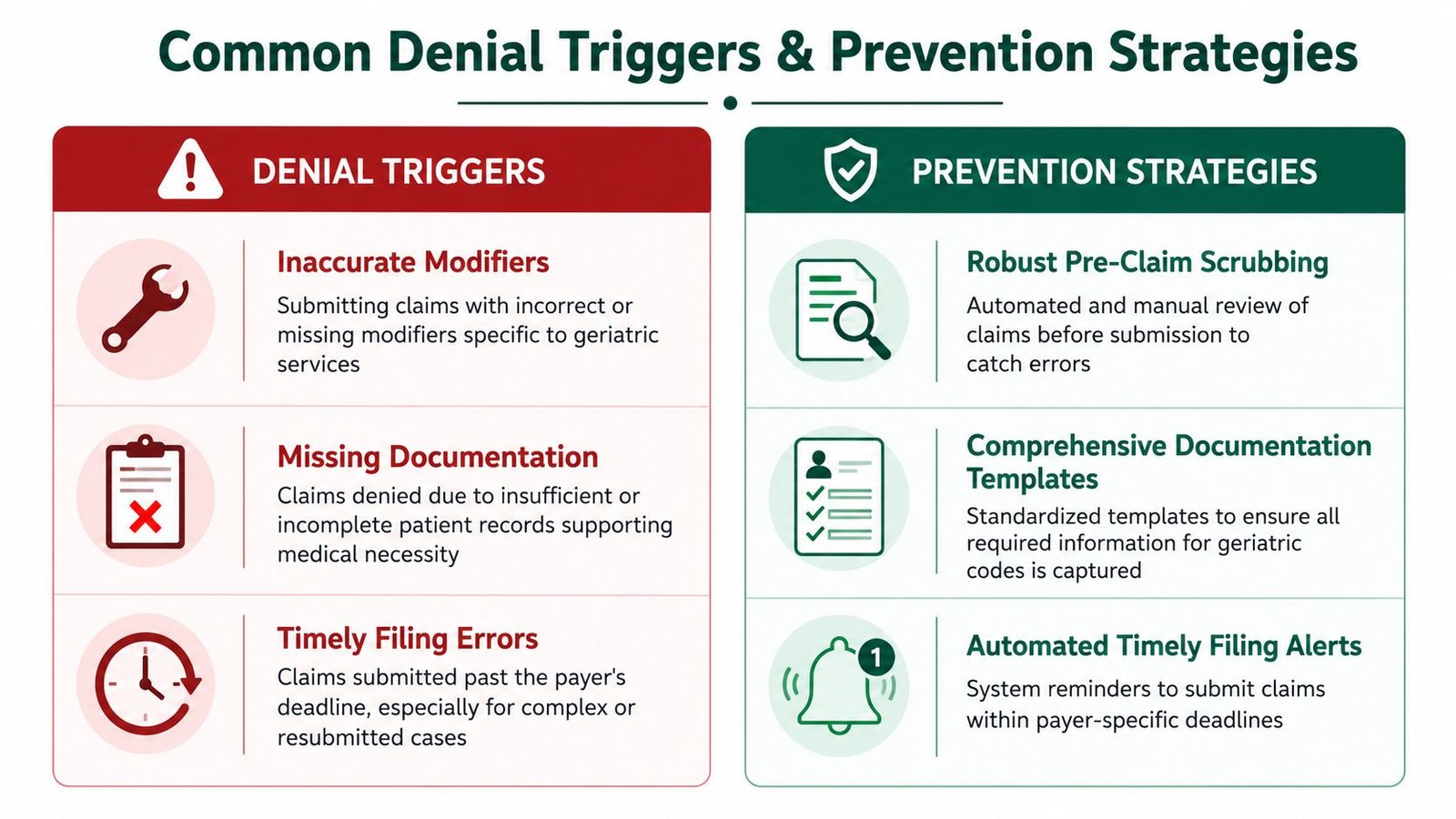
Common Denial Triggers and Proactive Prevention Strategies
Most geriatric denials don't come out of nowhere. They follow predictable patterns. If your team knows where claims tend to break, you can stop chasing denials after remittance and start preventing them before submission.
Denial trigger one is weak medical necessity support
In our experience, geriatric billing denials frequently trace back to documentation that names the service but doesn't justify why it was needed. That problem shows up often in cognitive and functional testing.
For CPT 96102 and CPT 96103, the risk is clear. Medwave notes that Medicare audits these services rigorously, and without a clear narrative linking the patient's condition to the service, claims are rejected at rates as high as 30%.
That's a practice management issue, not just a billing issue. If the physician note doesn't connect cognitive impairment, decline, behavior change, medication concerns, or functional deterioration to the testing performed, your biller is left defending a claim with no real support.
Denial trigger two is modifier misuse
Modifier problems don't always look dramatic on the front end. A claim may pass through charge entry and fail later because an E/M service was billed with a procedure but the record didn't justify a distinct, separately identifiable visit. In geriatrics, modifier 25 is the most common version of this issue when multiple services happen in one encounter.
Owners should care because these denials create expensive rework. Staff have to pull notes, compare payer edits, rebill, or appeal. Meanwhile, payment is delayed and the claim ages.
Denial trigger three is preventable filing delay
A denial prevention strategy fails if the clean-up happens too late. Geriatric claims often involve more moving parts, including care coordination, outside records, facility communication, and post-discharge events. That gives teams more chances to miss filing windows or let unresolved edits sit too long.
A disciplined denial prevention process should include:
Pre-claim chart checks
Confirm that time, medical necessity, place of service, and modifier logic are present before release.Service-specific templates
Use note prompts for cognitive testing, ACP, and care management so providers don't omit key support.Work queues by denial pattern
Separate medical necessity edits from eligibility problems and modifier issues. Generic queues hide trends.Payer-specific edit rules
Don't rely on a one-size-fits-all scrubber for Medicare and Medicare Advantage claims.
A practical resource for building that workflow is this guide to medical billing denial management and follow-up strategy.
Field observation: Practices usually don't have a denial volume problem first. They have a documentation design problem that denial volume later exposes.
What works better than appeals
Appeals matter, but appeals are recovery. Prevention is margin protection.
The strongest geriatric RCM teams review the encounter before claim submission with the denial reason already in mind. They ask: if this payer questions medical necessity, timing, modifier use, or service separation, does the record answer it immediately? If the answer is no, the claim isn't ready.
That mindset shortens A/R because fewer claims enter the cycle already damaged.
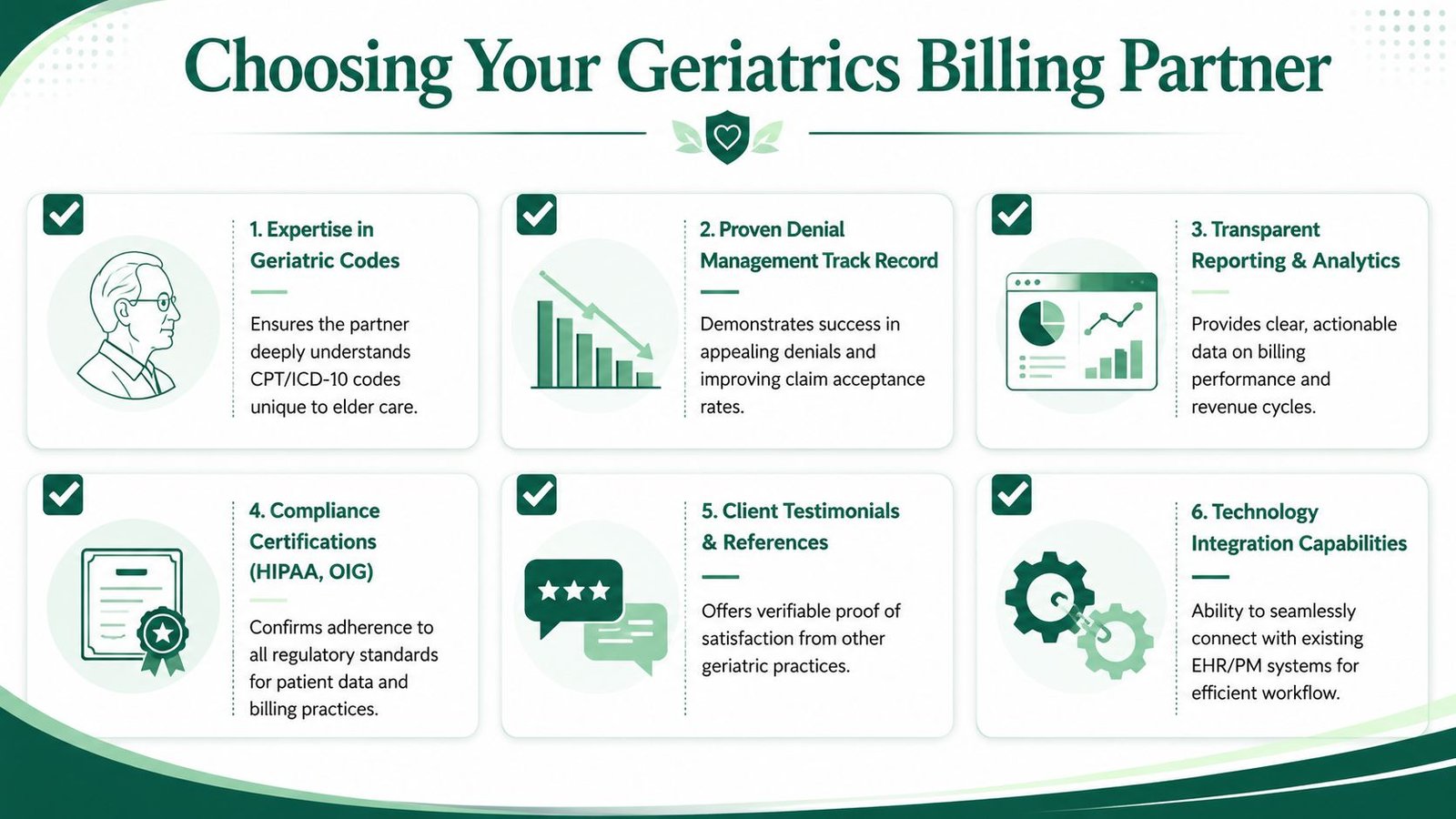
How to Evaluate a Geriatrics Medical Billing Partner
A geriatric practice can look busy, document good care, and still leave money on the table every week. The usual cause is not charge entry speed. It is weak control over high-value services that depend on timing rules, supervision rules, consent, and payer-specific edits. The billing partner you hire should close that gap and shorten A/R, not just submit claims faster.
Start with one question. Can this company explain how geriatric billing affects cash flow in your practice?
A qualified partner should be able to connect coding discipline to revenue in plain terms. For example, they should explain why missed TCM outreach can erase valid billing for 99495 or 99496, why weak monthly documentation can stall CCM under 99490, and why poor support for 99483 can trigger denials even when the clinical work was real. If they only talk about posting payments and chasing claims, they are describing a back-office vendor, not a specialty RCM partner.
Questions that reveal whether they understand the money
Ask direct questions and listen for operational detail.
How do you capture TCM from discharge through claim submission?
A strong answer should cover discharge feeds, outreach timing, visit scheduling, documentation review, and how the team verifies the 7-day or 14-day face-to-face requirement before billing 99496 or 99495.How do you monitor CCM eligibility and monthly time?
Look for a process around consent, care plan documentation, cumulative time, and conflicts with other care management services. If they cannot explain when 99490 is appropriate versus when another care management code may apply, expect revenue leakage.How do you review 99483 before release?
The right partner should mention required assessment elements, documentation support, and payer rules that affect medical necessity review.How do you handle Medicare Advantage plans differently from traditional Medicare?
A useful answer includes prior authorization checks when applicable, plan edits, referral rules, and claim-routing differences by contract. Medicare Advantage mistakes often show up as slower payment, not just denials.What will you change in our current workflow during the first 90 days?
Good partners can identify where money is currently missed. Weak partners give generic promises.
Use a structured hiring checklist if you want sharper interview questions. This guide on questions to ask a medical billing company before hiring is a practical place to start.
What to compare side by side
A generic billing company can collect on routine E/M claims and still underperform badly in geriatrics. Compare candidates against the work that drives margin.
| Evaluation area | What strong looks like | Warning sign |
|---|---|---|
| Specialty fluency | Can discuss 99490, 99495, 99496, 99497, 99483, modifier logic, and payer edits in revenue terms | Talks broadly about claim submission and follow-up |
| Workflow ownership | Has a defined process for discharge tracking, monthly care-management review, and chart-to-claim reconciliation | Waits for your staff to identify billable services |
| Reporting | Shows denial categories, payer lag, first-pass acceptance, A/R aging, and write-off reasons | Sends collections totals without root-cause detail |
| Technology fit | Works inside your current EHR and PM tools, with clear task ownership and audit trails | Pushes a disruptive platform change before fixing process |
| Compliance and audit readiness | Can show documented safeguards, role-based access, and claim-level review standards | Offers broad assurances without process documentation |
One more point gets missed during vendor review. Ask how they handle invoice accuracy and payment reconciliation on their side of the relationship, because billing partners that run disciplined financial operations usually report cleaner client data too. Some groups also use tools that streamline invoice management through AI to reduce administrative drag across vendor payments and internal finance workflows.
Pricing matters less than net collections and speed to cash
The cheapest contract often costs more in a geriatric practice.
Percentage-of-collections pricing can work if the partner is actively improving capture on underbilled services and reducing avoidable denials. Flat-fee pricing can work if service levels are clearly defined and the vendor still reviews high-risk claims with enough depth. The problem is the low-cost model that treats geriatrics like standard primary care, then leaves your team to fix TCM timing failures, unsupported ACP, or missed care-management months.
Judge price against three numbers: net collections, days in A/R, and revenue captured from specialty services your clinicians already perform.
KPI transparency should be claim-level, not just summary-level
Ask each vendor to show the exact reports you will receive. They should be able to produce:
- Days in A/R by payer
- Denial rate by reason code
- First-pass acceptance rate
- Turnaround time from date of service to claim submission
- Recovery performance on aging claims
- Monthly utilization trends for geriatric-specific codes
If those reports are missing, you will have a hard time proving whether the partner is improving cash flow or just keeping claims in motion. In this specialty, the right billing partner is not an expense line. It is a revenue control function.
The ROI of Specialized Billing Case Study Examples
The return on specialized geriatric billing usually shows up in three places first. Better capture on complex services, fewer preventable denials, and faster movement through A/R. The practices that benefit most are rarely the ones with the worst coders. They're the ones with the biggest gap between clinical complexity and revenue-cycle discipline.
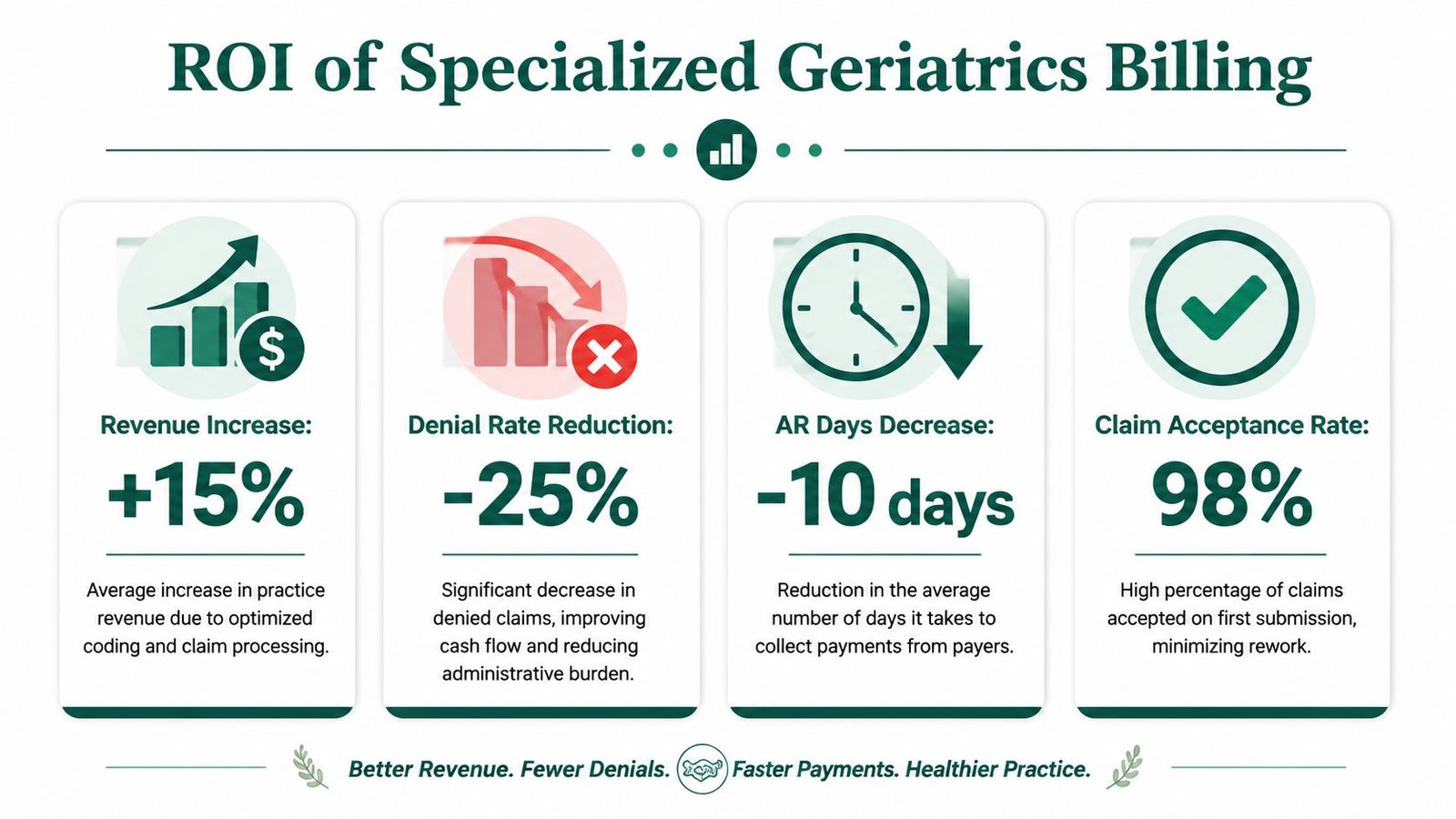
One common example is the independent geriatric group that bills standard E/M visits reliably but leaves care-management and post-discharge revenue inconsistent month to month. Once the workflow is rebuilt around discharge tracking, chart review, and service-specific charge capture, the revenue line becomes more predictable because fewer valid services go unbilled.
Another example is the physician who performs substantial cognitive work but documents it in a way that supports care clinically, not financially. Once the note structure changes, the claim reflects the true intensity of the encounter. That doesn't require more visits. It requires better reimbursement discipline.
We've also seen that billing improvement often depends on back-office efficiency outside claim submission itself. If your administrative stack still handles statements, follow-up, and payment workflows manually, it helps to study adjacent automation models such as how finance teams streamline invoice management through AI. The lesson carries over. The more standardized the workflow, the less revenue leaks through preventable handling errors.
ROI isn't abstract. It's captured work, shorter payment cycles, and fewer dollars stranded in preventable denial queues.
Frequently Asked Questions
Should a small geriatric practice outsource billing or fix its internal team first
Start with revenue performance. If your team can bill geriatric-specific services correctly, follow Medicare and Medicare Advantage rules, post charges on time, and show you clean KPI reporting, an internal rebuild may be enough. If TCM follow-up slips, CCM time is not captured consistently, or cognitive assessment work is documented but not billed at the right level, the problem is no longer just staffing. It is lost revenue and slower cash.
Outsourcing makes financial sense when specialty billing knowledge is the bottleneck. A strong partner usually fixes charge capture, denial follow-up, and aging claims faster than a generalist front-office hire.
Which geriatric services create the most revenue leakage
The biggest leakage usually sits in services with high clinical value and strict billing conditions. Common examples include TCM with 99495 and 99496, CCM with 99490, 99439, and 99491, cognitive assessment and care planning with 99483, and Advance Care Planning with 99497 and 99498.
These codes pay well because they require more than a routine visit. They also fail quickly when the workflow breaks. A missed interactive contact after discharge can kill a TCM claim. Incomplete time logs can sink CCM. A detailed cognitive care plan that is clinically sound but missing required billing elements can leave 99483 uncollected. That is why geriatric billing problems tend to hit margin harder than visit volume suggests.
How quickly should we know whether a billing partner is helping
You should see operational changes early. Within the first reporting cycle, the partner should be able to show where claims are stalling, which payer edits keep recurring, and which high-value services are being underbilled or written off.
Revenue improvement takes a little longer, but it should be visible. Clean-claim performance should rise. A/R over 90 days should start to come down. Rework should drop because the same denial reasons are being fixed at the front end instead of chased after submission.
What reports should I ask for every month
Ask for days in A/R, aging by bucket, denial rate, first-pass acceptance rate, payer mix, and a root-cause denial summary.
For geriatrics, ask for one more layer. Review performance by service line, especially TCM, CCM, cognitive assessment, and ACP. If those categories are missing from the monthly report, you cannot tell whether the practice is collecting the full value of the work your clinicians already perform.
If your geriatric practice is doing the work but not collecting the full value of that work, Happy Billing can help identify where revenue is slipping. Their team works inside your current EHR, combines AI-driven workflows with expert human review, and focuses on the metrics owners care about: cleaner claims, lower denial pressure, and faster cash flow. If you want a clear read on what is hurting collections today, request a free billing audit.