A Guide to DME Medical Billing Services for 2026
DME medical billing services are specialized revenue cycle management partners that handle the complex claims process for durable medical equipment, protecting your practice's cash flow. For a physician-owner, this means offloading the notoriously difficult process of getting paid for items like CPAP machines or orthopedic braces. Expert DME medical billing services directly impact your revenue by preventing costly denials and reducing A/R days, which are common problems for practices that manage this in-house.
Understanding DME Medical Billing Services
Durable Medical Equipment (DME) billing isn't just another service line; it's a completely different discipline from standard procedural billing. In our experience, practices trying to manage this in-house often see initial denial rates climb as high as 20-30%. That’s not a minor administrative issue—it's a direct threat to your practice's financial health that immediately puts tens of thousands of dollars of your revenue at risk.

Think of a dedicated DME billing service as a financial safeguard for this notoriously tricky revenue stream. They do more than just submit claims; they protect your bottom line by focusing on a few critical areas:
- Payer-Specific Rule Mastery: They live and breathe the constantly changing rules for equipment rentals, purchases, and repairs from Medicare, Medicaid, and dozens of commercial payers.
- Proactive Denial Prevention: Their goal is to get claims paid on the first pass. This means ensuring every piece of documentation, every modifier, and every prior authorization is perfect before the claim goes out the door.
- Accelerated Cash Flow: By slashing denial rates and aggressively working any claims that do get held up, they directly lower your days in A/R.
The financial stakes here are enormous. Industry data shows that up to 30% of DME claims are denied on first submission. If your practice submits 10,000 claims a year at an average reimbursement of $400, a 25% denial rate immediately puts $1 million in potential revenue at risk.
For a practice owner, the value is simple: A specialist partner stops this revenue leakage. They ensure every claim is handled correctly the first time, directly shrinking your A/R days and preventing massive financial losses before they even happen.
This specialized approach is a vital part of a healthy financial strategy. If you want to see how this fits into the bigger picture, you can learn more by reading our guide on what is revenue cycle management. Ultimately, bringing in expert DME medical billing services transforms a high-risk, high-frustration part of your business into a predictable and profitable one.
How DME Coding Errors Hurt Your Practice's Revenue
When it comes to Durable Medical Equipment (DME), a simple coding mistake isn't just a clerical slip-up—it's a direct leak from your practice's revenue stream. These small errors quickly snowball into major financial problems, driving up your denial rate and bloating your accounts receivable. From what we've seen across hundreds of specialty practices, this is one of the most vulnerable points in a practice's cash flow.
For a physician-owner, every DME claim is a high-stakes transaction. One wrong move, and the payment you’ve earned is gone. This isn't just a theoretical risk; a single coding error on a high-value item can freeze thousands of dollars in revenue for months, if not permanently.

The Financial Cost of Specific Coding Mistakes
The financial damage from DME coding mistakes isn't an abstract concept. It’s tied directly to specific HCPCS codes and modifiers that payers use to approve or deny payment. Getting these details wrong leads to instant denials and lost revenue that piles up faster than most practices realize.
Just look at these real-world, high-cost scenarios we regularly solve for our clients. The table below shows how seemingly minor slip-ups can put significant revenue at risk with every single claim.
The Financial Impact of Common DME Coding Mistakes
| DME Item | HCPCS Code Example | Common Reason for Denial | Typical Revenue at Risk per Claim |
|---|---|---|---|
| CPAP Machine | E0601 | Billed as a new purchase (NU modifier) without a documented sleep study or the required prior authorization. | $800 – $1,200 |
| Hinged Knee Brace | L1832 | Forgetting the RT (right) or LT (left) modifier, causing an automatic system rejection. | $150 – $250 |
| Power Wheelchair | K0823 | Failing to meet every strict requirement in Medicare's LCD, such as specific physician notes on mobility needs. | >$5,000 |
These examples show that a simple oversight isn't just an administrative task to fix later—it's a revenue event that halts cash flow and forces your team to chase money you should have already received.
These aren't just coding issues; they are revenue events. Each denial represents cash that isn't flowing into your practice, forcing you to spend more time and money chasing payments you should have received the first time.
Modifiers: The Difference Between Payment and a Write-Off
In the world of DME medical billing services, modifiers aren't suggestions. They are commands that tell the payer exactly how to process your claim. Using the wrong one is like sending a package to the wrong address—it’s coming right back to you, denied.
For example, billing with an RR modifier (rental) when the item was actually a new purchase (NU modifier) will trigger an immediate denial. This simple mix-up can turn a profitable transaction into a complete write-off if your team doesn't catch the error and file an appeal within the payer's tight timely filing window.
Our work with specialty practices has proven that mastering these nuanced rules is absolutely non-negotiable for financial health. You can explore more strategies for overturning these types of rejections in our detailed guide to medical billing denial management.
A Proactive Approach to DME Prior Authorization
Prior authorization is often the single biggest bottleneck in the entire DME revenue cycle. Think of it as the gatekeeper to your practice’s cash flow. In our experience, authorization failures are the root cause of up to 70% of all DME claim denials — a staggering number that lands a direct hit on your bottom line.
This isn’t just another administrative chore; it’s a critical revenue protection strategy. A reactive approach, where your team dispenses equipment first and chases the authorization later, is a recipe for financial disaster. It guarantees denied claims, bloated A/R days, and hours of staff time wasted on rework. The financial health of your practice depends on stopping these denials before they ever happen.
The Proven Workflow for First-Pass Approval
A disciplined workflow turns prior authorization from a revenue risk into a predictable process. The goal is simple: build an ironclad case for medical necessity that leaves payers with no reason to say no. This comes down to a few essential, non-negotiable steps.
Proactive Eligibility and Coverage Verification: Before any equipment is even ordered, your team must confirm the patient's insurance plan specifically covers the DME item in question. This first check prevents you from providing equipment that was never going to be reimbursed, saving you thousands in eventual write-offs.
Anticipatory Documentation Assembly: Don't just gather the minimum paperwork. The key is to assemble a complete documentation packet that anticipates and answers every potential payer question before it’s asked. This is exactly where most in-house teams fall short, leading to costly delays and denials.
For high-value equipment like a custom wheelchair (e.g., K0005), this means including not just the prescription, but also the physician's Detailed Written Order (DWO), chart notes from the required face-to-face encounter, and any functional assessments that prove medical necessity. Submitting an incomplete file is practically a guaranteed denial that puts thousands of dollars in revenue on hold.
- Secure Authorization Before Dispensing: The final step is to submit the complete packet and get a formal prior authorization number from the payer. Only after you have this approval in hand should the equipment be provided to the patient. This single discipline effectively eliminates the largest source of DME denials.
From Bottleneck to Revenue Accelerator
Putting a proactive authorization process in place does more than just slash your denial rate. It directly accelerates your cash flow by ensuring claims get paid correctly on the first submission. For practice owners struggling to keep their Days in A/R below 40 or 50, mastering this workflow is a game-changer.
Our dedicated process helps practices keep A/R under 35 days by clearing these predictable roadblocks. For a deeper dive into the mechanics, you can read our guide on what is prior authorization in healthcare. This proactive approach is a cornerstone of effective DME medical billing services.
Protecting Your Practice from Costly DME Audits
DME billing has a giant red target on its back for CMS audits, making compliance less about paperwork and more about financial survival. This isn't a simple administrative headache. Post-payment audits can trigger devastating recoupments that claw back years of revenue, putting your practice’s financial future on the line.
The Office of Inspector General (OIG) keeps an intense watch on DME, which accounts for billions in Medicare spending and is consistently flagged as a high-risk area. In fact, a CMS analysis found that 20–25% of claims from some high-volume suppliers were either not medically necessary or were missing basic documentation. That report kicked off a wave of audits that continues to this day.
How Audits Are Triggered and Why They Cost You
Auditors are trained to spot specific red flags. Common triggers include the sloppy use of the KX modifier—the one that attests you have all your documentation in order—or billing for equipment without bulletproof proof of medical necessity. If you can’t produce a perfect paper trail on demand, you risk having to pay back every single dollar you received for those claims, often with penalties attached.
For a busy practice owner, the threat is very real: a single, poorly documented claim for a high-cost item could trigger an audit that puts hundreds of thousands of dollars in past reimbursements at risk. That's a direct hit to your cash flow and operational stability.
The only way to defend against this is to build compliance into your billing process from the very start. A specialized DME medical billing services partner doesn't just chase payments; they build a fortress around your revenue.
This proactive approach is the only way to prevent the documentation gaps that lead to audit failures.
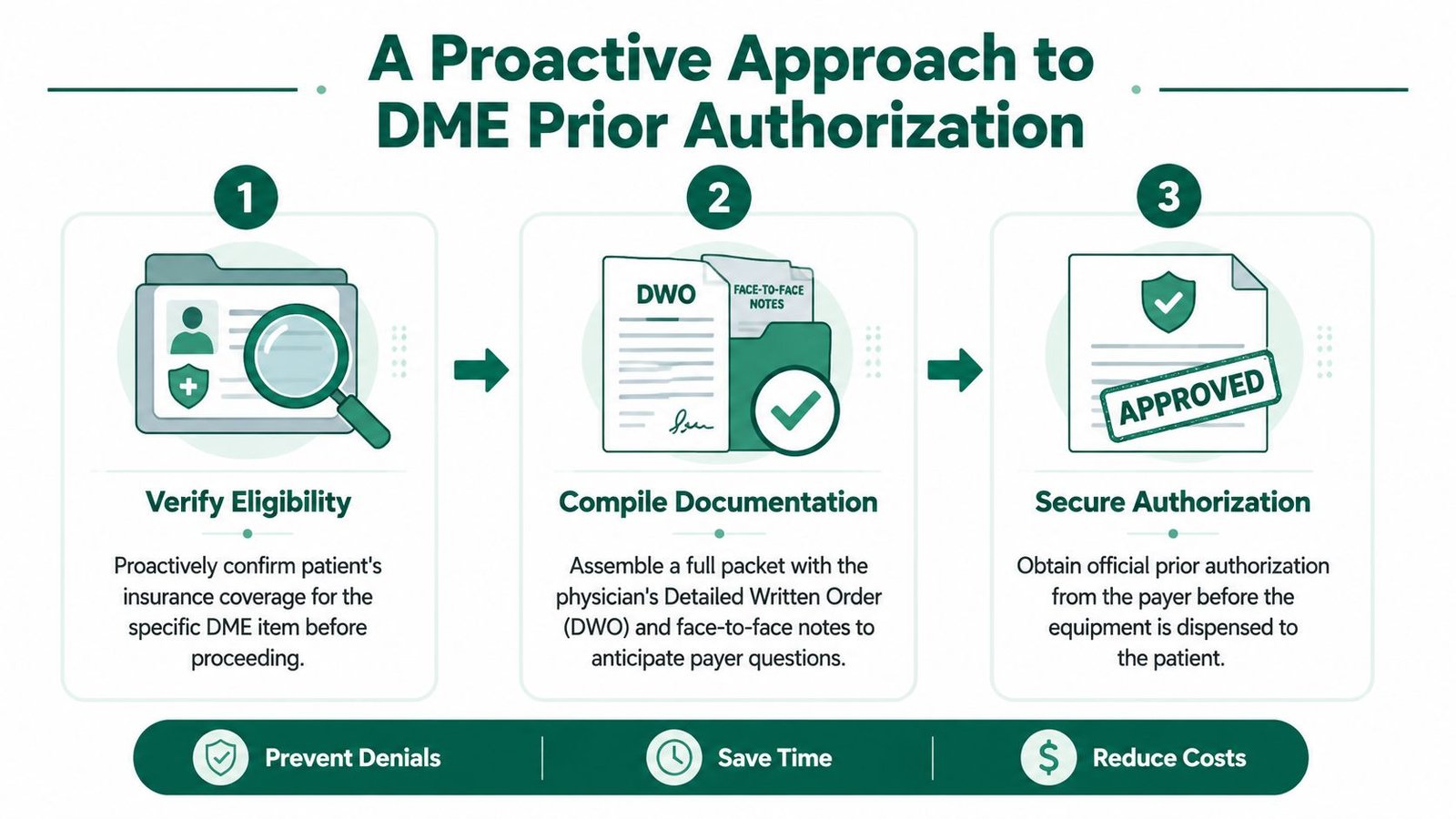
As you can see, building an audit-proof claim starts long before you hit "submit." It starts with rigorous verification and airtight documentation protocols. We protect your practice by running every claim through pre-submission reviews and strictly adhering to Certificate of Medical Necessity (CMN) requirements. The result is an audit trail that stands up to the toughest scrutiny.
You can learn more about how we help practices prepare for and respond to payer inquiries in our guide to medical billing audit services.
Measuring the Financial Health of Your DME Billing
You can’t manage what you don’t measure. For a practice owner, vague assurances from your billing team are meaningless without cold, hard data. The real financial health of your DME operation comes down to just a handful of numbers that show exactly where your cash is—and isn't—coming from.
These metrics are the only way to hold any billing team, whether in-house or outsourced, accountable. Without them, you’re flying blind, unable to see how much revenue is leaking out of your practice every single month. We’ve seen firsthand how reducing Days in A/R by just 10 days can pump tens of thousands of dollars straight back into a practice’s bank account.
The Three KPIs That Matter Most
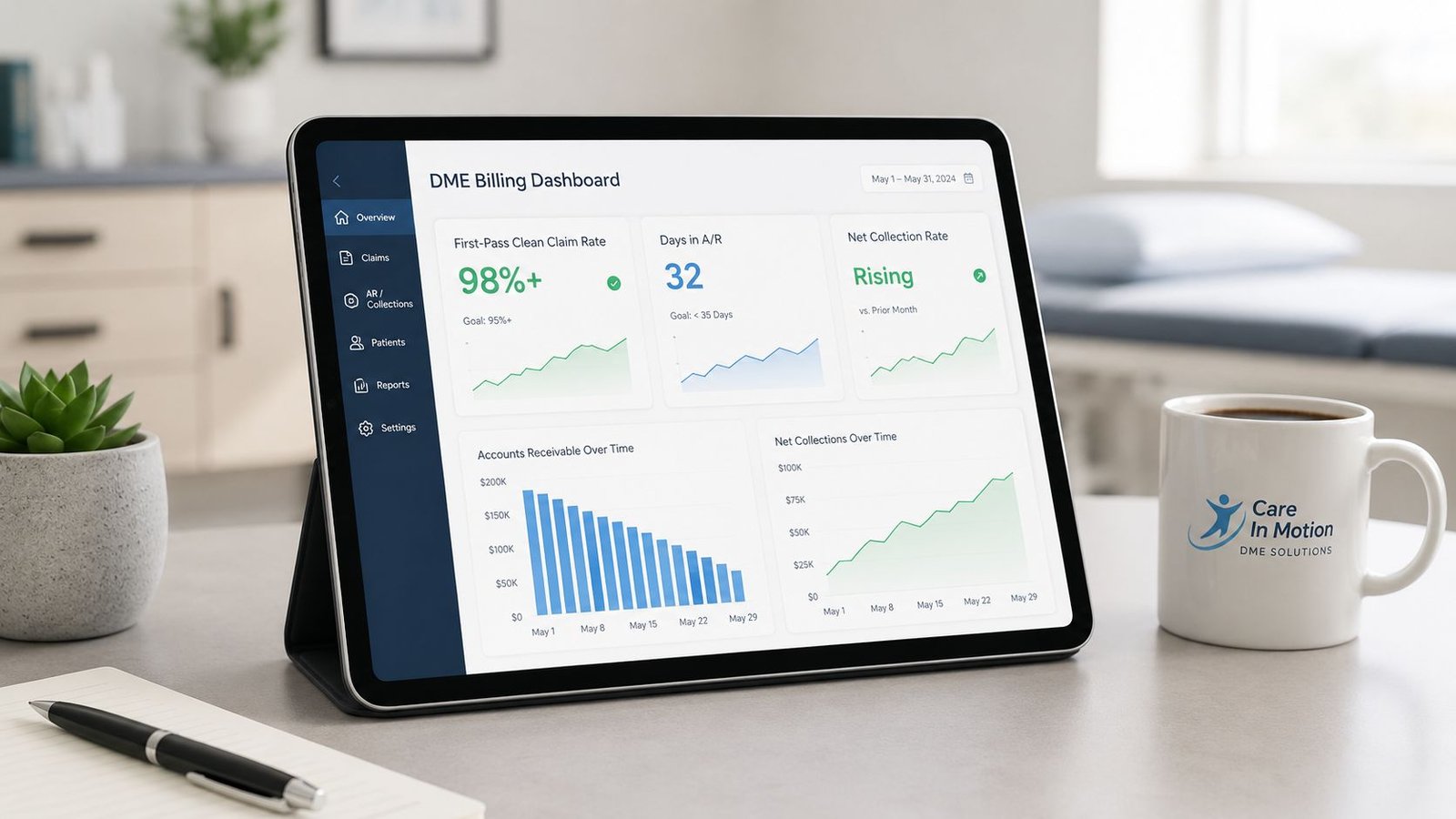
Forget the vanity metrics. Your DME practice's financial health really hinges on just three core numbers. These are the indicators that give you a clear, undeniable picture of your revenue cycle’s real-world performance.
First-Pass Clean Claim Rate (FPCCR): This is the percentage of your claims that get paid on the very first submission, no questions asked. A low rate means your team is making costly mistakes upfront that choke your cash flow from the start. Your target should be over 98%.
Days in Accounts Receivable (A/R): This tells you the average number of days it takes to get paid after submitting a claim. High A/R days mean your cash is trapped with payers instead of working for your practice. For DME, your goal should be under 35 days.
Net Collection Rate (NCR): This is the ultimate measure of success. It shows you the percentage of the total collectible amount you actually receive after all is said and done. A strong DME medical billing services partner should be hitting an NCR of 97% or higher.
When measuring your practice's overall financial health, it's also smart to understand all your cost factors. This even includes the capital costs for your equipment. You can learn more about Healthcare equipment financing options to get the full picture.
Knowing these numbers empowers you to see exactly how you're performing. If your metrics are falling short, it’s a bright red flag that your billing process needs a serious overhaul. You can get a complimentary, data-driven analysis of your practice's KPIs by requesting our free billing audit.
How to Choose the Right DME Billing Partner
Choosing your DME billing partner is one of the most critical decisions you'll make for your practice's financial health. Get it right, and you have a true extension of your team that fiercely protects your cash flow. Get it wrong, and you’ll watch a generic biller who doesn’t grasp DME’s unique rules cause significant financial damage.
We’ve seen it happen. Practices suffer devastating losses after hiring a standard medical biller who simply doesn’t understand the specialized documentation and coding that payers demand for durable medical equipment.
The right choice comes down to asking the right questions. Vague promises of "higher collections" are just noise. You need a partner who can give you specific, evidence-backed answers that prove their expertise and align with your financial goals.
Key Questions to Ask Potential Partners
Before you sign any contract, sit down with a potential partner and demand clear answers to these questions. Their responses will quickly reveal whether you’re talking to a genuine specialist or a generalist just trying to win your business.
Can you prove your experience with my specific DME products? A partner billing for an orthopedic practice needs to be an expert in codes like L1832 for knee braces. One working with a cardiology practice must be fluent in the documentation for cardiac monitoring devices. Ask for case studies or references from practices just like yours.
How will you integrate with our current EHR? The last thing you need is a months-long, painful data migration or a mandate that your staff learns entirely new software. A top-tier partner should operate seamlessly within your existing system, causing zero disruption to your clinical workflow.
Walk me through your exact process for overturning a denial. Don’t accept a fuzzy answer. Ask them to detail their appeal strategy for a common DME denial, like one for a CPAP machine (E0601) due to missing documentation. A true expert will have a step-by-step process ready.
Beyond process, remember that all aspects of your practice, including billing, must adhere to strict regulations. Be sure to inquire about their compliance protocols for protecting your practice from HIPAA fines.
Look for a Partner, Not Just a Vendor
The financial impact of a skilled DME billing partner is massive. Industry data shows that suppliers using standardized, tech-assisted workflows and robust denial management can slash their clean-claim failure rates from a typical 25% down to below 5%. At the same time, they often cut their days in A/R by 20–30 days.
Your goal is to find a partner who will protect your revenue as fiercely as you do. This means choosing a team that offers transparent reporting on key KPIs, proactive compliance, and a dedicated strategy for your specific financial challenges.
Finding the right fit involves a detailed evaluation of their people, processes, and technology. For more guidance on vetting potential partners, check out our guide on how to choose the best medical billing company for your practice’s unique needs.
How do I know if outsourcing DME billing is financially worth it?
The financial case is straightforward: compare the total cost of outsourcing to the revenue you are currently losing. A professional billing partner should recover far more in otherwise lost revenue than their service fee. We recommend looking at your current DME denial rate and A/R days—if your denial rate is above 5% and your A/R is over 45 days, outsourcing will almost certainly generate a significant positive ROI by fixing these revenue leaks. A complimentary billing audit can give you a precise ROI calculation for your specific practice.
What makes DME billing so much harder than regular medical billing?
The primary challenge is the sheer complexity and specificity of payer rules. Unlike billing for a standard office visit, DME billing involves unique modifiers (e.g., RR for rental, NU for new equipment), strict prior authorization mandates for high-cost items, and detailed medical necessity documentation that must be perfect. A single missing document for a power wheelchair (K0823), for example, can lead to the denial of a $5,000+ claim. This requires a level of specialized expertise that most general medical billing teams simply do not possess.
Will I lose control if I outsource my DME billing?
No—in fact, you gain more control. A high-quality DME medical billing services partner provides transparent, real-time data on your key financial metrics. Instead of being buried in the weeds of claim submissions and denial follow-up, you get a high-level, strategic view of your revenue cycle through clear dashboards. This lets you hold your billing team accountable to performance benchmarks (like A/R days under 35) and frees you to focus on patient care and practice growth, confident that your revenue is being expertly managed. We have deep expertise in related fields like orthopedics billing. To see exactly how much revenue is at stake, you can get a data-driven analysis of your practice with a free billing audit.