PR 26 Denial Code: Your Guide to Fixing & Preventing It

You’re probably looking at PR 26 denials after the visit is done, the claim is out, and your team is already chasing payment that should’ve been protected at check-in. PR 26 means the payer says the service happened before the patient’s coverage effective date. If you run a busy practice, that’s not a minor front-desk error. It’s a direct revenue leak.
What Is the PR 26 Denial Code and Why Does It Matter
PR 26 denial code means “expenses incurred prior to coverage.” In plain English, your claim was denied because the payer believes the date of service came before the patient’s insurance became active.

That sounds simple. It isn’t. A denial tied to effective-date failures sits in the most expensive part of the revenue cycle because it starts at registration, infects the claim, delays reimbursement, and often creates a patient balance nobody wants to collect.
According to Combine Health’s PR-26 denial code analysis, healthcare denial rates run 6% to 13%, registration and eligibility issues account for 30% of all denials, 85% of denials are preventable, and denial-related revenue cycle work can consume up to 20% of a provider’s budget. That is why I treat PR 26 as a management problem, not a billing nuisance.
Why practice owners should care
If your staff enters an old policy, misses a coverage start date, or assumes a returning patient still has active benefits, the payer doesn’t care that the clinical work was valid. The claim still fails.
This gets worse in specialties with expensive encounters and procedural coding complexity. A denied anesthesia claim with an ASA code, a cardiology imaging study, or a therapy series that crosses a coverage transition can tie up cash quickly. The denial starts with eligibility, but the financial impact lands in A/R, patient collections, and staff rework.
Practical rule: If your front desk treats eligibility as a demographic task instead of a revenue-control function, PR 26 will keep recurring.
What PR 26 is really telling you
When you see PR 26, assume one of four failures happened:
- The patient gave outdated coverage information and nobody validated the effective date.
- The staff verified the wrong plan or selected the wrong payer record in the PM system.
- The claim used the wrong subscriber or member ID, which made active coverage look inactive for that service date.
- The service date crossed a coverage transition, and your workflow didn’t catch it before claim submission.
A clean claim starts long before coding. If your team needs a refresher on what that standard should look like, review how a clean claim works in medical billing. PR 26 is what happens when the front end fails that standard.
Where PR 26 hits hardest
PR 26 is especially damaging when the claim includes time-sensitive or high-value billing elements, such as:
| Claim type | Why PR 26 hurts more |
|---|---|
| Procedural claims | Larger balances sit unresolved while staff investigates coverage |
| Series-based therapy claims | Multiple dates of service may need rebilling or split handling |
| Global-period follow-up | Coverage changes create confusion about financial liability |
| Diagnostic imaging | High-dollar pre-service claims get denied over a basic effective-date miss |
You can’t code your way out of a bad effective date. You have to verify it before the patient is seen, or correct it fast before the balance ages.
How to Read a PR 26 Denial on Your Remittance Advice
You’ll usually spot PR 26 on the ERA, the paper EOB, or inside the payer portal claim detail. The code appears in the adjustment reason area and tells you the payer assigned the denial under PR, which stands for patient responsibility.
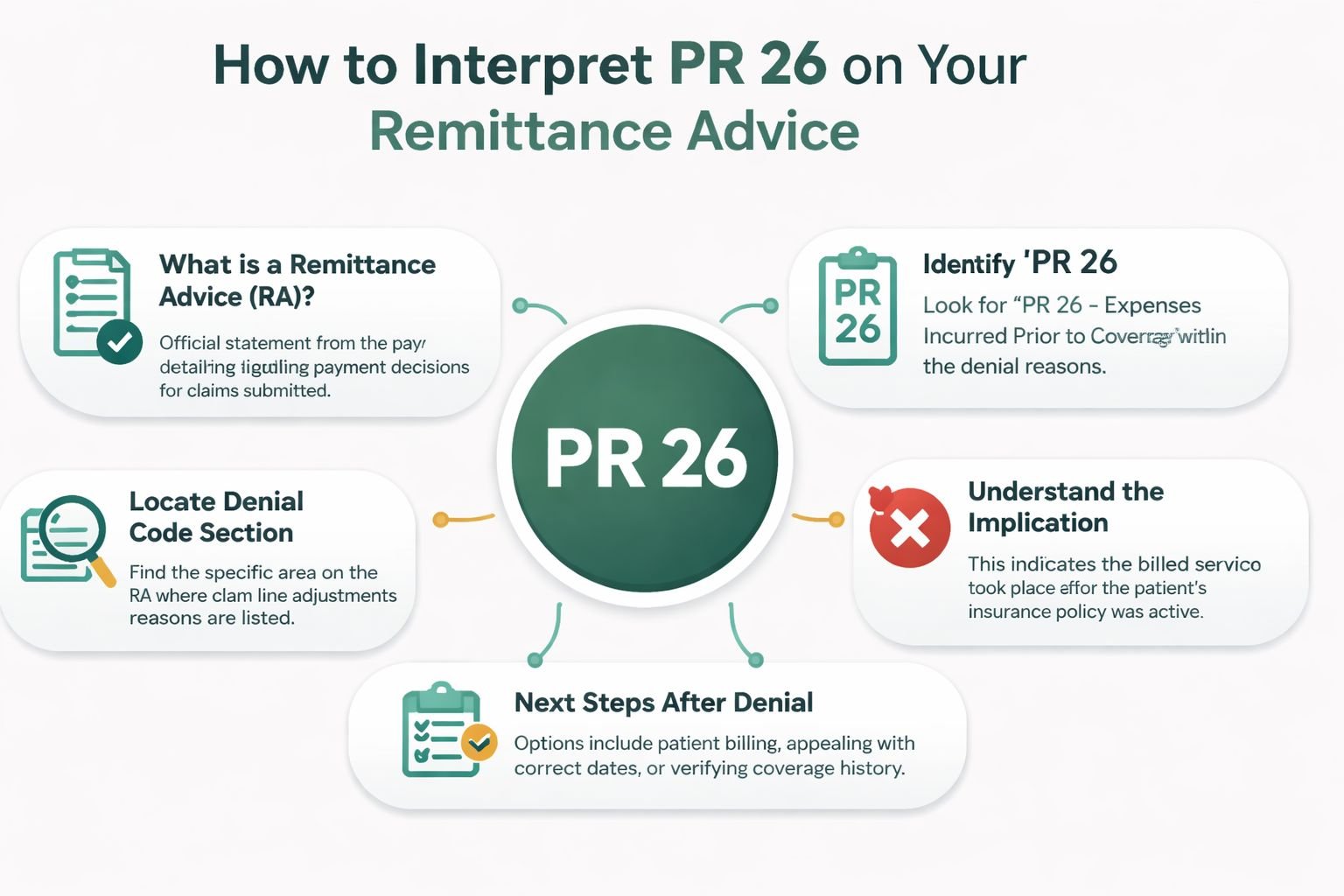
The easiest way to explain it to staff is this. It’s like trying to use a card before activation. The account may exist, but the coverage wasn’t active for that date of service.
What to look for on the ERA or EOB
On the remittance, your team should review three things together, not in isolation:
- The group code. PR means the payer is assigning liability to the patient unless the denial is overturned.
- The adjustment reason code. In this case, 26 identifies the issue as prior-to-coverage.
- The service line date. Confirm whether the payer denied one line, multiple lines, or the whole claim based on dates.
If the claim contains several dates of service, don’t assume every line is wrong. A recurring service or treatment series can have some dates before coverage and others after.
PR versus CO matters
Your billing team should distinguish PR from CO immediately. PR says the payer is shifting financial responsibility to the patient. CO usually points to a contractual adjustment issue instead.
That distinction changes your next move. With PR 26, you don’t send a patient statement just because the payer said so. You first validate the effective date, the insurance entered on the claim, and whether another payer was active.
A fast denial review saves more money than a fast patient statement. Bill the patient only after your team proves the denial is correct.
A quick reading workflow
Use this sequence every time PR 26 appears:
- Open the remittance line detail and confirm whether the denial is at claim level or service-line level.
- Match the denied date of service against the eligibility response stored in your PMS, clearinghouse, or verification tool.
- Check the payer record submitted on the claim against the card on file and scanned insurance images.
- Review any related remark codes that add context about eligibility, policy status, or member data mismatch.
If your staff struggles with remittance interpretation, have them standardize the process using this guide to reading an explanation of benefits. Most denial cleanup failures happen because teams read only the denial label and skip the service-line detail.
What this looks like in coding reality
A few examples make this clearer:
- CPT 90837 billed for a psychotherapy visit on the first week of the month. The patient’s new plan started later in the month. PR 26 posts to that DOS.
- CPT 78492 billed for a cardiac PET service done one day before a commercial plan effective date. The payer denies the imaging line with PR 26.
- ASA 00790 submitted for anesthesia services during abdominal surgery, but the member’s replacement plan wasn’t active yet. The entire claim can deny, even if your units and modifiers are correct.
The coding can be flawless. The effective date still wins.
Common Scenarios That Trigger PR 26 Denials
PR 26 doesn’t usually come from exotic payer behavior. It comes from ordinary operational misses that happen every day in busy practices.
The January enrollment gap
A patient books an appointment in December, shows up in early January, and says, “I have the same insurance.” The front desk copies the old card already in the system and moves on.
The problem is that the patient changed plans during open enrollment. The old plan ended. The new plan starts on a different date, or the patient hasn’t provided the new member ID yet. The claim goes out under stale coverage and comes back PR 26.
This is common with office-based services like 99213, 99214, and recurring follow-up visits. It also shows up on behavioral health series billing when staff rely on old registration data from the prior year.
The new job mix-up
An established patient leaves one employer and starts another. They know they have insurance again, but they don’t know the exact effective date. Your staff hears “active coverage” and doesn’t verify the date.
Then your practice bills a date of service that falls in the waiting period between plans. On paper, the patient was insured “around that time.” In payer terms, they were not covered that day.
That distinction is where PR 26 lives.
The card on file problem
Returning patients create false confidence. The card is scanned. The payer name looks familiar. The last visit paid. Staff assume nothing changed.
That’s how a wrong member ID or an outdated dependent record gets reused on a new claim. The denial isn’t always because the patient lacked insurance. Sometimes your team billed the wrong policy that wasn’t active for that date.
The split-series failure
This one hits mental health, PT, and any specialty with repeat dates of service. The patient begins treatment under one plan and then changes coverage mid-course. Nobody updates the payer sequence correctly.
Now you have one set of visits under the old plan, another under the new plan, and possibly a gap in between. If your billing team submits all dates under one payer, at least some of those claims will deny.
The moment a patient says “I changed jobs,” “I got a new card,” or “my spouse added me,” your staff should assume the dates matter more than the payer name.
The surgery scheduling assumption
Orthopedics, pain, GI, and cardiology practices see this often. A procedure is scheduled in advance, the patient is verified once, and nobody reruns eligibility near the date of service.
That’s risky for cases tied to codes like 27447, 45378, 62323, or 78452. Coverage can change between scheduling and the actual procedure date. If the effective date doesn’t align, the claim won’t care that the case was properly authorized or clinically necessary.
The subscriber confusion error
Front-desk teams also trigger PR 26 by selecting the wrong subscriber relationship or filing under a dependent’s old plan record. That can make the payer treat the member as not active yet, even when another policy was available and valid.
When that happens, the denial is recoverable, but only if your team catches it quickly and rebuilds the claim with the correct coverage history.
A Step-by-Step Workflow for Correcting PR 26 Claims
PR 26 claims need a disciplined workflow. Random follow-up wastes time and usually leads to either a bad patient bill or a write-off that should’ve been avoided.
Use this correction checklist
| Step | Action | Key Objective |
|---|---|---|
| 1 | Validate the denied date of service against the policy effective date | Confirm whether the denial is factually correct |
| 2 | Review registration, scanned card images, and eligibility logs | Find front-end entry errors or wrong payer selection |
| 3 | Contact the patient for other active coverage on the service date | Identify alternate primary, COB, or replacement coverage |
| 4 | Correct the claim record and rebuild the claim if needed | Submit with the right payer and subscriber information |
| 5 | Appeal when the payer applied PR 26 incorrectly | Recover payment when coverage was actually active |
| 6 | Transfer to patient balance only after full validation | Avoid preventable patient disputes and bad debt |
Step 1 and Step 2 should happen together
Pull the original claim, the eligibility response, and the insurance card image. Compare the exact date of service to the exact effective date.
Then review the registration record carefully. Was the subscriber ID entered correctly? Was the patient listed under the right payer plan? Did staff bill the visit under a prior plan instead of a replacement policy?
This is also where coding staff should look for date-sensitive issues tied to service lines. For example, if a claim includes modifier 25 on a same-day E/M with a procedure, or modifier 59 on separate procedural work, those details matter for reimbursement but they do not fix an effective-date failure. Don’t let the team chase coding edits when eligibility is the underlying issue.
Step 3 means asking better questions
Call the patient, but don’t ask vague questions like “Do you still have insurance?” Ask questions that produce billable facts.
Use questions such as:
- What was the effective date of your current plan
- Did you have another plan active on the date of service
- Was coverage through your employer, spouse, COBRA, Medicaid, or Marketplace plan
- Do you have a new member ID card or enrollment notice
If the patient had different active coverage that day, update the registration record and rebill correctly. If they didn’t, document that clearly before any balance transfer.
Step 4 means rebuilding, not patching
When your team finds the correct payer, don’t just edit one field and hope for the best. Rebuild the claim data so the payer, member ID, subscriber details, and filing order all match the active coverage for that service date.
This matters in specialty billing:
- Anesthesia claims with ASA 00790, time units, and modifiers such as AA, QK, QX, or QS need the right payer from the start because resubmission errors multiply quickly.
- Behavioral health claims using 90837 or 90791 often involve recurring appointments, so one coverage error can affect multiple dates.
- Cardiology claims for 78492, 93000, or procedural testing can be too valuable to leave in manual limbo.
- Orthopedic claims involving post-op follow-up and 99024 require careful review when insurance changes mid-global period.
Step 5 is where appeals belong
If your documentation shows the payer had the member active on the denied date, appeal the denial. Don’t write off a bad payer determination.
For a practical process, use a formal denied insurance claim appeal workflow. Your appeal should be brief, factual, and document-driven.
Appeal template:
Patient: [Name]
Claim number: [Number]
Date of service: [DOS]
Denial: PR 26, expenses incurred prior to coverageOur records show this denial was applied in error. Attached are the eligibility verification record, insurance card image, and registration documentation supporting active coverage or corrected payer information for the date of service. Please reprocess the claim using the enclosed coverage evidence.
Step 6 is the final decision point
Only after you’ve exhausted payer correction should you move the balance to patient responsibility. If your practice skips directly from remittance denial to patient statement, you’ll train patients not to trust your billing.
That creates a second problem. Even when the denial is valid, collections get harder because your team didn’t establish credibility first.
PR 26 Impact in High-Value Medical Specialties
PR 26 is more damaging in specialties where each claim is dense, high-dollar, or tied to tightly sequenced billing rules. The denial reason is still eligibility. The financial fallout depends on the type of practice.
Anesthesiology
An anesthesia group may bill ASA 00790 for upper abdominal intraperitoneal procedures, then add time units and modifiers such as AA, QK, or QX depending on medical direction structure. If the patient’s commercial coverage wasn’t active on the surgery date, the whole claim can fail under PR 26 even when the anesthesia coding itself is accurate.
That matters because anesthesia claims aren’t simple line-item office visits. The billing team has to defend base units, time documentation, concurrency logic, and modifier use. A basic eligibility miss turns a clean technical claim into a preventable collection problem.
For groups dealing with cardiovascular cases and related perioperative billing complexity, strong specialty-specific controls matter. Cardiology revenue cycle management best practices are useful here because the same front-end precision applies to high-acuity procedural workflows.
Behavioral health
Behavioral health clinics often see PR 26 when a patient’s coverage changes in the middle of a treatment plan. A clinic may bill 90791 for intake, then 90837 for ongoing psychotherapy, and the patient may not realize their new employer plan starts after several already-scheduled visits.
Billing teams often lose money due to batching mistakes. If staff submit the whole month’s therapy visits under one payer, some sessions may deny while others should’ve gone to a new payer or to self-pay based on the effective date.
Behavioral health also depends heavily on payer-specific authorization and benefit verification discipline. If your staff can’t distinguish authorization status from coverage start status, you’ll fix one issue and still miss payment because the wrong plan was billed.
In behavioral health, PR 26 rarely stays isolated to one claim. It tends to spread across an entire treatment series.
Cardiology
Cardiology groups feel PR 26 harder because the denied service is often expensive and pre-scheduled. A patient can arrive for 78492 cardiac PET imaging, 93306 echocardiography, or 93015 cardiovascular stress testing with what appears to be valid insurance. If the active plan begins after the date of service, the payer won’t care that the study was ordered appropriately.
This creates two operational problems. First, the charge is larger. Second, cardiology claims often involve pre-procedure scheduling, ordering provider coordination, diagnosis coding support, and payer edits. One coverage miss forces your staff to reopen the entire chain.
A second cardiology pain point is sequencing. Your team may clear medical necessity and authorization but still fail on effective date. That’s why front-end insurance validation has to be separate from prior auth workflow. They are not the same task.
Orthopedics
Orthopedic practices deal with PR 26 in two ways. The first is obvious: a patient presents for a major procedure such as 27447 total knee arthroplasty before coverage is active. The second is more subtle and more dangerous. The patient changes insurance around surgery, then returns for post-op care.
The practice may submit 99024 for a postoperative follow-up that is part of the global package, but the team still has to understand which payer was active on each relevant date and how the payer views global reporting. If registration records are wrong, staff can create downstream confusion about what belongs to the original payer relationship and what belongs to current coverage.
Modifier use can complicate this further. Orthopedic claims often involve modifier 24, 25, 57, 59, LT, and RT depending on the encounter. Those modifiers solve coding distinctions. They do not solve a bad insurance effective date.
Why specialty leaders should treat PR 26 differently
Practice owners in high-value specialties shouldn’t manage PR 26 as a generic denial bucket. They should stratify it by service type:
- Procedural claims need same-week correction because the dollars are larger.
- Series-based claims need date-by-date payer mapping.
- Global-period claims need billing review that combines payer logic with CPT package rules.
- High-frequency follow-up claims need front-desk scripting that catches plan changes before the visit starts.
If you own a specialty practice, your advantage isn’t working denials faster. It’s building a pre-service workflow that prevents the wrong payer from ever reaching the claim.
How to Build a Proactive PR 26 Prevention Workflow
If you want fewer PR 26 denials, stop treating eligibility as a front-desk courtesy. It is a revenue gate. Staff should not move a patient to clinical service until the coverage start date is known, documented, and matched to the scheduled date of service.

The economics are clear. According to Experian Health’s claims denial reporting summary, 71% of potentially avoidable denials stem from front-end errors, 22% are completely unrecoverable, and those failures contribute to $265 billion in annual U.S. healthcare administrative waste. That’s the cost of weak intake discipline.
Build hard stops into registration
Your team needs rules, not reminders. A hard stop means the encounter cannot proceed as normal until someone confirms active coverage for that date.
Use a checklist like this:
- Verify effective date, not just active status. “Eligible” is not enough if the plan starts after the appointment date.
- Scan both sides of the current insurance card. Card images support later correction and reduce wrong-payer rebills.
- Ask whether the patient changed jobs, spouses, Marketplace plans, or Medicaid status. Those are common triggers for date-sensitive coverage problems.
- Match subscriber data exactly. Wrong relationship or wrong member ID can create a false PR 26.
Give staff a script
Most front-desk teams fail because they ask lazy questions. Replace “Any insurance changes?” with a tighter script:
“I need to confirm the insurance that was active on today’s date. Did this plan start before today, and do you have any other coverage that may have been active for this visit?”
That wording matters. It forces the conversation toward the date of service, not general coverage assumptions.
Separate eligibility from authorization
Practices keep making this mistake. A prior authorization on file does not prove coverage was active on the service date. Your auth team and your eligibility team can both do their jobs and still leave you with a PR 26 denial if nobody confirms the effective date.
That is especially important for services commonly tied to payer controls, such as 78492, 90837, major orthopedic procedures, and anesthesia encounters with complex medical direction billing.
Automate what staff routinely miss
Real-time eligibility tools inside the practice management system, clearinghouse workflow, or EHR should run before the visit and again close to claim release. Automation is useful because humans skip steps when the waiting room gets full.
A solid prevention stack should flag:
| Control point | What it should catch |
|---|---|
| Pre-visit eligibility | Future effective dates before the appointment |
| Check-in verification | Card changes, subscriber mismatches, inactive old plans |
| Claim scrub review | Payer-plan mismatch versus stored eligibility data |
| Work queue escalation | High-value claims with unresolved effective-date questions |
Use a formal medical billing denial management process to route unresolved eligibility issues before they become patient statements or aged A/R.
Audit PR 26 like an owner, not a biller
Don’t just count denials. Categorize them by cause:
- wrong payer selected
- outdated insurance on file
- patient failed to disclose change
- front desk skipped verification
- payer applied denial incorrectly
That gives you something you can manage. If the same registrar, location, or service line keeps producing PR 26, fix the workflow there first.
Frequently Asked Questions About PR 26 Denials
Can a patient be billed if a PR 26 denial is final
Yes, but only after your team confirms the denial is accurate. Because PR indicates patient responsibility, the payer is saying the patient owes the charge. That does not mean your practice should immediately send a statement.
First confirm the effective date, review whether another payer was active, and document your outreach. If the denial is valid, bill the patient clearly and explain that the service date fell before the plan’s start date.
How is PR 26 different from CO 27
They address different problems. PR 26 means the payer says the service happened before coverage began. CO 27 is a different denial family tied to services after coverage termination, and the CO group code signals contractual obligation rather than patient responsibility.
The operational takeaway is simple. PR 26 is an effective-date-before-start issue. CO 27 is not the same denial, and your team should not mix the two in denial reporting or staff training.
What should we do if the patient insists the insurance was correct
Don’t argue. Verify.
Pull the card image, run eligibility again, and ask for any enrollment notice, payer letter, or secondary coverage information tied to the denied date. If the patient had replacement coverage or if the payer’s file was wrong, correct and rebill. If the patient was mistaken, document the verification steps and explain the result in writing.
Does prior authorization prevent a PR 26 denial
No. Authorization and eligibility are separate controls.
A payer can authorize a service like 78492, 27447, or a behavioral health treatment plan and still deny the claim if the date of service falls before the member’s policy effective date. Your staff must verify both.
If PR 26 is showing up in your A/R, your front-end workflow is leaking money before coding even starts. Happy Billing helps specialty practices tighten eligibility checks, reduce preventable denials, and protect cash flow with high-touch RCM built for complex billing environments.