Behavioral Health Billing Services: A Practice Owner’s Guide

Most practice owners think their biggest billing problem is low reimbursement. It isn't. The bigger problem is preventable leakage from code-level mistakes, authorization failures, and generic billing workflows that were never built for behavioral health.
That’s why mental health billing solutions matter. The right system does more than submit claims. It controls the exact failure points that kill cash flow in psychiatry, therapy, and hybrid telehealth practices.
What Are Mental Health Billing Solutions
Mental health billing solutions are specialized revenue cycle systems and services built for behavioral health claims. They handle the details generic billing teams miss, including time-based psychotherapy coding, telehealth modifiers, prior authorization tracking, and payer rules tied to behavioral health benefits.
That specialization became essential once telehealth changed the operating model of nearly every practice. Behavioral health telehealth visits rose from about 1% of total visits in 2019 to over 32% in the first half of 2022, and Medicare policy updates now cover most behavioral health telehealth services in patients’ homes, including audio-only visits and CPT codes 90834-90838 at parity with in-person rates, according to this behavioral health billing trend review.
Why generic billing breaks in behavioral health
A family medicine billing workflow can survive some coding sloppiness. Behavioral health often cannot.
Mental health claims rely on specifics such as:
- Session length: CPT 90832 and 90837 are time-based. If the note doesn’t support the time, the claim is exposed.
- Telehealth logic: CPT 90834-90838 billed remotely may require payer-specific modifier and place-of-service handling.
- Authorization status: Ongoing therapy often needs active approval across multiple visits, not solely at intake.
- Documentation depth: Payers want medical necessity, progress, and treatment response tied together.
An effective mental health billing solution sits inside those workflows every day. It catches errors before submission and keeps the front desk, clinical team, and billing team aligned.
What the solution should do
The minimum standard is operational control, not claim submission.
A strong setup should include eligibility checks, authorization monitoring, claim scrubbing, denial follow-up, and reporting that tells you exactly where money is getting stuck. If your current team can’t show you that level of control, you don’t have a solution. You have a vendor.
For a broader look at how specialized revenue cycle strategy supports physician groups, review this guide on RCM for physician practices.
Mental health billing isn’t hard because claims are numerous. It’s hard because every claim depends on details that small mistakes can invalidate.
The Hidden Costs of Billing Errors in Mental Health
The expensive part of behavioral health billing isn’t the denial itself. It’s the rework, delay, write-off risk, and staff time burned fixing problems that should never have made it out the door.

Mental health billing faces the highest claim denial rates in healthcare, and U.S. providers lose up to $262 billion annually from denials. 40% of those denials stem from initial errors such as improper coding, incomplete documentation, or eligibility mismatches, according to this review of top denial reasons in behavioral health billing.
The coding errors that drain revenue
In failing practices, I often see the same pattern. The claim looks close enough, so staff send it. Then the payer applies rules the practice never built into its workflow.
Common examples:
- Unsupported time-based psychotherapy codes: CPT 90832 requires documentation supporting a 30-minute psychotherapy service. CPT 90837 requires support for a 60-minute psychotherapy session. If the note omits session length or fails to support medical necessity, the denial is predictable.
- Eligibility mismatch at date of service: Staff verify insurance once, then assume coverage holds. It often doesn’t.
- Provider enrollment or taxonomy problems: A valid service billed under the wrong payer setup still gets rejected.
- Place-of-service inconsistency: Telehealth and facility-based services can fail if the coding setup doesn’t match payer rules.
A lot of offices call these payer issues. They’re not. They’re process failures.
Authorization is where practices lose control
Behavioral health authorization management is often weak because it’s labor-intensive and ongoing. A patient starts treatment with approval in place, then visits continue while frequency limits, expiration dates, or diagnosis restrictions subtly shift.
For time-based CPT codes like 90837, authorization denials can represent 15-25% of potential revenue loss, according to this analysis of mental health billing solutions and technology-driven authorization workflows.
That’s a massive leak because authorization failures often become uncollectible. Once the payer says the visit wasn’t authorized, the practice is left arguing medical necessity after the fact or eating the charge.
Practical rule: If your team checks eligibility but doesn’t actively track authorization windows and visit counts, you’re not protecting revenue. You’re guessing.
The significant cost isn’t just denied claims
Denied claims create four separate losses:
- Delayed cash flow because payment moves from clean submission to appeal or rebill.
- Labor waste because experienced staff spend time correcting avoidable errors.
- Higher write-offs when claims miss timely filing or can’t be fixed cleanly.
- Clinical friction because providers get pulled into retroactive documentation requests.
That’s why denial management has to start before claim submission. If you’re still treating denials as a back-end collections problem, you’re already late.
Practice leaders who want a sharper framework for prevention should review these medical billing denial management principles.
Anatomy of a High-Performance Billing Solution
A high-performance billing solution does one thing generic billing never does well. It prevents predictable denials before they happen.
That starts with claim logic built around behavioral health codes, modifiers, and payer edits. Not broad “scrubbing.” Proper pre-submission validation.
Modifier logic must be built in
Modifier misuse is one of the fastest ways to turn clean services into denied or underpaid claims. In behavioral health, Modifiers 25, 59, and 95 drive 25-40% of denials, and expert RCM platforms can flag over 90% of these errors before submission, pushing first-pass clean claim rates to 98%, according to this review on correctly using modifiers in mental health claims.
Here’s where practices get burned:
- Modifier 25: If you bill an E/M service with psychotherapy, documentation must show separate medical decision-making. Medication review, adjustment, and independent assessment must stand apart from the therapy note.
- Modifier 59: Used loosely, it triggers bundling scrutiny quickly.
- Modifier 95: Telehealth billing isn’t just “virtual equals 95.” Payer policy matters, and documentation has to align.
If your billing platform doesn’t apply code-level modifier logic tied to payer rules, staff will keep fixing the same denials every month.
The workflow has to start before the visit
Strong mental health billing solutions don’t begin at claim creation. They begin at scheduling.
The front-end should verify coverage, identify behavioral health carve-outs where they exist, and confirm whether the planned service requires authorization. For psychotherapy, psychiatry, and recurring treatment plans, the system should also monitor visit counts and renewal dates.
A competent workflow includes:
- Eligibility verification before each relevant visit
- Authorization tracking tied to CPT frequency
- Documentation prompts for time-based codes like 90832 and 90837
- Telehealth billing rules for remote therapy and psychiatry
- Claim edits that catch mismatched provider setup or invalid modifiers
That’s what turns billing into operations, instead of cleanup.
Denial management should focus on root cause
Most billing teams “work denials.” Few eliminate denial categories.
A high-performance solution categorizes each denial by root cause, then fixes the workflow that created it. If repeated denials come from missing session length on 90837, the answer isn’t better appeals. It’s standardized note requirements. If denials come from Modifier 25, the answer is a separate E/M documentation template.
Claims don’t fail randomly. Staff create repeatable errors, and disciplined systems remove them.
The technology matters here. A solid billing stack should support payer-specific edits, queue-based exception handling, and reporting that isolates denial patterns by code, provider, and payer. That’s where AI can help, but experienced billers must review what the software flags. Automation without specialty oversight creates faster mistakes.
For a view of how modern automation should support human review in revenue cycle operations, this breakdown of technology for revenue cycle is worth reading.
What separates average vendors from specialists
You can spot the difference readily.
Average vendors talk about clean claims in broad terms. Specialists can explain exactly why 90837 fails, when Modifier 25 is valid alongside psychotherapy, and how telehealth workflows affect behavioral health reimbursement. They can also explain how CMS-aligned documentation and payer-specific rules differ.
That’s the standard. If a billing partner can’t discuss CPT codes, modifier edits, authorization logic, and documentation dependencies in plain language, they aren’t a mental health billing solution. They’re a generalist.
A Checklist for Evaluating Billing Vendors
Choose a billing vendor the way you would hire a surgeon. Fee percentage and onboarding speed are secondary. The first question is whether they can protect reimbursement on the codes that carry your practice.
A weak vendor talks about “clean claims.” A serious mental health billing partner can explain why 90837 gets downcoded, when Modifier 25 is defensible on the same date as psychotherapy, how payer edits differ for telehealth, and who owns authorization follow-up before visits run out. That is the standard.
Vendor Evaluation Checklist
| Criteria | Question to Ask | Why It Matters |
|---|---|---|
| Technology and automation | Does your platform scrub behavioral health claims for CPT, modifier, place-of-service, and payer-rule conflicts before submission? | Generic edits miss common behavioral health failures tied to 90832, 90834, 90837, telehealth modifiers, and payer-specific claim logic. |
| Technology and automation | How do you detect documentation gaps for time-based psychotherapy codes before the claim drops? | If the note does not support the billed time, the claim is exposed before it ever reaches appeals. |
| Authorization control | Who tracks visit limits, expiration dates, and reauthorization dates for recurring therapy? | Authorization leakage is a process failure. If no one owns the calendar, revenue slips out one expired visit at a time. |
| Authorization control | What happens when a patient is scheduled for 90837 and the authorization only supports fewer units or has lapsed? | You want a vendor with a stopgap workflow. Flag the account, alert staff, and prevent an avoidable denial. |
| Specialty expertise | How do you handle Modifier 25 when psychotherapy and E/M are billed together? | If they cannot explain the documentation split between the E/M and psychotherapy service, denials will follow. |
| Specialty expertise | Which payer rules do you use for telehealth psychotherapy and psychiatry claims? | Telehealth reimbursement still varies by payer, code set, modifier, and place of service. “We follow CMS” is not enough. |
| Reporting and accountability | Will you report denial patterns by payer, provider, CPT code, and modifier? | Broad denial reports obscure the underlying problem. You need to see whether one payer is hitting 90837, one clinician is misusing 25, or one location is failing authorization. |
| Reporting and accountability | How do you define first-pass resolution rate and denial prevention? | Vendors hide behind vague success language. Ask for exact formulas and sample reports. |
| Support and implementation | Who owns payer enrollment, credentialing follow-up, and unresolved provider file issues? | Enrollment mistakes trigger rejections that have nothing to do with coding quality and everything to do with setup discipline. |
| Support and implementation | What happens in the first 30 days after go-live when claims start rejecting? | Early performance shows you the actual operating model. Good vendors escalate quickly, isolate root causes, and fix payer setup before A/R ages. |
The answers that should make you walk away
Some answers should end the conversation on the spot.
- “We bill all specialties the same way.” That means they use a generic workflow for a specialty that depends on code-specific documentation, authorization timing, and payer nuance.
- “Our software handles modifiers automatically.” Software can flag conflicts. It cannot judge whether Modifier 25 is supported by the chart.
- “Authorization is the practice’s responsibility.” Then they are leaving one of the most predictable denial categories untouched.
- “We’ll improve collections over time.” Weak vendors love soft promises. Ask what they will fix in the first 30 days, by code, payer, and workflow.
Ask for examples. Ask to see denial reports. Ask how they corrected a pattern of denials on 90837 or E/M plus psychotherapy combinations. If they stay high level, they do not know the work.
For a sharper screening tool, review these medical billing company red flags.
Your Step-by-Step Transition and Implementation Plan
Switching billing partners feels risky because most practices assume the transition will interrupt claims, confuse staff, and create a backlog. It doesn’t have to.
A controlled implementation follows a sequence. Audit first. Fix payer setup second. Integrate workflows third. Then go live with tight oversight.

Phase one audit the leaks
Start with your current data, not assumptions.
Review denied claims, aged A/R, unapplied payments, authorization failures, and payer-specific rejection categories. Pull a sample of psychotherapy claims, especially 90832, 90834, 90837, and any E/M plus psychotherapy combinations that used Modifier 25.
This phase tells you whether the biggest problem is front-end verification, documentation, modifier use, enrollment, or follow-up discipline.
Phase two fix payer enrollment and credentialing
A surprising number of “billing issues” are really payer file issues.
Before any transition, confirm each rendering provider, taxonomy, service location, and payer enrollment record. If you skip this step, the new vendor inherits bad setup data and gets blamed for rejections they didn’t create.
Practices opening new locations or adding clinicians should keep this credentialing timeline for a new practice close at hand because payer setup delays can cripple early cash flow.
Phase three integrate into the existing workflow
You do not need a chaotic platform replacement to improve billing.
The cleanest implementations work inside the existing EHR and practice management setup. The billing team should map scheduling, eligibility, authorization, charge entry, and denial follow-up to current staff responsibilities, then tighten the weak points.
The best transition is boring. Claims keep moving, staff know who owns each task, and the practice stops leaking revenue without changing how clinicians deliver care.
Phase four go live and tune the process
The first stretch after launch matters most.
Leadership should review held claims, rejections, missing documentation, and payer responses frequently. That’s where the team adjusts note templates, authorization reminders, front-desk scripting, and follow-up queues.
The goal isn’t a dramatic overhaul. It’s a stable operating rhythm where fewer claims fail for stupid reasons.
Measuring ROI The Metrics That Matter
If a billing partner can’t define success with revenue cycle metrics, don’t hire them. “Better collections” is not a metric. “Cleaner workflow” is not a metric either.
Mental health billing solutions should be judged by how quickly they turn documented care into paid claims, how often claims get paid the first time, and how much waste they remove from rework.
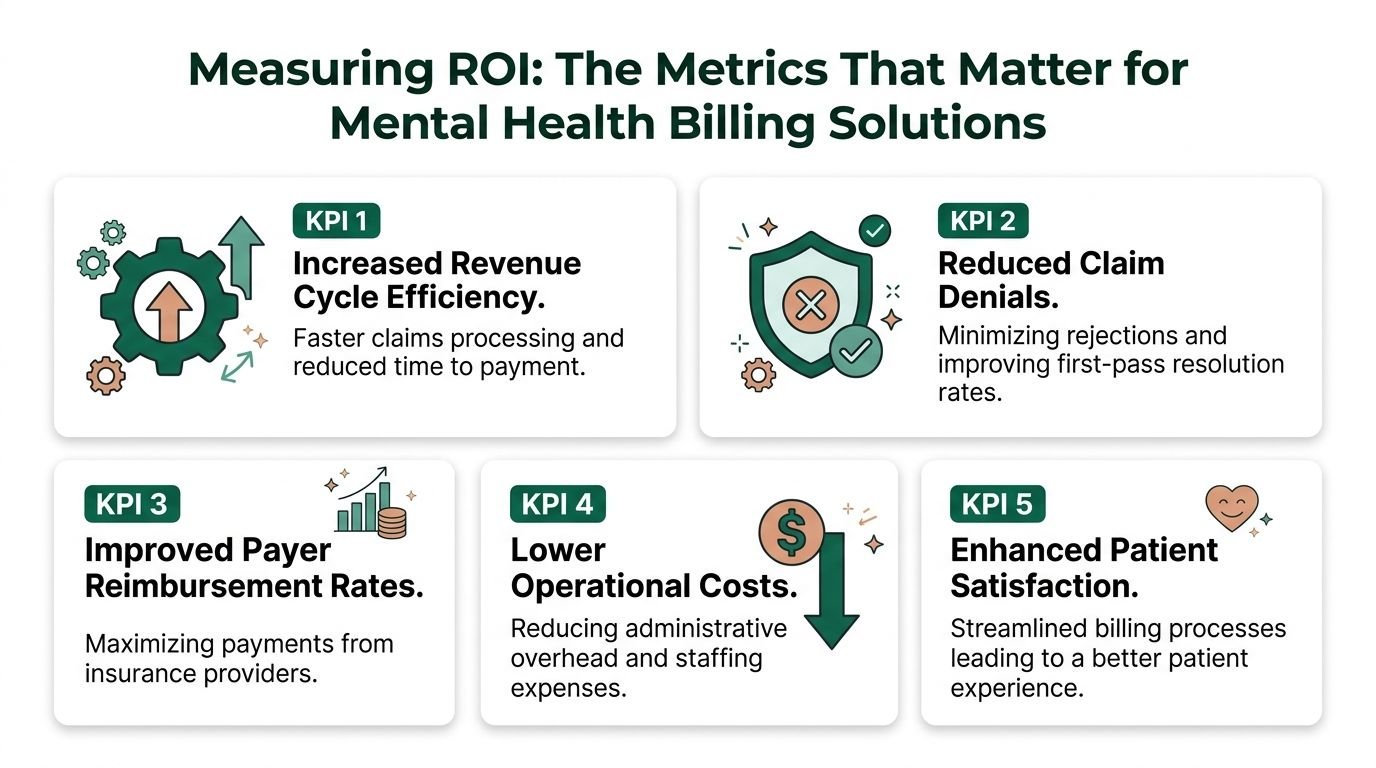
First-pass claim acceptance rate
This is the first metric I look at because it exposes whether the process is sound.
Specialized mental health billing solutions report 95-98% first-pass claim acceptance rates, compared with 85-90% for generalists or in-house processes. The same source notes that reworking a denied claim costs $25-$117, which is why denial prevention matters more than heroic follow-up. It also reports that reducing A/R from 45-60 days to under 35 days is associated with 15-25% revenue growth from captured charges alone, according to this review of how mental health billing services improve revenue for psychiatry and neurology clinics.
If your first-pass performance stays weak, your process is still broken upstream.
Days in accounts receivable
A/R tells you whether claims are moving or stalling.
Healthy mental health billing operations don’t let receivables linger because delayed claims often signal unresolved denials, missing documentation, or weak follow-up. For practice owners, A/R isn’t an accounting detail. It’s a direct measure of operational discipline.
Watch for these warning signs:
- Aged claims clustered by payer: often a sign of payer-specific workflow failure.
- Provider-specific delays: often tied to note quality or missing signatures.
- Recurring therapy claims stuck in review: often connected to authorization issues or coding inconsistencies.
Denial cost and preventable rework
A denial rate alone doesn’t tell the full story. You also need to know how much labor your team spends fixing avoidable mistakes.
Track:
- How many denials come from front-end errors
- How many involve modifier misuse or unsupported psychotherapy time
- How many require clinician addenda
- How long each category sits before resolution
A billing operation isn’t efficient because staff are busy. It’s efficient when the same denial category stops showing up month after month.
Outcome readiness is the next frontier
There’s a quieter metric that many practices ignore. Outcome documentation readiness.
Available guidance keeps pointing toward reimbursement models that reward measurable clinical results, but most practices lack billing-integrated systems for tracking treatment outcomes in payer-usable formats. That gap matters because value-based behavioral health reimbursement depends on more than clean claims. It depends on proving the care changed something meaningful.
The practices that prepare now will be easier to contract with and easier to pay.
Navigating Compliance With HIPAA and Parity Laws
Revenue without compliance is unstable revenue.
Behavioral health billing sits under heavier scrutiny because documentation, privacy, telehealth delivery, and benefit design intersect. A competent billing solution protects cash flow by making claims defensible under HIPAA, CMS requirements, and the Mental Health Parity and Addiction Equity Act.
Documentation has to support medical necessity
Parity laws matter in practice because behavioral health claims often face tighter utilization controls, authorization requirements, and documentation scrutiny. Your notes have to justify the service in a way that survives payer review.
For psychotherapy and psychiatric care, that means the record should connect diagnosis, symptom burden, functional impairment, treatment plan, and progress. If you bill E/M with psychotherapy, documentation for the E/M portion must stand on its own when required by payer policy and CMS-aligned standards.
The same applies to telehealth. If you use Modifier 95 or bill remote psychotherapy codes, the documentation and claim format have to match the payer’s current rules.
HIPAA risk rises when workflows get sloppy
Behavioral health practices handle highly sensitive PHI. Billing touches diagnoses, progress details, telehealth records, and financial data. That makes access controls and secure transmission are essential.
A compliant billing workflow should include:
- Role-based access to billing and clinical information
- Encrypted file transfer and secure system access
- Clear audit trails for claim edits and account activity
- Strict handling of documentation requests and appeals
These aren’t IT preferences. They’re operating requirements.
Compliance is also a denial prevention strategy
Most practice owners separate compliance from reimbursement. That’s a mistake.
When staff document poorly, misuse modifiers, or submit claims that don’t align with payer rules, the issue isn’t just a denial. It’s audit exposure. The cleaner your coding and documentation processes are, the less likely you are to face recoupments, prepayment review headaches, or payer disputes over medical necessity.
Billing discipline and compliance discipline are the same habit.
Frequently Asked Questions About Mental Health Billing
Should a mental health practice ever use a general medical billing company
Generally no.
Behavioral health depends too heavily on time-based CPT coding, recurring authorizations, telehealth rules, and psychotherapy plus E/M documentation logic. A generalist may know claim submission, but that’s not enough. You need people who understand codes like 90832, 90834, 90837, add-on complexity issues such as 90785 when justified, and modifier risk involving 25, 59, and 95.
If the vendor can’t explain those details without sounding vague, they’re not qualified.
What should I ask about telehealth billing
Ask how they bill remote psychotherapy and psychiatry visits by payer, not in general.
You want to hear specifics about CPT 90834-90838, audio-only policy handling where allowed, modifier use, place-of-service logic, and documentation requirements. Telehealth billing isn’t difficult because the codes are obscure. It’s difficult because payer rules vary, and behavioral health practices often assume one workflow fits all.
That assumption causes denials.
How do I know if authorization management is a significant problem
Look at recurring therapy claims first.
If denied claims cluster around ongoing treatment, frequency limits, expired approvals, or sessions that exceeded authorized units, authorization management is likely a major leak. This is especially common with 90837 because high-frequency therapy schedules can outrun weak tracking systems quickly.
A capable vendor should be able to show you how they monitor authorization status before claims go out. If they react solely after denials post, they’re too late.
Can a billing partner work inside my current EHR
Yes, and that’s often the smartest setup.
Most practices don’t need a full platform rip-and-replace. They need cleaner workflows inside the systems they already use. The best partners adapt charge review, claim edits, authorization tracking, and denial queues to your current EHR and PM environment instead of forcing a painful migration.
If you want to compare specialty-specific billing support across practice types, review the Happy Billing specialties page.
What metrics should I demand in monthly reporting
Demand metrics that expose execution, not vanity reporting.
At minimum, the report should show first-pass claim performance, denial categories, aged A/R, unresolved authorization issues, and payer trends by CPT code or claim type. For behavioral health, I want visibility into telehealth claim behavior and psychotherapy documentation-related rejections.
If the report shows total charges and total collections, you’re not seeing the machine. You’re seeing the scoreboard after the game is over.
If your practice is tired of chasing denials, fixing avoidable errors on 90837 claims, and wondering why cash is behind schedule, Happy Billing is built for exactly that problem. They combine agentic AI with expert human auditors, work inside your existing EHR, and focus on the specialty-specific controls that mental health practices need, especially authorization management, denial prevention, credentialing, and A/R recovery.