Medical Practice Billing Services That Protect Revenue

If your collections are stalling while claim volume keeps climbing, the problem usually isn't demand, it's billing control. Medical practice billing services should protect revenue by catching eligibility, authorization, documentation, and coding errors before they turn into denials and longer A/R days.
That's the test for a practice owner. If billing doesn't improve first-pass acceptance, reduce rework, and shorten the time between service and deposit, it's just overhead with a nicer logo.
What Medical Practice Billing Services Do
A multi-provider practice can look busy on paper and still bleed cash in the background. Claims go out, denials come back, staff rework the same files, and the aging report gets uglier every week. That is usually what owners are seeing when they start evaluating medical practice billing services.
At the simplest level, these services manage the work that turns documented care into collectible revenue. That includes claim creation, claim submission, payment posting, patient statements, denial follow-up, and reporting. If you want the plain-English version of the cash problem behind that work, it helps to understand AR management basics before you judge any vendor.
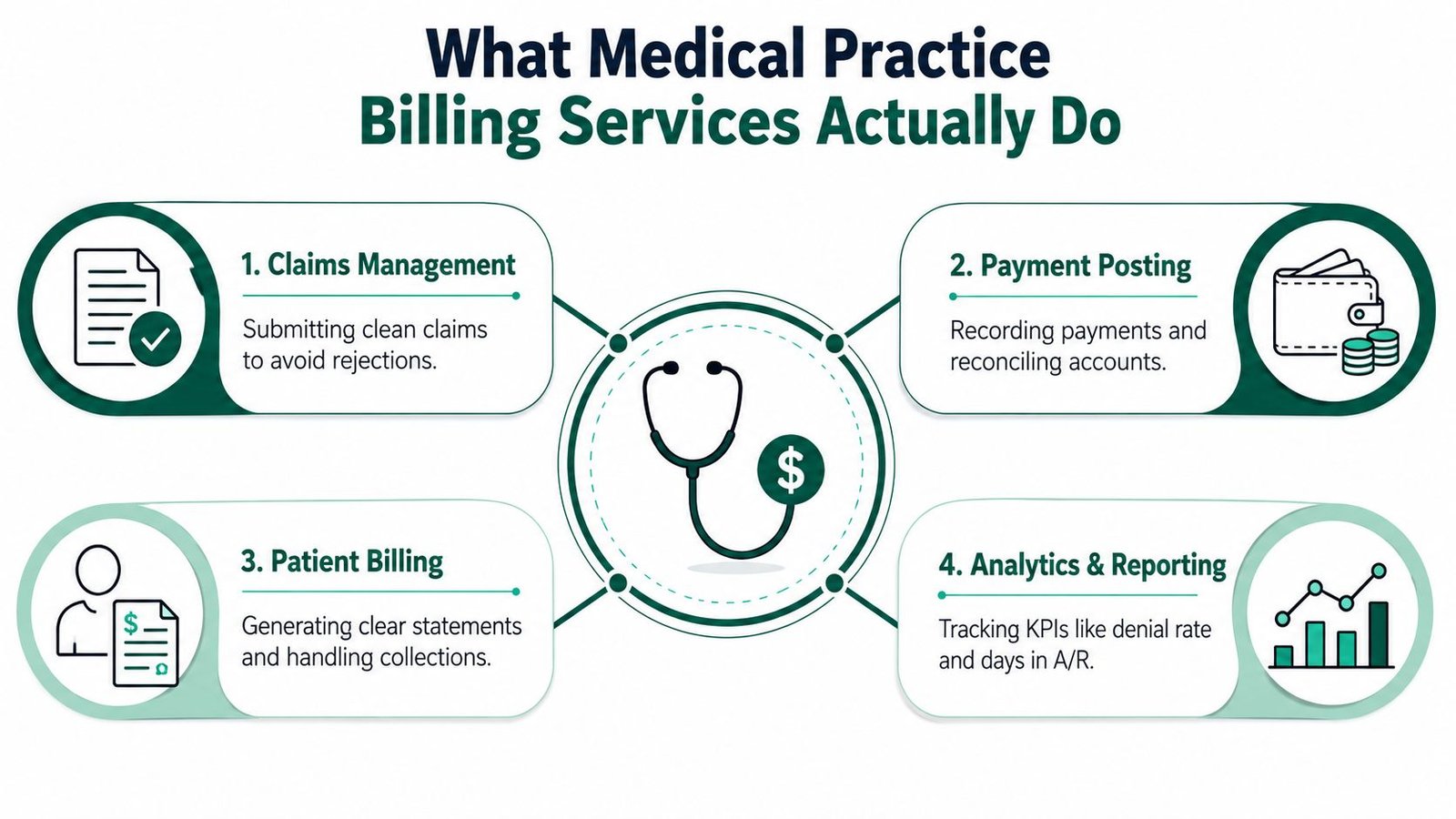
Claims are only one part of the job
A weak vendor likes to talk as if billing starts when a claim is submitted. That is too late. The front end, eligibility, benefits, and authorization, decides whether the practice is building collectible accounts or creating avoidable write-offs.
A real billing partner also handles patient-facing balances and account cleanup, because deposits do not come from claim files alone. When a team cannot reconcile payments cleanly, owner visibility drops and follow-up gets delayed. A practical overview of what medical billers do helps separate real billing work from a thin claim-sending setup.
Practical rule: if the vendor only talks about sending claims faster, they are selling motion, not revenue control.
The work has to connect to cash
A practice owner should look at billing as an operating system for money, not a clerical service. The point is to reduce friction at each step so the claim does not bounce between departments, payers, and appeal queues.
That also means the internal billing process cannot be isolated from the EHR or practice management system. The more handoffs between registration, documentation, and claim generation, the more chances there are for mismatched demographics, missing payer data, and duplicated entries. A basic vendor page can help explain the role, but the test is whether the workflow protects collections. You can also understand AR management basics to see how billing control shows up in the aging report.
For owners, the takeaway is simple. Billing decisions are cash-flow decisions. If the service does not improve the path from encounter to payment, it is not doing enough.
Full-Cycle RCM Functions a Billing Partner Should Cover
A billing partner earns its keep by controlling the whole revenue path, not by chasing claims after they fail. The strongest setups start before the visit, because the cheapest denial is the one that never gets submitted. CMS says practices must obtain billing information at the time the service is rendered, which makes front-end capture a revenue control, not an intake courtesy CMS billing responsibilities.
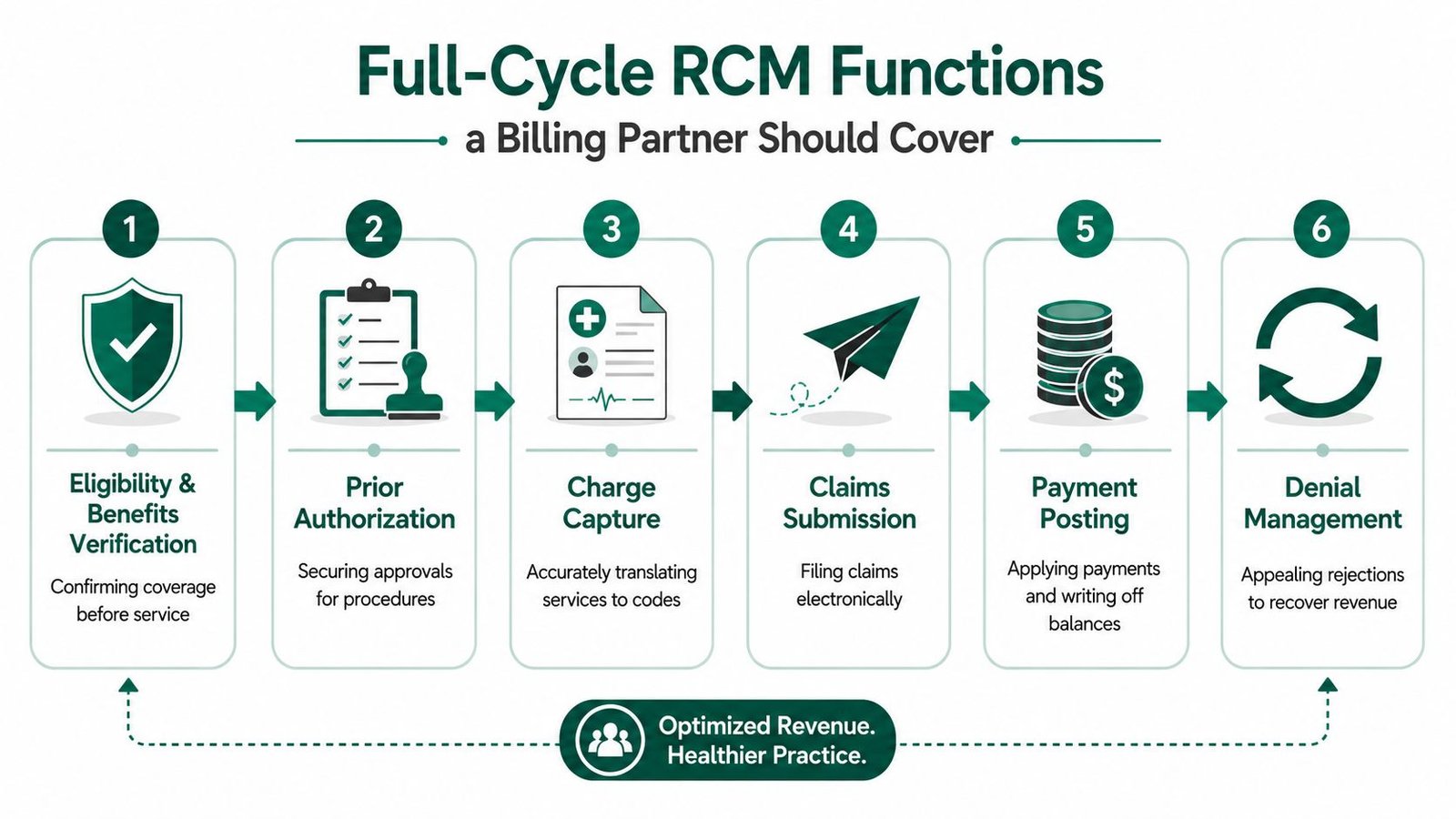
Start with front-end controls
Eligibility and benefits verification should happen before the encounter is over. If insurance is inactive, the plan has changed, or the patient is not what the front desk thought they were, the practice is about to spend time on avoidable follow-up. Prior authorization belongs in the same bucket, especially for imaging, behavioral health, orthopedics, and other specialties where missing approval blocks payment before adjudication.
Charge capture is the next critical area. The billing team has to translate the service into the right code set, attach the right modifier, and keep the claim aligned with the note. If that part is sloppy, the payer doesn't need to be difficult, the claim is already weak.
Claim submission is the easy part
Submitting the claim electronically is not the hard part. Submitting a clean claim is. That distinction matters because the market is still dealing with persistent payment errors and denials, including a 7.66% Medicare Fee-for-Service improper payment rate in FY 2024, equal to $31.70 billion Aptarro medical billing stats. The same data set shows Medicare Part C improper payments at 5.61%, or about $19.07 billion, and Medicaid at 5.09%, translating to $31.10 billion in federal funds, with 79.11% of improper Medicaid payments tied to insufficient documentation Aptarro medical billing stats.
Operational truth: if the vendor can't show you how they prevent front-end errors, they're inviting appeals later.
Payment posting should happen fast enough to preserve visibility. One industry guide says ERA posting is commonly expected within 24 to 48 hours MediBill RCM. Slow posting hides underpayments, delays follow-up, and makes your aging report useless.
Denials, A/R, and enrollment are not side tasks
Denial management should focus on root causes, not endless rework. Industry sources put first-pass denial or rejection rates around 15% to 20%, and some practices see 10% to 30% CodeEMR. That's why a billing partner has to catch documentation gaps, demographic mismatches, duplicates, and payer-policy problems before the claim exits the building.
Credentialing and payer enrollment belong in the same conversation. A complete billing operation should manage payer applications, re-credentialing, CAQH upkeep, NPI and tax-ID linkage, and EFT setup, because if enrollment isn't right, payment may never start. Happy Billing's RCM for physician practices is a useful reference if you want to compare a full-cycle model against a partial-service shop.
The KPIs That Tell You Whether Billing Is Working
Owners don't need more billing dashboards. They need a few numbers that tell the truth quickly. If your partner can't explain performance in plain language, they're hiding behind activity instead of results.
| Core RCM KPIs and Their Financial Impact | ||
|---|---|---|
| KPI | Healthy Benchmark | What It Means for Cash |
| First-pass clean claim rate | Higher is better, with top performers aiming for very strong acceptance | More claims get paid without rework, so deposits arrive sooner |
| Days in A/R | Lower is better, and practices should watch for claims sitting too long | Shorter aging means less revenue trapped in unpaid balances |
| Denial rate | Lower is better, especially after the first submission | Fewer denials mean less staff time lost to appeals and resubmissions |
| Net collection rate | Closer to expected collections is better | Tells you how much of allowed revenue actually reaches the practice |
First-pass acceptance is the cleanest sign
A good first-pass claim lands cleanly because the front end did its job. A weak one gets bounced for missing information, incorrect coding, demographic mismatches, duplicate claims, or payer-policy mismatches. Those are not mysterious problems, they're preventable defects.
That's why I care more about denial prevention than heroics in appeals. Industry reporting says about 30% of insurance claims are denied on first submission Aptarro medical billing stats, so any vendor promising to “work denials harder” without showing prevention controls is missing the main leak.
A/R days show whether cash is moving
A/R aging exposes whether the billing team is just busy or effective. The longer receivables sit, the more follow-up gets compressed into a smaller window and the more likely the practice is to miss recoverable balances.
Practical rule: ask for trend lines, not monthly bragging rights. One good month means little if A/R is still drifting upward.
Denials tell you where the process breaks
Denials should be categorized by cause, not lumped into a pile. When the team separates registration errors from coding issues and payer-policy conflicts, you can see whether the problem belongs to the front desk, the clinician workflow, or the billing vendor.
If you want a simple way to pressure-test the story, use a resource like medical billing KPIs to track and ask the vendor to show each metric by specialty, provider, and payer. If they can't, they probably don't manage the cycle at a useful level.
Specialty-Specific Billing Considerations That Change the Math
A clinic that bills anesthesia, cardiology, behavioral health, orthopedics, or pediatrics is not buying a generic billing service. The coding rules, authorization burden, and modifier logic change the math, and weak front-end controls show up later as denied or underpaid claims. If a vendor treats every specialty the same, expect avoidable leakage.
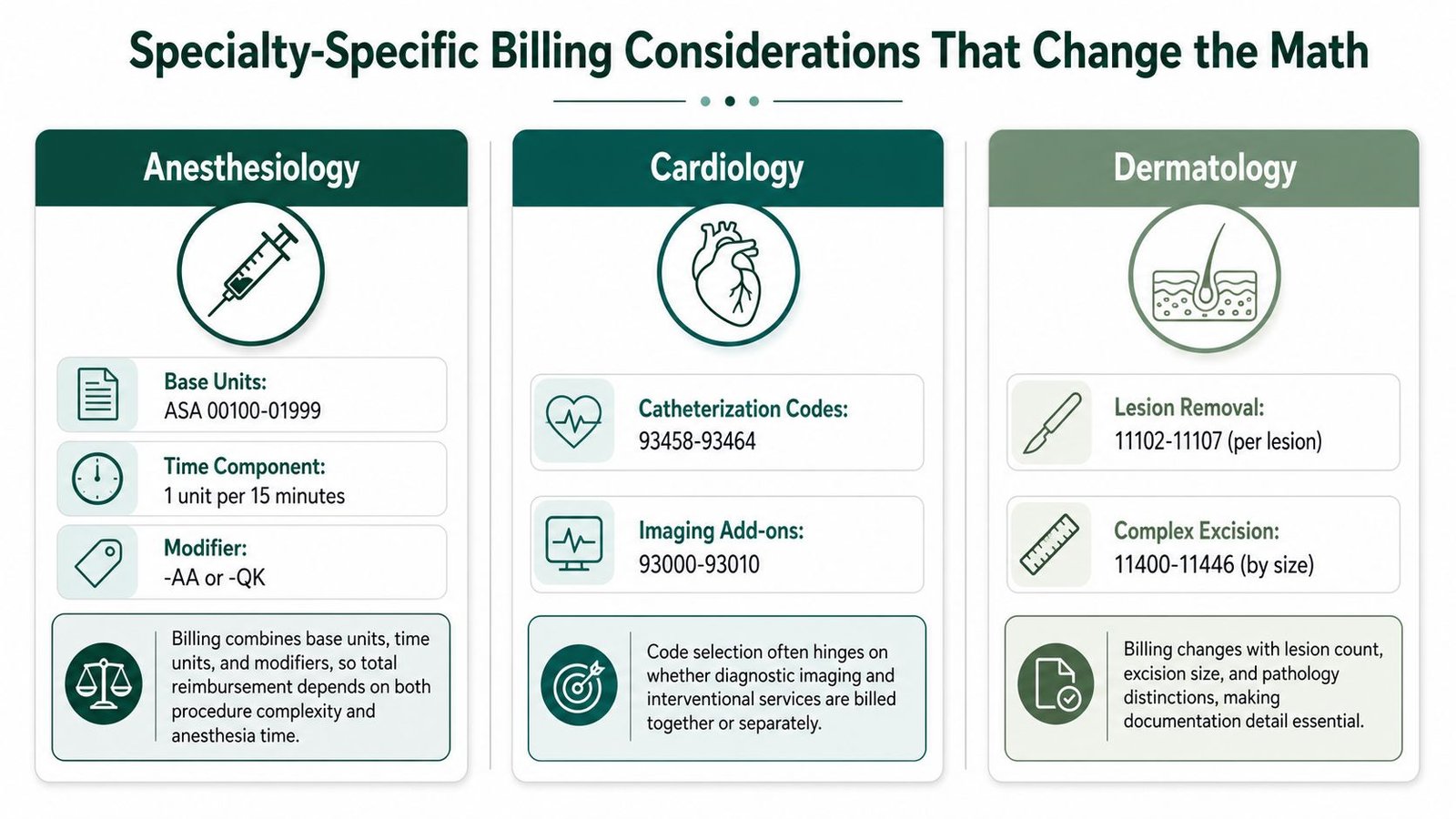
The specialty determines the billing risk
| Specialty | What Creates Complexity | Financial Risk if Mishandled |
|---|---|---|
| Anesthesiology | Base units, time units, modifiers, concurrency, and medical direction logic tied to ASA 00100-01999 workflows | Missed units or the wrong modifier can understate the claim and reduce revenue directly |
| Behavioral health | Prior authorization, session-based coding, and payer-specific visit rules | A missing authorization can block payment before the claim is even considered |
| Cardiology | Diagnostic and interventional complexity, plus the need to align procedure and imaging logic | Coding drift can trigger denials or underpayment on expensive claims |
| Orthopedics and pain management | Global periods, bundled services, and multiple-procedure reductions | Poor modifier handling can turn billable work into denials or reductions |
| Pediatrics | Vaccine administration and well-visit E/M alignment | Weak documentation or code selection can leave money on the table across high-volume visits |
Anesthesia deserves special scrutiny because the math is unforgiving. If a billing team misses a 15-minute time unit or misapplies a modifier, the loss is direct. The same problem shows up when concurrency or medical direction rules are handled loosely, because the claim has to match the actual operating arrangement, not the schedule on paper.
Behavioral health and procedure-heavy specialties need different controls
Behavioral health depends on authorization discipline. If the vendor does not manage prior auth cleanly, staff end up fixing avoidable blocks after care has already been delivered. In procedure-heavy specialties like orthopedics and pain, global periods and multiple-procedure reductions need to be understood before the claim goes out, or the payer will reduce revenue automatically.
If a billing company cannot speak your specialty's language, it will guess. Guessing costs money.
Cardiology and dermatology usually fail on nuance, not volume. Imaging add-ons, lesion work, and procedure sequencing all need specialty-specific review. A vendor like Happy Billing only belongs on the shortlist if it can handle that nuance inside the existing workflow, and if its security policy is clear enough to stand up to vendor review.
Security, Compliance, and Pricing Models That Actually Matter
Too many practice owners buy billing on price and discover the cost later in denials, privacy exposure, and cleanup. Secure billing is not just software. It's policy, access control, vendor oversight, and disciplined claim handling.

HIPAA controls have to be operational, not decorative
A compliant billing operation needs signed Business Associate Agreements, the minimum necessary access standard, encryption in transit and at rest, unique user IDs, audit logs, workforce training, incident-response procedures, and vendor oversight Accountable HQ HIPAA billing guide. If those pieces are missing, the practice is taking on breach risk and claim disruption at the same time.
That's why I always tell owners to read a vendor's actual security policy before they sign. If the policy is vague, the billing operation probably is too.
Rendering-provider errors quietly damage collections
There's also a compliance mistake that doesn't get enough attention. UC Davis Health's training says claims must be billed under the rendering provider's name unless a payer specifically directs otherwise, and a claim may not be billed under a provider who only co-signed a note for someone still awaiting enrollment UC Davis Health compliance training. That sounds administrative, but in real life it means denied claims, rework, and avoidable A/R drag.
Pricing should match the work
Percentage-of-collections, flat-fee, and hybrid pricing all have a place. Percentage models can align incentives if the vendor owns the revenue outcome. Flat-fee models make more sense when the practice wants stable budgeting and has strong internal volume discipline. Hybrid pricing can work when a practice wants a baseline service with added support for enrollment, denial recovery, or specialty complexity.
I'm far more skeptical of low-cost offshore models. Industry guidance warns that cheap offshore billing can miss U.S. payer rules and create privacy exposure, even when the headline price looks attractive Benchmark Systems outsourcing guide. If you're comparing vendors, use the in-house vs outsourced medical billing lens and ask which model reduces leakage without weakening oversight.
Vendor Selection Checklist and Implementation Timeline
The wrong billing vendor costs more than the right one, even if the invoice is smaller. Procurement has to be deliberate, because billing mistakes show up as lost cash, not just workflow annoyance. Use a written checklist and force clear answers.
| Vendor Selection Questions to Put in Writing | ||
|---|---|---|
| Category | Question to Ask | What Good Looks Like |
| Specialty experience | How many claims do you handle in our specialty? | Clear specialty knowledge, not general billing language |
| Reporting cadence | How often will we see performance reports? | Regular reporting with denial, A/R, and collection visibility |
| Denial prevention | What do you do before claims are submitted? | Eligibility, documentation, and code validation controls |
| Credentialing | Do you manage enrollment and re-credentialing? | Full support for payer setup and renewal tracking |
| Integration | Can you work inside our current EHR? | No forced migration, minimal disruption |
| Account management | Who owns our account day to day? | A named contact, not a call center maze |
| Guarantees | What happens if performance slips? | Contract terms with consequences, not vague promises |
If the vendor can't answer those questions cleanly, stop there. A polished demo does not make up for weak execution.
Go-live should be staged
The rollout should start with discovery, then EHR integration, payer enrollment review, workflow build, soft launch, and steady state. If the vendor rushes straight to production, they usually miss payer IDs, stale fee schedules, or credentialing renewals that should have been caught earlier.
The safest implementation is boring. It preserves the current EHR, aligns the payer files, and verifies that the billing rules match the specialty before volume ramps up. Use questions to ask a medical billing company before hiring as your written interview guide and make every answer specific.
When Outsourcing Makes Financial Sense and FAQs From Owners
If your denial rate is above 10%, your A/R aging is over 60 days, or your net collection rate is below 95%, the case for outsourcing is usually stronger than the case for staying the course. The math is straightforward. You're already paying for lost time, preventable denials, and delayed cash, just in a messier way.
A specialty partner is most useful when it improves prevention, not just cleanup. That's why the front-end controls matter so much.
For a baseline on whether your current setup is leaking revenue, start with a free billing audit. It's the fastest way to see whether your current process is holding cash back.
How long until we see results?
You should see the first signs in claim acceptance and follow-up discipline quickly, but meaningful cash improvement depends on how messy the current workflow is.
What switching costs should we expect?
Expect time spent on payer setup, EHR workflow alignment, and enrollment cleanup. The real cost of switching is usually the cleanup from the old process.
How do we protect PHI during transition?
Require BAAs, access limits, audit logs, encryption, and a clear incident-response process before any data moves.
Does outsourcing still make sense for a small practice?
Yes, if the practice has recurring denials, weak follow-up, or specialty-specific billing complexity that internal staff can't manage consistently.
Happy Billing builds medical billing operations around specialty-specific denial prevention, credentialing, and A/R control inside your existing EHR. If you want a partner that treats collections as a front-end systems problem instead of a back-office cleanup job, visit Happy Billing and review whether your current billing setup is leaving money behind.