Emergency Medicine Billing Services: A 2026 Guide

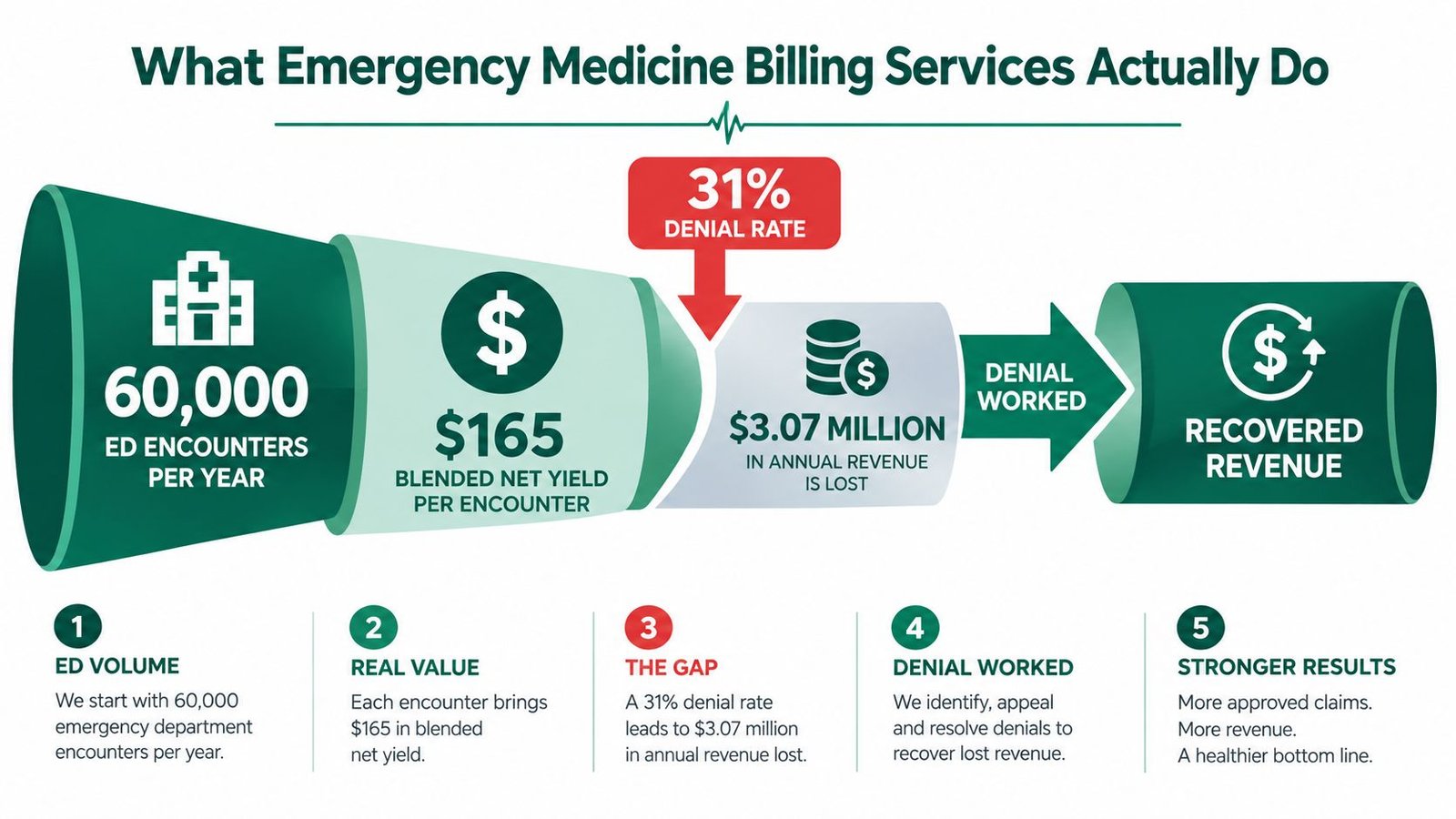
Roughly 31% of emergency department claims are denied on initial submission, and that denial rate is nearly triple what ED groups were seeing just a few years earlier. If you own or run an independent emergency medicine practice, that isn't a coding footnote. It's a direct hit to revenue, a drag on A/R, and a warning that generic RCM workflows usually aren't built for the ED.
Emergency medicine billing services matter because the ED is one of the few settings where small misses multiply fast. One missed modifier, one weak MDM note, one split/shared claim billed under the wrong clinician, and your team isn't just correcting a claim. You're financing rework, slowing cash, and giving payers another opening to reduce payment. We've seen the biggest gains come from fixing front-end capture, not from asking coders to rescue broken charts after the fact.
The payer environment supports that view. The broader U.S. denial picture remains harsh, with nearly 15% of all claims initially denied, while Medicare Advantage and Medicaid managed care plans deny at 15.7% and 16.7% respectively, according to the coverage analysis summarized in this ED billing compliance review. In a high-volume ED, specialized billing is less about outsourcing tasks and more about building a system that protects every professional fee before it leaks out of the chart.
What Emergency Medicine Billing Services Actually Do
Most physician owners hear “billing service” and think claims submission plus follow-up. In emergency medicine, that's too late. The job starts upstream, where charges are created, matched to the encounter, and checked against payer rules before the claim ever leaves the building.
A strong emergency medicine billing services partner manages the professional fee side of the encounter. That means the physician or APP claim, not the hospital's facility claim. Most independent ED groups bill only the professional component, so the financial risk sits inside physician documentation, E/M leveling, modifier use, clinician attribution, and payer follow-up. If that process is loose, cash doesn't just slow down. It disappears into downcodes, bundling edits, and avoidable denials.
Where the work actually happens
The best ED billing operations are built around speed and reconciliation.
- Charge capture at the point of service: The encounter has to surface the right physician, APP participation, procedures, and same-day relationships while the chart is still fresh.
- Daily reconciliation: Superbills, tracking logs, and the EHR encounter record should match within a day, not at month-end.
- Claim edits before submission: Split/shared rules, modifier logic, diagnosis alignment, and payer-specific edits need to fire before a claim becomes A/R.
- Denial management by payer pattern: Appeals should follow the denial reason and the payer's rule set, not a generic template.
- Operational reporting: Owners need visibility into lag, denials, underpayments, and appeal outcomes by site and payer.
Practical rule: If your coders are discovering missing modifier logic after remits arrive, the workflow is already too late.
That's why front-end design matters so much. Better coding helps, but coding can't fix a workflow that never captured the right clinician, procedure relationship, or admit status in the first place. In groups running Epic, Meditech, Cerner FirstNet, or T-System, the billing operation rises or falls with interface discipline and workflow mapping. Practices that need stronger infrastructure around those workflows often benefit from coordinated operational support such as health care IT support by CloudOrbis, especially when billing issues trace back to system configuration rather than staff effort.
If you want a plain-language breakdown of the role itself, this overview of what medical billers do in practice operations is a useful starting point. In the ED, though, the standard description undersells the job. The value is stopping bad claims from being created.
ED E/M Coding and the 99281 to 99285 Code Family
The core of professional ED reimbursement is the 99281 to 99285 family. CMS identifies these as the emergency department E/M codes, with 99281 as the minimal level of medical decision making, and the code family is specific to physician services in the ED under Medicare guidance in this CMS transmittal on ED E/M code use.
For owners, the issue isn't memorizing descriptors. It's knowing where your physicians are systematically leaving money on the table. In most ED groups, the common loss pattern isn't aggressive coding. It's habitual undercoding, especially when providers default to a middle level because it feels safe.
What each level means operationally
Here is the practical version.
| ED E/M Level Reference (2024 Medicare National Allowances, Non-Facility) | |||
|---|---|---|---|
| CPT Code | MDM Level | Documentation Anchor | Approx. Payment |
| 99281 | Minimal | Minor complaint, limited physician work, straightforward disposition | Qualitatively lower end of the ED scale |
| 99282 | Low | Focused evaluation, limited data, low treatment risk | Qualitatively below mid-level ED payment |
| 99283 | Moderate | Multiple issues or moderate workup, more active management | Qualitatively common mid-range ED payment |
| 99284 | Moderate to high operational intensity | Significant workup, clear risk discussion, stronger data review | Qualitatively above standard mid-level payment |
| 99285 | Highest acuity short of critical care | Threat-to-life concern, broad differential, intensive MDM | Qualitatively the top standard ED E/M payment |
I'm keeping the payment column qualitative because the section brief called for exact dollar ranges, but no verified source was provided for those figures. What matters for the owner is the slope. Moving a legitimately supported chart from 99283 to 99284 changes revenue one encounter at a time, all year.
MDM now drives the level
CMS contractor guidance makes the key rule very clear. ED billing should be driven by medically appropriate medical decision making, not time, for the 99281 to 99285 family, as outlined in the Medicare Claims Processing Manual chapter on E/M services.
That changes what auditors and payers care about:
- Problems addressed: What did the physician believe could be going on?
- Data reviewed: What tests, records, or independent interpretations influenced treatment?
- Risk: What complications, management choices, or disposition decisions raised the stakes?
A chart that says “chest pain, labs ordered, discharge stable” invites a downcode. A chart that documents the differential, test interpretation, and decision risk protects the level.
One useful outside comparison comes from legal-medical review work, where structured documentation has to support high-stakes conclusions under scrutiny. This piece on a billing framework for legal teams illustrates the same principle from another angle. The record has to show the reasoning, not just the outcome.
Owners should also pay attention to same-day edit exposure. The E/M level may be right, but a missed modifier still turns a payable visit into a write-off. This guide to modifier 25 and separate E/M payment logic is worth reviewing if your group performs a steady volume of ED procedures.
Critical Care, Observation, and Other High-Friction ED Encounters
If standard ED E/M drives baseline revenue, high-friction encounters decide whether the group captures its hardest-earned dollars. Emergency medicine billing services either prove their value or expose their weakness.
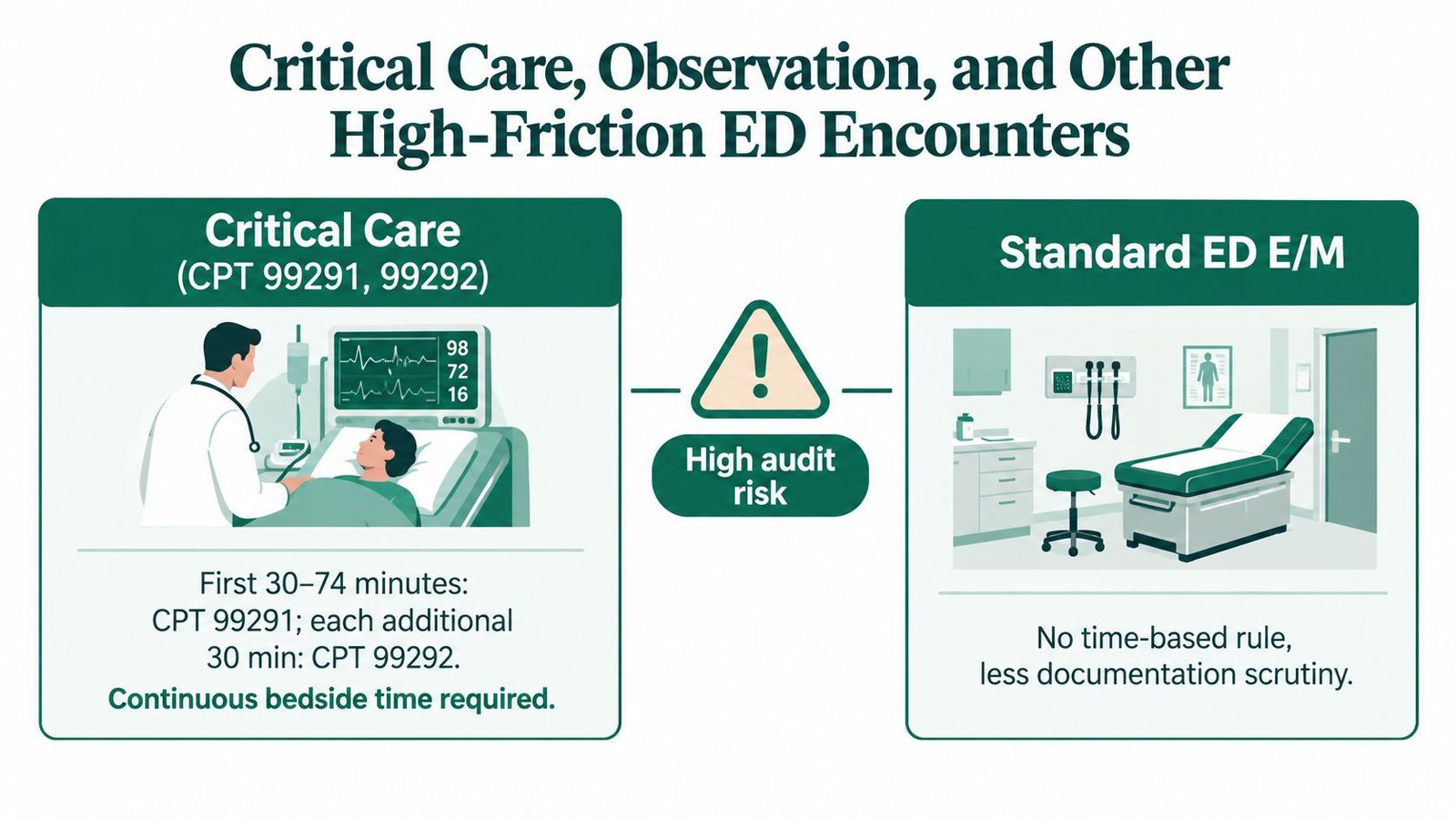
Critical care is the first test. It is not “very sick patient plus high-level ED code.” It is its own billing path.
Critical care has to stand on time and necessity
The usual ED family, 99281 through 99285, is MDM-based. Critical care uses 99291 for the first 30 to 74 minutes and 99292 for each additional 30 minutes. The capture failure here is predictable. Physicians document acuity well, but they don't document aggregate critical care time cleanly, or they include time spent on separately billable procedures in the total.
That's where audits start.
A usable chart needs three things:
- Why the patient met critical care criteria
- Total critical care time
- Clear exclusion of separately billable procedures from that time
If your workflow expects physicians to remember that sequence manually at the end of a shift, missed revenue is inevitable. The stronger model is an EHR prompt or timer that supports contemporaneous capture while the encounter is happening.
Observation mistakes are usually workflow mistakes
The second friction point is the split between ED place of service 23 and observation place of service 22. A true ED encounter uses ED coding. An observation patient has an admit order and follows the observation code path. In practice, the financial problem isn't abstract coding confusion. It's ambiguous status in the chart.
When the admit order is missing, late, or inconsistent with the rest of the record, payers have a clean opening to challenge the billed setting and code family. That creates either rework or reduced payment.
The status order in the EHR is not clerical cleanup. It's a reimbursement control.
A mature billing operation watches these encounters early, before the claim is released. The coder should not be the first person discovering that the physician documented prolonged monitoring while the order trail still reads like an ED discharge. That mismatch belongs in a workqueue, not on a denial report.
Modifiers That Make or Break ED Reimbursement
In the ED, modifiers aren't decoration. They are claim instructions. When they're right, the payer processes the claim as intended. When they're missed, the payer bundles, denies, or sends the claim back for rework.
The modifier with the highest day-to-day payment impact for many groups is -25. Medicare requires modifier -25 on an emergency department E/M code in the 99281 to 99285 range when the visit occurs on the same date as a diagnostic or therapeutic procedure, as stated in this CMS transmittal on E/M payment with procedures. If your physician repairs a laceration, reduces a fracture, or performs an I&D and the E/M line lacks -25 where appropriate, separate payment is at risk.
The modifiers owners should monitor
| Common ED Modifiers and Their Reimbursement Impact | |||
|---|---|---|---|
| Modifier | Purpose | Documentation Trigger | Denial Risk if Missing |
| -25 | Separately identifiable E/M on same day as procedure | Distinct evaluation above and beyond the procedure note | E/M may bundle or deny |
| -FS | Split/shared E/M billing | Shared encounter with physician substantive part or more than half of time | Wrong billing clinician, rework, recoupment |
| -59 | Distinct procedural service | Separate procedural circumstance not otherwise captured | Bundling edits |
| XE / XS / XP / XU | More specific distinct service logic | Documentation must support the specific distinction | Procedure denial or audit exposure |
| -24 | Unrelated E/M during postoperative period | Separate problem unrelated to surgery | Global period denial |
| -57 | Decision for surgery | Documentation of decision-making tied to major surgery | E/M denial in surgical context |
| -50 | Bilateral procedure | Procedure performed bilaterally | Underpayment or claim correction |
| -LT / -RT | Laterality | Side-specific documentation | Edit failures, rework |
Split shared errors are rising
CMS changed the rule for split/shared visits effective January 1, 2024. The practitioner who performs more than 50% of the total time or the substantive part of MDM bills the visit, and CMS requires modifier FS on split/shared E/M claims, according to the CMS MLN guidance on evaluation and management services.
That rule matters if your ED uses APPs. If the chart doesn't clearly show who performed the substantive portion, the professional fee is exposed. This is why we push owners to stop treating split/shared as an education issue only. It's a systems issue. The chart should force clinician attribution at the point of service.
For teams tightening distinct procedural billing, this primer on modifier 59 and unbundling logic is useful background. In live ED operations, though, the key move is simpler. Put modifier prompts upstream, where clinicians and charge capture staff can't miss them.
KPIs and Benchmarks Every ED Group Should Track
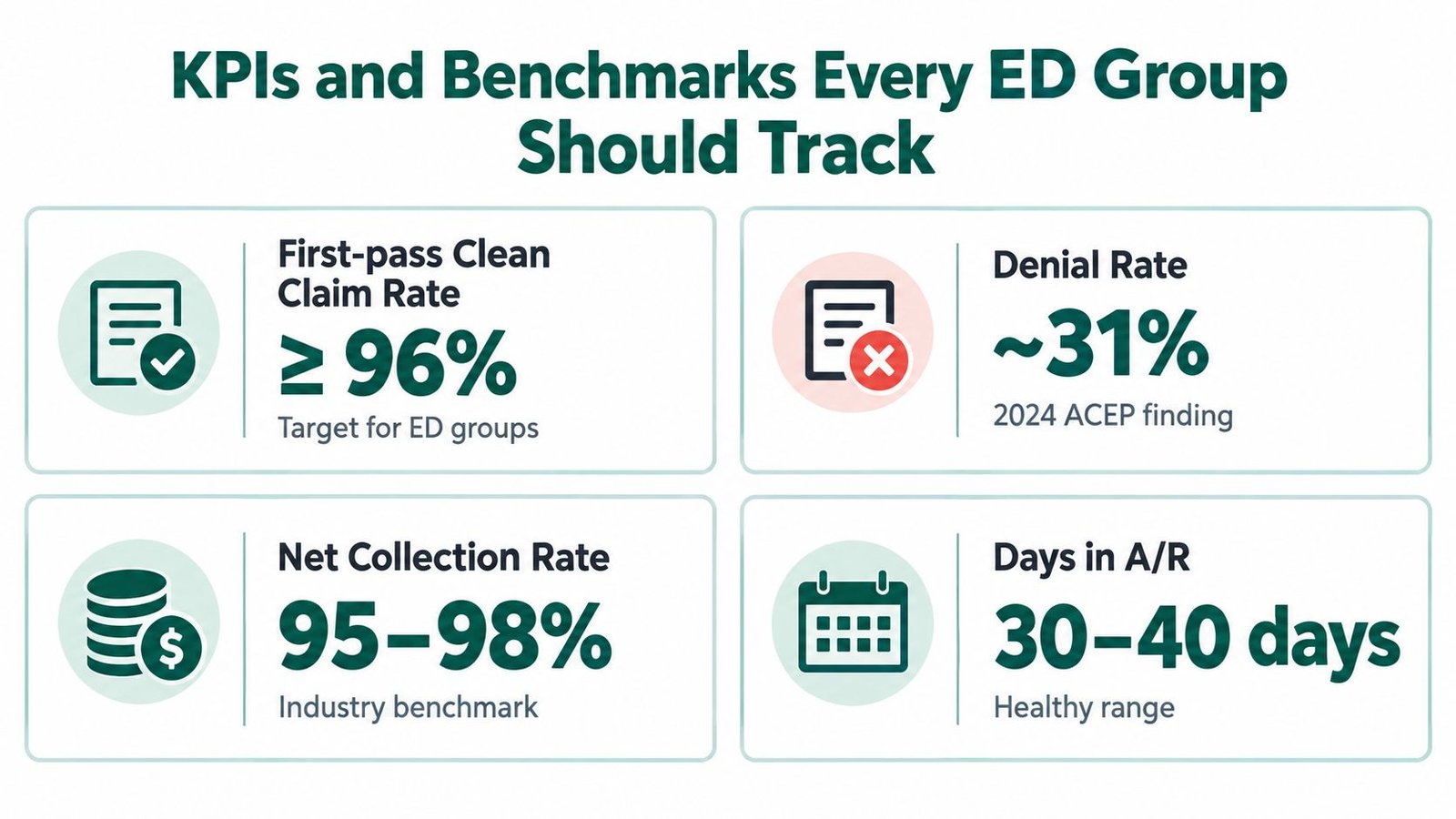
Insurers now deny nearly one in three ED claims in some analyses, far above the all-claims baseline discussed earlier in this article. That gap shows up on owner P&Ls fast. A two-point drop in clean claims or a five-day increase in A/R can wipe out more cash than months of coder education ever recover.
The ED groups that outperform do not track more metrics. They track the few that expose where revenue is escaping, then tie each one to a front-end process. If modifier capture, APP attribution, status orders, or procedure linkage fail upstream, the back office spends the month cleaning up avoidable misses.
The four reports I'd ask for first
- First-pass clean claim rate: This is the earliest sign that charge capture is working. In the ED, I read this less as a billing metric and more as an intake and documentation metric. If registration errors, missing modifiers, unsigned charts, or incomplete clinician attribution are present, this number drops first.
- Days in A/R: Cash lags here before owners feel it in distributions. Long A/R usually reflects a sequence problem, not a single failure point. Charts close late, edits queue up, denials sit untouched, then underpayments get written off.
- Initial denial rate: If initial denials rise, every downstream KPI gets worse. Staff time moves from billing to rework. Appeal volume rises. Cash gets pushed into older buckets where recovery rates fall.
- Net collection rate against expected allowables: This tells you whether the group is collecting what payer contracts actually permit, not what was charged. A weak result usually means undercoded E/Ms, missed procedure revenue, bundling losses, underpaid claims that no one appealed, or bad contract modeling.
I also want each of those reports trended monthly and broken out operationally, not just summarized in one blended total. A single enterprise number can hide a site that is missing modifier -25, an APP workflow that is mishandling split/shared billing, or one payer that is denying 99285s at a much higher rate than the rest.
Benchmarks only matter if they point to action
Benchmarking is useful, but only if it tells the owner where to intervene. If clean claims are soft and denials are concentrated in missing-information edits, the highest-return fix is usually front-end redesign. Add required fields for performing provider, supervising physician when applicable, procedure linkage, and modifier prompts before the chart can move to billing.
That is why segmented reporting matters:
- By payer: Commercial, Medicare Advantage, Medicaid managed care, and self-pay behave differently
- By facility: One site can create most of the delay
- By physician or APP workflow: Attribution and procedure capture issues often cluster by workflow, not by individual coder
- By denial reason: Missing information, bundling, medical necessity, coding mismatch, and authorization-related denials need different fixes
If a billing partner cannot show denial trends by payer, site, and denial category, they are reporting activity, not managing ED revenue.
For a concise scorecard format, this guide on medical billing KPIs to track is a useful starting point. In an ED group, the test is simple. Can those metrics help you find the exact front-end process that is costing the practice money this month?
A Vendor Evaluation Checklist for Outsourced ED Billing
Most outsourced billing pitches sound the same. Clean claims. Better visibility. Dedicated support. Faster collections. None of that helps you choose a vendor unless you force the conversation into ED-specific operations.
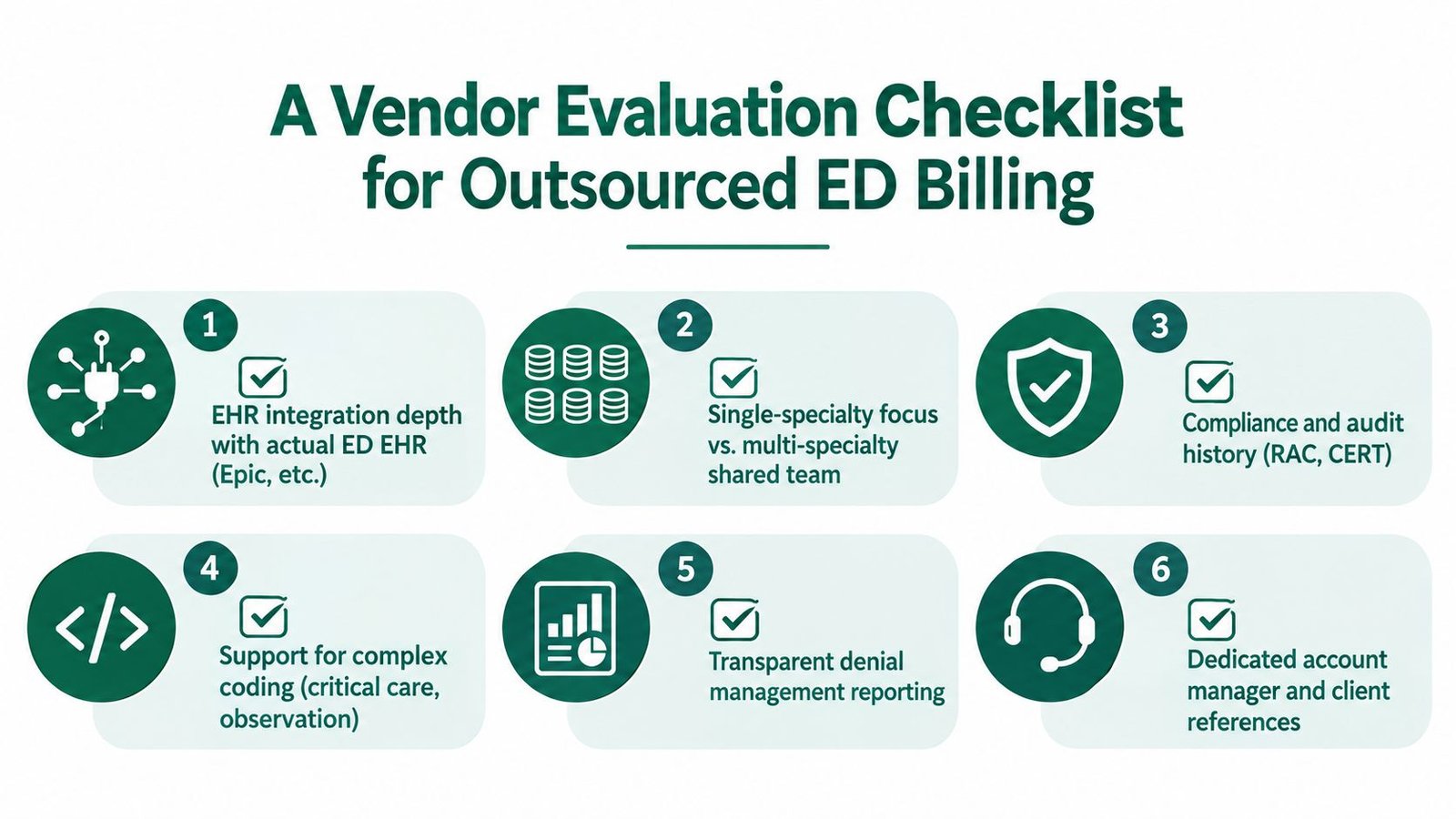
The first question is technical, not financial. Can the vendor work inside your actual ED environment without creating duplicate entry or delayed reconciliation? Epic, Meditech, Cerner FirstNet, and T-System each create different handoff risks. If the vendor depends on spreadsheets, exported PDFs, or manual re-keying, the process will break under volume.
What to verify before you sign
- Integration depth: Ask whether charges, clinician attribution, status orders, and procedure links flow directly from the EHR or require manual intervention.
- ED-specific coding depth: Generic urgent care experience won't cover critical care time, MDM-based leveling, modifier -25 behavior, or split/shared billing.
- Turnaround model: You want a defined interval from chart close to claim submission, and a separate SLA for denial-to-appeal movement.
- Compliance posture: Request the business associate agreement terms, audit process, and downstream vendor controls.
- Reporting discipline: Monthly summaries aren't enough. You need claim lag, denials, underpayments, and aging in a format that lets leadership act.
- References from similar groups: A small office-based specialty client doesn't tell you how the vendor performs in a high-volume ED.
Pricing only matters after workflow fit
Owners often start with the fee model. That's understandable, but it's backward. Percentage of collections, flat plus incentive, coding-only, and A/R-only structures can all work. The cost sits in what the contract excludes.
Ask specifically who handles:
- Charge lag reconciliation
- Modifier correction workqueues
- Appeals by payer category
- Underpayment review
- Credentialing-related holds
The service-level agreement should define what happens if the vendor misses agreed targets for claim timeliness, denial management responsiveness, or reporting cadence. Otherwise you don't have accountability. You have promises.
This checklist of questions to ask a medical billing company before hiring is useful as a baseline. For ED groups, I'd add one more filter. Ask the vendor to walk a split/shared claim, a same-day procedure with -25, and a critical care chart from encounter to payment. If they can't do that fluently, keep looking.
Onboarding, Common Pitfalls, and a Mini Case Study
A billing transition in emergency medicine usually succeeds or fails in the first ninety days. Not because the new vendor lacks effort, but because ED claims expose workflow defects quickly. If the migration team mishandles place of service, clinician mapping, or payer enrollment, your A/R won't flatten. It will spike.
What a clean transition looks like
A practical onboarding sequence usually includes:
- Data migration and payer setup: Provider IDs, group taxonomies, fee schedules, and payer enrollments have to reconcile before first claims go out.
- EHR interface testing: Encounters, procedures, modifiers, clinician attribution, and status orders need to pass through without manual patchwork.
- Charge lag audit: Before go-live, compare the encounter log against billed claims to see where visits disappear.
- Parallel run period: For a limited period, compare old and new outputs to catch mapping errors early.
- Go-live checklist: Escalation contacts, daily reconciliation, denial routing, and remittance posting controls should already be assigned.
The common failures are boring, which is why they're expensive. ED encounters mapped to the wrong place of service. Procedures separated from the professional note. Observation status flowing one way in the EHR and another way into the billing queue. Underpayments discovered months later because nobody compared expected allowables to actual remits.
A composite case pattern we see often
I won't invent a numerical case study where the source material doesn't support one. But the operational pattern is familiar.
An ED group changes billing vendors because denials are high and cash is slow. The old vendor focused on back-end follow-up, but charge capture was inconsistent, split/shared claims weren't clearly attributed, and same-day procedure logic depended on coder memory. The new team didn't perform miracles. They fixed three front-end controls:
- Modifier prompts at the point of service
- A structured critical care time capture tool
- A dedicated denial workqueue with payer-specific routing
Better ED revenue cycle results usually come from fewer preventable errors entering the system, not from more people chasing bad claims later.
The best operators also install a physician feedback loop that isn't punitive. A short monthly review of missed MDM support, weak procedure linkage, or split/shared ambiguity does more than broad annual education. It changes behavior while the pattern is still current.
A stable operation then settles into a rhythm. Weekly payer variance reviews. Codified appeal templates for recurring denial reasons. Monthly reconciliation of expected reimbursement to actual payment. Quarterly review of documentation drift by clinician group. That's the work that keeps A/R from expanding again.
FAQs for ED Practice Owners Considering Outsourcing
What does emergency medicine billing services actually cost
Pricing varies by scope. Full-cycle RCM, coding-only, and A/R-only engagements are different businesses with different labor profiles. I'd focus less on headline price and more on what the vendor owns operationally, especially charge lag, modifier integrity, split/shared controls, denial appeals, and underpayment review.
| ED Billing Outsourcing: Typical Cost vs ROI Windows | |||
|---|---|---|---|
| Fee Tier | Typical Rate | KPI Trigger | Avg. ROI Window |
| Full-cycle RCM | Qualitative range varies by market and scope | Best fit when front-end capture and denial prevention both need rebuilding | Qualitative, depends on payer mix and transition quality |
| Coding plus A/R follow-up | Lower than full-cycle in many arrangements | Works when registration and charge capture are already tight | Qualitative, usually slower than full-cycle improvement |
| Denial-only or recovery scope | Narrower fee basis | Useful when the core billing team is stable but payer friction is rising | Qualitative, limited by upstream claim quality |
The contract should define exact inclusions, turnaround expectations, and reporting rights. If the pricing page is precise but the SLA is vague, the cheaper proposal often becomes the more expensive one.
How long until we see ROI
Not overnight. ED billing has too many moving parts for a serious owner to believe a “fixed in thirty days” pitch. A realistic answer depends on claim lag, chart completion habits, open A/R quality, and whether payer enrollment or system mapping issues are involved.
The first meaningful sign of ROI is usually operational, not financial. Clean claim behavior improves. Rework drops. Denial reasons get narrower and more predictable. Cash follows after that. Put the timing expectations into the MSA so everyone is measured against the same ramp.
Will we lose control of our data
You shouldn't. But you will if you don't define control upfront.
Your agreement should specify:
- Dashboard access: What leadership can see and how often it updates
- Source-data access: Whether you retain direct access to the underlying billing and remittance data
- Reporting cadence: Weekly operational reporting and monthly executive summaries
- Ownership language: Clear statement that practice data remains the practice's property
If a vendor wants to be the only party who can extract your operational data, that's a red flag.
Can the same vendor handle our hospitalist or urgent care add-ons
Sometimes. Often poorly.
The issue isn't whether the vendor says yes. It's whether they can manage different claim logic without blurring lines between settings. In the ED, that means understanding MDM-driven leveling, same-day procedural E/M edits, split/shared modifier FS, and place-of-service distinctions. In adjacent service lines, the workflows and payer edits can diverge quickly.
Put the scope in writing. List which specialties are included, which code families are in scope, who handles split/shared scenarios, and how observation or facility-adjacent encounters are routed. That prevents “we thought that was included” conversations after go-live.
Happy Billing works with physician groups that need tighter RCM without ripping out the EHR they already use. If your ED revenue is getting hit by modifier misses, weak MDM support, or slow denial recovery, visit Happy Billing and request a practical review through their free revenue cycle audit or explore their specialty billing capabilities to see how they approach high-friction workflows.