Orthopedic Surgery Billing: Reduce Denials, Boost Cash Flow

Between 2016 and 2024, mean reimbursements for evaluated orthopaedic surgeries fell 26.2%, from $1,558 to $1,150, while E/M reimbursements fell 15.82%, from $102.3 to $86.12 PubMed. For an independent practice, that is not an abstract trend. It means every preventable denial, every missed bedside charge, and every global-period mistake lands harder on cash flow, days in A/R, and the margin you need to keep surgeons, staff, and block time intact.
Orthopedic surgery billing is no longer a back-office function. It's a specialty revenue system with too many leakage points to manage casually, especially when 14,368 clinicians billed Original Medicare Part B in 2024 and generated $2,404,045,029 in total allowed amounts, an average of $167,319 per clinician Doctor Payments Data. That scale is exactly why small errors matter. A practice that misses a few high-value claims, misclassifies site of service, or lets global-period encounters slip through unmodified can lose real money before coding even starts.
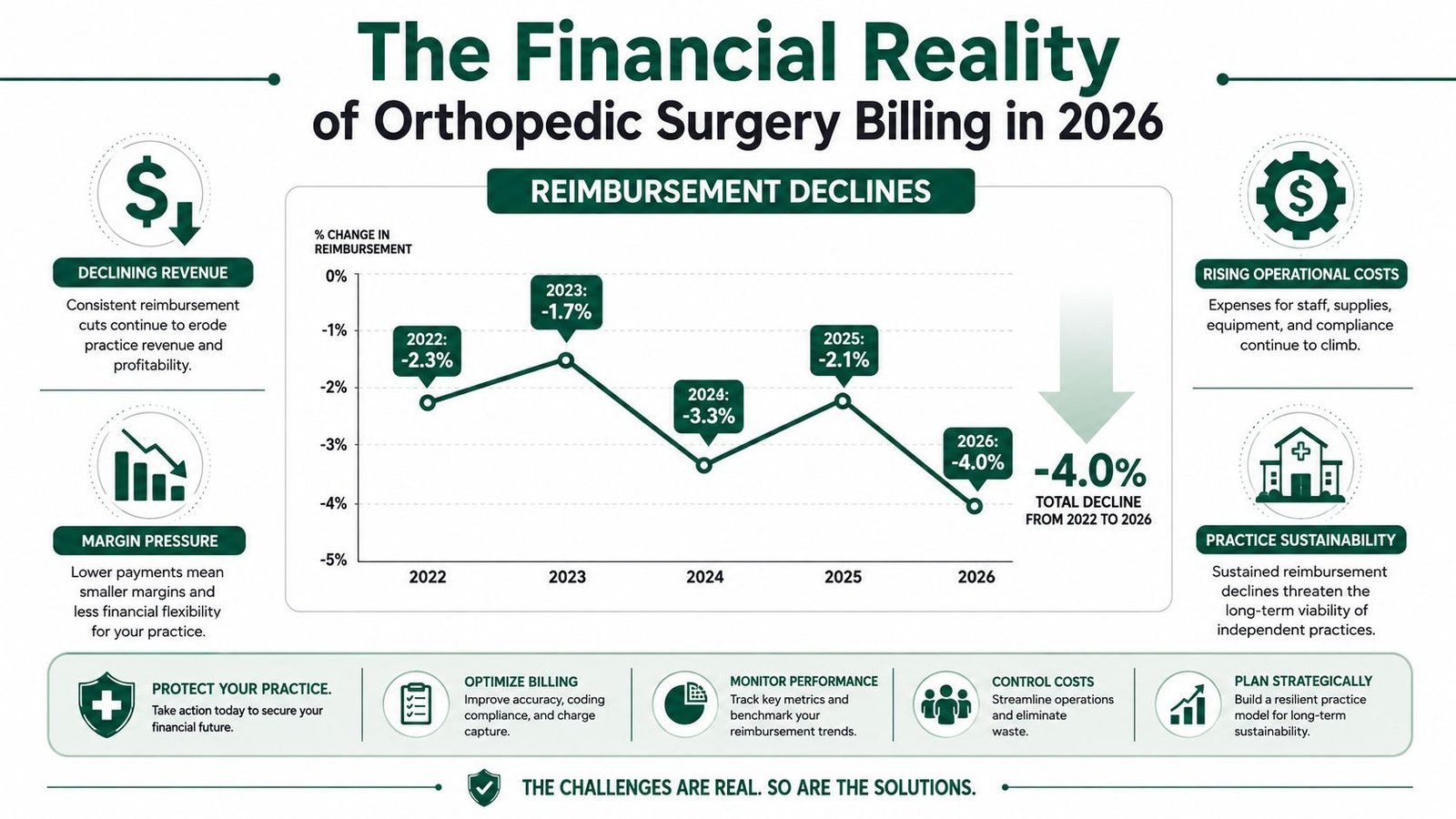
The Financial Reality of Orthopedic Surgery Billing in 2026
Orthopedic billing pressure is coming from two directions at once. Payment per service is slipping, and utilization in federal orthopaedic surgery has also declined from 2016 to 2022. That combination is hard on independent owners because it squeezes both sides of the revenue equation. The same practice that once recovered from a few denial cycles now has less room for write-offs, longer follow-up work queues, and more staff time spent on appeals.
What matters to a practice owner is not just that reimbursement is down, but that the remaining dollars sit in a relatively small number of high-value claims. Medicare billing data show a large professional billing footprint among orthopaedic surgery clinicians, which means even modest workflow defects can create outsized leakage Doctor Payments Data. In practical terms, orthopedic surgery billing should be treated like a production line with strict controls, not a generic claim stream that any outsourced team can handle well without specialty knowledge.
Front-end work is where a lot of the money disappears. ED charge capture, site-of-service disputes, and bedside procedures have to be handled before the claim ever reaches coding review, or the practice spends weeks trying to recover revenue that should have been captured on day one.
Why generic RCM underperforms here
Generalist billing teams tend to focus on clean claim submission and broad denial follow-up. Orthopedics needs more than that. The practice has to manage 90-day global periods, high-dollar joint codes, site-of-service disputes, and front-end charge capture for ED and bedside work before the claim even exists Transcure ADSC site-of-service guidance. If that sounds like a lot, it is.
Practical rule: if your team can't explain why a claim was billed, denied, adjusted, or written off at the code level, you're probably losing money in patterns you haven't isolated yet.
The right response is to decide whether your current billing operation can reliably handle orthopedic complexity, or whether a specialty partner is needed to stop the leakage. If you want a deeper specialty review, start with the orthopedic billing resources that map directly to surgical revenue risk, then compare that against your current denial trends and A/R aging.
High-Value CPT Codes That Drive Orthopedic Revenue
Orthopedic revenue is concentrated in a small set of CPT codes, so a miss on one high-dollar case can distort the month quickly. In many practices, 27447 for total knee arthroplasty, 27130 for total hip arthroplasty, and 27446 for partial knee replacement sit at the top of the reimbursement stack. These are not routine line items. They are the claims that expose weak scheduling, weak authorization work, and weak pre-bill review before the denial ever reaches posting.
The codes matter, but the hidden leakage often starts earlier than coding. If the front desk, surgery scheduler, or clinical team misses a site-of-service mismatch, a bedside procedure, or a documentation gap tied to the operative episode, the best coder in the office is still working from a damaged chart. For a broader perspective on record review, see the Ares guide to medical record CPT codes. High-value orthopedic claims deserve the same level of scrutiny because once the chart is incomplete, recovery becomes slower and more expensive.
Where denial dollars hide
A denied arthroplasty claim does more than delay payment. It creates rework time, payer follow-up, and slower collections that can push a clean claim into a second or third work cycle. In arthroplasty-heavy groups, that pressure matters because a small number of claims drives a large share of professional revenue PMC arthroplasty payment analysis. A denial queue should be ranked by procedure value, not by whatever arrived first.
| CPT Code | Procedure | Avg Reimbursement | Denial Cost Impact |
|---|---|---|---|
| 27447 | Total knee arthroplasty | High-value elective joint case | Delays a major surgical claim and adds rework time |
| 27130 | Total hip arthroplasty | High-value elective joint case | Disrupts cash flow on one of the practice's largest claims |
| 27446 | Partial knee replacement | High-value elective joint case | Creates avoidable A/R aging if documentation or auth is weak |
The table does not need invented dollar figures to show the risk. The practical point is that these claims deserve first-pass review by someone who understands arthroplasty documentation, payer policy, and appeal logic. That matters even more when the billed episode includes related imaging, pre-op work, or implant documentation that does not separate cleanly from the operative record.
What owners should audit first
A useful audit starts with three questions.
- Was the authorization aligned to the exact procedure? A planned 27447 is not automatically covered if the case becomes a more complex revision or different construct.
- Was the note specific enough for medical necessity? Conservative treatment history, functional limitation, and imaging findings need to line up with the requested operation.
- Was the denial prioritized by value? If your team works low-dollar accounts first, the workflow will miss the claims that matter most.
Use a code-level cross-check before the claim leaves the queue. The knee arthroscopy CPT code resource helps teams keep arthroscopy logic separate from arthroplasty logic, which is where many miscoded episodes start. When an office reviews the case at that level, it is easier to catch mismatched procedure descriptions, missing supporting notes, and billing assumptions that do not fit the actual surgery.
Mastering Global Period Rules and Modifier Strategy
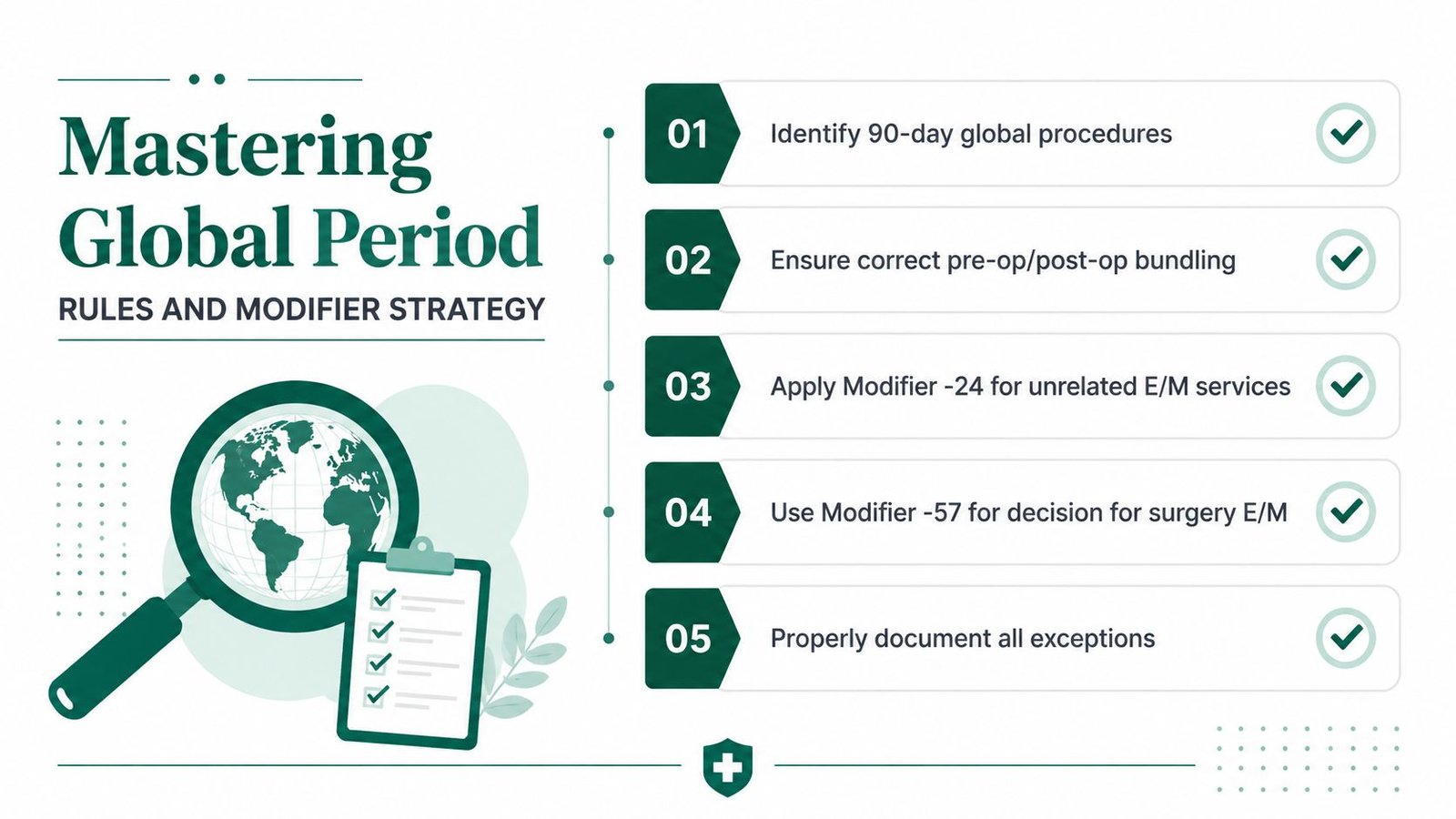
A major orthopedic case often carries a 90-day global surgical period, which bundles the operation, routine pre-op work, and routine post-op care into one payment. That package can swallow a follow-up visit, staple removal, wound check, or X-ray review if the service is billed as separate care without the right support. In practice, the denial usually comes down to whether the service belongs inside the global package and whether the chart proves otherwise.
The modifiers that protect real revenue
Global-period denials are often traceable to missing carve-outs or thin documentation. Modifier 24 is used for an unrelated E/M service during the global period, 25 supports a separately identifiable E/M on the same day as a procedure, and 57 applies when the decision for major surgery is made at an E/M encounter Healix RCM. Return-to-OR billing is more delicate. 58, 78, and 79 carry different meanings, and they do different work in the claim.
A clean workflow starts with a surgeon-facing checklist that mirrors the global package.
- Identify the global clock early. Tag every major orthopedic procedure before follow-up scheduling starts, so the team knows which encounters sit inside the package.
- Separate routine from unrelated care. If the visit is outside the surgical episode, the note has to say that plainly and show why.
- Match the modifier to the clinical story. Staged care, a complication return, and an unrelated procedure all require different coding logic.
A technically correct note still denies if the modifier trail does not match the encounter.
What practice owners should inspect in denial reports
Global-period denials tend to cluster around the same services. If the payer keeps rejecting post-op visits, wound checks, or return procedures, the problem usually sits in the workflow, not in random claim noise. The practical question is whether the denial came from documentation gaps, modifier selection, or staff not recognizing the service as billable in the first place.
The CPT modifier 59 reference is a useful cross-check when your team needs to separate distinct procedural services from bundled ones. Use it as a comparison point, not as a substitute for payer-specific review. Orthopedic billing gets expensive when teams use one modifier by habit instead of applying the right one to the right clinical event.
The biggest leak often starts before the modifier is even chosen. If the charge never gets attached to the right encounter, no modifier can recover it. Owners should look at how the office captures bedside work, how the surgery scheduler labels the global period, and whether the biller can see the full clinical story before the claim leaves the queue. Those handoffs decide whether the claim pays cleanly or becomes avoidable A/R aging.
Capturing Revenue from ED and Bedside Procedures
A lot of orthopedic revenue never makes it into coding because nobody captures it at the point of care. That's especially true in trauma-heavy practices where the surgeon moves from the ED to the OR and back again, sometimes before the documentation is complete. The missed work isn't necessarily complex. It's often a fracture reduction, splint application, bedside procedure, or consult that never survives the handoff from clinician memory to charge entry SwiftPayMD.
A common failure pattern
A surgeon evaluates a displaced wrist fracture in the ED, performs a reduction, applies a splint, and then gets pulled into the OR for another case. The bedside procedure gets documented later from memory, the trauma call log never gets reconciled, and the charge disappears into the gap between clinical urgency and billing workflow. By the time anyone notices, the encounter has aged enough that staff assume it was either captured already or is too messy to fix.
That pattern is avoidable, but only if the practice treats ED capture as a daily operating task. The most effective teams use a same-day reconciliation process between the trauma list, operative schedule, and submitted charges. They also run monthly audits that compare bedside procedure activity against billed encounters so the missed work shows up as a repeatable pattern, not a one-off mystery.
What needs to be documented before the clinician leaves
The capture problem starts before coding does. If the note doesn't describe the bedside work clearly, billing can't defend it later. That's why the documentation has to be completed while the event is still fresh, with the reduction, splinting, or consult tied to the exact encounter and the exact anatomical site.
Best operating habit: reconcile the ED log the same day, not at month-end, because forgotten bedside work turns into permanent leakage fast.
Charge capture discipline pays off here. A practice doesn't need more generic billing advice; it needs a workflow that forces the encounter to be documented, queued, and reconciled before the surgeon's next surgical block makes the earlier bedside case disappear from memory. In orthopedics, the leak often happens before the coder ever touches the chart.
Preventing Site of Service Denials and Classification Disputes
Site-of-service denials start with a simple mismatch. The surgeon plans one setting, the authorization names another, and the claim lands in the payer's review queue. In orthopedic billing, that mismatch can be enough to stop payment even when the procedure was clinically appropriate, because payers judge the work by both the service and the setting where it occurred.
Compare the options before the case is scheduled
A clean site-of-service workflow compares the planned location, the authorization, and the clinical order before the patient is placed on the schedule. If those three pieces do not agree, the case needs an escalation path right away. Fixing it before the OR date is far cheaper than trying to reverse a denial after the claim has already been processed.
The internal link POS 21 in medical billing is useful when your team needs a practical reference point for hospital outpatient billing logic. Many denials do not turn on the surgery itself. They turn on the billing position selected later, and that position has to match the documented site.
What tends to go wrong
Prior authorization is only one part of the control process. The authorization must fit the exact procedure, the exact site, and the patient status documented by the surgeon. If the payer sees a gap between those elements, the claim can stall or deny even when the care decision was sound.
Operational standard: validate the site before the OR date, not after the remittance date.
That difference decides whether the issue stays an administrative correction or becomes a write-off. High-cost orthopedic procedures, including joint replacement and spine surgery, draw closer payer review because the dollar exposure is larger and the classification choice matters more, as ADSC site-of-service guidance notes. Staff who cannot flag the mismatch early usually find it later in the denial queue, when the fix is slower and the cash is already delayed.
Documentation Quality and Authorization Workflows
Documentation and authorization aren't separate jobs in orthopedic surgery billing. They're the same revenue control system seen from two angles. A weak note leads to a weak authorization request, and a weak authorization request usually becomes a denial or a reschedule Suby compliance documentation. That's why the best orthopedic groups stop treating clinical documentation as a physician habit and start treating it as a revenue input.
How undercoding and auth failure feed each other
The PubMed study on an academic multispecialty orthopedic practice found that fewer level 4 evaluation-and-management reports were associated with an estimated annual revenue loss of $81,281.11 PubMed. That number matters because it shows documentation quality isn't a compliance abstraction. It's direct top-line leakage. If the note undercodes the visit, it can also weaken the case for surgery, reduce the credibility of the authorization packet, and lower the odds that the payer accepts the clinical story.
The same problem shows up in prior auth. If the surgeon's note doesn't clearly show symptom duration, functional limitation, conservative treatment failure, and imaging support, the authorization team is left building a case from fragments. That's slow, and in orthopedics, slow often means denied or delayed.
What a strong workflow actually looks like
A workable workflow ties the note, the auth request, and the charge capture together. The surgeon documents enough detail for medical necessity. The staff converts that into a payer-ready packet. Billing then checks whether the authorization, place of service, and code set line up before the claim leaves the system.
- Surgeon documentation: state the diagnosis, failed conservative care, and clinical reason for the operation.
- Authorization packet: mirror the payer's requirements, not your internal shorthand.
- Feedback loop: send denial trends back to the surgeons so the next note is stronger.
The prior authorization resource is a useful operational reference when you're tightening that loop. Practices that connect documentation quality with authorization discipline usually see fewer day-of-surgery surprises and fewer claims that stall because the record can't support the payer's request.
KPIs and Workflow Benchmarks for Orthopedic RCM Success
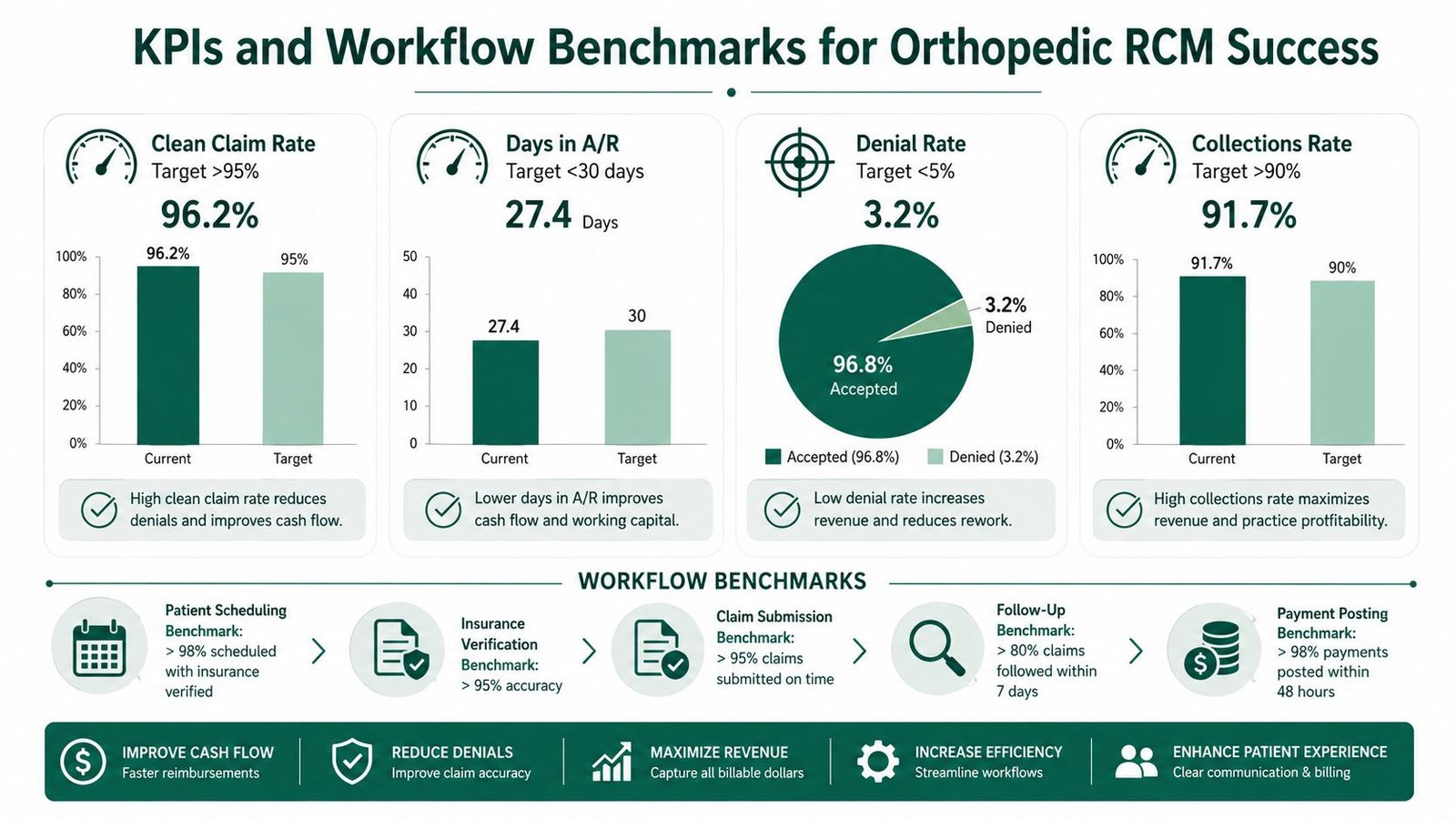
A strong orthopedic billing operation is visible in its numbers long before it becomes visible in bank deposits. The right dashboard doesn't need dozens of vanity metrics. It needs a few clear signals, tracked by payer, code family, and denial reason so the owner can see where cash is leaking MakeAutomation revenue cycle management. In orthopedic surgery, the most useful measures are the ones that show whether the team is preventing problems or just reacting to them.
What to track every week
The core KPIs are straightforward. First-pass clean claim rate tells you whether claims are leaving the practice ready to pay. Days in A/R tells you whether the team is collecting promptly. Denial rate by payer and code tells you where the system is breaking. Charge lag time shows whether the practice is capturing work before it ages out. Net collection rate tells you whether the full workflow is producing money.
The internal benchmark page medical billing KPIs to track is a useful supplement if you're building a dashboard from scratch. For orthopedic owners, the important part is not the spreadsheet itself. It's whether someone reviews the trends weekly and forces a fix when a metric slips.
How to read the numbers
If clean claims are strong but A/R is drifting up, the bottleneck is probably denial follow-up or payer reprocessing. If denial rate is concentrated in a few CPTs, especially arthroplasty or spine, the fix is code- and payer-specific rather than broad retraining. If charge lag is high in the ED or bedside workflow, the leak is happening before the coder ever sees the chart.
A practice should also know when internal management stops being efficient. If your team can't keep global-period logic, site-of-service disputes, bedside charge capture, and authorization work under control at the same time, then the issue isn't effort. It's specialization. In a field with this much billing friction, orthopedic surgery billing rewards teams that can operate with discipline, specialty knowledge, and tight denial controls.
If you want a hard look at where your orthopedic revenue is leaking, bring your denial reports, A/R aging, and top CPT list to Happy Billing. We'll map the hidden loss points in your orthopedic surgery billing, show you what's worth fixing first, and help you decide whether your current workflow can protect cash flow.