7 Best Medical Billing Companies in USA for 2026

98%+ first-pass clean claims and under 35 days in A/R are the kind of numbers that separate the best medical billing companies in USA from the rest. If your billing partner cannot move cash faster and keep denials down, you are paying for friction, not recovery.
Choosing the right revenue cycle partner is a revenue decision, not a vendor decision. The best fit depends on your specialty, your payer mix, and whether you need a specialist team, an integrated platform, or enterprise-scale throughput. In our experience, the wrong choice pushes days in A/R higher, slows appeals, and forces your staff to spend time on avoidable rework instead of patient care. That is especially true in specialties where modifiers, authorizations, and payer rules drive cash flow, like modifier 25 and 59 workflows in orthopedics or unit-based anesthesia billing.
The market itself now rewards measurable performance. Independent U.S. ranking pages highlight benchmarks like a 99% claim accuracy target with sub-48-hour turnaround, a 20% revenue increase with 24-day A/R recovery, and another standard set around 98% clean claims, 97% first-pass ratio, 96% collections, and average A/R under 30 days (SwiftMDS ranking analysis). That is the frame you should use as a practice owner. If a company cannot speak in those terms, it is not ready for your contract.
You also need to evaluate scale and specialty fit. The U.S. medical billing services market is estimated at $4.3 billion in 2026 (IBISWorld industry overview), which means buyers have plenty of choices, but only a few vendors can prove real RCM discipline. Use this list to compare companies the same way we do in audits, by cash velocity, denial prevention, and specialty-specific execution. If you want a second set of eyes on your numbers, start with our free revenue audit and compare your current workflow against the vendors below. For broader operational due diligence, this small business audit guide is a useful complement.
1. Happy Billing
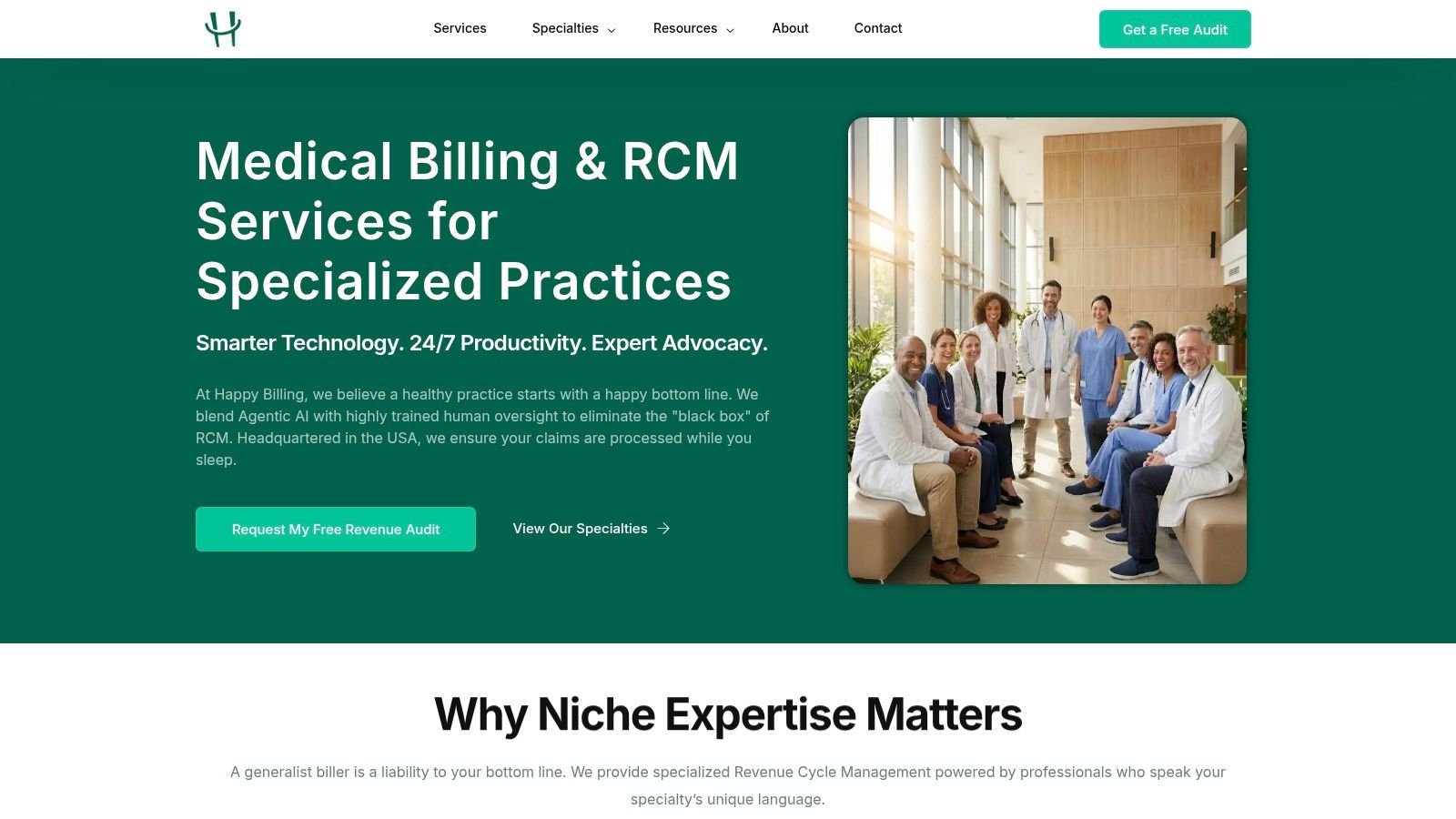
Happy Billing is the strongest choice for independent practices that care about collections speed, specialty accuracy, and less administrative drag. It is built for owners who want their billing partner to behave like a revenue team, not a ticket queue. That matters because cash flow problems usually start with slow claim movement and end with old A/R that never gets properly worked.
The company's published performance is the kind of benchmark practice owners should demand. Happy Billing states a 98%+ first-pass clean claim rate and days in A/R under 35, and it operates inside your existing EHR so you do not have to rebuild your workflow or migrate data. Its site also emphasizes a 24/7 follow-the-sun model, HIPAA-first security, bank-level encryption, and AAPC-aligned coding standards, which is the right mix for owners who want speed without losing control. You can review that positioning on the company's own best medical billing company resource.
Specialty fit is the real differentiator
Happy Billing stands out because it is not trying to be generic. The company explicitly maps workflows to anesthesiology, mental and behavioral health, cardiology, orthopedics, pediatrics, and other specialties, which is exactly how you reduce denial risk in the real world. Anesthesia groups need cleaner unit and concurrency handling, behavioral health needs tighter authorization discipline, and orthopedics needs disciplined handling of global periods and multiple-procedure reductions.
Practical rule: if your current biller cannot explain your top denial reasons by specialty and payer class, they are managing paperwork, not revenue.
That specialty depth is why Happy Billing belongs at the top of this list for physicians who want outsourced RCM without giving up operational visibility. We also like that it works inside your current EHR, because integration friction is one of the fastest ways to kill adoption in a busy office. For practice owners comparing outsourced billing against internal cleanup, that alone can make the difference between a smooth transition and months of disruption.
2. athenahealth Revenue Cycle Services
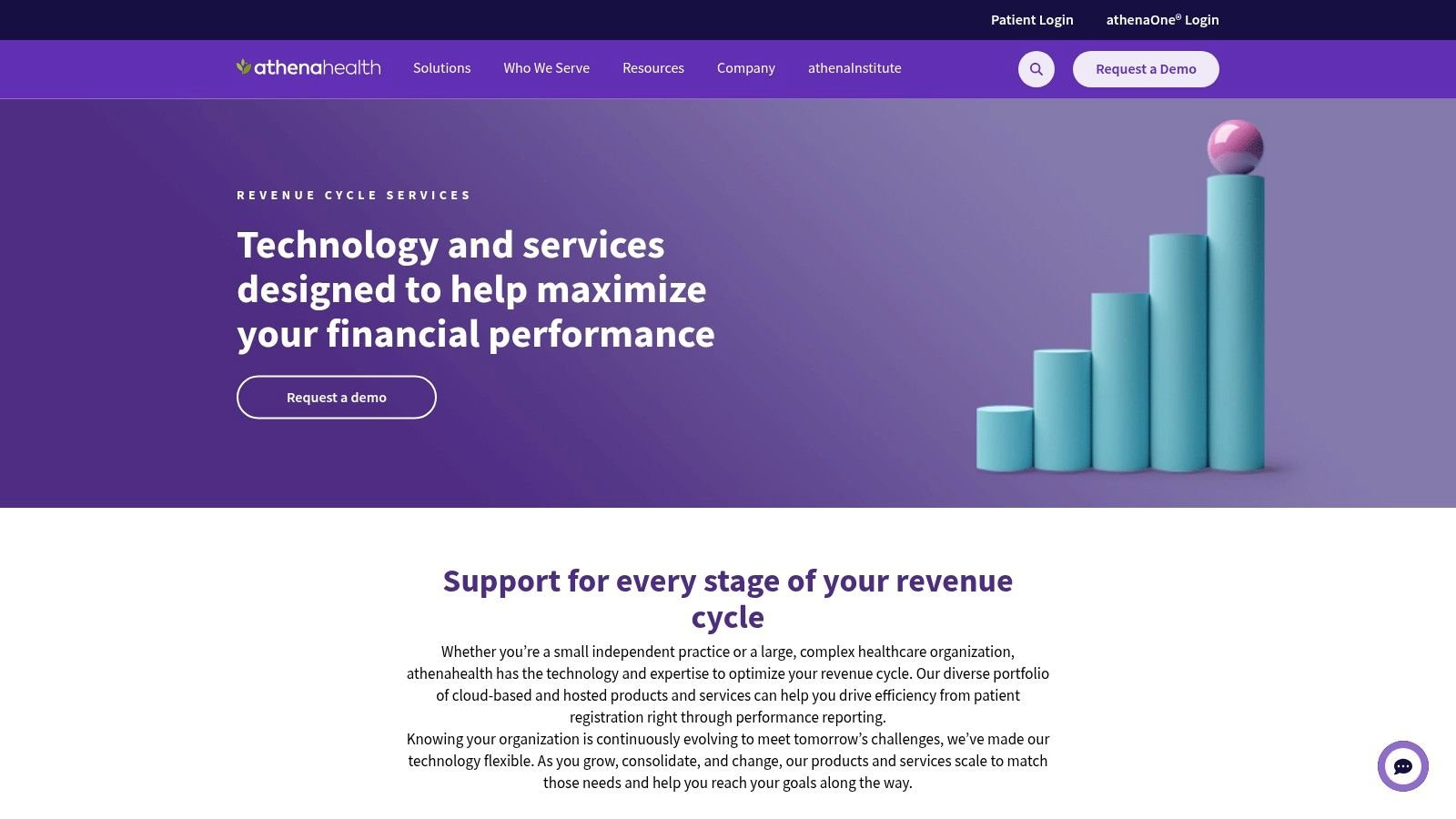
athenahealth is the right pick if you want billing services tied tightly to a broad platform, not a standalone outsourcing shop. Its Revenue Cycle Services sit inside the athenaOne ecosystem, so practices that already live in that environment can centralize eligibility, denials, appeals, and coordination-of-benefits work without stitching together separate tools. For larger groups, that operational unity is the main selling point.
The company also has an enterprise option in athenaIDX, which matters for multi-entity organizations that need more structure than a basic billing service can provide. We see athenahealth as strongest when the buyer wants a mature platform with managed services layered on top, especially in groups that need role-based dashboards and payer-rule updates across many locations. The public service scope is clear, and that makes the evaluation easier than with vendors that hide everything behind vague sales decks.
Where athenahealth fits, and where it doesn't
athenahealth is a good fit for practices that want software plus services and are comfortable with a quote-based commercial process. It is not the first choice for an owner who wants a highly customized specialty RCM team with deep denial coaching by service line. The model is more platform-led than boutique-led, and that usually works best for organizations that value standardization over close-knit account management.
Large groups should ask one question first, whether the service model actually gives their staff faster payer resolution or just more screens to manage.
The business case is straightforward. If your practice already uses athenaOne or is planning a larger operational consolidation, athenahealth can reduce fragmentation and give you one billing stack to govern. If you are a smaller specialty group that wants direct specialty firepower, it is probably too broad for your needs. Happy Billing's RCM automation guide is a useful comparison point if your goal is faster cash, not just more software.
3. R1 Physician Revenue Cycle Management
R1 is built for scale, and that is exactly why large physician groups and health systems keep it on the shortlist. Its physician revenue cycle offering is designed for embedded and on-site operating models, with AI-enabled workflows, automation, analytics, and EHR-agnostic execution. That combination is powerful when you have multiple locations, multiple specialties, and a leadership team that wants standardized RCM playbooks rather than a patchwork of local workflows.
The strength here is operational consistency. R1 is a fit for organizations that need enterprise-style governance across patient access, coding, claims, and A/R recovery, especially where there are many moving parts and high internal reporting expectations. The company's recognition in ambulatory RCM also signals that it is being evaluated as a serious enterprise vendor, not a commodity biller.
Who should use R1
R1 makes sense for physician enterprises that already operate like a system. If your practice is still small, or if your team wants very hands-on specialty support, this is too heavy. It is also not the easiest option for owners who want transparent, quick decision-making from a smaller account team.
The buying test is simple. If your main problem is not just billing but governance across multiple sites, R1 belongs in your process. If your biggest pain point is specialty-specific denials or local payer friction, a more focused partner usually wins. We tell practice owners to separate scale from fit, because they are not the same thing.
Happy Billing's physician-practice RCM resource is worth comparing if you are deciding between enterprise standardization and a specialty-led service model. R1 is strong at structure. It is not the best answer for every owner who wants faster cash and fewer denials.
4. CareCloud Concierge RCM
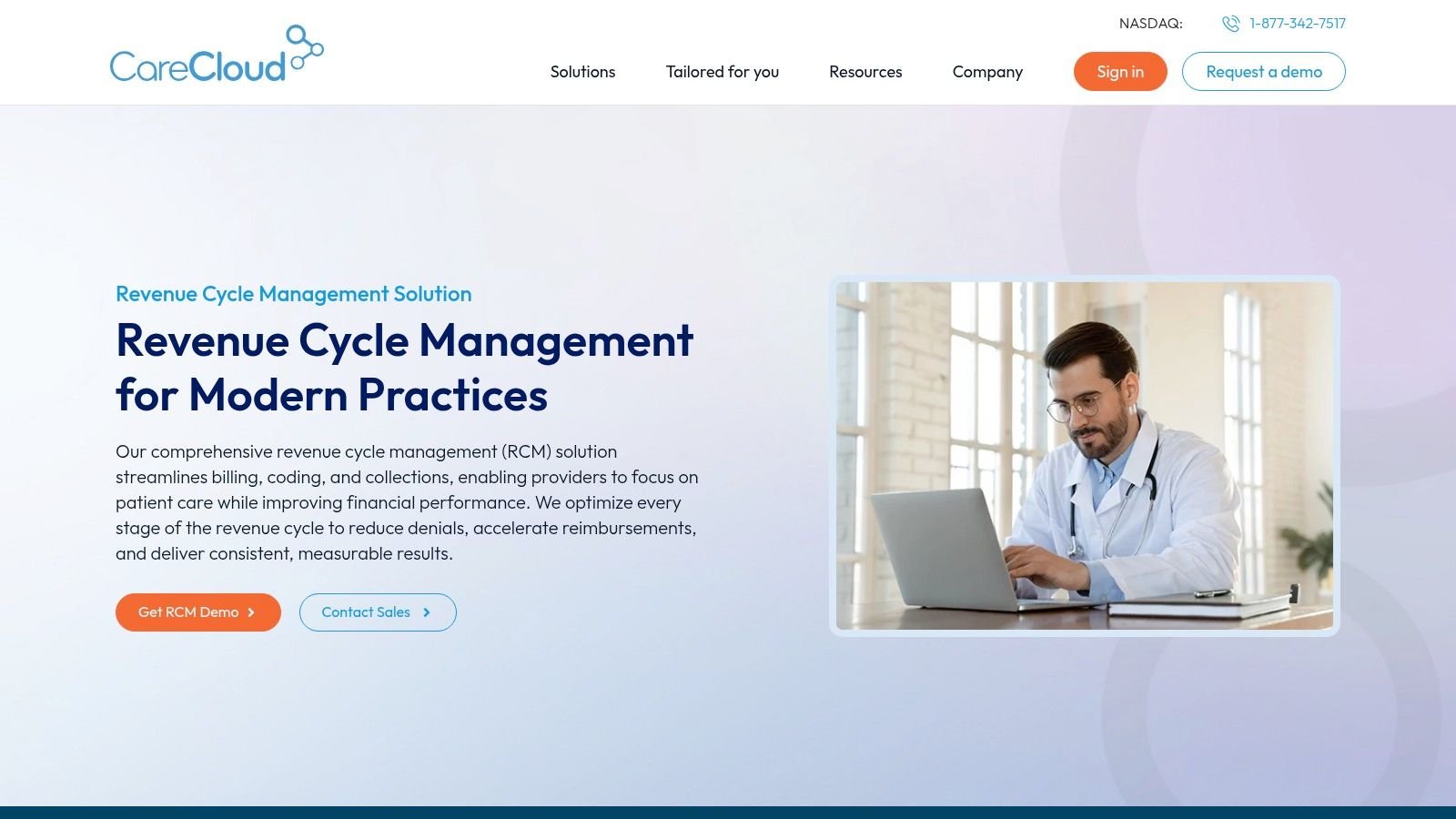
CareCloud is a practical choice for practices that want billing, analytics, and practice management under one roof. Its Concierge RCM sits alongside a platform that includes claim rules, dashboards, and multiple service tiers, so owners can scale up from software-only support to fuller outsourcing as needs change. That flexibility is valuable if you are not ready to hand over the entire revenue cycle on day one.
The company's CollectiveIQ rules engine is the key operational feature here because it is meant to reduce edits and denials before claims go out. That is a good financial model, since preventable claim rework is expensive even when the dollar amounts per claim are small. CareCloud also gives you real-time KPI visibility, which matters when you are trying to see where the money is getting stuck.
Best use case for practice owners
CareCloud is strongest for buyers who want a platform-first relationship and need a clear runway from in-house billing to outsourced RCM. It is useful for organizations that value dashboards, claim scrubbing, and managed follow-up without immediately moving to a fully specialty-dedicated model. The tradeoff is that some tiers may not include medical coding, so you need to check exactly what is in scope before signing.
Owner's check: if the quoted package excludes coding, denial appeals, or robust AR work, you are comparing software support, not full revenue cycle management.
We like CareCloud for practices that want to keep some control in-house while tightening claims performance. It is not the most specialized answer on this list, but it does give owners a middle path between software and full outsourcing. The Revenue Cycle Management best practices guide is useful if you want to benchmark how much process discipline your current setup is missing.
5. Coronis Health Specialty-Focused Billing
Coronis Health belongs on this list because it speaks the language of specialty billing instead of generic outsourcing. Its model brings together full-cycle RCM, credentialing, and analytics across physician groups, hospitals, and community health centers, with special strength in areas like anesthesia, orthopedics, behavioral health, and imaging. For practice owners, that is the difference between a vendor that knows your service line and one that only knows claims intake.
The transparency layer also matters. Client-facing dashboards give owners a view into billing activity and performance, which helps when you need to hold a partner accountable for denial work and front-end authorization discipline. That is especially useful in high-stakes specialties where a missed authorization or incorrect workflow can create a real cash leak.
Why specialty depth matters here
Coronis is best for organizations that want a billing partner capable of handling complex, specialty-specific operations across multiple locations. The model is broader than a niche anesthesia shop but more focused than a general software-led platform. That makes it a reasonable fit for owners who need breadth and specialty awareness in the same package.
The caution is simple. If your patient-pay workflow is unusually sensitive, confirm how the company handles those interactions before you move forward. Publicly visible business reviews can vary, so the contracting conversation should stay focused on workflow control, reporting, and accountability. For specialty practices, we recommend pairing this kind of review with a specialty-specific internal benchmark, and Happy Billing's specialty page is a good example of how a partner should speak to service-line differences.
6. nimble solutions for ASC and Surgical Specialists
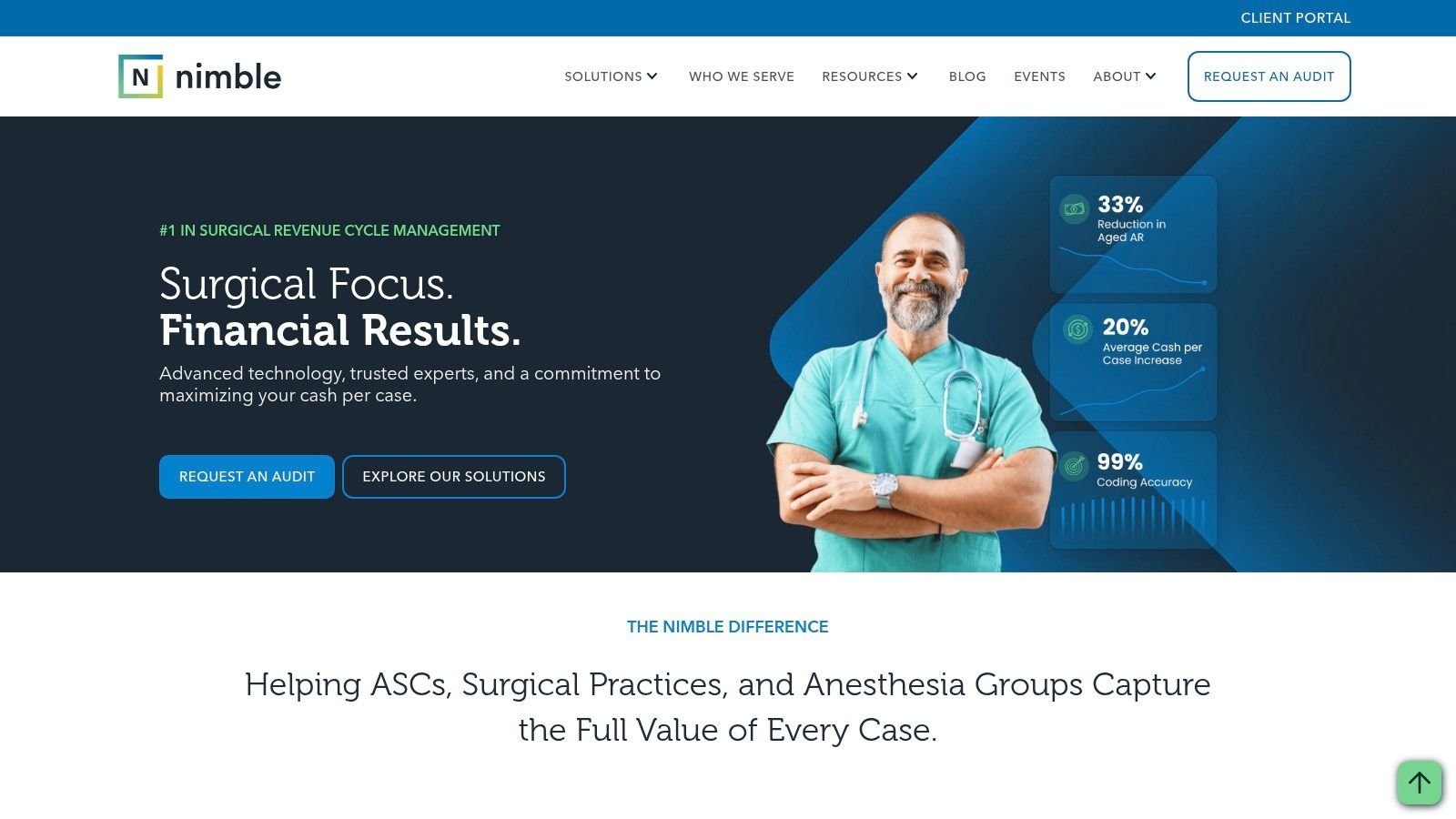
nimble solutions is built for ambulatory surgery centers, surgical practices, and anesthesia groups, and that niche focus is its biggest strength. When your revenue depends on surgical workflows, payer policy changes, documentation quality, and managed care contracting, a general biller often misses too much. nimble's model is designed to cover the entire revenue cycle for that environment, from front-end work through coding, billing, and A/R recovery.
The company also leans into documentation optimization and payer-policy monitoring, which is exactly where surgical practices can lose money if the workflow is sloppy. Those details matter in ASCs because the stakes are higher, the rules are tighter, and the margin for error is smaller. A partner that understands surgical reimbursement mechanics can save more money than a cheaper generalist ever will.
The right fit for surgical revenue
This is not a primary care billing company, and it should not be judged like one. Its value comes from depth in surgical and anesthesia settings, where specificity beats breadth every time. If your practice is built around procedural volume, this kind of niche expertise is often worth more than a lower headline fee.
We would put nimble on the shortlist for owners who need someone fluent in ASC economics and surgical documentation pressure. It is less compelling for office-based groups that do not live in those workflows. The buying question is not whether the company can bill, it is whether it understands the reimbursement rules that decide your margin.
7. Ventra Health for Facility-Based Physician Specialties
Ventra Health is a strong choice for facility-based physician groups, especially anesthesia, emergency medicine, hospital medicine, and radiology. Its national scale came from consolidating specialty RCM firms, and that background shows up in the way it handles specialty-built workflows and reporting. For groups that need visibility into denials, A/R, and reimbursement trends, Ventra's analytics-first posture is a real advantage.
The vCision platform is central to that value proposition because it gives leaders a cleaner view of performance and provider education. That matters in facility-based specialties where reimbursement is often shaped by complex coding patterns, handoffs, and clinical documentation discipline. If your physician group wants a partner that is used to large-scale specialty operations, Ventra is worth serious consideration.
Why it makes the list
Ventra is not trying to be everything to everyone. It is most useful for physician groups that are already operating in facility-based environments and need a service model built around those realities. Its white-glove approach and metrics focus make more sense for anesthesia and ED than for a small office-based primary care practice.
The limitation is just as clear. It is not the best fit for purely office-based groups that want a simple outsourced billing team. Owners should treat it as a specialty enterprise option, not a universal answer. If your business is tied to facility-based revenue streams, this is one of the more relevant vendors to review.
Top 7 U.S. Medical Billing Companies Comparison
| Provider | Implementation complexity | Resource requirements | Expected outcomes | Ideal use cases | Key advantages |
|---|---|---|---|---|---|
| Happy Billing | Low, integrates inside existing EHR with no migrations | Agentic AI + expert human auditors; 24/7 follow‑the‑sun operations | Very high first‑pass clean claims (98%+); <35 days in A/R; faster cash flow | High‑stakes specialties (anesthesiology, cardiology, orthopedics, behavioral health) seeking rapid revenue recovery | Specialty‑tailored workflows, HIPAA‑first security, 24/7 turnaround, free revenue audit |
| athenahealth, Revenue Cycle Services | Medium, integrated with athenaOne; enterprise option available | Requires athenaOne platform adoption or integration; managed service resources | Centralized denial handling, mature RCM tooling and dashboards | Practices wanting combined software + managed services; multi‑entity groups (athenaIDX) | Broad U.S. install base, payer‑specific workflows, specialty accelerators |
| R1, Physician Revenue Cycle Management | High, enterprise‑style, often on‑site/embedded engagements | Large-scale implementation, AI workflows, analytics and standardized playbooks | Scalable, standardized RCM with automation and advanced analytics | Large multi‑location practices and health systems with high volume | EHR‑agnostic, strong analytics, KLAS recognition for ambulatory RCM |
| CareCloud, Concierge RCM | Medium, platform integration with tiered service options | CollectiveIQ rules engine, real‑time analytics, potential implementation fees | Reduced edits/denials pre‑submission; improved KPIs and AR reduction (Concierge tier) | Practices wanting flexibility from software‑only to full outsourced RCM | Strong claim scrubbing, real‑time dashboards, flexible service tiers |
| Coronis Health, Specialty‑Focused Billing | Medium, specialty consolidation with client dashboards | Specialty billing teams, credentialing and analytics support | End‑to‑end RCM with specialty reporting and transparency | Specialty practices and hospital‑affiliated or multi‑location groups | Broad specialty catalog, client‑facing dashboards, scalable model |
| nimble solutions, ASC & Surgical Specialists | Low–Medium, purpose‑built for ASCs and surgical workflows | Specialty advisors, managed care contracting, documentation optimization | Improved turnaround, payer contracting outcomes, ASC workflow acceleration | Ambulatory surgery centers, surgical practices, anesthesia groups | Deep ASC/surgical expertise, documented case studies and outcomes |
| Ventra Health, Facility‑Based Physician Specialties | Medium–High, national consolidation with specialty platform | vCision analytics, national operational scale, provider education resources | Improved metrics (denials, A/R, reimbursements) and transparency | Facility‑based physician groups (anesthesia, ED, hospital medicine, radiology) | Deep facility‑based experience, AI analytics platform, national scale |
How to Make Your Final Outsourcing Decision
Choosing the best medical billing company is not about finding the loudest marketing claim. It is about matching the vendor to your specialty, your payer mix, and the financial problem you need solved right now. If your denial issue comes from authorizations and payer-specific rules, you need a partner that can handle that work consistently. If your problem is stale A/R, you need a team that can work old balances aggressively without losing accountability.
Start with three questions. First, can the company show specialty-specific results for practices like yours, not just a generic success story? Second, can it explain how it manages denial prevention, not just denial submission? Third, can it give you a clear answer on how quickly claims move from encounter to cash? Those are the filters that protect revenue.
Compliance matters too. A billing partner should be able to work within HIPAA, manage CPT, ICD-10, and HCPCS-based workflows, and demonstrate real credentialing standards before you sign anything. One U.S. guide explicitly tells buyers to verify HIPAA, ISO, and ASRM certifications and confirm coder credentials before contracting (MedibillMD compliance guide). That is not paperwork. It is your defense against preventable payer rejections and avoidable write-offs.
Pricing should never be your only filter, but it still matters. Market guidance puts most billing companies at 4% to 9% of monthly collections, with smaller practices sometimes quoted $500 to $1,400 per provider per month. A/R recovery work often runs 20% to 30% of recovered money (Credex Healthcare pricing guide), so you should separate routine billing from collections cleanup before comparing proposals. Otherwise, you will overpay for a bundle you do not need or underbuy a team that cannot fix your problem.
If you want the cleanest path, compare your current performance against one specialty-led partner and one platform-led partner. Then decide which model moves cash faster with less internal strain. For many practice owners, that decision becomes obvious once they see their own denial patterns, payer mix, and aging balances side by side.
What percentage of revenue should I expect to pay for a top medical billing service?
Most vendors are priced from collections, and the quoted market range is generally 4% to 9% of monthly collections (Credex Healthcare pricing guide). The right number depends on specialty complexity, claim volume, and whether you need coding, credentialing, or A/R recovery. If a quote looks unusually cheap, ask what they are not doing.
How long does it take to switch medical billing companies?
A proper switch usually takes time because payers, EHR connections, and account handoff all need to stay clean. In most cases, you should plan for a transition period that protects cash flow rather than rushing the cutover. The better partner will map the handoff before it touches live claims.
Can an outsourced billing company really understand my specialty's coding?
Yes, but only if the company is built for your specialty. Anesthesia, cardiology, orthopedics, and behavioral health each have different denial patterns, authorization demands, and documentation risks. We have seen generalist vendors miss those details and leave money on the table.
What should I ask before I sign a billing contract?
Ask for specialty-specific denial rates, payer-class A/R days, and the workflow they use to overturn denials. Then ask who handles follow-up, what systems they use, and whether they operate inside your current EHR or force a migration. Those questions tell you whether the company is protecting revenue or just processing claims.
If you want a billing partner built to reduce denials, tighten specialty workflows, and keep cash moving, talk to Happy Billing. We work inside your existing EHR, focus on specialty-specific revenue recovery, and give practice owners a clearer path to fewer denials and faster collections.