Medical Billing Services in Texas: A 2026 Guide for Practice Owners

Yes, for Texas medical practices, outsourcing your billing is a critical financial strategy to maximize revenue and reduce administrative overhead. It transitions your revenue cycle from a costly, high-maintenance operation into a predictable, high-performing asset by leveraging specialized expertise in complex Texas payer rules, like those from BCBSTX and Texas Medicaid. This allows you to focus on patient care while experts secure every dollar you’ve earned. Texas practices can also explore our medical billing services in Texas for dedicated local support.
Quick answer: Texas practices typically pay 4–9% of monthly collections for full-service medical billing. Beyond the usual claim work, a Texas billing partner has to know the state’s payer landscape — BCBS of Texas, UnitedHealthcare, Aetna and Texas Medicaid (TMHP) — and the Texas Prompt Pay Act, which requires insurers to pay clean electronic claims within 30 days (45 for paper) and adds penalty interest when they don’t. Happy Billing is a Texas-based billing company serving independent practices statewide.
Looking city by city? See our guides to Austin, Houston and Dallas billing companies.
Practices with locations outside Texas can find the same state-level payer and prompt-pay guidance in our pages on medical billing services in Illinois, medical billing companies in Florida and medical billing companies in Minnesota.
Why Texas Practices Are Switching to Outsourced Billing
For many physician owners and practice managers in Texas, running the revenue cycle in-house has become an uphill battle. You’re fighting rising administrative costs, a tough hiring market for skilled staff, and a relentless stream of rule changes from payers. It’s a perfect storm that chips away at your bottom line and pulls your focus from patient care.
This is precisely where a dedicated billing partner steps in. They’re not just submitting claims; they’re your financial backstop. They live and breathe the complex, ever-shifting rules set by major Texas payers like Blue Cross Blue Shield of Texas (BCBSTX), UnitedHealthcare, and Texas Medicaid. That expertise is the key to stopping costly denials before they happen.
The Challenge of Complex Texas Payer Rules
Consider a daily scenario in a busy Texas orthopedic practice. A patient comes in for an established patient E/M service (99213) and, during the same visit, receives a knee injection (CPT 20610). An in-house biller who isn’t up-to-date might miss a critical detail: appending modifier 25 to the E/M code to show it was a separate, significant service.
Under BCBSTX and other major payer policies, that simple omission guarantees a denial. The E/M service gets bundled into the injection’s payment, and that revenue vanishes. An outsourced expert catches this instantly, securing payment for both services and plugging a needless leak.
This one example shows the financial risk tied to thousands of similar coding and payer-specific rules. Keeping an in-house team trained on this stuff is a constant, expensive effort. For an outsourced partner, it’s their entire job to protect your bottom line. You can see a full financial breakdown in our guide on in-house vs. outsourced medical billing. This move allows you to offload the administrative weight and get back to focusing on patient outcomes and practice growth.
The Financial Case for Outsourcing Your Revenue Cycle
When practice owners look at their billing, they often see a fixed cost—salaries, benefits, software licenses. But what if you could change that? The real financial case for outsourcing your billing isn’t just about saving a few dollars. It’s about turning a clunky, expensive overhead into a nimble, variable cost that grows only when your collections do.
Let’s run the numbers. A single certified coder in Texas can easily command a $60,000+ salary. Now, add payroll taxes, health insurance, retirement contributions, and ongoing training. The costs stack up fast, and you pay them whether your collections are up or down.
An expert partner flips that model on its head. Instead of fixed salaries, you pay a simple percentage of what’s collected—typically between 4-6%. This simple shift aligns your goals perfectly. They only make money when you do.
Uncovering the Hidden Costs of In-House Billing
The real drain of an in-house team isn’t just the salaries you see on a spreadsheet. It’s the hidden costs that bleed your practice dry. Staff turnover is a massive one. When a biller leaves, you’re not just paying for a recruiter; you’re dealing with a huge knowledge gap, a drop in productivity, and a spike in claim errors while you scramble to find and train a replacement.
These disruptions show up in the metrics that matter most to your cash flow:
- Productivity Nosedives: One person’s resignation can overwhelm the rest of the team. Claims get filed later, and follow-ups fall through the cracks.
- Painful Training Gaps: A new hire, no matter how experienced, needs months to learn your specific payer contracts and EHR quirks. Mistakes happen. Revenue gets lost.
- Written-Off Denials: An overworked team doesn’t have time to fight complex denials. They often take the easy way out, writing off revenue that was rightfully yours.
We see it all the time. A payer denies a CPT 99214 for “medical necessity.” The fastest fix for an in-house biller is to downcode it to a 99213 and get a quick, smaller payment. An expert partner, however, digs into the documentation and builds a meticulous appeal to get the full reimbursement you earned.
How Outsourcing Directly Boosts Net Collections
A dedicated billing partner improves your bottom line in two ways: they cut your costs and they get you paid faster. It’s that simple. On average, outsourcing can slash what you spend per claim by 30-40%. In a healthcare market that’s projected to hit $21.6 billion globally by 2026, Texas practices are realizing they can get better results while eliminating the constant headache of hiring and retaining billing staff.
This infographic lays out the core benefits pretty clearly.
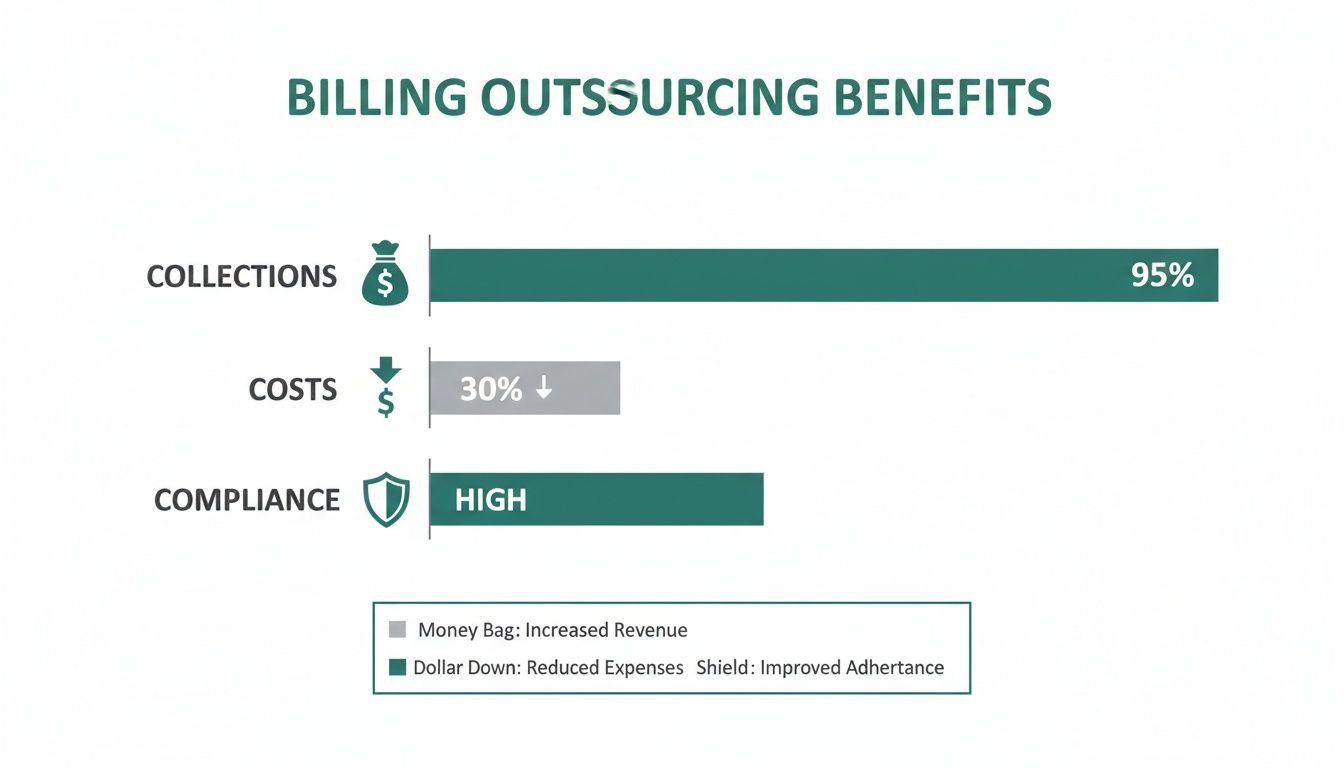
The data doesn’t lie. A specialist team increases your collections while reducing what it costs to get that cash in the door. They live and breathe metrics like Days in A/R and First Pass Acceptance Rate.
A top-tier partner focused on medical billing outsourcing in Texas will push your clean claim rate above 98%. That means your revenue is captured correctly the first time, dramatically speeding up your practice’s cash flow. For a deeper look at the specific costs involved, check out our guide on how to calculate the cost of outsourcing medical billing. This isn’t just about trimming expenses; it’s about building a stronger, more profitable financial foundation for your practice.
Navigating Texas-Specific Payer and Regulatory Hurdles

Managing revenue in Texas is a different game entirely. It’s not just about general billing knowledge; it’s about mastering a unique set of state regulations and the fiercely specific policies of dominant local payers. This is precisely where national, one-size-fits-all billers fail.
They apply a generic approach to the Texas market, leading directly to compliance failures, audit risks, and what amounts to a massive, preventable leak in your revenue.
The Texas healthcare landscape has its own rulebook, one that can either supercharge your cash flow or bring it to a grinding halt. Take the Texas Department of Insurance (TDI) prompt pay law. It mandates that payers must pay electronic claims within 30 days and paper claims within 45 days.
But here’s the catch: this protection only applies to a perfectly clean claim. One small mistake—a missing prior authorization or a misapplied modifier—and the clock stops, the claim gets kicked back, and the whole process starts over. A partner specializing in medical billing outsourcing in Texas knows how to turn these laws into an advantage by getting claims right the first time, every time.
Mastering Blue Cross Blue Shield of Texas Policies
Blue Cross Blue Shield of Texas (BCBSTX) is one of the biggest players in the state, and their policies are notoriously specific. A common tripwire for practices is the use of modifier 25 on an evaluation and management (E/M) service when a minor procedure happens on the same day.
Let’s say a patient has a scheduled follow-up for hypertension (CPT 99213) but you also end up removing a suspicious skin lesion (CPT 11100).
- Incorrect Billing: You submit both codes but forget to add modifier 25 to the 99213 E/M code. The BCBSTX system will automatically bundle the E/M service into the payment for the biopsy. The result? You get $0 reimbursement for the office visit you performed.
- Correct Billing: You append modifier 25 to 99213. This tells BCBSTX that the E/M service was significant and separately identifiable from the procedure. Of course, the documentation must clearly support this—a detail an expert billing team confirms before the claim goes out the door.
This isn’t a suggestion. It’s a hard-and-fast rule. Failing to follow BCBSTX’s exact modifier policy means you are voluntarily giving away revenue.
The Texas Medicaid Prior Authorization Maze
Texas Medicaid is its own beast, especially when it comes to prior authorizations for specialty drugs and complex procedures. The process is rigid, incredibly time-consuming, and utterly unforgiving.
Attempting to get reimbursed for a high-cost biologic without first navigating the Texas Medicaid portal for prior authorization is a guaranteed path to a write-off. An expert outsourced team doesn’t just submit a claim and hope for the best. They manage the entire authorization lifecycle—from initial request to final approval—ensuring the service is payable before it’s even performed.
A Texas-based billing partner has the dedicated workflows and established knowledge to manage these payer-specific demands. They’ve seen the denial patterns, built the denial prevention playbooks, and know what it takes to win. For a deeper look at how a local expert can fortify your practice, check out our guide on medical billing services in Texas. This local expertise is the difference between a struggling revenue cycle and a thriving, profitable practice.
Your Specialty Isn’t Generic. Your Billing Shouldn’t Be, Either.
Generic billing advice is worthless. The real money in your practice isn’t found in broad best practices; it’s captured or lost in the code-level details of your specific field. A one-size-fits-all approach to billing guarantees you’re leaving cash on the table.
This is where an expert partner proves their worth—by understanding the unique revenue drivers and common denial traps of your specialty. For practices in Texas evaluating a new billing partner, this specialty-specific knowledge is the single most important factor. It shows they understand your business, not just the billing process.
Let’s break down the practical, code-level differences that define clean claims in four high-value specialties.
Anesthesiology: The Formula for Full Reimbursement
Anesthesiology billing is a complex formula: Base Units + Time Units + Modifying Units. Get it wrong, and you get paid a fraction of what you’re owed. The most common errors we see involve physical status modifiers and qualifying circumstances.
- Physical Status Modifiers: These account for patient complexity. A healthy patient is straightforward. But for a patient with severe systemic disease (P3) or one with a constant threat to life (P4), adding the correct modifier is non-negotiable. Missing a P4 modifier on a claim means you forfeit the additional base units CMS and commercial payers allocate for that higher-risk case. It’s just lost money.
- Qualifying Circumstances Codes: These are add-on codes for difficult conditions. For instance, using anesthesia during a procedure complicated by extreme patient age (under 1 or over 70) requires adding CPT code +99100. Billing for anesthesia complicated by controlled hypotension requires +99135. These aren’t suggestions; they are billable events that directly increase reimbursement.
A true anesthesiology billing team audits every single case to ensure all applicable modifiers and add-on codes are applied, maximizing payment on every procedure.
Mental Health: Authorization and Service Duration
For mental health practices, revenue integrity hinges on two things: meticulous authorization management and precise coding for service duration. A standard 60-minute therapy session is coded with CPT 90837, but what happens when a crisis extends the session?
This is where prolonged service codes become critical. You can’t just bill for two sessions. Instead, if a 90837 session runs long, you must use the prolonged service add-on code, CPT +99417, for each additional 15 minutes of direct patient contact—but only after the first 74 minutes of the service are complete.
The documentation must rigorously support the medical necessity for the extra time. Without it, payers will deny +99417 instantly. A specialized billing partner ensures your clinical notes justify the code, preventing a costly denial and securing payment for the additional work you performed.
This level of detail is a core piece of effective medical billing denial management. You can find more approaches in our guide to proactive denial management strategies.
Cardiology: Contrast vs. Non-Contrast and Interventions
Cardiology billing is defined by its technical complexity, especially in diagnostic imaging and interventions. A frequent point of confusion is billing for a cardiac CTA. The codes might look similar, but the requirements are worlds apart.
A cardiac CTA without contrast is billed with CPT 75572. The same scan with contrast is CPT 75574. The reimbursement for 75574 is significantly higher, but it demands precise documentation of the contrast administration and medical necessity. A simple documentation oversight can lead to a downcode and a big revenue hit.
It gets even more complex when multiple interventions occur in the same session, like placing a stent and performing an atherectomy. This is where understanding modifier rules is crucial. Appending the correct modifier, like -XU for an unusual non-overlapping service, is essential to stop payers from bundling the procedures and only paying for one.
Orthopedics: The 90-Day Global Period
Orthopedic practices live and die by their understanding of surgical global periods. Take a total knee arthroplasty, coded with CPT 27447. This code comes with a 90-day global period as defined by CMS.
This means all typical pre-operative and post-operative care related to that surgery is bundled into the payment for 27447. An inexperienced biller might try to bill for a routine follow-up visit two weeks after surgery, triggering an immediate denial.
But what if the patient returns during that 90-day window for a completely unrelated issue, like a wrist fracture? This is where modifier 59 (Distinct Procedural Service) or more specific modifiers like -XE (Separate Encounter) become vital. By appending the correct modifier to the E/M service for the wrist fracture, you signal to the payer that this care was separate from the knee surgery, ensuring it gets paid.
This deep, code-level expertise is what separates a standard biller from a true revenue cycle partner. For a deeper look at our expertise, visit our specialties page.
How to Evaluate a Texas Medical billing Partner
Picking a medical billing partner is one of the biggest financial decisions your Texas practice will ever make. A great partner finds cash and plugs revenue leaks. A bad one can sink your practice.
The vetting process has to be a deep dive, moving past slick marketing to demand verifiable proof. The right questions will quickly unmask the difference between a true revenue cycle expert and a generic, low-performance billing factory. Start with the absolute non-negotiables: security and performance.
Data Security and HIPAA Compliance
Your first questions should be all about how they protect your patient data. A data breach isn’t just a financial headache; it’s a direct hit to your reputation that can take years to repair.
Get straight to the point with their security posture:
- Are you HIPAA compliant? This is table stakes. The only acceptable answer is an immediate “yes,” backed by documentation they can show you right away.
- Do you have SOC 2 Type II certification? This is the gold standard. It proves they don’t just have security policies, but that they consistently follow them. A simple “HIPAA compliant” claim isn’t nearly enough.
- How is our data encrypted? They need to specify bank-level encryption for data both in transit (as it moves) and at rest (on their servers).
If a potential partner gets defensive or vague on these points, walk away. The risk is just too high.
Verifiable Performance Metrics
Next, you need to see their real-world performance. Don’t fall for vague promises of “improved collections.” Demand hard numbers and the proof to back them up.
The two numbers that tell the real story are Clean Claim Rate (CCR) and Days in A/R. An elite partner will have a track record of hitting a CCR above 98% and keeping Days in A/R under 35. Anything less points to a reactive, inefficient process that will leave your money on the table.
Ask them to show you anonymized reports from a practice just like yours—same specialty, same volume. If they can’t (or won’t), it’s a huge red flag.
The U.S. medical billing outsourcing market is exploding, projected to jump from $6.95 billion in 2025 to $17.69 billion by 2033. This boom is driven by the sheer complexity of healthcare finance, which means more vendors are popping up. But not all are created equal. As high-volume specialties increasingly turn to Texas-based experts like Happy Billing, knowing how to spot true performance becomes critical. You can find more data about the booming medical billing market here.
Vendor Evaluation Scorecard
Use this scorecard to compare potential medical billing outsourcing partners on the metrics that matter most to your practice’s financial health and security.
| Evaluation Criteria | Question to Ask | Ideal Answer / Red Flag |
|---|---|---|
| Security & Compliance | Can you provide proof of your SOC 2 Type II certification and latest HIPAA risk assessment? | Ideal: "Yes, here it is." Red Flag: "We are HIPAA compliant" with no documentation. |
| First-Pass Rate (CCR) | What is your average First-Pass Clean Claim Rate, and can you show reports for a practice like mine? | Ideal: Above 98%. Red Flag: Below 95% or an unwillingness to share anonymized proof. |
| Days in A/R | What is the average Days in A/R for your clients in my specialty? | Ideal: Under 35 days. Red Flag: Over 45 days or vague answers like "it depends." |
| EHR Integration | Do you work directly within our existing EHR, or do we have to use an external portal? | Ideal: "We work natively inside your EHR." Red Flag: Requires manual data entry or a clunky third-party portal. |
| Reporting & Transparency | Can I get 24/7 access to a real-time dashboard showing all my key financial KPIs? | Ideal: "Yes, you'll have full, on-demand visibility." Red Flag: "We send monthly reports." |
| Contract Terms | What is the contract length, and are there fees for initial A/R cleanup or early termination? | Ideal: A 90-day out clause and pricing based on performance. Red Flag: Long-term lock-ins and hidden fees. |
Choosing the right partner is about finding an extension of your team that is as invested in your financial success as you are.
Technology and Contractual Terms
Finally, put their technology and contract under the microscope. A great partner makes your life easier, not more complicated.
- EHR/EMR Integration: Do they work inside your existing EHR? A partner who forces you to switch systems or log into a separate portal is adding friction, not removing it. Native integration is a must-have for accuracy and efficiency.
- Reporting Transparency: What metrics can you see, and how often? Insist on 24/7 access to a live dashboard showing your CCR, Days in A/R, denial rates, and collection velocity. If they can't provide that, they're hiding something.
- Contract Terms: Scrutinize the fine print for traps like long-term lock-ins, extra fees for "A/R cleanup," or confusing termination clauses. A confident partner knows they have to earn your business every month and won't need to lock you in. Watch out for these and other red flags when choosing a medical billing company.
A true partnership is a two-way street. A transparent, high-performing billing company will welcome these tough questions—they're an opportunity to prove they have what it takes.
Your Go-Live Checklist for a Seamless Transition

So, you’ve decided to make the switch. Good. Now the real work begins. A successful go-live isn't magic; it's the result of a meticulously planned handover designed to get your new partnership running without a single hiccup in your cash flow.
Too many practices dread the transition, imagining chaos and lost revenue. We're here to replace that anxiety with a clear, battle-tested roadmap. Think of this as your pre-flight check before taking off toward higher collections and fewer headaches.
Pre-Launch Preparation (Weeks 1–2)
The first two weeks are all about laying the groundwork. Your new partner needs to get under the hood of your practice's financial engine, and that requires secure access and clean data.
- Granting Secure EHR Access: First, we need the keys. Your new billing team will get secure, role-based credentials for your EHR. This isn't for day-to-day operations—it's so they can start mapping your current workflows and analyzing historical claim data without disrupting your staff.
- Historical Data Extraction: Next, your partner will perform a secure extraction of your existing accounts receivable (A/R) data. This is a complete snapshot: every outstanding claim, every payer message, and every denial record. This is absolutely critical so they can start attacking your aged A/R from the moment they take over.
- Payer & Clearinghouse Enrollment: The billing team immediately begins the tedious but essential process of enrolling as your practice’s authorized agent with every single payer, from Texas Medicaid to BCBSTX. They’ll also configure their clearinghouse connections for electronic claims (EDI) and remittance advice (ERA) to ensure data flows directly to them.
Don't be shocked when this initial audit uncovers skeletons in the closet. It always does. For instance, a partner might find a batch of cardiology claims (CPT 93306 – Transthoracic Echocardiogram) that a commercial payer denied six months ago for "missing clinical documentation." This initial dig provides immediate, actionable proof of where the revenue leaks are.
Go-Live and Staff Training (Week 3)
Transition week is all about execution and clear communication. Your front-desk team is on the front lines, and they need to know the new game plan to prevent any friction.
Your team needs to be crystal clear on the new communication protocols. Who do they call with an eligibility question? How do they transmit superbills? A well-defined workflow prevents the confusion that kills clean claim rates.
This is also when you'll have your first weekly performance call with your new partner, setting the tone for transparency and accountability right from the start. For Texas practices in demanding fields like anesthesiology, this is the time to nail down specialty-specific workflows. You can see how we customize our approach on our specialties page.
Post-Launch Monitoring (First 90 Days)
The first three months are when the new system stabilizes and the results start to show up in your bank account. It’s all about building momentum and tracking performance.
- First 30 Days: Expect an intense focus on claim submission speed and payment posting. Your partner is establishing a new, faster rhythm and setting the baseline for your key performance indicators (KPIs).
- First 60 Days: You should see a noticeable drop in your Days in A/R. The new team is clearing out old, stubborn claims while accelerating the payment cycle on new ones. The logjam is finally breaking.
- First 90 Days: By now, the new process should feel like second nature. More importantly, your financial reports will reflect the change, showing a higher clean claim rate and a measurable improvement in your net collection percentage.
Ready to see how a dedicated, Texas-based partner can transform your revenue cycle? Happy Billing combines agentic AI with expert human oversight to deliver a 98%+ clean claim rate and keep your Days in A/R under 35. Stop chasing claims and schedule your free revenue analysis today.
What is a good first-pass clean claim rate to expect?
A good rate is 95%, but an elite partner should be hitting 98% or higher. This metric is the most direct measure of a billing team's accuracy and process discipline. A high clean claim rate means fewer denials, less time spent on rework, and significantly faster cash flow for your practice.
How are outsourcing fees typically structured?
The industry standard and most aligned model is a percentage of net collections, usually between 3% and 8%, depending on specialty, volume, and claim complexity. This model ensures your billing partner is 100% motivated to collect every dollar you've earned. Be cautious of partners charging a percentage of "charges" or a flat "per-claim" fee, as their financial success is not directly tied to your actual revenue collected.
Will I lose control over my practice's financials?
No, you should gain more control and insight. A transparent partner functions as an extension of your team, providing 24/7 access to financial dashboards and detailed performance reports. You'll be able to track key metrics like Days in A/R, collection rates, and denial trends with more clarity than most in-house setups can provide.