Pain Management Billing Services: A Vendor Evaluation Guide

If your pain practice is outsourcing billing to a generalist and you're seeing denials on procedures like 64483, 64635, or facet injections, the short answer is this: your biller probably understands medical billing, but not pain management billing services at the level your revenue requires. In pain management, small mistakes around modifiers, documentation, prior auth, and payer edits turn high-value procedures into delayed cash, rework, or write-offs.
That hits your business fast. A denied interventional claim doesn't just slow reimbursement. It pushes up A/R days, buries staff in appeals, and makes it harder to trust your monthly numbers. We have seen owners blame payer behavior when the underlying problem was a billing partner using generalist workflows on a specialty that punishes generic billing.
Why Your Pain Management Claims Keep Getting Denied
A common scenario goes like this. Your physician performs a lumbar transforaminal epidural injection, bills 64483, and the claim comes back denied or underpaid. Your biller says the payer is difficult. The payer says documentation was incomplete, a modifier was wrong, or the service didn't match policy edits. Meanwhile, the charge sits in A/R and your front office gets no useful explanation.
That pattern is exactly why specialized pain management billing services exist. Pain management claims carry a different risk profile than general outpatient billing. Industry data shows denial rates for pain management claims often exceed 20-30% without specialized handling, compared to the overall medical billing average of 10-15% according to Medical Billers and Coders on pain management billing. For an independent practice, that gap is the difference between stable collections and a month-end report full of unresolved revenue.
We have seen practices tolerate this for too long because each denial looks isolated. It isn't. The pattern usually traces back to a billing team that doesn't fully understand procedural pain medicine.
Where general billing breaks down
A generalist biller can usually submit claims. That's not the same as protecting reimbursement on pain procedures. Pain claims often depend on exact documentation of site, laterality, imaging, drug details, diagnosis linkage, and payer-specific edits before the claim ever leaves the system.
A clean claim in pain management starts in the procedure note, not in the billing office.
When that handoff is weak, the financial damage shows up in three places:
- Delayed cash flow: High-value procedural charges sit unresolved while staff chase records, appeal edits, and rebill.
- Artificial write-offs: Practices post avoidable adjustments because no one wants to keep fighting old denials.
- Unreliable reporting: Owners can't tell whether the problem is payer mix, physician documentation, charge capture, or billing quality.
If you want a useful outside perspective on operational fixes, this guide on improving pain management revenue cycles is worth reviewing alongside your own denial trends.
The denial usually starts before claim submission
The most expensive mistake is assuming denials start with payer behavior. In pain management, they often start earlier. The procedure note may be vague. The diagnosis may support pain broadly but not the billed intervention specifically. The biller may not know when a payer expects a modifier, when imaging is bundled, or when an authorization was tied to a narrower service than what got billed.
If your team is trying to patch those problems after submission, you're already late. A practice that wants to tighten this up should review its diagnosis strategy and procedure linkage, especially for interventional services. This reference on pain management ICD-10 alignment is a good place to start.
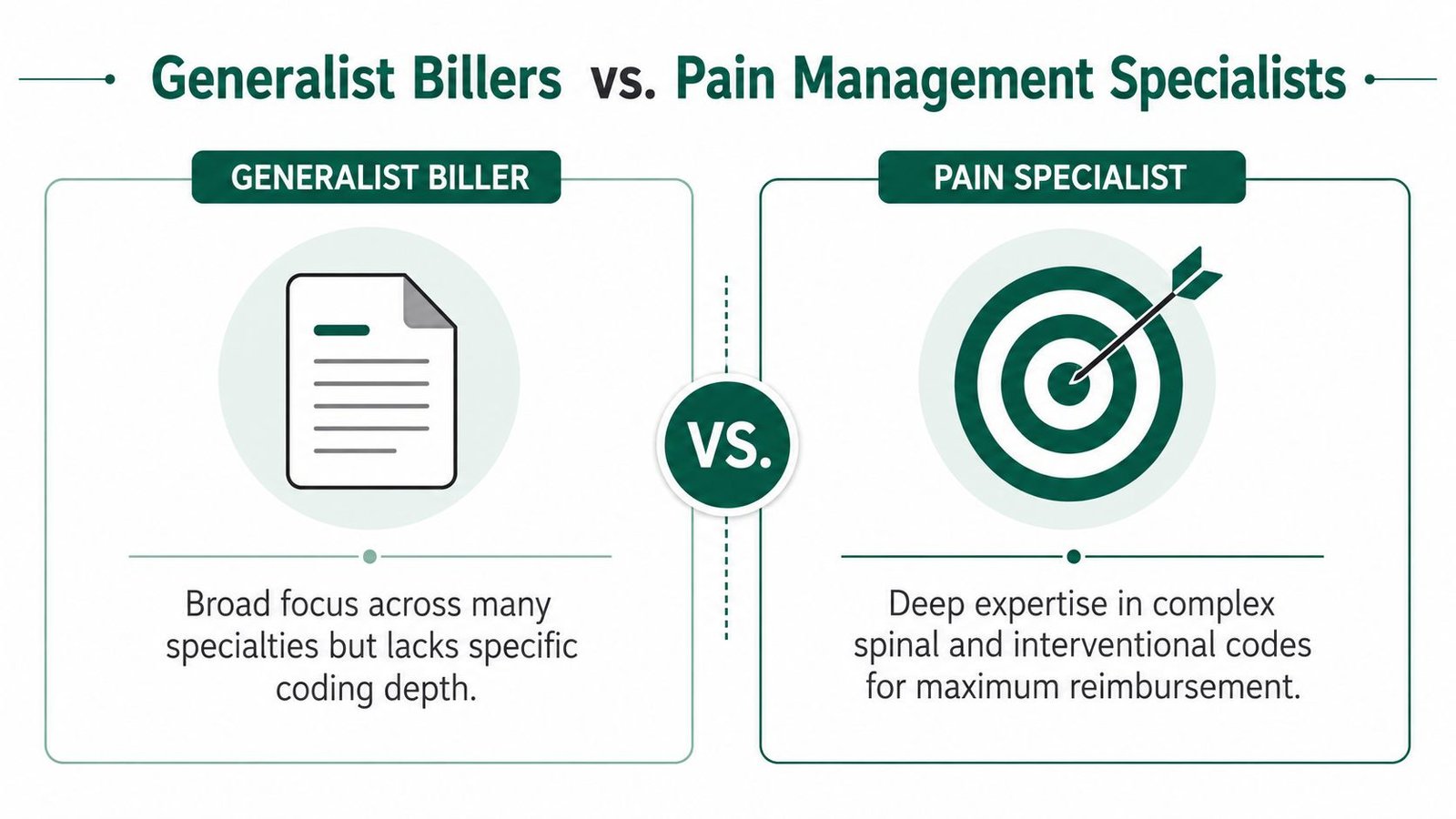
Generalist Billers vs Pain Management Specialists
The difference isn't effort. It's depth. A generalist biller may work hard, follow up consistently, and still underperform because pain management has too many specialty-specific failure points. A specialist sees those issues before they become denials.
How a generalist thinks
A generalist biller usually applies broad billing logic across multiple specialties. That works for straightforward E/M-heavy practices. It fails when the practice depends on spinal injections, RFAs, facet work, and payer rules that change by procedure.
Typical weak points include:
- Modifier handling: Misuse of 50 for bilateral procedures or 59 when a payer expects more specific distinct service logic.
- Procedure nuance: Limited familiarity with the documentation needed to support 64635, 64483, facet injections, and related imaging rules.
- Authorization follow-through: Treating prior auth as an administrative checkbox instead of tying the approved service to the exact code set, date range, and payer requirement.
- Denial reporting: Sending generic aging reports instead of denial-by-code, denial-by-payer, and rework pattern analysis.
How a pain specialist works
A pain-focused billing partner looks at the same claim differently. They know pain reimbursement rises or falls on the interaction between documentation, coding, modifiers, medical necessity, bundling edits, and payer policy.
A specialist typically does all of the following:
| Area | Generalist biller | Pain management specialist |
|---|---|---|
| Procedure review | Confirms charge entry | Reviews whether the note supports the exact interventional code |
| Modifier logic | Uses broad modifier habits | Applies payer-aware logic for 50, 59, and related distinct service rules |
| Prior auth | Verifies approval exists | Confirms approval matches the billed procedure and setting |
| Imaging and bundling | Often reactive after denial | Checks bundled versus separately billable components before submission |
| Denials | Works denials in batches | Tracks denial patterns by procedure family and payer |
Practical rule: If a vendor can't discuss denial patterns for 64483, 64635, and facet injections without speaking in generalities, they are not a pain specialist.
Why this difference matters financially
The issue isn't academic. Interventional pain procedures are too valuable to run through a generic billing process. A specialist knows that one payer may scrutinize imaging use differently, another may enforce prior auth narrowly, and another may edit bilateral logic in a way that changes whether a claim pays cleanly.
That's why many owners moving away from generic outsourcing start by reviewing a dedicated pain management billing partner rather than another multi-specialty vendor. What you need is not a biller who can “also do pain.” You need one who already understands where pain claims fail.
The High Cost of Common Pain Management Coding Errors
Most practice owners don't need a coding lecture. They need to know where the money is leaking. In pain management, the leak usually comes from claims that looked billable on the day of service but weren't built to survive payer review.

Documentation failures on injections
For injection procedures, weak documentation doesn't just create extra work. It directly cuts revenue. For injection procedures like CPTs 62310–62323, CMS and private payers require thorough documentation of site, laterality, imaging use, and medications. When documentation is poor, audits can reduce revenue per encounter by 20–40% in high-volume pain groups as outlined in Transcure's pain management billing guidance.
That same logic affects the procedures you're likely watching most closely. If your physician performs 64483 and the note doesn't clearly support laterality, level, imaging, and medication details, the claim may deny, downcode, or pay only after repeated rework. A generalist biller often finds that out after submission. A specialist catches it before the claim leaves the queue.
Trigger point and imaging mistakes
CMS has specific expectations around trigger point billing. It limits trigger point injections to one code per day regardless of injection sites and expects strong procedure documentation to support medical necessity. If your team treats 20552 like a simple injection code, that's a predictable source of denials and lost charges.
Imaging creates another trap. When fluoroscopy-compatible procedures are billed incorrectly, payers may reject the imaging component as duplicative. That doesn't always void the entire case, but it can cut reimbursement on a procedure you expected to perform well.
When a biller doesn't understand bundled versus unbundled logic, the practice may complete the work and still collect less than the case should have produced.
Why owners should care about code-level detail
You don't need to memorize every edit. You do need a billing partner who can explain why these claims fail and what they changed to stop it. For owners, the right question isn't “Did you submit the claim?” It's “Did you build the claim correctly for this payer, this procedure, and this note?”
A useful starting point is reviewing your own procedure mix against a current pain management CPT code reference. The point isn't to code claims yourself. It's to pressure-test whether your current vendor really understands the services driving your revenue.
Red Flags Your Current Biller Is Costing You Money
Most owners know something is off before they can prove it. Collections feel slow. Denials stay vague. Old balances linger. The billing company says they're “working on it,” but your reporting never gets clearer.

Watch your reports, not their promises
The first red flag is rising A/R without a code-level explanation. If interventional claims keep aging and your biller can't show what's happening by payer, procedure, and denial reason, you're not managing revenue. You're waiting on it.
The second red flag is unexplained write-offs or broad adjustment categories. In pain management, those often hide preventable denials, underpayments, and claims the vendor stopped pursuing because the rework was too difficult.
A third red flag is denial reporting that sounds polished but says very little. “Payer issue,” “medical necessity,” and “documentation” aren't enough. You should be hearing specifics tied to procedures and rules.
Credentialing gaps are often invisible
This one gets missed constantly. Your provider may be enrolled with a payer generally, but that doesn't always mean they're cleared for every interventional service you perform. Some payers impose procedure-level credentialing requirements, especially for complex pain interventions.
A pain practice billing $2M annually could lose 3–7% of revenue ($60K–$140K) annually to credentialing mismatches alone according to Peregrine Healthcare's credentialing analysis for pain management. That's why a “clean claim” can still stall if the enrollment file and procedure approvals aren't aligned.
Owner check: Ask your biller to identify denials caused by credentialing mismatches versus coding errors. If they can't separate the two, they're probably missing both.
Operational clues your vendor is stretched too thin
Not every billing failure starts in coding. Sometimes the vendor lacks the operational depth to support a specialty with high-touch claims. If follow-up is inconsistent, authorizations aren't reconciled cleanly, and patient balance calls lag, the revenue cycle weakens fast. There are useful lessons in how other industries think about scaling customer support operations, especially around consistency, queue ownership, and response standards.
Review your current billing partner with the same skepticism you'd use for any other critical vendor. This checklist of medical billing company red flags can help you spot issues that often stay hidden until cash flow deteriorates.
How Specialized RCM Technology Solves These Challenges
A pain practice does not fix 64483 denials by asking the same generalist biller to work faster. It fixes them by putting specialty logic in front of the claim. The right RCM technology checks the charge, the note, the authorization, and the payer edit before the claim goes out. That is how practices stop losing money on preventable errors with 64635, bilateral billing, and 59 usage.
What proactive claim scrubbing actually does
In pain management, a useful scrubber is built around specialty risk points, not generic CPT validation. We have seen the biggest improvement when the system reviews documentation support for laterality, diagnosis linkage, modifier logic, frequency limits, NCCI edits, and authorization details tied to the exact procedure performed.
That matters because the expensive mistakes are usually specific. A generalist may submit 64483 without catching a diagnosis mismatch or miss when modifier 50 is payer-inappropriate and the carrier expects RT and LT lines instead. They may append 59 to force a claim through without checking whether the documentation supports a distinct service. Software configured for pain management flags those issues before they turn into denials, rework, or post-payment takebacks.
The operational gain is measurable even without broad vanity metrics. MGMA notes that the average medical practice loses revenue to billing errors and delayed collections each year, and specialty groups with higher-complexity procedures feel that gap faster because each claim carries more dollars and more edit risk. In a pain practice, one bad batch of interventional claims can distort the week's cash flow.
Why human auditors still matter
Technology catches patterns. Auditors catch bad assumptions.
We have seen systems flag 64635 correctly while a specialist reviewer catches the actual problem: the note supports a different level, the auth only covers one side, or the payer's bilateral rule conflicts with the way the charge was entered. Generalist teams often stop at “claim passed edits.” Specialty teams keep going until the claim is defensible.
A practical workflow usually includes three checkpoints:
- Pre-bill edit review: the system checks CPT, ICD-10, modifiers like 50 and 59, payer rules, and auth status.
- Human validation: a pain-focused reviewer compares the procedure note to the charge detail and catches unsupported assumptions.
- Feedback to the practice: the provider or MA gets a specific correction request, not a vague “claim issue” message.
That process cuts down on the bill-deny-rebill cycle that keeps aging reports full and staff distracted.
Good technology reduces rework. Good specialty reviewers protect revenue that generic automation misses.
Integration matters more than another login
Practice owners do not need another dashboard that staff ignores after two weeks. They need billing controls inside the workflow already tied to scheduling, charge entry, and documentation. If the vendor can pull the op note, compare it to the posted code, and route a correction before submission, turnaround improves and front-desk staff stop chasing preventable resubmissions.
The same principle shows up outside healthcare when teams try to streamline customer support with Stripe. Automation works when it reduces handoffs and gives staff the next action clearly.
If you are vetting vendors, ask how they use revenue cycle automation in practice workflows to prevent pain-specific coding errors before claim submission, especially on procedures and modifiers that generalist billers routinely mishandle.
Your Vendor Evaluation Checklist for Pain Management Billing
A vendor meeting usually sounds fine for the first ten minutes. Then you ask how they handle a denied 64483 with laterality confusion, or a 64635 line that paid below contract after modifier review, and the room gets vague fast. That is the point of the checklist. You are not screening for a polite sales team. You are screening for a vendor that can stop specialty-specific revenue loss.

Questions that expose real specialty depth
Start with the procedures that usually expose a generalist.
- Ask about 64483: How do you verify diagnosis linkage, level selection, documentation support, and payer edits before the claim goes out?
- Ask about 64635: What is your workflow for matching the authorization to the billed service, checking modifier logic, and identifying underpayments after adjudication?
- Ask about facet injections: How do you review bilateral billing, distinct procedure use, and payer bundling rules tied to imaging or related services?
Then push one level deeper. Ask what they do when the op note and the charge do not match cleanly. Ask who makes the correction request. Ask how often they audit denials by code, not just by payer. We have seen generalist teams answer confidently until the conversation gets specific to 50, 59, laterality, units, or LCD-driven documentation standards.
Demand KPI proof tied to pain management
A real pain billing vendor should show performance at the specialty level. Ask for reports on denial rate, first-pass acceptance, days in A/R, top denial reasons by CPT, and recovery results on high-value interventional claims.
As noted earlier, strong pain practices usually keep days in A/R in the mid-30s to 40-day range, denial rates under 5%, and first-pass acceptance above 95%. Do not accept a verbal promise. Ask the vendor to show those numbers for pain management accounts specifically, and ask what portion of their book of business is interventional pain versus general multispecialty billing.
Use this table during the interview:
| What to ask | Strong answer | Weak answer |
|---|---|---|
| Pain procedure experience | Names specific codes, payer edits, and denial patterns for 64483, 64635, and related procedures | Says they bill “many specialties” |
| Denial reporting | Tracks denials by code, payer, modifier, and root cause | Sends only aging reports |
| Prior auth workflow | Reconciles approved service, levels, laterality, and dates against the final claim | Confirms only that an auth number exists |
| Modifier controls | Explains payer-specific rules for 50, 59, RT/LT, and unit review | Says coders “check modifiers” |
| Underpayment review | Compares allowed amounts to contract terms on high-value procedures | Focuses only on denials |
| Credentialing support | Confirms enrollment status aligns with the procedures each provider performs | Treats credentialing as separate office admin |
Evaluate financial impact, not just the billing fee
A lower percentage fee can still cost more if the vendor misses preventable denials, posts adjustments incorrectly, or lets high-value claims age past timely follow-up windows. In pain management, a few repeated mistakes on interventional codes can wipe out any savings from a cheaper contract.
Ask for examples of the monthly review they conduct with practices. The packet should show more than collections and total A/R. It should show where money is leaking, which codes are driving rework, how modifier errors are trending, and what corrective action the vendor takes with your staff and providers. If they cannot show that operating discipline, you should assume they are reacting after revenue is already lost.
For a broader framework, review these criteria for evaluating revenue cycle management companies.
Frequently Asked Questions About Switching Billing Services
How disruptive is it to switch pain management billing services
A switch feels risky when your current vendor already knows your payers, your providers, and your software. In practice, the bigger disruption usually comes from staying put while the same errors keep hitting high-value claims.
A competent transition plan starts with open A/R, payer enrollments, ERA and EFT access, authorization records, procedure templates, fee schedules, and ownership of old denials. In pain management, that also means reviewing where your current team is losing money on procedure-specific billing logic. We have seen takeovers fail when a new vendor imports claims data but never audits how 64483, 64635, bilateral billing, or modifier 59 were handled before go-live.
Your front desk should not be building that plan for the billing company. The vendor should run it, assign deadlines, and show you exactly how cash posting, claim submission, denial follow-up, and old A/R recovery will be split during the handoff.
Should I replace my biller if only a few procedures are getting denied
Yes, if those procedures carry meaningful reimbursement.
That is the mistake many owners make. They look at total collections, see money still coming in, and assume billing is basically working. Then we examine the denial mix and find the losses are concentrated in the procedures that matter most to margin. A generalist biller may do fine on office visits and still underperform badly on interventional pain claims.
If denials keep clustering around codes like 64483 or 64635, or around bilateral and distinct procedure modifier use, that usually points to a repeatable workflow defect. It can be coding, documentation review, charge entry, or payer rule mapping. Whatever the source, those claims deserve more attention than a generic “few denials” label because they often represent the most expensive mistakes in the entire revenue cycle.
What should a new vendor review before taking over
They should start with the money path, not just the software login. Review aged A/R, denial categories, top procedures by revenue, payer-specific edits, provider credentialing, authorization workflows, adjustment posting, write-off patterns, and documentation issues tied to your common interventions.
The review should answer specific questions. Are denials concentrated on a few interventional codes. Are modifiers 50 and 59 being applied correctly by payer. Are bilateral services being reduced incorrectly. Are claims being resubmitted fast enough to stay inside payer deadlines. Is old A/R collectible, or has it been sitting untouched because the current biller does not understand the underlying coding issue.
You should come out of that review with a list of fixable revenue leaks, who owns each fix, and how improvement will be measured.
How quickly should I expect to see improvement
Expect visibility first, then cash improvement.
A strong vendor should identify the main failure points early and show them to you in plain terms. Which denials are front-end failures. Which are coding failures. Which are underpayments. Which are recoverable if worked now. We have seen the fastest early gains come from correcting repeat errors on a small group of high-value procedures, cleaning up modifier usage, and tightening payer follow-up on aged claims.
Some results take longer. Credentialing corrections, payer enrollment issues, and older A/R recovery move on payer timelines, not yours. The right benchmark is operational control. Cleaner claim submission, fewer preventable denials, faster correction cycles, and reports that show whether your interventional procedures are being paid correctly.
If your current billing company handles pain management like any other specialty, you're likely paying for that mistake in denials, A/R drag, and hidden write-offs. Happy Billing works with high-stakes specialty practices that need tighter procedural billing, stronger denial prevention, and cleaner reporting without disrupting the EHR your team already uses. If you want to see where your current process is leaking revenue, start with a free billing audit.