Medical Billing Services for Internal Medicine
Outsourcing medical billing services for internal medicine is usually the fastest way to lift collections, cut denials, and shorten A/R. If your practice isn't consistently collecting at the level high performers do, cash is leaking through E/M downcoding, modifier mistakes, avoidable denials, and slow follow-up.
For independent practices, this isn't an administrative debate. It's a revenue decision. Top-performing internal medicine groups reach Net Collection Rates between 95% and 97% according to MGMA benchmarking cited here. If you're below that range, your billing workflow is almost certainly leaving money behind. We see the same pattern repeatedly: physicians focus on volume, but the significant financial gain comes from fixing the points where claims are weakened before they ever leave the office. If you need a quick grounding in the full process, this overview of revenue cycle management in medical billing is a useful baseline.
Introduction to Medical Billing Services for Internal Medicine
According to the Centers for Medicare & Medicaid Services physician fee schedule search, small coding and charge-capture misses in common internal medicine services can change reimbursement on high-volume visits and add-on services fast. That is why practice owners should review billing performance at the encounter level, not just at month-end collections.
Revenue loss in internal medicine often occurs in routine visits that staff stop questioning: an under-supported 99214, a missed G2211, an unbilled care management service, or a same-day diagnostic visit that should have carried modifier -25. Generic billing support misses these leaks because the work looks ordinary on the schedule. It is not ordinary on the ledger.
Internal medicine billing services should protect margin in two places that general billing guides understate. First, they need disciplined E/M review, because this specialty runs on documentation quality and code selection. Second, they need active capture of care management revenue, because chronic care management, transitional care management, and related follow-up services are often performed but not billed with the consistency owners assume.
What strong billing support should fix
A capable billing partner does more than submit claims. The team should find where money is slipping out before the claim leaves the office, then show the financial effect in plain numbers.
For example, a group may think its problem is denials. The larger problem is often weaker charge capture and conservative coding upstream. If even a small share of established patient visits are billed below the supported level, or if G2211 is inconsistently appended when allowed, the annual loss can exceed what the practice writes off in denials.
That is the hidden economics of internal medicine. Routine E/M and care management work create the biggest revenue leaks because they happen every day.
What owners should expect from a billing service
Use three standards.
- Stronger E/M accuracy: The billing team should audit encounter patterns, identify downcoding trends, and push documentation feedback back to providers quickly.
- Reliable care management capture: The service should track eligibility, consent, time, and payer rules so chronic care and transitional care revenue does not disappear between clinical work and claim submission.
- Tighter claim control: The team should manage edits, follow up on unpaid claims aggressively, and report root causes by payer and CPT category.
If a vendor mainly talks about posting payments and reworking denials, the service is too reactive.
Owners should also ask how the vendor handles privacy and workflow controls, especially if staff will touch charts, eligibility data, and patient balances across multiple systems. Essential 2026 HIPAA compliance insights is a practical reference point for evaluating whether a billing operation treats compliance as a daily process instead of a policy binder.
If you want a baseline framework for assessing handoffs, edits, follow-up, and cash posting, this revenue cycle management overview for medical billing teams is a useful starting point.
Cheap billing services usually fail in internal medicine for a simple reason. They process claims. They do not protect revenue.
Defining Billing Needs for Internal Medicine
Small misses in internal medicine billing add up fast. A slightly undercoded office visit, an unbilled chronic care month, or a modifier mistake on a same-day service can erase more revenue than owners expect because these errors happen repeatedly across high-volume E/M work.
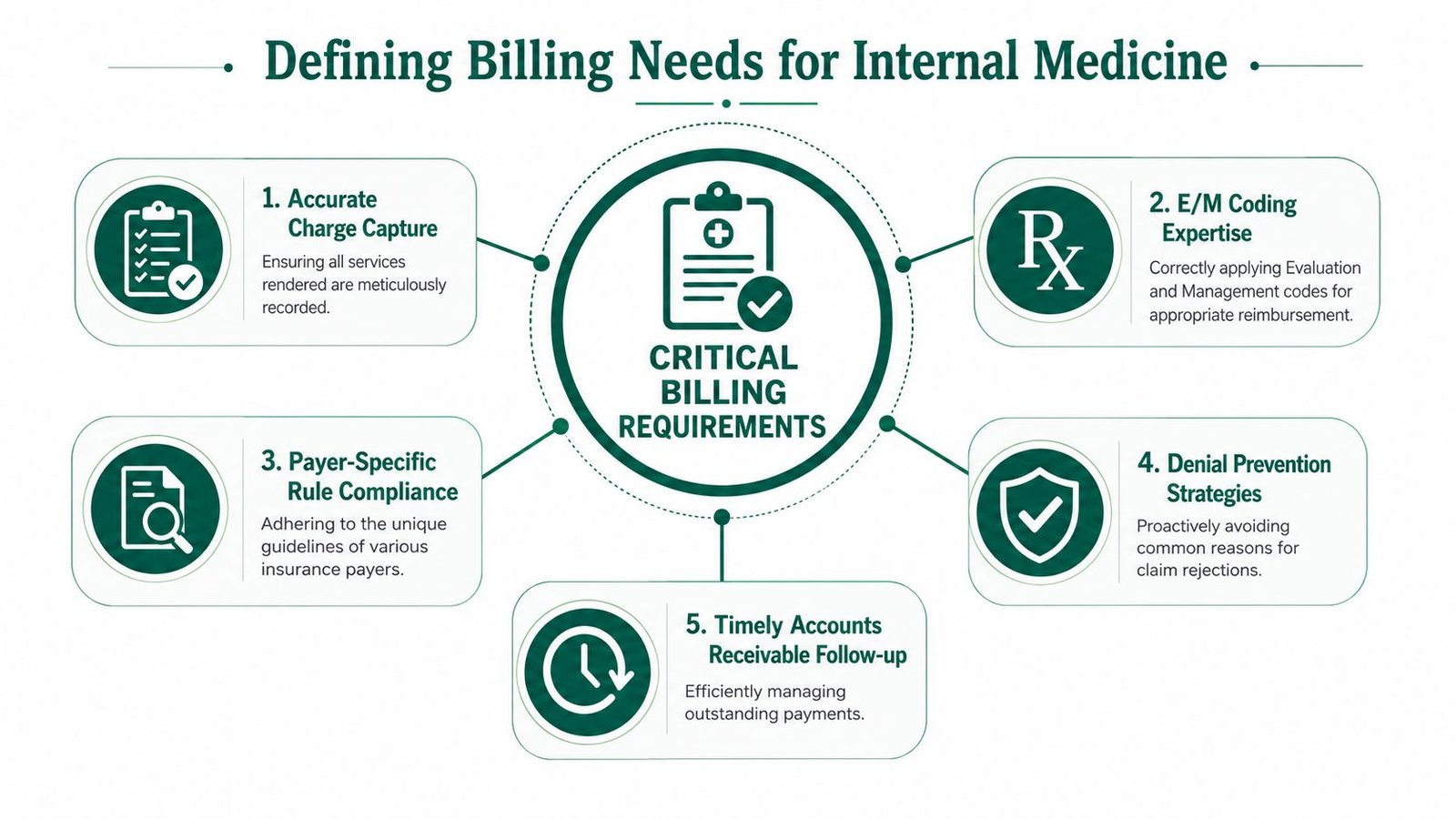
Internal medicine needs billing rules built around recurring follow-up visits, preventive and problem-oriented visit combinations, chronic disease management, and payer-specific documentation edits. Generic billing support misses critical vulnerabilities because it focuses on claim submission after the fact instead of protecting value at charge entry, coding review, and care management tracking.
MGMA benchmarks matter here because they give owners a practical way to judge whether billing performance is acceptable or expensive. If your group trails peer performance on days in A/R, collections, or provider productivity, assume the gap is coming from process failures in E/M coding, care management capture, or payer follow-up until proven otherwise.
The five billing requirements that protect margin
Complete charge capture
Every rendered service has to reach the claim with enough detail to survive payer edits. Internal medicine groups lose money when nurse visits, in-office procedures, vaccine administration, and care management time stay in the chart instead of the billing queue.Disciplined E/M coding
This specialty depends on getting office and outpatient visit levels right. Downcoding one visit does not look dramatic. Downcoding hundreds of established patient visits across a year will distort physician productivity and cut collections without triggering a denial report.Care management workflow that supports billing
CCM, TCM, and similar services break long before claim submission. Eligibility checks, consent, time tracking, and documentation standards must be built into the workflow. This guide to internal medicine CCM billing is useful if you need a practical view of where capture usually fails.Payer rule control
Internal medicine billing staff must handle preventive-plus-sick visit rules, telehealth requirements, modifier logic, and Medicare versus Medicare Advantage differences correctly. If your team applies one generic rule set across all payers, write-offs will follow.Fast follow-up on underpayments and aging claims
Owners should care less about whether a report exists and more about whether someone is pushing action by payer, CPT category, and aging bucket. Slow follow-up hides underpayments and keeps collectible dollars sitting in A/R.
A simple case proves the point. One multi-provider internal medicine group can appear stable because visit volume is steady and denial rates look manageable. Yet the practice still loses revenue every month if level-four visits drift to level three, TCM is performed but not billed, and Medicare Advantage underpayments are posted without appeal. Those are hidden revenue leaks, not isolated mistakes.
Owners also underestimate operational risk. A billing vendor that touches charts, eligibility data, and patient balances needs clear privacy controls and documented access rules. Essential 2026 HIPAA compliance insights is a useful reference when you evaluate whether a billing operation treats compliance as a daily control issue instead of a policy document.
Internal medicine billing needs are specific. The practices that protect margin treat E/M accuracy, care management capture, and underpayment recovery as core financial controls, not back-office cleanup.
Typical Internal Medicine Billing Workflow
Internal medicine revenue doesn't break in one dramatic place. It breaks in sequence. One weak handoff in the workflow can turn a valid claim into a delayed payment, reduced payment, or denial.
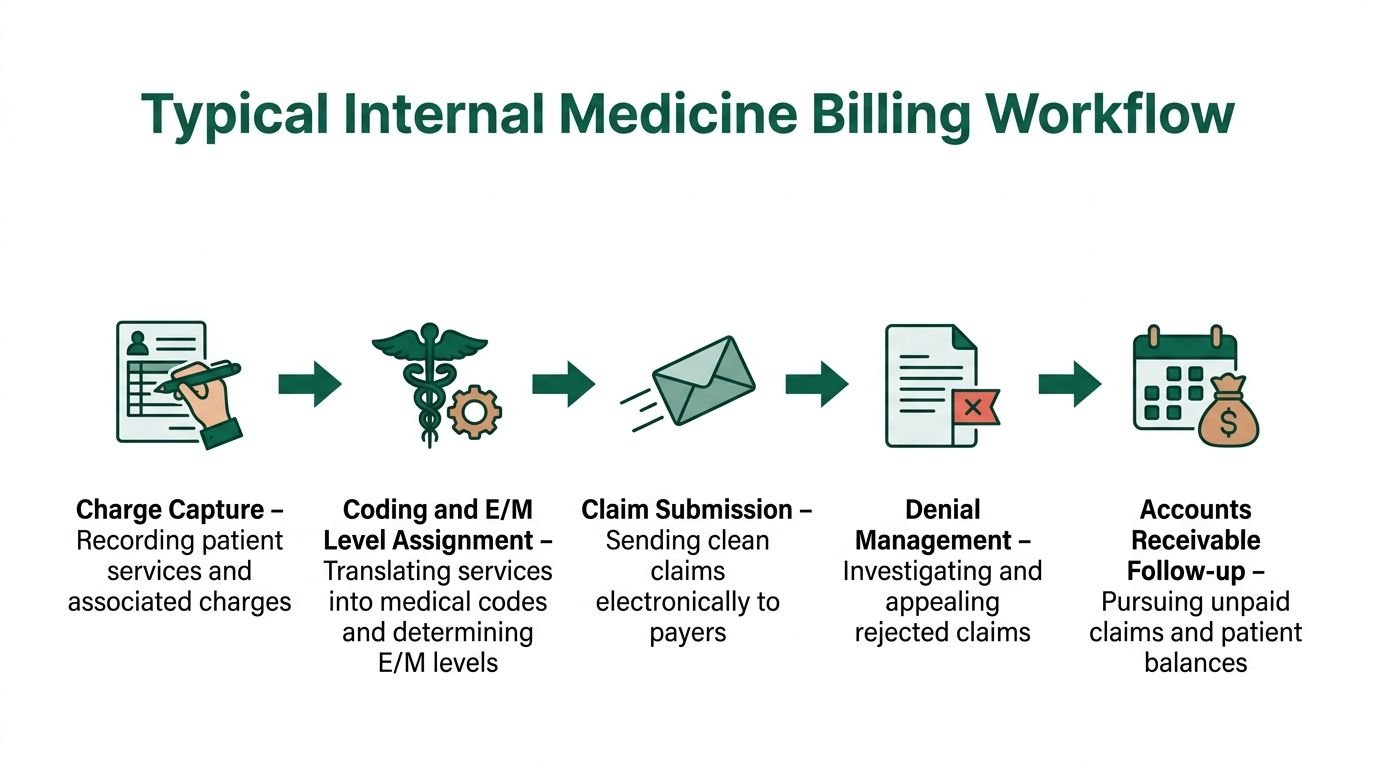
A well-managed internal medicine billing operation must sustain a clean claim rate above 95%, a first-pass acceptance rate of 90%+, and keep days in A/R below 35, according to this internal medicine billing benchmark summary. Those aren't vanity metrics. They tell you whether cash is moving or stalling.
Step one through step three
| Workflow stage | What should happen | What usually causes leakage |
|---|---|---|
| Charge capture | Every visit, procedure, and care service gets recorded correctly | Missing services, weak encounter detail, poor handoff from provider to billing |
| Coding and E/M level assignment | Claims reflect the highest defensible level supported by documentation | Conservative downcoding, missed add-on opportunities, modifier errors |
| Claim submission | Claims go out clean and payer-ready | Eligibility issues, edit failures, missing data, wrong payer routing |
The first failure point is usually charge capture. If the superbill, EHR task flow, or provider documentation doesn't clearly reflect what happened, the coder or biller is forced to guess conservatively. Internal medicine practices feel this most on office visits, preventive-plus-problem visits, and chronic disease follow-up.
The second pressure point is claim creation. Same-day combinations need scrutiny. If an E/M service and a separately billable procedure occur together, the claim has to reflect that correctly and the note has to support it. Weak documentation turns a payable claim into a preventable denial.
Step four and step five
The back half of the cycle matters just as much.
- Denial management must find root cause: If a claim denies for modifier conflicts, medical necessity mismatch, or missing information, staff need to correct the underlying process, not just rework the individual claim.
- A/R follow-up must be active: Old claims don't fix themselves. Teams need payer-specific follow-up queues, timely appeals, and patient balance workflows that don't let accounts drift.
- Reporting must drive action: Owners should review trends by denial category, payer, and provider documentation pattern, then assign accountability.
We've seen practices improve collections by rebuilding the handoffs between front desk, provider, and billing. The best starting point is process visibility. This resource on revenue cycle workflow improvements is useful if you're trying to identify where the current sequence is breaking.
Clean claims create leverage. Once a claim leaves your system correctly, every later step gets easier.
What owners should ask for every month
Don't ask for generic billing summaries. Ask for reports that tell you where money is slowing down.
- Claim quality indicators: clean claim performance and first-pass acceptance
- Delay indicators: unpaid claims by aging bucket and payer
- Failure patterns: denials by root cause, especially modifier and eligibility issues
- Provider patterns: repeated documentation gaps tied to visit type or service line
If your billing vendor can't turn workflow data into operational decisions, they're processing claims, not managing revenue.
Specialty Challenges in Internal Medicine Billing
Internal medicine has a narrow margin for billing error because so much revenue depends on judgment-based documentation. Generic billing teams usually understand claim mechanics. They often miss the clinical and payer nuance that determines whether a visit is paid correctly.
The biggest leak starts with E/M. Under 2021 AMA/CMS guidelines, internal medicine practices must document either total time spent or all three MDM elements, and 99214 requires moderate MDM or 30+ minutes total time. If neither standard is supported, the visit gets down-coded and revenue is lost, as outlined in this summary of internal medicine E/M billing requirements.
The expensive mistakes owners don't see on the dashboard
The first is routine downshifting from 99214 to 99213. This happens when the physician did more work than the note proves. Owners often don't notice because the claim still gets paid. But paid low is still lost revenue.
The second is missed longitudinal care capture. Internal medicine practices managing ongoing, complex chronic conditions should pay attention to G2211. When that add-on is consistently missed, your practice absorbs the workload without collecting for the additional complexity.
The third is same-day billing logic. If the physician performs an E/M service and a separately billable procedure on the same date, modifier -25 isn't optional. The documentation has to show the E/M was significant and separately identifiable. If it doesn't, reimbursement slows or disappears.
Internal medicine billing fails most often on claims that look ordinary.
Care management and telehealth create their own traps
Chronic Care Management, code 99490, is another common leak. It requires 20 minutes of tracked clinical staff time per month, plus written patient consent and a detailed, updated care plan. Miss one of those requirements and Medicare can deny the claim at audit.
Telehealth adds another layer. Internal medicine telehealth claims require careful use of POS 10 for the patient's home with modifier 95 for synchronous audio/video visits, and established-patient audio-only E/M visits use CPT 99441 through 99443. Commercial payer policies still vary, so staff can't assume one rule applies across plans.
If you're reviewing vendor security and documentation tools around remote workflows, this data privacy software guide is a practical reference because telehealth billing accuracy and PHI handling are tightly connected in day-to-day operations.
Why specialty knowledge changes collections
A billing company that mainly works broad primary care may still miss internal medicine's revenue details. Owners should insist on demonstrated familiarity with:
- E/M leveling under current CMS and AMA rules
- Modifier -25 logic for same-day visits and procedures
- CCM requirements for 99490
- Telehealth POS and modifier combinations
- Longitudinal care billing opportunities such as G2211
If your team can't explain where internal medicine loses money before denials even appear, they don't know the specialty well enough.
Benefits and ROI of Outsourcing Billing
MGMA cost and productivity benchmarks make one point clear: small percentage losses in collections erase margin fast in internal medicine. The reason to outsource billing is simple. Stop revenue leaks, speed up cash, and tighten control over follow-up.
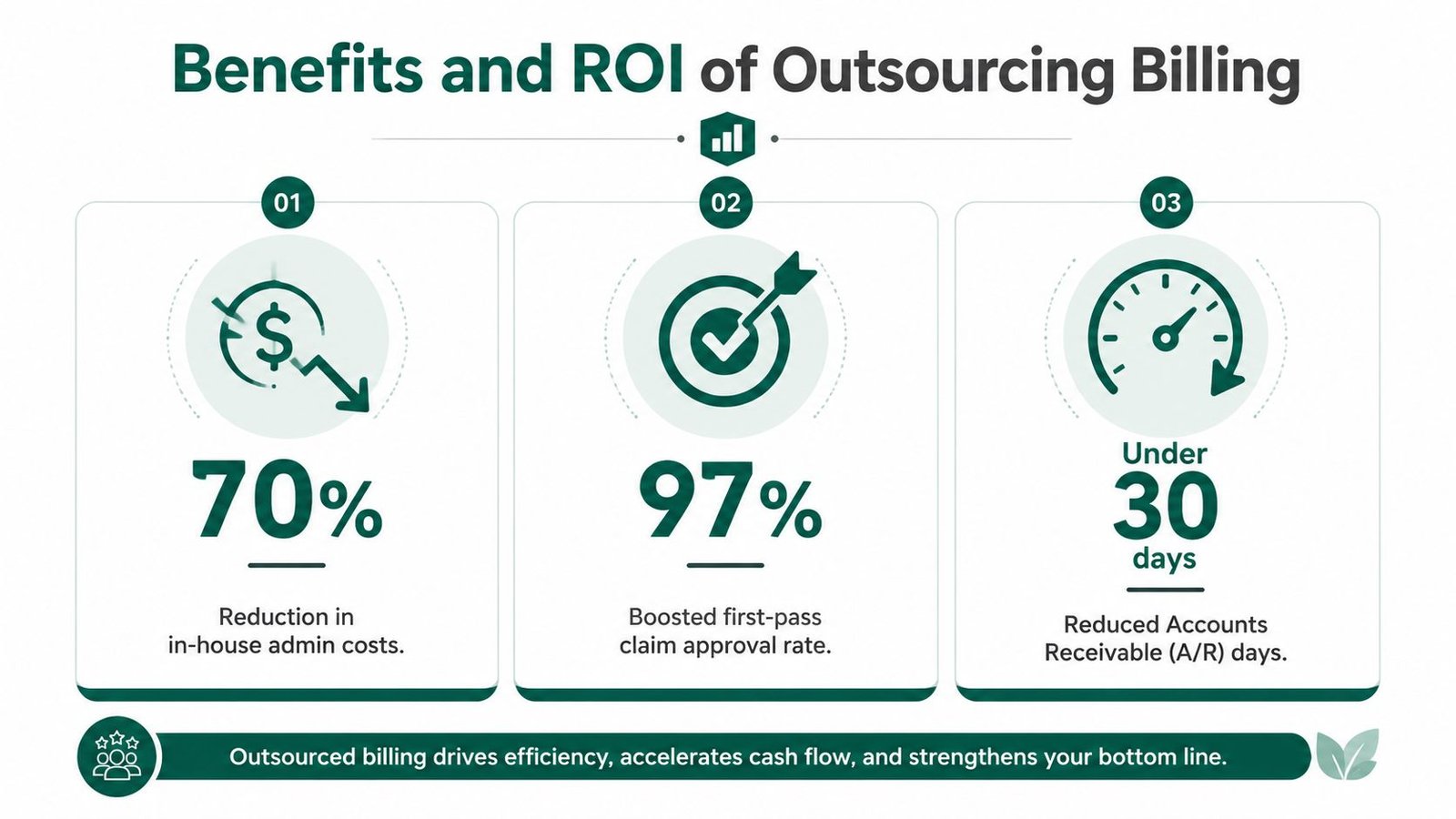
The strongest returns usually do not come from cutting payroll alone. They come from finding money already earned but never collected. In internal medicine, that often means undercoded E/M visits, missed care management charges, weak denial follow-up, and modifier errors that suppress payment without creating a clean denial trail.
One internal medicine group recovered $15,000 in one quarter after an outside billing team corrected modifier -25 use on same-day problem visits and minor procedures. Their in-house staff had been submitting conservative claims to avoid scrutiny. The result was predictable. Lower reimbursement on work the physicians were already doing.
Where outsourcing produces real ROI
A specialist billing partner should improve financial performance in four specific ways.
- Reduce preventable write-offs: Clean claims give you control over the payment process and cut rework before claims hit the payer.
- Raise net collections on E/M volume: Internal medicine lives on visit coding accuracy. Small errors repeated across hundreds of encounters become a major monthly loss.
- Capture care management revenue consistently: CCM, TCM, and related services often fail because documentation, consent, and time tracking break down operationally.
- Shorten A/R cycles: Faster claim correction and disciplined follow-up improve cash timing, which matters more than owners admit until payroll gets tight.
For owners weighing internal staff against a specialist, this summary of the benefits of outsourcing medical billing is useful if you want a side-by-side framework for comparing cost, control, and collection performance.
How to calculate ROI honestly
Do not build the case around vendor promises. Audit your current leakage.
Start with three numbers: net collection rate, days in A/R, and monthly dollars sitting in denials older than 60 days. Then review a sample of paid internal medicine visits for missed E/M levels, missing G2211 where supported, and care management services started clinically but never billed. That is where hidden loss shows up.
Ask hard questions:
- How many established patient visits are being coded lower than documentation supports?
- How many care management patients meet requirements clinically but never reach a billable claim?
- How much staff time is spent fixing denials instead of preventing them?
- How much cash is delayed because no one owns payer follow-up with urgency?
If even a few of those numbers look weak, outsourcing usually pays for itself. The return comes from stacked gains. Better coding review. Faster submission. Tighter denial management. More complete charge capture. Those are not abstract operational improvements. They are direct increases in collected revenue.
Judge outsourcing by added collections, cleaner A/R, and fewer missed billing opportunities. Fee percentage matters. Revenue retention matters more.
Vendor Selection and Onboarding Guide
Choosing a billing partner for internal medicine shouldn't be based on price, personality, or software demos. It should be based on whether the vendor can protect your revenue in the exact places internal medicine loses it.
One fact matters here: the 12 root causes driving 90% of internal medicine denials include eligibility not verified, missing prior authorization, incorrect modifiers, diagnosis-code mismatch, and timely filing deadlines missed, and a 90-day denial analysis can isolate where the leakage starts, as described in this review of internal medicine denial root causes. A serious vendor should already be measuring those failure points.
What to ask before you sign
Use a practical screening checklist.
- Show me your denial logic: Ask how the vendor tracks denials by category, payer, and root cause. If they can't explain the workflow clearly, expect repeat denials.
- Explain your E/M review process: Internal medicine requires real competency in encounter leveling, not generic coding support.
- Walk through modifier compliance: They should be able to discuss modifier -25 confidently and explain how they audit for missed or unsupported use.
- Describe payer policy management: Telehealth, preventive visits, and care management rules shift. The vendor needs a reliable method for updating workflows.
- Show your pre-submission edits: AI-assisted scrubbing can help, but human review still matters on nuanced internal medicine claims.
If you're comparing outsourcing models, this guide on how to outsource medical billing is a strong framework for evaluating operational fit, reporting, and control.
What a solid onboarding plan looks like
A billing transition doesn't need drama. It needs discipline. We recommend a simple phased approach.
| Onboarding phase | Owner focus | Vendor responsibility |
|---|---|---|
| First 30 days | Approve access, define reporting, review legacy issues | Map workflows, review payer mix, identify denial patterns |
| Next 30 days | Monitor early claim quality, enforce provider documentation feedback | Launch claim edits, clean A/R queues, standardize follow-up |
| Next 30 days | Review performance trends and unresolved payer issues | Tighten denial prevention, stabilize cadence, refine dashboards |
The vendor should also address core transition questions upfront:
- HIPAA and data handling: Confirm BAAs, access controls, and audit processes.
- EHR integration: You should not have to migrate systems just to change billing partners.
- Service-level expectations: Define turnaround times for coding questions, claim submission, denial work, and month-end reporting.
- Legacy A/R responsibility: Decide what happens to old unpaid balances before go-live.
What separates a real partner from a claim processor
A claim processor submits what it's given. A revenue partner improves what gets submitted.
That means they should challenge weak documentation, flag payer rule changes, and show you exactly where money is being delayed. One option in this category is Happy Billing's internal medicine billing support, which works inside existing EHR workflows and combines automated claim review with human oversight. That's the right model in general. Technology handles repetition, and experienced reviewers handle the nuance.
The wrong vendor says yes to everything and sends monthly reports full of surface metrics. The right vendor tells you where the process is breaking and fixes it.
Conclusion and Common Questions
For internal medicine practices, billing quality shows up directly in cash flow. Stronger E/M support, better modifier control, tighter care management documentation, and disciplined A/R follow-up all improve collections faster than merely adding visit volume.
Owners should make the decision based on revenue performance, not convenience. If your practice is missing higher-level visit support, carrying preventable denials, or watching claims age too long, your current workflow is costing more than it appears. The smart next step is to review denial patterns, compare vendors against specialty-specific criteria, and get an outside read on where claims are leaking. If you want a concrete starting point, request a free revenue cycle audit for your practice.
Should I outsource billing or fix my in-house team?
If your issues are isolated and leadership has time to rebuild process discipline, an internal fix can work. If E/M leakage, denial trends, and A/R delays are already affecting cash flow, outsourcing is usually faster and more reliable.
How long does onboarding a new billing partner usually take?
The transition should be phased, structured, and tied to clear reporting. What matters most is not speed alone, but whether the new partner can stabilize clean claims quickly without disrupting posting, follow-up, and payer communication.
What performance guarantees should I ask for?
Ask for accountability around claim quality, denial visibility, turnaround times, documentation feedback, and A/R follow-up cadence. Avoid vague promises. Get reporting expectations in writing.
Will a new billing vendor force us to change EHR systems?
Not necessarily. Many strong vendors work within your existing EHR and PM setup. For most independent practices, that is the preferred model because it reduces disruption and shortens the path to measurable results.
Happy Billing helps independent practices tighten revenue cycle operations without forcing an EHR migration. If you're evaluating medical billing services for internal medicine and want a practical view of where collections are slipping, start with a focused review of denials, E/M patterns, and aging A/R at Happy Billing.