Top Medical Billing Services Delaware: Boost Your Practice

If you're looking at medical billing services in Delaware because cash is slowing down, denials are rising, or your front office is spending too much time fixing payer edits, the short answer is this: the right billing partner can protect revenue and shorten A/R, but a generic or low-cost service can make both worse. In Delaware, payer-specific workflows, fee-for-service rules, and modifier mistakes directly affect whether claims pay cleanly or sit in rework.
Most independent practices don't have a billing problem in theory. They have a velocity problem. Money that should have posted this month gets trapped in denials, contractual underpayments, or avoidable claim edits. That shows up in higher A/R days, lower net collections, and more owner time spent chasing explanations instead of running the practice.
What Are Medical Billing Services and Why Do They Matter in Delaware
A Delaware physician-owner sees the warning signs before the monthly report lands. Yesterday's visits are coded, claims are filed, and staff assume the work is done. Two weeks later, cash is light, a batch of claims is stuck for correction, and someone is rebilling visits that should have paid on the first pass.
Medical billing services exist to prevent that revenue drag. A capable billing team handles charge entry, claim submission, payment posting, denial follow-up, underpayment review, and A/R work so billed services turn into collected dollars instead of aging balances. In practice, that means getting the coding right, matching each payer's rules, and catching mistakes before they become a 45-day collection delay.
What a billing service should actually control
For a Delaware practice, billing is operational finance. The vendor or in-house team should own the parts of the cycle that directly affect net collections and denial rate:
- Charge capture and claim submission based on complete provider documentation
- Coding review for CPT, ICD-10, HCPCS, and modifier accuracy before the claim leaves the system
- Payer edit resolution tied to Delaware Medicaid, MCO, and commercial plan requirements
- Payment posting and adjustment review to spot underpayments and incorrect contractual write-offs
- Denial management and appeals for rejected, denied, or downcoded claims
- A/R follow-up on unpaid balances before timely filing or appeal windows close
For a plain-language reference, this overview of what medical billers do is useful.
The difference between average billing and strong billing usually shows up in small details. Modifier misuse is a common example. A visit that needs modifier 25 attached to a separate E/M service can pay correctly when documented and billed cleanly. The same claim can be denied or reduced when the modifier is appended automatically without chart support. That is not a coding technicality. It is lost revenue, more staff rework, and older A/R.
Why Delaware changes the stakes
Generic billing companies often miss Delaware-specific payer behavior. They may submit claims correctly in a broad sense, then fail on the details that drive payment speed here: fee-for-service requirements, payer-specific workflows, authorization mismatches, and documentation tied to the exact code set billed.
Every mismatch between your documentation and a payer's required workflow creates friction that leads to denials and delayed cash.
I tell practice owners to test a billing company with specific questions. Ask how it handles Delaware Medicaid fee-for-service claims versus managed care claims. Ask how it reviews modifier use on same-day services. Ask how it works underpayments and whether it reconciles posted payments back to contracted expectations. If the answers stay general, the service is probably built to submit claims, not manage revenue.
Practices that perform well usually treat billing as a control system for cash, not clerical cleanup. For a broader operational view, this resource on mastering healthcare revenue cycles is worth reviewing against your current process.
The Financial ROI of Outsourcing Your Medical Billing
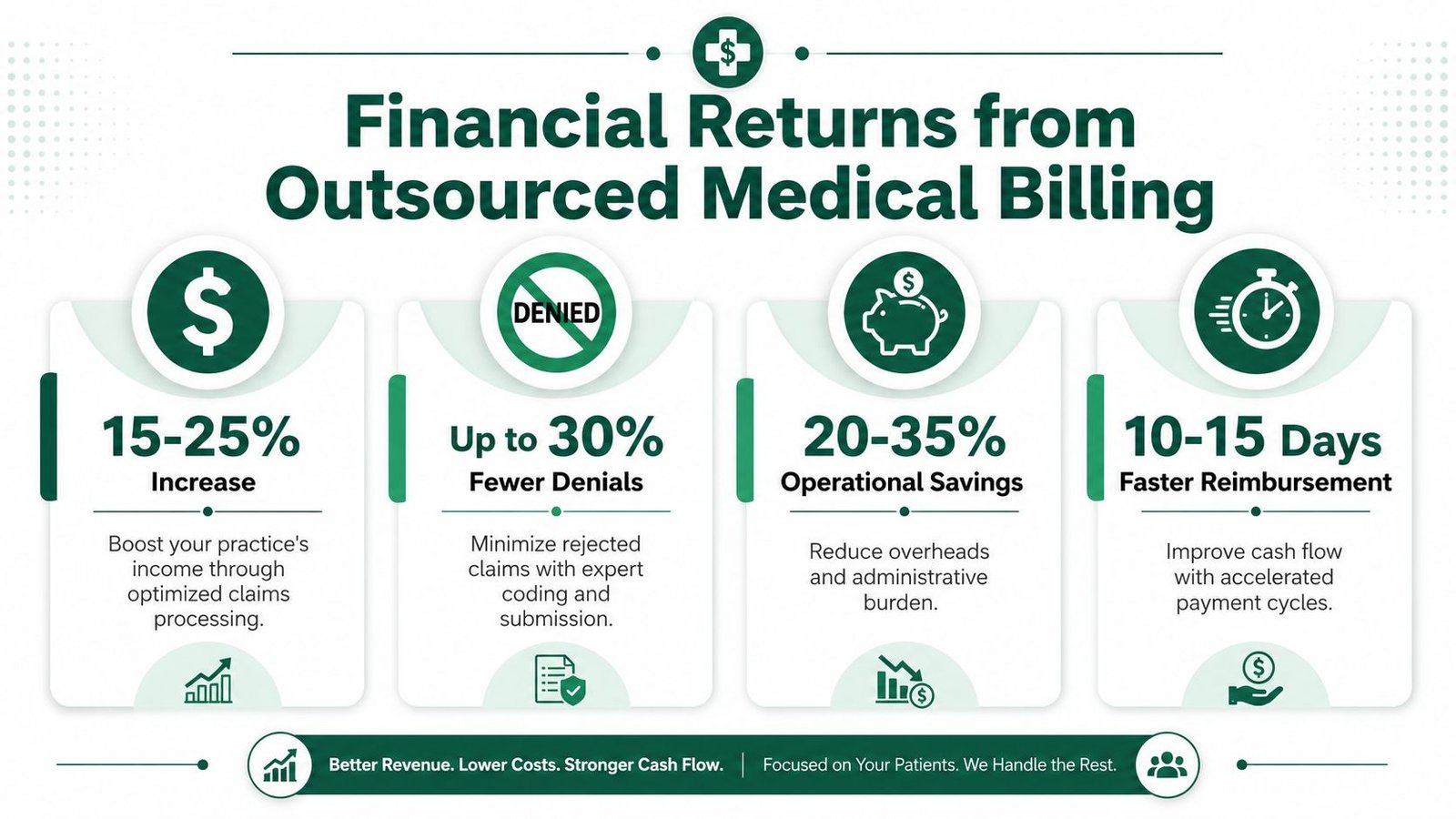
The financial case for outsourcing is simple. You don't outsource billing to save administrative effort alone. You outsource to speed up collections, reduce rework, and stop revenue leakage.
In 2026, top-rated Delaware billing companies reported that partnered clients achieved A/R limits of less than 30 days, a 10 to 15% increase in revenue, and a 97% first-pass clean claim rate, according to MediBillMD's Delaware billing benchmarks. Those are not vanity metrics. Each one changes your cash position.
Why first-pass performance matters
A first-pass clean claim rate tells you how often claims leave your system ready to pay without manual intervention. At 97% first pass in the Delaware benchmark above, the key advantage isn't bragging rights. It's fewer claims falling into denial queues, fewer staff hours spent correcting preventable edits, and faster reimbursement.
Every time a claim fails on first pass, your practice pays twice. First in labor. Then in time.
Consider what happens operationally when clean claims improve:
| KPI | What it means to the practice owner |
|---|---|
| First-pass clean claim rate | Fewer avoidable payer rejections and less rework |
| Days in A/R | Faster access to earned revenue and less cash strain |
| Revenue lift | More complete capture of work already performed |
A billing vendor that can explain these numbers in your actual payer mix is worth hearing out. A vendor that only discusses price usually isn't. This breakdown of outsource medical billing cost is useful if you're comparing fee models against expected revenue impact.
Where the ROI actually comes from
The return doesn't come from "doing billing cheaper." It comes from doing key tasks better.
- Cleaner charge capture reduces front-end edits.
- Payer workflow accuracy avoids unnecessary holds.
- Faster denial correction shortens the time between service and payment.
- Better adjustment review catches underpayments before they become accepted losses.
A physician-owner should ask one question first: "Will this vendor improve cash velocity?" If the answer is unclear, the rest of the pitch doesn't matter.
That is why outsourced medical billing services in Delaware can improve economics even when the fee is higher than the cheapest option. The wrong vendor lowers visible cost while subtly extending the time it takes to get paid.
Navigating Delaware's Unique Payer and Regulatory Rules
A Delaware practice can post a strong week of patient volume and still miss payroll projections because claims stall in payer edits, sit in development, or come back denied for issues the billing team should have caught before submission. I see this most often when a national billing vendor applies one workflow to every payer and treats Delaware fee-for-service rules like a minor variation instead of a payment risk.

Direct payer communication affects cash flow
Delaware payers do not all accept the same correction path, documentation set, or follow-up sequence. That matters because every mismatch adds days to A/R. A claim that could have paid in the first cycle turns into a rebill, an appeal, or a manual status chase.
For an owner, the operational warning signs are clear:
- claims held for missing attachments or authorization details
- corrected claims submitted in the wrong format
- denials written off as "payer quirks" instead of process failures
- staff time spent fixing avoidable defects rather than posting clean payments and resolving true underpayments
This is not an admin nuisance. It is a revenue timing problem. If your billing partner cannot tell you how Delaware Medicaid, local commercial plans, and managed care entities each want corrections and supporting records handled, your denial rate rises and cash slows down.
Line-level coding mistakes cost more in Delaware than many practices expect
Coding accuracy is not only about passing an audit. It decides whether the claim reaches adjudication cleanly and whether the payer pays the full allowable. Delaware billing workflows tend to expose weak coding discipline fast, especially on office visits, preventive services, injections, and same-day minor procedures.
A common example is an E/M claim such as 99213 or 99214 billed on the same date as a procedure. If the documentation does not support separate work, or the modifier logic is wrong, the payer can bundle the visit, reject the line, or force a manual review. The result is familiar. More rework, older receivables, and lost revenue on services the physician already performed.
I advise practices to audit these encounters by payer, not just by provider. One payer may accept a corrected claim route that another payer rejects outright. One may require records earlier in the cycle. One may deny first and only reverse after a structured appeal. Generic billing teams miss those differences and then wonder why the same CPT mix produces different collection results.
Compliance and patient billing rules intersect
Delaware practices also need billing operations that match payer rules and patient-facing obligations. If those workflows are disconnected, the back office creates its own denial and refund risk. That is why many groups review coding edits, payer rules, and No Surprises Act compliance workflows together rather than treating them as separate projects.
The right billing partner does more than submit claims. It sets payer-specific rules, catches modifier misuse before submission, and shortens the time between date of service and payment. In Delaware, that level of specificity protects collections. Anything less usually shows up in A/R aging first, then in monthly revenue.
Why Your Medical Specialty Demands Specialized Billing
Two practices can use the same EHR, submit claims to the same payer, and still have completely different billing risk. Specialty drives the risk. A billing team that treats cardiology, dermatology, orthopedics, anesthesia, and behavioral health as variations of the same workflow will miss the edits that determine whether you get paid.

The Modifier 25 mistake that wipes out same-day visit revenue
This is one of the clearest examples. When a physician bills an E/M visit on the same day as a minor procedure, Modifier 25 is the critical companion code that shows the E/M service was significant and separately identifiable. According to Medwave's review of modifier-driven claim denials, without Modifier 25, Medicare and most commercial payers will automatically deny the E/M portion as bundled, causing the practice to lose 100% of the revenue for that visit, and that visit volume can represent 30 to 40% of a day's total claim volume.
For an owner, that is not a coding technicality. It's same-day revenue disappearing because the billing process failed to protect it.
A familiar example looks like this:
- Office visit billed with 99213 or 99214
- Minor procedure performed the same day
- Modifier 25 omitted or unsupported
- E/M line denied as bundled
Now your team has to reopen the chart, validate distinct work, correct the claim, and wait again.
CO-45 is where silent losses hide
The more dangerous problem is often not the denial you see. It's the adjustment you accept. CO-45 means contractual reduction. The payer pays the allowed amount, and the difference must be written off as a contractual adjustment rather than billed to the patient. If the payer applied the contract incorrectly and no one reconciles it, the practice absorbs the loss.
According to Aspect Billing Solutions' explanation of CO-45 denial code handling, if incorrect CO-45 adjustments are ignored, they can erode gross revenue by 15 to 25% annually across a typical practice's claim portfolio.
That is why specialty-specific billing matters. Different specialties experience different adjustment patterns, bundling edits, documentation risk, and modifier exposure.
Specialty knowledge changes what gets watched
A strong specialty billing team doesn't review every claim the same way. It watches for the failure points most likely in your field.
- Cardiology often depends on exact procedural coding and documentation alignment. Practices exploring help in that area should look at specialty-specific cardiology medical billing services.
- Behavioral health faces authorization and payer workflow complexity.
- Orthopedics and pain management live inside modifier logic, procedure relationships, and global period issues.
- Dermatology often runs into bundled services and same-day E/M disputes.
Owner takeaway: Ask a prospective billing partner which denial codes, modifiers, and adjustment patterns it monitors most aggressively in your specialty. If the answer sounds generic, expect generic results.
EHR Integration Security and HIPAA Compliance
A billing partner sits inside the most sensitive part of your business. It touches patient demographics, diagnoses, procedure codes, payer IDs, remittance data, and bank-linked posting workflows. If that partner handles data poorly, the damage isn't only operational. It becomes legal, financial, and reputational.
Integration should reduce risk, not create it
The safest billing relationship usually works inside your current EHR or PMS with controlled access and clear permissions. That avoids unnecessary data exports, spreadsheet handoffs, and duplicate systems that create version conflicts.
When integration is weak, practices tend to see avoidable problems:
- Duplicate work queues between front office and billing staff
- Posting mismatches because remits and charges aren't living in the same workflow
- More PHI exposure through manual file transfers and ad hoc communication
Technology should make the process tighter. It shouldn't force your staff into side channels.
Security is a revenue issue
Many owners treat HIPAA and security as IT concerns. That is too narrow. A billing vendor with weak controls can expose the practice to investigations, operational disruption, and payment delays while systems or workflows are reviewed.
It is reasonable to ask detailed questions about access controls, encryption, audit logging, business associate agreement terms, and incident response. Practices that want a deeper external benchmark can review examples of HIPAA penetration testing services to understand what mature security validation looks like.
A strong billing operation should also fit your workflow without disruptive migration projects. If you're evaluating the operational side, this guide to technology for revenue cycle lays out what to look for in integration, automation, and reporting.
Security isn't separate from RCM. If your billing partner creates system risk, it creates revenue risk.
How to Choose the Right Delaware Billing Partner
A Delaware practice can post a strong clean-claim rate and still lose cash every month. I see it when a vendor submits claims quickly but misses the payer rules that control payment. The result is familiar. Modifier denials pile up, fee-for-service claims age past 30 days, and underpayments stay buried in adjustments no one reviews.
Choosing a billing partner starts with one question. Can this company protect net collections inside Delaware's payer mix?
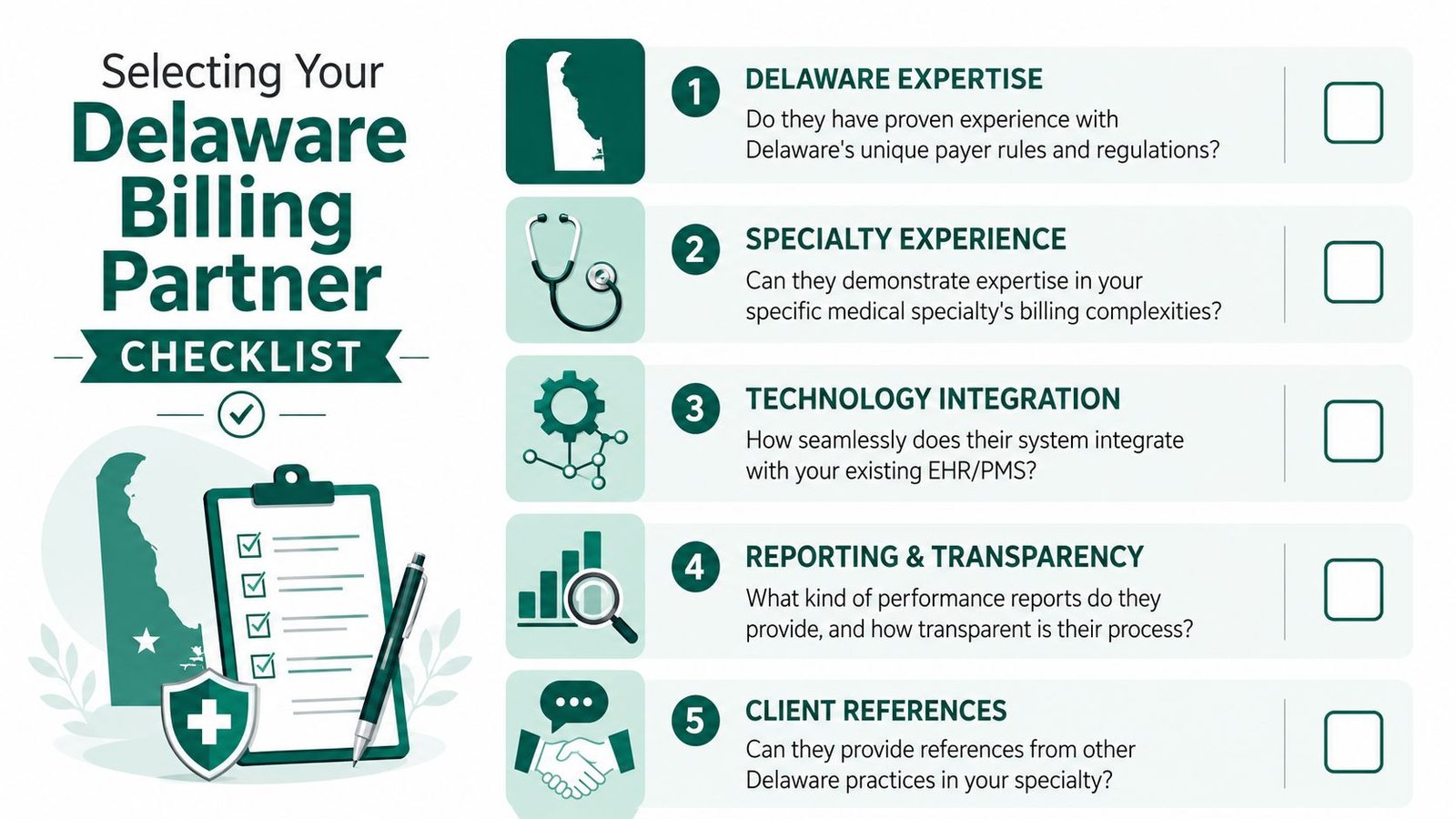
According to MedCare MSO's review of top medical billing companies in Delaware, low-cost vendors charging $8/hour may report 98% clean claims, while average days in A/R still sit above 42. Higher-performing RCM firms in that comparison kept A/R under 35. That gap matters more than the hourly rate because slower cash creates owner draw pressure, payroll stress, and more aged balances that never convert.
Questions that expose whether a vendor can actually perform
Ask for operating numbers, not sales language.
What are your average days in A/R, denial rate, and net collection rate for practices in my specialty?
If they only talk about claim submission volume, they are avoiding the financial outcomes that matter.How do you handle Delaware payer rules by plan, not just by payer name?
Delaware practices often get into trouble when a vendor treats fee-for-service Medicaid, MCO workflows, and commercial edits like the same process. They are not the same, and the wrong assumption costs time and cash.How do you prevent modifier misuse before the claim drops?
A capable team should be able to explain how it reviews cases involving Modifier 25, 59, and the X{EPSU} modifiers, and how it separates coding issues from documentation issues. If the answer is "we appeal denials," that is too late.Who works underpayments and contractual variance?
Many vendors post the ERA and move on. That leaves revenue behind. You want a process for comparing paid amounts against expected reimbursement and escalating short pays.What is the turnaround time on denials and pended claims?
A denial touched in 3 days behaves very differently from one touched in 18. The older the denial gets, the lower the recovery rate.What does the monthly owner report show?
It should show aging by bucket, denial categories, top CPT issues, payer turnaround, and provider-level trends. A stack of transaction reports does not help you run the practice.
Delaware experience shows up in the details
Generic billing companies often say they work nationally, which sounds fine until a Delaware-specific issue hits cash flow. A partner worth hiring should be able to discuss local payer behavior with specifics. That includes fee-for-service claim edits, authorization failure patterns, modifier scrutiny, and how they handle claims that bounce between clinical documentation, coding, and payer policy.
That detail matters because the financial traps are small at first. One modifier pattern can raise denials by a few points. One weak follow-up process can push A/R days from the low 30s into the 40s. On a busy practice's monthly charges, that shift can tie up thousands of dollars that should already be in the bank.
Price only matters after performance is clear
Cheap billing is expensive when it slows cash.
| Vendor type | What usually happens |
|---|---|
| Low-cost claim submitter | Lower visible fee, weak denial ownership, slower payment, limited underpayment review |
| Performance-focused RCM partner | Tighter edit control, faster follow-up, stronger A/R discipline, clearer revenue reporting |
The right Delaware billing partner should be able to explain how it gets paid claims across the line, not just how it sends them out. If a vendor cannot show control over denial rate, days in A/R, and payer-specific rework, the lower fee rarely holds up once collections soften.
FAQs from Delaware Practice Owners
How do I know if my billing issue is a staffing issue or a system issue
Start with the money trail. If claims are filed on time but denials keep repeating around the same modifiers, payer edits, or documentation gaps, the problem sits in workflow control, coding review, or claim scrub rules. If untouched encounters, aging charges, and delayed follow-up are the pattern, staffing capacity is part of the problem.
In Delaware practices, I usually see both. Good staff can still produce weak results if the process allows claims to leave with missing authorization data, unsupported modifiers, or inconsistent charge review. That kind of failure raises denial rate and slows cash even when the team feels busy all day.
What should worry me most in my current denial mix
Modifier-related denials should move to the top of the list, especially if they involve Modifier 59 or the related modifiers XE, XS, XP, and XU. Those denials often point to a larger issue with unbundling risk, documentation support, and payer scrutiny. In Delaware, that matters because small recurring errors can pull a practice into prepayment review, delay payment on otherwise valid claims, and increase rework across the billing team.
According to Medical Billers and Coders' analysis of modifier misuse and bundling denials, this exposure can force a practice to repay 10 to 30% of historically billed revenue.
Review these denials by provider, CPT code, and payer. That is how you find whether the issue is isolated training, a documentation habit, or a billing rule that needs to be tightened.
Should I switch billing partners if my current vendor says clean claims are high
A high clean-claim rate does not answer the main question. Is cash posting fast, completely, and at the contracted rate?
A vendor can keep front-end edits tight and still miss underpayments, age claims past timely follow-up windows, or fail to work Delaware payer rejections aggressively. Ask for average days in A/R, denial categories by volume, and a clear explanation of how adjustments and underpayments are reconciled. If those numbers are weak, the clean-claim statistic is not protecting revenue.
How disruptive is a billing transition for a practice
A billing transition is manageable when ownership is clear from day one. Providers should stay in the same documentation workflow while the new team takes control of edits, submission, payment posting, and follow-up.
Problems start when nobody defines who handles payer enrollment, open A/R, claim corrections, patient statements, and credit balances. I have seen transitions fail for that reason alone. The practice changed vendors, but old claims sat untouched and new claims went out with the same edit problems. Collections dropped, A/R days climbed, and the owner paid two teams to create the same mess.
If your Delaware practice is still losing cash to slow payments, recurring denials, modifier misuse, or underpayment leakage, Happy Billing can help identify where revenue is stalling and what needs to change first. Their team works inside your current systems and supports specialty-specific RCM with a practical billing audit that focuses on denial rate, A/R velocity, and missed reimbursement.