Your Guide to Cardiology Medical Billing Services

Cardiology medical billing is a high-stakes financial discipline where a single coding error on a complex procedure can cost a practice thousands. Expert cardiology medical billing services ensure clinical work is converted into maximum, compliant reimbursement by mastering complex CPT codes, modifiers, and payer-specific rules. For instance, correctly billing a diagnostic left heart catheterization (CPT 93458) versus one that includes a percutaneous coronary intervention (PCI) with a stent (CPT 92928) is fundamental to avoiding denials and protecting revenue.
What Are Cardiology Medical Billing Services?

Cardiology medical billing services are an end-to-end revenue cycle management framework designed specifically for the financial complexities of a cardiology practice. This specialized service goes beyond simple claim submission to manage procedural coding, prior authorizations, denial management, and compliance with intricate payer policies. For physician owners and practice managers, these services act as a financial specialist for the practice, safeguarding its fiscal health.
The financial environment for cardiologists is unforgiving. Claim denials are the silent revenue killer, with many practices losing a significant portion of their income to preventable mistakes. According to AAPC and industry data, claim denials frequently stem from specific, preventable issues: 35% from "medical necessity" failures, 28% from incorrect coding, and another 22% from missing prior authorizations.
The Core Functions of a Specialized Service
A dedicated cardiology billing partner focuses on the strategic functions that protect revenue and ensure compliance—areas where generalist billers often fail.
Key functions include:
- Expert Procedural Coding: Correctly applying CPT codes for diagnostic and interventional procedures, like percutaneous coronary interventions (PCI), and knowing exactly which modifiers to append. This includes distinguishing between a diagnostic study (e.g., CPT 93458) and an interventional procedure (e.g., CPT 92928) performed in the same session, and applying Modifier 26 for professional interpretation of tests performed in a facility.
- Proactive Prior Authorization: Securing approvals for high-cost imaging (e.g., Cardiac MRI, CPT 75557-75564) and interventions, a notorious source of denials for many practices.
- Navigating Payer-Specific Rules: Staying current with constantly shifting policies from CMS, Medicaid, and commercial payers to prevent rejections before they happen.
- Aggressive Denial Management: Systematically analyzing, appealing, and resolving denied claims to recover revenue that would otherwise be lost.
The goal isn't just to process claims; it's to build a resilient revenue cycle. A specialized service acts as a strategic asset, protecting your practice against financial leaks and positioning it for sustainable growth.
Ultimately, these expert services ensure the financial performance of your practice is as strong as its clinical excellence. For a more detailed look at the components involved, check out our guide on cardiology revenue cycle management.
Mastering Complex Cardiology Coding and Reimbursement
Cardiology is not just another specialty in medical billing. It demands a deep, practical understanding of the CPT codes, modifiers, and payer rules unique to cardiovascular medicine. The financial health of your cardiology practice hinges on this level of coding accuracy.
A single mistake in coding a diagnostic or interventional procedure can vaporize thousands in revenue. For example, a diagnostic left heart catheterization with coronary angiography is captured by CPT 93458. But if a percutaneous coronary intervention (PCI) with a stent is performed during the same session, the correct code flips to CPT 92928. According to CMS's National Correct Coding Initiative (NCCI) edits, billing these two codes together without the proper modifier will result in a denial, as the diagnostic cath is considered bundled into the interventional procedure.
The Critical Role of Modifiers
In billing, modifiers tell the story behind the procedure, justifying payment for services that might otherwise look like duplicates or errors. For cardiologists, they are non-negotiable.
Two of the most vital modifiers are:
- Modifier 26 (Professional Component): Essential when your physician interprets a test (like an echo or stress test) but does not own the equipment, which is typical in a hospital setting.
- Modifier TC (Technical Component): Billed by the facility that owns the equipment and employs the technicians who perform the test.
Getting this wrong is one of the fastest ways to get a denial. If you bill for a complete transthoracic echocardiogram (CPT 93306) without a modifier when it was performed in a hospital, that claim will be rejected. The payer expects to see one claim with Modifier 26 from the cardiologist and a separate claim with Modifier TC from the hospital.
Navigating Diagnostic and Remote Monitoring Codes
The coding for non-invasive diagnostics and remote monitoring is just as complex. The 932xx series for ambulatory cardiac monitoring, for instance, requires meticulous documentation to prove medical necessity, duration, and the type of monitoring performed.
Was it Holter monitoring (CPT 93224-93227), event recording, or mobile cardiac telemetry (CPT 93228-93229)? The correct code depends entirely on what your clinical notes can substantiate. Similarly, nuclear stress tests (e.g., CPT 78451, 78452) have multiple components—stress induction, imaging, and interpretation—each with its own coding rules. Without rock-solid documentation, these high-value procedures become prime targets for payer audits and denials. For a deeper analysis of how to manage and prevent these issues, explore common cardiology billing denials.
Think of cardiology coding like a combination lock. Having some of the right numbers isn't enough; you need the exact sequence, including modifiers and medically necessary diagnoses, to unlock payment. One wrong digit and the entire claim is stuck.
Staying Ahead of Payer and CMS Rule Changes
The rulebook for cardiology is constantly being rewritten. As we look at cardiology billing for 2026, the Medicare Physician Fee Schedule (PFS) final rule offers a slight reprieve, with conversion factors inching up to $33.57 for qualifying alternative payment models (APMs) and $33.40 for non-APMs.
However, the details reveal a continued trend: while new codes for complex cases may see higher work RVUs, established PCI codes like 92928 face reimbursement adjustments. This reflects a relentless push from payers like CMS to tie payments directly to proven procedural effort and value. A vigilant billing team must proactively adapt to align with the latest AAPC standards and CMS guidelines. Partnering with a specialist in cardiology medical billing services ensures your practice is protected from these disruptions. To learn more about how Happy Billing provides this level of expertise, visit our dedicated page for cardiology practices.
The KPIs That Tell the Real Story of Your Cardiology Practice
A profitable cardiology practice runs on data, not gut feelings. To know the true financial health of your group, you must focus on the handful of Key Performance Indicators (KPIs) that act as the vital signs for your revenue cycle.
For cardiology, where high-value procedures and complex coding are the norm, two numbers matter more than all the others: First-Pass Clean Claim Rate (FPCR) and Days in Accounts Receivable (A/R). Get these right, and your practice is on solid financial ground.
First-Pass Clean Claim Rate (FPCR)
Your FPCR is the single most honest measure of your billing team's performance. It’s simple: what percentage of claims get paid on the first submission, without any errors or rejections? A high rate means your front-end data capture, coding, and compliance checks are all working in sync.
Outdated billing processes often limp along with FPCRs between 78-82%, leading to revenue leakage of 5-8%. Elite cardiology groups, however, consistently hit a 98% first-pass acceptance rate. The data shows why this is so hard: in cardiology, denial rates average 35% for medical necessity alone, and another 28% come from coding errors on complex procedures like PCI and ablations.
Days in Accounts Receivable (A/R)
This KPI tells you exactly how long, on average, it takes to get paid for your work. For a cardiology practice, the target should always be under 35 days. When your Days in A/R starts creeping past that mark, it’s a red flag for slow payment processing, weak denial management, or a simple lack of follow-up on aging claims.
High A/R directly suffocates your cash flow. The longer a claim sits unpaid, the less likely it is you will ever collect that revenue. Aggressive, disciplined A/R follow-up is a non-negotiable part of any expert cardiology billing service.
Payer rules and fee schedules are constantly shifting, and even minor adjustments from CMS can impact your bottom line.
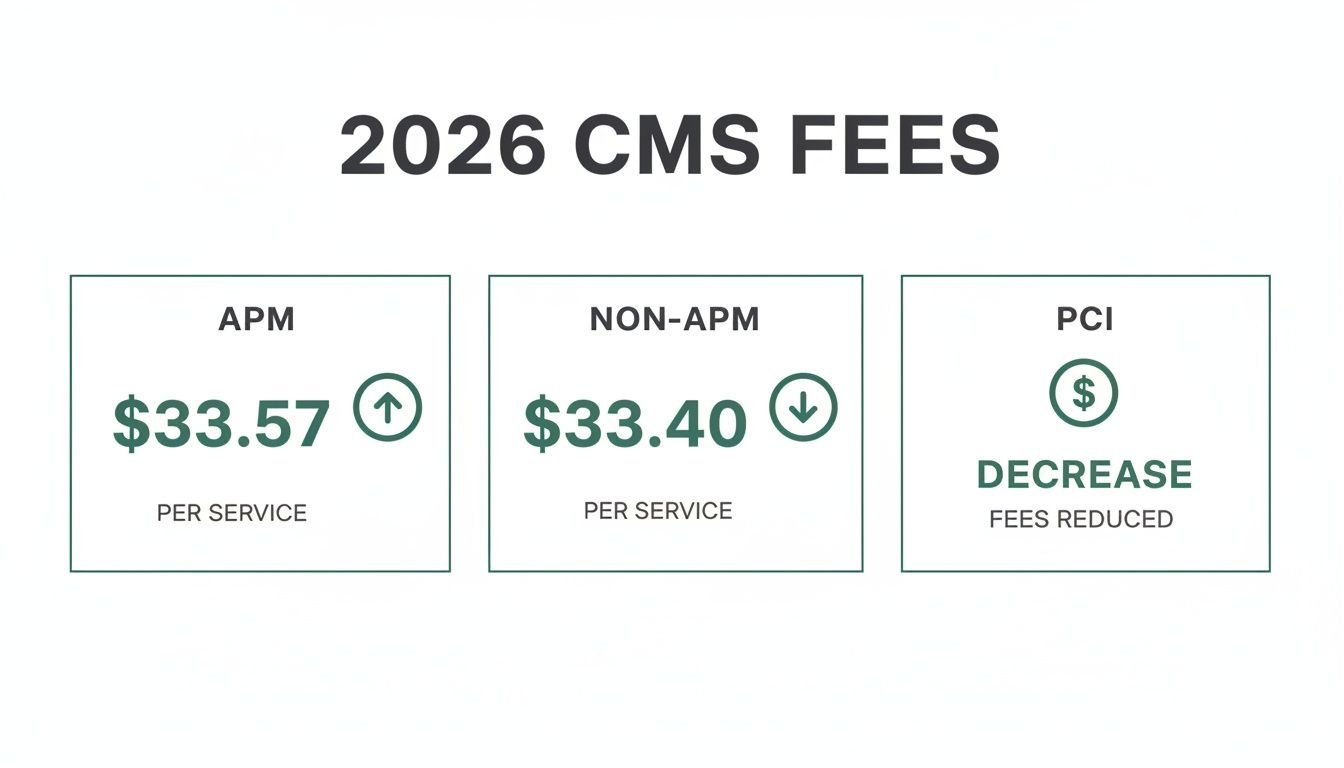
For example, the proposed 2026 CMS Physician Fee Schedule shows a small bump for APM participants to $33.57, while non-APM rates dip slightly to $33.40—a clear signal of CMS’s continued push toward value-based care.
Cardiology RCM Performance Benchmarks
Not all billing operations are created equal. The table below shows the massive gap between poor, average, and elite performance on the KPIs that truly matter for a cardiology practice's financial health.
| KPI | Poor Performance | Average Performance | Elite Performance (Target) |
|---|---|---|---|
| First-Pass Clean Claim Rate (FPCR) | Below 85% | 85-94% | 98%+ |
| Days in A/R | 50+ Days | 36-49 Days | Under 35 Days |
| Denial Rate | Over 10% | 6-10% | Under 5% |
| Net Collection Rate (NCR) | Below 90% | 90-95% | 96%+ |
| A/R Over 90 Days | Over 20% | 10-20% | Under 10% |
Where does your practice fall? If your numbers are in the "Poor" or "Average" columns, it's a clear sign that you are leaving significant revenue on the table every month.
Other Critical Cardiology KPIs to Monitor
While FPCR and Days in A/R are your north stars, a few other metrics give you the complete financial picture.
- Denial Rate: This needs to be tracked by root cause—like "coding error" or "missing prior auth"—so you can fix the source of the problem. Aim for a total denial rate below 5%.
- Net Collection Rate (NCR): This measures how much of the allowed amount you actually collect. The benchmark for top performers is 96% or higher.
- A/R Aging Buckets: Watch how much of your money is stuck in older buckets (91-120 days, 120+ days). A healthy practice keeps over 85% of its A/R in the 0-60 day range.
By tracking these specific numbers, you stop guessing and start knowing exactly where your revenue cycle is breaking down. To dive deeper into these metrics, check out our complete guide on the most important medical billing KPIs to track.
How to Choose the Right Cardiology Billing Partner
Choosing your cardiology billing partner is one of the most important financial decisions your practice will make. Look past the sales pitch and find a true partner with deep, specific expertise in cardiology—not general medical billing.
A generalist won't know the first thing about coding a percutaneous coronary intervention (PCI) with CPT 92928 or navigating the brutal prior authorization gauntlet for a nuclear stress test. This isn't a decision driven by the lowest price; it's about who delivers the best financial results. The right vendor acts as an extension of your team, protecting every dollar you earn and providing the data to grow.
Evaluate Their Cardiology-Specific Performance
When you're interviewing potential partners, get straight to the data. Don't fall for vague promises of “better collections.” Demand verified performance metrics from their current cardiology clients.
Key questions to drill down on:
- What is your average First-Pass Clean Claim Rate (FPCR) for your cardiology practices? (You want to hear 98% or higher.)
- What is your average Days in Accounts Receivable (A/R) for your cardiology clients? (The goal is under 35 days.)
- Can you show me a denial analysis for your cardiology book of business, broken down by root cause like medical necessity, coding errors, or missing prior auths?
A top-tier partner will have these numbers on hand and be eager to share them. If a vendor gets defensive or only offers generic, all-specialty data, it’s a massive red flag. They don't have the focused expertise you need.
Choosing a billing company is like choosing a surgeon. You wouldn't hire a general surgeon for a complex heart procedure. So why would you trust your cardiology revenue to a generalist who also bills for family practice and dermatology?
Assess Their Technical and Procedural Expertise
A great billing partner understands your clinical workflow and tech stack. They must be experts in the specific ways revenue leaks out of a cardiology practice.
Focus on these areas:
- Prior Authorization Management: How do they manage the intense prior authorization demands for advanced imaging (cardiac MRI, PET scans) and interventional procedures? Make them walk you through their process, step-by-step.
- EHR and System Integration: Are they true experts in your specific EHR? A partner who knows your system inside and out can optimize workflows and capture every charge without forcing you into a costly migration.
- Team Structure and Certifications: Who, specifically, is managing your account? Insist on a dedicated account manager and direct access to certified coders (like a Certified Cardiology Coder – CCC) who know the crucial difference between a diagnostic cath (CPT 93458) and a cath with LV/RV angiography (CPT 93453).
Asking these detailed questions will quickly separate the real experts from the pretenders. To help you spot other potential problems, it's smart to review the common red flags when hiring a medical billing company.
Verify Their Security and Reporting Capabilities
Your billing partner will handle a massive volume of your Protected Health Information (PHI). Their security has to be ironclad, and their reporting must be radically transparent.
Demand clear answers on these final points:
- HIPAA Compliance and Data Security: Ask for the specifics on their security measures—data encryption, access controls, and what protocols they have in place to prevent a data breach.
- Reporting and Transparency: What reports will you get? You should demand on-demand access to a dashboard showing your key performance indicators, detailed denial analysis, and A/R aging reports.
Choosing a partner who delivers in these three areas—verifiable performance, technical expertise, and total transparency—is the key to unlocking your practice's true revenue potential.
Your Smooth Transition to Outsourced Billing

The fear of a chaotic transition keeps many cardiology groups stuck with underperforming billing. But switching to a specialized billing partner shouldn’t be a painful overhaul. It's a structured, collaborative project designed for one thing: a smooth handoff that protects your revenue from day one.
A competent partner manages the entire project meticulously. The goal is simple: migrate your billing operations so seamlessly that your physicians, staff, and patients feel zero friction. The heavy lifting is their job, not yours.
The Phased Implementation Checklist
A successful transition follows a clear roadmap. This ensures all parties are aligned and key milestones are met without throwing your daily operations into chaos.
Here’s what that journey looks like:
- Discovery and Workflow Analysis: We start by diving deep into your current processes. We map out everything—from patient intake and charge capture to your existing denial workflows—to find strengths we can build on and weaknesses we need to fix.
- Secure EHR Integration: Our team sets up a secure, HIPAA-compliant connection to your existing Electronic Health Record (EHR). There is no need to migrate systems or learn new software. We work inside the environment your practice already knows.
- A/R Takeover Strategy: A clear plan is locked in for managing your legacy accounts receivable. The new team gets to work immediately on your aged claims, often starting with high-dollar accounts to inject cash back into your practice right away.
- Staff Training and Communication: Your front-desk and clinical staff get brief, focused training on any new communication protocols. This is usually a simple adjustment to how charge information is flagged or sent to the billing team, making sure nothing falls through the cracks.
A well-executed transition should feel less like major surgery and more like a routine check-up. The implementation team handles the complexity so your practice can keep its focus entirely on patient care.
Go-Live and The Hypercare Period
The "go-live" date kicks off the hypercare period—an intensive 30- to 90-day window where your new billing team monitors performance relentlessly to ensure everything is running perfectly.
During this phase, your dedicated account manager and billing team will:
- Track Initial Claims: Every single claim is tracked in real-time to confirm payer acceptance and spot any unexpected rejections. For example, we make sure a claim for a cardiac catheterization (CPT 93458) with a PCI (CPT 92928) is processed correctly by a specific payer without an immediate bundling denial.
- Monitor Key Metrics: Your First-Pass Clean Claim Rate (FPCR) and payment velocity are measured daily. This data-first approach lets us make rapid adjustments if any issues pop up.
- Provide Weekly Performance Reviews: You get regular updates and reports, giving you full transparency into the transition's progress and early results.
This intense focus guarantees that any small wrinkles are ironed out on the spot, validating the new workflow and building confidence. It ensures the move to outsourced cardiology medical billing services isn't just smooth but immediately effective. This level of specialized management is a core part of what our team provides for cardiology practices.
Calculating Your ROI and Understanding Pricing
Thinking about a specialized billing partner purely as a cost is the wrong way for a practice manager to frame the decision. The real financial impact isn't just about what you save on administrative overhead—it's about the significant revenue you gain from better collections, fewer denials, and recaptured time.
When the right partner can generate a 10-15% revenue lift, their fee doesn't just get covered; it turns into a profit-generating line item on your P&L. It becomes a strategic investment, not an expense.
Common Pricing Models Explained
Most cardiology billing services use one of three pricing structures. Knowing how each works is key to picking one that aligns with your practice’s financial goals.
- Percentage of Collections: This is the most popular model for a reason. The vendor takes a percentage (typically 4-7%) of the money they actually collect for you. It creates a powerful incentive—they don't get paid unless you get paid.
- Flat Fee Per Claim: You pay a fixed price for every claim filed, no matter the outcome or value. This model offers predictable costs, but it can be a poor fit for high-volume, lower-value services. It also doesn't motivate your partner to fight hard for underpayments or tough denials.
- Hybrid Model: Some partners offer a blended approach, combining a lower flat fee with a smaller percentage of collections. This can be a good middle ground, offering a bit of predictability with a performance incentive.
For most cardiology groups, the percentage-of-collections model is the clear winner. It ties your partner’s success directly to your bottom line. For a complete breakdown of what to expect, read our guide on the cost of outsourcing medical billing.
A Simple Framework for Calculating Your ROI
Figuring out your potential return on investment doesn't require a complex spreadsheet. It's a straightforward comparison between your current financial state and the improvements a specialist can deliver.
A cardiology group generates $3 million a year but loses 8% ($240,000) to billing errors and missed collections. A new partner, charging 6% of collections, plugs half of those leaks. The practice instantly adds $120,000 in net revenue, making the partnership a clear financial win.
Let's walk through a real-world example. Imagine a cardiology practice with these numbers:
- Annual Collections: $2,000,000
- Net Collection Rate: 92% (meaning 8% or $160,000 is left on the table)
- Billing Partner Fee: 6% of collections
An expert partner comes in and raises the Net Collection Rate to a healthy 97%.
- New Annual Collections: $2,000,000 / 0.92 * 0.97 = $2,108,695
- Revenue Lift: $108,695
- Billing Fee: $2,108,695 * 0.06 = $126,521
At first glance, it looks like a net cost. But that new revenue lift of $108,695 almost completely covers the partner's fee. When you add the value of freed-up administrative staff, less stress from fighting denials, and a more predictable cash flow, the ROI becomes undeniable. This is the real power of specialized cardiology medical billing services.
What specific CPT codes cause the most billing errors in cardiology?
The most common errors involve procedural bundling and modifier usage. For example, incorrectly billing a diagnostic left heart cath (CPT 93458) with a PCI (CPT 92928) without proper justification will trigger a bundling denial under NCCI edits. Another common issue is failing to use Modifier 26 (Professional Component) for interpretations of tests like echocardiograms (CPT 93306) performed in a hospital, leading to automatic rejections.
How do cardiology billing services handle prior authorizations for complex procedures?
Expert services use a proactive, structured approach. They maintain a database of payer-specific requirements for high-cost procedures like cardiac PET scans (CPT 78428, 78491, 78492) or electrophysiology studies. The process starts the moment a procedure is scheduled, with a dedicated team gathering clinical documentation to prove medical necessity and submitting the request electronically, tracking it to full approval to prevent last-minute cancellations or post-procedure denials.
What is a good "clean claim rate" for a cardiology practice?
An elite cardiology practice should target a First-Pass Clean Claim Rate (FPCR) of 98% or higher. An average performance falls between 85-94%, while anything below 85% signals significant problems in your coding, documentation, or front-desk processes. A high FPCR is the most direct indicator of an efficient revenue cycle, as it means claims are being paid without costly delays, rework, or denials.
At Happy Billing, we pair AI-powered precision with deep human expertise to hit a 98%+ clean claim rate for our cardiology clients. We work directly within your current EHR to accelerate cash flow and slash denials, all without disrupting your practice. See how our specialized cardiology medical billing services can transform your revenue cycle.