Starting an Intensive Outpatient Program (IOP): Payer Credentialing, Medicaid Plan Contracting and the Policies You Need
An intensive outpatient program gets paid only after four gates clear in order: the state license and service definition, effective Medicaid enrollment, managed-care credentialing, and a fully executed provider agreement. Of the roughly 87 million people enrolled in Medicaid in 2024, 84.8% received some or all of their care through managed care, which means clearing only the state gate leaves most members out of reach.
The advice you'll hear most often is to start credentialing on day one, in parallel with everything else. That advice is wrong for most IOP launches, and it's expensive. Payer files get rejected or stalled without a license number, a defined level of care and a written policy set, so the "parallel" work gets restarted two or three times while rent and clinical salaries run.
Count the revenue cost in weeks, not months. Every week between your opening day and a plan's effective date is a week of scheduled groups you cannot bill, and those unbilled days land in A/R as aging you will never collect. An owner who opens with two groups running and no effective dates is funding payroll from cash reserves while the payer matrix sits half-finished.
Starting an intensive outpatient program (IOP) is a payer project before it is a clinical one. The clinical model is the part most owners already know how to build. What decides whether a scheduled visit becomes a paid claim is the state benefit definition, the policy manual a reviewer reads, and the contracts that are signed and in force.
The Launch Sequence That Gets an IOP Paid
New Jersey publishes the order in writing. Confirm the license or certification, the service location, ownership disclosures, malpractice coverage, NPI, taxonomy, W-9 and accreditation status. Submit the organization and its rendering clinicians through state Medicaid enrollment. Only after that enrollment is active, complete each managed-care organization's credentialing file and negotiate a signed agreement. Hold the plan to 60 days for processing a complete credentialing application once the file is clean (New Jersey DMHAS provider readiness packet).
A scheduled visit becomes a paid claim only when the license is issued, Medicaid enrollment is active, that plan has credentialed the clinicians, and the provider agreement is executed. Treat members as in-network only after the contract is fully executed. One plan's approval does not transfer to the next.
Credentialing timelines depend on the payer and the state. They can run from several weeks to a few months. Set the opening date against the slowest gate, not the fastest.
| Gate | What it requires | Who acts | Typical timing |
|---|---|---|---|
| 1. State license or certification | Facility license, service location, ownership disclosures, malpractice coverage, NPI, taxonomy, W-9 | State licensing agency and your team | Set by the state agency's review window, and the license number is a prerequisite for most payer files |
| 2. Medicaid enrollment | Organization and rendering clinicians, required screening and background checks | State Medicaid agency | Screening runs before approval, with revalidation on a recurring cycle |
| 3. Managed-care credentialing | Credentialing file for each managed-care plan | Each plan and your credentialing staff | Several weeks to a few months, set by the payer and the state |
| 4. Signed provider agreement | Fully executed contract before members are treated as in-network | You and the plan | After credentialing approval. No in-network status until the agreement is executed |
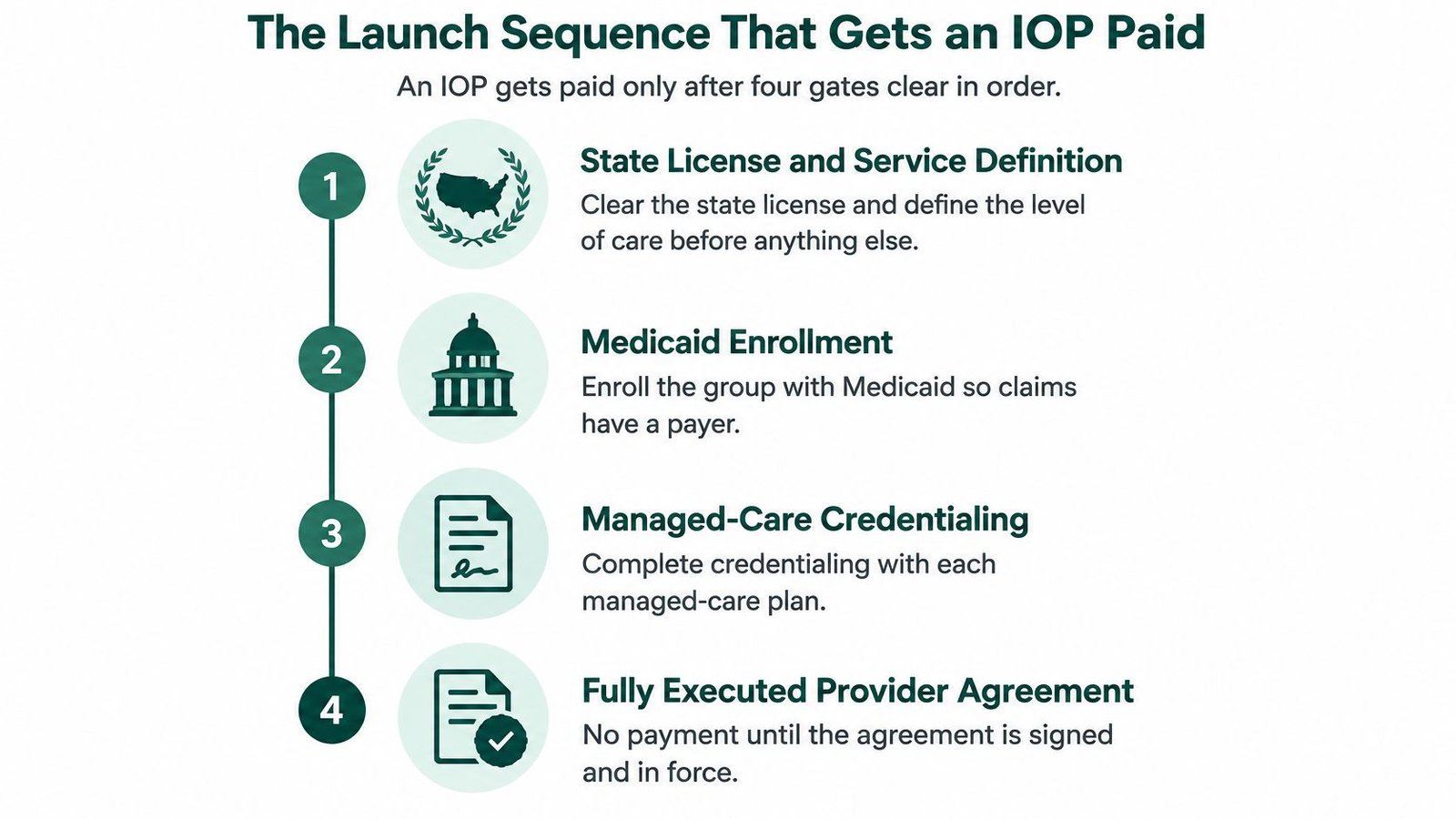
Do not open the schedule on a credentialing letter. In-network status starts when the provider agreement is fully executed.
Happy Billing's credentialing work runs in four steps: a free credentialing audit, application prep, payer follow-up, and ongoing maintenance. That sequence carries an IOP and PHP program launch from initial enrollment through re-credentialing and keeps the payer contracts current.
Write the group portion of the service description at the level of detail you will deliver. Published descriptions of group therapy for anxiety formats show how a clinical group hour is commonly organized, so the narrative in the application matches a real group rather than a one-line label.
US practices only.
Confirm the State Benefit Definition Before You Forecast Revenue
Pull your state's Medicaid IOP benefit description and any stand-alone program policy before you build a single week of revenue forecast. The definition decides the minimum service hours, the staffing mix, the group-size limit, and whether the program pays per day, per hour or per unit. Get that wrong and your forecast describes a program the payer doesn't buy.
North Carolina shows how much a state can specify. Its Medicaid program published a stand-alone substance-use intensive outpatient policy effective January 1, 2026, defining adult services at 9 to 19 skilled hours weekly and adolescent services at 6 to 19 hours, and requiring Medicaid participation, a signed provider agreement and delivery in a properly licensed facility (NC DHHS Medicaid coverage policy update). Two programs with the same clinical model can bill differently in the same state if one serves adults and the other serves adolescents. Read the age split before you design the schedule.
New Mexico shows how a threshold turns into a denial. The state pays IOP at a daily rate of $269.80, but eligibility for that day requires at least three hours of service (New Mexico HCA IOP rate guidance). A program that schedules two and a half hours, or that documents attendance without capturing the time threshold, doesn't see a minor coding variance. It sees a zero.
Run the arithmetic on that threshold. At 20 billable days a month, that daily rate is $5,396 in potential gross Medicaid revenue per patient before any adjustment, which makes schedule design and attendance documentation revenue controls rather than clinical preferences. A calendar built at 2.9 hours loses everything the rate sheet promised.
Policy text can also decide participation itself. Mississippi's Medicaid intensive-outpatient procurement materials require policies on nondiscrimination by ability to pay, race, sex, age, creed, national origin or disability, plus a sliding-fee scale, and they set a Level 2.1 group-therapy rate of $28.81 per one-hour session (Mississippi DMH intensive outpatient RFA). A rate that low has to be tested against clinician wages, required staffing, documentation time and expected attendance before you accept the contract. Some contracts should be declined.
Owners who forecast from a generic hourly assumption often build a revenue plan the payer rules do not support. Build the forecast from the state definition instead: extract the required hours, the unit type and the rate, price your staffing against that number, and get every unclear hours or unit rule confirmed in writing before the schedule is built.
Policies and Procedures to Write Before You Apply
State and payer reviewers read your written policies before they read your clinician files. Write the policy set first, then file, because a thin manual produces a stalled application and a payer file that never gets to a reviewer's desk.
Start by defining the level of care precisely: IOP versus partial hospitalization versus ordinary outpatient treatment. Then map each covered service to the state benefit definition, the eligible rendering discipline, units, place of service, group-size rules and prior-authorization requirements. Medicaid's behavioral-health network adequacy guidance frames this as converting the clinical model into a payer-auditable policy system, and it lists the policies a program needs before opening: admission criteria, medical-necessity assessment, individualized treatment planning, attendance and daily encounter documentation, medication management, crisis and suicide-risk response, incident reporting, care coordination, discharge and relapse-prevention planning, telehealth, privacy, accessibility, nondiscrimination, records retention and clinical supervision (CMS behavioral health provider network adequacy toolkit).
The privacy layer most IOP owners underbuild
Substance-use services can fall under 42 CFR Part 2 in addition to HIPAA, which creates a separate operational checkpoint for consent, revocation, permitted disclosures, emergency disclosures, legal requests and patient record access (42 CFR Part 2). Build those policies before the first admission, because the distinction shows up in releases of information, payer audits, hospital coordination and how your EHR is configured. Retrofitting Part 2 consent into a live workflow means re-papering charts you already billed.

Keep plan-specific addenda rather than one universal procedure. Medicaid guidance warns that managed-care organizations apply different credentialing, billing and prior-authorization rules, so a single SOP will be wrong for at least one plan in your market. Version-control each policy, train staff on it, and record the training date.
Practical rule: audit at least 10 synthetic or de-identified charts against every required field before go-live, then reconcile your first 30 claims by code, modifier, units, authorization and clinician roster.
New Jersey's guidance identifies 30 days for substance-use partial-care and IOP initial authorizations, a useful starting benchmark for your first concurrent-review calendar. Where your state sets a different window, that window governs.
Medicaid Fee-for-Service Versus Managed Care Contracts
CMS reported that approximately 87 million people were enrolled in Medicaid in 2024, and more than 73 million, or 84.8%, received some or all of their care through managed-care arrangements (CMS 2024 Medicaid managed care enrollment report). That single ratio should reset how you plan the contracting calendar. A state Medicaid provider number gets you into the program. It does not get you to most of the members.
The same report shows total Medicaid managed-care enrollment falling 13.4% from 2023 to 2024, with MCO enrollment down 11.1%, from 76.4 million to 67.9 million, after the end of the continuous-enrollment condition on March 31, 2023. Read that as a warning about maintenance, not just about the initial application. Membership shifts, plan footprints change, and rosters need updating long after your first contract is signed.
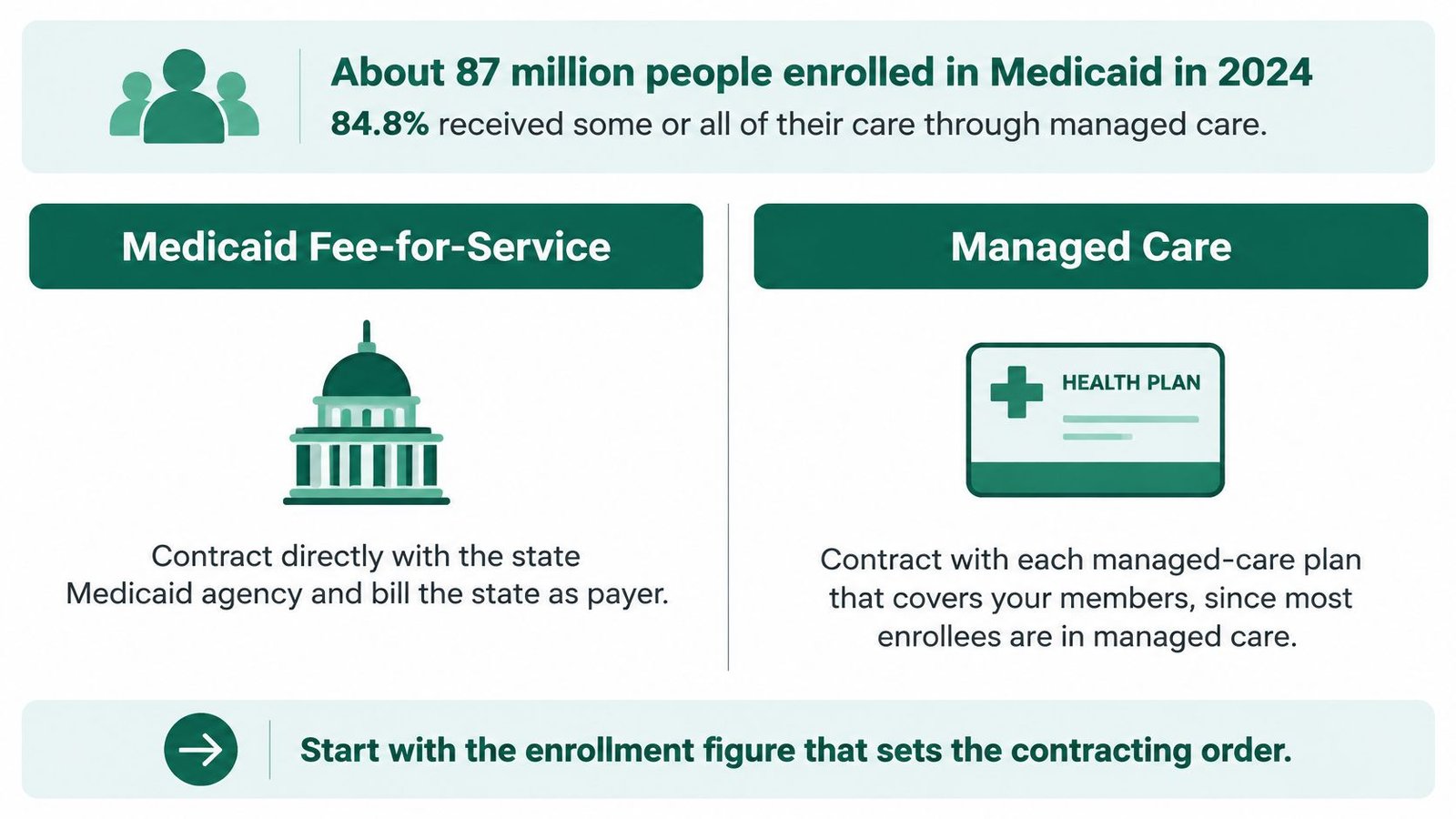
| Factor | Fee-for-service Medicaid | Managed-care plan contract |
|---|---|---|
| Who you enroll with | State Medicaid agency | Each managed-care organization or behavioral-health plan in your service area |
| What you submit | Organization and clinician enrollment | Credentialing file and signed provider agreement |
| Members it reaches | Fee-for-service members | Most Medicaid members; 84.8% received some or all care through managed care in 2024 |
| Claims and authorization | State rules | Plan-specific claim address, authorization and concurrent-review rules |
| Ongoing upkeep | Revalidation generally at least every five years | Recredentialing on plan schedule and roster updates |
Rank plans by member count, not by logo
Map each target state's Medicaid structure and identify which plans administer behavioral-health benefits, because the largest general plan in your market may carve behavioral health to a different entity. CMS publishes plan-level and state-level enrollment data, so you can rank contracts by real member volume instead of reputation. Then get written confirmation from each plan of covered IOP services, authorization rules, rates, timely-filing limits, documentation standards and claims submission pathways.
In our experience, owners who call only the biggest plan first spend weeks chasing an organization that never administers the benefit they sell. Families navigating coverage often hit the same confusion, and Children Psych's Medi-Cal coverage resources are a useful picture of how members experience the plan maze you're trying to enter. For the operational side of behavioral-health claims once contracts are live, our guide to medical billing for mental health practices covers where these claims usually break.
Enrolling the Group, Clinicians and NPI Setup
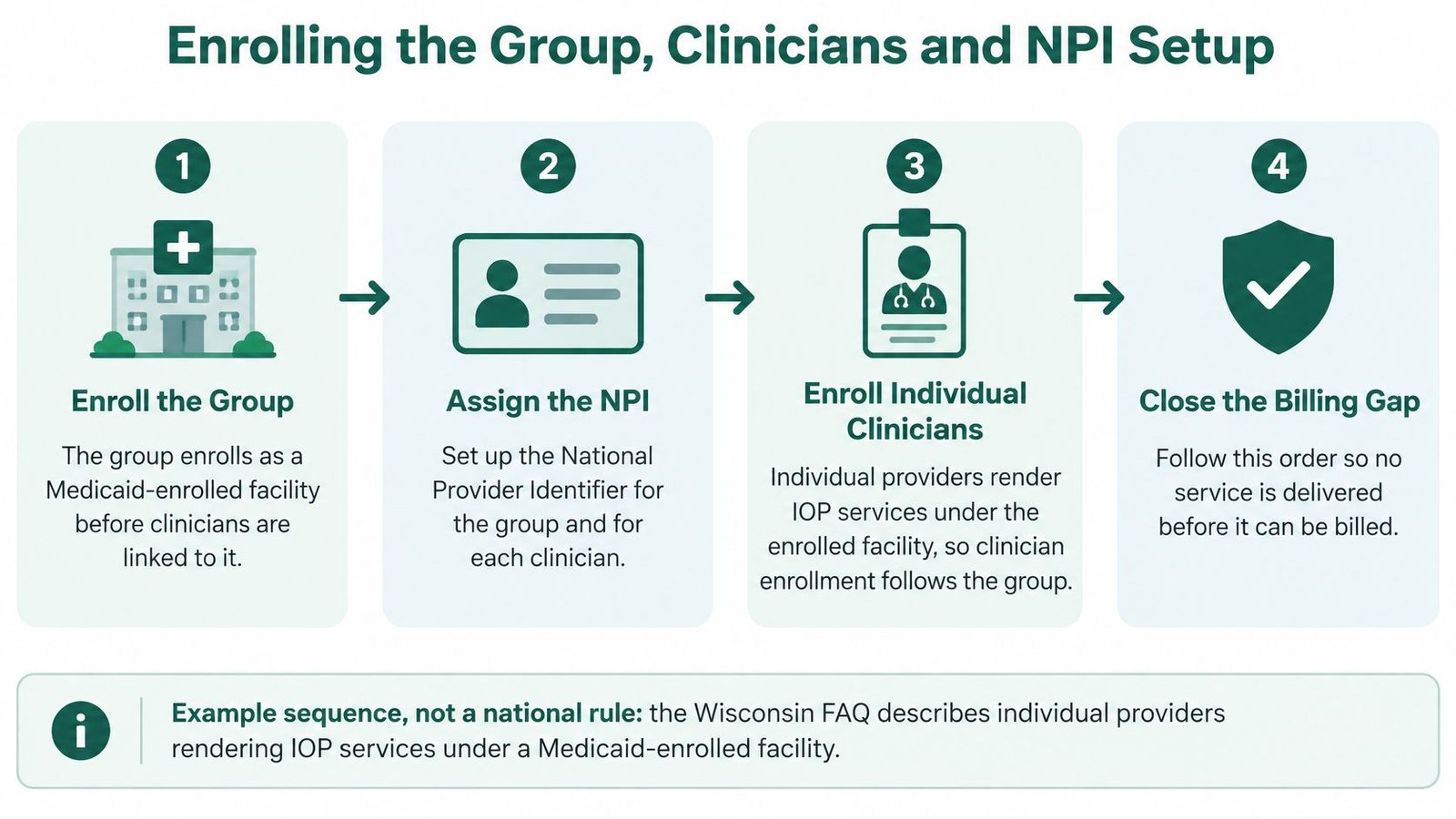
The enrollment order is where new programs lose the most money, because a fully licensed clinician can produce zero payable claims if the facility record, the location record or the group affiliation is incomplete. Wisconsin's Medicaid IOP FAQ shows the dependency clearly: individual providers render IOP services under a Medicaid-enrolled provider facility, and that facility must either hold DHS 75.51 certification or be a federally qualified health center (ForwardHealth IOP FAQ). The same source reports that ForwardHealth usually notifies applicants within 10 business days, and no later than 60 days, after receiving a completed application.
Treat Wisconsin as an example of the sequence to test in every state, not as a national rule. Then work the setup in this order.
- Confirm the facility license or certification and every service location. The license is the gate the payer file depends on, and a location the state hasn't approved cannot be billed.
- Confirm the group NPI and the taxonomy that matches the IOP service you bill. A taxonomy that describes outpatient therapy instead of a program-level service invites denials you'll spend months appealing.
- Enroll the organization with the state Medicaid agency. This is the record the plan's claims will pay to, so it has to exist before clinician files are meaningful.
- Enroll each rendering clinician and link each one to the group. Unlinked clinicians get paid as individuals or not at all, and neither outcome matches your contract.
- Enroll every additional location as its own record. An agency operating multiple facilities generally needs to address enrollment for each location, and skipping it creates unbillable days at the new site.
- Submit commercial individual and group applications and follow each one until approved. We submit individual and group enrollment applications with commercial payers and follow up until each is approved, because an application that sits untouched for six weeks looks identical to one that was never filed.
- Put every recredentialing date on a calendar. Revalidation generally runs at least every five years for Medicaid, while plan recredentialing follows each plan's schedule.
Scheduling Medicaid patients before the facility is active produces uncompensated care, retroactive-enrollment disputes and denial volume you will be cleaning up for a year. Budget several weeks, sometimes longer, for enrollment and credentialing. Our provider credentialing work runs initial enrollment through re-credentialing and keeps payer contracts current, and the four steps are a free credentialing audit, application prep, payer follow-up and ongoing maintenance. If you want the full sequence and what to hand off, read our breakdown of provider credentialing and payer enrollment timelines and our medical credentialing services.
Benefits Verification and Prior Authorization Before Day One
A scheduled IOP day becomes a paid day only when eligibility is verified and the authorization is on file with the right dates and units. This is the part of the launch that owners most often hand to whoever answers the phone, and it's the part that generates the denials.
Verify eligibility for each plan before the first visit, then capture the payer's initial request, the clinical assessment behind it, the requested frequency and duration, the concurrent-review dates, the authorization number, and the escalation or appeal deadlines. A missing authorization or an unsupported unit is one of the most frequent denial triggers, and attendance records that don't match approved days create the same result.
The fields that decide whether a day gets paid
Run every plan through one matrix and assign a named owner per plan. The matrix is what keeps a live program from billing against an authorization that expired two weeks ago.
| Matrix field | What it protects | Denial or gap if missing |
|---|---|---|
| State enrollment ID | Proof of Medicaid participation | Claims cannot be paid to the facility |
| NPI and taxonomy | Identifiers that match on every claim | Mismatched group and rendering IDs deny claims |
| Effective date | First date you may bill the plan | Billing before the effective date |
| Authorization rules and review dates | Approved days and units | Unsupported units or a lapsed authorization |
| Clinician roster and recredentialing deadline | Active providers on each plan | A lapsed clinician billed under the plan |
Build the review calendar around the authorization period your state uses, not a generic 90-day assumption. If the state sets an initial window, the first concurrent-review date belongs inside it, with the request submitted early enough to survive a slow plan response.
The control that prevents most of this: one owner per plan, a monthly matrix review, and a flag on every authorization 10 days before its review date.
When denials are already stacking up, start with the authorization record rather than the claim. Our medical billing denial management workflow begins there for exactly this reason. If your team is still learning how plans sequence these requests, this explanation of how prior authorization works in healthcare covers the request, review and appeal stages.
Decide Who Owns Credentialing and Billing Before Launch
Credentialing and billing are two functions with one revenue outcome. Splitting them across two vendors who never speak is how a program ends up sending clean claims to a plan that has no effective date for the group. Decide before launch who owns the matrix, who owns the claims, and who answers when a denial traces back to an enrollment gap.
Keep the work in-house when one staff member already tracks each plan's effective dates, authorization rules and recredentialing calendar, and when denials are not clustering around a single payer. Bring in a partner when nobody owns the matrix, when enrollment applications have sat untouched for a month, or when denials concentrate on one plan in a pattern your biller cannot explain. Any one of those three is reason enough on its own. Waiting for all three means months of delivered visits that never convert to payment.
The middle path is common and it works. Credentialing is separate from billing, so your current biller can keep the parts it handles well while credentialing and payer enrollment move elsewhere. A partner can run billing end to end or work alongside the biller already in place. The division of labor matters less than one rule: whoever owns enrollment must report effective dates in writing to whoever owns the claims, because a claim submitted before the effective date is a denial you created yourself.
Happy Billing is a medical billing company headquartered in Houston, Texas. We handle provider credentialing and payer enrollment through re-credentialing, coding, claims submission and billing, and denial management and A/R follow-up. We do not issue the state license; the state agency does. Behavioral-health program workflows sit on our behavioral health billing specialty page, and if you are weighing an in-house hire against an outside team, our analysis of what outsourced medical billing costs lays out the trade-offs. For the full-cycle view of authorizations, per-diem claims and denial patterns in these programs, see our guide to mental health revenue cycle management.
Book a free 30-minute call
US practices only.
Questions Owners Ask Before Opening an IOP
Can we hire clinicians before their plan effective dates?
Yes, onboard them internally and train them on your documentation standards. Do not schedule them to bill a plan until that plan's effective date is confirmed in writing. Model the idle weeks as a real cost in your opening budget rather than assuming retroactive enrollment will rescue the claims, because in many states it will not.
What should opening-month cash flow actually cover?
Three things at once: the lag between your first visit and the first payer payment, the enrollment wait before any claim can go out, and full clinical salaries during both. Size the reserve against your payer mix, and assume the slowest plan sets your first meaningful deposit date. The fast plans do not matter here. The slow one does.
Should we open a second location before the first one is billing?
No. Each location is its own enrollment record with its own facility approval and its own payer files, so a second site adds a full gate before it adds a dollar. Get the first location paying, with effective dates documented for every plan, before you file for the second.
What happens when a state rule changes after we apply?
Assign one person to read state Medicaid notices and plan bulletins, version-control every policy, and recheck the benefit definition at each contract renewal. Programs that also serve court-referred or mandated clients should build attendance and progress documentation that supports meeting court-ordered treatment requirements, since those clients often make up a meaningful share of IOP census and their records carry extra reporting obligations.
Which numbers should we watch in year one?
Denial rate by plan, A/R days by payer, authorizations approaching their review date, and recredentialing deadlines. A denial rate that spikes on one plan usually points to a matrix error, an authorization gap or a roster problem, not to a coding problem. Review these monthly at minimum, weekly in the first quarter, because small enrollment mistakes compound into months of unpaid per-diem claims if nobody catches the pattern early.
Happy Billing works with practice owners opening IOP and PHP programs: Medicaid and commercial payer enrollment, clinician credentialing and re-credentialing, and the per-diem billing, denial management and A/R follow-up that turn authorized days into collected revenue. We can take the whole revenue cycle or plug into the parts your team doesn't want to own, and credentialing is separate from billing, so your current biller can stay for the parts it wants to keep. Visit Happy Billing to start the conversation, or book a free 30-minute call with a billing specialist to walk through your state's gates before you set an opening date.
Where this fits