Medical Billing Services in New Jersey for Out-of-Network Specialty Practices
NJ practices have the best out-of-network position because Horizon's 14-month timely filing window, DOBI complaint authority, and the density of Fair Health benchmark data in metro markets all stack in the provider's favor. If your PT, chiropractic, OT, acupuncture, or sports medicine group is still leaking money to repricing tools, the problem isn't demand, it's bad billing execution.
Quick answer: NJ practices have the best OON position in the country because of Horizon's 14-month TFL, NJ DOBI complaint authority, and Fair Health data density in the Metro region.
That value only turns into cash when your billing is built to preserve it. In our experience, out-of-network specialty practices in New Jersey don't lose revenue because the state is weak, they lose revenue because claims are filed late, appeals are sloppy, CPTs are under-argued, and teams let A/R days drift while commercial payers reprice the file. If you want tighter denial control and faster cash conversion, start with a focused review through our medical billing services in New Jersey page and compare it against your current workflow.
Quick Answer and Why This Guide Matters for NJ Practice Owners
For an out-of-network specialty practice in New Jersey, the answer is direct. Treat NJ as an active reimbursement state, not a passive billing state. Emergency, urgent, and inadvertent out-of-network services sit inside a state dispute framework that gives owners real payment pressure if the billing team works fast and documents well. New Jersey's rules restrict balance billing in covered emergency and urgent cases, and for inadvertent out-of-network services above the patient's in-network cost-sharing amount. They apply to fully insured plans, State Health Benefit plans, and some self-funded plans that opt in, with a formal dispute path that moves payment fights away from the patient and toward the carrier. New Jersey DOBI consumer out-of-network guidance
For an owner, every underpaid claim is cash sitting on the table. A sloppy appeal on 97140, 97112, 97530, or the acupuncture codes 97810, 97811, 97813, and 97814 can turn collectible revenue into permanent leakage. The same loss shows up when your team misses timely filing, accepts repricing without a rebuttal, or fails to press a repeat underpayment through the DOBI complaint process.
Practical rule: in New Jersey, weak billing hands commercial payers control of your specialty revenue.
We see too many NJ owners hand out-of-network work to a generic medical billing company as if it were routine in-network billing. That is a costly mistake. If you want the state's rules to show up in cash, your process has to treat disclosure, coding, appeal timing, and payer pressure as one financial workflow, not four separate chores. If you want a tighter version of that workflow, start with our medical billing services in New Jersey page and compare it against what your team is doing now.
How New Jersey Gives OON Specialty Practices Unmatched Leverage
New Jersey gives out-of-network specialty groups a real payment edge because the state regulates the dispute process, not just the bill. DOBI's arbitration materials and specialist-network data show that New Jersey treats specialist participation as a policy issue, while many states leave out-of-network payment fights to carrier math and contract pressure. That difference matters. A practice that understands the rules can push back when repricing tools drag the allowed amount below a defensible benchmark. DOBI arbitration and specialist-network data
What the payment rules mean in practice
For out-of-network emergency, urgent, and inadvertent services, the carrier must make an initial payment or offer within 20 days of receiving the claim. The provider then has 30 days to reject that offer, the carrier has 7 days to issue its final offer, and either side then has 30 days to request arbitration. That sequence is cash-flow control, and generic billers often run it too casually. NJ OON billing timeline
The threshold rules also matter. Earlier guidance discussed a $1,000 minimum difference between final offers, and later statutory language adds that the gap must be at least $1,000 for claims with billed amounts of $2,500 or more, while claims under $2,500 also reference a $500 threshold for binding arbitration. NJ arbitration threshold statute
Why this is a moat, not a nuisance
The DOBI complaint path is a moat because few billing companies use it well. They file claims, send standard appeals, and stop there. That leaves money on the table. A specialty practice that documents the underpayment pattern, compares it to Fair Health benchmarks, and uses DOBI pressure in a disciplined way can often force the payer to treat the file seriously instead of burying it in repricing logic. My team uses a structured approach like the one in this Data iSight underpayment appeal guide when the carrier's first offer is obviously off.
Use DOBI when the pattern is systemic, not when a single claim is off by a small amount.
New Jersey is different from a lot of other states. The dispute is not just between your front desk and a claims rep, it sits inside a layered state and federal framework after the No Surprises Act took effect on January 1, 2022 for self-funded surprise-bill claims not covered by New Jersey's own law. NJ DOBI out-of-network framework
The NJ Repricing Gauntlet Every OON Practice Faces
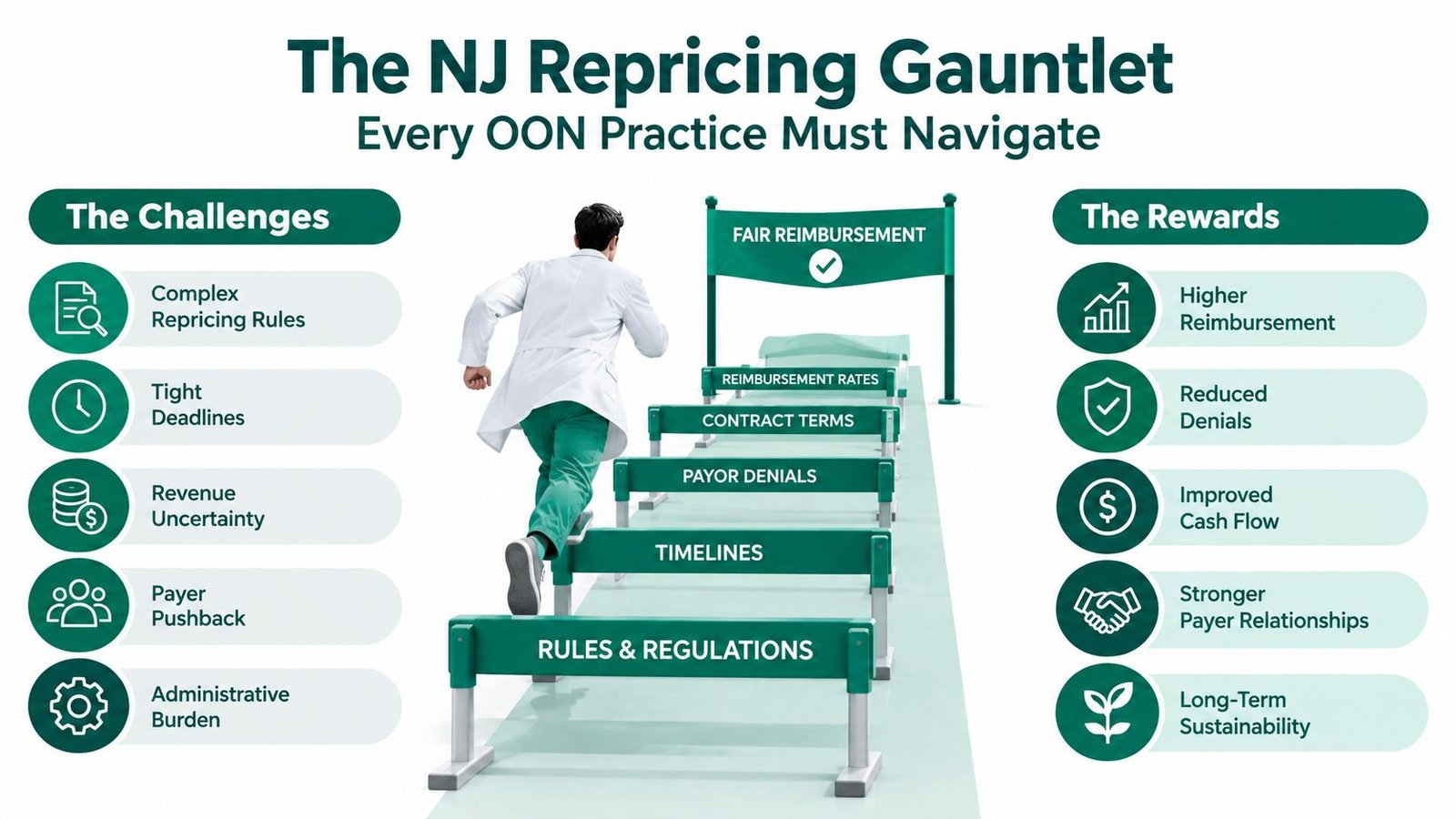
Commercial repricing is the main reason out-of-network specialty practices in New Jersey feel like they are doing more work for less money. Data iSight, Zelis, and MultiPlan can all cut the allowed amount, then expect the practice to absorb the haircut unless someone pushes back with documentation and state advocacy. Horizon BCBS commercial plans and Cigna deserve close review because repricing can hide behind ordinary-looking remits. New Jersey is the strongest out-of-network pressure point in the country because Horizon's long TFL window, DOBI complaint authority, and deep Fair Health density give specialty practices real room to fight back, while generic billers leave that money sitting on the table.
Where generic appeals usually fail
Most appeals fail because the biller argues emotion, not payment logic. A proper rebuttal ties the charge to the episode, the documentation, and the benchmark comparison, then forces the payer to justify why it repriced a clearly documented specialty service. If your team cannot show that the file was built for an out-of-network dispute, the payer treats it like a generic claim.
That is why the billing partner has to understand the repricing stack, not just the claim format. A generic appeal letter will not move the needle if the payer is using a tool like Zelis or MultiPlan to push the allowed amount down before anyone reviews the file. Repricing is a revenue problem, not a paperwork problem. Best out-of-network medical bill repricing tools
What owners should look for on the remit
You do not need a hundred data points. You need a pattern.
- If the allowed amount keeps landing low on the same payer, the issue is probably repricing, not random adjudication.
- If Horizon claims reprice while the documentation is clean, your team should compare the remit to your specialty benchmark file, not resubmit blindly.
- If Cigna claims with MultiPlan involvement keep coming back short, the appeal has to be built like a reimbursement dispute, not a coding correction.
The payer's first offer is rarely the economic truth. It is the opening move.
When practices ignore that reality, they normalize underpayment. When they fight it with clean documentation, benchmark support, and escalation discipline, they protect revenue that generic billing teams routinely miss.
CPT Codes and Fair Health Benchmarks That Drive NJ OON Revenue
High-risk CPTs are where New Jersey out-of-network practices either recover real money or give it away one visit at a time. For PT, chiropractic, and OT, the codes that matter most in the out-of-network fight are 97140, 97112, and 97530. For acupuncture, the revenue pressure sits on 97810, 97811, 97813, and 97814. When these are underpaid, the loss compounds across every plan line and every recurring visit.
Clean-claim modifier work matters because modifier errors can turn a payable claim into a discount, a delay, or a denial. That's especially true when the payer is already looking for a reason to reprice the file. I've seen enough specialty claims to say this plainly, if the modifier story is weak, the payer will use it against you.
Use local benchmark thinking, not national averages
Fair Health data is useful because it gives you a local negotiation anchor. In New Jersey, that matters most in major zip codes like Paramus 07652, Newark 07102, Jersey City 07302, and Cherry Hill 08002. Those metro and suburban markets don't behave the same way, and your underpayment strategy shouldn't either.
The correct play is to anchor disputes to the relevant local benchmark, then compare the payer's repriced amount to the service mix on the claim. That is far more persuasive than saying the payment feels low.
| CPT Code | Specialty Use | NJ Underpayment Risk |
|---|---|---|
| 97140 | PT, chiropractic, OT | Often squeezed when manual therapy is bundled or repriced |
| 97112 | PT, chiropractic, OT | Frequently challenged when documentation looks generic |
| 97530 | PT, chiropractic, OT | At risk when therapeutic activity is treated like a lesser service |
| 97810 | Acupuncture | Commonly underpaid when initial visit structure is ignored |
| 97811 | Acupuncture | Vulnerable to unit-level discounting |
| 97813 | Acupuncture | Often under-reimbursed in commercial OON claims |
| 97814 | Acupuncture | High risk when extended treatment documentation is weak |
What owners should demand from billing
If your biller can't show why a claim was underpaid against a relevant zip-code benchmark, they're not doing out-of-network work, they're just posting remits. For specialties that bill these codes repeatedly, that distinction is the difference between a healthy collection rate and a slow bleed.
Specialized OON Billing Service vs Generic Medical Billing in New Jersey
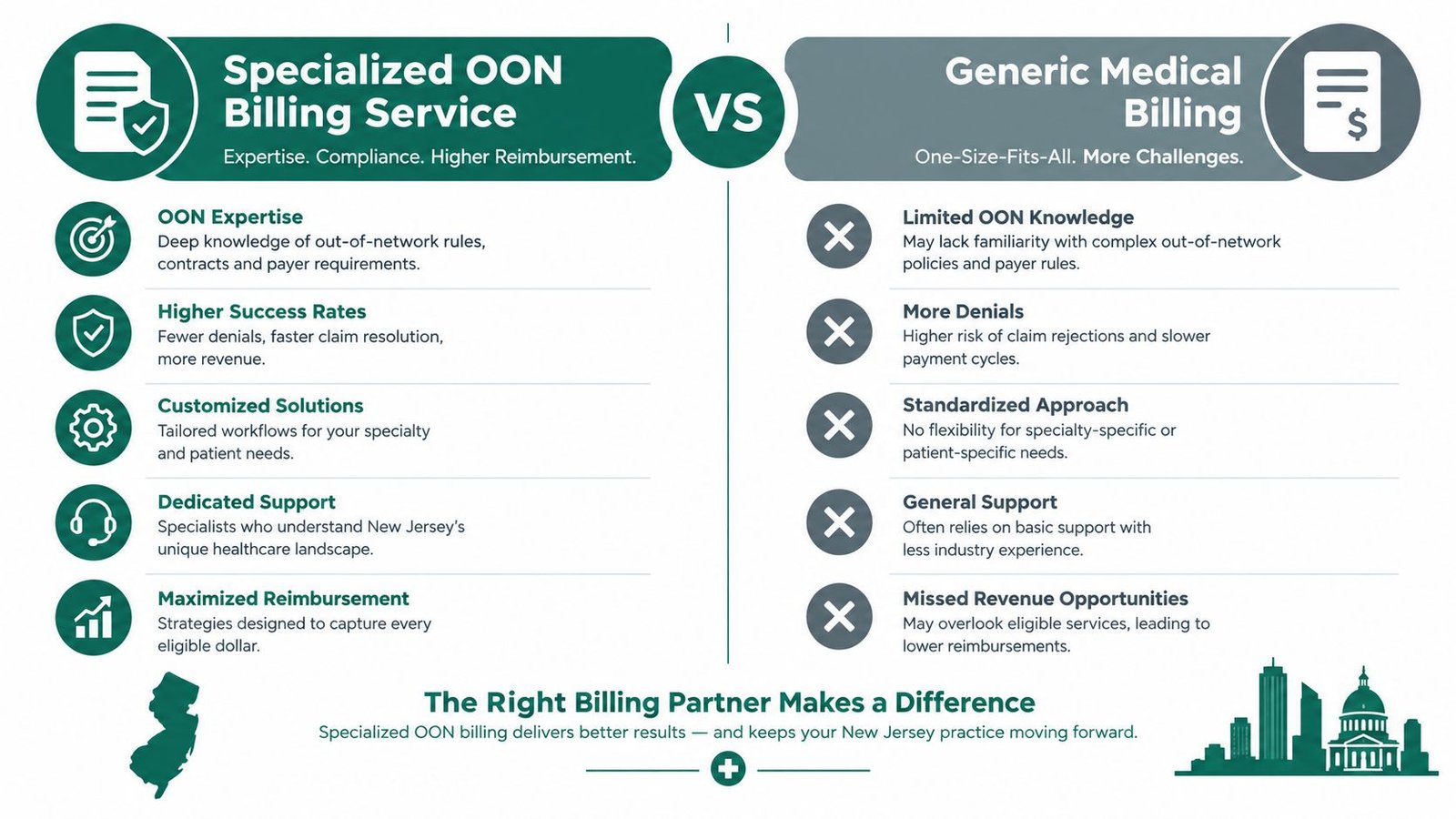
A specialized out-of-network billing service is built to win reimbursement disputes. A generic medical billing company is usually built to push claims through a standard workflow and hope the payer pays fairly. In New Jersey, that difference is huge because the state rewards precision and punishes lazy filing.
What the specialist does that the generalist won't
A specialized OON team tracks repricing vendors, builds appeal logic around episode-level reimbursement, watches DOBI deadlines, and knows how to frame a file for arbitration. A generic biller usually knows the claim form and the clearinghouse. That's not enough in New Jersey.
If you want one concrete example of the difference, think about the difference between a payer saying a claim is “processed” and a payer paying fairly. One is administrative closure. The other is revenue.
For owners comparing vendors, I'd use a simple scorecard.
| Capability | Specialized OON Service | Generic MBS |
|---|---|---|
| Repricing defense | Built in | Usually weak or missing |
| DOBI complaint filing | Active tool | Often ignored |
| Fair Health analytics | Used in appeals | Rarely used well |
| Appeal cadence | Tight and tracked | Often inconsistent |
| Specialty coding depth | High | Variable |
| Denial prevention | Proactive | Mostly reactive |
Where Happy Billing fits, and where other resources help
Happy Billing is one option if you want OON billing handled inside your existing EHR with claim auditing, denial work, and appeal follow-through. For owners still evaluating broader positioning, browse Leaping Lemur Media for a different view of service packaging and vendor presentation.
If your current vendor can't explain how they protect revenue on disputed OON claims, they're probably underperforming in New Jersey. The state is too favorable to leave that money uncollected.
Inside a High Performance OON Workflow and Tech Stack
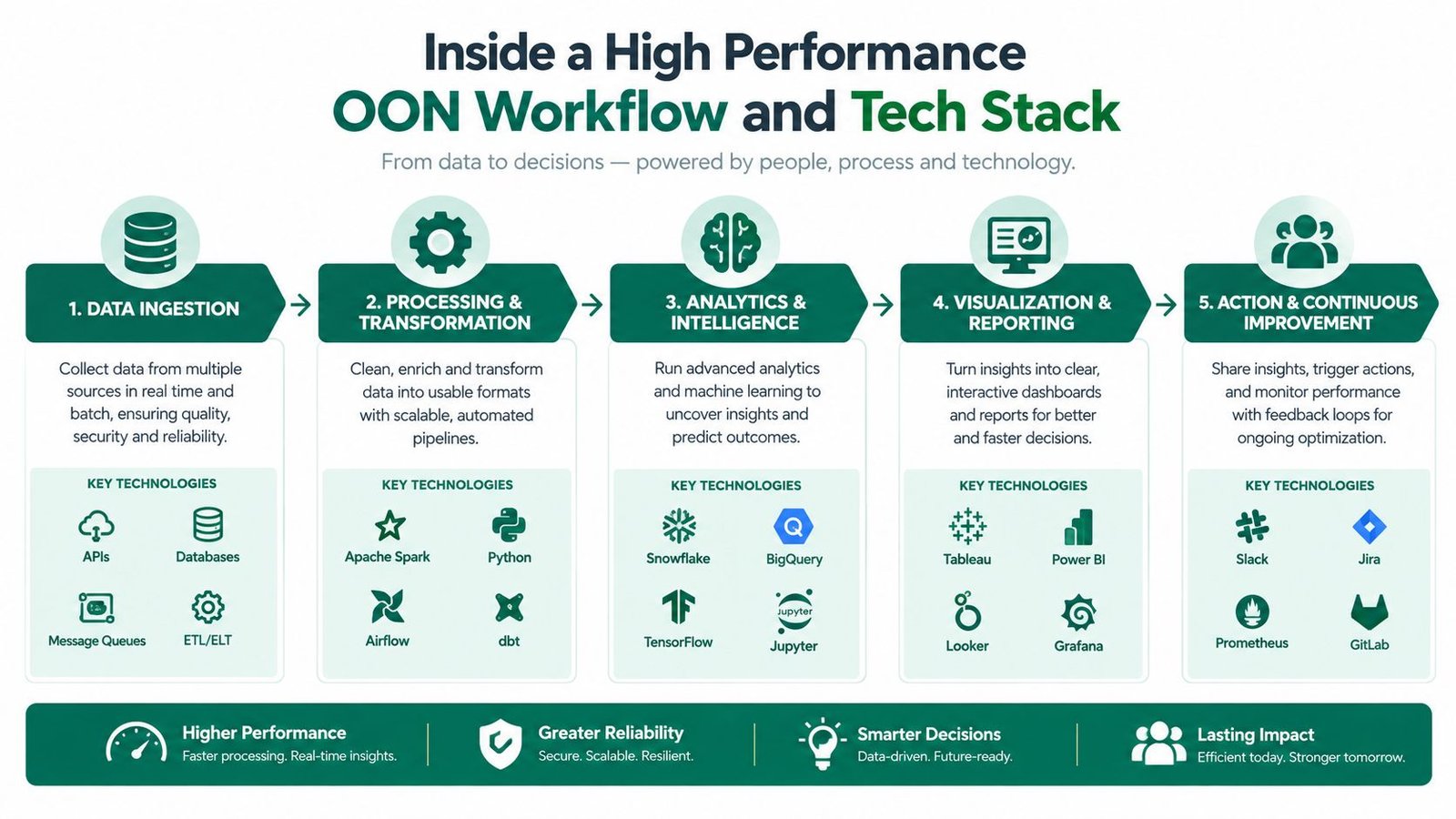
A high-performing out-of-network workflow starts before the claim ever leaves the practice. Eligibility verification, benefit review, and timely documentation have to happen up front, then the claim needs pre-submission scrubbing so the payer can't hide behind basic errors. In Horizon cases, that timing matters even more because the filing window is long enough to lull teams into complacency, then short enough to punish them if follow-up slips.
The workflow that protects cash
In practice, the file should move through five clear stages.
- Intake and verification. Confirm coverage status and service type before the visit.
- Clean claim build. Scrub modifiers, code sequencing, and episode support before transmission.
- Repricing rebuttal. Compare the remit to local benchmark logic and specialty documentation.
- DOBI escalation. Use the complaint pathway when the payer ignores the economics.
- Arbitration prep. Package the episode cleanly when the dispute has to move forward.
That is the rhythm. Anything else is drift.
What the tech stack should look like
The billing partner should work inside your existing EHR, not force a migration. That keeps your staff from relearning workflows and keeps claim history intact. Security should be HIPAA-first, with strong encryption and controlled access, because specialty billing involves enough PHI risk already.
We also expect around-the-clock follow-up because claims don't wait for business hours. A follow-the-sun model matters when a payer portal opens, closes, or changes status while your office is closed. For PT, chiro, OT, and acupuncture practices, that kind of responsiveness keeps multi-visit claims from aging into avoidable write-offs.
Pricing Models Contract Terms and Red Flags to Watch
The wrong contract can erase the upside of strong out-of-network billing. Percentage-of-collections pricing is common because it aligns incentives, but it needs to be paired with clear language on repriced claims, arbitration work, and what counts as recoverable collections. Flat-fee pricing can work, but only if the vendor is still motivated to fight on underpaid OON files.
The terms that matter
Pay attention to the language around denial ownership. If the contract says the vendor handles billing but leaves appeals vaguely defined, you're paying for transaction processing, not revenue recovery. You also want termination language that lets you exit without being trapped in a long lock-in if the vendor misses timely filing or lets claims age.
- Carve-outs for disputed claims should be explicit, or the vendor may avoid hard cases.
- Arbitration fees need to be addressed upfront, because those costs affect net recovery.
- DOBI capability should be written into the service scope, not treated as an optional add-on.
If a contract doesn't define who owns the dispute, it usually means the practice owns the loss.
I'd be skeptical of any proposal that sounds cheap but doesn't spell out specialty-specific appeal work. In New Jersey, the cheapest vendor is often the one that leaves the most money behind.
KPIs Outcomes and What to Expect From Outsourcing in NJ
You should measure an out-of-network billing partner by cash behavior, not promises. A serious partner should be working toward a 98%+ first-pass clean claim rate and days in A/R under 35, with denial management strong enough to stop underpayments from becoming write-offs. Those are the operating standards Happy Billing uses in its own model, and they're the right ones to hold any vendor to.
How to audit the current shop
Start with your last few months of specialty claims and ask three questions. How many claims were clean on first submission, how many underpayments were appealed, and how often did the team use local benchmarks or DOBI escalation instead of just resubmitting the file? If the answer is vague, your current RCM is probably leaking revenue.
CMS-style discipline and AAPC-level coding rigor matter here because clean claim behavior depends on the same fundamentals every time, accurate codes, correct modifiers, and documented support. The commercial side just adds more ways to fail.
What outcomes should feel different
You should see less guesswork from your staff and fewer “we're still waiting” answers from your biller. You should also see more underpaid claims converted into recoveries instead of abandoned appeals. If the vendor can't show you the difference between a standard denial and a repricing event, they're not managing OON revenue at the level New Jersey requires.
Patient Communication and Balance Billing Best Practices in New Jersey
Good patient communication protects revenue because it prevents confusion from turning into complaints, and complaints invite scrutiny. New Jersey requires disclosure before non-emergency procedures, and the state's balance-billing rules limit what you can collect directly from patients for emergency, urgent, and inadvertent out-of-network services. Your front desk has to say the right thing the first time.
For a practical privacy reference that sits alongside billing compliance, see keeping health data compliant. If your team handles financial discussions without respecting HIPAA and notice obligations, you create a second problem while trying to solve the first.
What staff should say and what they shouldn't
Your team should explain that the patient may owe in-network cost-sharing where the law applies, but that the practice will pursue the payer dispute through the proper channel. They should not threaten collections on a protected out-of-network balance or imply that the patient is personally responsible for a disputed emergency file. That can backfire fast.
Use a simple script structure.
- Confirm status early. Tell the patient whether the visit appears subject to out-of-network protections.
- Explain cost-sharing plainly. Say what the patient may owe without inventing estimates.
- Reference the dispute path. Let the patient know the practice handles payer disagreement through the formal process.
- Document the conversation. Keep the note tight, factual, and auditable.
Balance billing guidance for New Jersey practices is worth reviewing if your front office has ever improvised on this topic. Improvisation is expensive.
Frequently Asked Questions From NJ Specialty Practice Owners
Should I stay out of network in New Jersey or move in network?
If your specialty has strong commercial demand and you know how to use New Jersey's dispute framework, staying out of network can still make financial sense. The decision comes down to whether your billing team can defend underpayments, meet filing deadlines, and use DOBI when the payer stalls or underpays.
Does filing a DOBI complaint hurt my payer relationship?
It may irritate a payer rep, but that is the wrong metric. The question is whether the complaint helps recover money the payer should have paid already. If the pattern is systemic, I would use the complaint pathway.
What does Fair Health data actually change in negotiation?
It gives you a benchmark that is harder for the payer to dismiss than a subjective appeal. When the zip-code-level evidence matches your documentation, the discussion shifts from opinion to reimbursement logic.
When does outsourcing billing pay for itself?
When your internal team cannot keep claims clean, appeals timely, and repricing disputes organized, outsourcing usually pays back through recovered revenue and fewer write-offs. For out-of-network specialty practices in New Jersey, the actual test is whether the vendor can protect cash, not whether they can just post payments.
If you run a PT, chiropractic, OT, acupuncture, or sports medicine practice in New Jersey, stop letting generic billing leave money sitting in repricing files. Book a free audit, compare your current recovery with the New Jersey advantage you already have, then review specialty support options at Happy Billing specialties.