Medical Oncology Billing Services: What Your Practice

Medical oncology billing services are a revenue-integrity function, not a claims-submission task. Medical oncology-specific Medicare reimbursement fell by $541 million, or 10%, from 2010 to 2020, while chemotherapy reimbursement declined 40% and immunotherapy reimbursement rose 21%, according to a PubMed-indexed review of oncology reimbursement trends. If your team treats drug coding, authorization, modifiers, and infusion documentation as separate chores, your practice is probably losing cash in each handoff.
That loss appears as denials, underpaid drug claims, avoidable write-offs, and aging A/R. The right partner should show you exactly which CPT or HCPCS line failed, why the payer rejected it, how much remains recoverable, and which front-end control prevents the same error from returning.
Why Medical Oncology Billing Is a Different Kind of Revenue Problem
Medical oncology runs on a reimbursement structure that has long been shaped by buy and bill. The practice purchases infused drugs, stores them, administers them, and seeks reimbursement from the payer. A 2014 PubMed-indexed review describes this model as a central feature of U.S. oncology payment history.
That structure puts more than professional fees at risk. Your balance sheet carries drug acquisition costs, inventory timing, administration labor, and payer-specific reimbursement rules before the claim is paid. A denied J-code claim isn't merely delayed physician revenue. It can leave the practice carrying the cost of a high-value product while staff spend additional time correcting, appealing, and reposting the account.
The reimbursement environment has also shifted unevenly. The same analysis found that chemotherapy reimbursement decreased 40% between 2010 and 2020, while immunotherapy reimbursement increased 21%. That difference makes broad collection percentages a poor measure of performance. Owners need drug-level claim precision, accurate units, correct modifiers, and payer-specific follow-up.
Owner's rule: If your billing report shows only total collections, it isn't showing you where oncology cash is leaking.
Oncology billing differs from general specialty billing because one encounter can combine E/M services, drug administration, hydration, therapeutic infusions, discarded medication, and authorization requirements. Codes in the 96401 to 96549 range must align with documentation, sequencing, time, and payer edits. The claim also needs the correct drug code, units, place of service, and supporting clinical record.
| Metric | Oncology Practice | General Specialty Practice |
|---|---|---|
| Primary financial exposure | Professional fees plus infused drug acquisition and administration | Primarily professional and procedural fees |
| Common claim dependency | Authorization, drug code, units, infusion time, diagnosis, modifiers | Procedure coding, documentation, eligibility, and payer edits |
| Cash-leak pattern | Drug underpayment, denied administration, missing waste, authorization mismatch | Bundling, eligibility, coding, and documentation errors |
| Owner-level consequence | Margin compression and extended A/R on high-value claims | Delayed professional reimbursement and rework |
Claims and reimbursement variability reinforce the problem. In a multicenter analysis covering 3,428 hospitals, outpatient oncology charges were often far above Medicare payment levels. Medical oncology departments charged about 2.4 times Medicare payment, hematology/oncology 2.3 times, radiation oncology 3.6 times, radiology 3.7 times, and pathology 4.1 times, as reported in multicenter Medicare billing analysis coverage. The point for owners is simple: billed charges don't equal collectible reimbursement, so every claim needs disciplined payment validation.
The Real Scope of Medical Oncology Billing Services
A credible oncology billing partner owns the full path from treatment order to payment variance. If a vendor only scrubs claims and posts remittances, you still own the most expensive failures.
Coding must connect diagnosis, service, and drug
The coding team should sequence ICD-10 diagnoses according to the clinical record and connect them to the relevant CPT and HCPCS lines. That includes E/M services, drug administration codes in the 96401 to 96549 range, and the drug itself. The financial output is a stronger clean-claim process and fewer avoidable rejections caused by diagnosis pointers, invalid code combinations, or unsupported services.
Drug coding requires more than selecting a J-code. The reviewer should match the NDC to the HCPCS file, confirm the administered units, identify discarded amounts, and validate whether the claim falls under the medical or pharmacy benefit. Where applicable, the workflow must also account for 340B purchasing considerations.
Claims submission should preserve encounter context
The submission process needs the correct place of service, rendering and referring provider information, payer-specific attachments, authorization identifiers, and line-level documentation. A claim can contain clinically correct services and still fail if the submitted code, date, unit count, or site doesn't match the payer's approved record.
Denial management must change the upstream process
Appeals are only half the job. The partner should work denials promptly, tag the root cause, track overturns, and identify the originating workflow. A denial report that says “authorization” without separating expired authorization, wrong code, wrong site, and missing reference number isn't actionable.
Track net collection rate, days in A/R, denial overturn rate, and denial write-off levels together. These measures tell you whether the vendor is recovering cash or just moving accounts between work queues.
Infusion charge capture determines whether work becomes revenue
Infusion documentation should support start and stop times, the primary service, sequential or concurrent administration, hydration, and any separately reportable E/M service. The charge-capture process must also reconcile the medication administration record with the claim.
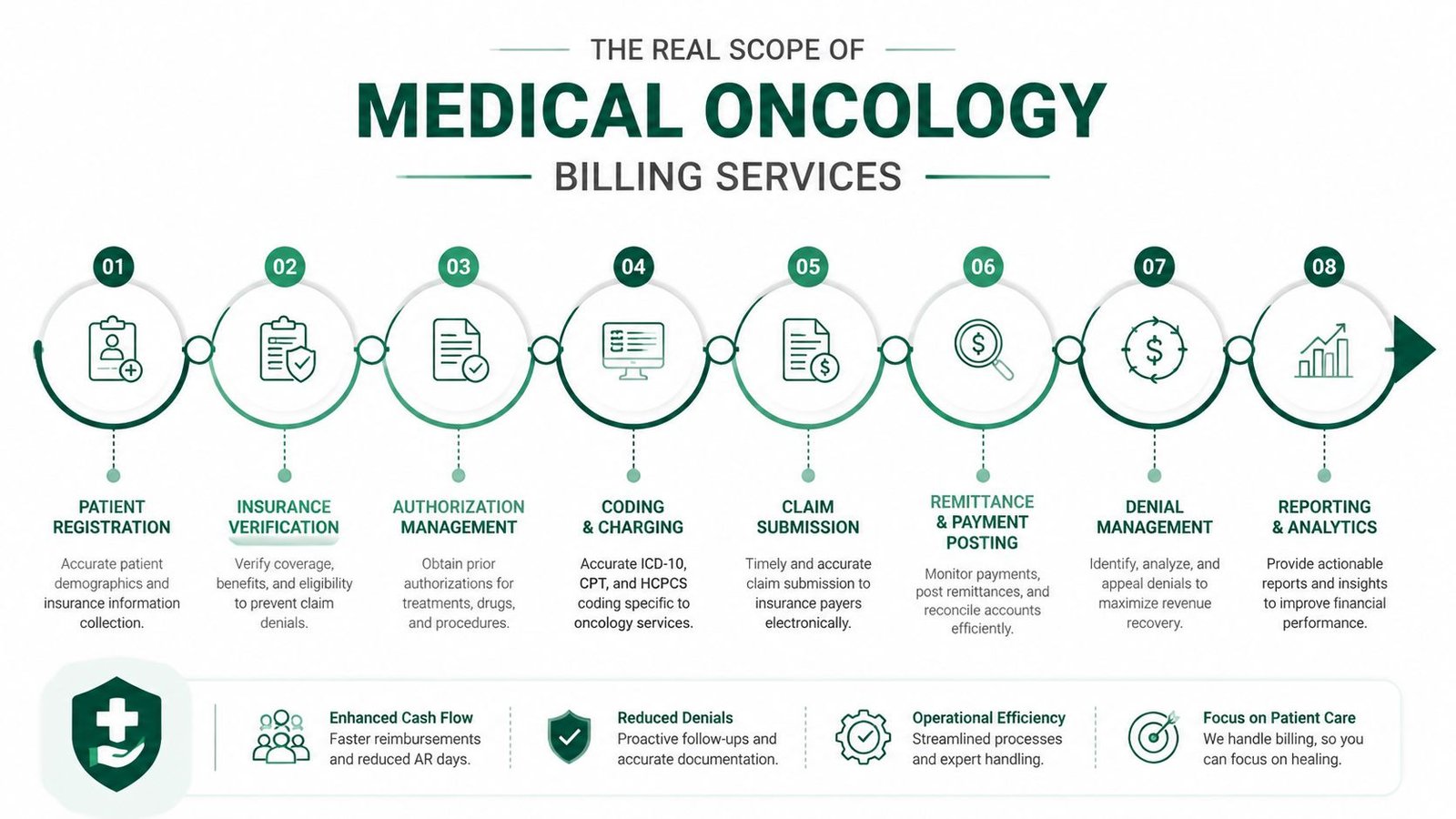
Technology should connect these stages rather than create another silo. Owners evaluating platforms should review practical guidance on how to boost ROI with unified tech by connecting registration, authorization, charge capture, claims, remittance data, and denial analytics.
Oncology-Specific Billing Challenges That Drain Cash
Oncology billing loses money when owners treat each claim line as an administrative detail. A single NDC-to-HCPCS mismatch can deny the drug, while an authorization mismatch can reject both the medication and its administration. The financial exposure begins before billing receives the account.
Infusion charge capture must connect the treatment plan, medication record, administration codes, and claim. If start and stop times are missing, the claim may not support the intended sequencing. Hydration, concurrent or sequential administration, and separately reportable E/M services also require the correct code structure and documentation.
Administration coding creates another direct payment risk. A hydration service billed in the wrong sequence, or a therapeutic infusion code submitted without defensible time records, can reduce payment for the entire encounter. The cost includes more than the denied line. Staff must investigate the chart, correct the charge, submit a replacement claim or appeal, and monitor the account through payment.
A 2025 cohort study of cancer-related next-generation sequencing claims among Medicare beneficiaries found that 23.3% of 29,919 claims were denied overall, with denials increasing from 16.8% before the National Coverage Determination period to 20.3% after implementation in 2018 and 27.4% after the 2020 amendment, according to the published Johns Hopkins cohort study report. The figures reinforce a practical requirement: documentation, authorization matching, and appeal preparation must operate as one revenue-integrity system.
| Denial Category | Typical Cause | Avg $ Per Claim | Annual Exposure (Mid-Size Practice) |
|---|---|---|---|
| Drug code mismatch | Incorrect NDC-to-HCPCS crosswalk or unit calculation | Must be measured from your remittance data | Depends on regimen mix and claim volume |
| Authorization mismatch | Wrong code, diagnosis, date, unit, provider, site, or expired approval | Depends on the denied service | Depends on recurrence and follow-up speed |
| Infusion administration | Missing start and stop times, sequencing, or hydration support | Depends on the administration lines | Depends on weekly infusion volume |
| E/M and modifier error | Missing or unsupported modifier 25, 59, or split/shared attribution | Depends on the E/M service | Depends on provider mix and visit frequency |
| Documentation gap | Missing infusion log, medical necessity evidence, or regimen support | Depends on the payer and service | Depends on audit and denial patterns |
Review medical billing denial management resources against your remittance codes and root causes. Do not accept a vendor's claim that it “handles denials” without evidence. Require the team to identify the failed charge-capture control, quantify the affected service, and show how the next claim will avoid the same error. Authorization data, modifier selection, and infusion documentation belong in that review together.
Prior Authorization as a Revenue Integrity Workflow
Prior authorization is the most controllable upstream revenue lever in oncology. Approval alone doesn't guarantee payment. The submitted CPT or HCPCS code, dates, units, provider, site of service, diagnosis, and authorization record must remain aligned.
A treatment plan approved for lung cancer in January can deny later if the diagnosis pointer, drug code, units, or authorization vendor changes. Recent payer updates emphasize exact code matching and, in some programs, movement to new authorization vendors or portals. The payer alert on oncology drug authorization transitions illustrates why practices must maintain synchronized regimen templates, authorization lists, and charge capture.
Use a controlled workflow:
- Capture the regimen at ordering. Record the diagnosis, drug, dose, units, administration code, site, provider, and planned dates.
- Map diagnosis to drug in the EHR. The authorization request should pull from the same clinical and charge data used for billing.
- Lock units and NDC information. Any variance between the approved treatment and administered amount needs review before submission.
- Attach the authorization ID at charge capture. Staff shouldn't rely on a separate spreadsheet or memory.
- Reconcile denials by authorization number weekly. Look for recurring mismatches, payer changes, expired approvals, and regimen modifications.
This matters especially for molecular testing. The NGS denial experience described in the earlier Medicare claims analysis demonstrates that coverage changes can alter denial exposure over time. The operational answer is a traceable authorization record connected to the order, clinical documentation, charge, claim, and appeal.
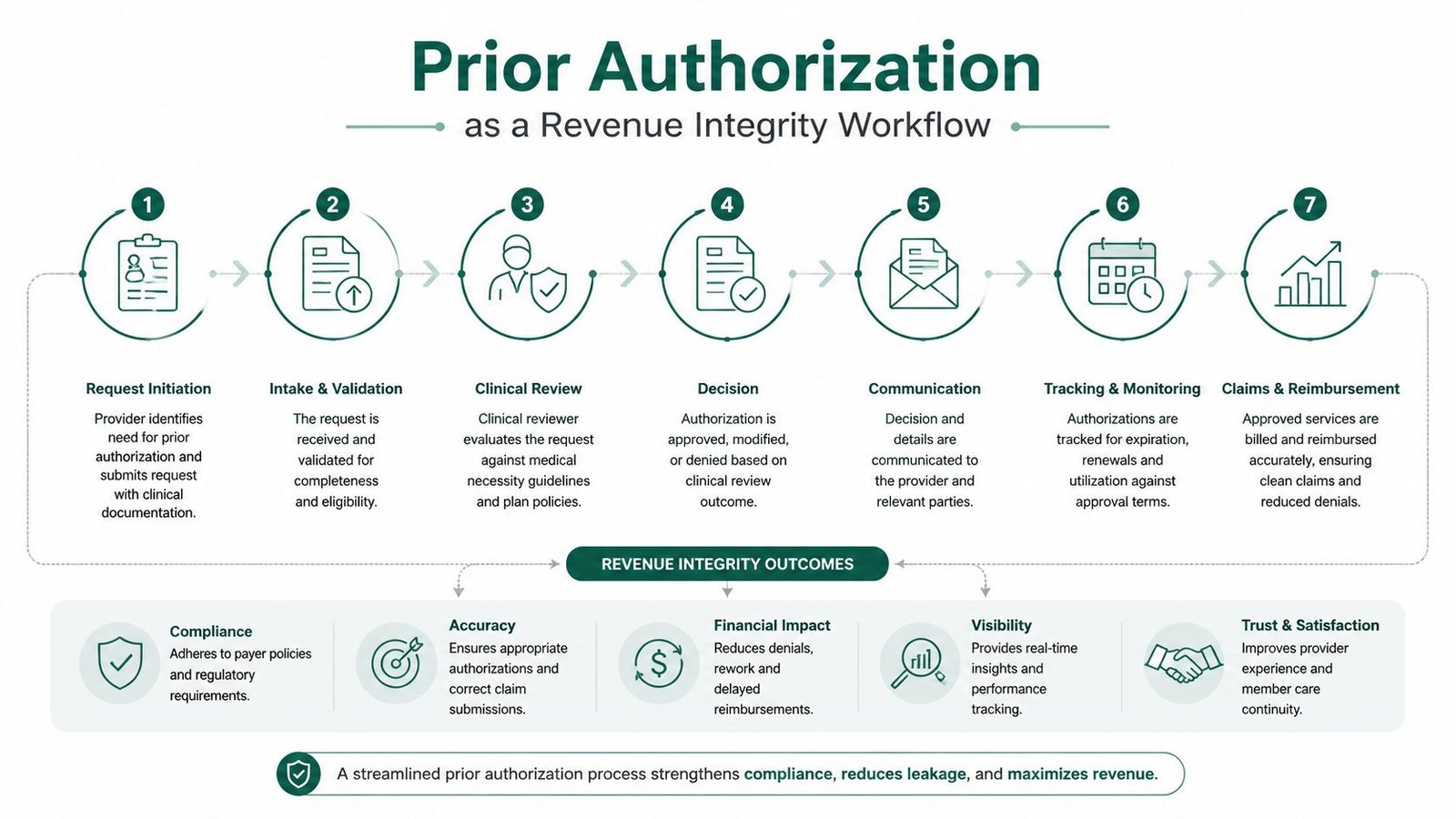
Read a practical explanation of what prior authorization in healthcare involves and then test whether your current process preserves the same data from order through payment. A spreadsheet may track whether approval was obtained. It won't reliably protect the claim from post-approval drift.
Modifiers and Split/Shared Rules That Decide Whether Claims Pay
Modifiers determine whether the payer separates two same-day services or bundles them into one payment. Each unsupported modifier can erase a separately reportable service, while a missing modifier can leave the practice absorbing work it already performed.
Modifier 25 protects a distinct E/M service
CMS NCCI guidance says modifier 25 applies only when the E/M service is significant and separately identifiable from another procedure performed on the same day. In oncology, a physician may evaluate disease progression, review toxicity, change a regimen, and oversee an infusion. If the record supports distinct E/M work, omitting modifier 25 can bundle the visit and remove that payment from the claim.
Use modifier 25 only when the documentation supports separate work. An infusion alone does not justify it. Apply the CPT modifier 25 documentation guidance alongside the CMS NCCI FAQ on modifiers 25 and 59 during coding review.
Modifier 59 and the X modifiers require edit-specific support
Modifier 59 identifies a distinct procedural service when no more specific CCI-associated modifier applies. CMS policy focuses on different anatomic sites or different encounters. For biopsies, port work, or multiple same-day procedures, the chart must prove that the services were distinct. A generic modifier attached to weak documentation invites a bundle denial and delays payment for the procedure.
The X modifiers provide more specific support for distinct procedural circumstances. Select them when the edit requires a particular distinction rather than defaulting to modifier 59.
JW and JZ require medication accountability
Drug waste reporting must reconcile the vial, administered amount, discarded amount, and payer requirement. Missing waste information leaves collectible reimbursement unreported and can create compliance exposure. Charge capture should validate the medication record before the claim leaves the practice, because an authorization match cannot repair incomplete drug documentation.
CMS also updated split/shared E/M rules for 2024. The practitioner who performs more than half of the total time, or the substantive part of medical decision-making, bills the service. CMS states that office visits and nursing facility visits aren't billable as split/shared services. Apply the rule to the setting, and do not assume a physician and APP can share every encounter. Review the CMS split/shared E/M update before assigning the billing practitioner.
| Rule | When It Applies | Typical Denial If Missed | Revenue at Stake Per Encounter |
|---|---|---|---|
| Modifier 25 | Distinct E/M on the same date as a procedure | E/M bundled into infusion or procedure | The separately reportable E/M payment |
| Modifier 59 | Distinct procedural service when no more specific modifier applies | CCI edit or bundled procedure | Payment for the distinct procedure |
| X modifiers | More specific support for distinct procedural circumstances | Generic modifier rejected or unsupported | Payment depends on the edit and service |
| JW | Reportable discarded drug amount where required | Waste reimbursement omitted or questioned | The reimbursable discarded amount |
| JZ | No discarded drug amount for applicable single-dose vial reporting | Missing drug accountability detail or audit concern | Clean processing and defensible drug billing |
| Split/shared rule | Substantive portion or majority time determines billing practitioner | Wrong NPI, denial, or misallocated revenue | Payment assigned to the correct practitioner |
In-House vs Outsourced Oncology Billing and the Pricing Models Behind Them
The in-house option gives you proximity, but proximity isn't the same as specialty competence. A practice needs oncology coding expertise, A/R ownership, drug-file maintenance, payer monitoring, compliance review, and reporting. If one employee carries all of that knowledge, turnover or leave creates a direct continuity risk.
Outsourcing can reduce internal management burden, but the contract determines whether the vendor is paid to recover difficult accounts or merely process easy claims. Percentage-of-collections arrangements and flat-fee-per-claim arrangements each create different incentives.
Before comparing prices, define the fee base. Drug reimbursement is pass-through revenue tied to acquisition and treatment delivery, not the same as professional collections. Your contract should state whether the vendor's percentage applies to gross claims, posted payments, adjusted payments, or net professional collections. It should also identify treatment drugs, waste, refunds, credit balances, and patient payments.
A simple calculation shows why this clause matters. If a vendor charges 6% on $12 million in collections and $4 million represents pass-through drug revenue, including that drug revenue produces a $240,000 fee on money that shouldn't be part of the vendor's professional billing base. Those figures are an example of contract math, not a market benchmark.
Contract protection: Exclude pass-through drug reimbursement from the percentage fee base, and define how refunds, credit balances, and recoupments are handled.
Flat-fee models can be easier to forecast, but they may not include complex denial work, appeal preparation, drug reimbursement review, or old A/R recovery. Percentage models align payment with collections, yet they can still encourage a vendor to prioritize easy accounts unless the agreement includes denial aging, overturn, write-off, and A/R performance requirements.
Use a written comparison of in-house and outsourced medical billing before you request proposals. Ask each vendor to price the same scope and disclose every excluded service.
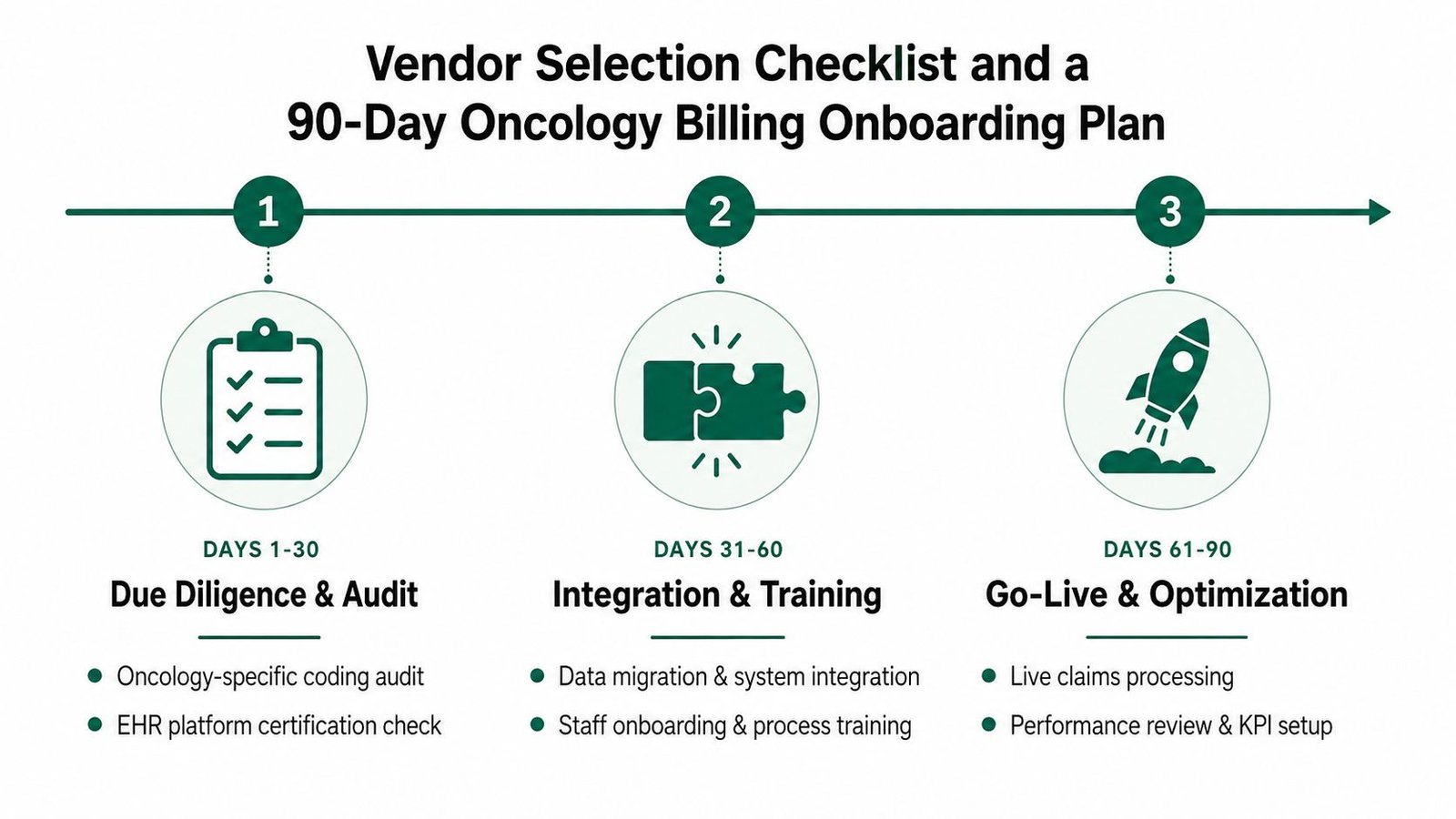
Vendor Selection Checklist and a 90-Day Oncology Billing Onboarding Plan
Choose a vendor by testing its oncology operating model, not its sales presentation. Ask for evidence of oncology-specific coding audits, references from comparable infusion-heavy groups, and a documented approach to drug files, authorization reconciliation, denial appeals, and A/R ownership.
Your security and integration review should cover:
- EHR capability: Confirm experience with Epic Beacon, Cerner, OncoEMR, or the platform your practice uses.
- Data security: Request HIPAA and SOC 2 documentation, access controls, audit trails, and breach-response procedures.
- Charge mapping: Require a review of infusion codes, drug files, waste reporting, E/M rules, and payer-specific edits.
- Performance reporting: Put first-pass denial rate, days in A/R, net collection rate, aging, overturns, and write-offs in the contract.
- Transition ownership: Identify who owns data migration, clearinghouse setup, credentialing verification, open claims, and credit balances.
The onboarding should be staged so you can detect errors before full production:
- Weeks 1 to 2: Complete EHR and clearinghouse integration, verify credentials, confirm payer enrollment, and inventory the existing A/R.
- Weeks 3 to 4: Map charge capture, build the drug file, load fee schedules, validate authorization fields, and test claim edits.
- Weeks 5 to 6: Run parallel billing with the incumbent, compare line-level claims, and resolve differences before go-live.
- Weeks 7 to 8: Go live and audit a 10% A/R sample for payment posting, denial classification, and follow-up accuracy.
- Weeks 9 to 12: Stabilize workflows, clear the denial backlog, and review payer-specific trends with ownership assigned.
Demand measurable go-live milestones. A vendor should be prepared to work toward a first-pass denial rate under 6%, days in A/R under 38, and a net collection rate above 96%. These are management targets for the transition, not guarantees, and your contract should define the measurement method.
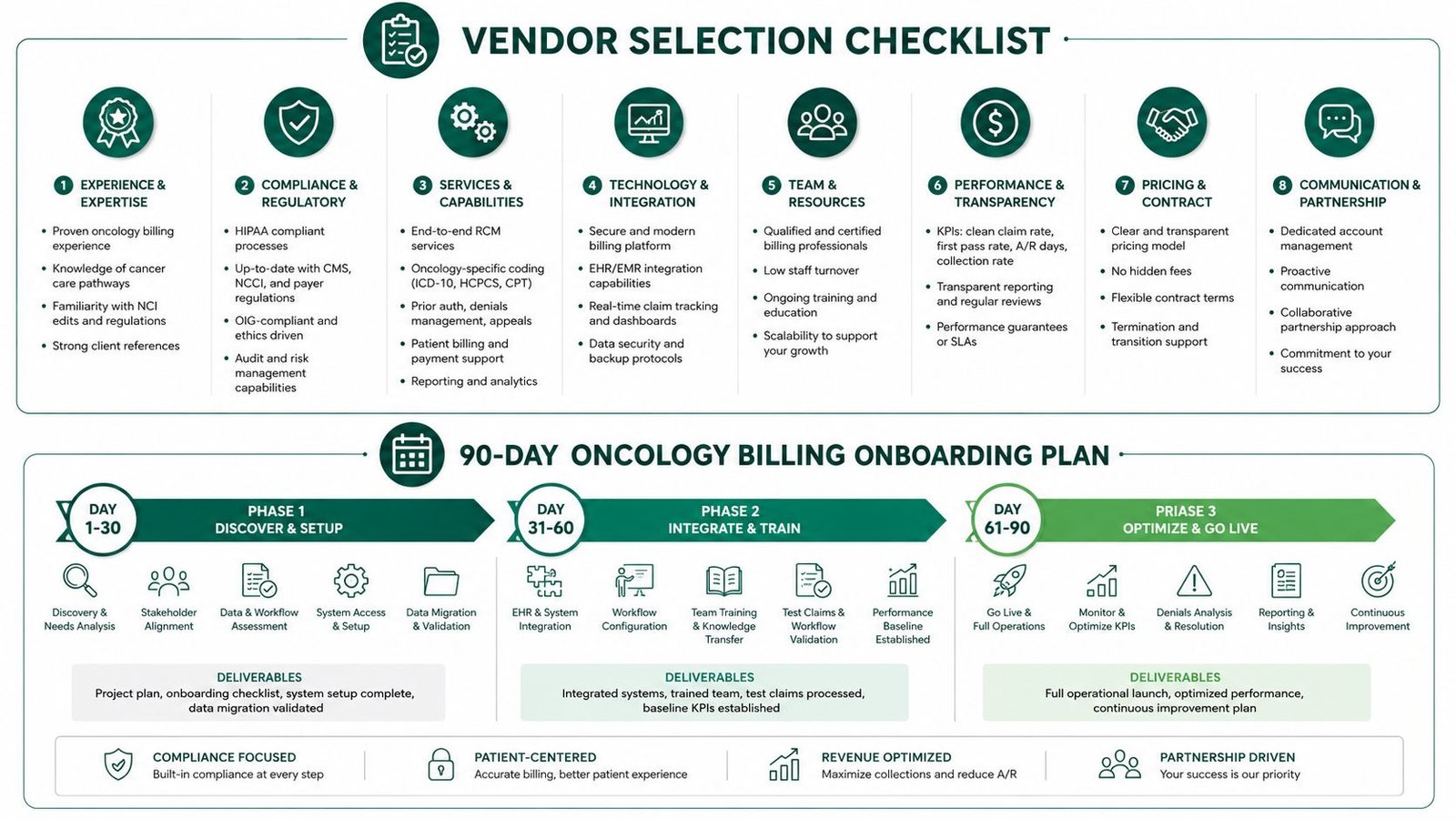
Use this medical billing company interview checklist to force specific answers about ownership, escalation, reporting, and transition risk.
What Practice Owners Ask Before They Sign
How should a percentage-of-collections fee be calculated?
Base the fee on net professional collections, not gross charges and not pass-through drug reimbursement. The agreement should define whether the vendor excludes drug payments, refunds, credit balances, recoupments, patient refunds, and payments posted from pre-existing A/R.
Ask for a sample monthly statement that shows every included and excluded line item. If the vendor can't explain the calculation using your remittance structure, the contract isn't ready to sign.
What denial benchmark should a stabilized oncology group expect?
Don't accept a single headline number. Review first-pass denials by category, payer, drug versus administration, E/M, molecular testing, authorization, and documentation. A useful partner should show how quickly the practice will identify root causes, how much denied A/R gets overturned, and how much gets written off.
The Medicare NGS claims experience shows why denial categories matter. Overall denials reached 23.3% of 29,919 claims, and the rate changed across coverage periods, according to the Medicare NGS cohort analysis. Your vendor should explain which services are included in its benchmark rather than comparing your full oncology claim mix with a narrow specialty sample.
Can the vendor support an EHR change from OncoEMR to Epic Beacon?
Require a written migration plan. It should identify data ownership, charge and drug-file mapping, authorization history, open A/R, claim status, credit balances, payer configurations, and parallel testing. The vendor must also explain how it will preserve clinical-to-billing links during the transition.
Don't let “we integrate with your EHR” substitute for a test plan. Ask who validates the first production claims and who pays for corrections if the migration breaks charge capture.
Is a 30-day termination clause enough?
The clause matters less than the post-termination obligations. Specify who owns outstanding A/R, denial appeals, medical records requests, credit balances, refunds, payer correspondence, and reporting access. Require continued cooperation through a defined transition period, with no ambiguity about data export or claim follow-up.
| Topic | Red Flag | Green Flag |
|---|---|---|
| Fee base | Percentage applies to all posted payments, including drugs | Pass-through drug revenue is excluded in writing |
| Denials | Vendor reports totals without root-cause categories | Reports separate authorization, drug, administration, E/M, and documentation failures |
| Technology | Sales team promises compatibility without testing | Vendor documents EHR, clearinghouse, charge, and drug-file validation |
| A/R ownership | Old balances are excluded from the scope | Open A/R, appeals, credits, and refunds have named owners |
| Termination | Penalties and unclear data-return terms | Clear notice period, transition duties, and data access |
| Performance | Generic clean-claim promise | Contracted definitions for denial rate, A/R days, collections, and write-offs |
We have seen practices focus on the percentage fee while ignoring the fee base, drug reconciliation, and denial ownership. That reverses the decision. First protect the revenue model, then compare the service price.
If you want a direct review of your oncology claims, request a free oncology billing audit and compare the findings with the specialty capabilities outlined on the oncology billing services page.
Happy Billing audits oncology charge capture, authorization alignment, drug reimbursement, infusion coding, denial recovery, and A/R performance inside your existing workflow. Visit Happy Billing to identify where your practice is losing collectible revenue and decide whether your current RCM model is protecting every claim.