7 Orthopedic Billing Companies to Consider in 2026

The best orthopedic billing company is the one that can prove specialty-specific control over global periods, multiple-procedure reductions, surgical coding, denials, and A/R, not one that promises general billing support. That distinction matters because orthopedic surgery benchmarks commonly show denial rates of 8% to 13% and 38 to 52 days in A/R, compared with initial denial rates closer to 5% to 10% across the industry, according to specialty billing benchmarks. For a physician-owned practice, every preventable denial and aging claim delays cash, weakens forecasting, and can turn a correctable coding issue into a permanent write-off.
This comparison is for independent practice owners and physician decision-makers deciding whether to outsource revenue cycle management or replace an underperforming partner. We evaluate seven orthopedic billing companies through the financial failure points that matter most, including global-period handling, modifier accuracy, implant and surgical workflows, authorization controls, clean claims, A/R performance, technology fit, security, staffing, scale, and implementation trade-offs. CMS guidance, AAPC-aligned standards, and payer-specific rules should anchor the review, while vendor-reported metrics and case studies should always be verified against your own payer and procedure mix.
Orthopedics deserves specialized attention. Major procedures commonly carry a 90-day global period, and Medicare's multiple procedure payment reduction generally pays the highest-valued procedure at 100%, with the second and later procedures often paid at 50% under applicable rules, as explained in CMS and orthopedic billing guidance. Review orthopedic billing services and consider a free revenue audit before comparing proposals. For practices that also need consolidated reporting for healthcare, reporting architecture should be part of the diligence process, not an afterthought.
1. Happy Billing
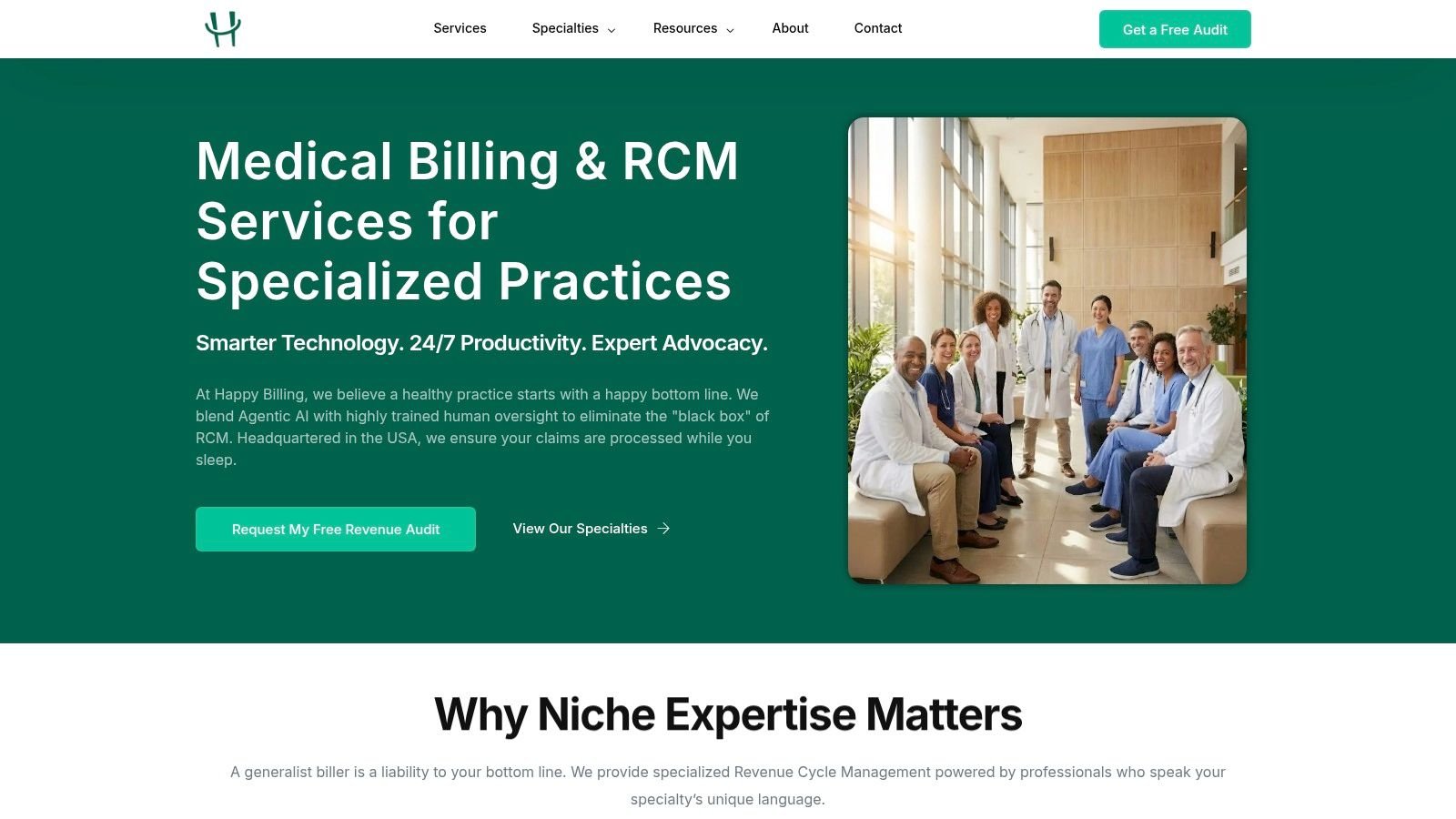
Happy Billing stands out for practices that want specialty-focused RCM without replacing their current EHR or practice-management environment. The company combines agentic AI with expert human auditors, positioning automation as an early error-detection layer rather than a substitute for orthopedic judgment. That matters when a claim depends on whether a service is bundled, separately billable, staged, unrelated, or connected to a complication.
The orthopedic workflow addresses global periods and multiple-procedure reductions, while the broader service includes registration, eligibility, charge capture, coding, claim submission, payment posting, denial management, credentialing, and old A/R recovery. CMS identifies modifiers 24, 25, 57, 58, 78, and 79 as central to global surgery scenarios, while modifiers 54, 55, and 56 divide surgical, postoperative, and preoperative responsibilities when care is shared, according to CMS global surgery guidance and CMS payment-accuracy guidance. A vendor should show how those rules are reviewed before submission, not merely promise denial follow-up afterward.
Happy Billing advertises a 98%+ first-pass clean claim rate and under 35 days in A/R, figures that align with the practical operating targets described in orthopedic billing benchmarks. Those are vendor-reported performance claims, so owners should request definitions, reporting periods, exclusions, and comparable orthopedic references. The company also highlights real-time dashboards, HIPAA-first security, bank-level encryption, AAPC-aligned coding standards, and a 24/7 follow-the-sun model with U.S. leadership and a global back office.
Where the model fits
This is a strong option for independent practices that want a hands-on partner but don't want a data migration or a new billing platform. The model can support surgical practices with complex payer mixes, provided the implementation team demonstrates experience with implants, authorization tracking, operative documentation, and appeals.
Practical rule: Treat a clean-claim percentage as useful only when the vendor defines whether it measures claim acceptance, payment, or error-free submission.
The primary drawback is commercial transparency. Public pricing and clear contract terms aren't listed, so the practice must request a scoped proposal. Some owners may also have concerns about global back-office access, even though the company emphasizes privacy controls, encryption, and U.S. oversight. Request the security documentation, access model, audit logs, and business associate agreement before signing.
For a closer review of the specialty workflow, see orthopedic revenue cycle management. Happy Billing's central trade-off is clear: it offers broad, technology-enabled support with measurable operating targets, but buyers must validate the reported results and negotiate the commercial details directly.
Website: Happy Billing
2. Nimble Solutions
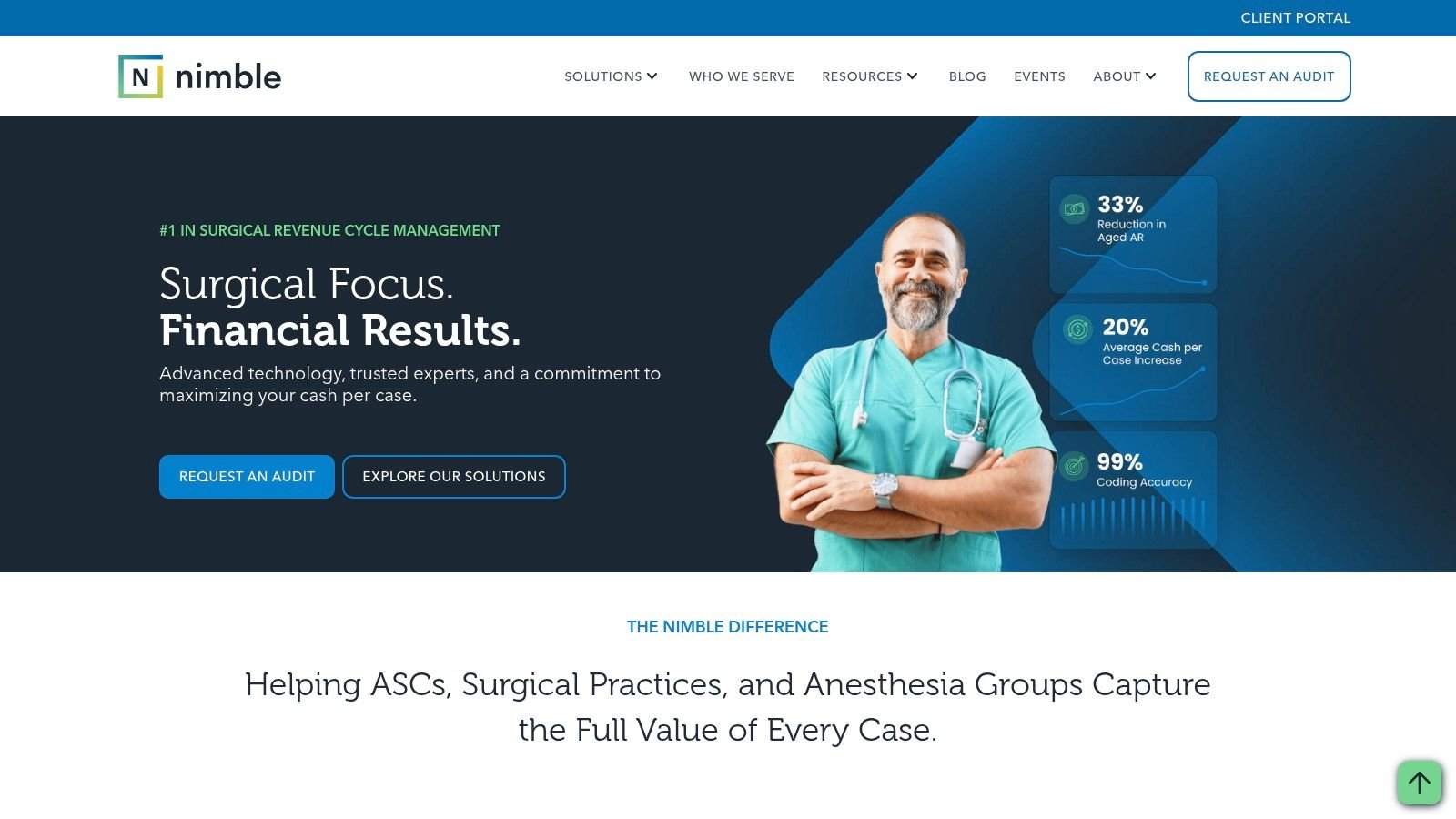
Nimble Solutions, formerly National Medical Billing Services, is built around surgical and ASC revenue cycles. That focus makes it especially relevant to orthopedic groups whose revenue depends on operating-room throughput, accurate charge capture, implant documentation, and fast resolution of high-value claims.
Its service scope spans coding, charge capture, claims, denials and appeals, A/R, analytics, and payer contracting support. The important differentiator isn't the length of that list. It's whether the workflow connects the front end to the final payment. A missing authorization, incomplete implant record, or incorrectly ordered multiple-procedure claim can create a financial problem before the billing team ever sees a denial.
Modifier 51 is particularly important when multiple procedures occur in one session. CMS and AAPC-aligned guidance describes the second through fifth procedures as typically subject to a 50% payment level under Medicare's multiple-procedure payment reduction, as summarized in modifier and surgical payment guidance. Nimble's orthopedic and ASC orientation should lead buyers to ask for examples showing how procedure sequencing, bundling edits, and implant-related documentation are handled in actual workflows.
Best fit and trade-offs
Nimble is likely a better fit for medium-to-large orthopedic groups and ASCs than for a small office with limited surgical volume. Its enterprise orientation can support operational scale, analytics, and structured processes, but onboarding may feel thorough or lengthy to an owner who wants immediate intervention on a modest A/R backlog.
Ask for a transition plan that identifies who owns charge reconciliation, authorization follow-up, coding edits, denial appeals, and payer escalation during implementation. A vendor can have strong surgical credentials and still underperform if responsibilities are split between the practice, facility, and RCM team.
The strongest diligence question is not whether Nimble understands orthopedics. It is whether its reporting separates authorization denials, modifier denials, bundling conflicts, implant documentation failures, and eligibility issues. Those causes have different owners and different recovery paths. The company's surgical specialization makes it a serious candidate, but the practice should compare staffing depth, implementation burden, and reporting detail against its own scale.
For a related evaluation framework, review orthopedic revenue cycle management questions.
Website: Nimble Solutions
3. Medusind
Medusind offers an end-to-end RCM model with a defined orthopedic program, including coding support, authorization management, denial prevention, analytics, and collections operations. Its platform flexibility is commercially important. A practice can evaluate whether Medusind will work inside the existing EHR and PM system or use Medusind infrastructure, rather than assuming a full technology replacement is necessary.
That choice affects implementation risk. Staying inside the current system can reduce disruption and preserve historical reporting, while moving to vendor infrastructure may create a more standardized operating environment. Neither option is automatically better. The owner should compare migration requirements, data ownership, interface costs, workflow changes, and exit obligations before accepting a technology proposal.
The security question deserves direct answers
The plan notes identify a security incident reported to regulators in 2025. That fact doesn't establish the vendor's current security posture, but it does make security diligence essential. Ask for current security documentation, incident-response procedures, penetration-testing summaries where available, access-control policies, employee training standards, subcontractor disclosures, and a clear explanation of what changed after the reported incident.
A mature RCM review examines not only whether a company can collect money, but also whether it can protect the data that gives it access to claims, accounts, and protected health information.
Medusind's national operating footprint may appeal to practices seeking continuity and broad specialty support. The trade-off is that a large, multi-specialty operation may require the practice to insist on a dedicated orthopedic team rather than accepting generic coding coverage. Request references with similar surgical complexity, payer concentration, ASC or hospital exposure, and implant workflows.
Owners should also ask how authorization status is tracked from scheduling through expiration, how global-period edits are applied before claim submission, and how denial analytics distinguish preventable front-end failures from payer adjudication issues. Pricing is custom, so the proposal should state whether coding, authorization work, appeals, old A/R recovery, reporting, and security reviews are included or priced separately.
See orthopedic surgery billing services for a practical comparison point.
Website: Medusind orthopedic billing solutions
4. SYNERGEN Health
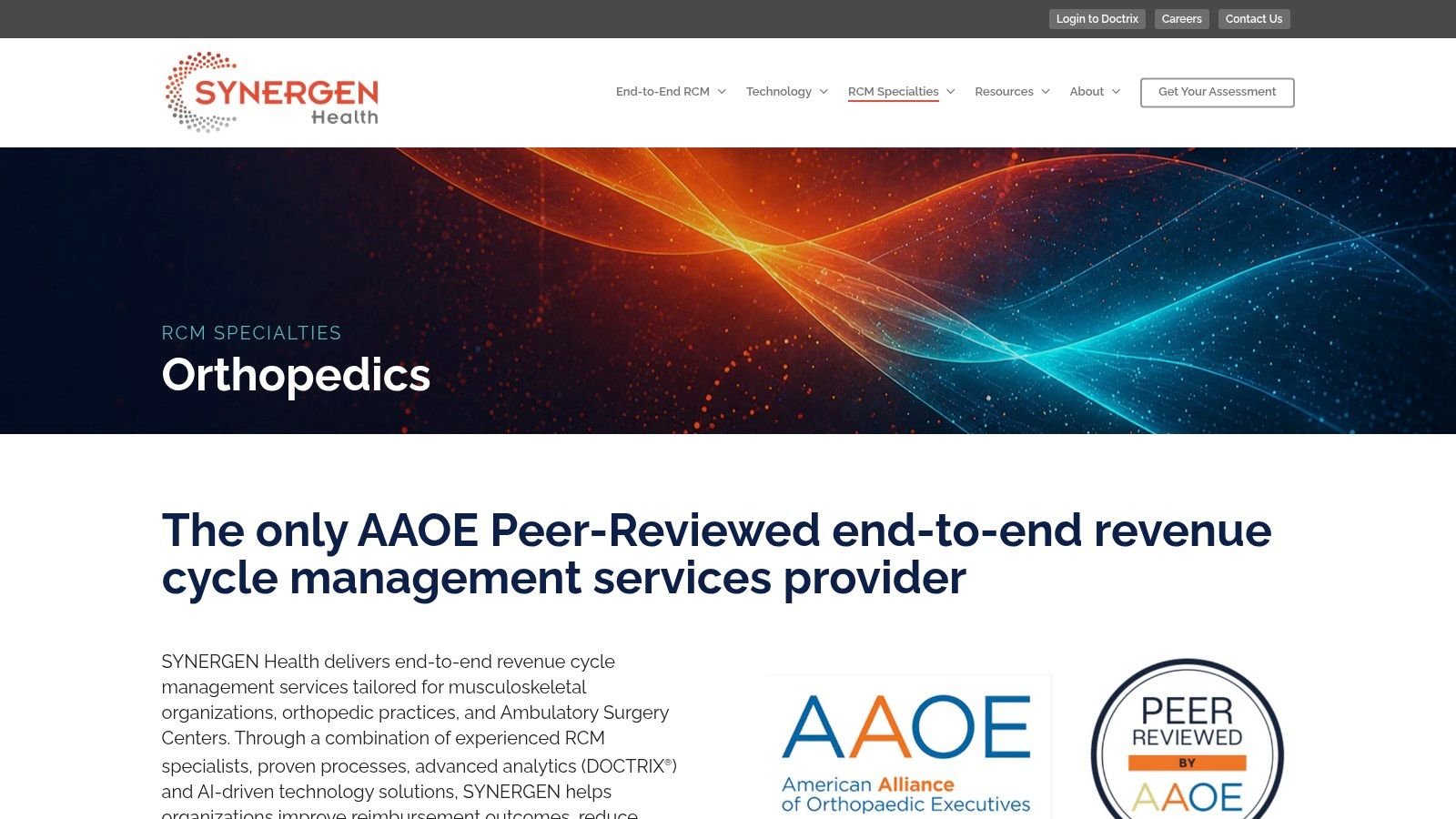
SYNERGEN Health positions itself around musculoskeletal organizations, orthopedic practices, and ASCs. That positioning matters for multi-location groups because the operational problem isn't limited to claims. Eligibility, authorization, coding, charge capture, denial work, and A/R follow-up must remain consistent across locations without hiding location-level performance.
The company emphasizes denial analytics, workflow automation, front-end eligibility and authorization support, and end-to-end A/R services. For an orthopedic owner, the useful question is whether those tools identify the root cause of a denial early enough to prevent repetition. A dashboard showing denial volume is less valuable than one showing whether the same payer is rejecting modifier 25, whether a particular procedure is failing authorization, or whether a location is missing documentation before charge entry.
A scalable option that needs proof
SYNERGEN may suit multi-location groups and ASCs that want specialty positioning without selecting the largest national provider. The potential advantage is focus. The risk is diligence depth, because online case studies are recent and curated. Reference calls should test whether reported outcomes hold across procedure types, payer contracts, and facility arrangements.
Ask the vendor to demonstrate a sample work queue. The demonstration should show how an authorization is escalated, how a global-period encounter is reviewed, how a multiple-procedure claim is scrubbed, and how an unpaid surgical claim moves from first follow-up to appeal. The practice should also see whether dashboards distinguish gross charges, allowed amounts, payments, adjustments, denial rates, net collections, and days in A/R.
Owner's test: If the report can't explain why a claim failed and who must change the workflow, it isn't a management report. It's a transaction log.
SYNERGEN's lesser brand recognition compared with the largest national firms isn't automatically a weakness. A smaller market profile can coexist with strong delivery. It does mean owners should request orthopedic references, staffing ratios, escalation contacts, implementation milestones, and evidence that the assigned team has handled the group's actual surgical mix.
Review these questions to ask a medical billing company before hiring before the final proposal review.
Website: SYNERGEN Health orthopedics
5. Orthos, Inc.
Orthos, Inc. takes the boutique route, focusing specifically on orthopedic groups rather than presenting itself as a broad multi-specialty platform. For an independent practice, that specialization can shorten the learning curve. The team is more likely to understand the financial effect of global-period classification, fracture-care workflows, surgical modifiers, patient statements, and appeal documentation without requiring extensive specialty education during onboarding.
The service model includes claims, denials and appeals, A/R, patient billing, payment posting, collections escalation, and performance reporting. That breadth gives owners one accountable operating partner, but it also creates a diligence question. A boutique company must demonstrate that its processes remain reliable when one client experiences staffing changes, payer disruptions, or a sudden increase in surgical volume.
Personal service versus operational scale
The case for Orthos is strongest when a practice values direct access and orthopedic-only familiarity. A small or independent group may prefer that model over an enterprise vendor with multiple escalation layers. A multi-state MSO or rapidly expanding network should test capacity more aggressively, including coverage during absences, implementation support for new locations, credentialing throughput, and management reporting across entities.
The company highlights real-time transparency, so request a live or sample dashboard rather than accepting a screenshot. The dashboard should make it possible to trace a claim from submission to payment, identify the denial reason, view aging, and separate practice-controlled delays from payer-controlled delays.
Boutique doesn't mean informal. Require the same written controls, security evidence, KPI definitions, and disaster-recovery details that you'd request from a national RCM firm.
Orthos can be a good fit for a practice that wants specialty-tuned service without an enterprise footprint. Its limitation is breadth and scale. Owners should ask how the firm handles complex spine, arthroplasty, trauma, implant documentation, multiple procedures, and payer-specific authorization rules if those services represent a substantial share of revenue.
Use this best medical billing company evaluation to structure the commercial and operational questions.
Website: Orthos, Inc.
6. Health Prime
Health Prime, also known as HPI, combines full-cycle RCM with a technology-enabled orthopedic program. Its orthopedic materials address surgical coding and modifiers, implant tracking, global-period management, physical therapy, imaging, fracture-care bundling, and denial reduction. That combination is relevant to practices whose revenue spans both surgery and recurring ancillary services.
The company also emphasizes integrated analytics, linear workflows, dedicated customer success, and employed teams rather than contractor networks. Staffing structure can affect accountability. When coders, auditors, account managers, and denial specialists work under one operating model, the owner should be able to identify who owns each KPI and how escalations reach leadership.
What to verify before choosing
Health Prime's broad multi-specialty portfolio creates a clear diligence requirement. Ask whether the proposed team is dedicated to orthopedics, how many similar accounts it supports, which subspecialties it handles, and whether its references include complex surgical mixes. A general orthopedic label isn't enough if the practice depends on revision arthroplasty, spine, trauma, sports medicine, or high-volume ASC work.
Test the integration claims in a controlled demonstration. The vendor should show how it receives surgical charges, captures implant information, flags missing documentation, applies payer-specific edits, and reports claims that fail before submission. Confirm whether the practice must migrate data, change its PM workflow, or purchase an additional analytics layer.
The company doesn't publish pricing, so owners should request a line-item proposal. It should identify fees for coding, billing, authorization work, denial appeals, A/R cleanup, reporting, credentialing, implementation, interfaces, and termination support. A lower percentage fee can be misleading if high-value services are excluded.
Health Prime may fit practices that want a staffed, structured partner with technology and customer-success support. Its trade-off is the need to confirm that the orthopedic program isn't one offering within a larger portfolio. Evaluate the assigned team, not just the corporate capability.
Website: Health Prime orthopedic RCM
7. Coronis Health
Coronis Health is a national RCM provider with an orthopedic service line for physician groups. Its offering includes coding, auditing, denial management, A/R cleanup, reporting, strategic planning, automation, AI-enabled workflows, client portals, and payment access. That infrastructure may appeal to multi-site practices that need standardized processes, centralized oversight, and client access across locations.
The financial advantage of scale is consistency. A large group can benefit from repeatable onboarding, broader staffing coverage, and centralized analytics. The risk is that a broad portfolio can dilute specialty attention. Orthopedic owners should not assume that enterprise technology automatically delivers orthopedic coding depth.
Where enterprise infrastructure helps
Coronis is most compelling for organizations with multiple locations, complex reporting requirements, or a need to coordinate billing operations across a larger physician network. Request reports segmented by location, payer, provider, procedure family, denial root cause, and aging bucket. A single aggregate collection figure can conceal one site that consistently misses authorizations or one payer that delays high-value surgical claims.
The portal should also be evaluated as an operating tool, not just a convenience. Owners need to know whether it supports payment visibility, task escalation, appeal status, documentation exchange, and audit history. Ask how the platform handles role-based access and whether back-office users can access only the PHI required for their assigned work.
Scale is valuable only when the reporting preserves the details that explain orthopedic leakage.
Because Coronis serves many specialties, require orthopedic references that match the practice's payer contracts and procedure mix. Ask specifically about global-period edits, modifier review, multiple-procedure sequencing, implant documentation, authorization status, and old A/R recovery. The engagement will require a custom proposal and scope, so insist that the contract define service levels, KPI reporting, staffing commitments, security obligations, transition assistance, and data return at termination.
Coronis may be a strong enterprise candidate, but it shouldn't win solely because it has national reach. The right decision depends on whether that reach improves the practice's measurable revenue performance without turning specialty exceptions into generic work queues.
Website: Coronis Health orthopedic services
Top 7 Orthopedic Billing Companies Comparison
| Vendor | Implementation complexity | Resource requirements | Expected outcomes | Ideal use cases | Key advantages |
|---|---|---|---|---|---|
| Happy Billing | Low–medium (works inside existing EHR; minimal migration) | AI + specialist auditors; 24/7 global back office | Very high first‑pass clean claims (98%+), <35 days A/R, faster cash flow | High‑stakes specialties needing specialty workflows and rapid claim velocity | Agentic AI + human audit, specialty workflows, real‑time dashboards |
| nimble solutions (formerly National Medical Billing Services) | Medium–high (thorough onboarding; enterprise playbook) | Strong ASC/ortho resources, analytics and front‑end teams | Reduced denials, improved orthopedic/ASC collections | Medium‑to‑large orthopedic groups and ASCs with high ortho volume | Purpose‑built orthopedics/ASC workflows, strong ortho references |
| Medusind | Medium (flexible: integrate or use vendor infrastructure) | National operations; full‑cycle RCM capabilities | Accurate coding, denial prevention, comprehensive RCM | Practices needing platform flexibility and national scale | Platform‑flexible delivery and mature national operations |
| SYNERGEN Health | Medium (scalable deployments; analytics tuning) | Denial analytics and workflow automation; scalable teams | Measurable orthopedic MSK outcomes and validated KPIs | Multi‑location MSK groups and ASCs seeking analytics | MSK/orthopedics focus, denial analytics, scalable workflows |
| Orthos, Inc. | Low (boutique, faster ramp for ortho) | Smaller, hands‑on teams; focused capacity | Faster specialty ramp, reduced ortho knowledge gaps | Independent orthopedic practices wanting niche expertise | Orthopedic‑only focus, real‑time reporting, hands‑on denials |
| Health Prime (HPI) | Medium (integrates with common EHR/PMs) | Employed dedicated teams, integrated analytics | Faster cash flow, improved implant/multiple‑procedure handling | Groups needing dedicated customer success and employed staff | Ortho tooling (implants/global periods), dedicated teams |
| Coronis Health | High (custom scoping for enterprise clients) | Large national footprint, automation/AI, client portals | Scalable improvements, automation‑driven efficiency | Multi‑site physician groups seeking enterprise RCM | Wide U.S. reach, mature portals and automation |
How to Choose Without Buying Another A/R Problem
A vendor switch won't repair an undefined revenue cycle. Before signing, establish the practice's baseline by payer, provider, location, procedure family, denial root cause, and aging bucket. Then require every orthopedic billing company to explain how its process will change those results.
Start with coding depth. The partner should demonstrate working knowledge of global surgery modifiers 24, 25, 57, 58, 78, and 79, shared-care modifiers 54, 55, and 56, and multiple-procedure modifier 51. CMS and AAPC guidance make these rules financially material because they determine whether postoperative, staged, unrelated, complication-related, or same-session services are bundled, separately billable, or paid at a reduced rate. The review should include operative notes, implant documentation, fracture care, surgical charge capture, payer-specific edits, and NCCI-related bundling logic.
The buyer's operating checklist
Request written answers to each of these points:
- Global-period controls: How are 90-day surgical periods tracked, and how are legitimate separately billable services identified?
- Multiple-procedure workflow: How does the team sequence same-session procedures and apply modifier 51 or other applicable modifiers?
- Authorization controls: Which procedures, imaging services, therapy services, and DME workflows require authorization for your major payers, and how are expiration dates escalated?
- Implant documentation: Who captures manufacturer, model, invoice, and operative details before submission when payer rules require them?
- Clean claims: What exactly does “first-pass clean claim rate” mean, and what exclusions are applied?
- Denial performance: Are denial rates reported by root cause, payer, CPT family, modifier, location, and avoidability?
- A/R performance: What are current days in A/R, aging over 90 days, net collections, unresolved claims, and old A/R recovery results?
- Reporting cadence: Will owners receive weekly work-queue visibility and monthly baseline-to-target reporting?
- Technology fit: Can the team work inside the existing EHR and PM system, or does implementation require migration, interfaces, or new workflows?
- Security: Can the vendor provide its HIPAA safeguards, business associate agreement, encryption documentation, access controls, incident-response plan, and back-office access policy?
- Staffing model: Are coders and auditors employed, contracted, domestic, offshore, or blended, and who supervises quality?
- Implementation: What happens during the transition, who owns legacy claims, and what is the expected implementation timeline?
- Contract terms: How are termination, data return, transition assistance, service levels, audit rights, and fee changes handled?
- Pricing structure: Is the fee based on collections, charges, claims, encounters, fixed monthly services, or a blended model, and what work costs extra?
Ask for sample dashboards, payer-specific examples, security documentation, three relevant references, and a written recovery plan for existing A/R before approving the contract. If a vendor won't disclose KPI definitions, the practice can't distinguish improved billing from changed measurement.
Match the model to the practice
A boutique orthopedic firm may provide direct access and deep procedural familiarity, but capacity and continuity require close review. A specialty-focused company can offer stronger orthopedic workflows for global periods, implants, denials, and surgery, with a potentially longer implementation process. An enterprise RCM provider may be better for multi-site groups, centralized reporting, and staffing resilience, but owners must verify that specialty controls survive at scale. A technology-enabled partner can improve visibility and workflow speed, but automation must be paired with human coding review, escalation ownership, and security controls.
In our experience, the strongest choice isn't the vendor with the longest feature list. It's the partner that can demonstrate measurable improvement in revenue, denial rate, and A/R days for the practice's actual payer and procedure mix. A free orthopedic revenue audit can establish that baseline before proposals are compared.
What KPIs should an orthopedic billing company guarantee or report?
Require consistent definitions for first-pass clean claims, denial rate, days in A/R, aging over 90 days, net collections, appeal recovery, write-offs, and authorization performance. Industry guidance identifies a practical orthopedic target of 95% or higher first-pass clean claims and total A/R under 35 days, while top-performing practices in one benchmark discussion report net collection rates of 95% to 98%, compared with a national median near 93% to 94%, as described by orthopedic billing market benchmarks. Treat those figures as comparison points, not promises, and require payer-level reporting.
How should a practice evaluate pricing for outsourced orthopedic billing?
Compare total cost against recoverable revenue, not just the quoted percentage. Confirm whether coding audits, authorization work, denial appeals, credentialing, old A/R recovery, interfaces, dashboards, and implementation are included. A low headline fee can become expensive if the vendor leaves global-period review or high-value appeals with the practice.
Can an RCM partner work inside our existing EHR?
Many vendors can integrate with an existing EHR or PM system, but the operating details vary. Ask whether the arrangement requires migration, interfaces, duplicate data entry, new templates, or changes to charge capture. A demonstration should trace a surgical case from scheduling and authorization through coding, claim submission, denial work, payment posting, and reporting.
What should we verify about HIPAA security and offshore access?
Request the business associate agreement, encryption details, role-based access controls, audit logs, incident-response process, subcontractor list, workforce training standards, and back-office access policy. If the vendor uses a global team, confirm where PHI is accessed, how access is limited, how supervisors monitor work, and what happens after an employee or subcontractor leaves.
Happy Billing combines agentic AI, expert human auditors, full-cycle RCM, proactive denial prevention, credentialing, and old A/R recovery while working inside your existing EHR. If your orthopedic practice needs tighter global-period controls, cleaner surgical claims, and more predictable A/R, visit Happy Billing to begin a specialty-focused revenue review.