No Surprises Act Texas: What Practice Owners Must Know
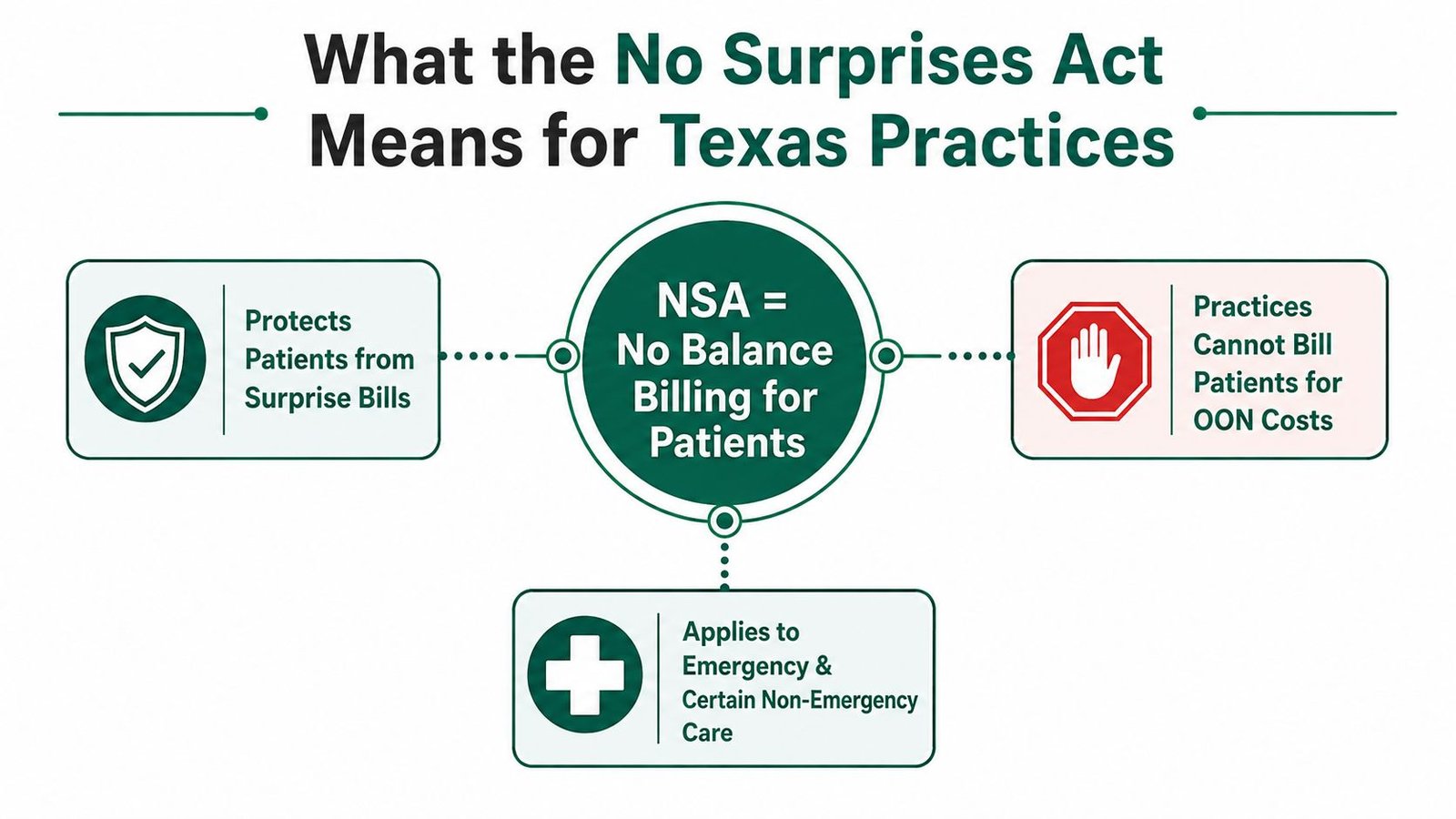
The No Surprises Act in Texas means you can't bill patients for covered out-of-network emergency care, air ambulance, and certain in-network facility scenarios, and the fastest way to lose money on those claims is to route them to the wrong dispute track. If your team misclassifies the plan type, you're not just creating compliance risk, you're adding avoidable A/R days and letting clean money sit unpaid.
For a practice owner, this is a revenue-cycle problem first. The law doesn't just change what you can say to a patient, it changes how fast you get paid, which claims get stalled, and whether your billing team sends the file into state mediation or federal IDR.
Texas rules sit on top of the federal baseline. For the underlying obligations every physician practice must meet — Good Faith Estimates, notice and consent, public disclosure and the dispute timelines — see our No Surprises Act compliance guide for practice owners.
Quick answer: The federal No Surprises Act protects Texas patients from balance billing on emergency services, out-of-network care at in-network facilities, and air ambulance. On top of that, Texas SB 1264 (effective January 1, 2020, before the federal NSA) already banned balance billing on state-regulated PPO and HMO plans and set up the state’s own arbitration process through the Texas Department of Insurance. Two implications for Texas practices: (1) which arbitration path applies depends on whether the patient’s plan is state-regulated (SB 1264, TDI) or federally-regulated / self-funded (federal IDR), and (2) the Texas Prompt Pay Act still applies alongside NSA compliance — insurers owe payment on clean electronic claims within 30 days or face penalty interest. Good Faith Estimates and the public disclosure notice are still required regardless.
What the No Surprises Act Means for Texas Practices
The money leak starts with one wrong assumption. If your team treats every out-of-network Texas claim the same, you'll misroute disputes, lose days in A/R, and end up chasing balances you were never allowed to bill the patient for in the first place.
Texas has its own surprise-billing law that already protected many insured patients starting January 1, 2020, and the federal No Surprises Act took effect on January 1, 2022 for people with group health plans or group and individual health insurance coverage, passed in the Consolidated Appropriations Act of 2021 and signed in December 2020 (Texas Law Help). In plain English, Texas did not get one single billing rule. It got two overlapping systems, and the wrong one on the wrong claim slows collections.
The first question is coverage, not coding
That's where billing teams go wrong. They jump to CPT, modifiers, or the superbill before they classify the plan, but the dispute path depends on whether the claim falls under Texas state rules or federal NSA rules.
Practical rule: classify the plan first, then choose the dispute lane, then worry about the rest of the claim work.
The Texas framework continues to handle some out-of-network rate disputes, while the federal government handles others, including many self-insured ERISA plans that did not opt into Texas law (Texas Law Help). If you send the matter to the wrong channel, the team doesn't just waste time, it restarts the clock.
Which Services and Settings Trigger NSA Protections
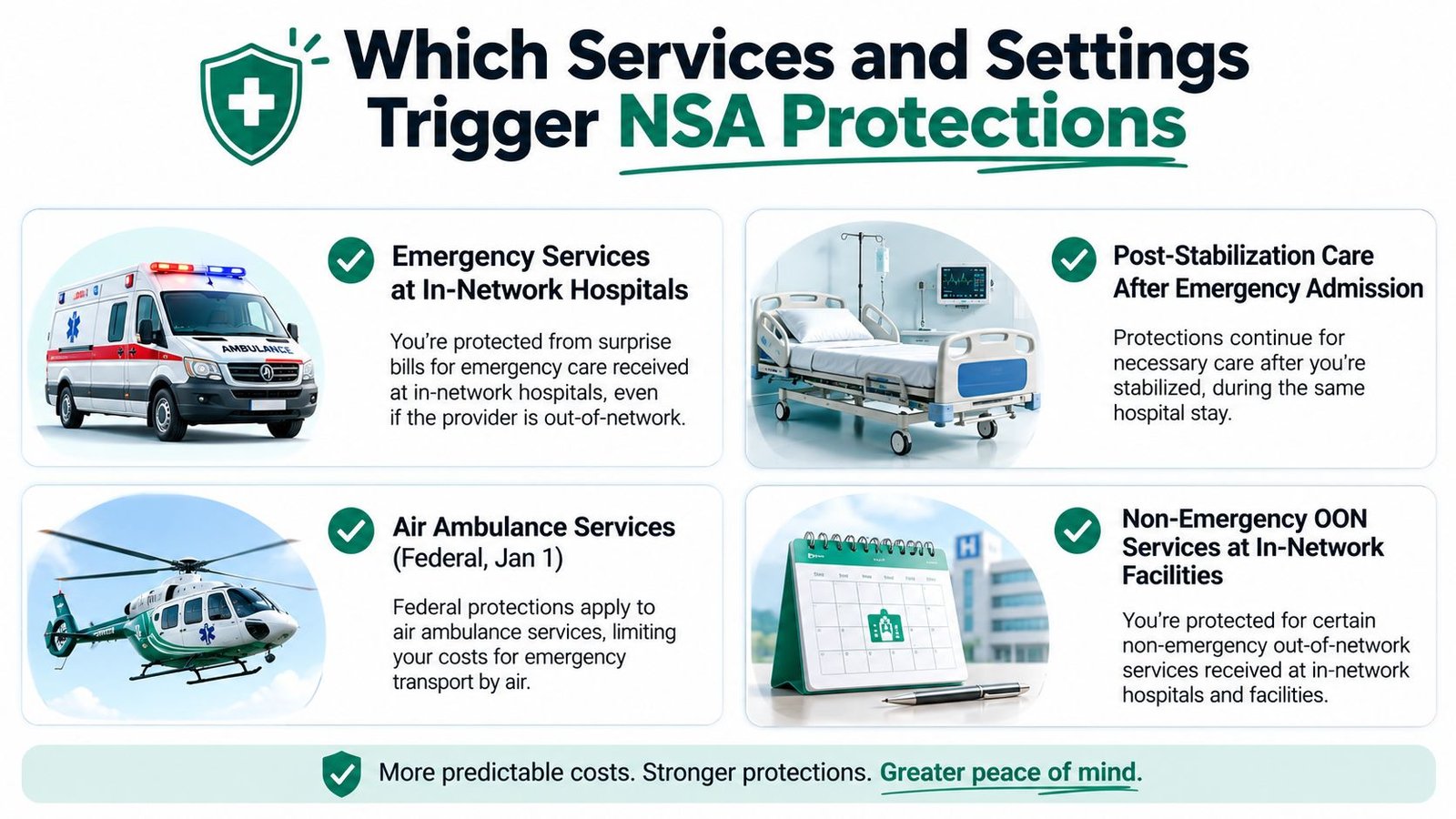
The statute is broader than most front desks realize. It reaches emergency care, air ambulance, and certain care at in-network facilities where the patient did not get to choose the out-of-network doctor, which means surprise-billing exposure shows up in places that look routine on the scheduling screen.
Texas Department of Insurance says the state bans balance billing for emergency care received on or after January 1, 2020, for care at in-network facilities when the patient did not have a choice of doctors on or after that date, and for emergency ground ambulance services on or after January 1, 2024; federal law separately bans balance billing for air ambulance services on or after January 1, 2022 (Texas Department of Insurance provider guidance). Texas Blue Cross Blue Shield's provider FAQ also says the law reaches out-of-network physicians and facilities at in-network hospitals, birthing centers, ambulatory surgical centers, and freestanding emergency medical care facilities, including diagnostic imaging and laboratories tied to in-network care (BCBSTX provider FAQ).
The specialties that feel this the most
If you run anesthesiology, radiology, pathology, emergency medicine, or an imaging-heavy group, this is not abstract compliance. This is your contracting tool, your cash conversion, and your write-off exposure.
The practical effect is simple. These specialties show up over and over in disputes because the physician often isn't the patient's chosen out-of-network provider, yet the service is part of a covered encounter. That's why patient balance billing becomes the first thing you have to stop.
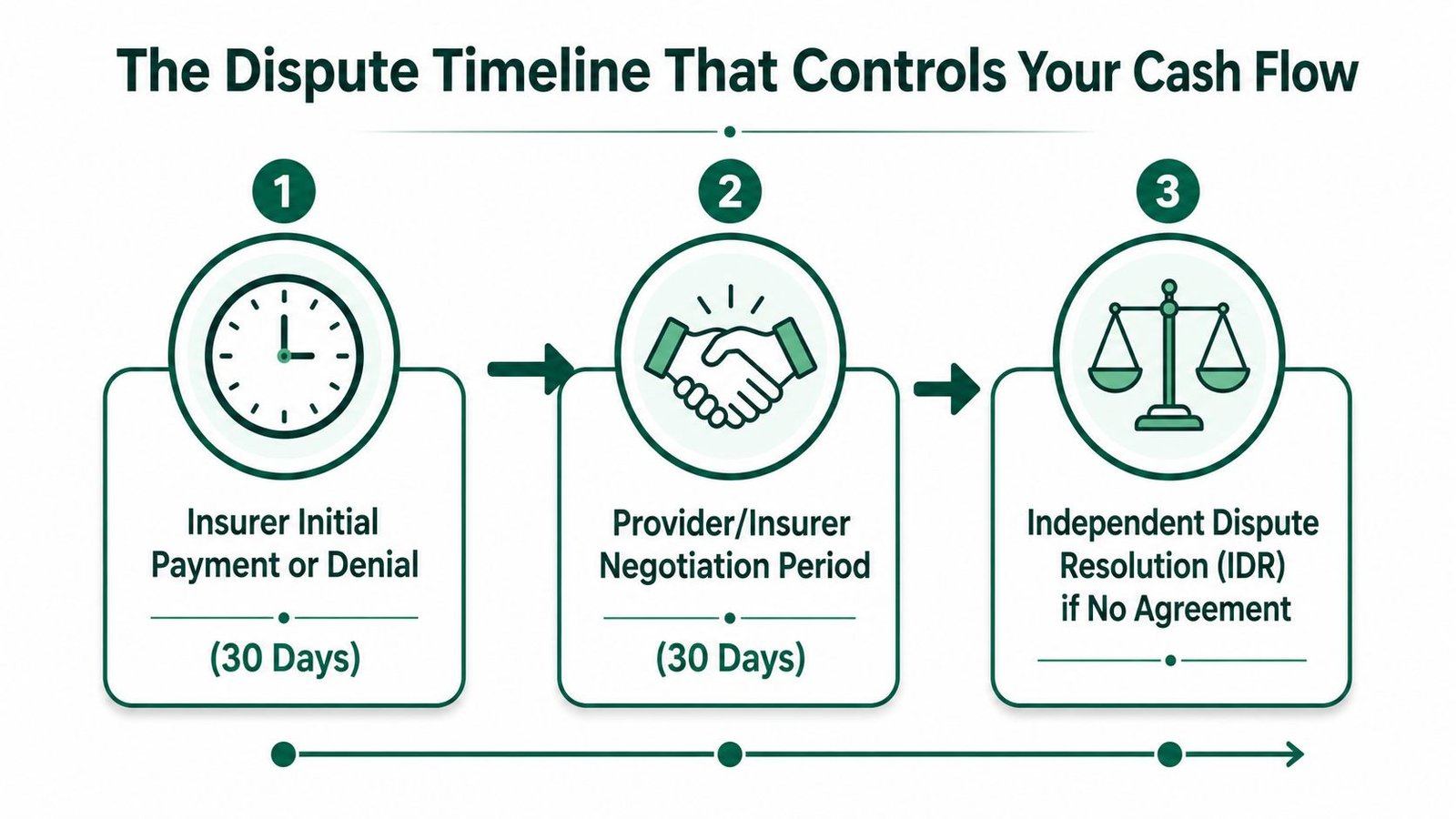
The timeline matters too. Covered claims can move from initial payment or denial into negotiation and then into IDR, so every missed trigger delays cash and increases the odds someone on your team pursues a balance that won't survive review.
If your practice works across emergency departments, surgery centers, or hospital-based diagnostics, build a service-line list now. Don't wait for the first complaint letter to tell you where the exposure is.
The Dispute Timeline That Controls Your Cash Flow
The dispute process is built to move in stages, but it still drags when your team treats it like a normal unpaid claim. On covered out-of-network disputes, the insurer generally has 30 days to make an initial payment or issue a denial, then provider and payer get a 30-day open negotiation window, and only after that can Independent Dispute Resolution begin (Nossaman overview of NSA dispute mechanics). That sequence is the difference between controlled recovery and passive A/R aging.
Why the QPA changes the economics
In IDR, each side submits a proposed payment amount, and the arbitrator considers the qualifying payment amount, or QPA, which is the median in-network rate for the service in the relevant geographic area (Nossaman overview of NSA dispute mechanics). That means your documentation, contract data, and rate benchmarking are no longer back-office chores. They are the evidence that shapes whether you can push back on an underpayment.
Revenue teams get lazy. They file the appeal late, they don't stage the packet, and they let the claim sit while someone searches for the right contract file or reprices the service. By the time they act, the account has already burned through avoidable days in A/R and often has to be defended under pressure instead of on your terms.
For practices that rely on high-acuity specialties, the business issue is not just payment level. It's network behavior, cash timing, and whether being out-of-network still makes sense under the new rules. The law has changed the math on what you can afford to leave unorganized.
If your team needs a cleaner playbook for dispute filing and escalation, use this IDR process guide as the operational reference your staff can follow.
When cash gets stuck in dispute, some owners look for a separate short-term bridge while they clean up the backlog. In those cases, stabilize cash flow with Business Loan Warrior can be a useful side resource while your team works the claims.
QPA Notices and Why Your Front Desk Matters
Most practices lose ground before the negotiation even starts. Federal rules require plans and issuers to include certain disclosures about the QPA with each initial payment or notice of denial of payment, and they must provide additional information on request under 26 CFR 54.9816-6T(d), 29 CFR 2590.716-6(d), and 45 CFR 149.140(d) (DOL no surprises act final rules FAQ).
What your team should log immediately
The front desk doesn't need to argue the law, but it does need to trigger the paper trail. If the first EOB lands and the claim is covered, request the QPA disclosure right away and log the basics.
- Payer ID so the dispute doesn't get sent to the wrong carrier bucket.
- Date of initial payment or denial so your negotiation clock starts correctly.
- QPA amount because that's the number the payer is leaning on.
- CPT code so the appeal packet matches the service billed.
- In-network median rate you'll use as a counter so the provider side has an internal benchmark ready.
Operational truth: if your staff waits until the claim is already aged, you're negotiating blind.
The difference between state and federal handling matters here too. State mediation and federal IDR are not interchangeable, and the QPA sits at the center of the federal process. If the disclosure never gets requested, the practice often ends up accepting a weak offer or filing with a thin packet that can't support a stronger position.
Teams that want tighter call handling on these claims also need better phone workflow, because payer follow-up and documentation requests get dropped when staff are bouncing between lines. Practices that use why clinics choose SnapDial usually do so because cleaner routing and call logging reduce the chance a key denial follow-up gets missed.
For a quick read on remittance details, keep this EOB reading guide in your internal workflow library.
State vs Federal Routing for Texas Claims
The most expensive Texas mistake is acting like one surprise-billing workflow fits every plan. It doesn't. Texas law mainly applies to fully insured plans and covers out-of-network services at in-network hospitals, birthing centers, ambulatory surgical centers, and freestanding emergency medical care facilities, while the federal No Surprises Act applies to self-insured ERISA plans that did not opt into Texas rules (BCBSTX provider FAQ, HFMA overview of Texas and federal interplay).
A 60-second routing rule
Your team should make the decision in this order.
- Check the member ID card and plan type. If it's self-insured ERISA, federal NSA is usually the lane.
- Check the setting and service. If it's within the Texas statutory list, state handling may apply.
- Route the dispute correctly the first time. Texas mediation for Texas-covered fully insured matters, federal IDR for federal matters.
If you send a claim to federal IDR when state arbitration applies, you waste time because the dispute has to be corrected and restarted. If you send a state matter into the federal lane, you lose the federal timing advantage and stall collections. That's not a compliance glitch, it's bad cash management.
What your workstation needs
Keep one routing sheet at every billing station. If the team has to “look it up later,” the claim is already bleeding days.
The sheet should include the plan-type check, the facility list, and the owner or manager's escalation contact for borderline cases. If you need help identifying provider data during setup, find providers' NPI numbers through OMOPHub and keep the reference handy for claim validation.
For practices that are trying to reduce handoffs and clean up outsourced workflows, this Texas billing outsourcing guide is the right internal reference to pair with your routing policy.
RCM Workflow Changes That Prevent Denials and Penalties
The law only protects revenue when the workflow is built to use it. Practices that keep the old “bill first, sort it out later” habit end up refunding patients, rewriting claims, and eating delay after delay that never had to happen.
Four moves that tighten the pipe
- Good faith estimates at scheduling or intake. For uninsured and self-pay patients, get the estimate out before the bill grows teeth. That cuts complaint-driven refund cycles and keeps the office from chasing self-pay balances that should have been handled up front.
- Advance notices and consent for the narrow allowed exceptions. If you're using a post-stabilization or facility-of-choice consent path, document it carefully. Missing consent language turns a collectible account into a forced reversal.
- Claim edits that flag protected NSA scenarios before submission. The edit should stop patient balance from being pursued on a covered claim. That one control saves staff time and avoids write-offs that spiral into complaints.
- A denial script that triggers negotiation or IDR automatically. Your team should not debate the law on the phone. It should recognize the NSA pattern, pull the right file, and move fast.
Those changes matter because they shorten the path from denial to action. In practices we've worked with, a clean denial script can compress A/R days by 20–40 on protected claims when the team acts immediately and doesn't let the file go stale. That's not a legal win, it's a cash win (Texas law and federal handling overview).
The owner-level decision
Stop asking whether the claim can be “worked later.” Ask whether it can be correctly routed now. If your staff can classify coverage first, route disputes second, and never pursue patient balance on a protected NSA scenario, you'll see fewer denials, fewer patient complaints, and better cash velocity.
Answers to the Questions Texas Practice Owners Ask Us
How do I know if the payer is using the right QPA?
Ask for the QPA disclosure on every covered out-of-network denial or initial payment, then compare it against your own in-network benchmarks and the service code on the claim. Federal rules require QPA-related disclosures with the notice, and that's the opening you need to challenge a weak offer (DOL FAQ). This week, have your billing lead spot-check three recent denials and log the QPA, CPT, payer ID, and response date.
Can we ever bill the patient for an out-of-network balance after NSA?
Only in narrow situations, and you need the documentation to prove it. Covered emergency care, certain in-network facility scenarios, air ambulance, and related protected services are not patient-balance opportunities, and Texas rules plus federal NSA rules split the handling by plan type (Texas Law Help, HFMA). This week, review one service line and confirm your team knows when consent and notice are required before any patient bill goes out.
What happens if we billed the patient incorrectly?
You risk refund demands, complaints to TDI or CMS, and more work to unwind the account. The fix is to stop balance collection, correct the payer routing, and document why the claim should have gone through dispute handling instead of patient billing. This week, pull every open NSA-flagged account and make sure none are sitting in patient AR.
Should we outsource NSA-heavy billing?
If your practice lives in anesthesia, radiology, emergency medicine, pathology, or hospital-based ancillary care, outsourcing can help if the partner knows Texas routing, QPA disputes, and denial timing. Don't shop for a generic billing vendor, shop for one that can keep the claim from aging while the payer disclosure and dispute window are still live. This week, ask any vendor how they handle Texas-vs-federal routing, IDR packet prep, and patient-balance prevention.
If you're tired of watching protected claims sit in A/R because the dispute path wasn't set up correctly, Happy Billing can help your practice tighten routing, cut avoidable denials, and keep NSA claims moving. We work inside your existing system, so your team doesn't have to rebuild workflow to stop revenue leakage.