Medical Billing Services for Group Practices Explained

If you're asking whether medical billing services for group practices are worth it, the answer is yes when your current billing operation is slowing cash flow, tolerating denials, or letting A/R age. Poor billing practices cost U.S. healthcare providers an estimated $125 billion annually according to Aptarro's medical billing statistics summary, and group practices feel that loss fast because small errors get multiplied across multiple providers, locations, and specialties.
For an owner or administrator, this isn't a back-office debate. It's a revenue decision. If your team is mishandling eligibility, submitting weak documentation for 99213 visits, or missing a valid modifier -25 on a same-day E/M with a procedure, you're not dealing with a coding nuisance. You're giving up collectible revenue, increasing denial work, and stretching A/R longer than it should run. We've seen practices focus on staffing problems when the underlying issue was process design, payer rule drift, and no disciplined follow-up against CMS guidelines, AAPC standards, and payer-specific edits.
Introduction to Medical Billing Services for Group Practices
Medical billing services for group practices are outsourced or hybrid revenue cycle functions built to turn encounters into collected cash with less delay, fewer denials, and tighter control of A/R. When they're run well, they improve claim accuracy at the front end, move clean claims out faster, and stop avoidable denials before they damage monthly collections.
That matters more in a group setting than most owners realize. A solo provider can sometimes brute-force billing with one experienced employee. A multi-provider practice can't. Once you have several physicians, multiple service lines, and a larger payer mix, billing breaks in patterns. Eligibility gets checked too late. Documentation supports one code but the claim goes out with another. A routine issue with 99213, 93000, or a procedure paired with modifier -25 becomes a recurring leak across the entire organization.
What a group practice is actually buying
You're not buying “billing help.” You're buying tighter control over four things:
- Claim velocity: How quickly charges move from encounter to submission.
- Denial prevention: Whether edits catch problems before the payer does.
- A/R discipline: Whether unpaid balances get worked while they're still collectible.
- Revenue integrity: Whether the practice collects what its contracts and documentation support.
CMS guidance, payer medical policies, and AAPC coding standards all affect whether a claim pays cleanly. Group practices need those rules translated into a repeatable operating model, not left to memory and heroics.
Practical rule: If your physicians are asking why collections don't match patient volume, the answer is usually in denial patterns, slow charge entry, or underworked A/R.
Specialty fit matters too. An anesthesiology group doesn't have the same risk profile as pediatrics or cardiology. If you want to compare how billing workflows differ by service line, review the specialty billing pages and use a free billing audit for your practice to identify where revenue is leaking now.
Understanding How Group Practice Billing Works
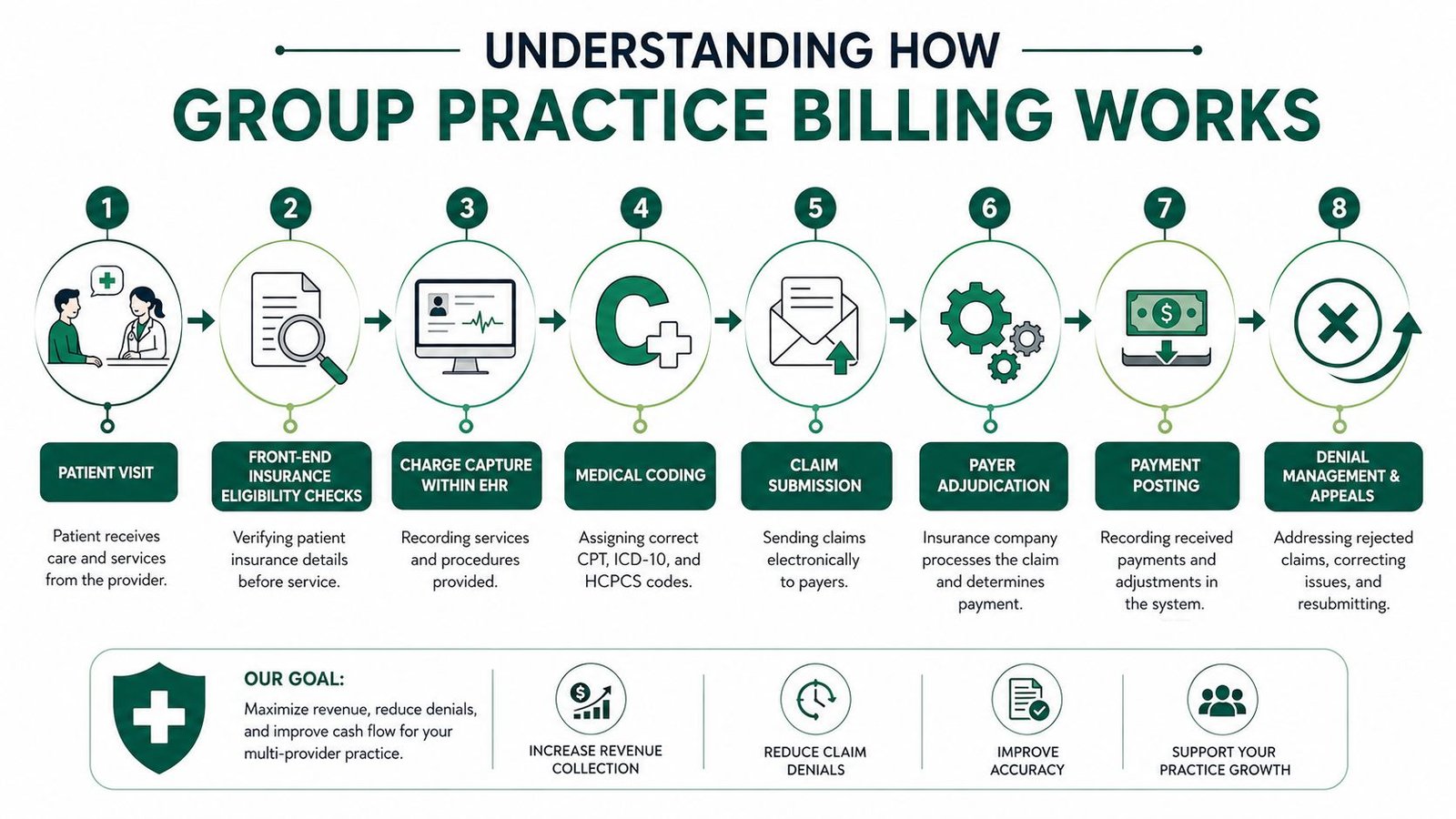
The billing cycle for a group practice is a chain. If one link fails, cash slows down for every provider attached to that workflow. That's why more organizations are moving to external RCM partners. The U.S. Medical Billing Outsourcing Market generated $7.4 billion in revenue in 2025 and is projected to reach $25.3 billion by 2035, reflecting a broad shift toward external RCM for physician offices and hospitals, according to Market.us reporting on the U.S. medical billing outsourcing market.
The workflow that actually determines collections
A competent billing operation usually follows this sequence:
Eligibility before the visit
Insurance verification has to happen before the encounter and be rechecked when needed. If a plan is inactive or the wrong payer order is used, the claim starts life broken.Charge capture inside the EHR
Providers document the encounter, and charges are pulled or entered based on what was performed. In a group practice, delay here becomes a system problem, not an individual one.Coding review
In coding review, procedure ranges and modifiers are critical. Anesthesia claims in the 00100 to 01999 range carry different financial logic than cardiology work in the 93000 to 93299 range. A missing modifier, unsupported diagnosis linkage, or weak documentation can turn a valid service into a denial.Claim scrubbing
Claims should be checked against National Correct Coding Initiative edits, payer rules, and internal edits before submission. That's where issues such as invalid modifier combinations, diagnosis mismatches, or authorization gaps should get stopped.Submission and adjudication
Clean claims go out electronically, then move into payer adjudication.Payment posting and variance review
Posting isn't just bookkeeping. It's where underpayments, contractual inconsistencies, and payer behavior become visible.Denial management and appeals
A denied claim needs classification, correction, and fast resubmission. Slow appeal cycles age cash and eventually kill collectability.A/R follow-up
Every unpaid claim needs ownership and a work queue, not passive aging.
Where technology helps and where humans still matter
Agentic AI can flag likely errors before submission. Human auditors still matter because many claim failures aren't simple syntax errors. They involve documentation interpretation, modifier judgment, and payer nuance. In our experience, the best model combines automated scrubbing with experienced review of high-risk claims.
A group practice doesn't need more claim volume. It needs fewer claims coming back for rework.
If you want a broader operational view of physician-group revenue cycle design, this guide on RCM for physician practices is worth reviewing.
Benefits of Outsourced Billing for Your Practice
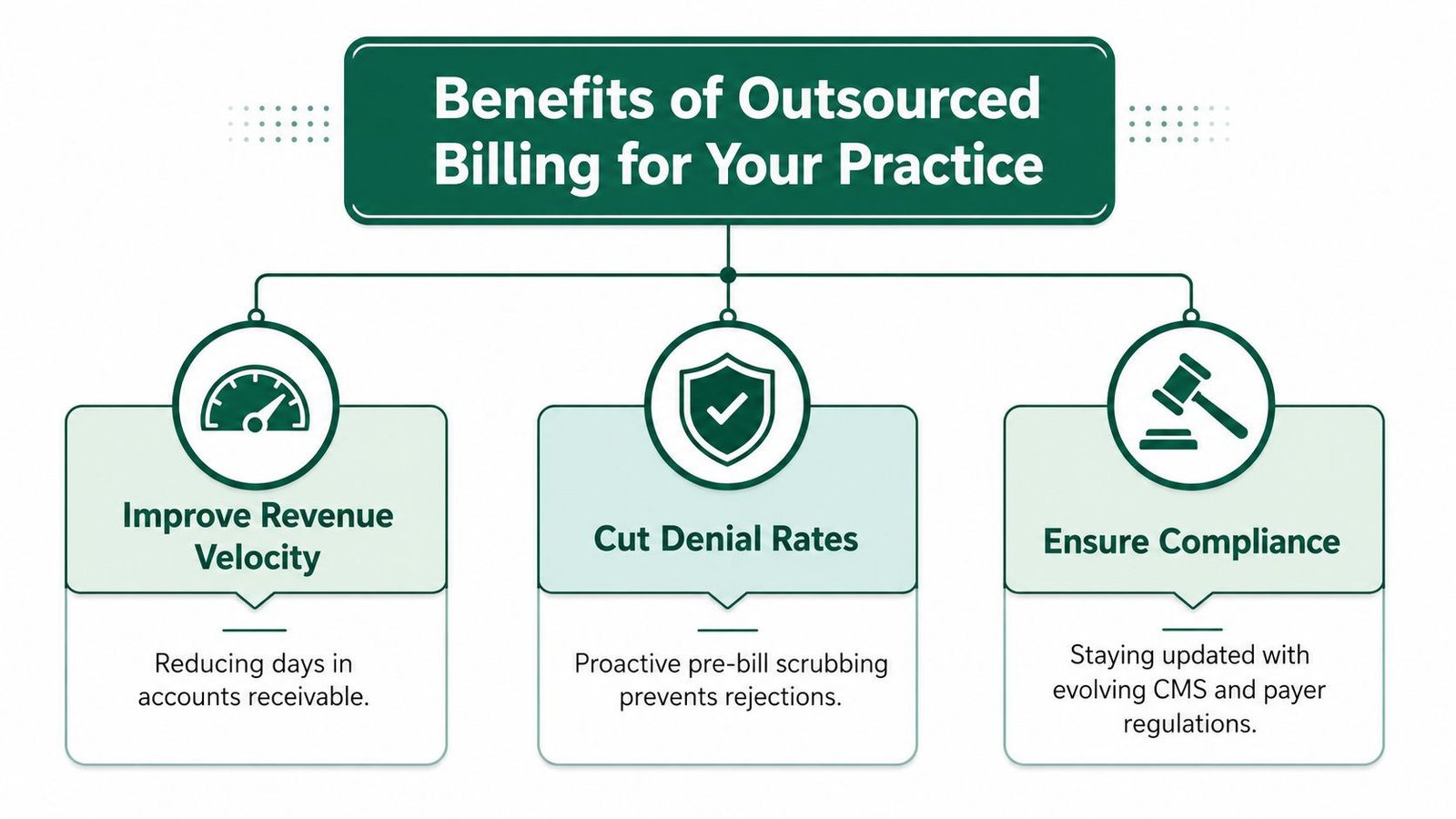
Outsourcing only makes sense if it changes financial outcomes. For group practices, the primary benefits are faster collections, fewer denials, and less exposure to CMS and payer rule changes.
Faster revenue velocity
A claim that sits too long becomes harder to recover. Once claims exceed 120 days in A/R, recovery rates drop below 40%, making proactive outsourced models that keep A/R under 35 days critical to preserving revenue, as noted by Medical Billers and Coders in its A/R recovery discussion.
That's the reason I push owners to treat A/R age as a management issue, not a bookkeeping metric. If your internal team is posting payments but not actively moving unpaid balances, you aren't preserving revenue. You're watching it expire.
Lower denial burden
Most denial prevention happens before submission. That includes verifying eligibility, checking authorization status, and validating coding logic. A clean example is modifier -59. If it's used incorrectly, payers may treat the service as unbundled and deny or reduce payment. If it's omitted when justified, the practice can lose legitimate reimbursement.
The same applies to Medicare global periods. In orthopedic or surgical settings, billing a visit or procedure inside the global window without the right documentation and modifier strategy creates avoidable friction. Outsourced teams that specialize by service line usually catch that sooner than generalist in-house staff.
- Eligibility discipline: Fix payer order and coverage issues before the visit.
- Modifier review: Catch missing or unsupported modifiers such as -25 or -59 before the claim leaves.
- Authorization control: Track approvals and payer-specific rules before high-risk services are performed.
Better compliance without slowing operations
Group practices don't need abstract compliance talk. They need billing operations that keep up with payer changes without disrupting front-desk flow or physician productivity. We've seen anesthesiology groups lose revenue on medically directed cases because required modifiers like QK weren't applied consistently. That's not just a coding miss. It's a margin problem repeated across the month.
If you're weighing the financial tradeoffs, this breakdown of the benefits of outsourcing medical billing helps frame the decision in operating terms.
Specialty Specific Billing Considerations
A group practice with mixed specialties shouldn't expect one generic billing workflow to protect revenue equally across the board. Specialty billing fails in different places. The owner's job is to know where the risk sits.
Revenue risk changes by specialty
Anesthesiology depends on unit accuracy, concurrency logic, and modifier precision. Mental health depends heavily on authorization tracking and visit-level policy compliance. Cardiology combines diagnostics, imaging, and intervention, which means coding complexity and documentation alignment matter on a broader range of claims. Orthopedics carries global period pressure and multiple-procedure reduction issues. Pediatrics often runs into preventive and problem-visit bundling friction.
Here's a practical comparison.
| Specialty | Key Considerations | CPT Ranges |
|---|---|---|
| Anesthesiology | Base units, time units, concurrency, modifiers AA and QK | 00100 to 01999 |
| Mental health | Authorization tracking, documentation support for intake and psychotherapy length | 90791, 90837 |
| Cardiology | Diagnostic testing, echo coding, interventional claim complexity | 93000 to 93299, 93306, 92920 |
| Orthopedics | Global periods, modifier logic, multiple-procedure reductions | Includes codes such as 27600 |
| Pediatrics | Preventive services, bundle separation, E/M distinction | 99381 to 99397 |
What owners should watch in each specialty
Anesthesiology
If your billing team doesn't understand the financial effect of AA versus QK, you have a structural problem. These modifiers affect how the case is paid. Add weak time capture or concurrency mistakes, and your collected revenue won't match the work performed.
Mental health
Claims for 90791 and 90837 can fail when authorizations lapse, visit limits aren't tracked, or documentation doesn't support the billed service. Behavioral health groups often think they have a scheduling issue when the underlying issue is poor authorization surveillance.
Cardiology
A cardiology practice can bill cleanly on basic diagnostics and still leak money on imaging or intervention. 93306 and 92920 require more than code entry. They require clean documentation, diagnosis support, and payer-specific review. If your group performs both office-based diagnostics and higher-acuity procedures, the variance between what was done and what was collected can get wide. For a deeper look, review this page on cardiology medical billing services.
Cardiology and orthopedics usually don't have one billing problem. They have several small ones that stack into a major revenue gap.
Orthopedics
Orthopedic groups live inside payer edits. If your team mishandles the global period around a code like 27600, or fails to account for multiple-procedure reduction logic, you may submit technically complete claims that still underperform financially.
Pediatrics
Pediatrics often loses money when preventive visits in the 99381 to 99397 range are improperly bundled with problem-oriented services or documented in a way that doesn't support separate reimbursement. The issue isn't coding trivia. It's whether the practice gets paid for both the preventive and additional medically necessary work.
The hybrid-model implication
The hybrid model often makes sense for many groups. Keep patient-facing intake, scheduling, and front-desk collection work internal. Outsource coding, claim submission, denial management, and A/R follow-up to specialists who understand the billing logic of your service lines. That structure usually fits multi-provider groups better than forcing a full outsource on workflows that are closely tied to day-to-day patient flow.
Key Performance Indicators to Track
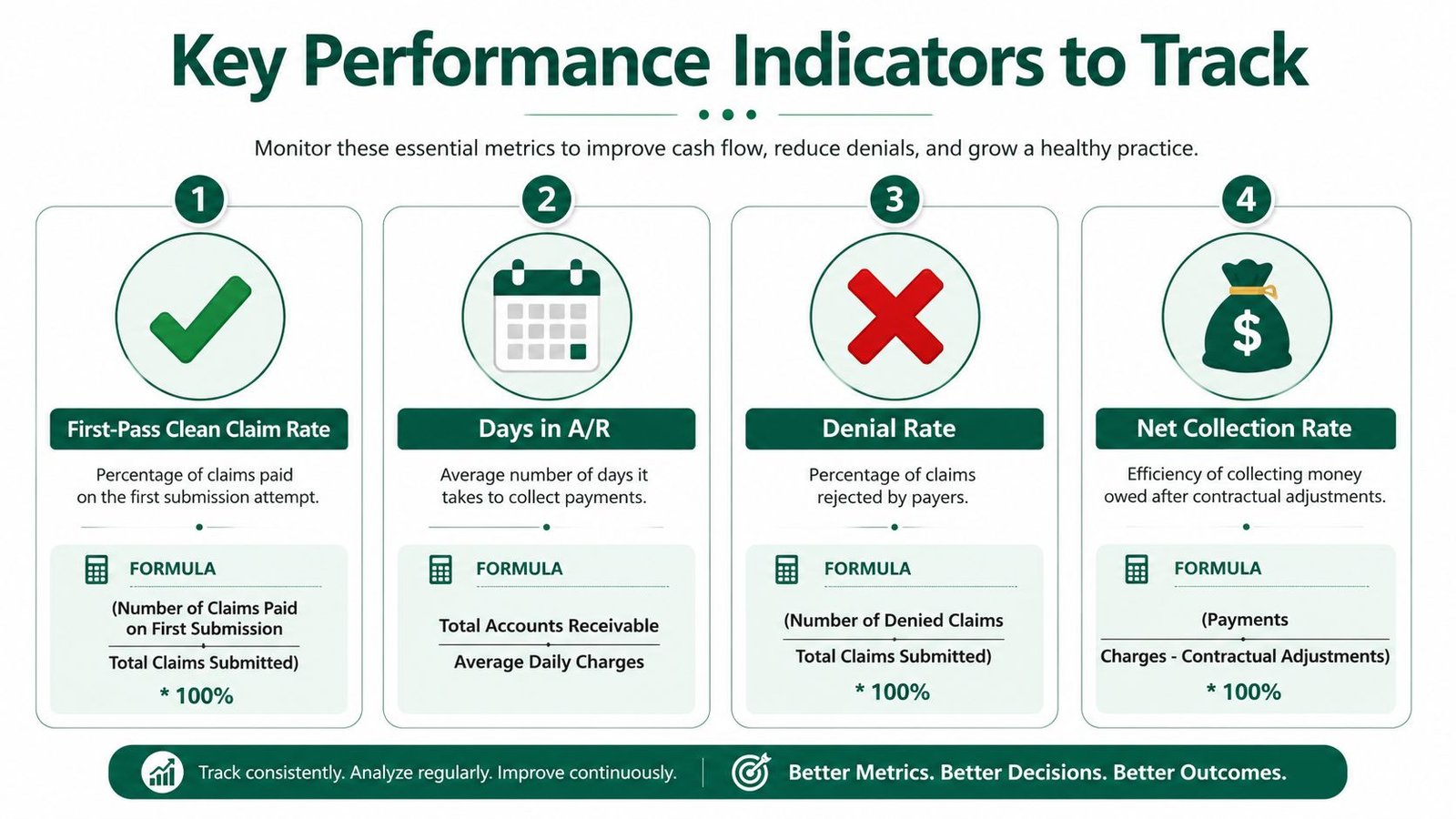
A group practice can stay busy, add providers, and still lose margin if billing performance is weak. Four KPIs show whether your billing partner is protecting revenue or letting cash slip through the cracks: first-pass clean claim rate, days in A/R, denial rate, and net collection rate.
The four metrics that matter
First-pass clean claim rate
Formula: (Number of Claims Paid on First Submission / Total Claims Submitted) * 100%
This measures how often claims get paid without edits, rework, or delay. In a group practice, that directly affects staffing load and weekly cash availability.Days in A/R
Formula: (Total Accounts Receivable / Average Daily Charges)
This shows how long earned revenue sits unpaid. If A/R days rise across one location or specialty, cash flow usually tightens before owners notice it in the bank account.Denial rate
Formula: (Number of Denied Claims / Total Claims Submitted) * 100%
This tracks preventable friction in your revenue cycle. For multispecialty or multi-location groups, denial rate should also be broken out by payer and service line, because one weak workflow can drag down the whole organization.Net collection rate
Formula: (Payments / Charges – Contractual Adjustments) * 100%
This shows whether the practice is collecting the revenue it is entitled to collect. A healthy posting team can make reports look clean. Net collection rate shows whether money is still being missed.
Benchmarks owners should use
Use benchmark ranges as a starting point, then compare each number by provider, payer, location, and specialty. A dermatology division, an ortho service line, and a pediatric office can produce very different denial patterns. One blended practice-wide average hides the problem.
As HFMA explains in its guidance on healthcare revenue cycle KPIs, clean claim rate, denial trends, A/R aging, and collection performance belong on the management dashboard because they tie directly to reimbursement speed and recovery. That matters even more in a hybrid model where the front desk is internal and claim follow-up is outsourced. If those teams are not measured against the same targets, cash slows down and no one owns the gap.
Here is the standard I recommend. Clean claim rate should stay high and stable. A/R days should trend down, not bounce around month to month. Denial rate should be low enough that your outside billing team is spending time on recovery and underpayments, not constant rework. Net collection rate should stay close to expected reimbursement after contractual adjustments. If one metric improves while another gets worse, your vendor is fixing optics, not performance.
Owner checklist: Require monthly KPI reporting by provider, payer, location, and specialty. If your billing company cannot segment results that way, it cannot manage a group practice well.
What to do with the numbers
Use KPIs to make financial decisions, not just review reports. If first-pass rate drops in one specialty, audit charge entry, modifier use, and documentation feedback for that service line. If A/R days improve but net collections stall, check for underpayments and weak follow-up on aged balances. If denials rise only in one office, the problem is often front-end eligibility or authorization discipline, not the billing platform.
The best hybrid billing setups turn KPI review into accountability. Internal teams own registration accuracy, copay capture, and schedule-side inputs. The outsourced billing partner owns coding accuracy, claim submission, denial recovery, and payer follow-up. Split the work that way, then score both sides against the same financial outcomes.
For a tighter reporting framework, use this guide on medical billing KPIs to track.
Onboarding and Pricing Models Explained
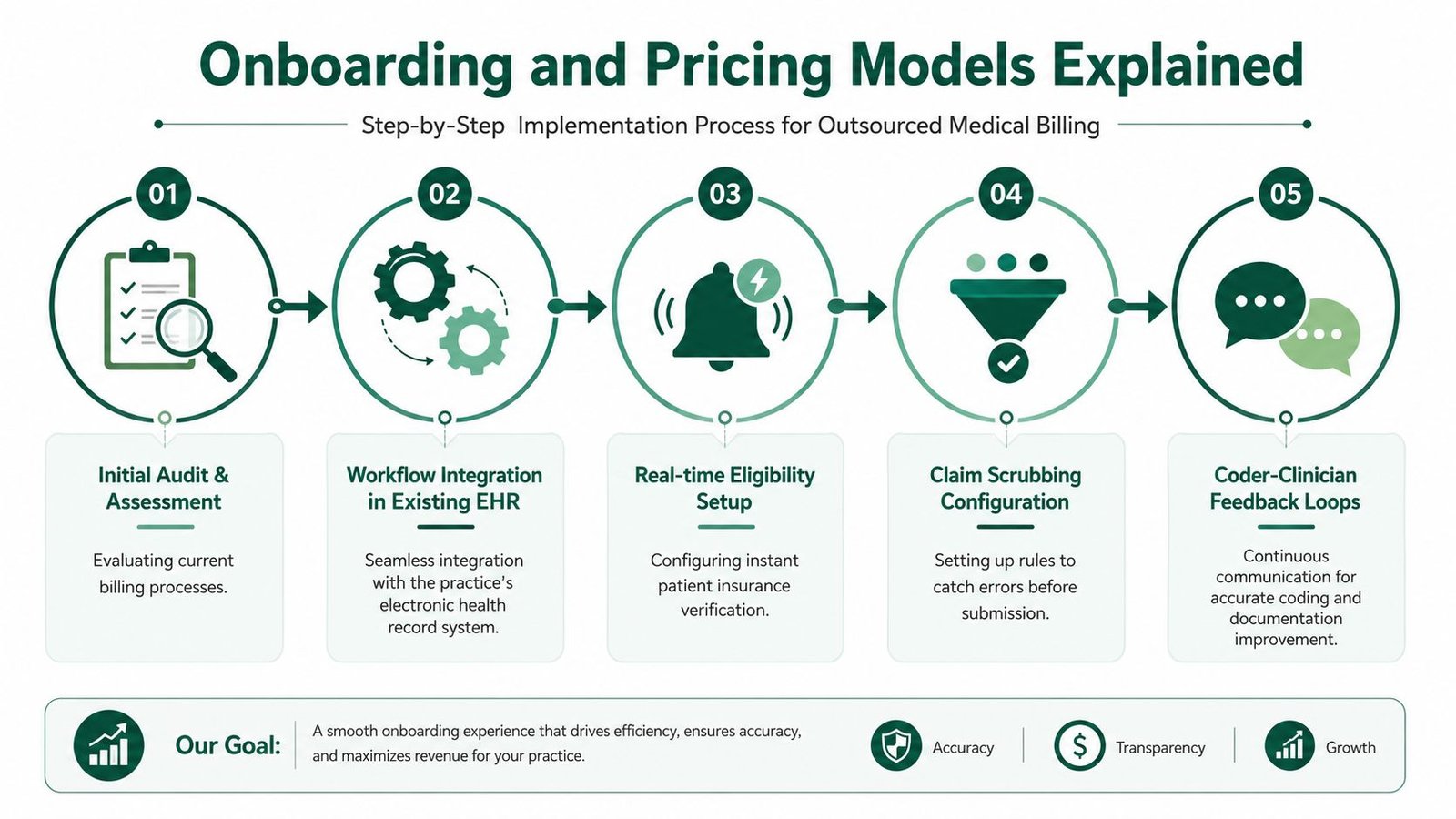
Billing transitions fail fast. A weak first 60 to 90 days can drag down cash for an entire quarter, which is why group practices should judge onboarding by how quickly it protects collections, not by how polished the sales presentation sounds.
The onboarding sequence that works
Start with a revenue audit tied to dollars at risk. Review charge lag, denial categories, A/R aging, authorization failures, modifier usage, payer edits, and underpayment trends by specialty. In a group practice, this matters because the leak is rarely uniform. Orthopedics may be losing money on surgical authorization gaps while primary care is bleeding cash through missed preventive billing opportunities.
Then map the handoffs. Define who owns scheduling inputs, eligibility checks, charge capture, coding review, claim submission, denial follow-up, patient balances, and underpayment appeals. Hybrid models work best when ownership is explicit. Your internal team should keep control of front-desk accuracy and patient-facing workflows. The outside billing partner should own the backend work that directly raises collections.
Keep your current EHR and PM stack unless the system itself is the problem. Replacing software during billing outsourcing creates avoidable friction, slows staff adoption, and usually hurts cash in the short term. The better approach for most group practices is to plug a billing partner into the existing workflow, then tighten edits, payer rules, and reporting around each specialty.
Coder to clinician feedback needs to be built in from day one. If one physician keeps missing documentation support for modifier -25, prolonged services, incident-to rules, or procedure level specificity, the billing partner should correct that pattern before it turns into recurring write-offs.
Full outsourcing versus hybrid
Group practices should not default to full outsourcing. They should choose the model that protects margin with the least operational disruption.
Full outsourcing makes sense when:
- Internal billing is already buried in old denials, stale A/R, and charge entry delays.
- The group has multiple specialties and one internal team cannot keep up with different coding and payer rules.
- Leadership wants one outside partner accountable for backend performance.
Hybrid usually wins when:
- Front office operations are stable.
- Patient intake, scheduling, and point-of-service collections are handled well internally.
- A significant problem sits in coding quality, denial recovery, payer follow-up, or specialty-specific claim edits.
For many physician groups, hybrid is the smarter first move. It keeps local control over the patient experience and hands the financially sensitive work to specialists. That structure is especially effective for multi-location groups where one specialty needs aggressive prior authorization oversight and another needs stronger follow-up on underpaid commercial claims.
Pricing benchmarks owners should know
Pricing only matters in relation to collections performance. A lower percentage fee is a bad deal if denials stay high, underpayments go untouched, or A/R drifts older every month.
Neolytix reports that outsourced billing commonly runs at a lower cost than maintaining a full in-house billing department when you account for labor, benefits, software, training, and turnover in the comparison of medical billing services cost. For group practices, that cost gap matters most when the vendor can improve speed to bill and specialty-level follow-up, not just replace headcount.
Rate structure usually follows complexity more than practice size. Primary care and behavioral health groups with cleaner claim patterns often get lower percentages than cardiology, orthopedics, pain management, or multi-specialty groups with heavier authorization, procedure coding, and denial workloads. You should expect pricing to reflect payer mix, claim volume, specialty complexity, and whether the vendor is taking on old A/R.
Do not accept a quote without asking what is excluded. Credentialing, patient statements, coding support, prior authorization work, legacy A/R cleanup, and underpayment appeals are often priced separately. A clear breakdown matters more than the headline rate. This practical guide to outsource medical billing cost is a good benchmark for comparing proposals.
Contract terms I'd negotiate hard
Push on operating terms before you sign.
Reporting scope
Require monthly reporting by provider, location, payer, and specialty. Group practices need segmented reporting because one underperforming service line can hide inside blended numbers.Defined workflow ownership
Spell out who handles payer enrollment, EDI setup, work queues, coding edits, denial classes, patient calls, and old A/R. If ownership is vague, cash will slip during go-live.Specialty coverage
The contract should name the specialties and claim types covered. “Multi-specialty experience” is not enough. You want proof they can handle your exact mix.Underpayment recovery
Make them explain how they identify contract variance and payer shortfalls. Groups with several specialties and contracts lose meaningful revenue here when nobody owns the analysis.Exit rights and data control
Keep termination terms simple. Your data, payer enrollments, and open A/R files should transfer without delay or extra drama.
One more operational detail gets missed during transitions. If onboarding includes retiring old scanners, desktops, or servers, treat device disposal as a compliance and revenue protection issue. IT asset disposition for healthcare is part of a clean handoff when legacy systems may still hold PHI tied to billing operations.
Ensuring Security and Spotting Vendor Red Flags
Security is not the boring part of vendor evaluation. It's the part that tells you whether the company is disciplined enough to manage your revenue. A billing partner touching PHI should operate with HIPAA-first controls, bank-level encryption, role-based access, audit logs, and a signed Business Associate Agreement before a single file moves.
What a serious vendor should already have
Ask for specifics, not reassurances.
- Business Associate Agreement: If they stall here, stop the process.
- Audit logging: You need a record of who touched what and when.
- SOC 2 or equivalent controls documentation: You're looking for evidence of operational maturity.
- Leadership oversight: A global back office can work well, but only if U.S.-based leadership owns quality, escalation, and compliance.
If your practice is also retiring hardware during a transition, don't overlook device disposal risk. Old workstations, scanners, and servers can still contain PHI. This overview of IT asset disposition for healthcare is a useful reminder that compliance extends beyond software and login policies.
Red flags that usually show up before performance problems
Opaque pricing is one. If the proposal is vague about what the percentage includes, expect add-on fees later. Another is generic specialty coverage. If the vendor says they “do all specialties” but can't discuss 93306, 90837, QK, -59, or orthopedic global periods in financial terms, they probably don't have real depth.
I also get wary when a vendor won't commit to a target clean-claim standard, won't define denial escalation, or avoids questions about underpayment variance. A billing partner should be comfortable discussing where money is lost after a clean claim pays short.
If a vendor can explain denials but can't explain underpayments, they're only managing half your revenue problem.
Ten questions every practice owner should ask
- What first-pass clean claim target do you manage to?
- How do you handle payer-specific edits and NCCI conflicts?
- Who reviews specialty-specific modifiers and global period issues?
- What is your process for real-time eligibility and re-verification?
- How do you identify underpayment variance against payer contracts?
- What reporting will I see by provider, payer, and location?
- How do you escalate denials tied to authorizations, COB, or medical necessity?
- Who owns old A/R during the transition period?
- What security controls protect PHI across your workflow?
- What happens operationally if we terminate the agreement?
A good vendor answers those questions directly. A weak one gives a polished demo and dodges the hard parts.
Summary and Frequently Asked Questions
For most independent groups, the decision isn't whether billing matters. It's whether the current operation is protecting revenue or draining it. Medical billing services for group practices work when they tighten the front end, improve claim accuracy, shorten A/R, and give leadership clean visibility into denials, underpayments, and collections.
The biggest mistake I see is treating outsourcing as an all-or-nothing decision. It isn't. Many groups should start with a hybrid model, keep patient-facing workflows in-house, and outsource backend coding, claim submission, denial management, and A/R follow-up. That approach fits how physician offices operate.
The second mistake is choosing on fee alone. A lower percentage doesn't help if the vendor lacks specialty depth, weakens clean claim performance, or misses payer variance after payment posts. Owners should evaluate billing partners by operational fit, reporting quality, security discipline, and their ability to manage the specialties your group performs.
Strong billing operations don't just collect faster. They make physician growth easier because the practice can trust what happens after the visit is documented.
How do I know if my group practice needs outsourcing or just tighter internal controls
Look at your denial patterns, charge lag, and A/R aging first. If the problems are limited and your front-end team is strong, a hybrid model may be enough. If denials are recurring across providers, coding accuracy is inconsistent, and unpaid claims are sitting too long, full backend outsourcing is usually the cleaner fix.
What should happen during the transition from my current billing setup
You need a controlled handoff of open claims, payer enrollments, user access, reporting, and ownership of old A/R. We've seen transitions go badly when no one defines who works denials already in process or who tracks payer responses during the cutover. Require a written implementation plan and weekly accountability during go-live.
How should I measure whether the new billing partner is performing well
Review first-pass clean claim rate, days in A/R, denial rate, and net collection rate every month. Don't accept summary reporting only. You need detail by provider, payer, and location so you can tell whether the billing partner is fixing root causes or just reshuffling work.
How do I keep patient billing transparent if I outsource backend RCM
Keep financial conversations and front-desk expectations inside the practice, especially if your team already handles those well. Outsource the backend mechanics, not the patient relationship. The best setups separate patient-facing communication from technical insurance follow-up so your staff keeps control of the experience while the billing team protects collections.
Happy Billing helps independent practices and specialty groups tighten revenue cycle performance without forcing EHR migrations or workflow chaos. If your denials are climbing, A/R is dragging, or you need a billing partner that understands specialty nuance and financial accountability, visit Happy Billing to evaluate your next move.