Medical Billing Services for Healthcare Providers: ROI Guide

Medical billing services for healthcare providers make financial sense when they recover more revenue, shorten A/R days, and reduce denials beyond what your in-house team can do at a lower total cost. That matters because U.S. physicians lose an estimated $125 billion annually due to billing mistakes, and approximately 80% of medical bills contain errors, with the average error on a bill over $10,000 costing $1,300 according to Aptarro's medical billing statistics overview.
For an independent practice owner, this isn't an abstract industry problem. It shows up as slower cash flow, more claims sitting in follow-up, and preventable write-offs when filing or appeal windows are missed. The right billing partner isn't just processing claims. They're protecting revenue that your practice already earned.
Why Your Practice Is Leaking Revenue Without You Knowing
Most physician-owners assume they'd notice a billing problem. In practice, the biggest losses are usually quiet. A modifier isn't validated before submission. A claim is filed correctly but not followed aggressively after payer silence. A denial sits in a work queue until the appeal window is gone. None of that looks dramatic day to day, but it adds up fast.
Medical billing services for healthcare providers exist because the revenue cycle is full of these failure points. When a practice hands billing to a specialist team, the goal isn't “outsourcing” alone. The goal is to stop revenue leakage at every stage, from eligibility and coding review to denial prevention, payment posting, and aged A/R follow-up.
Where owners usually lose money
We have seen revenue leak in four places more than anywhere else:
- Submission errors: Incorrect ICD-10, CPT, HCPCS, or modifier combinations trigger preventable rejections before payment ever starts moving.
- Unworked denials: Claims are denied, but nobody owns root-cause correction and resubmission with urgency.
- Missed payer deadlines: Medicare's timely filing rules and commercial payer filing windows don't forgive internal delays.
- Aged receivables: Old balances stay on reports, but they stop behaving like cash.
Aging reports tell the truth quickly. If you want a practical overview of how practice leaders use them for improving cash flow with aging reports, that framework is useful because it forces attention onto collectability, not just charges posted.
Billing should be judged by cash velocity
If your current billing setup produces acceptable collections but takes too long to get there, the business is still underperforming. Owners should care about how quickly earned revenue becomes usable cash. That's why Days in A/R matters as much as gross collections.
For a deeper look at that benchmark, this guide on Days in A/R for medical practices is worth reviewing before you compare any billing vendor or internal team.
Practical rule: If you can't explain where claims are sitting by payer, age bucket, and denial reason, you don't have billing under control. You have delayed visibility.
A solid billing service should be evaluated as a revenue acceleration system. If it plugs preventable errors, tightens follow-up discipline, and turns old receivables into recoverable dollars, it's not overhead. It's one of the few operational decisions that can improve profitability without adding a single patient visit.
The Core Components of a Complete Billing Service
A complete service works like a financial immune system for the practice. It catches problems before they become denials, responds quickly when payers push back, and keeps old balances from turning into write-offs.
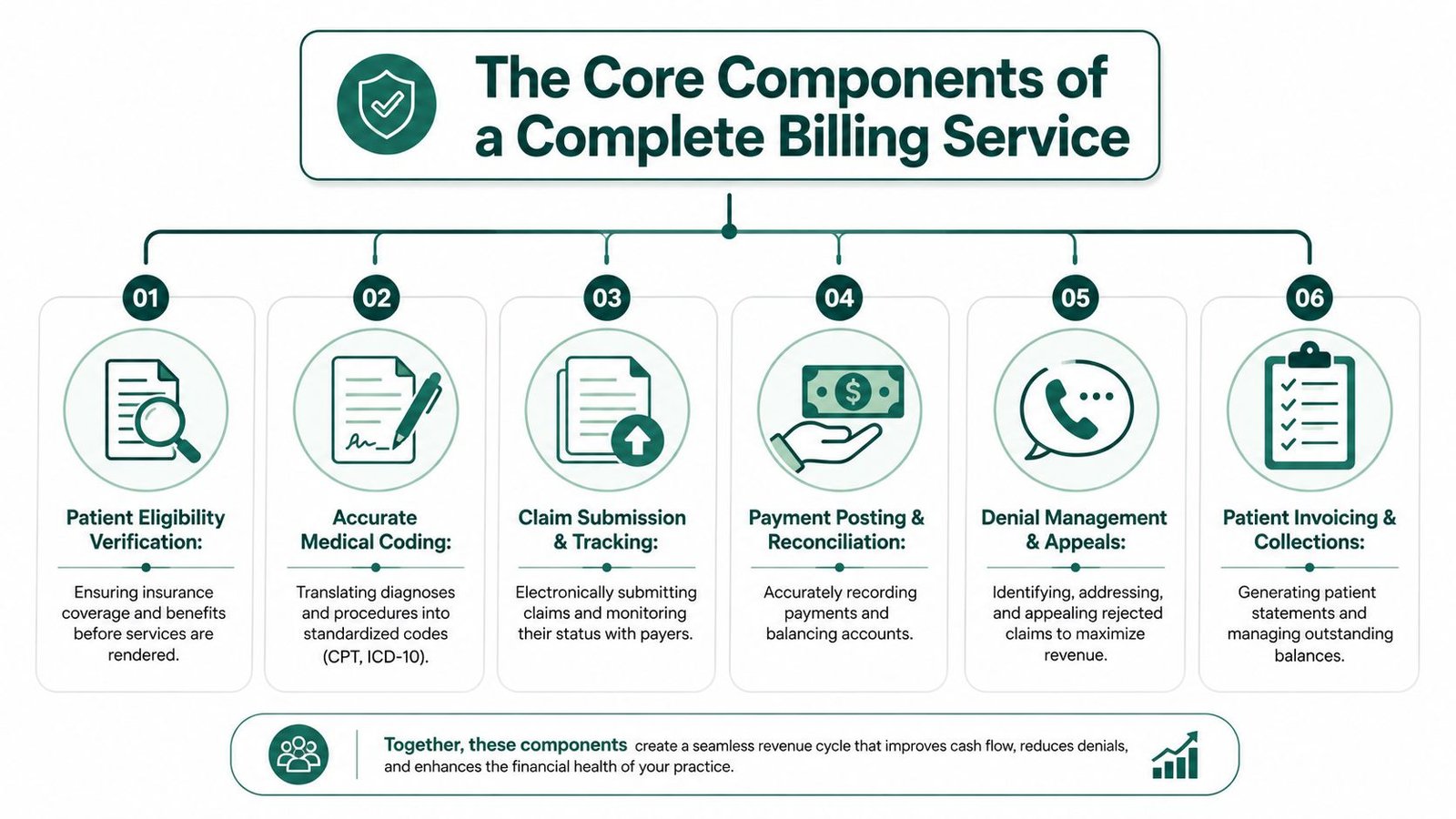
The operating model is broader than charge entry and claim submission. A full-cycle partner should manage the flow from front-end verification through final payment and follow-up. If you need a concise refresher on the full framework, this overview of revenue cycle management in medical practices is a useful baseline.
Full-cycle RCM
Full-cycle RCM means the billing team owns the claim after the visit is documented. That includes eligibility review, charge capture, coding review, claim submission, payment posting, underpayment checks, patient balance transfer where appropriate, and payer follow-up.
Standards matter. High-performing practices rely on ANSI X12 837 for claim submission, 835 for payment processing, and proper use of CARC and RARC codes to identify and resolve payment issues before they become repeat denials. CMS rules, payer edits, and AAPC coding standards all affect whether revenue moves cleanly or stalls.
Denial prevention is worth more than denial appeal
Most vendors talk about denial management as if appeal work is the main value. It isn't. The bigger value is prevention.
A 1% increase in the claim denial rate directly adds 15 to 30 days to A/R, and the industry average denial rate reached 11.8% in 2024, which means nearly 12% of total revenue is lost or delayed before recovery work even begins. Left unresolved, denials can erode margins by up to 5% of net patient revenue annually, based on Qualigenix's A/R analysis for medical billing.
That's why the best teams focus on pre-submission edits, payer-specific rules, modifier logic, and documentation validation. In telehealth-heavy practices, for example, validating modifiers like 95 or GT before submission can be the difference between clean payment and avoidable delay.
Claims teams that only “work denials” are reacting too late. The stronger model prevents avoidable denials before the clearinghouse ever sees the claim.
For practices exploring automation, tools like an AI agent for medical records are useful to understand because they show the difference between passive flagging and systems that can actively review records for billing risk before submission.
A/R recovery and credentialing
A/R recovery is different from routine billing follow-up. It requires disciplined prioritization by payer, age, denial reason, and appeal status. Once receivables age badly, the collection effort gets harder and the practice's working capital gets tighter.
Credentialing belongs in this conversation too. An enrollment lapse or payer participation issue doesn't look like a coding problem, but the financial effect is the same. Claims hold. Payments stop. Cash flow gets hit. We have seen physician-owners blame the billing team for reimbursement slowdowns that started with payer enrollment or provider file issues.
A complete billing service should own both the mechanics and the accountability. If no one is responsible for the entire chain, leakage becomes everyone's problem and no one's metric.
Key Metrics That Measure Billing Performance
Most billing reports are full of activity metrics that sound impressive and tell you almost nothing. Practice owners don't need more dashboards. They need a short list of numbers that connect directly to cash flow, speed, and collectible revenue.
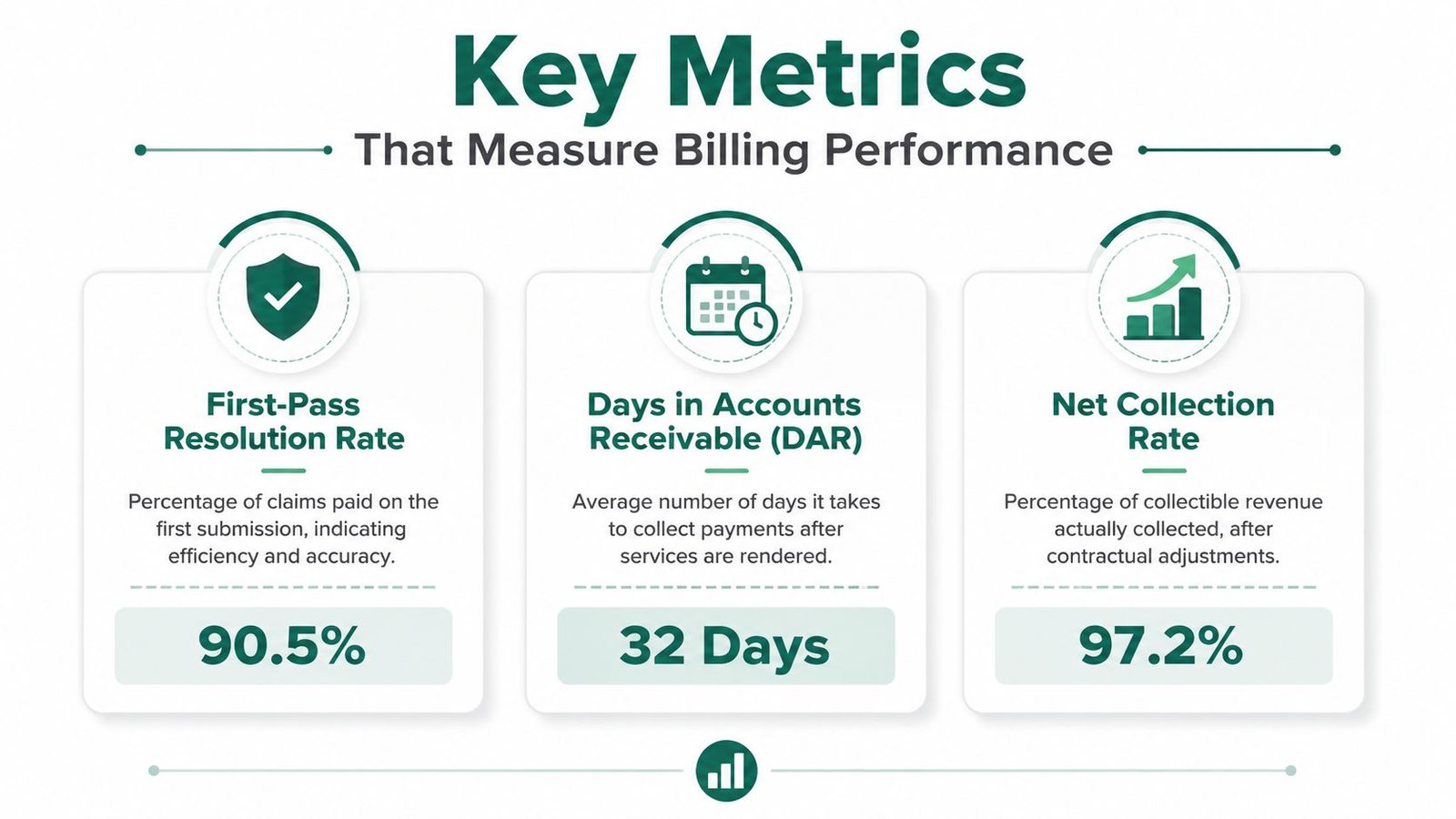
Three KPIs matter more than the rest.
Clean claims and why first-pass matters
The first is your first-pass clean claim rate. If too many claims need rework after the initial submission, your team is spending labor to fix avoidable mistakes instead of accelerating collections.
In practical terms, first-pass performance depends on disciplined use of payer edits, EDI standards, and automated claim scrubbing. Manual coding mistakes in ICD-10, CPT, and HCPCS remain a primary cause of rejection. That's why owners should ask not only for the clean claim rate, but also for the process behind it.
Days in A/R and adjusted collection rate
The second KPI is Days in A/R. The benchmark for strong performance is 30 to 40 days, and the third KPI is adjusted collection rate above 95%, according to Stripe's medical billing RFP guidance. Those two numbers tell you whether your practice is converting earned revenue into cash within a healthy time frame and whether you are collecting what is collectible after contractual adjustments.
That's a much better lens than looking at gross charges or total payments in isolation.
A scorecard owners can actually use
For practice owners, this is the dashboard that matters:
- First-pass clean claim rate: Shows whether your front-end billing process is accurate enough to avoid rework.
- Days in A/R: Shows how quickly revenue becomes cash.
- Adjusted collection rate: Shows whether the practice is collecting the money it should collect.
If you want a practical KPI list to compare an internal team with an external vendor, this resource on medical billing KPIs to track gives a useful operating checklist.
Owner's test: If a billing company can't show you its definition of clean claim rate, adjusted collection rate, and A/R days, it probably doesn't manage to those numbers with discipline.
Vanity metrics create false comfort. Real billing performance is visible in speed, collectability, and how little revenue gets trapped in preventable friction.
How Billing Challenges Vary by Medical Specialty
Generic billing support usually breaks at the specialty level. The claims may still go out, but reimbursement quality drops because the team misses the rule nuances that drive payment.

A family medicine workflow is not an anesthesiology workflow. Behavioral health is not cardiology. Orthopedics is not pain management. The financial risk changes with the specialty because the denial patterns are different.
Behavioral health and mental health
Behavioral health is one of the clearest examples. Authorization failures cause 20% of all claim denials, and in mental health, session-by-session prior authorization is often mandatory. Failing to obtain authorization 3 to 5 days early can guarantee a denial, and coding errors tied to session length, such as CPT 90837 versus 90834, are a primary denial driver according to Dr. Biller RCM's review of hospital A/R challenges.
For an owner, the lesson isn't “code more carefully.” It's that your revenue depends on building operational controls around authorization timing and documentation specificity. If your therapists document loosely and your billing team submits late, you don't have a coding issue. You have a margin issue.
Anesthesiology and cardiology
In anesthesiology, small misses can distort payment fast. Time units, base units, concurrency, and modifiers such as QK all affect what the payer will allow. A team that doesn't understand medical direction rules can submit technically complete claims that still underperform financially.
Cardiology creates a different kind of risk. Diagnostic testing, interventional procedures, imaging services, and payer-specific modifier use all require specialty familiarity. Documentation has to support not just the CPT code, but the clinical necessity and modifier logic behind it. Owners comparing vendors should ask for examples from their exact subspecialty, not just “cardiology experience.”
For a closer look at those challenges, this guide to cardiology revenue cycle management is worth reviewing.
Why specialty expertise changes the economics
We have seen the same pattern repeatedly. A generalist billing team may keep the process moving, but a specialty-aware team protects revenue by catching issues before they hit the payer. That difference shows up in denials, underpayments, and A/R aging.
If your practice has specialty-specific exposure, you should evaluate billing partners by specialty depth first. The broad directory of specialty billing support across practice types is the right way to think about the market. Start with whether the team understands your claims, not whether they gave the lowest fee quote.
Evaluating and Selecting the Right RCM Partner
Choosing an RCM partner is a business decision with long-term effects on cash flow, staff workload, and owner visibility. Price matters, but it shouldn't be the first filter. A low-fee vendor that creates more denials or weakens follow-up discipline is expensive in the ways that matter most.
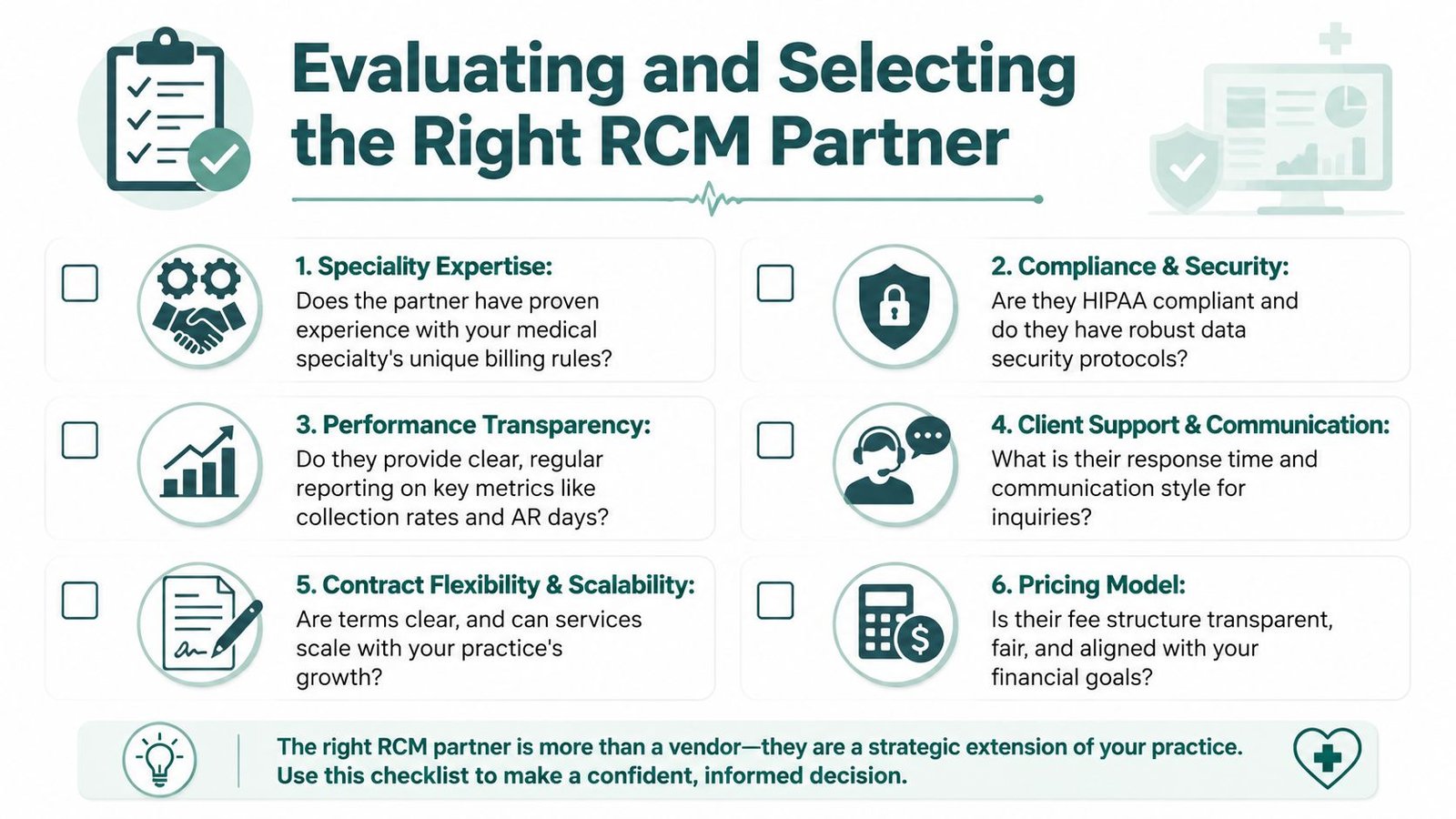
The non-negotiables
Start with these questions:
- Security and compliance: Are they HIPAA-first, with strong PHI controls and clear escalation protocols?
- EHR compatibility: Can they work inside your current system, or are they attempting to force a migration?
- Specialty familiarity: Do they understand your payer mix, your common CPT sets, your modifier exposure, and your denial profile?
- Reporting discipline: Will they report performance in owner-level metrics, not just billing department activity?
- Communication model: Who owns your account, how often do they meet with you, and how are unresolved issues escalated?
A strong partner should also understand payer rules well enough to protect hard deadlines. Medicare's timely filing limit is 12 months, while many commercial payers require filing within 90 to 180 days. Once denied, up to 90% of denied claims are recoverable if appealed within the payer's window, and high-acuity specialties using structured appeals can achieve overturn rates above 60%, according to Medical Billers and Coders on revenue recovery in medical billing services. If a vendor can't explain how it tracks those windows, you're not hiring a revenue partner. You're hiring a submission vendor.
Pricing and break-even math
The break-even question is simple. Compare your total in-house billing cost against the outsourced fee, then factor in whether the partner improves collections and lowers billing overhead.
The market benchmark matters here. Full-service RCM yields an average 11.6% revenue increase and a 16.9% reduction in billing costs for small practices, while solo practices often pay roughly 10% to 12% of collections to vendors, based on DrCatalyst's medical billing service cost analysis.
Here's a decision model you can use without inventing assumptions.
| Cost Component | In-House (Annual Cost) | Outsourced (Annual Cost) |
|---|---|---|
| Billing staff salaries and coverage | Your actual cost | Included in vendor fee |
| Payroll taxes and benefits | Your actual cost | Included in vendor fee |
| Billing software and clearinghouse | Your actual cost | Often included or reduced |
| Training and turnover risk | Your actual cost | Shifted to vendor |
| Management oversight time | Your actual cost | Reduced, but not eliminated |
| Vendor fee as % of collections | N/A | Usually roughly 10% to 12% of collections |
| Revenue lift from stronger RCM | N/A | Potentially positive if partner performs |
| Billing cost reduction | N/A | Potentially positive if partner performs |
If your internal cost is already near the outsourced fee range, the partner doesn't need dramatic gains to win the comparison. It only needs to improve clean submissions, reduce denials, and shorten follow-up enough to create net cash flow improvement.
For vendor shortlisting, this breakdown of what to look for in the best medical billing company for your practice is a practical next step.
Don't buy on fee percentage alone. Buy on whether the partner can outperform your current cost structure and cash conversion speed.
Your Implementation Checklist and Common Pitfalls
A billing transition succeeds or fails in the first operational handoff. The contract is the easy part. The hard part is getting claims, payer rules, workflows, and accountability aligned without disrupting cash flow.
Implementation checklist
Use this sequence when you bring on a new billing partner:
- Define ownership early: Name the internal physician-owner or administrator who approves workflow decisions and escalations.
- Map the current process: Document how charges enter the system, who reviews notes, how denials are routed, and where payer follow-up lives today.
- Set reporting rules: Decide what you'll review weekly and monthly. Keep it focused on owner-level metrics.
- Confirm system access: EHR, PM system, clearinghouse, payer portals, ERA access, and credentialing files should be validated before the first live submission cycle.
- Review payer-specific risk points: Telehealth modifiers such as 95 or GT, authorization-heavy services, anesthesia concurrency rules, and specialty-specific edits should be identified upfront.
- Validate sample claims: Test live workflows before assuming the handoff is clean.
- Lock communication cadence: Weekly operational calls early on prevent small issues from becoming A/R problems.
Common mistakes that hurt the transition
We have seen the same issues derail otherwise good partnerships:
- Expecting instant A/R cleanup: Old receivables often need staged recovery, not a quick cosmetic improvement.
- Leaving the front desk out of the process: Eligibility errors, demographic mistakes, and authorization gaps often begin before the claim exists.
- Changing too many workflows at once: New billing partner, new templates, and new internal processes at the same time usually creates confusion.
- Ignoring documentation discipline: If physicians and mid-levels aren't documenting with payer scrutiny in mind, the billing team inherits weak source material.
- Treating reports as optional: If no one reviews denial reasons, payer trends, and aged A/R consistently, the practice loses the benefit of outsourcing.
What a smooth start looks like
The best implementations feel controlled, not flashy. The billing partner asks detailed questions, requests access methodically, and flags risk points before they create denials. Owners should expect a transition plan, not promises.
A good partner doesn't just “take over billing.” They reduce uncertainty, create accountability, and give the practice a clearer line of sight into revenue.
Frequently Asked Questions from Practice Owners
How do I know if outsourcing billing will actually pay for itself
Start with your current total in-house cost, not just salary. Include software, clearinghouse fees, management time, coverage during staff absence, turnover risk, and what unresolved denials are doing to cash flow. Then compare that to a percentage-based outsourced fee and ask whether the partner can improve collections, reduce billing costs, and shorten A/R enough to create a net gain. If your internal costs are already close to the outsourced range, the break-even point is often closer than owners expect.
What should I ask a billing company before signing
Ask how they define clean claim rate, adjusted collection rate, and Days in A/R. Ask how they handle timely filing, payer appeals, and authorization-heavy workflows. Ask whether they work inside your current EHR and whether they have specialty experience with your common CPT codes and modifiers. If the answers stay generic, keep looking.
Will outsourcing mean losing control of the revenue cycle
Not if the arrangement is built correctly. Good outsourcing increases owner control because reporting becomes clearer and accountability becomes easier to enforce. The practice should still control policy decisions, documentation expectations, payer contracting priorities, and escalation thresholds. The vendor should own execution and transparency.
Which practices benefit most from medical billing services for healthcare providers
Independent practices usually benefit most when they have one or more of these problems: growing denial pressure, slow A/R, specialty-specific billing complexity, weak denial follow-up, or too much dependence on one internal billing employee. Practices with authorization-heavy services, complex modifiers, and payer-specific workflows usually gain the most from specialized support because the operational errors are more expensive.
If you want a clearer answer than “outsourcing might help,” get an objective baseline first. Happy Billing helps independent practices evaluate denial risk, A/R drag, specialty-specific billing exposure, and the break-even point between in-house costs and outsourced RCM. A practical place to start is their free billing audit for physician practices.