Mastering Days in AR: Strategies to Optimize Cash Flow in 2026

Days in Accounts Receivable (AR) is a key performance indicator that measures the average number of days it takes a medical practice to collect payment after providing a service. Top-performing practices maintain a Days in AR under 35, which signifies a healthy revenue cycle and predictable cash flow, while the industry average languishes between 45-60 days. A lower number is critical because it means your earned revenue is quickly converted to cash, enabling you to pay staff, invest in equipment, and fund practice growth.
Think of it as the time your earned money spends trapped in paperwork instead of sitting in your bank account. A high number is a major red flag, signaling that your working capital is stuck in unpaid claims, which directly threatens your practice's financial stability.
What Are Days in AR and Why This Metric Matters

Days in AR is your practice's financial pulse. Just like a physician checks vitals to assess a patient's health, a practice manager must watch this metric to diagnose the health of the revenue cycle. Every single day a claim sits unpaid is a day you can't use that cash to pay staff, invest in new equipment, or fuel growth.
The formula itself is straightforward, but its implications are profound.
Total Accounts Receivable ÷ Average Daily Charges = Days in AR
This simple calculation tells a powerful story about your operational efficiency. It reveals how quickly your team submits claims, how effectively they fight denials, and how well they collect from both payers and patients. A stubbornly high Days in AR almost always points to deeper, often hidden, problems in your billing workflow.
Benchmarks for Success
Knowing your number is the first step, but what does it actually mean? Context is everything. Industry benchmarks show that top-performing practices keep their Days in AR under 35 days.
Meanwhile, the national average languishes between 45-60 days. The difference isn't just 20 days on a calendar; it's 20 days of missing cash flow that should be funding your operations.
This isn't just theoretical. A 2026 MGMA report found that practices with optimized RCM processes cut their Days in AR by an average of 22%. For high-volume groups, that translated into millions in accelerated and recovered revenue. Monitoring this metric alongside other key indicators is fundamental to financial health. For a full picture, you can check out our guide on the most important medical billing KPIs to track.
This table breaks down what those numbers look like in the real world.
Days in AR Performance Benchmarks
| Performance Tier | Average Days in A/R | Impact on Cash Flow |
|---|---|---|
| Top Performing | Below 35 Days | Healthy & Predictable: Cash flow is consistent, enabling strategic investments and growth. |
| Average | 45-60 Days | Constrained: Cash flow is tight, creating budget uncertainty and delaying important expenses. |
| Underperforming | Over 60 Days | Critical: The practice is starved for cash, facing significant operational and financial risk. |
Ultimately, a low Days in AR is a direct reflection of a high-performing billing operation. It proves you have a team that prevents errors before they happen, manages denials with surgical precision, and ensures you get paid fully and on time, every time.
How to Accurately Calculate Your Practice's Days in AR

Before you can control your Days in AR, you have to measure it. While the formula itself is straightforward—divide your total accounts receivable by your average daily charges—an accurate calculation is another story. The real work is in using the right numbers, because a sloppy formula can hide serious revenue cycle problems behind a misleadingly low number.
The key is getting both sides of the equation right. It’s the only way to get a true measure of your financial velocity and an honest look at how long your earned revenue sits uncollected.
(Total Accounts Receivable ÷ Average Daily Charges) = Days in AR
Getting this number right isn't just a bookkeeping exercise. It's a non-negotiable metric for effective practice management.
Finding Your Total Accounts Receivable
Your total AR is the sum of all money owed to your practice for services you've already delivered. You can find this figure in your practice management (PM) system or billing software, usually on a main financial dashboard or within a dedicated AR aging report.
But here’s a critical adjustment most practices miss: you must subtract any credit balances from your total AR. Credit balances are overpayments you owe back to patients or payers. Including them in your calculation artificially deflates your AR, making your Days in AR look better than it really is.
An honest calculation only reflects what is truly owed to you.
Calculating Average Daily Charges
Next, you need to calculate your average daily charges. This figure represents the average dollar amount of services your practice bills for each day. Using a standard look-back period is essential to smooth out the natural peaks and valleys of your billing cycle.
The industry standard, and our firm recommendation, is to calculate this over the past 90 days. A 30-day window is too short and can be easily skewed by a single busy week. On the other hand, a 180-day period might not reflect recent, important shifts in your payer mix or service volumes.
Here’s how to get a stable, reliable daily average:
- Sum the total charges posted for the last 90 days.
- Divide this total by 90.
This gives you the solid daily average you need to plug into the Days in AR formula.
Worked Example: An Orthopedic Practice
Let's walk through an example for a hypothetical orthopedic practice to see how this works in the real world. A specialty practice like orthopedics, which handles high-value procedures, must have a firm grasp on its cash cycle. For a deeper look at the unique challenges different specialties face, you can explore our insights on our specialties page.
Here are the numbers for our example practice:
- Total Accounts Receivable: $1,500,000 (this is the true AR, after subtracting credit balances)
- Total Charges for the Past 90 Days: $2,700,000
First, we calculate the average daily charges:
$2,700,000 ÷ 90 days = $30,000
Now, we can calculate the Days in AR:
$1,500,000 ÷ $30,000 = 50 Days
The result—50 days—gives the practice manager a clear, actionable benchmark. It shows that while they are performing around the industry average, there's a significant opportunity to improve cash flow by tightening up their collection timeline.
Why Are Your Days in A/R So High? It's Your Specialty.
High days in A/R are never a single, isolated failure. They're a symptom of deeper, specialty-specific problems clogging your revenue cycle like sludge in a pipe. A one-size-fits-all approach to A/R is doomed to fail because the billing headaches for an anesthesiology group are entirely different from those facing a mental health clinic.
If you want to unclog your cash flow, you have to understand where the blockages specific to your field are hiding. A bloated A/R isn't just an administrative annoyance; it's a direct threat to your practice's financial health. Every unpaid claim is earned revenue you can't use for payroll, new equipment, or growth. The root causes are often hiding in plain sight, embedded in the daily coding and billing decisions unique to your practice.
Anesthesiology: The Math of Modifiers and Minutes
For anesthesiology practices, high A/R is almost always tied to the complex math of billing for time and the proper use of concurrency modifiers. Anesthesiologists bill for a combination of base units (procedure complexity) and time units. A simple data entry error—like logging 45 minutes instead of 60—is a direct, unforced revenue cut that can also trigger payer audits.
Even more common are mistakes with concurrency modifiers. These codes tell the payer how many cases the anesthesiologist was medically directing at once.
- Modifier QK: Medical direction of two, three, or four concurrent anesthesia procedures.
- Modifier QY: Medical direction of one resident or CRNA by an anesthesiologist.
Filing a claim with the wrong modifier—QK instead of QY, or vice versa—is a guaranteed denial or a request for more information. That one mistake sends the claim straight to A/R limbo, where it sits for weeks, aging your accounts and strangling your cash flow.
Mental Health: The Prior Authorization Bottleneck
Mental health practices face a completely different primary obstacle: prior authorizations. Many payers demand pre-approval for ongoing services like psychotherapy, especially for high-frequency CPT codes like 90837 (psychotherapy, 60 minutes). A slip-up at this first step creates a chain reaction of denials that are brutal and time-consuming to overturn.
When front-office staff fail to secure or correctly document a prior authorization, the resulting claim denial is almost immediate. This single administrative breakdown is a leading cause of inflated A/R days in behavioral health, turning predictable revenue into a lengthy appeals battle.
This isn't just a paperwork problem. It's a systemic breakdown where each denial for a missing authorization adds weeks, if not months, to the collection timeline.
Cardiology and Orthopedics: The Modifier 25 & 59 Minefield
For procedure-heavy specialties like cardiology and orthopedics, modifier usage is a constant battleground. These practices routinely perform Evaluation and Management (E/M) services on the same day as a minor procedure or conduct multiple distinct procedures in the same patient encounter.
This is where modifier 25 and modifier 59 become absolutely critical.
- Modifier 25: Bills for a significant, separately identifiable E/M service performed by the same physician on the same day as a minor procedure.
- Modifier 59: Identifies a distinct procedural service that isn't normally reported with another service but is appropriate under the circumstances.
Payers scrutinize these modifiers with extreme prejudice. If you append modifier 25 to an E/M service that wasn't truly separate from the pre-operative work, you'll get a denial. If you use modifier 59 on a bundled service without rock-solid documentation proving it was a distinct procedure, you'll get a denial. These aren't just payment delays; they are costly, time-wasting denials that require significant effort to fix. To build a process that avoids these traps, you need a disciplined approach, which you can read about in our guide to improving medical billing denial management.
The data shows a clear line between these coding nuances and poor A/R performance. For specialties like dermatology and gastroenterology that also fight with modifier compliance, Days in A/R averaged 62 days in 2026, driven by an 18% E/M coding error rate. Happy Billing's Texas-headquartered approach gets practices under 35 days by targeting these specialty-specific bottlenecks, like the authorization issues in mental health where 25% of delays originate. You can read more about the history of such challenges by reviewing this timeline of events in Arkansas.
For a deeper dive into billing solutions designed for your field, explore our guides at happybilling.co/specialties/.
Actionable Strategies to Reduce Your Days in AR
Ready to take control of your cash flow? Bringing your Days in AR down isn’t about working harder—it’s about having a smart, disciplined plan that attacks weaknesses across your entire revenue cycle. It's about preventing revenue leaks before they happen and methodically pursuing every dollar you're owed.
This isn't just about chasing old, dusty claims. The best approach combines rock-solid front-end processes, an intelligent follow-up system, and deep, payer-specific knowledge. When you get this right, your A/R stops being a financial drag and becomes a fast-moving, predictable asset.
Strategy 1: Hit a 98%+ Clean Claim Rate
The fastest way to slash your Days in AR is to get paid on the first submission. A clean claim rate of 98% or higher should be your non-negotiable benchmark. Hitting this target cuts out the automatic 30-day delay that a simple denial triggers. It all comes down to painstaking diligence on the front end.
It starts with 100% insurance eligibility and benefits verification for every patient, every single time. Before a patient is even seen, your front desk must confirm active coverage, know the co-pay and deductible status, and check if a prior authorization is needed. This one step stops a huge chunk of front-end denials dead in their tracks.
Next, you need a powerful claim scrubbing process. Modern billing partners use AI-powered software that works like an expert auditor, checking every claim against millions of payer rules before it ever goes out the door. This tech catches the tiny errors a human eye will almost always miss:
- Incorrect patient demographic information
- Mismatched diagnosis and procedure codes
- Invalid CPT or ICD-10 codes
- Missing or wrong modifiers based on specific payer rules
Think of AI claim scrubbing as the final quality control checkpoint for your revenue. By catching and fixing errors before a claim leaves your system, you bypass the entire denial-and-appeal cycle—the primary engine driving up Days in AR.
This proactive discipline means your claims fly through adjudication, and payment lands in your bank account in weeks, not months.
Strategy 2: Launch an Aggressive and Intelligent A/R Follow-Up
Even with a near-perfect clean claim rate, some claims will get denied or stuck. A relentless, data-driven follow-up strategy is your tool for recovering this money quickly. Waiting for a claim to hit 90 or 120 days old is just a recipe for a write-off.
Instead, you need a structured follow-up timeline based on a claim’s age. This system ensures no unpaid claim ever falls through the cracks.
- Day 21: If a claim isn’t paid, your team makes the first move. Check the payer portal. If it's pending, find out why. If it’s been denied, start the appeal process immediately.
- Day 45: For any claim still sitting unpaid, it's time to escalate. This means a phone call to the payer's provider relations team to pinpoint the hold-up and get a clear timeline for payment.
- Day 60: Any claim hitting this age needs senior-level intervention. These accounts are a major risk and demand urgent attention before they cross the 90-day mark, where your chance of collecting plummets.
To make this work, segment your A/R for follow-up. Don't just work an alphabetical list. Prioritize your accounts by payer and balance, focusing your team's energy where it will deliver the biggest financial return. For a complete blueprint on optimizing your entire workflow, grab our detailed Revenue Cycle Management Checklist.
Strategy 3: Master Payer Rules and Build a Knowledge Base
Payers don’t play by a single rulebook. How UnitedHealthcare handles a claim with modifier 25 is often totally different from how Aetna or Blue Cross Blue Shield does. Failing to master these tiny differences is a massive source of preventable denials that keep your Days in AR stubbornly high.
Your practice has to build and maintain an internal knowledge base that documents these payer-specific quirks. This should be a living document and the go-to resource for your entire billing team.
Example Payer Rule Differences
| Payer | Rule for Modifier 25 (E/M with a Procedure) | Common Pitfall |
|---|---|---|
| UnitedHealthcare | Requires documentation to clearly prove the E/M service was separate and well beyond the usual pre-op care. | Automatically denying claims without a human review, which forces you into an appeal. |
| Aetna | Scrutinizes the diagnosis codes tied to the E/M vs. the procedure to confirm medical necessity for both. | Insufficiently detailed provider notes that fail to justify a separate service. |
| Cigna | Often bundles the E/M service if notes don't explicitly state the time spent or the distinct nature of the counseling. | Using generic documentation templates that don't capture the unique details of the encounter. |
When you document these rules and train your team on them, you stop reacting to denials and start preventing them altogether. This expert-level approach—combining AI for speed with human oversight for complex issues—is the key to keeping your Days in AR consistently low and your cash flow strong.
The Financial Impact of Lowering Your AR Days
Shrinking your Days in AR isn't just about cleaning up a spreadsheet. It’s about injecting a massive, one-time cash infusion directly into your practice’s bank account. This is where a high-performance revenue cycle stops being a concept and starts funding real growth.
Let’s put some real numbers on this. Picture a mid-sized cardiology practice bringing in $10 million in annual revenue. Their Days in AR is 55 days—a common, but financially draining, figure.
Using the standard formula, their total outstanding accounts receivable is a staggering $1,506,849.
(Annual Revenue / 365 Days) x Days in AR = Total Accounts Receivable
($10,000,000 / 365) x 55 = $1,506,849
That’s over $1.5 million in earned money that's just sitting there, tied up in billing limbo. It's revenue you've worked for but can't use.
Now, watch what happens when they get serious about RCM for physician practices and drive their AR days down to a top-tier benchmark of 31 days.
The ROI of Speed
The math doesn't lie. By slashing their collection time, the practice’s new outstanding A/R plummets.
($10,000,000 / 365) x 31 = $849,315
The difference? A one-time cash flow surge of $657,534. This isn't theoretical profit. It’s cold, hard cash freed up to work for the practice.
This kind of working capital is a game-changer. Suddenly, strategic moves that were once out of reach are on the table.
- Fund New Technology: Buy that new diagnostic imaging machine without taking on expensive debt.
- Improve Physician Compensation: Offer competitive bonuses and salary bumps to keep your best people.
- Expand Services: Invest in a new satellite clinic or add a profitable service line.
- Build a Financial Cushion: Create a robust cash reserve to navigate economic shifts or surprise payer policy changes.
Achieving this kind of reduction isn't magic. It's the result of a disciplined, repeatable process.
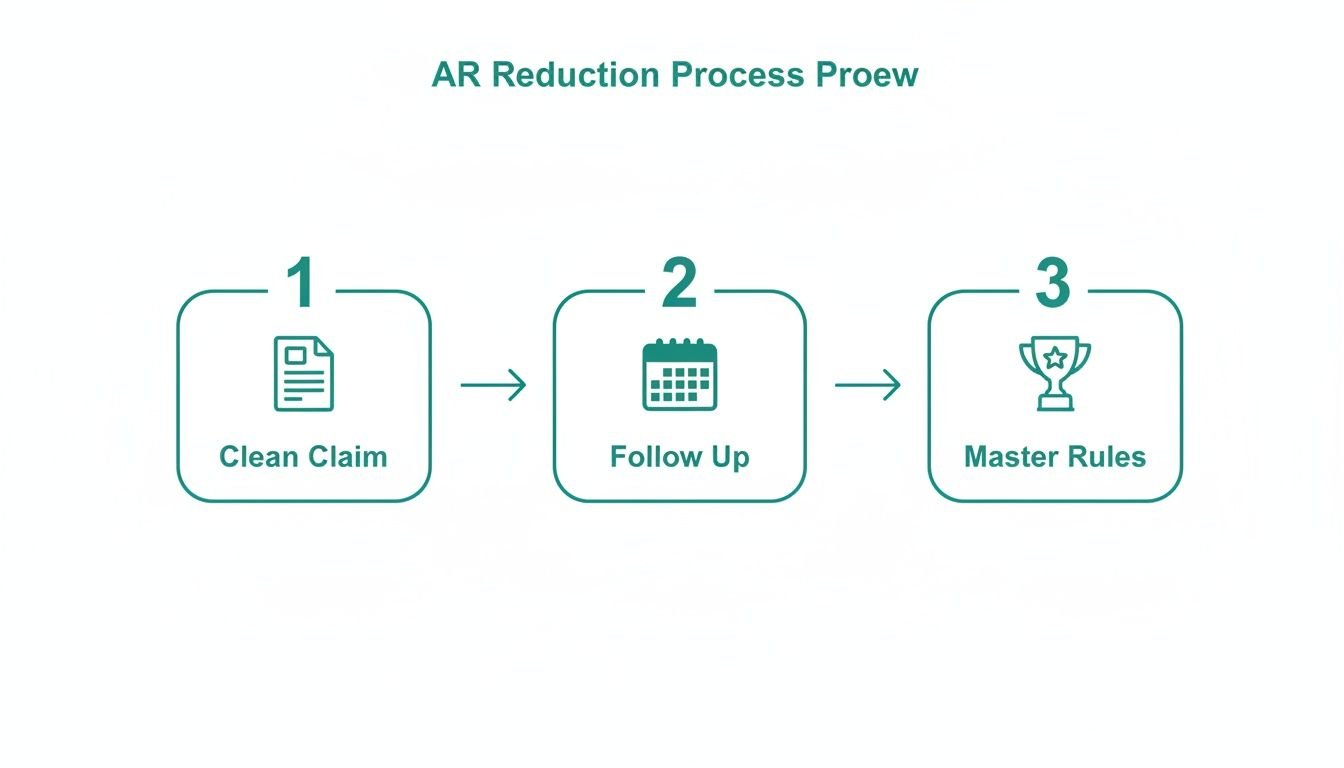
As you can see, it comes down to three core actions: submitting clean claims from the start, maintaining relentless follow-up, and mastering the rules of the game.
The Hidden Cost of Waiting
Beyond the immediate cash injection, there’s a quieter, more insidious cost to high A/R: inflation.
A dollar collected in 30 days is worth more than the same dollar collected in 90 or 120 days.
When your Days in AR are high, you are effectively giving payers an interest-free loan while your own practice’s purchasing power slowly erodes. For a practice running on thin margins, this slow decay in value is a constant headwind.
It’s the most compelling business case there is for investing in a high-velocity process.
Ultimately, driving down your Days in AR unlocks financial freedom. It stops the exhausting cycle of chasing old claims and allows you to put your capital—and your energy—back into what really matters: providing superior patient care and building a thriving, sustainable practice.
Don't Let Days in AR Mislead You: Track These Metrics, Too
A low Days in A/R is a great headline number, but it doesn't tell you the whole story. Obsessing over this single metric can be dangerous—it might look good on a report, but it can easily mask deeper financial rot.
It’s a classic case of solving one problem by creating a bigger one, like sacrificing collectible dollars just to make your A/R days look low.
To get a real handle on your practice's financial health, you need a dashboard of interconnected metrics. Think of it as the difference between checking a patient's temperature and reading their full chart. A balanced view confirms that your improvements in one area aren't secretly tanking another.
Track the Percentage of A/R Over 90 Days
The first metric to add to your dashboard is the percentage of your total accounts receivable that is over 90 days old. This is a direct measure of your team's ability to fight for and resolve tough claims before they turn into write-offs. Your overall Days in A/R might seem healthy, but a high percentage of old claims signals a major problem brewing under the surface.
Top-performing medical practices consistently keep their A/R over 90 days at less than 15% of their total accounts receivable. Anything higher points to serious revenue leakage and weak follow-up processes.
This aged A/R is the hardest cash to collect. The longer a claim sits unpaid, the less likely you are to ever see that money. Watching this percentage is your early warning system for accounts about to become bad debt.
Measure Your First Pass Resolution Rate
Next up is your First Pass Resolution Rate (FPRR), often called the clean claim rate. This metric tells you what percentage of your claims get paid in full on the very first try, with no rework, appeals, or follow-up needed.
FPRR is a direct reflection of your front-end accuracy. A high FPRR (your target should be 98% or higher) is proof that your team is crushing it at:
- Verifying insurance eligibility and benefits upfront.
- Nailing down prior authorizations before they become a problem.
- Ensuring every claim goes out with error-free coding and modifiers.
A low FPRR is a primary cause of high Days in A/R. Every single claim denied on the first pass automatically adds 30-45 days to your payment cycle while you figure out what went wrong, fix it, and resubmit.
Calculate Your Net Collection Rate
Finally, the Net Collection Rate (NCR) might just be the most important financial metric of them all. It tells you what percentage of the money you're allowed to collect you are actually collecting. You find it by dividing your total collections by your total allowed charges after all contractual adjustments.
A low Days in A/R is a hollow victory if your Net Collection Rate is in a nosedive. For example, a practice could fake a low Days in A/R by aggressively writing off difficult balances way too early. Sure, the claims are off the books quickly, but they've also thrown away real, collectible revenue. A healthy NCR—which should be 97% or higher—proves you’re collecting nearly every dollar you are contractually owed. To see how these figures work together, check out our guide on key revenue cycle performance metrics.
When you look at these metrics as a group—Days in A/R, Percentage of A/R > 90 Days, FPRR, and NCR—you get a true, three-dimensional view of your revenue cycle’s performance. This balanced scorecard ensures you’re winning on both speed and completeness, turning your billing operation into an engine for financial stability.
How do specific CPT codes and modifiers affect Days in AR?
Specific codes and modifiers are a primary driver of high Days in AR because payers have unique rules for them that, if violated, result in immediate denials. For example, many payers automatically scrutinize any claim with modifier 25 (Significant, Separately Identifiable E/M Service) or modifier 59 (Distinct Procedural Service), flagging them for medical necessity reviews that add weeks to the payment cycle. Similarly, incorrect use of anesthesiology concurrency modifiers like QK vs. QY, or failing to secure prior authorization for a common psychotherapy code like CPT 90837, will send a claim directly into AR limbo, inflating collection times.
What is a good Days in AR benchmark for my specialty?
While the universal gold standard is under 35 days, a "good" benchmark varies by specialty due to different billing complexities. For an anesthesiology practice, 30-40 days is excellent, as success hinges on accurate time-unit and modifier (QK, QY) reporting. For mental health, where prior authorizations for codes like 90837 are a constant battle, under 45 days is a strong performance. Procedure-heavy specialties like orthopedics and cardiology should target 40-50 days, with top performers getting below 40 by mastering complex surgical coding and modifier use. Find more detail on our page for medical specialties.
Why would my practice's Days in AR suddenly increase?
A sudden spike in Days in AR is a red flag indicating a new, specific breakdown in your revenue cycle. Common culprits include a major payer like CMS or a commercial insurer implementing a new, uncommunicated policy for a high-volume CPT code, causing a wave of unexpected denials. Other causes can be internal, such as a new front-desk employee consistently failing to verify insurance, a software update causing claim submission errors, or a new biller repeatedly making the same coding mistake. Pinpointing the root cause requires analyzing denial trends by payer, code, and date to isolate the change that triggered the increase.