What Does a Cardiology Billing Company Actually Do?

A cardiology billing company translates your practice's complex cardiac procedures and diagnostic services into maximized, predictable revenue by deploying certified coding experts and revenue cycle specialists. These firms manage the entire financial workflow—from claim creation using specific codes like CPT 92928 for stenting to appealing denials for services like electrophysiology studies—to ensure compliance and capture payments often lost to intricate payer rules. Their function is to be a specialized financial partner, focused solely on optimizing the unique reimbursement challenges of a cardiology practice.
Turning Complex Procedures Into Predictable Revenue
A specialized cardiology billing company acts as your practice's financial engine. Their job is to translate clinical work into consistent cash flow. Unlike a generalist biller, these teams are fluent in the unique language of cardiovascular medicine and, more importantly, its corresponding reimbursement rulebook. They own the entire financial journey, from submitting the initial claim to aggressively chasing down unpaid balances and dissecting complex denials.
This laser focus is critical. According to CMS data and industry analyses, cardiology practices can lose 5-8% of their total revenue to preventable claim denials and coding mistakes, particularly with high-value interventional procedures. The financial stakes are too high for a "good enough" approach.
The Core Functions of a Cardiology Billing Partner
A dedicated partner moves far beyond just filing claims to actively protecting and growing your revenue. They provide expert oversight on coding, compliance, and revenue cycle management.
Here’s a look at the core functions a cardiology billing expert handles, compared to what a typical in-house team might juggle.
In-House vs Outsourced Cardiology Billing Core Functions
| Billing Function | Typical In-House Team | Specialized Cardiology Billing Company |
|---|---|---|
| Coding & Auditing | General coders may miss nuances in modifiers or bundled procedures, leading to under-billing. | Certified cardiology coders ensure every component is billed, from imaging to intervention, maximizing reimbursement. |
| Denial Management | Reactively works denials as they come in, often lacking time for deep root-cause analysis. | Proactively scrubs claims to prevent denials and uses analytics to spot negative payer trends before they impact cash flow. |
| A/R Follow-Up | Overwhelmed by aging claims; A/R often balloons as staff focuses on new billing. | Relentlessly pursues every dollar in A/R, with dedicated teams for claims older than 60, 90, and 120 days. |
| Compliance & Governance | Struggles to keep up with constant CMS and payer policy changes, increasing audit risk. | Maintains an active compliance program, guaranteeing adherence to all guidelines and protecting the practice from penalties. |
As you can see, the difference lies in specialization and resources. While an in-house team is often forced to be reactive, a specialized partner is built to be proactive, armed with the tools and expertise to stop problems before they start.
The graphic below shows the simplified, three-step process a specialized company manages to get you paid.
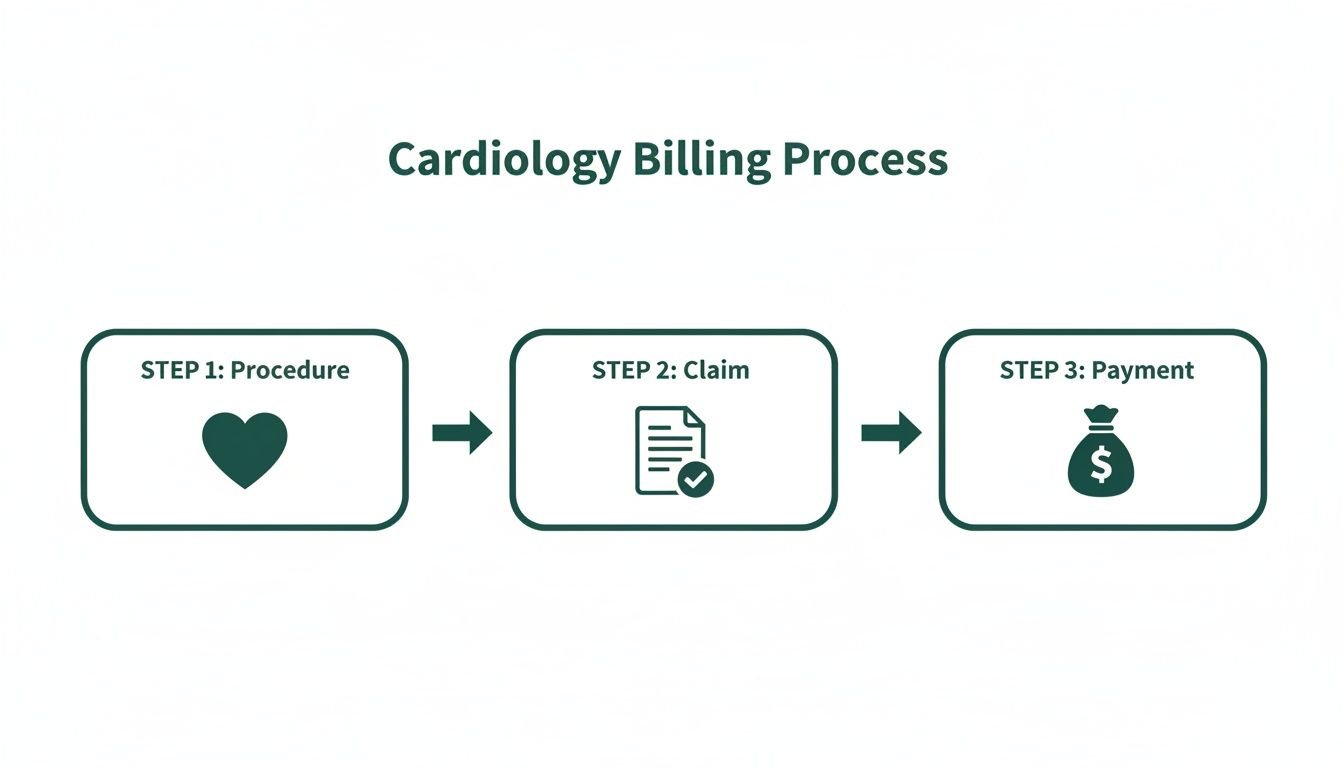
This streamlined path from procedure to payment is where the real value lies—removing the friction and delays that chip away at your bottom line.
Market Growth and Financial Impact
The demand for this kind of expert support is exploding. The U.S. medical billing outsourcing market is expected to rocket from USD 6.95 billion in 2025 to USD 17.69 billion by 2033. This growth isn't just a trend; it's a direct response to mounting procedural complexity and the sheer volume of money being left on the table.
With U.S. providers losing over $125 billion a year to billing errors, cardiology practices are right in the crosshairs.
By partnering with a firm that understands the intricacies of cardiology, practices can finally stabilize their finances. The goal is straightforward: achieve a first-pass clean claim rate above 98% and shrink your Days in A/R to under 35. This is how you convert clinical excellence into financial security.
Outsourcing these critical functions means you can finally stop the revenue leaks and get back to focusing on patient care. To see exactly how this is achieved, check out our guide on cardiology medical billing services. This is the proven way to make sure your practice collects every single dollar it has rightfully earned.
Navigating Unique Cardiology Billing Challenges

Cardiology billing isn’t just another medical specialty—it’s a different league of complexity. The sheer volume of procedural, diagnostic, and bundled services creates financial traps that simply don't exist in other fields. The financial health of your practice depends entirely on mastering these specific coding hurdles, as one patient encounter can easily involve diagnostic imaging, a complex intervention, and follow-up care, each with its own labyrinth of coding rules and payer policies.
Denial rates have shot up to 12% on average, and 73% of providers say they've seen an increase since 2022. For cardiology, that often means a 5-8% revenue hit from procedural miscoding alone, according to recent industry analyses of cardiology billing trends.
Mastering Modifiers and Component Billing
One of the most common—and costly—mistakes is the incorrect use of modifiers for diagnostic services. This occurs frequently when cardiologists interpret a test performed on equipment the practice doesn't own, a common scenario in hospital settings.
For a routine echocardiogram (CPT 93306), when your physician reads the results from a test run on hospital equipment, the claim must have modifier 26 (Professional Component) appended. Omitting it triggers an instant denial. The hospital bills the same CPT code with modifier TC (Technical Component) for its part. An expert cardiology billing company automates these rules based on place of service, ensuring claims are correct before submission.
A simple modifier error can be the difference between full reimbursement and a zero-dollar payment. In cardiology, where diagnostic interpretations make up a significant portion of revenue, these small details have a massive cumulative impact on your practice's bottom line.
The Intricacies of Interventional Coding Hierarchies
Interventional cardiology is where billing becomes even more complex due to hierarchical and bundled codes. If your billing team doesn't understand the sequence, denials are guaranteed. Percutaneous coronary interventions (PCIs) are a prime example. You can't just bill for a stent; you must know the "base" code and the correct "add-on" codes.
Imagine a multi-vessel PCI:
- Base Code: The first stent placed in a major coronary artery is billed with a code like CPT 92928 (stent placement).
- Add-on Code: Each additional stent placed in a different major coronary artery requires the add-on code CPT 92929.
If your biller submits two base codes (92928) instead of a base code plus an add-on (92928 + 92929), the second procedure will be denied as a duplicate. Payers like UnitedHealthcare have automated edits specifically designed to catch this error. You can discover more strategies for addressing these common cardiology billing denials in our guide.
Electrophysiology and Audit Risks
Electrophysiology (EP) studies and ablations are significant revenue drivers but are also a favorite target for payer audits. High-value codes like CPT 93653 (SVT ablation) or CPT 93656 (atrial fibrillation ablation) are constantly scrutinized for medical necessity based on strict payer policies.
Payers demand rock-solid documentation to justify an ablation. This includes proof of failed drug therapies, diagnostic test results, and a clear clinical narrative that meets their specific guidelines. An expert cardiology billing partner works with your providers to ensure this documentation is airtight from the start, creating an audit-proof record that defends your revenue from aggressive payer takebacks. Without this specialized oversight, practices face the risk of substantial financial clawbacks, sometimes years after the service was performed.
Measuring ROI and Critical KPIs for Your Billing Partner

Vague promises don't pay the bills, but hard data does. The right cardiology billing company shouldn't just manage your billing—they should measurably improve it, with the numbers to prove it. To hold a billing partner accountable and see a real return on your investment (ROI), you must track the key performance indicators (KPIs) that directly impact cash flow and financial leakage.
The Three Most Critical Billing KPIs
Dozens of metrics exist, but a few core KPIs tell you almost everything you need to know about your revenue cycle's health. Your billing partner should provide transparent reports on these metrics weekly.
First Pass Clean Claim Rate (FPCCR): This is the percentage of claims accepted by payers on the first try, with no errors. An elite cardiology billing company should hit 98% or higher. A low rate indicates sloppy coding, outdated insurance information, or a failure to scrub claims before submission.
Days in Accounts Receivable (A/R): This is the average time it takes for you to get paid. For a high-performing cardiology group, the target is under 35 days. If this number creeps up, it's a massive red flag that your partner isn't aggressively chasing unpaid claims or resolving denials.
Net Collection Rate (NCR): This KPI shows how much of your contractually owed revenue you are actually collecting. After all write-offs and adjustments, your NCR needs to consistently hit 96% or more. Anything less is money you've earned but will never see.
These three metrics are the vital signs of your practice's financial health. A great partner doesn't just meet these benchmarks; they have a clear strategy to improve them. You can dive deeper into these metrics in our complete guide to the medical billing KPIs every practice should track.
Calculating a Clear Return on Investment
The true ROI from a specialized cardiology billing company shows up in your bank account. The math is simple. If your practice bills $5 million a year and a new, expert partner boosts your net collection rate by just 5%, that’s $250,000 in new revenue. This isn't just about plugging leaks; it's about generating real cash flow.
The benchmark for a top-tier cardiology billing company is clear and data-driven. They should be able to demonstrate their value not in promises, but in performance dashboards that show tangible financial improvements to your practice's bottom line.
The difference between a generic biller and a true specialist is their ability to deliver these results. As one analysis on the medical billing market highlights, top firms drive 10-15% revenue boosts with clean claim rates over 98% and A/R days under 30. For a cardiology practice, hitting those numbers is the only ROI that matters. This is the standard you should expect—and demand.
Decoding Pricing Models and Contract Terms
The real story of any billing partnership is written in the contract. Getting the pricing and terms right isn’t just a legal formality—it determines whether your new partner is truly invested in your success. A solid agreement aligns incentives and protects your practice’s financial health, while a weak one is a recipe for hidden fees and performance disputes.
The Percentage of Collections Model
The most common structure you’ll find is percentage of collections. In this model, the billing company takes a fee—usually between 4% and 8%—of the money they actually collect. This model is popular for a reason: it gives the billing company real skin in the game. When you get paid, they get paid. This creates a powerful incentive for them to fight for every last dollar and push your net collection rate as high as it can go.
A critical point to hammer out in any percentage-based deal is the definition of "collections." Does the fee apply only to what payers reimburse? Or does it also include every patient copay, deductible, and balance payment? A transparent partner will define this upfront, leaving no room for surprise calculations later.
Alternative Pricing Structures
While the percentage model is king, you'll run into a few other options. It’s crucial to understand how each one could play out for a specialty like cardiology.
Flat-Fee Model: You pay a fixed monthly rate for each provider. The predictability is nice for budgeting, but it can create a massive incentive problem. The billing company gets paid the same whether they collect 85% of your earnings or 99%, which can lead to lazy A/R follow-up.
Fee-per-Claim Model: You pay a small, set price for every single claim filed. This might look cheap for a low-volume practice. For cardiology, with its high-value procedures and constant need for complex coding and appeals, this model can quickly become a financial disaster.
Before you lock anything in, it's smart to run the numbers. You can learn more about how to estimate the cost of outsourcing medical billing in our detailed guide and see how these different models would impact your practice’s specific financials.
Essential Contract Terms to Scrutinize
A fair contract is a shield for both you and your partner. As you comb through proposals, treat vague language as the major red flag it is. Your agreement must spell out these points in plain English:
- Termination Clause: Look for a fair "out," like a 60 or 90-day notice period, without excessive penalties. Be wary of long-term, auto-renewing contracts that try to lock you in.
- Data Ownership and Access: The contract must state, unequivocally, that you own your practice's data. It also needs to specify exactly how that data will be handed back to you—in a standard, usable format—if you part ways.
- Scope of Services: The agreement should be an exact checklist of what's included. Does it cover coding, claim submission, denial management, patient statements, A/R follow-up, and reporting? Anything not explicitly listed is a potential extra charge.
- Reporting Guarantees: Insist on contract clauses that guarantee you’ll have access to transparent, real-time performance dashboards and receive regular reports on your most important financial vital signs, like Net Collection Rate and Days in A/R.
Your Vendor Evaluation Checklist for Cardiology Billing
Picking a cardiology billing partner is one of the highest-stakes financial decisions you'll make. It’s not just about outsourcing a task; it’s about entrusting your entire revenue stream to an expert. Use this checklist to cut through sales pitches and ask the tough questions that reveal a vendor's real-world capabilities.
Cardiology-Specific Expertise
Generic billing knowledge won't cut it. Your partner must have deep, demonstrated experience with the specific CPT codes, modifiers, and complex payer rules that define cardiology revenue. Vague assurances are a massive red flag—demand proof.
Get right to the point with questions about high-value, complex procedures:
- Describe your team’s experience coding for TAVR (CPT 33361) or Watchman device implants (CPT 33340).
- How do you ensure coders correctly distinguish the base code for PCI (CPT 92928) from the add-on code for an additional vessel (CPT 92929)?
- Walk me through your process for guaranteeing the documentation for an electrophysiology ablation (CPT 93656) will survive a payer audit.
A confident, detailed answer proves they’ve been in the trenches. If they hesitate or give you a textbook response, they'll be learning on your dime.
Reporting and Transparency
You can't fix what you can't see. Any potential partner must provide clear, actionable data on your practice's financial pulse. Don't settle for vague promises of "custom reports"—insist on seeing exactly what you will get.
A billing company that hesitates to show you sample reports is a company with something to hide. Total transparency isn't a feature; it's a non-negotiable requirement from day one.
Demand to see their standard reporting package. Ask them directly:
- "Show me a sample of the daily, weekly, and monthly reports our practice manager will see."
- "How does your dashboard give us real-time visibility into our most critical KPIs, like Days in A/R and Net Collection Rate?"
The reports should be clean and intuitive, giving you a clear snapshot of performance, not just a confusing data dump.
Denial Management and Appeals Process
Every cardiology practice gets denials. What separates the experts from the amateurs is how they react. A proactive, data-driven denial management process is the only way to protect your revenue.
Present them with a specific, challenging scenario:
- "A multi-vessel PCI claim was denied by Aetna for 'medical necessity.' Walk us through your exact, step-by-step appeals process."
- "How do you analyze denial trends to pinpoint the root cause, and what specific actions do you take to stop those same denials from happening again?"
Their answer should outline a multi-stage process that involves clinical documentation review, expert coder analysis, and direct, persistent follow-up with payers. A robust process shows they are ready to fight for every dollar you've earned. Digging into a vendor's process helps you spot some of the most common red flags when choosing a medical billing company.
To help you spot trouble early, use this quick-reference table during your evaluation.
Cardiology Billing Vendor Red Flag Indicator
| Red Flag | What It Means | The Right Question to Ask |
|---|---|---|
| Vague Pricing | The vendor can't clearly explain all potential fees. You risk being hit with hidden charges for "extra" services like report generation or appeals. | "Provide a complete fee schedule. What services are not included in the base percentage fee?" |
| No Specialty References | They can't connect you with other cardiology practices they serve. This suggests a lack of proven experience in your complex field. | "Can you provide three references from cardiology groups similar in size and scope to ours?" |
| Weak Technology Story | They talk about people but not systems. This often means their process is manual, slow, and prone to human error, leading to more denials. | "Show me how your technology automates claim scrubbing and integrates with our specific EHR system." |
| "We Appeal All Denials" | This sounds good, but it's an inefficient strategy. It means they lack the data to prioritize high-value claims and identify root causes. | "What is your strategy for prioritizing appeals? How do you decide which denials are worth fighting?" |
A vendor who stumbles on these questions is likely not equipped to handle the unique financial pressures of a modern cardiology practice.
Technology and Automation
Modern billing is driven by smart technology that catches errors before they become costly problems. A partner’s tech stack reveals their commitment to efficiency and accuracy. Their technology should be a shield that protects your cash flow.
Ask about their specific tech-driven workflows:
- "How does your AI or rules engine prevent common cardiology coding mistakes, like incorrect modifier 26 usage, before a claim is even submitted?"
- "Can your system integrate directly with our current EHR, or will this require a painful and complicated data migration?"
A forward-thinking partner will describe how their technology acts as a financial safety net, flagging issues that would otherwise turn into denials based on specific payer rules. Their goal must be to get claims paid on the first pass, and technology is the engine that makes it happen.
What CPT codes are most commonly denied in cardiology?
Payers heavily scrutinize certain high-value cardiology CPT codes, leading to frequent denials. The most common problem areas include add-on codes for cardiac catheterization, such as CPT 93462 (left heart cath with imaging of bypass grafts), which are often denied if the primary procedure isn't documented or billed correctly. Another major issue is the incorrect use of modifier 26 (Professional Component) on diagnostic tests like echocardiograms (CPT 93306), and finally, comprehensive electrophysiology (EP) studies like CPT 93656 (atrial fibrillation ablation) are consistently targeted for medical necessity denials.
How much does a cardiology billing company cost?
A specialized cardiology billing company typically charges a percentage of collections, ranging from 4% to 8%. The exact rate depends on your practice's size, monthly claim volume, and the complexity of your procedural mix (e.g., interventional vs. non-invasive). This percentage-based model aligns the company's incentives with your practice's financial success—they get paid when you get paid. It's crucial that your contract clearly defines "collections" to ensure transparency on fees.
How long does it take to onboard with a new billing company?
A well-managed onboarding process with a new cardiology billing company should take approximately 30 to 60 days. This timeframe allows for a comprehensive transition that includes payer credentialing verification, seamless integration with your existing EHR system to avoid disruptive data migration, workflow analysis, and establishing secure communication channels. The goal is a smooth handoff that protects your cash flow and avoids operational interruptions for your staff. You can find more information about our approach to various medical specialties at happybilling.co/specialties/.