Best Cardiology Billing Companies for Independent Practices
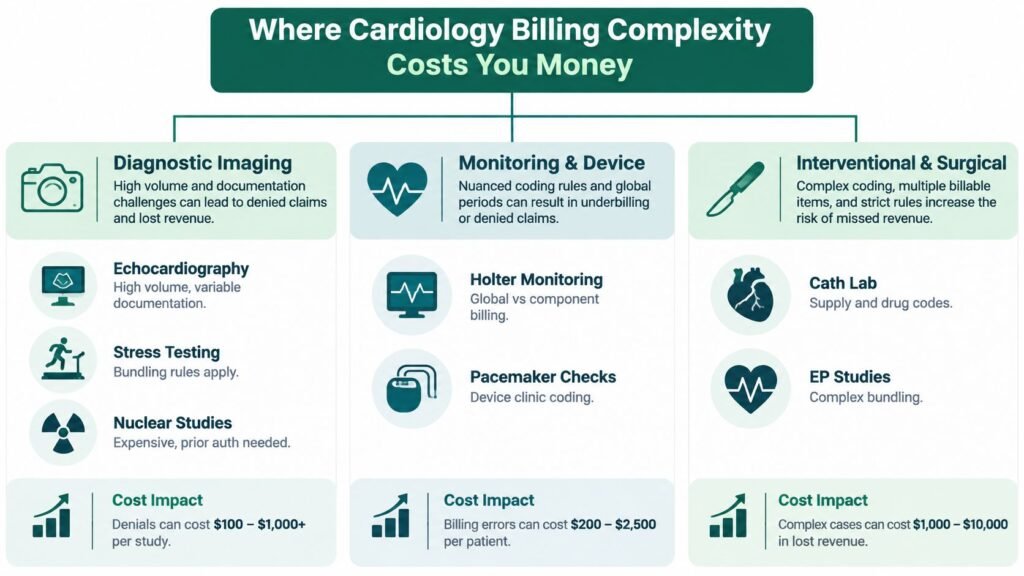
To choose a cardiology billing company, check three things in writing: how it decides between global billing and modifiers 26 and TC on every echo, stress and nuclear study, who owns prior authorization for imaging, cath and device work, and whether it disputes underpaid out-of-network cases or only bills routine ones. This page compares eight cardiology billing companies and Happy Billing on what each says on its own website, and it sends you to our separate guide for the questions to ask before you hire.
The companies compared: Happy Billing, AnnexMed, BillingParadise, CareCloud, CureMD, MedCare MSO, P3 Healthcare Solutions (P3Care), Pro Medical Billing Solutions (Pro MBS) and Transcure. If you already know you want us, see our cardiology billing services.
Disclosure and method: Happy Billing wrote this page and is one of the options listed. We read each company’s own cardiology page in November 2026 and included companies that Google and AI search tools name for this question and that have a cardiology service page. We describe them only with what those pages say, we link every source, and we write “not stated” where a page is silent. We do not rank the options, and we leave out fees and self-reported results such as clean-claim rates, years in business or coder counts, because none of them can be checked from the outside.
Who this page is for
You own or co-own an independent cardiology practice, from a small group offering office visits and in-house echo and stress testing to a larger group with a cath lab, electrophysiology or a device clinic. You want a team to take claims, authorizations and denials off your desk, or you suspect payments are coming in lower than they should. This page is not written for hospital-employed cardiology departments.
Why cardiology billing is different
One cardiology visit can include an office visit, an ECG, an echo, a stress test and a device check, and payers test how each pair is coded. The CMS NCCI Policy Manual says that when a physician attending a stress test takes a history and exam, a separate E&M code is not reported unless the service is significant and separately identifiable, and then it carries modifier 25. It also says only one PCI code may be reported for all PCIs of a major coronary artery through the native circulation (NCCI Policy Manual, Chapter 11, section I). A biller who does not know these rules either loses revenue or sends claims that invite audits.
Global, 26 and TC. A test you perform and read in your office is usually billed global. If you only interpret it, the claim takes modifier 26, and if you only provide the equipment and technician, it takes TC. Equipment ownership and place of service decide which applies. Our guide to modifier 26 vs TC walks through it.
Authorizations and device cadence. Nuclear and advanced imaging, cath and EP procedures often need approval first, and the approval has to match the test, the site and the date. Pacemaker, defibrillator and remote monitoring checks have their own codes, and payers limit how often each is paid.
Three trade-offs to settle before you compare companies
Cardiology specialist or multi-specialty company. Several companies here, such as AnnexMed and Pro MBS, describe cath lab, EP and device work in detail. Others, such as CareCloud and P3Care, cover cardiology in more general terms on the page we read. Either can work. What matters is whether the people on your account work cardiology claims every day.
Billing only, or billing plus software and reporting. Some companies code and collect claims. Others sell EHR or practice management software, or add MIPS reporting or bookkeeping. All-in-one EHR and billing software, for example from athenahealth or Tebra, is a software purchase rather than a billing team, and it is not compared here. Decide what you want from one vendor before you take calls.
Your systems or theirs. Some companies work inside your EHR and practice management system. Others run billing on their own platform. Ask whether you must change software, and who owns the data if you leave.
Summary: what each company says publicly (as of November 2026)
| Company | Best for, based on its own page | Out-of-network or No Surprises Act IDR on its cardiology page | Credentialing on its cardiology page | Systems |
|---|---|---|---|---|
| Happy Billing | Independent practices that want daily cardiology billing plus out-of-network recovery and IDR from one team | Yes: recovery and IDR handled in-house | Yes | Works in your existing systems |
| AnnexMed [1] | Interventional, EP and device-heavy groups that want a named tool for each billing layer | Not stated | Yes | Own platform (ImpactRCM.AI); EHR integration not stated |
| BillingParadise [2] | Practices that want credentialing bundled with billing done in their EHR | Not stated | Yes, included with RCM | Bills inside your EHR; names AdvancedMD, Kareo, NextGen, eClinicalWorks |
| CareCloud [3] | Groups that want billing from the vendor that also sells EHR and practice management software | Not stated | Not stated | Own EHR and practice management; also describes EHR-agnostic service for mid-size practices |
| CureMD [4] | Practices open to billing on CureMD’s own AI-assisted platform | Not stated | Navigation only | Own platform and EHR; says it integrates with cardiology EHRs |
| MedCare MSO [5] | Practices that want billing plus optional EHR, scribe and coding software, or to keep their own | Not stated | Yes | Says it integrates with your existing software or replaces it; own EHR and practice management |
| P3Care [6] | Practices that want billing plus MIPS and ACO reporting from one firm | Not stated | Navigation only | Not stated |
| Pro MBS [7] | Practices that want cath lab, EP and device billing described up front | Not stated | Navigation only | Says it works within your existing systems |
| Transcure [8] | Practices that want 26/TC, device and remote monitoring rules spelled out first | Not stated | Discussed as a billing prerequisite, not offered on the page | Names Epic, Athenahealth, AdvancedMD, eClinicalWorks, NextGen and Veradigm in its navigation |
“Not stated” means the page we read does not mention it. It does not mean the company lacks the capability, since a vendor may describe it on another page or offer it on request. “Best for” is our reading of what each company emphasizes on its own page, not a judgment of quality.
See how we recover out-of-network underpayments
Each company, in detail
Happy Billing
Best for: independent cardiology practices that want routine billing and the harder recovery work handled by one company.
- Global, 26 or TC billing chosen from who owns the equipment and who reads the study, with echo, stress and nuclear pairings and modifier 25 visits checked before claims go out.
- Imaging, cath and procedure authorizations requested and tracked against the test, the site and the date, and pacemaker and defibrillator checks tested against payer frequency limits.
- Happy Billing runs No Surprises Act open negotiation and federal IDR in-house, alongside daily billing. See out-of-network underpayment recovery.
- Credentialing and payer enrollment (credentialing services), denial management and old receivables. Works inside the EHR and practice management system you already use. Weekly reporting, and questions answered within 24 hours.
We fit less well if you want billing bundled into one software purchase, or if your department is hospital-employed.
AnnexMed
Best for: interventional, EP and device-heavy groups that want a named tool for each billing layer.
- Describes “TC/26 modifier billing based on equipment ownership” for echo, stress and nuclear studies, and lists a “Multi-Vessel PCI Optimizer” [1].
- Device module tracks “serial numbers” and generator replacement schedules; prior authorization covers cath, advanced imaging, device implants, EP and nuclear stress testing [1].
- Credentialing with commercial, Medicare and Medicaid payers [1].
- Runs billing on its own ImpactRCM.AI platform across offices, hospitals, cath labs and EP labs; EHR integration is not stated on the page [1].
Ask them: what the service covers for out-of-network claims and No Surprises Act disputes, which EHRs they work in, and what the contract and exit terms are.
BillingParadise
Best for: practices that want credentialing included with billing, done inside their own EHR.
- Navigation lists independent practices, group practices, hospitals and in-house billing teams as audiences [2].
- Says “credentialing management services are included for all clients” who enroll for RCM, with Medicare revalidation support [2].
- Says it bills “within your EHR system” and names AdvancedMD, Kareo, NextGen and eClinicalWorks [2].
- The page is light on cardiology procedures: no 26/TC, NCCI, device or nuclear detail [2].
Ask them: how they handle 26/TC splits, device checks and nuclear authorizations, and how they treat out-of-network underpayments.
CareCloud
Best for: groups that want billing from the same vendor that sells EHR and practice management software.
- Offers an end-to-end RCM solution for “cardiology practices of any size,” with separate descriptions for 1-5, 6-15 and 15+ provider groups [3].
- Authorization support covers “submitting requests, tracking approval status, maintaining required documentation” [3].
- Describes integration with the CareCloud EHR, and calls its mid-size service “EHR-agnostic” [3].
- The page is general on cardiology coding: no 26/TC, NCCI or device detail [3].
Ask them: whether you must move to the CareCloud EHR, who handles credentialing and out-of-network disputes, and how they handle 26/TC and device billing.
CureMD
Best for: practices open to billing on CureMD’s own AI-assisted platform, with an EHR option from the same vendor.
- Says its service fits “large multispecialty groups and individual practitioners” [4].
- Says its team is “well-versed” in the CMS codes and “appropriate modifiers for cardiology billing,” and lists ECG, stress test and device evaluation codes [4].
- Says “integration with cardiology EHRs allows direct transfer of patient data”; also sells its own EHR and billing platform [4].
- Credentialing appears in its navigation only; MIPS and quality reporting are also listed there [4].
Ask them: which cardiology EHRs they connect to, how they handle 26/TC and prior authorization, and whether out-of-network disputes are in scope.
MedCare MSO
Best for: practices that want billing plus optional EHR, scribe and coding software, or to keep their own systems.
- Handles “professional and technical (-26 / -TC)” portions of echo, stress and SPECT/PET studies, and mentions bundling under NCCI edits [5].
- Obtains authorizations for ablations, implantable devices, stress tests and advanced imaging before the procedure date; bills device checks and remote monitoring [5].
- Pairs AAPC-certified coders with a “dedicated account manager”; says it manages credentialing [5].
- Says its software can “integrate with your existing software (or replace it)”; also sells its own EHR and practice management system [5].
Ask them: what the onboarding plan and timeline look like, whether out-of-network disputes are included, and what the exit terms are.
P3 Healthcare Solutions (P3Care)
Best for: practices that want billing plus MIPS and ACO reporting from one firm.
- Describes “AHIMA-approved medical billers and coders” for cardiology [6].
- Lists “MIPS consulting and reporting services,” and its navigation also lists bookkeeping and tax filing [6].
- Credentialing appears only as a navigation and form option [6].
- The page covers scheduling checks, modifiers and denials in general terms, with no 26/TC, device or nuclear detail, and names no systems [6].
Ask them: which EHRs they work in, how they handle prior authorization for imaging and procedures, and whether out-of-network disputes are in scope.
Pro Medical Billing Solutions (Pro MBS)
Best for: practices that want cath lab, EP and device billing described up front, run inside their own systems.
- Names “modifier 26/TC reporting” for diagnostics and “NCCI updates for cath lab and interventional codes” [7].
- Lists device monitoring for “pacemaker, ICD, ILR, and CardioMEMS,” plus EP, ablation and structural heart procedures [7].
- Authorization workflows for cardiac imaging, procedures and advanced interventions [7].
- Says its team will “work within your existing systems”; credentialing appears in its navigation only [7].
Ask them: whether credentialing and out-of-network disputes are included, which EHRs they have worked in, and what the contract and exit terms are.
Transcure
Best for: practices that want 26/TC, device and remote monitoring rules explained before they call.
- Its cardiology page is a long guide: for hospital-owned equipment it says the cardiologist “bills the interpretation with –26” [8].
- Covers remote patient monitoring set-up, consent and device requirements, pacemaker and ICD codes, and NCCI bundles [8].
- Says its team “tracks all payer rules” for pre-authorization; the only No Surprises Act mention is the Good Faith Estimate for self-pay patients [8].
- Navigation names Epic, Athenahealth, AdvancedMD, eClinicalWorks, NextGen and Veradigm; also lists MIPS consulting [8].
Ask them: whether they provide credentialing, who handles out-of-network disputes, and what the contract and exit terms are.
What we check first in any cardiology account review
These are patterns, not results from any one client. Tests billed global when the practice only read the study, or split when it owned the equipment. Stress and echo pairings coded in a way the payer bundles. Modifier 25 office visits sent without documentation of a separate service. Imaging or cath authorizations that do not match the test, site or date. Device and remote monitoring checks sent past a payer’s frequency limit. Out-of-network cases paid near the qualifying payment amount and posted as final. Old denials nobody appealed because each looked small. Any billing company you hire should be able to tell you how it catches each of these.
Questions to ask any cardiology billing company
- How do you decide between global, 26 and TC? Ask who confirms equipment ownership and who reads the study.
- Who owns prior authorization? Ask for a named owner for imaging, nuclear, cath and device approvals.
- Are your coders certified in cardiology coding? Ask whether the people on your account hold AAPC or AHIMA credentials and work cardiology daily.
- Do you file No Surprises Act disputes in-house? Ask who runs open negotiation and federal IDR, and whether a third party takes a separate cut.
- How do you catch underpayments? Ask whether payments are checked against your contracts automatically, or posted and closed.
- Do we have to change software? Ask whether billing runs in your EHR or theirs, and who owns the data if you leave.
- How are you paid, and what happens at exit? Ask what the fee applies to, how “collected” is defined, and get the notice period in writing.
- What happens to old receivables on day one? Some companies only take new claims.
- Who owns the payer enrollments and portal logins? They should be in your practice’s name.
For a longer scorecard on vendor answers, red flags and report contents, read what to ask before hiring a cardiology billing company. For a version that works for any specialty, see our guide to the best medical billing companies for independent practices.
When Happy Billing is the right call, and when it is not
Owners choose us when they want one team for daily cardiology billing and for the work routine billing skips: out-of-network underpayment recovery, No Surprises Act open negotiation and federal IDR, old denials and payer enrollment. Your team keeps its EHR and practice management system. Read how we run it on our cardiology billing services page.
You will likely be better served elsewhere if you want billing bundled into a single software purchase, if you want MIPS reporting or bookkeeping from your billing company, or if your cardiology billing sits inside a hospital system.
Talk to us about your cardiology billing
Bring a few recent denials or payments that looked low, and tell us which EHR you use. We will tell you whether we are a fit and which of the questions above matter most for your practice. Prefer to call? Our office is at 5333 Westheimer Rd, Houston, TX, and the phone is +1-832-384-4250.
Related comparisons: best anesthesia billing companies.
Frequently asked questions
What is the best cardiology billing company for an independent practice?
There is no single best company. The right one depends on whether you want billing only or software and reporting too, whether you need out-of-network and No Surprises Act disputes handled, and whether you will change systems. CareCloud, CureMD and MedCare MSO also sell their own software, and P3Care adds MIPS reporting. Happy Billing combines daily billing with in-house out-of-network recovery and IDR.
What should a cardiology billing company do that a general billing company does not?
It should choose global, 26 or TC billing for each diagnostic study, check echo, stress and nuclear pairings against bundling edits, and manage authorizations for imaging, cath and devices. It should also track device check frequency. Ask a general billing company how it handles each before you assume it can.
Will a cardiology billing company recover underpaid out-of-network claims?
Only if it is in scope. Of the eight company pages we read, none describes out-of-network recovery or No Surprises Act IDR for cardiology. Happy Billing runs both in-house. Ask any company whether it is included, who performs it, and whether a third party is involved.
Do I have to change my EHR to outsource cardiology billing?
Not always. Pro MBS and BillingParadise say they work in your existing systems, and MedCare MSO says it can integrate with them or replace them. CareCloud and CureMD describe their own platforms. Happy Billing works inside your existing systems. Get the answer in writing, with a list of the access your team will need to provide.
How do cardiology billing companies charge?
Common models are a percentage of collections, a flat monthly fee or a per-claim fee. With a percentage, what matters is what it is applied to and when a payment counts as collected, so ask for both definitions in the contract. Happy Billing quotes after a call, based on your practice.
How long does switching take?
It depends on your systems, your payers and your open receivables. None of the eight pages we read gives a timeline. MedCare MSO says it completes a practice assessment and an onboarding plan. For any company, expect to provide EHR access, payer portal logins and a list of open claims, and ask who handles the handoff from your current biller.
Can my current biller stay on if I bring in a billing company?
That depends on the company. At Happy Billing, your current biller can stay for the daily work while we handle recovery work such as old denials and out-of-network underpayments. Ask any company you are considering whether it supports that arrangement.
Specialty comparisons: anesthesia, radiology, cardiology, gastroenterology and pain management billing companies.
Sources
All company pages read in November 2026.
- AnnexMed, Cardiology Billing Services: annexmed.com/cardiology-billing-services
- BillingParadise, Cardiology Medical Billing: billingparadise.com/specialties/cardiology
- CareCloud, Cardiology Medical Billing Services: carecloud.com/specialties/cardiology/medical-billing
- CureMD, Cardiology Billing Services: curemd.com/cardiology-billing-services
- MedCare MSO, Cardiology Billing Services: medcaremso.com/specialties/cardiology-billing-services
- P3 Healthcare Solutions, Cardiology Billing Services: p3care.com/cardiology-billing-services
- Pro Medical Billing Solutions, Cardiology Billing Services: prombs.com/specialties/cardiology-billing-services
- Transcure, Cardiology Billing: transcure.net/medical-billing/cardiology
- CMS, NCCI Policy Manual for Medicare Services, Chapter 11 (2026): cms.gov NCCI Policy Manual, Chapter 11
Companies change their pages. Confirm what matters to you directly with each company before you decide.
Where this fits