Private Practice Billing Services: The Complete Guide

An 8% first-submission denial rate is a practical benchmark for physician practices, based on 2023 MGMA-reported data summarized by MedPrecision Billing. For an independent practice, that isn't a minor administrative defect. It can mean slower collections, more A/R days, and repeated staff effort spent correcting claims that should have been clean the first time.
The right private practice billing services partner should therefore be judged by preventable denials, clean-claim performance, and A/R recovery, not by how quickly it sends claims or how low its fee appears. The objective is straightforward: submit accurate claims, identify payer-specific failure patterns, and recover legitimate reimbursement before aging balances become harder to collect.
Solo practitioners running lean have a different math than group practices, and it’s worth reading our dedicated guide on affordable medical billing services for solo practices alongside this article — it breaks down the 4–9% pricing tiers, the break-even math against an in-house biller, and the specific vendor traits that matter when you’re the only clinician on the schedule.
Why Private Practice Billing Services Matter Now
The medical billing outsourcing market has moved well beyond a niche back-office function. One recent industry estimate places the market at USD 12.22 billion in 2026 and projects it to reach USD 20.76 billion by 2031, implying an 11.18% compound annual growth rate. The same estimate reports that North America represented 49.21% of revenue in 2025, while ambulatory and other non-hospital providers were the fastest-growing end-user segment at an 11.55% CAGR through 2031. These figures are reported in Mordor Intelligence's medical billing outsourcing market estimate.
For practice owners, the significance isn't market size alone. Outsourcing has become a strategic response to complex claims, reimbursement pressure, specialty-specific coding, payer edits, and the cost of maintaining revenue-cycle expertise internally. If your denial rate is high, your A/R is aging, or your clinicians and front-desk staff are spending too much time on claim follow-up, billing performance is already affecting the practice's operating margin.
What the service should actually include
Private practice billing services should cover the full revenue cycle, not just charge entry and claim transmission. A capable program typically connects:
- Eligibility and registration: Confirm coverage, subscriber details, benefits, and payer requirements before the appointment becomes a receivable.
- Charge capture and coding review: Match documented services to the correct CPT, diagnosis, modifier, place of service, and payer rules.
- Claim submission and scrubbing: Correct structural and clinical billing defects before transmission.
- Denial prevention and appeals: Categorize denials, identify recurring causes, correct upstream workflows, and pursue valid appeals.
- A/R recovery: Work unpaid and underpaid claims according to payer, age, balance, and appeal potential.
- Reporting: Show owners where performance is changing by payer, provider, specialty, and denial category.
In our experience, weak vendors focus on the middle of that chain. They submit claims, then measure activity rather than cash conversion. Stronger programs connect front-end accuracy with downstream denial outcomes, so the practice can see whether registration, authorization, documentation, or coding problems are creating financial leakage.
Owner's test: Ask whether the vendor can show fewer preventable denials in your payer mix, not merely a high volume of claims submitted.
Outsourcing also creates a capacity decision. An in-house team may offer immediate visibility and control, but it can struggle with specialty complexity, staff turnover, payer follow-up, and coverage during absences. An external partner may provide broader expertise and structured reporting, but only if the contract defines responsibilities, access, escalation paths, and measurable service levels. The decision should be based on the gap between your current revenue-cycle performance and the performance you need to sustain.
For a broader operational view, review these benefits of outsourcing medical billing before comparing vendors.
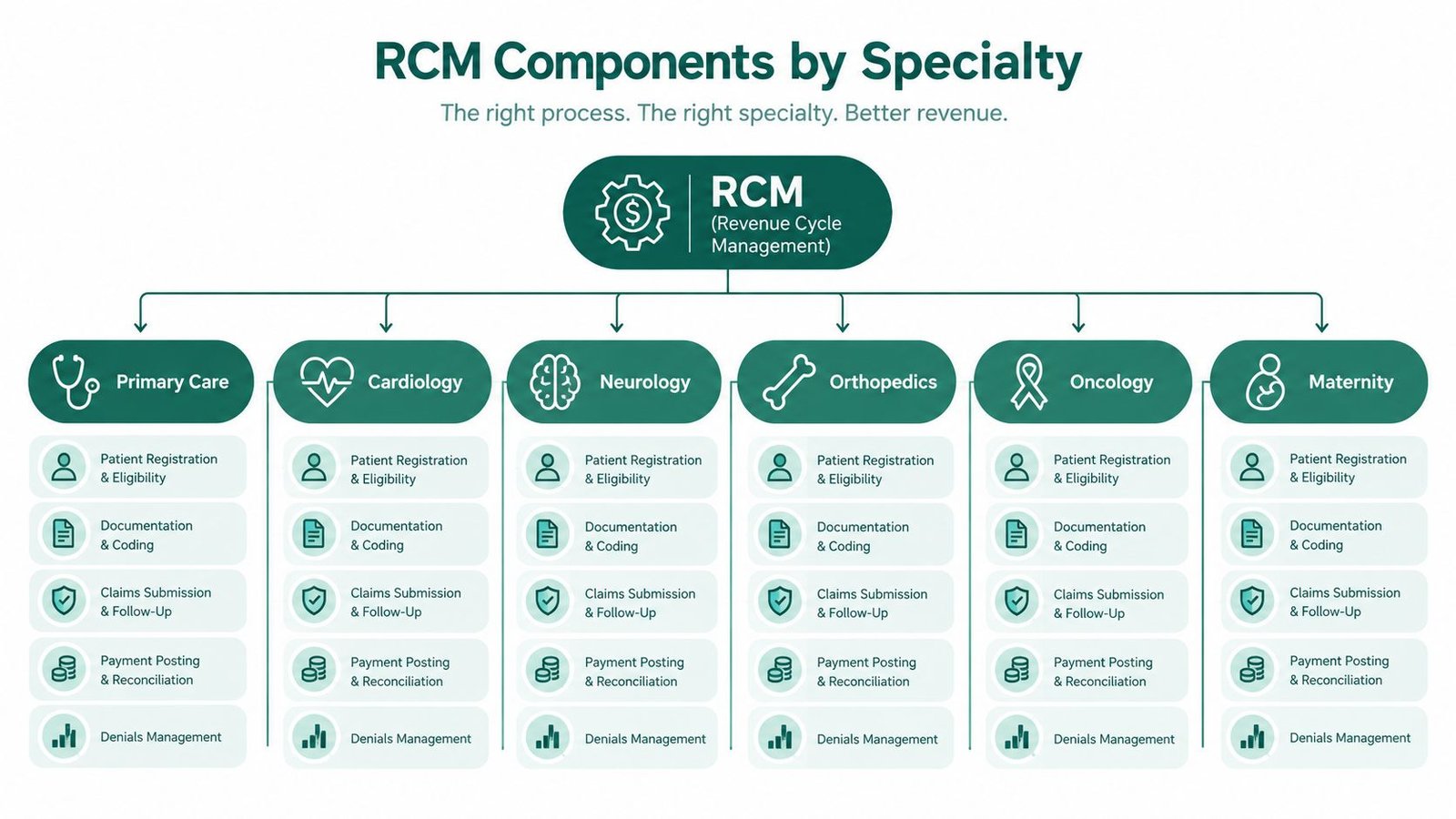
RCM Components by Specialty
Revenue-cycle management doesn't look the same across specialties. The hierarchy is practical:
Registration and eligibility → documentation and charge capture → specialty coding → claim edits → submission → payer response → denial prevention and A/R recovery
Anesthesiology
Anesthesiology billing depends on accurate base units, time units, provider roles, and applicable modifiers. A workflow that misses anesthesia time or misapplies medical-direction rules can reduce payment on otherwise valid services. Modifier QK, for example, signals medical direction by an anesthesiologist of two, three, or four concurrent anesthesia procedures, but the claim also needs to align with documentation and concurrency requirements.
The financial risk isn't limited to a coding correction. A missed time unit across recurring cases can create an annual revenue gap, while an incorrect concurrency or modifier pattern can prompt payer review. Owners should require reporting that separates unit capture, modifier edits, medical-direction issues, and unpaid anesthesia claims rather than accepting a single overall collection figure.
Mental and behavioral health
Behavioral health practices often face authorization management, benefit limitations, documentation requirements, and telehealth-specific place-of-service rules. A claim can fail even when the clinical service was appropriate if the authorization doesn't match the billed service or if the place of service and telehealth modifier conflict with payer expectations.
The result is avoidable rework and delayed reimbursement. A billing partner should track authorization-related denials separately from eligibility, medical necessity, missing information, and telehealth formatting issues. Practices can also examine a healthcare consent eSignature workflow when consent and preauthorization documentation need a more controlled process.
Cardiology
Cardiology workflows combine office E/M services, diagnostic imaging, testing, interpretation, and interventional procedures. The billing risk often sits in the relationship between services. Bundled services, component billing, global arrangements, and payer-specific edits can cause a technically complete claim to deny or pay below expectation.
Owners should ask whether the vendor reviews procedure combinations before submission and whether it reports underpayments separately from outright denials. A practice that receives payment on a claim may still lose revenue if the payer applies an edit the vendor never investigates.
Orthopedics and pain management
Orthopedic and pain practices must manage global periods, multiple-procedure reductions, postoperative services, and same-day E/M visits. CMS guidance says modifier 25 should be used only when the same physician or qualified nonphysician practitioner performs a significant, separately identifiable E/M service on the same day as another procedure or service. It isn't a general-purpose override, and misuse can trigger denial or downcoding, as described in CMS modifier 25 guidance.
Medicare global-surgery guidance also addresses modifier 25 when a procedure has a 0- or 10-day global period, and some payer policies reduce payment by 50% when an E/M code such as 99202-99215 is billed with a procedure carrying a 0-, 10-, or 90-day postoperative period. The practice owner's concern is the reimbursement consequence: same-day billing must satisfy documentation and payer rules, or the practice may lose part of the expected payment. Further context appears in Medicare global surgery modifier guidance.
For a specialty-focused operating model, compare the guidance on RCM for physician practices.
Key Performance Indicators That Protect Revenue
A vendor dashboard should make financial performance obvious. Three measures deserve consistent attention: first-pass clean claim rate, days in A/R, and denial rate. Each identifies a different failure point, so an attractive result in one metric can't compensate for poor performance in the others.
The following benchmarks come from clean-claim guidance, denial benchmark analysis, and CMS claims-processing rules.
| KPI | Average Performance | Best-In-Class Target | Financial Impact of Gap |
|---|---|---|---|
| First-pass clean claim rate | Practices may operate below the level needed for predictable cash conversion | At least 95%, with top performers reaching 97% to 98% or higher | More rejected or returned claims create rework, delay payment, and increase the chance that staff miss filing or appeal deadlines |
| Days in A/R | A/R rises when claims wait for correction, payer response, or follow-up | Keep aging under active control and compare payment speed with CMS processing expectations | Older balances consume staff time and become harder to recover |
| First-submission denial rate | Around 8% in the cited physician-practice benchmark | Below 5% is a best-in-class target for many physician practices | Denials increase appeal workload, A/R days, and the labor cost of collecting revenue |
When the clean-claim rate falls below the 90% to 95% range, the problem usually begins upstream. Registration errors, coding defects, eligibility mismatches, and missing modifiers create downstream correction work. A vendor that only reports claim submission speed won't tell you which front-end process is producing the leakage.
Use CMS timing as an operating control
CMS says Medicare contractors must process and notify providers about other-than-clean claims within 45 calendar days of receipt, although the count pauses while the contractor waits for additional information. CMS also states that clean claims must be paid or denied within 30 calendar days of receipt, with counting beginning the day after receipt and ending when payment is made. The rules are detailed in CMS contractor processing guidance and the Medicare claims-processing manual.
These aren't guarantees that every balance will resolve on schedule. They are useful controls for identifying claims that need investigation. Request monthly reporting by payer, claim age, denial reason, appeal status, and responsible workflow owner. Practice owners evaluating their current performance can begin with a medical billing KPI review and compare trends rather than relying on a single monthly snapshot.
Denial Prevention as the True Measure of Value
Claim submission speed is easy to market and difficult to interpret. A vendor can transmit claims quickly while allowing the same eligibility, authorization, documentation, or modifier errors to recur. Denial prevention is the more meaningful measure because it tests whether the billing operation protects collectible revenue before the payer rejects the claim.
A 2024 benchmark reported an initial denial rate of 11.81% across mixed hospital and physician claims, while recent coverage reports 11.8% industrywide initial denials in 2026, approximately 15.7% for Medicare Advantage, approximately 21% for commercial payers, and approximately 44% for Medicaid inpatient claims. These figures and the discussion of specialty variation appear in Medical Billers and Coders' 2026 denial-rate coverage.
The figures shouldn't become a universal target for every practice. A behavioral health clinic, telehealth-heavy group, orthopedic practice, and cardiology office face different denial mixes. The useful comparison is your practice against its own payer distribution and service lines.
Match prevention controls to the specialty
Telehealth claims often fail because the modifier, place of service, and payer policy don't align. Other practices see recurring denials from:
- Eligibility failures: Coverage wasn't verified or the subscriber information was wrong.
- Authorization gaps: The service required authorization, or the authorization didn't match the billed procedure.
- Documentation deficiencies: The record doesn't support medical necessity or the level of service.
- Timely filing: Corrected claims and appeals weren't submitted within the payer's window.
- Procedure and modifier conflicts: The billed code combination doesn't satisfy payer edits.
AI can help with structured front-end work. Claims scrubbing, document understanding, and denial prediction are sensible use cases because the system can identify patterns and route exceptions. Complex appeals involving medical necessity, bundled services, preauthorization mismatches, or modifier-specific coding still need expert review. Recent coverage of automation and analytics in medical billing supports this more measured approach.
Vendor standard: Require evidence that automation reduces preventable errors without removing human accountability from high-risk appeals.
A vendor's per-claim price matters, but it shouldn't outrank measurable denial avoidance. Review the partner's medical billing denial management approach and ask for results segmented by your specialty and payer mix.
Vendor Evaluation Checklist and Red Flags
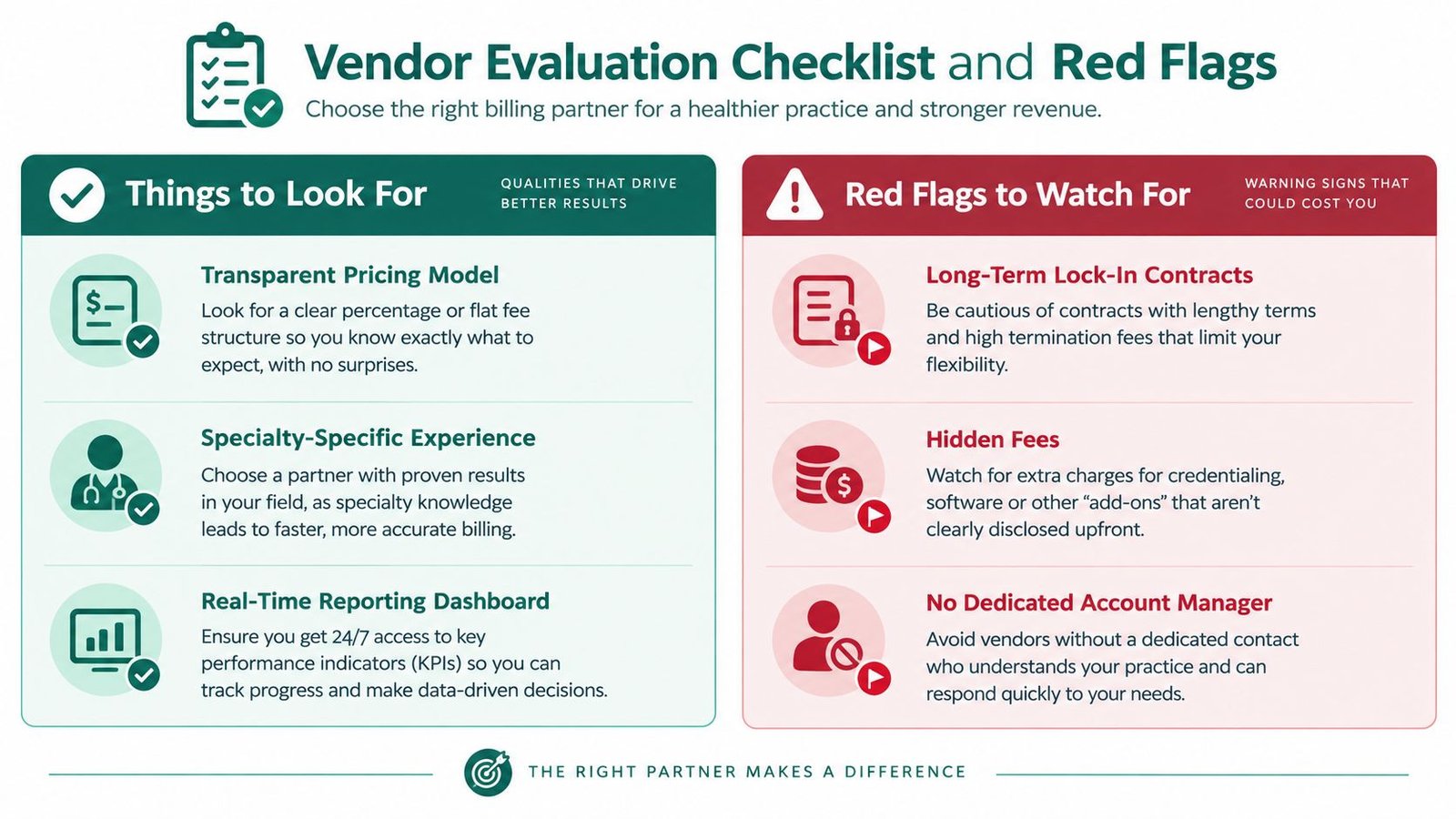
Start with the vendor's operating model, not the sales presentation. You need to understand who verifies eligibility, who reviews coding, who works denials, who owns payer escalation, and who has authority to change a claim. If those responsibilities are vague, the contract may leave your practice carrying the risk.
Compare the pricing models
Percentage of collections aligns the vendor's compensation with collected revenue, but the agreement must define which collections count and how refunds, patient payments, and old A/R are treated. Per-claim pricing can be easier to forecast, though it may not create enough incentive for sustained denial follow-up. A hybrid model can combine predictable processing costs with performance expectations for A/R recovery and appeals.
Don't select a fee structure without reviewing the service-level agreement. The SLA should define reporting frequency, escalation ownership, clean-claim expectations, denial-rate monitoring, A/R follow-up, security obligations, and termination procedures.
Ask for proof, not broad promises
Use the sales call to test operational depth:
- Request specialty evidence. Ask for references from practices with comparable payer mix, procedure complexity, and organizational scale.
- Review denial categories. Require reporting for eligibility, authorization, missing information, medical necessity, timely filing, and coding or modifier conflicts.
- Inspect the dashboard. It should show performance by payer, provider, specialty, claim status, and aging category.
- Test the appeal process. Ask who drafts appeals, who reviews clinical arguments, and how payer escalations are documented.
- Clarify system access. Confirm whether the team works in the existing EHR or expects a disruptive migration.
- Examine security terms. Verify HIPAA responsibilities, access controls, encryption commitments, audit processes, and the business associate agreement.
The red flags are predictable. A promise of a 100% clean claim rate is not credible as an operating explanation unless the vendor defines the denominator, claim type, correction policy, and measurement period. Hidden credentialing or software fees make comparisons unreliable. Long lock-in periods, high termination fees, no dedicated account manager, or offshore appeals without qualified oversight should prompt deeper scrutiny.
A practical transition checklist should include historical A/R review, payer enrollment verification, EHR access, claim-workqueue ownership, authorization rules, denial codes, and open appeals. Medical billing company red flags are useful to review before signing, but the final decision should come from documented workflow evidence and contract language.
Onboarding and Transition Timeline
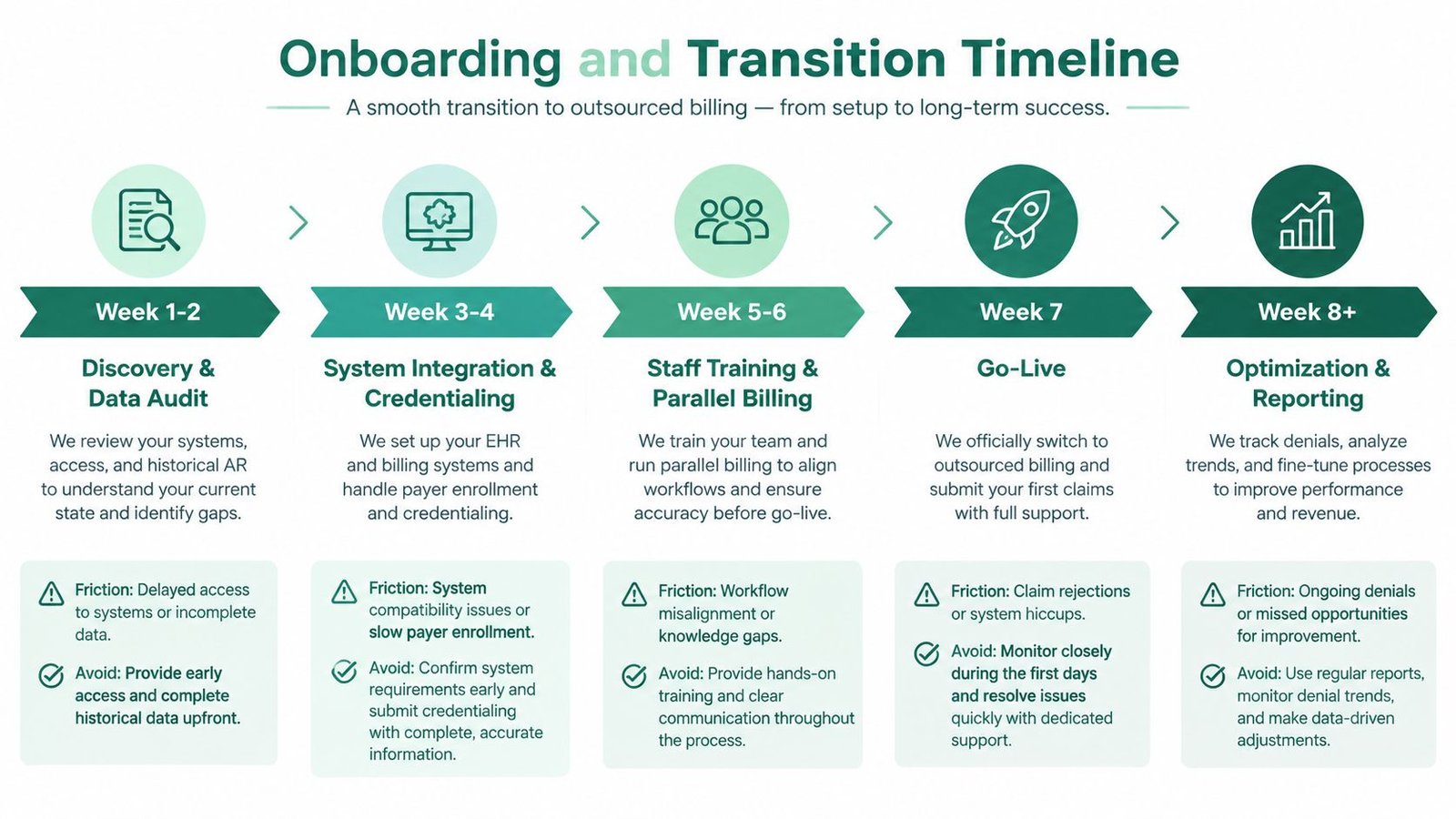
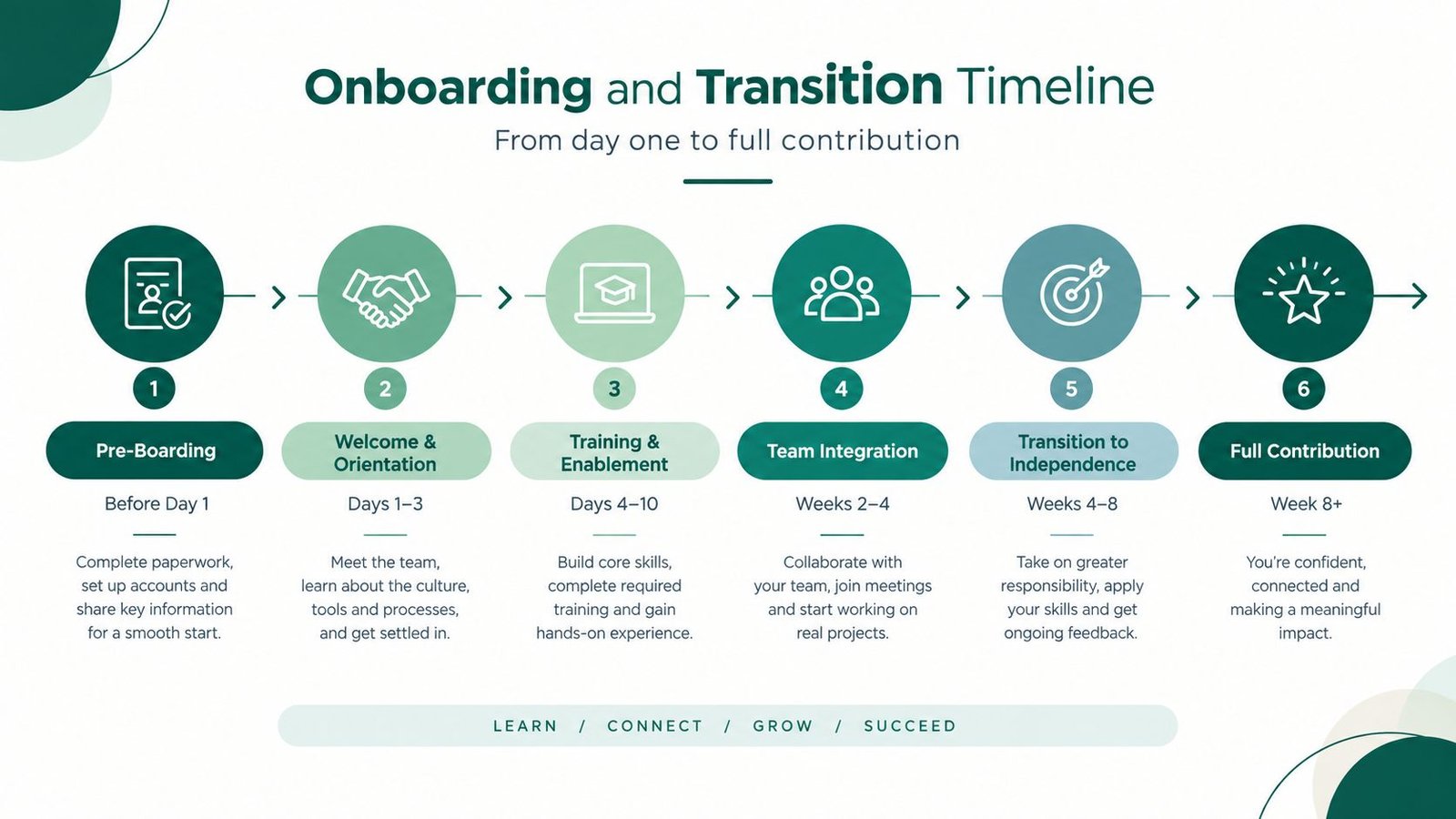
A billing transition fails when the practice treats it as a vendor handoff instead of an operating change. The new team needs historical A/R, payer contacts, credentialing records, EHR permissions, authorization rules, and a clear list of unresolved claims. Without that information, the vendor starts by guessing.
Before the first live claim
During discovery, the practice should provide historical A/R and identify high-value unpaid balances, recurring denial codes, payer-specific edits, and provider enrollment issues. The vendor should verify that each clinician is correctly connected to the relevant billing entities and payer contracts.
The next stage is workflow configuration. That includes EHR permissions, charge-routing rules, claim-scrubbing edits, authorization queues, corrected-claim procedures, and appeal ownership. A parallel period can expose discrepancies between the old and new workflows before the new team assumes full responsibility.
The first operating phase
The first live claims deserve close review. Practice leadership should inspect whether charges are captured on time, whether claims are held for valid edits, whether payer responses route to the correct workqueue, and whether staff understand which issues require provider clarification.
We have seen transitions slow down when the vendor introduces a separate platform that forces clinicians and staff to learn a new system. An EHR-integrated approach avoids unnecessary migration and keeps the practice's existing clinical workflow in place. Happy Billing, for example, describes an operating model inside the existing EHR, with U.S. leadership and a global back office supporting a 24/7 follow-the-sun workflow, alongside HIPAA-first security and bank-level encryption.
Transition rule: Don't judge the new partner by the first clean month alone. Require a documented review of open A/R, denial recurrence, payer response times, and SLA performance.
Stabilization and optimization
After the initial handoff, leadership should compare actual results against the agreed benchmarks and investigate every unfavorable trend. A rising denial category may require a registration change, a documentation prompt, an authorization checkpoint, or a coding review rather than more appeal labor.
The practice should also establish a recurring governance meeting. Review payer performance, unresolved high-balance claims, appeal velocity, recurring edits, provider-level patterns, and any security or access exceptions. This turns outsourcing into a controlled operating function instead of a black box.
Frequently Asked Questions
Which denial categories cost my specialty the most?
Start with your own payer and service-line data. Separate authorization, eligibility, medical necessity, missing information, timely filing, and modifier or procedure conflicts, then rank them by unpaid balance and recurrence. A high-volume low-dollar issue may deserve a front-end fix, while a smaller number of high-value medical necessity or bundled-service denials may require specialist review.
What should my billing vendor report every month?
Demand first-pass clean claim rate, denial rate, A/R aging, payer-level performance, open appeals, corrected claims, underpayments, and the top recurring denial categories. The report should identify the owner and corrective action for each material trend, not just display totals.
How much AI can safely automate?
Use automation for structured work such as claim scrubbing, document matching, and denial prediction. Keep human review for medical necessity, complex appeals, bundled services, authorization mismatches, and modifier-specific judgments. Automation should route exceptions, not conceal uncertainty.
When should I expect results after changing vendors?
Establish a baseline before transition, then evaluate early workflow accuracy and later A/R and denial trends. A realistic review focuses on measurable movement against the agreed SLA, not a vague promise of immediate ROI.
Happy Billing provides EHR-integrated full-cycle RCM, denial management, credentialing, and A/R recovery for independent practices, with workflows customized to specialty requirements. Visit Happy Billing to evaluate whether your current billing operation is preventing denials or merely processing them.