Medical Billing Cost: A 2026 Guide for Practice Owners

Outsourced medical billing typically costs 4% to 8% of gross collections. The trap is that in-house billing often looks cheaper on paper while subtly draining more from your net revenue through overhead, denials, rework, and slower cash flow.
That's the part most practice owners miss. A billing quote isn't just an expense line. It affects how much revenue you keep, how often claims get denied, and how long cash sits in A/R. If billing errors are common and coding mistakes show up in first-submission denials, the cheapest-looking setup can become the most expensive one fast. We've seen owners focus on a vendor's percentage while ignoring the larger financial question: what does your current billing model cost once you include staff time, software, payer follow-up, and write-offs that never should have happened?
The broader context matters. In 2012, billing and insurance-related administrative costs in the U.S. health care system reached about $471 billion, including $70 billion in physician practices alone, according to the National Institutes of Health analysis of billing and insurance-related costs. The system has never rewarded complexity. It punishes practices that underestimate it.
Quick answer: Outsourced medical billing typically costs 4–9% of monthly collections. Typical percentage-of-collections rates by practice size:
| Practice size | Typical rate | Common alternative |
|---|---|---|
| Solo (1 provider) | 6–9% of collections | $4–$8 per claim |
| Small group (2–5 providers) | 5–8% of collections | Flat monthly retainer |
| Group (6–10 providers) | 4–7% of collections | Hybrid: base fee + % |
Setup fees run $0–$1,000, and specialty complexity moves the rate more than practice size does — high-volume, low-ticket specialties (mental health, PT) price toward the top of each range, while surgical specialties with large average claims price toward the bottom. Compare that against an in-house biller at $45,000–$60,000 a year plus software, clearinghouse fees and turnover risk.
What Is the True Medical Billing Cost for Your Practice
For most independent practices, the visible number is only half the story. As of 2026, outsourced medical billing services typically cost 4% to 8% of gross collections, while poor billing practices cost providers an estimated $125 billion annually due to revenue leakage. The same market analysis notes that about 80% of U.S. medical bills contain some kind of error, coding mistakes are cited in about 32% of first-submission denials, and practices commonly lose 4% to 5% of revenue to billing inefficiency, according to this 2026 medical billing cost breakdown.
If you own the practice, that should reframe the conversation immediately. The primary concern isn't whether a billing company charges 6% or 7%. Instead, the central problem is whether your current process is leaking revenue through avoidable denials, undercoding, missing modifier logic, and slow follow-up.
Practical rule: If your billing decision increases denials or extends A/R, it isn't saving money. It's shifting costs into places you don't see until cash gets tight.
The fee you see versus the cost you feel
An outsourced percentage is obvious. You can model it in one line on a spreadsheet.
In-house billing feels cheaper because many owners only count salary and software. They don't count turnover, training, clearinghouse friction, underworked denial queues, or the time an administrator spends chasing payer issues instead of running the practice.
That's why total cost matters more than sticker price. If you're trying to benchmark alternatives, this outsource medical billing cost guide is a useful starting point for comparing what's included and what usually gets buried in the fine print.
Why practice economics matter more than list price
A private practice doesn't have the margin to absorb preventable leakage. Every unresolved denial affects payroll, recruiting, expansion plans, and physician compensation.
The same logic applies outside billing. Many owners who are tightening operations also review staffing overhead, benefits administration, and compliance costs through a broader PEO cost strategy for medical practices. Revenue cycle decisions should be evaluated the same way. Not by line-item price alone, but by total operating impact.
Decoding Medical Billing Pricing Models
A billing contract usually comes in one of three forms. Percentage of collections, flat fee per claim, or monthly subscription. None is automatically best. The right choice depends on your specialty, claim complexity, and whether you care more about predictability or tight incentive alignment.
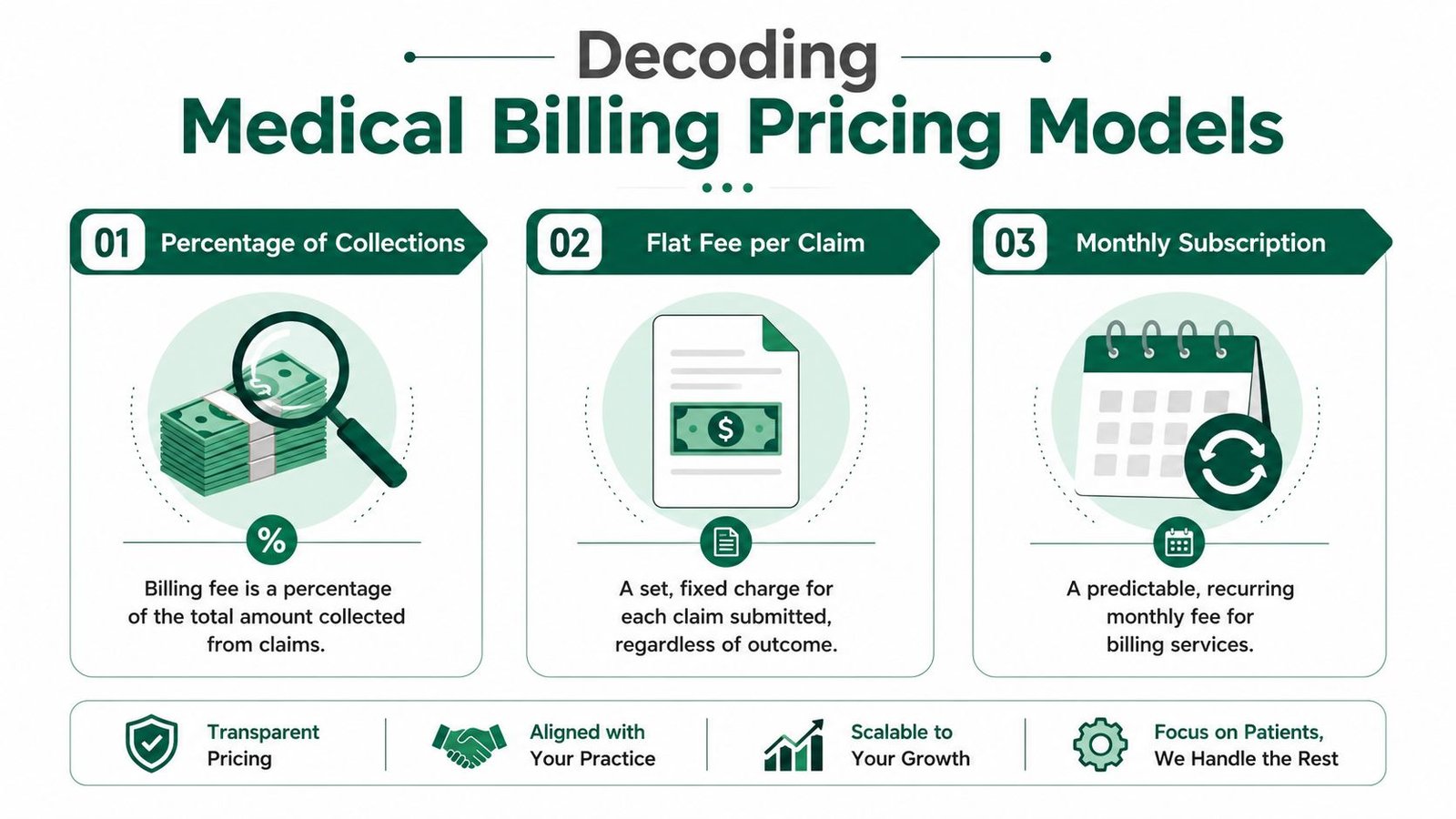
Percentage of collections
This is the most common structure, and for many practices it's the cleanest. The billing company gets paid when money is collected, which usually keeps incentives aligned around claim accuracy, payment posting, denial management, and follow-up.
That alignment matters. If the vendor only gets paid after collections happen, they have a direct reason to work denials and underpayments instead of just pushing claims out the door.
Best fit:
- Growing practices that want variable cost instead of fixed staffing overhead
- Specialties with payer complexity where follow-up work is a major part of collections
- Owners who want cost tied to performance, not just activity
Watch-outs:
- Gross versus net collections definitions need to be explicit
- Credentialing, old A/R, and patient statements may be charged separately
- Very high collections with low billing difficulty can make the model feel expensive if the vendor adds little strategic value
Flat fee per claim
This model sounds simple. It often isn't. Per-claim pricing typically ranges from $3 to $12 per claim, and the economics change sharply based on volume and claim complexity. A practice submitting 3,000 low-complexity claims at $3 per claim costs $9,000 per month, while a specialty sending 1,000 complex claims at $10 per claim costs $10,000 per month, as outlined in this medical billing services pricing analysis.
That tells you something important. A low per-claim fee doesn't always mean low total medical billing cost.
| Model question | What to check |
|---|---|
| High claim volume | Can your practice absorb a large monthly claim count without overpaying for routine work? |
| Denial ownership | Does the vendor still get paid if the claim is denied and reworked? |
| Complexity mix | Are simple office claims and complex surgical claims charged the same way? |
A per-claim model rewards submission volume. It does not automatically reward collection quality.
A comparison like this medical billing outsourcing cost comparison helps owners pressure-test whether a claim-based quote is aligned with outcomes.
Monthly subscription
Some vendors charge a recurring monthly fee, often with service limits. This can help with budgeting, especially if your volume is stable and your workflow is standardized.
The problem is scope creep. If the subscription excludes denial appeals, secondary claims, or payer calls, the practice can end up paying extra while assuming everything is covered. Before signing, ask exactly what happens with aged A/R, corrected claims, and payer-specific edits tied to CMS rules or specialty coding standards.
Key Factors That Drive Your Billing Costs
Your quote isn't random. Billing cost moves according to operational friction. Two practices with the same collections can pay very different rates because the billing workload behind those dollars is completely different.
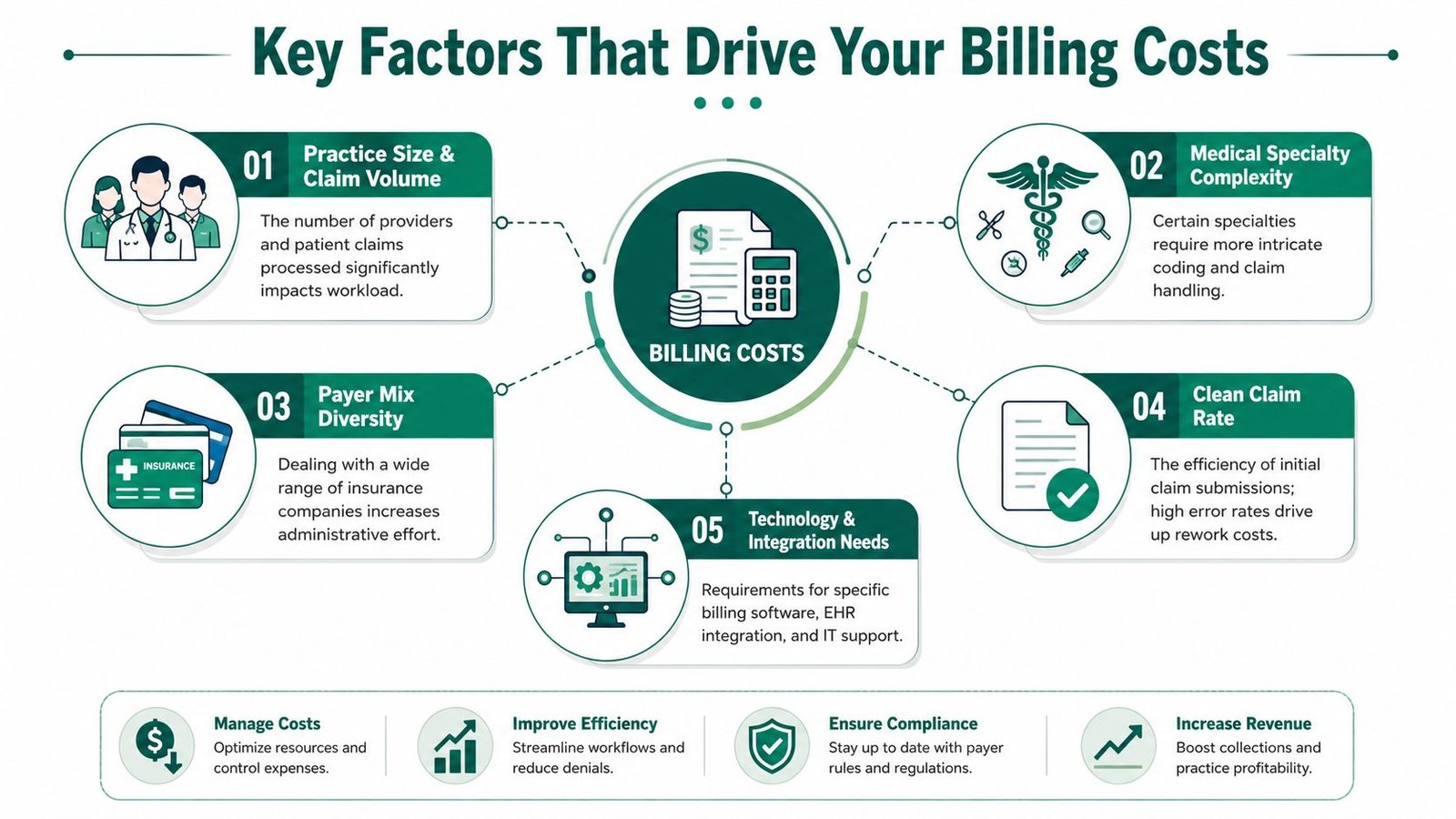
Practice size and claim volume
Billing has what many vendors call volume elasticity. Mid-to-large groups with 11+ providers can often secure rates of 3% to 6% of net collections, while solo and small practices typically pay 5% to 9%, because fixed RCM work gets spread across more claims. That benchmark is explained well in this small practice medical billing cost breakdown.
If you run a smaller practice, don't take that personally. It's math. A vendor still needs staff for posting, edits, payer calls, denial handling, and reporting even if your claim count is modest.
Specialty complexity changes everything
Primary care claims don't behave like interventional cardiology or orthopedic surgery claims. The more your revenue depends on procedure coding, modifier logic, prior authorization, and payer-specific edits, the more expensive billing becomes.
Take cardiology. A claim involving CPT 93306 may trigger authorization and documentation review issues before the payer even considers payment. If your team mishandles modifier logic on interventional work or fails to track local payer edits, your cost isn't the vendor fee. It's delayed reimbursement and preventable denials.
Clean claim rate and payer mix
A practice with a messy front-end process always pays more downstream. Eligibility problems, missing referrals, bad subscriber data, and weak documentation create rework. Rework is labor, and labor drives cost.
Owners should stop treating billing as back-office administration. It's revenue protection. Reviewing the right medical billing KPIs to track gives you a clearer read on whether the issue is registration quality, coding, denial management, or payer behavior.
Technology and integration requirements
Billing gets more expensive when systems don't talk to each other. EHR quirks, clearinghouse edits, custom reporting, and payer portal workflows all add labor.
In our experience, practices underestimate this category constantly. They assume software solves the problem. It doesn't. Integration, maintenance, and workflow design determine whether your staff spends the day resolving exceptions or resubmitting the same avoidable errors.
For owners exploring automation, this look at healthcare finance automation is useful because it frames where automation helps and where human oversight still matters.
Ancillary services expand the scope
Provider credentialing, old A/R recovery, patient statements, and authorization management can all sit outside the base billing fee. That's normal. What matters is knowing whether those services are optional add-ons or essential parts of your revenue cycle that the vendor is excluding to make the percentage look lower.
If the proposal looks cheap, check what's missing before you compare what's included.
In-House vs Outsourced Billing A Financial Breakdown
Most comparisons falter at this point. Owners compare an outsourcing percentage to one salary line and conclude in-house is cheaper. That's not financial analysis. That's wishful accounting.
What in-house actually costs
The most useful benchmark here is simple. The Medical Group Management Association reports that in-house medical billing costs an average of 13.7% of total collections. The same analysis states that for a practice collecting $600,000 annually, outsourcing at a 7% rate instead of managing billing internally could recover $40,200 in revenue otherwise consumed by overhead, according to this MGMA-based billing cost comparison.
That's the headline number, but the hidden layer is what makes the difference feel bigger in real life.
A separate analysis of total cost of ownership notes that in-house billing often carries a 20% to 40% hidden cost layer above the visible budget due to integration complexity, data migration, maintenance, denial write-offs, and turnover. It also notes that cloud billing software priced at $200 per month can become an effective $1,500 to $3,000 monthly burden for a 5-provider practice once operational realities are included, based on this medical billing cost guide on software and hidden costs.
The hidden inflation most owners ignore
Another breakdown on the in-house versus outsourced decision makes the point even more directly. It argues that annual in-house billing costs often end up 20% to 40% higher than the visible budget because denial write-offs and staff turnover distort the actual cost. It also notes that owners often compare a biller salary in the $55,000 to $75,000 range to an outsourced fee of 6% to 9% without accounting for operational inflation, as explained in this outsource versus in-house billing analysis.
That's exactly the mistake we see. A practice hires one or two people, buys software, and assumes control equals savings. Then one biller leaves. Appeals stall. Secondary claims pile up. A/R stretches. The owner spends nights reviewing reports instead of reviewing strategy.
Here's the cleaner way to compare the two models:
- In-house favors control: You keep people, systems, and processes under your roof. You also keep the staffing risk, training burden, compliance drift, and management load.
- Outsourcing favors variable cost: You replace a chunk of fixed overhead with a percentage. That can be the more conservative financial choice when your internal process is unstable.
- Total cost of ownership is the key metric: If you don't count software maintenance, turnover, denied claims, and leadership time, your comparison is incomplete.
A lot of owners already understand this principle in adjacent functions. The economics behind front-desk staffing show the same pattern in this review of human vs AI receptionist pricing. The visible wage is rarely the full operating cost.
When outsourcing wins financially
Outsourcing wins when your practice has any of these conditions:
- Denials require specialized follow-up and your current team is mostly posting and submitting.
- You depend on a small internal billing bench where one resignation can disrupt cash flow.
- Your administrator is acting as the billing manager instead of running the practice.
- Your current software stack creates extra work rather than reducing it.
This in-house vs outsourced medical billing comparison is worth reviewing if you want a side-by-side lens on cost, control, and operational trade-offs.
Choosing a Partner and Avoiding Billing Red Flags
A cheap billing company can be the most expensive line item in your revenue cycle. If they miss denials, hide weak follow-up behind vague reports, or burn through your old A/R, the cost shows up in write-offs and delayed cash, not just in their percentage.

The right question is not, “What do you charge?” Ask, “What work is included, how will you prove performance, and what revenue usually gets missed under your model?” That is how practice owners avoid signing a low-rate contract that effectively costs far more in lost collections.
Questions worth asking before you sign
Start with scope. A vendor should tell you, in plain language, what they handle, what triggers extra fees, and what stays on your staff.
- Who owns denial work: If routine denial follow-up, appeals, or corrected claims cost extra, your quoted rate is incomplete.
- How do you report by payer, provider, location, and CPT category: You need enough detail to spot whether revenue is getting stuck at eligibility, coding, claim edits, or payer response.
- What happens with old A/R: Some firms focus on clean new claims and let aging balances sit until they are uncollectible.
- How do you handle CMS and payer rule changes: Ask how they manage modifier updates, NCCI edits, authorization rules, and documentation-sensitive services.
- What specialty work do you already manage: A team that performs well in primary care may struggle in anesthesia, orthopedics, cardiology, or behavioral health.
Ask who touches your account day to day. If the sales team sounds sharp but the operating model is a black box, expect inconsistency.
A strong partner should explain workflows, escalation paths, reporting cadence, and handoff expectations without hiding behind a dashboard screenshot or generic promises.
Red flags that should end the conversation
Some problems are expensive enough that you should walk away.
| Red flag | Why it matters |
|---|---|
| Vague reporting | You cannot identify whether cash loss starts at the front desk, in coding, or in payer follow-up |
| Extra fees for basic follow-up | The contract looks cheaper than the actual operating cost |
| No specialty examples | They may not understand your coding patterns, modifiers, or payer rules |
| Weak transition plan | Poor onboarding can slow submissions, increase denials, and disrupt cash flow |
| No clear ownership of old A/R | Hard balances often become write-offs if nobody is accountable |
A billing vendor should show you how they protect collections, reduce preventable write-offs, and keep visibility high month after month.
If you want a tighter vetting process, use this checklist of medical billing company red flags to watch before signing.
Before you switch, review your current numbers first. Compare net collections, denial trends, days in A/R, aging by payer, and staff turnover cost. That gives you a real baseline and keeps you from replacing one expensive billing model with another.
Specialty-Specific Billing Cost Considerations
Specialty billing isn't expensive because vendors say it is. It's expensive because small errors have outsized financial consequences.
Anesthesiology and time-based risk
Anesthesia billing is unforgiving. If your team mishandles time units, concurrency, or modifier assignment, revenue slips fast. Modifiers such as QK and QY aren't abstract coding details. They determine how payer rules apply and whether the claim supports the level of medical direction billed under CMS requirements.
We've seen anesthesia groups lose money not because the case volume was weak, but because documentation and time capture didn't line up cleanly with submitted units. Owners in this space need a billing partner who understands records, timing, and concurrency logic, not just claim submission.
Mental health and authorization drag
Behavioral health often looks simple from the outside. It isn't. Services like CPT 90837 can turn into administrative drag if authorizations, visit limits, or payer-specific documentation rules aren't managed tightly.
The issue for the owner is operational cost. When staff spend too much time fixing missed authorizations or resubmitting avoidable denials, the billing burden rises even if individual claims look straightforward.
Cardiology and orthopedics carry heavier billing costs
High-complexity specialties such as cardiology and orthopedic surgery often face outsourced billing costs of 10% to 12% of net collections because of coding complexity, frequent prior authorizations, and the need to manage rules like global periods and multiple procedure reductions. That benchmark is outlined in this specialty medical billing rate analysis.
For orthopedics, the difference between modifier 58 and modifier 79 can affect whether follow-up procedural work gets paid correctly inside or outside a global period. For cardiology, diagnostic and interventional services often require stronger payer-rule discipline than many generalist billing teams can provide.
If your specialty lives or dies by modifiers, time rules, authorizations, or procedural edits, generic billing support won't hold up. Therefore, exploring specialty-specific medical billing services makes sense. The billing model has to match the revenue model.
Frequently Asked Questions by Practice Owners
Should I choose the lowest percentage quote?
Choose the quote that protects cash, shortens follow-up time, and covers the work your practice needs. A lower percentage often hides costs elsewhere. If denial appeals, payer follow-up, old A/R, authorization work, or patient billing support sit outside the agreement, your staff picks up the slack and your real billing cost rises fast.
A cheap rate with weak execution is not cheap. If even a small share of claims goes unpaid or ages longer because the vendor does not handle the hard work, the lost revenue can wipe out any headline savings.
When does per-claim pricing make sense for a practice owner?
Per-claim pricing fits simple environments. High claim volume, predictable workflows, limited coding variation, and low denial pressure.
It breaks down when collections depend on persistence. If your practice needs repeated payer follow-up, complex modifier use, authorization tracking, or appeals, a per-claim vendor can be aligned to push claims out the door rather than get them paid. Submission is not the same as collection.
How can I tell whether my in-house team is really too expensive?
Start with total cost of ownership, not payroll. Add salaries, taxes, benefits, software, clearinghouse fees, training time, manager oversight, turnover, vacancy gaps, and the physician or administrator hours spent fixing billing issues. Then add the expensive part owners often miss. Underworked denials, slow A/R follow-up, missed timely filing, and write-offs that never should have happened.
Here is the blunt test. If your in-house team looks cheaper on paper but collections lag, denials sit unresolved, or one resignation throws the whole office off balance, it is not cheaper. It is unstable.
Staff turnover is usually the hidden cost that changes the math. One experienced biller leaves, claims queue up, payment slows, overtime starts, and someone senior gets pulled into daily fire drills. The salary line stays familiar. The revenue damage does not.
What should I ask a billing company about specialty expertise?
Ask for specifics tied to payment, not general promises. Which claim types do they work every week in your specialty? How do they handle your common denial categories? What edits, modifiers, authorization rules, or documentation failures usually delay payment in your payer mix?
Then push harder. Ask what they do when claims are not paid on first pass, how they report denial trends, and who owns follow-up. A credible billing partner should answer with process, examples, and accountability. If the answers stay vague, assume your practice will become their training ground.
If you want a clearer answer than a vendor pitch, Happy Billing can review your current revenue cycle and show where your real medical billing cost is coming from. Their team works inside existing EHR workflows, focuses on denial prevention and faster collections, and offers a practical audit for independent practices that need better numbers, not more guesswork.