Outsourced Pediatric Medical Billing: Is It Right for You?

Outsourced pediatric medical billing is often the right move when your practice needs to convert billing from a staffing problem into a revenue function. In most pediatric groups, the key decision is whether a partner charging 2.5% to 8% of collections can recover more cash, faster, than your current process is leaving on the table.
If you're dealing with rising A/R, recurring denials, or a billing team that works hard but still misses payer nuance, you're already paying for inefficiency. In pediatrics, small coding misses create outsized revenue loss because the volume is high, reimbursement is often tight, and payer rules change by age, service type, and plan. That is why outsourced pediatric medical billing works best as a strategic partnership managing the full revenue cycle, from claim submission through denial follow-up and A/R recovery, with the specific goal of improving cash flow and reducing denials tied to pediatric complexity.
A general medical billing vendor can process claims. A pediatric-focused partner should do more than that. They should catch what costs you money: missed vaccine administration revenue, incorrect modifier use, pre-authorization failures for behavioral health services, Medicaid and CHIP mismatches, and family-account collection friction. Those are business problems, not coding trivia.
What Is Outsourced Pediatric Medical Billing
A lot of practice owners start looking at outsourcing after the same pattern repeats for months. Claims go out late. Aging grows. One experienced biller leaves, and the whole back office becomes fragile. The physicians keep seeing patients, but cash stops moving the way it should.
Outsourced pediatric medical billing is a third-party arrangement where a specialized team manages your revenue cycle on the practice's behalf. In a strong model, that includes charge review, coding support, claim submission, denial management, payment posting, A/R follow-up, patient statements, and payer-facing issue resolution. It isn't just task delegation. It's an operating decision about how your practice gets paid.
It should improve revenue velocity, not just reduce admin work
For pediatric owners, the standard to judge outsourcing isn't whether someone else files claims. The standard is whether the partner can turn completed visits into payment with fewer delays and fewer avoidable denials. Professional outsourced pediatric billing teams typically submit claims on the same day or next day, within 24 to 48 hours of service, rather than waiting for the weekly or bi-weekly batching that often happens in-house, according to this pediatric workflow analysis.
That speed matters because every extra day between the encounter and submission stretches A/R. In our experience, practices often underestimate how much working capital gets trapped by slow claim release, especially in high-volume well-visit and vaccine seasons.
Practical rule: If your billing partner can't explain how they move claims from signed note to payer in a predictable daily workflow, they are not managing revenue. They are processing paperwork.
The pediatric piece is what makes the difference
Pediatric billing isn't interchangeable with general family medicine billing. Vaccine administration, counseling-based coding, age-linked preventive codes, behavioral health pre-auth requirements, and Medicaid-heavy payer mixes all create failure points. If you want a useful refresher on the coding foundation behind those claim mechanics, this guide to healthcare data coding gives a practical overview.
From an ownership standpoint, outsourced billing only works when the partner understands your specialty's denial patterns and payer behavior. That is the same reason many groups revisit how they define the full revenue cycle in the first place. This revenue cycle management overview is worth reading if you want to evaluate outsourcing as a complete financial workflow rather than a claims-only service.
Why Pediatric Billing Is Uniquely Complex
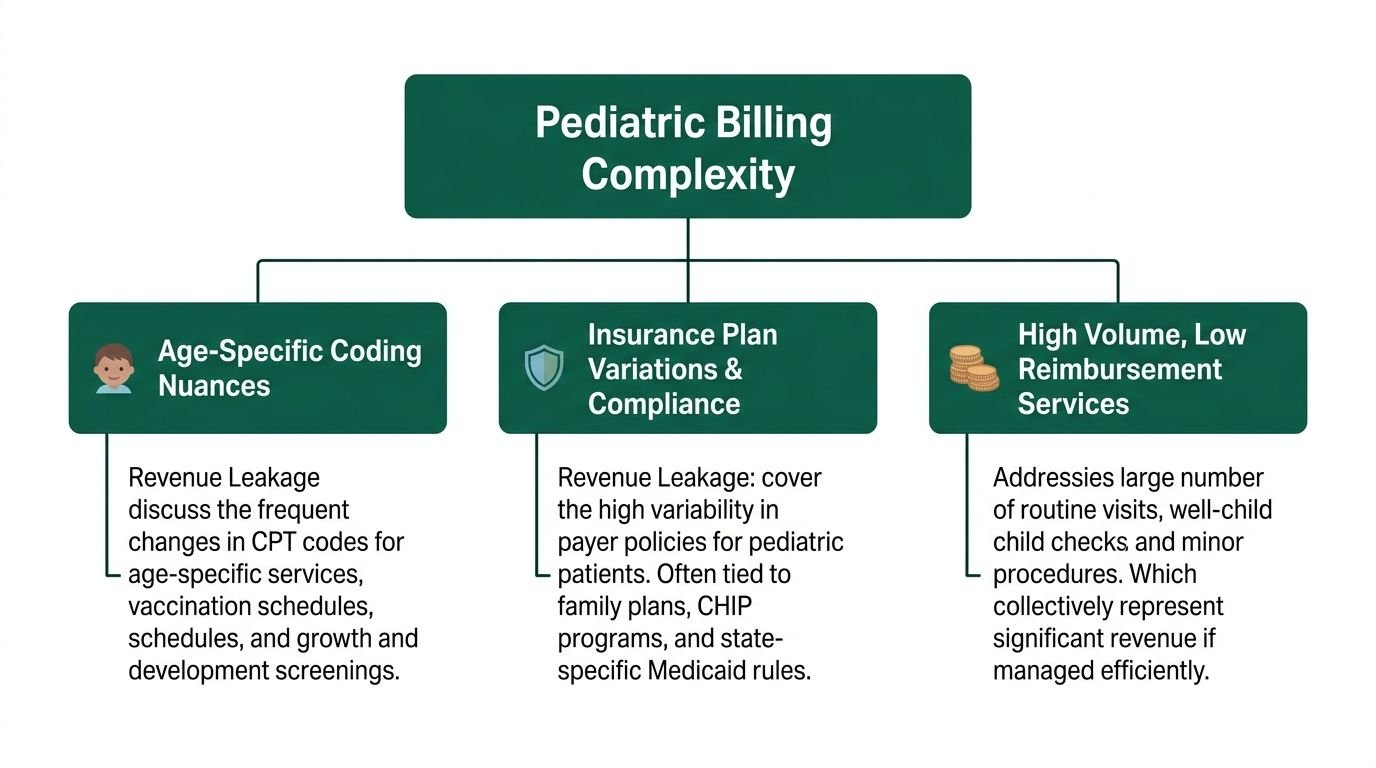
Pediatrics creates a type of revenue leakage that generic billing teams often don't even notice. The claim may go out. The payer may respond. But if the product code is billed without the right administration logic, if the age-specific service is mapped incorrectly, or if the family account balance sits unresolved across multiple children and plans, your practice still loses money.
Vaccine billing is a margin issue
One of the most common pediatric mistakes is treating immunization billing as a simple product charge. It isn't. Pediatric-specific denial risks include inaccurate vaccine inventory coding, missing administration modifiers, and missed administration logic around CPT 90460 and 90461, including situations requiring modifiers such as -59 for separate procedures, as outlined in this review of pediatric billing denials and prevention tactics.
For a practice owner, the financial issue is straightforward. If your team bills only the product correctly but fails on administration detail, you don't just get a clean denial report. You under-collect on a service line that appears routine and therefore escapes scrutiny.
Age-specific coding isn't a detail you can delegate to a generalist
Preventive and procedural coding in pediatrics changes with age, and sometimes with clinical setting. A generic billing operation may know mainstream E/M workflows but still miss pediatric claim logic that ties reimbursement to the patient's age, service category, and payer rule set.
The result is either a denial or an underpayment that your staff has to detect and appeal later. We have seen practices lose time on avoidable rework merely because the billing team knew general coding but didn't know pediatric coding behavior at the payer level.
A pediatric group evaluating specialty support should look closely at specialty billing services that understand those distinctions before claim submission, not after money is delayed.
Family balances and split payer workflows slow down collections
Pediatric A/R isn't just about insurers. Family billing creates its own friction. One household can have multiple children, more than one policy, changing guarantor details, and recurring copay or deductible balances that must be communicated clearly and consistently.
That doesn't always produce an outright denial. Often it produces slower self-pay collections, more statement confusion, and more front-desk time spent untangling old balances. Generic vendors tend to treat that as a patient collections problem. Pediatric-focused teams treat it as part of account design and follow-up workflow.
The pediatric practices that collect more consistently usually don't have fewer billing variables. They have tighter systems for handling them before those variables reach A/R.
Behavioral health and authorization gaps create preventable write-offs
Pediatric groups that offer developmental or behavioral services face another problem. Pre-authorization lapses for behavioral health visits can stop reimbursement even when the care was clinically appropriate and fully documented.
That is one reason outsourced pediatric teams often use pre-submission scrubbing and real-time eligibility verification. The goal isn't administrative neatness. The goal is to stop a billable visit from turning into non-billable labor.
If your current team is constantly fixing these issues after remittance, this medical billing complexities breakdown helps frame what should be caught upstream.
In-House Billing vs a Specialized Outsourced Partner
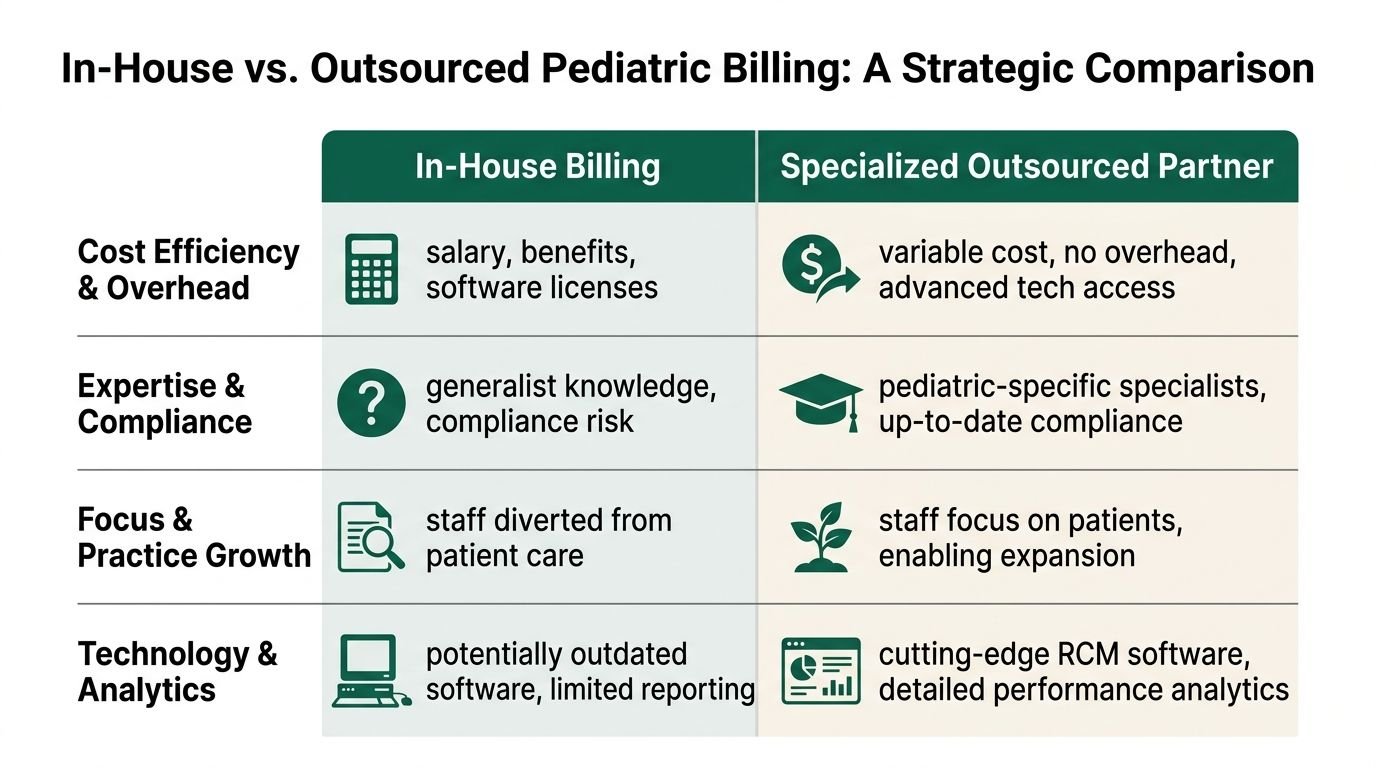
A pediatric practice can look busy all month and still finish the month short on cash. I see it when claims sit in limbo for Medicaid eligibility issues, CHIP coverage changes, vaccine administration coding edits, or newborn charges that were filed under the wrong payer sequence. The key comparison is not control versus convenience. It is fixed internal overhead versus the amount of revenue your billing model protects.
Cost model and operating risk
An in-house team gives you visibility and day-to-day access. It also gives you salary expense, benefits, turnover exposure, training time, software costs, and a single-point-of-failure problem if your lead biller quits or goes on leave.
Outsourcing changes that cost structure. The fee usually rises and falls with collections instead of sitting on payroll regardless of performance. That matters in pediatrics because volume is rarely steady. Back-to-school surges, vaccine season, Medicaid redeterminations, and payer policy changes can all shift workload fast. Internal staffing does not flex well when claims suddenly need more touches per visit.
The larger risk is mismatch. A generalist vendor may be cheaper on paper, but lower rates do not help if they miss pediatric-specific edits that delay payment or force avoidable write-offs. The HFMA Revenue Cycle Map makes the point clearly in its review of outsourcing revenue cycle functions. Practices have to measure vendor cost against process performance, denial prevention, and net collections, not fee percentage alone.
Expertise and denial control
Pediatric billing fails in small places that become expensive quickly. Vaccine counseling documentation may support one code set while the claim goes out with another. A behavioral visit may need authorization tracking that an adult-primary-care billing team does not watch closely. Medicaid managed care plans may require a different filing rule for the same service depending on county or plan assignment.
Those are not rare edge cases in pediatrics. They are routine revenue risks.
A specialized outsourced partner usually has payer rules, edit logic, and follow-up workflows built around those risks. A generic billing company often handles them after the denial arrives. By then, staff time has already been spent twice and cash is delayed again. On high-Medicaid or CHIP-heavy books of business, that lag shows up fast in aging and write-offs.
Owner's lens: The issue is not whether your current team works hard. The issue is whether your current setup catches pediatric payment errors before they become rework.
Side-by-side decision points
| Business factor | In-house billing | Specialized outsourced partner |
|---|---|---|
| Cost structure | Fixed payroll, software, and management overhead | Variable fee tied to collections and workload |
| Pediatric expertise | Depends on one or two employees | Team-based pediatric billing experience across coders, billers, and A/R staff |
| Payer mix pressure | Medicaid and CHIP rules can overwhelm a small team | Workflows are usually built around multi-plan pediatric payer rules |
| Scalability | Hiring and training lag growth | Capacity expands faster as visit volume changes |
| Denial follow-up | Competes with front-end work and daily posting | Dedicated staff handle appeals, resubmissions, and payer follow-up |
| Operational continuity | Turnover can stall claims for weeks | Coverage is distributed across a larger team |
Some groups should stay in-house. If you have stable staff, low turnover, a simple commercial payer mix, and a manager who watches denials every week, internal billing can perform well.
But practices with heavy Medicaid, CHIP, vaccine, newborn, or behavioral health volume need more than generic billing labor. They need pediatric rule accuracy. That is where the financial gap opens between a low-cost vendor and a true specialist. If you are weighing the trade-offs, this in-house versus outsourced medical billing comparison gives a broader framework for evaluating whether your current model is protecting margin or quietly eroding it.
Calculating the ROI of a True Pediatric Billing Partner
The ROI question isn't whether outsourcing costs money. It does. The better question is whether a pediatric specialist captures more money, faster, than the fee costs you. In many practices, that's where the business case becomes clear.
A/R improvement changes cash flow before year-end accounting does
Pediatric billing outsourcing can produce a 25% to 35% improvement in days in A/R, bringing performance from an industry average of 45 to 50 days to under 35 days, driven by systematic denial workflows and proactive pre-claim audits that support a 98%+ first-pass claim acceptance rate, according to this review of pediatric billing challenges and revenue cycle outcomes.
For an owner, that means money lands closer to the date of service. Payroll, rent, supply expense, and provider compensation don't wait for your oldest claims to mature. Faster A/R is not an abstract KPI. It is liquidity.
The net gain usually comes from three places
A true pediatric partner tends to create ROI through a combination of revenue capture and process discipline:
- Cleaner first submissions: Claims are less likely to bounce for modifier, eligibility, or authorization issues.
- Faster appeal cycles: Denials get worked on a defined timetable instead of aging on a work queue.
- Better payer-specific execution: Pediatric rules around vaccines, screenings, and age-linked services are reviewed before submission.
What does not create ROI is outsourcing to a generalist that submits quickly but misses pediatric nuance. Fast bad claims still become slow cash.
Use a simple owner-level formula
You don't need a finance committee to model this. Start with:
- Current net collections
- Current A/R performance
- Current denial trend
- Estimated outsourced fee
- Expected lift from better claim acceptance and follow-up
If the increase in collected revenue and the reduction in administrative drag exceed the vendor fee, outsourcing works financially. If not, it doesn't.
In our experience, the key variable isn't the percentage fee by itself. It's whether the vendor is built to protect pediatric revenue categories that your current process mishandles. This medical billing cost guide can help frame that calculation in practical terms.
Your Vendor Selection Checklist
Most outsourcing failures happen before the contract is signed. The practice chooses a vendor that can talk generally about billing but can't answer pediatric questions with operational clarity. That is how a service that looks efficient on paper still leaves revenue behind.
Ask about Medicaid and CHIP first
The most revealing question is often the simplest one: how do you handle state-specific Medicaid rules for pediatric vaccines, screenings, and managed care claims?
That question matters because the hidden cost in pediatric outsourcing often comes from Medicaid and CHIP errors, not from the visible fee. Industry audits cited in this review of pediatric outsourcing and Medicaid leakage found that 68% of pediatric billing denials stem from Medicaid coding mismatches, while 90% of vendors treat Medicaid as a secondary payer issue, creating $15K to $45K per year in lost revenue for practices that thought they had solved billing by outsourcing.
A vendor that gives you a generic answer on Medicaid is telling you exactly how they will perform.
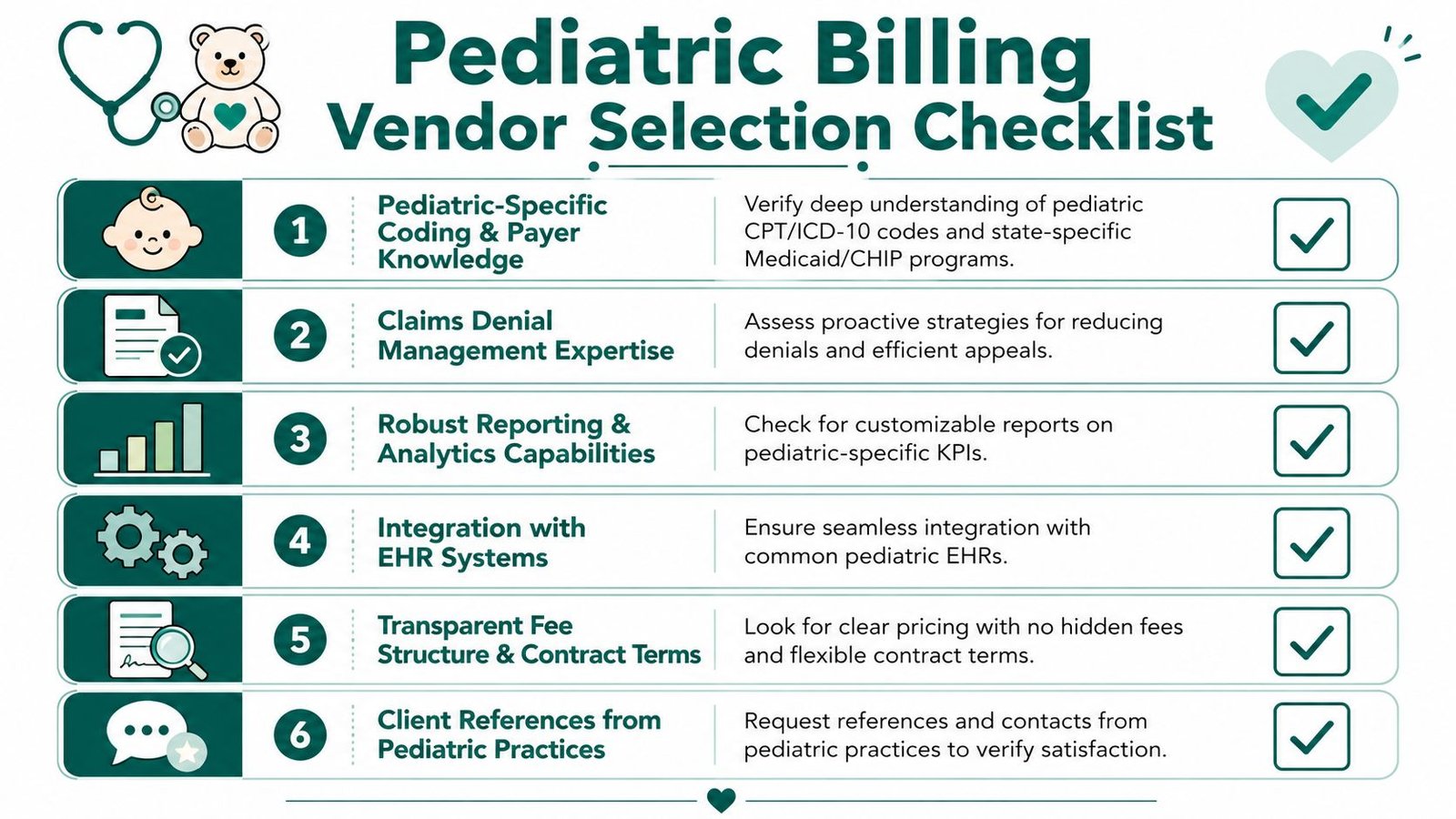
Use this checklist before you sign
- Pediatric-specific payer knowledge: Ask how they bill and review services involving CPT 90460, 90461, modifier -59, preventive age-based services, and authorization-dependent pediatric behavioral claims.
- Documented denial process: Ask what happens when a claim is denied. You want a defined workflow, root-cause review, and accountability by payer category.
- EHR compatibility: The partner should work inside your current system or integrate cleanly with it. A billing transition shouldn't force a platform migration.
- Reporting transparency: Demand dashboards or reports that let you see denial reasons, A/R aging, and unresolved payer issues in plain language.
- Data security posture: Ask about HIPAA controls, encryption, user access, and business associate agreement terms.
- Pediatric references: Don't ask for a generic client list. Ask for references from independent pediatric groups with a similar payer mix.
A vendor that understands pediatrics will answer with workflows, payer examples, and escalation rules. A vendor that doesn't will answer with adjectives.
Look for operational specifics, not polished presentations
Good vendors explain how they scrub claims, how they validate eligibility, how they track authorization risk, and how they separate Medicaid logic from commercial workflows. Weak vendors rely on broad phrases like "full denial management" or "end-to-end billing support."
If you're unsure where your own weak points are, start with a complimentary billing audit before you compare vendors. You need a baseline before you can judge anyone's promises.
Implementation Roadmap and Key Performance Indicators
A pediatric practice can sign a good billing partner and still lose money in the first 90 days if the handoff is sloppy. I have seen clean commercial claims keep moving while Medicaid well-child visits, vaccine administration, and CHIP balances stall in work queues because nobody defined ownership early. The result is predictable. Cash slows down, old A/R ages, and the owner starts questioning the outsourcing decision before the new process has a fair chance to work.
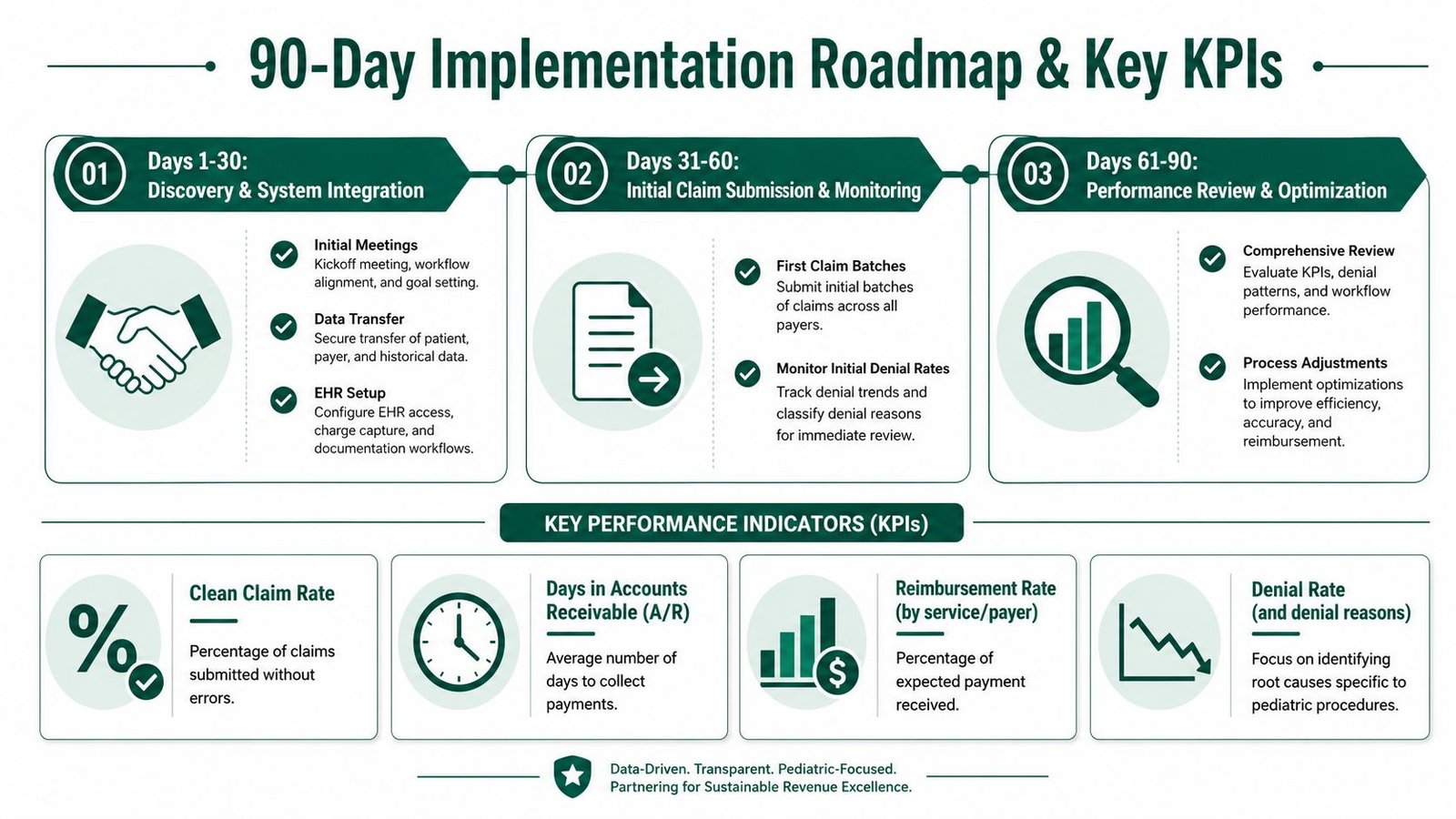
Days 1 to 30
The first month is about control, not speed. A pediatric-focused partner should review payer mix, fee schedules, open A/R, charge lag, authorization rules, and access inside the EHR and PM system. They should separate workflows by claim type because pediatric revenue does not fail in one uniform way. Preventive visits, vaccines, same-day sick visits, behavioral health, and Medicaid secondary claims each create different payment risks.
This is also the point where weak generalist vendors start showing cracks. If they treat all government plans like one bucket, they miss state-specific Medicaid edits and CHIP filing rules that can delay cash for weeks.
Days 31 to 60
The second month is the pressure test. Claims are now moving through the new workflow, and early errors should be reviewed by pattern and payer, not fixed one at a time in isolation. If a partner sees repeated denials tied to modifier usage, eligibility timing, vaccine coding, or authorization gaps, the response should include process changes at the front desk, coding, and claim scrub level.
Owners should ask for baseline and trend reporting here, not at the end of the quarter. You need to know whether denied dollars are concentrated in Medicaid managed care, whether clean claims are improving, and whether old A/R is being worked down.
Days 61 to 90
By the third month, the partner should be able to show operational traction in plain terms. Which payer is slowing payment. Which denial categories are recurring. Which claim types are taking too long to drop. Which balances are collectible and which are likely write-off candidates.
That distinction matters financially. A generic outsourcer may keep collections stable on easy commercial claims while hidden leakage continues in pediatric-specific categories. A specialized partner should be able to show where that leakage was happening and what changed.
The KPIs that deserve your attention
Track a short list of metrics every month and review them against payer mix, not just practice-wide averages:
- Days in A/R: Measures how fast billed services convert to cash. Watch this by payer class because Medicaid and CHIP delays can hide behind stronger commercial performance.
- First-pass clean claim rate: Shows whether claims are being submitted correctly the first time. In pediatrics, this often reflects front-end eligibility checks, coding accuracy, and vaccine administration logic.
- Net collection rate: Shows how much allowed revenue the practice collects after contractual adjustments. This is one of the clearest ways to judge whether the vendor fee is producing a return.
- Denial rate: Shows how much revenue is being delayed or placed at risk. Break denials out by payer and reason code so repeat pediatric issues do not get buried in a blended total.
Most outsourced billing contracts are priced as a percentage of collections. The exact rate matters less than the spread between the fee and the revenue recovered. A 5% fee that improves Medicaid follow-up, reduces vaccine-related denials, and shortens payment lag can produce a better margin than a cheaper generalist vendor that leaves pediatric dollars on the table.
Use a monthly scorecard, then compare it against your pre-go-live baseline. This medical billing KPI guide is a useful framework for structuring that review. If the partner cannot connect their fee to cleaner claims, faster cash, lower denial volume, and less staff rework by day 90, the problem is not patience. It is fit.
Frequently Asked Questions from Practice Owners
How do I know if my pediatric practice needs outsourced billing or just a better internal process
Look at trend, not effort. If claims go out slowly, denials repeat for the same reasons, A/R keeps stretching, or billing performance depends on one employee who can't be replaced easily, the issue is structural. A good audit should tell you whether workflow repair is enough or whether you need a specialty partner.
Will I lose control if I outsource pediatric billing
Not if the relationship is set up properly. The practice should still control policy, documentation standards, payer strategy, and financial review. A strong partner gives you more visibility because reporting becomes consistent, denial categories are clearer, and accountability is easier to assign.
Is a percentage-of-collections fee worth it
It can be, if the partner improves revenue quality and speed. A variable fee often makes more sense than fixed staffing cost when collections fluctuate or when your current team is leaking revenue on pediatric-specific claims. The fee is justified only when collections improve enough to cover it.
What should I ask a vendor in the first meeting
Ask how they manage Medicaid and CHIP for pediatric claims, how they handle vaccine administration coding, how they work authorization-dependent services, and what reporting you will see every month. Their answers should be operational, specific, and easy to test.
If your pediatric practice wants a clearer view of denial risk, A/R drag, and revenue leakage, Happy Billing is built for exactly that kind of review. The team works inside your existing EHR, focuses on specialty-specific RCM execution, and can help you benchmark whether your current billing setup is protecting collections or slowing them down.