Medical Billing Outsourcing: Cut Costs & Boost Revenue

Medical billing outsourcing is a strategic decision proven to reduce denial rates by 30% to 40% and accelerate cash flow, not just an administrative cost-cutting measure. For practice owners, that directly affects net collections and days in A/R because cleaner claims get paid faster and fewer dollars stall in rework.
That reframes the decision. The question isn't whether billing should sit inside your four walls or outside them. The question is whether your current model is protecting revenue at the speed your practice needs.
We have seen physician owners focus on staffing cost and miss the bigger leak. A claim that goes out with the wrong modifier, an authorization gap, or a payer-specific edit failure doesn't just create clerical work. It extends A/R, inflates denial volume, and turns earned revenue into a negotiation. In a margin-tight practice, that is a business problem, not a back-office inconvenience.
The strongest outsourced models don't win because they are cheaper on paper. They win when they combine automation with human review, catch issues before submission, and work denials with enough specialty depth to keep collections moving. That is where AI plus human audit starts to matter. Automation can flag patterns. Experienced auditors can interpret payer behavior, documentation gaps, and specialty-specific rules before those issues hit your aging buckets.
What Is Medical Billing Outsourcing Really About
Medical billing outsourcing is the decision to hand revenue-critical workflows to a specialist team that is built to submit, scrub, follow up, appeal, and reconcile claims with more consistency than most practices can maintain internally. For a physician owner, the core issue isn't task delegation. It's whether your revenue cycle can keep pace with payer complexity without adding fixed overhead and management drag.
The market itself shows how practice leaders are thinking about it. The global medical billing outsourcing market is projected to grow from USD 12.22 billion in 2026 to USD 20.76 billion by 2031, with hospitals holding 55.74% of market share and ambulatory settings showing the fastest growth, according to Mordor Intelligence's medical billing outsourcing market analysis. That growth isn't happening because owners suddenly want less control. It's happening because billing has become too financially important to treat as a clerical function.

Revenue protection, not task transfer
A good outsourced partner changes the structure of the problem. Instead of carrying payroll for billers, training them on payer changes, and hoping key staff stay, you shift to a model where billing performance is monitored continuously and operational risk is spread across a broader team.
That matters when one staff departure can slow claim submission, payment posting, denial follow-up, and appeals all at once. In-house teams can absolutely perform well, but they often depend on one or two people knowing your payer quirks. That's fragile.
Practical rule: If your billing operation depends on one person remembering which payer wants which modifier combination, you don't have a process. You have a vulnerability.
Why technology alone doesn't solve it
Many owners assume a better PM or EHR workflow will fix collections. Sometimes it helps. It rarely solves the root issue by itself. Rules engines can catch missing fields and obvious edits, but they don't replace specialty judgment or payer pattern recognition.
That's why it's useful to look at tools built around smarter coding and billing workflows, such as EkagraHealth AI billing technology. The value of AI isn't that it replaces billing expertise. It's that it shortens the path to finding exceptions worth human review. In real operations, that combination is what keeps claims from aging unnecessarily.
For a deeper look at the operating model behind this shift, outsourced revenue cycle management for physician practices is worth reviewing. The key takeaway is simple. Outsourcing works when it improves financial control, not when it merely relocates billing tasks.
The True Cost of In-House Billing vs Outsourcing
Most practice owners know what they pay an employee. Fewer know what they pay for billing as a system. Salary is only the visible line item. The larger cost sits in turnover risk, slower denial recovery, inconsistent claim quality, and the owner's own time spent managing a nonclinical department.
The hard numbers make the comparison clearer. Outsourcing medical billing can reduce denial rates by 30% to 40% and lower billing costs by 30% to 50% compared with a U.S.-based in-house specialist, whose annual expense can range from $45,000 to $75,000. For a practice handling $100 million in claims, a 5% reduction in denials can recover $5 million in revenue, according to this analysis of outsourced medical billing performance.
What owners usually undercount
In-house billing costs more than compensation. You also carry:
- Recruitment drag: Replacing a biller means lost institutional knowledge and slower collections while the new person ramps.
- Compliance upkeep: CPT updates, payer edits, modifier guidance, and workflow changes don't pause because your office is busy.
- Technology overlap: Clearinghouse edits, reporting tools, eligibility workflows, and denial work queues often sprawl across multiple systems.
- Management load: Someone has to review performance, coach staff, handle escalations, and own denials by payer.
Those expenses don't always show up as a single billing line. They still hit EBITDA.
In-House vs. Outsourced Billing A Financial Breakdown
| Metric | In-House Billing | Outsourced Billing |
|---|---|---|
| Core labor cost | A U.S.-based in-house specialist can cost $45,000 to $75,000 annually | Often replaces fixed staffing with a variable service model |
| Denial performance | Often depends on team experience and capacity | Can reduce denial rates by 30% to 40% |
| Cost efficiency | Higher fixed overhead when staffing, training, and supervision are included | Can lower billing costs by 30% to 50% |
| Revenue recovery impact | Revenue leakage can persist if denials aren't prevented and appealed quickly | A 5% denial reduction on $100 million in claims can recover $5 million |
| Operational resilience | Vulnerable to absences, turnover, and uneven specialty expertise | Broader bench strength and process redundancy |
The real trade-off
Owners often frame this as control versus convenience. In practice, it's fixed cost versus performance accountability.
If your current team is excellent, your payer mix is manageable, and your specialty complexity is low, keeping billing in-house can work. But if denials are climbing, A/R is stretching, or no one can give you a clean answer on where money is stalling, in-house billing becomes expensive even before you count payroll.
We have seen the biggest mistake here. Practices compare an outsourced fee to one salary and assume the internal model is cheaper. It rarely is once claim quality, rework, delayed cash, and owner oversight are included.
A useful comparison framework is in-house vs outsourced medical billing for private practices. The right decision comes down to which model collects more of what you've already earned and does it with less volatility.
A cheap billing model that lets denials sit isn't cheap. It's deferred revenue loss.
Key Financial Benefits Beyond Cost Savings
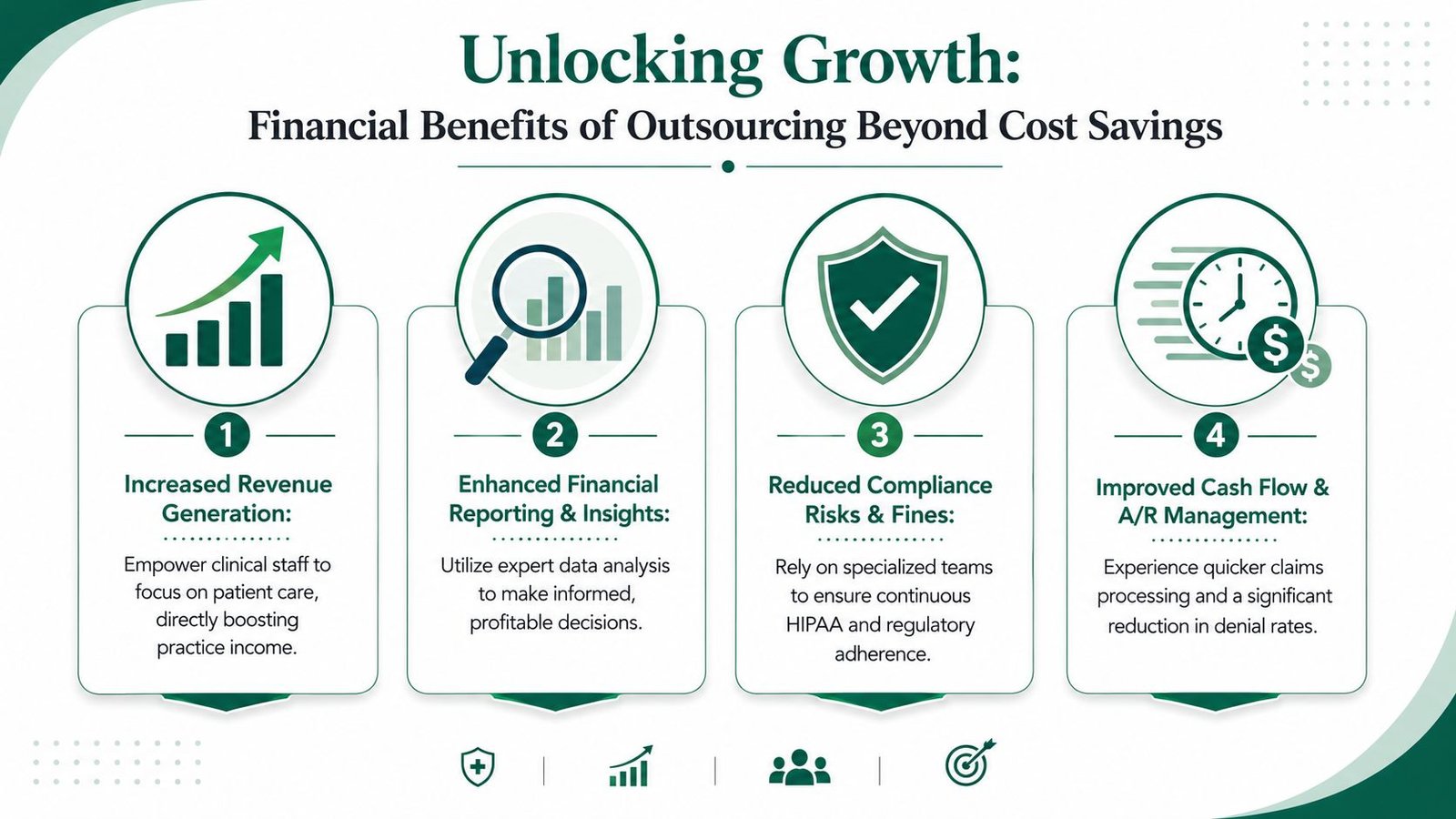
The strongest argument for medical billing outsourcing isn't labor arbitrage. It's revenue velocity. Faster, cleaner claims improve cash flow, stabilize forecasting, and reduce the amount of money trapped in avoidable rework.
That becomes obvious when you look at collection performance. Top-performing outsourced billing operations consistently achieve net collection rates above 98%, show a 10–20% higher claim approval rate than in-house teams, and drive a 15–25% improvement in overall revenue collection, according to this review of outsourced medical billing trends and statistics.
Better claims change cash timing
Revenue doesn't improve only when more claims get paid. It improves when they get paid sooner and with less staff touch.
A claim that pays on first submission is worth more than a claim that pays after multiple edits, calls, and appeals because the first one keeps cash moving. That affects payroll confidence, hiring decisions, and provider compensation planning. It also lowers the amount of old A/R your team has to chase.
Three financial effects show up quickly:
- Cleaner front-end execution: Eligibility checks, charge review, modifier validation, and payer-specific edits reduce preventable denials before submission.
- Stronger net collections: More approved claims means less write-off pressure and fewer balances aging beyond useful recovery windows.
- Less physician distraction: Owners stop acting as the final escalation point for billing failures.
AI helps, but audit discipline closes the gap
We have seen plenty of automation projects that produced more dashboards than dollars. The financial upside comes when automation is tied to review discipline.
An AI layer can identify repeat denial patterns, authorization gaps, missing demographic data, and payer mismatch trends. Human auditors then decide whether the issue is documentation, workflow, coding, credentialing, or payer behavior. That distinction matters. If you misdiagnose a denial source, you can work the same problem for months without fixing it.
Owner lens: Ask whether your billing model prevents denials before claims go out, not just whether it works denials after the fact.
The benefit your P&L doesn't label clearly
When billing runs well, your front desk isn't pulled into insurance firefighting, your administrator isn't spending half the week on aging reports, and your physicians aren't fielding basic payment delays. That operational breathing room doesn't appear as a tidy line item, but it improves how the entire practice functions.
If you're evaluating outcomes beyond pure cost, the financial and operational benefits of outsourcing medical billing gives a practical way to think about it. The best outsourced relationships don't just lower expense. They help the practice collect with fewer interruptions.
Navigating Specialty-Specific Billing Complexities
General billing knowledge isn't enough when your revenue depends on specialty rules. The payer edits that hurt owners most are usually not obvious. They sit in modifier logic, time calculations, global periods, prior authorization rules, and split professional versus technical billing.
A generic team can post charges. A specialty-capable team protects collections.
Anesthesiology is where billing errors get expensive fast
Anesthesia is the clearest example. Practices without specialized oversight can face denial rates of 15% to 25%, and incorrect modifier usage on codes such as QK and QZ accounts for up to 35% of rejections, directly costing a mid-sized group over $150,000 annually, according to this analysis of anesthesia billing denial patterns.
That isn't abstract. Under CMS medical direction rules, the difference between QK, QZ, and AA changes whether the claim reflects medical direction, CRNA service without medical direction, or personally performed anesthesia. If your documentation doesn't support the modifier, you don't just get a technical denial. You expose the claim to underpayment, repayment risk, or audit attention.
Take CPT 00567 as an example. It's a high-value anesthesia code used for complex cardiac procedures. If time units are miscalculated or concurrency rules are mishandled, the lost reimbursement isn't minor. It compounds over repeated cases.
CMS also expects correct application of base units, time units, and physical status modifiers. This review of anesthesia revenue killers under Medicare medical direction notes that failing to include appropriate modifiers can lead to yearly underpayments in the $50,000 to $100,000 range. If anesthesia is your specialty, anesthesiology billing services for modifier and concurrency management is the type of specialty-specific benchmark you should compare against.
If your anesthesia claims are clean only when one senior biller touches them, your process won't scale.
Other specialties leak revenue differently
Behavioral health often loses money at the authorization stage. A service like CPT 90837 may be clinically appropriate and fully documented, but if prior authorization rules or payer visit limits aren't handled correctly, reimbursement can drop to zero. That's not a coding failure alone. It's a workflow failure.
Cardiology groups run into a different issue. Imaging and diagnostic work often turns on the correct use of modifier 26 for the professional component and TC for the technical component. When those are applied incorrectly, practices either underbill, overbill, or trigger denials that delay payment on high-volume services.
Orthopedics has its own traps. During a global period, using modifier 58 versus 79 can determine whether a postoperative service is payable or denied as bundled. Owners don't need to memorize every rule. They do need to know that these distinctions are where margin disappears.
For orthopedic groups comparing process depth, orthopedic revenue cycle management strategies gives a useful operational reference point.
What works and what doesn't
What works is specialization tied to payer-specific review. What doesn't work is assigning every specialty to the same general billing queue and hoping claim edits catch the nuance.
The highest-performing teams usually share three habits:
- They audit high-risk modifiers early: QK, QZ, AA, 26, TC, 58, and 79 should never be treated as afterthoughts.
- They reconcile documentation against payer rules: CMS guidance, payer manuals, and specialty workflows all need to line up before submission.
- They escalate patterns, not just claims: If one payer starts denying a procedure class, the response should be systemic, not one appeal at a time.
Ensuring Compliance Security and EHR Integration
Owners usually ask two questions before signing with any billing partner. Will this create a HIPAA problem, and will it disrupt the way my office works?
Those are the right questions. A billing vendor will touch protected health information, financial workflows, and daily claim operations. If security is weak or integration is clumsy, any labor savings disappear quickly.

What to verify before granting access
Start with the basics. A serious vendor should be willing to sign a Business Associate Agreement, document role-based access controls, explain encryption standards, and show how they monitor user activity. You also want clarity on incident response, audit logs, and whether subcontractors touch PHI.
For owners who want a plain-English refresher on the underlying privacy framework, AONMeetings patient data protection and HIPAA compliance overview is a practical resource. It won't replace legal review, but it helps frame what a competent vendor conversation should include.
A few questions separate polished sales talk from operational maturity:
- Who can access PHI: Ask by role, not by vague department.
- How is access revoked: Offboarding controls matter as much as onboarding controls.
- How are incidents escalated: You want a defined process, not a promise to "notify you if needed."
- Where does work happen: Especially if state rules, payer contracts, or internal policy affect offshoring decisions.
EHR integration shouldn't force a workflow reset
The second fear is disruption. Practices worry they'll have to migrate systems, retrain staff, or rebuild scheduling and charge capture workflows. In well-run outsourcing relationships, that shouldn't happen.
We have seen the cleanest transitions occur when the billing partner works inside the existing EHR and PM environment. That preserves established physician workflows while allowing billing specialists to manage charge review, claim edits, rejection handling, and follow-up without forcing the office onto a new platform.
What to insist on: The vendor should adapt to your operating environment whenever possible. If their first move is to replace your systems, ask whether you're solving a billing problem or buying a software project.
A secure partner with disciplined access controls and a low-friction EHR approach lowers risk on both sides. That matters because even a technically strong billing team will struggle if your front office stops trusting the workflow.
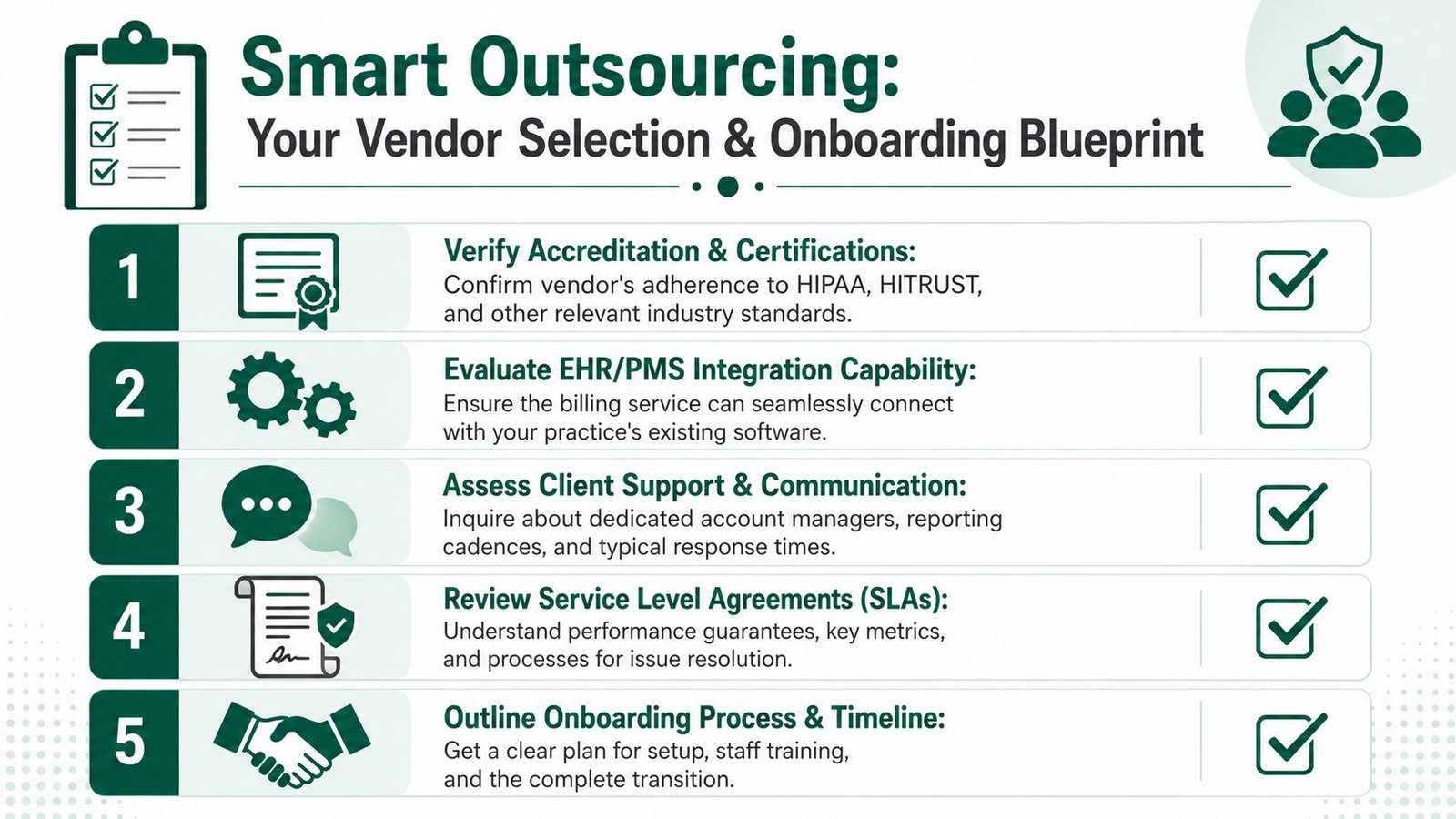
Your Vendor Selection and Onboarding Blueprint
Most bad outsourcing decisions are made before the contract is signed. Owners ask about price first, get a polished demo, and skip the questions that predict collection performance.
A better process is blunt. Treat vendor selection like you would a key physician hire. You want proof of specialty fit, process discipline, reporting transparency, and compliance maturity.
Questions that expose weak vendors quickly
Use questions that require specifics, not adjectives.
Which specialties do you support deeply
If the answer is "we work with everyone," keep pushing. Ask how they handle anesthesia concurrency, behavioral health authorizations, cardiology component billing, or orthopedic global periods.
How do you report claim quality and denial activity
You should receive regular visibility into first-pass performance, denial categories, payer trends, A/R segmentation, and follow-up activity. If reporting is vague, accountability will be too.
What happens to denied claims
Ask who owns denial analysis, who files appeals, how root causes are documented, and how recurring payer issues are escalated into workflow changes.
How do you address compliance exposure
Billing accuracy isn't only an operational issue. It can become a legal one. For owners who want a practical overview of claim integrity risk, this False Claims Act compliance guide is a useful starting point.
A strong screening checklist also helps. Questions to ask a medical billing company before hiring covers the kind of diligence most owners wish they had done earlier.
What onboarding should actually look like
A clean onboarding process is structured, but it shouldn't feel disruptive. The strongest implementations usually move through these stages:
- Access and discovery: The vendor reviews your payer mix, specialty workflows, current aging, denial patterns, and EHR permissions.
- Workflow mapping: Charge entry, coding review, claim edits, payment posting, denial ownership, and patient balance workflows are defined clearly.
- Parallel oversight: Early claims are reviewed closely so payer-specific issues can be caught before they affect a full month of production.
- Go-live with reporting: You need visibility from day one. If reporting arrives months later, you've lost the chance to manage the transition tightly.
What owners should watch in the first months
The first signs of a good fit are operational, not promotional. Your team should know who to contact. Front-office questions should be answered quickly. Claims should move cleanly through the existing system. Denials should be categorized in a way that leads to action.
We have seen transitions fail when both sides assume the other "will figure it out." They won't. Clear ownership beats goodwill every time.
Frequently Asked Questions From Practice Owners
Will I lose control if I outsource billing
Not if the relationship is built correctly. You should lose clerical burden, not visibility.
A good outsourcing model gives you more control over revenue because reporting becomes more disciplined and denial ownership becomes clearer. What owners usually fear is being shut out of their own data or waiting days for basic answers. That's a vendor management problem, not an outsourcing problem. If dashboards, aging views, denial categories, and payer trend reports aren't part of the engagement, the model is weak.
How do I know whether my current billing team should be fixed or replaced
Start with performance, not loyalty. If your team can show stable clean claims, manageable denials, timely follow-up, and aging that doesn't drift, you may need process improvements rather than a full change.
But if your practice has recurring payer issues, no one agrees on the root causes of denials, and ownership keeps getting pulled into collections conversations, the billing structure itself is probably the issue. We have seen practices spend too long trying to coach around a system problem. If the same leakage points keep recurring, replacement becomes a rational financial decision.
Does outsourcing work for smaller independent practices
Yes, when the partner can match the practice's complexity and communication needs. Small practices often feel billing pain more sharply because one denial trend or one staff absence can disrupt cash flow quickly.
The key is fit. A small group doesn't need a bloated vendor. It needs a responsive team that understands the specialty, works inside the current EHR, and treats every unresolved claim as meaningful. Smaller practices often benefit the most when they no longer have to build billing redundancy in-house.
What should I measure after go-live
Measure the few metrics that reveal whether revenue is improving. Focus on claim quality, denial patterns, A/R movement, payment speed, and follow-up discipline.
Also watch for qualitative signals. Are physicians getting fewer billing escalations? Is the front office spending less time cleaning up eligibility or claim issues after the fact? Are payer-specific problems being identified early rather than discovered weeks later in aging reports? If those answers improve, the outsourcing relationship is doing its job.
If you're evaluating whether your current billing model is protecting enough revenue, Happy Billing offers specialty-focused RCM built around AI-assisted workflows and expert human auditors. If you'd like to see where denials, A/R drag, or payer-specific leakage may be hiding, request a complimentary revenue cycle audit and get a practical view of what your practice could tighten without changing the way your clinicians work.