Pain Management CPT Codes: A Practice Owner’s Guide

Monday starts with a full procedure schedule, but the owner is still checking cash twice before payroll. In pain management, that gap usually starts after the encounter. A lumbar epidural is performed, the claim goes out, and payment stalls because the CPT code, modifier, diagnosis support, or imaging documentation did not line up the way the payer expected.
That is why pain management CPT codes matter at the ownership level, not just the billing desk. A missed modifier on a bilateral injection, a weak same day E/M note, or a bundled service posted separately can turn high physician output into preventable write-offs, rework, and aging A/R. I have seen practices focus on volume while losing margin on the back end, claim by claim.
The financial risk is not abstract. One coding miss on a high-frequency service can be corrected. A repeated pattern across injections, nerve blocks, RFAs, and chronic pain follow-up visits can suppress collections for months.
Strong groups treat coding as a revenue protection system. They review code selection, documentation support, payer edits, and modifier logic before claims leave the office. Many are also using tools tied to AI in healthcare to catch repeat error patterns, standardize workflows, and flag exceptions before they turn into denials.
If you want a practical benchmark, compare your current process against a specialty-specific pain management billing workflow built around pain procedures, payer rules, and denial prevention. That comparison usually shows where cash is leaking long before the month-end reports do.
Your Guide to Pain Management CPT Codes
If you're seeing strong procedure volume but disappointing net collections, your coding process deserves a hard look before you blame payer contracts. Pain management is one of the easiest specialties to underbill in and one of the fastest to trigger denials when documentation, imaging rules, and modifiers don't line up.
Owners usually feel the problem first through cash flow. A/R stretches. Appeals pile up. Your team says claims were “sent correctly,” but reimbursements still don't match the work your physicians performed. In pain, that often comes down to small but expensive misses around code selection, laterality, imaging inclusion, or same-day E/M support.
The fix isn't just hiring faster staff. It's building a process that treats coding as a financial control system. Many groups are now borrowing operational discipline from adjacent tools such as AI in healthcare, especially for pattern detection, workflow standardization, and exception handling before claims leave the practice.
For owners comparing internal cleanup against outside support, it helps to benchmark your process against a specialty-specific workflow like pain management billing services. The right framework should tell you exactly where money is leaking, which codes create the most rework, and which payer edits your current team keeps missing.
Why Your Current Coding Is Costing You Money
A physician finishes a full procedure day. The schedule looked productive, the rooms stayed full, and the documentation appears complete. Then the remits arrive. One facet claim paid at the base level instead of multiple levels. A bilateral injection went out without the modifier the payer expects. An add-on service never made it onto the claim. The revenue loss is real, and it rarely shows up as one dramatic denial.

That is how pain practices bleed cash. The problem is usually repetitive underbilling, payer edits, and rework across procedure lines your team performs every day.
Pain coding punishes small mistakes. If your staff confuses a bundled imaging service with one that can be reported separately, misses laterality support, or applies the wrong modifier logic to a bilateral service, you do not just risk a denial. You also risk reduced payment on a claim that should have been clean the first time. I see this often with facet work, epidural series, and peripheral nerve procedures where the clinical note is strong but the billed detail is weak.
Three revenue leaks owners should watch
The first leak is undercoding procedural scope. A provider treats multiple levels, performs a bilateral service, or documents separate work that supports an add-on code, but the claim only reflects the primary line. That money is usually gone unless someone audits the encounter against the operative note.
The second leak is bundling confusion. Some pain procedure codes include imaging guidance. Others do not. If your team bills an included component, payer edits hit the claim. If your team leaves off a separately reportable service because they assume it is bundled, you collect less than the case supports. Owners feel this as lower reimbursement per visit, not just as denials.
The third leak is modifier failure. Modifier mistakes change payment faster than many owners realize. A missing modifier can force manual review. An unsupported modifier can trigger recoupment risk. A modifier applied by habit instead of by payer rule can reduce payment even when the procedure itself was coded correctly.
What this means financially: every coding miss creates extra touches, slower cash, more staff time, and a higher chance the balance gets written off instead of recovered.
What underperforming pain RCM teams get wrong
The pattern is usually operational, not accidental:
- Procedure notes do not match charge detail. The physician documents the work performed, but the claim leaves out levels, laterality, or code-specific elements needed for full payment.
- Coders treat pain cases like general ortho or primary care injections. Facet injections, epidurals, SI work, trigger points, and nerve blocks each have their own payer rules.
- No one reviews denials by code family. If 64493, 64494, or 62323 keeps hitting edits, the fix should happen at the workflow level, not one appeal at a time.
- Front-end and back-end teams work from different rules. Authorization, documentation, charge capture, and appeals need the same code logic or the claim breaks later in the cycle.
Schedule management matters too. An empty procedure slot hurts margin before the claim is even created, which is why some groups use tools like Call Loop for no-show prevention to protect booked volume. But a full schedule does not fix bad billing. If high-value cases are coded incorrectly, you are still producing work faster than you are collecting cash.
Owners who want to stop the leaks need a tighter process for charge review, modifier control, and payer edit tracking. A focused review of your medical billing denial management process will usually show whether the losses start in documentation, code selection, modifier usage, or weak follow-up after the first denial.
The High-Volume Injection Codes You Must Get Right
Monday starts with a full procedure schedule. By Friday, the bank deposit does not match the work your physicians performed. In many pain practices, the gap starts with routine injection claims that looked harmless on the charge sheet but failed under payer review.
These are the cases that keep the lights on. They also create the fastest recurring losses when code selection and documentation do not match.
Common pain management codes and their denial risks
| CPT Code | Procedure | Typical Reimbursement | Top Denial Reason |
|---|---|---|---|
| 20552 | Trigger point injection, 1-2 muscles | Lower-dollar but high-frequency service | Documentation does not support the muscle count |
| 20553 | Trigger point injection, 3 or more muscles | Higher than 20552 when properly supported | Note does not identify 3 or more muscles |
| 20610 | Major joint injection | Common office-based procedural revenue | Diagnosis linkage, laterality, or site detail is weak |
| 62323 | Interlaminar epidural injection, lumbar or sacral | Mid-range procedural payment that adds up quickly with volume | Procedure note is missing approach, region, or payer-required support |
| 64483 | Transforaminal epidural injection, single level | Higher-value injection claim with heavier audit risk | Level selection, laterality, or imaging support is incomplete |
| 64405 | Greater occipital nerve block | Varies by payer and diagnosis support | Medical necessity and diagnosis specificity are not clear |
The owner risk is simple. High-frequency codes create small mistakes that repeat all month.
For 20552 and 20553, coders need more than “trigger point injection performed.” The record has to show the number of muscles treated. If the physician documents multiple sites loosely and the claim goes out as 20553 without clear support, you have an easy downcode or refund exposure. If the work supported 20553 and staff defaulted to 20552, you gave away revenue for a service already performed.
For 20610, the code itself is familiar, which is why teams get careless. Payers still expect the diagnosis to match the joint treated, and they look for clear site documentation and laterality when applicable. In mixed ortho and pain groups, I often see one provider documenting at a specialist level and another charting as if every injection were interchangeable. That inconsistency creates avoidable denials and slows payment on claims that should have passed cleanly.
62323 and 64483 carry a different trade-off. The payment is better, but payer scrutiny is tighter. If the chart does not clearly support the approach, spinal region, level, imaging use when required by the payer, and the diagnosis driving medical necessity, the claim may deny, pend for records, or pay at a lower level than expected. A busy ASC or office can lose a meaningful amount of monthly cash from those errors alone.
64405 is another code owners should watch closely because teams often treat nerve blocks as simple injections. They are not billed the same way, and payer expectations differ. If your physicians perform occipital nerve blocks often, this guide to the occipital block CPT code and billing requirements is a useful reference point for note quality and claim setup.
The real question is not whether your team submitted a claim. It is whether the note supported the exact CPT code that pays correctly and survives an audit.
Where routine work breaks down
The first failure point is charge capture. Staff picks a familiar code from memory, and no one checks whether the physician documented the count, level, site, or laterality needed for that exact service.
The second failure point is payer logic. An epidural or nerve block may be clinically appropriate and still deny because the claim omitted details the payer uses to validate medical necessity or bundling edits.
The third failure point is volume. A coding error on one spinal injection is a problem. The same error on twenty claims a week is a revenue pattern.
A quick owner audit
Review your last 25 injection claims and check for these issues:
- Exact site and level support. “Lumbar epidural” is often not enough for the billed CPT.
- Muscle count support for 20552 versus 20553. The note should make the threshold obvious.
- Laterality and diagnosis specificity. This matters often on joint work and payer edits.
- Approach documentation for epidural services. Interlaminar and transforaminal claims cannot be treated as interchangeable.
- Guidance and bundling accuracy. Separate reporting errors can erase valid reimbursement or create recoupment risk.
If your denial log shows repeat trouble in these code families, do not treat it as random payer behavior. Treat it as a margin problem with a code-specific fix.
Advanced Nerve Block and Ablation Coding Strategies
A physician finishes a two-level lumbar facet ablation on a packed procedure day. The claim goes out with one level instead of two, or the note supports one side clearly and leaves the other implied. The practice does not feel that mistake once. It feels it every time that provider performs the case.

That is why nerve block and ablation coding deserves owner-level attention. These are high-value services, but they are also services where a small documentation gap can cut payment, trigger a denial, or create audit exposure months after the money posts. The financial risk is not abstract. It sits inside level selection, laterality, imaging support, and whether the operative note matches the charge ticket.
Facet coding rewards precision and penalizes shortcuts
Facet family coding is one of the fastest ways to see the difference between a billing team that keys claims and one that protects revenue. For injections, the code set changes by region and by whether you are reporting the first level or each additional level. For ablation, the same discipline applies. If the physician treats multiple facet joint nerve levels and the chart supports them, every supported level needs to reach the claim correctly.
Undercoding feels safe to some internal teams. It is expensive.
I tell owners to audit this family in a very practical way. Pull ten recent facet procedure notes and compare three things side by side: the documented spinal region, the count of treated levels, and the final CPT line items. If those three do not match cleanly, you have a margin leak.
Radiofrequency ablation errors are expensive because the base payment is higher
Radiofrequency ablation claims magnify operational weaknesses. Codes such as 64635 and 64636 require disciplined charge capture because payment changes by level, and payer reductions often apply to secondary lines. A reduced secondary payment is not the same problem as a missed secondary code. One is expected contract math. The other is lost revenue caused by your process.
The same logic applies to peripheral nerve blocks and destruction procedures. The op note has to answer basic payer questions without forcing an auditor to infer anything. What nerve was treated? How many levels? Which side? Was imaging used when the code family expects it? Was this a repeat service, and if so, is the medical necessity documented clearly?
Those details decide whether the claim pays on first pass or enters rework.
Owners should separate compliance risk from avoidable underbilling
Some practices react to denials by coding down. That usually makes the reporting cleaner on paper and worse in the bank account. The better approach is tighter documentation templates, cleaner physician charge selection, and front-end edits that catch unsupported additional levels before the claim leaves the system.
A strong review process for this section of your revenue cycle includes:
- Facet and ablation code-to-note matching. Confirm the billed first level and add-on levels match the procedure note exactly.
- Laterality support. If the claim reflects bilateral work, the note should state bilateral treatment clearly.
- Add-on code usage. Additional level reporting should follow the primary code and payer rules without guesswork.
- Expected payer reductions versus true underpayments. Your team should know when a lower payment is contractual and when it deserves an appeal.
- Procedure-to-follow-up capture. Pain practices with heavy longitudinal management should also review related non-procedural revenue, including chronic care management billing workflows for medically complex follow-up patients.
Build a revenue protection plan around your highest-risk procedures
The goal is not merely to know the code set. The goal is to protect revenue on the procedures most likely to produce large dollar losses when coded loosely. In pain management, that usually means multi-level facet work, ablations, and other interventional services where one missing detail changes payment materially.
Owners who monitor these claims by physician, by payer, and by denial reason usually find patterns quickly. One provider may be documenting levels inconsistently. One payer may be editing add-on lines aggressively. One coder may be dropping supported units to avoid attention. Each problem has a different fix. All three affect cash.
E/M and Chronic Care Codes for Comprehensive Billing
A patient comes in for a repeat lumbar injection. The claim goes out with only the procedure code. The physician also adjusted medications, reviewed a failed response to the last intervention, discussed imaging, and changed the treatment plan for the next 60 days. If that work is documented but never billed, the practice absorbs the cost while overhead keeps rising.
That loss adds up fast in pain management because the business model is rarely procedure-only. Follow-up decision-making, medication risk review, care-plan changes, and between-visit management all create legitimate revenue if your documentation and workflows support the claim.
Chronic care management is often underused
Pain groups with medically complex patients often perform chronic care work already. The problem is operational discipline. If your team is not capturing time, consent, care-plan maintenance, and qualifying clinical staff activity, the practice does the work and gets none of the reimbursement.
For eligible patients, 99490 can convert recurring non-procedural work into monthly revenue. The trade-off is administrative rigor. You need clean enrollment, defensible time logs, and a process that keeps staff activity tied to the care plan instead of scattered across phone notes and inbox messages.
Owners should look at CCM the same way they look at procedure coding risk. It is a revenue protection issue. Missed CCM billing leaves money uncollected. Weak CCM documentation creates takeback exposure later.
If your practice is building a recurring follow-up model for complex pain patients, this guide to chronic care management billing workflows for medically complex follow-up patients is a useful operational reference.
Same-day E/M is valuable when the record supports separate work
Same-day E/M coding is one of the clearest places where weak habits hurt cash. Some practices never bill the visit and give up revenue they earned. Others append modifier -25 too freely and train payers to deny the line.
The standard is straightforward. Bill the E/M only when the note shows work above and beyond the usual pre-service and post-service elements tied to the procedure. In pain management, that may include a distinct evaluation of worsening radicular symptoms, medication adjustment for adverse effects, review of new diagnostic findings, or a revised treatment strategy because the prior intervention failed.
A usable chart does not bury that work inside the procedure note. It makes the separate history, exam as medically appropriate, and medical decision-making easy to defend on appeal if needed.
Use these guardrails:
- Bill the E/M only when distinct physician work is documented. Routine assessment tied to performing the injection is usually included.
- Support modifier -25 with visible decision-making. A changed medication plan, separate pain generator assessment, or documented treatment revision matters.
- Audit by provider, not just by denial code. One physician may support 99213-25 or 99214-25 consistently, while another writes notes that collapse everything into the procedure.
- Watch financial yield by payer. Some carriers pay same-day E/M appropriately when the note is clean. Others require tighter coding edits and stronger appeal follow-through.
The owner-level question is simple. Are you running a procedure shop that gives away medically necessary cognitive work, or a pain practice that bills the full episode of care with discipline? In a specialty built on repeat visits and ongoing treatment changes, that difference shows up directly in monthly collections.
Critical Modifiers That Make or Break Reimbursement
A physician performs bilateral lumbar medial branch blocks, documents both sides clearly, and the claim still underpays. The procedure was correct. The modifier setup was not. That is the kind of preventable revenue loss that keeps showing up in pain practices with decent coding and weak claim logic.
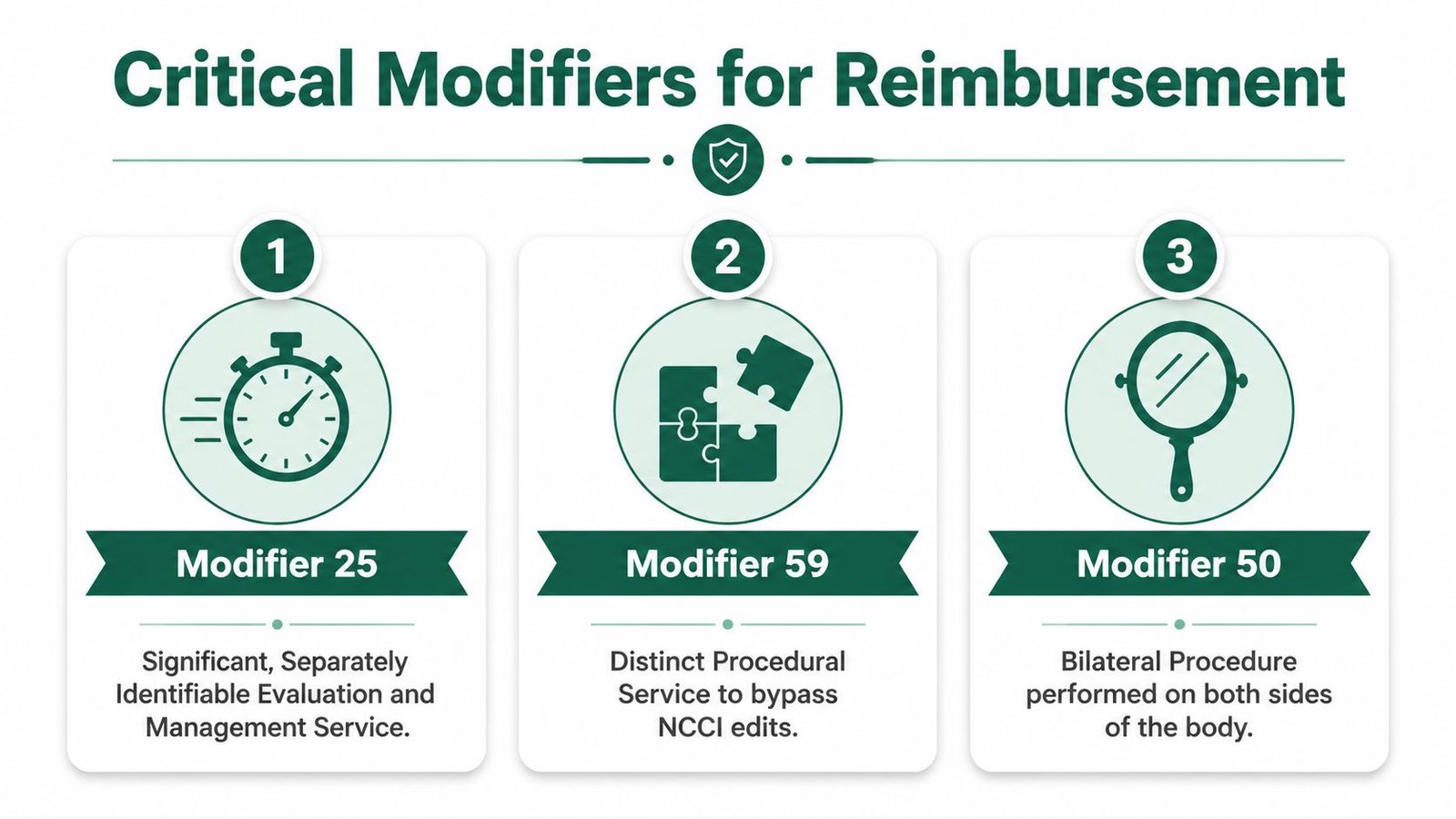
Modifiers control how the payer reads the work you already did. In pain management, that can mean the difference between full payment, reduced payment, a denial, or an audit target. Owners should treat modifier accuracy as revenue protection, not a back-office detail.
The highest-cost errors usually involve -25, -50, -59, LT, and RT. Each one changes payer interpretation in a different way, and each one carries a different financial risk.
The modifier mistakes that hurt most
Modifier -25 is where practices either protect legitimate E/M revenue or give it away. If the physician performed a distinct evaluation on the same day as an injection, the note has to show separate decision-making, not just pre-procedure discussion. Without that distinction, the payer often folds the visit into the procedure and cuts the payment.
Modifier -50 creates a different problem. Bilateral work may be medically appropriate and fully documented, but payers do not all want it billed the same way. Some want one line with -50 and one unit. Others want two lines with RT and LT. Some apply their own bilateral adjustment logic and reject claims that use the wrong format. If your team uses one default rule for every carrier, you will leave money on the table.
Modifier -59 is where billing judgment matters. It should support a distinct procedural service, not patch over a coding conflict after the fact. Applied correctly, it can separate services that would otherwise bundle. Applied carelessly, it attracts denials and post-payment review. For a practical reference your billing team can use during edit review, keep this guide to CPT modifier 59 in your workflow.
Laterality modifiers matter more than many owners realize.
On unilateral services, LT and RT help the payer match the claim to the procedure note, diagnosis, and authorization. If the chart says left-sided SI pain and the claim goes out without laterality where the payer expects it, the denial is often framed as technical. The lost cash is still real.
What owners should audit every month
- -25: Does the chart support separate physician work beyond the usual pre-procedure assessment?
- -50: Is the claim built in the payer's preferred bilateral format?
- -59: Is the distinct service clear in the documentation and code pair logic?
- LT/RT: Does laterality on the claim match the procedure note, diagnosis, and auth?
I see more money lost from weak modifier use than from obvious code selection mistakes. The claim looks close enough to submit, then pays short, suspends, or denies for reasons the practice could have prevented.
Why modifier policy beats generic coding knowledge
Knowing the CPT code is only the starting point. Payment depends on how the payer processes the combination of procedure, modifier, diagnosis, units, and claim line structure. Two physicians can perform the same service correctly and get different outcomes because one claim was configured for the payer's rules and the other was not.
That is the owner-level issue. Modifier discipline protects margin. If your team cannot tell you which carriers want bilateral services with -50 versus separate LT/RT lines, or which same-day E/M patterns routinely fail without stronger documentation, your pain management CPT strategy is incomplete.
Outsmarting Payer Edits and Bundling Traps
Payer edits are where average billing teams lose control. The procedure may have been medically appropriate, documented, and charge-entered on time, but the claim still fails because the payer says two services can't be billed together, imaging was already included, or the post-op global logic swallows a charge the practice expected to collect.
Owners usually experience this as unpredictability. One claim pays. The next similar claim denies. Staff call it a payer issue. Sometimes it is. More often, it's a payer rule your process didn't catch before submission.
Bundling mistakes are expensive because they look minor
A classic example in pain management is imaging. Some procedures allow separate billing for guidance. Others include it. If your team bills guidance on a code where imaging is already bundled, the denial was preventable.
That distinction matters in related services too. Acupuncture codes 97810-97814 are time-based and depend on whether electrical stimulation was used, while greater occipital nerve block 64405 may allow separate ultrasound guidance 76942 when appropriate, but 62321 already includes imaging according to this coding overview for pain procedures.
NCCI edits are not optional reading
National Correct Coding Initiative edits are, in practical terms, Medicare's way of saying certain code pairs usually shouldn't be paid together. If your team doesn't check those relationships before claim submission, denials become a routine byproduct instead of an exception.
The practices that manage this best don't rely on memory. They build edit awareness into charge review, modifier review, and denial trend analysis.
Here's what disciplined teams do differently:
- Review code pairs before submission: Especially when multiple injections or procedural combinations occur on the same date.
- Differentiate bundled guidance from separately billable guidance: This is a recurring pain-management trap.
- Check global-period implications: Particularly in orthopedic and anesthesiology crossover cases.
- Treat postoperative pain coding cautiously: Services like 01996 require attention to surgery-day bundling restrictions.
This is where specialized RCM earns its keep
Pain management sits at the intersection of procedural coding, imaging logic, modifier strategy, diagnosis specificity, and payer interpretation. Generalist billing vendors often know enough to get claims out the door. They don't always know enough to protect margin on the back end.
The upside is that complexity creates opportunity. A practice that understands its edits, bundling rules, and denial patterns can often improve cash flow without adding a single patient visit. Cleaner coding, stronger documentation standards, and payer-aware claim review produce more predictable reimbursement and less staff chaos.
FAQs for Practice Owners on Pain Management Billing
How do I know if my pain management CPT codes are actually hurting revenue
Look at three things first: denial patterns by CPT family, underpayments on high-volume procedures, and claims that require repeated touchpoints before payment. If trigger points, epidurals, nerve blocks, or ablations are creating rework, your issue usually isn't isolated staff performance. It's a broken coding-control process.
Owners should also compare physician documentation habits. If one provider's claims pay cleanly and another provider's claims stall, the gap often sits in note specificity, modifier support, or diagnosis linkage.
Should I keep pain billing in-house or outsource it
That depends on whether your current team can manage specialty-level nuance consistently. Pain billing requires strong command of bundled imaging, bilateral logic, level-based coding, multiple procedure reduction, and payer-specific edits. If your in-house team can do that with disciplined denial review and stable A/R performance, keeping it internal may work.
If not, outsourcing can make sense, especially when leadership wants tighter controls without hiring and training around a narrow specialty skill set.
What should I audit first in a pain practice with rising denials
Start with your highest-volume and highest-value code families. In most groups, that means injections, epidurals, nerve blocks, and ablations. Review whether the documentation supports the exact code billed, whether modifiers are defensible, and whether imaging was billed correctly.
It also helps to review your documentation workflow itself. Practices using tools for transcribing medical records with HIPAA safeguards often improve note completeness and turnaround, which can strengthen coding support if the templates are designed well.
What is the fastest way to improve collections without adding patient volume
Tighten charge capture, modifier review, and payer-edit prevention around the procedures you already perform every day. In pain management, the quickest gains usually come from fixing repeatable errors, not chasing exotic optimization projects.
A focused audit should answer a few direct questions. Which codes deny most often? Which providers underdocument levels or laterality? Which payers reduce payments in predictable ways? Once those answers are clear, collections usually improve through process correction, not more effort from already overloaded staff.
If your pain practice is producing work that isn't turning into cash quickly, get a second set of eyes on the revenue cycle. Happy Billing helps specialty practices identify coding leakage, denial patterns, and A/R drag without forcing an EHR migration. If you want to see where your current process is missing money, request a free revenue cycle audit.