Top Revenue Cycle Management Companies in 2026

The best revenue cycle management companies are those with deep, demonstrable expertise in your specific medical specialty. A top-tier partner maximizes revenue not by offering generic billing services, but by mastering the complex CPT codes, modifiers, and payer-specific rules that dictate your practice's financial health. This specialized competence is the single most important factor in reducing claim denials, accelerating cash flow, and freeing your clinical team from administrative burdens.
How to Choose the Right RCM Partner for Your Practice
Expertise must be concrete and measurable. For a busy multi-specialty clinic, a top-tier RCM team is one that can flawlessly apply modifier 25 to an E/M service (like a CPT 99214) on the same day as a minor procedure—without triggering an automatic denial from a payer like UnitedHealthcare, which has stringent policies on this. For an anesthesiology group, a partner must live and breathe base units, time calculations, and the critical differences between modifiers like QK (medical direction of 2, 3, or 4 concurrent procedures) and QZ (CRNA service, without medical direction by a physician), as defined by CMS.
The entire goal is to find a vendor whose core competency is a mirror image of your most common—and most complex—billing scenarios.

When this alignment is achieved, the results are immediate: a higher first-pass clean claim rate, lower days in A/R, and a clinical team that can focus completely on patient care.
If your practice is just starting to explore this, our guide to outsourced revenue cycle management is a great place to begin. And for a deeper look at the financial levers you can pull, understanding the fundamentals of unlocking practice financial health is essential.
Defining Your Practice's Core RCM Needs and KPIs
Before evaluating any vendor, you must define the problem you are solving with data from your own practice. Avoid vague goals like “improve collections.” That is a wish, not an actionable target.
Get specific and let your data tell the story. Is your Days in A/R creeping past 45? Are you seeing a sudden spike in denials for "medical necessity" that has your team scrambling? Pinpoint 3-5 of these critical pain points and translate them into measurable Key Performance Indicators (KPIs) based on AAPC and industry benchmarks.

For instance, a real, actionable objective is to “Reduce Days in A/R to under 35 days” or “Achieve a First-Pass Clean Claim Rate of 98% or higher.” Understanding these operational details is key; diving into a resource like DocParseMagic's guide to claims processing can give you valuable context for where your own process might be breaking down.
These hard numbers are what you’ll build your Service Level Agreement (SLA) around. They become the non-negotiable metrics for success.
A strong RCM partner won't shy away from these targets; they will show you precisely how their process meets them. You can explore our deep dive into the essential medical billing KPIs to track for more ideas.
Why Specialty-Specific RCM Expertise Is Non-Negotiable
A generic, ‘one-size-fits-all’ approach to revenue cycle management is a recipe for leaving money on the table. The billing complexities unique to your specialty are where the real revenue is won or lost, and any potential RCM partner has to prove they live and breathe those details. Their expertise can’t be surface-level; it needs to be concrete and code-specific.
For example, a cardiology practice needs a vendor who doesn’t just know about cardiac procedures—they must understand the intricate CMS rules for billing a cardiac catheterization (CPT 93458) alongside bundled stent placements. We dive deep into these kinds of billing traps in our guide to cardiology revenue cycle management.
An orthopedics group has its own set of challenges. Their RCM partner absolutely must have mastered global surgery periods for a total knee arthroplasty (CPT 27447) and know precisely when to apply modifier 59 (Distinct Procedural Service) for a separately identifiable procedure performed on the same day, versus modifier XE (Separate Encounter). Get it wrong, and you’re looking at instant denials.
For mental health practices, financial success often hinges on managing prior authorizations and session limits for time-based codes like 90837 (psychotherapy, 60 minutes). A generalist biller just won't have the persistence or knowledge to fight for these.
Here’s a simple test when you’re vetting a potential partner: ask them to walk you through their exact workflow for your top five most-denied CPT codes. Their answer—or lack thereof—will tell you everything you need to know about their real-world competence.
Decoding RCM Pricing and Sidestepping Contract Traps
Understanding how a revenue cycle management company structures its fees is just as important as evaluating its performance. Most RCM vendors charge a percentage of collections, but the real trap is in how they define ‘collections.’
Is their fee based only on payer reimbursements? Or does it also dip into patient payments, taking a cut of money you collected yourself at the front desk? These are the questions that can cost you thousands.
Watch Out for Hidden Fees and Contract Lock-ins
You also have to be on the lookout for hidden fees. These often pop up for services that should be standard, like system implementation, generating monthly reports, or even mailing patient statements. A transparent partner lays out a clear, all-inclusive fee structure from the very beginning.
A major red flag is a long-term, auto-renewing contract that lacks clear performance-based exit clauses. What happens if their clean claim rate drops below your agreed-upon KPI? You need an out.
Another critical negotiation point is the A/R wind-down process. If you decide to part ways, the contract must explicitly state who is responsible for collecting the outstanding accounts receivable. Don't get stuck chasing old money after a partnership ends.
For a detailed breakdown of costs, check out our guide on what to expect when outsourcing medical billing.
Your Vetting Checklist for RCM Vendor Due Diligence
You’ve got a shortlist of RCM companies. Now the real work begins. It's time to move beyond the sales demo and into serious due diligence.
The key is to run a structured, apples-to-apples comparison. This methodical approach, often formalized in a Request for Proposal (RFP), takes the emotion out of the decision. It ensures you’re partnering with a vendor based on their actual capabilities, not just a slick presentation.
Part of this process involves looking under the hood at their security and operational controls. Ask for certifications like SOC 2, which provides an independent auditor's report on how they manage and protect data. It's a non-negotiable proof point for any vendor handling your sensitive financial information. You can dig deeper with the AuditReady toolkit for SOC 2.
Your checklist has to go deep. Verify HIPAA compliance, demand sample performance reports, and check at least three references from practices in your exact specialty. Don’t be afraid to ask pointed questions: "Walk me through your denial appeal process for a complex clinical validation denial." Their answer will tell you everything you need to know about their real-world expertise.
The following visual outlines some common contract hazards to watch out for.
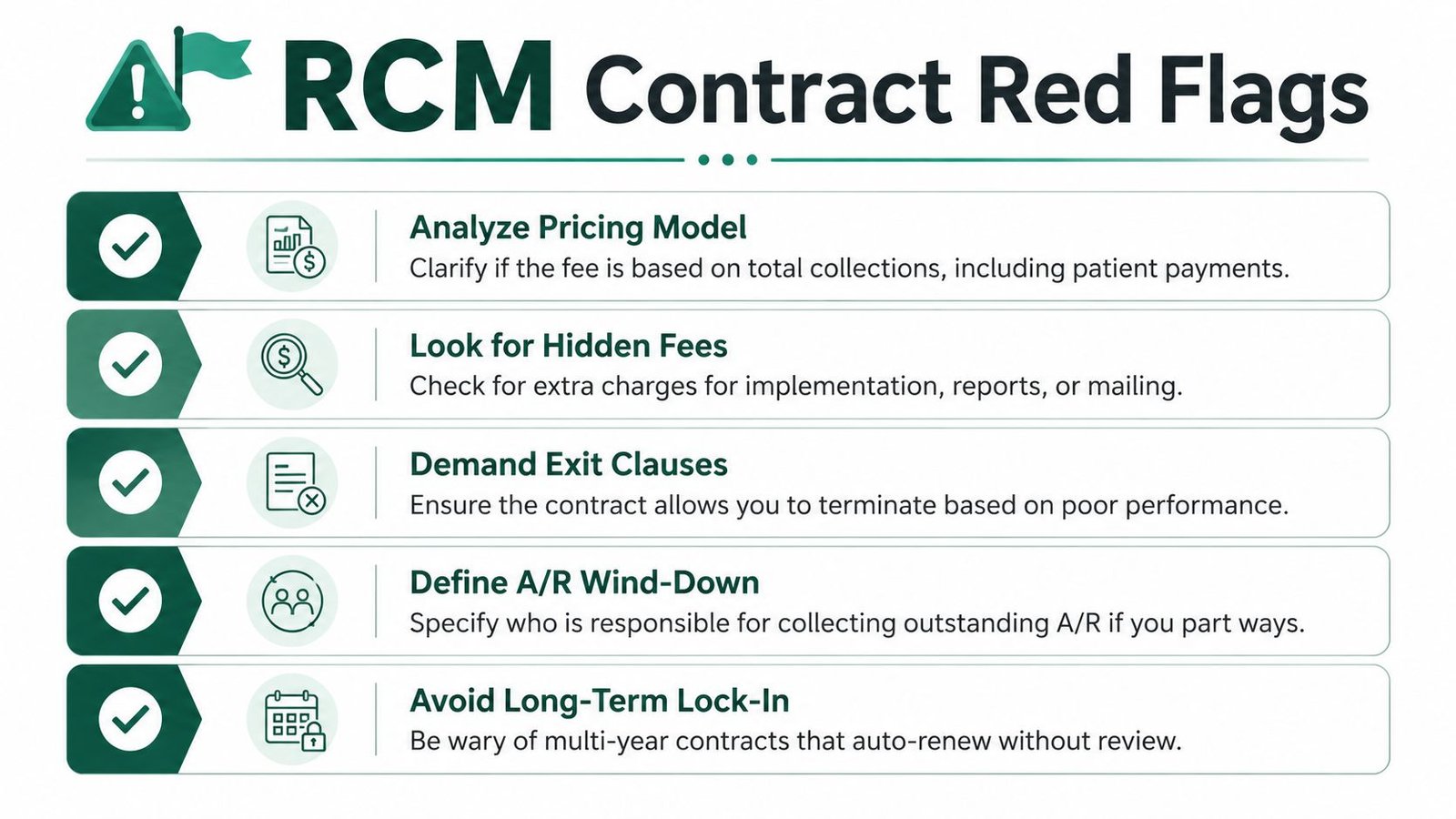
As the infographic shows, vague pricing models and a lack of performance-based exit clauses are huge risks. Be sure to also check out our other guidance on medical billing company red flags before you sign anything.
A Realistic Look at RCM Implementation and Onboarding
Handing over your practice’s billing operations is a huge undertaking. Let’s be honest, it can feel overwhelming. But it absolutely shouldn't be chaos. Any RCM company worth its salt will have a clear, structured implementation plan designed to minimize disruption and kick off your partnership on the right foot.
The process starts with the technical nuts and bolts—integrating their system into your EHR and tackling provider credentialing for any new payers. It also means getting your front-office team trained on new registration or charge capture workflows. This is where a good partner shines, and it’s why so many practices are making the switch. In fact, the global RCM market was valued at $102.16 billion in 2024 and is forecast to approach $291 billion by 2033. You can dig into what's driving this growth in this comprehensive market report.

A critical transition point is managing existing A/R. Will the new company work the old balance, or will your previous vendor wind it down?
This is a detail that can’t be overlooked. You need to know exactly how that legacy A/R will be handled before you sign anything.
Finally, insist on having a dedicated implementation manager who will be your single point of contact. The first 90 days after you go live are the most crucial. This is the time to establish a solid communication rhythm, review the first batches of reports, and fine-tune your shared workflows before old habits creep back in.
H3: What is the typical cost for an RCM company?
The most common pricing model is a percentage of monthly net collections, typically ranging from 4% to 8%. This rate is influenced by your practice's specialty, claim volume, average reimbursement per claim, and payer mix complexity. It is critical that your contract defines "collections" as actual cash collected, not gross charges, and explicitly states that there are no hidden fees for standard services like reporting or implementation.
H3: Will an RCM vendor work within my current EHR system?
Yes, a competent RCM company in 2026 must be platform-agnostic and operate seamlessly within your existing EHR, whether it is a major system like Epic or Cerner, or a specialty-specific platform. This eliminates the need for disruptive data migrations and allows your clinical staff to maintain their established workflows. Confirming a potential partner's direct experience with your specific EHR is a mandatory step in the vetting process. For more on how this works across different specialties, you can see how we tailor our approach at Happy Billing.
H3: What first-pass clean claim rate should I expect?
While many RCM vendors consider a 95% first-pass clean claim rate (FPCR) acceptable, a truly expert partner will consistently achieve 98% or higher. According to AAPC standards, a high FPCR is a primary indicator of an efficient billing process. This metric directly translates to faster payments, reduced days in A/R, and less administrative work for both the vendor and your practice. Always demand to see a vendor's proven FPCR, broken down by specialty.
At Happy Billing, we combine expert human oversight with agentic AI to deliver unmatched results directly within your EHR. Stop chasing claims and start focusing on patient care. Book a demo today to see how we can optimize your revenue cycle.