Top Medical Billing Outsourcing Companies 2026

The best medical billing outsourcing companies are the ones that fit your specialty, your workflow, and your cash flow goals. If you're choosing well, you should see cleaner claims, faster reimbursement, and fewer dollars trapped in A/R.
If you're reading this, your front desk is probably chasing eligibility, your providers are asking why paid claims still don't match production, and your current billing setup feels harder to manage than it should. We've seen this pattern across independent practices. The issue usually isn't effort. It's that revenue cycle work breaks down in small places that compound fast, like a missed prior auth in behavioral health, a mishandled modifier 59 in procedural work, or an anesthesia claim where QZ, QK, AA, or concurrency rules weren't handled correctly.
That's why outsourcing isn't just an admin decision. It's a cash flow decision. A billing partner that understands CMS rules, payer edits, modifier logic, and specialty-specific coding can tighten denial control and stop claims from aging out before anyone notices. For many owners, that matters more than staffing relief.
This guide gets to the point. We're reviewing seven medical billing outsourcing companies through the lens that matters to a practice owner: financial performance, specialty fit, technology compatibility, and how likely each vendor is to help you stop revenue leakage. If your operation also touches broader phone workflows, this look at fonea for UK healthcare operations is worth a separate review.
1. Happy Billing
Monday starts with 40 encounters on the schedule. By Friday, several of those visits are sitting in edit queues because authorization was missed, a modifier was wrong, or the payer rejected documentation logic your staff thought was fine. That is how small billing errors turn into slower cash and older A/R.
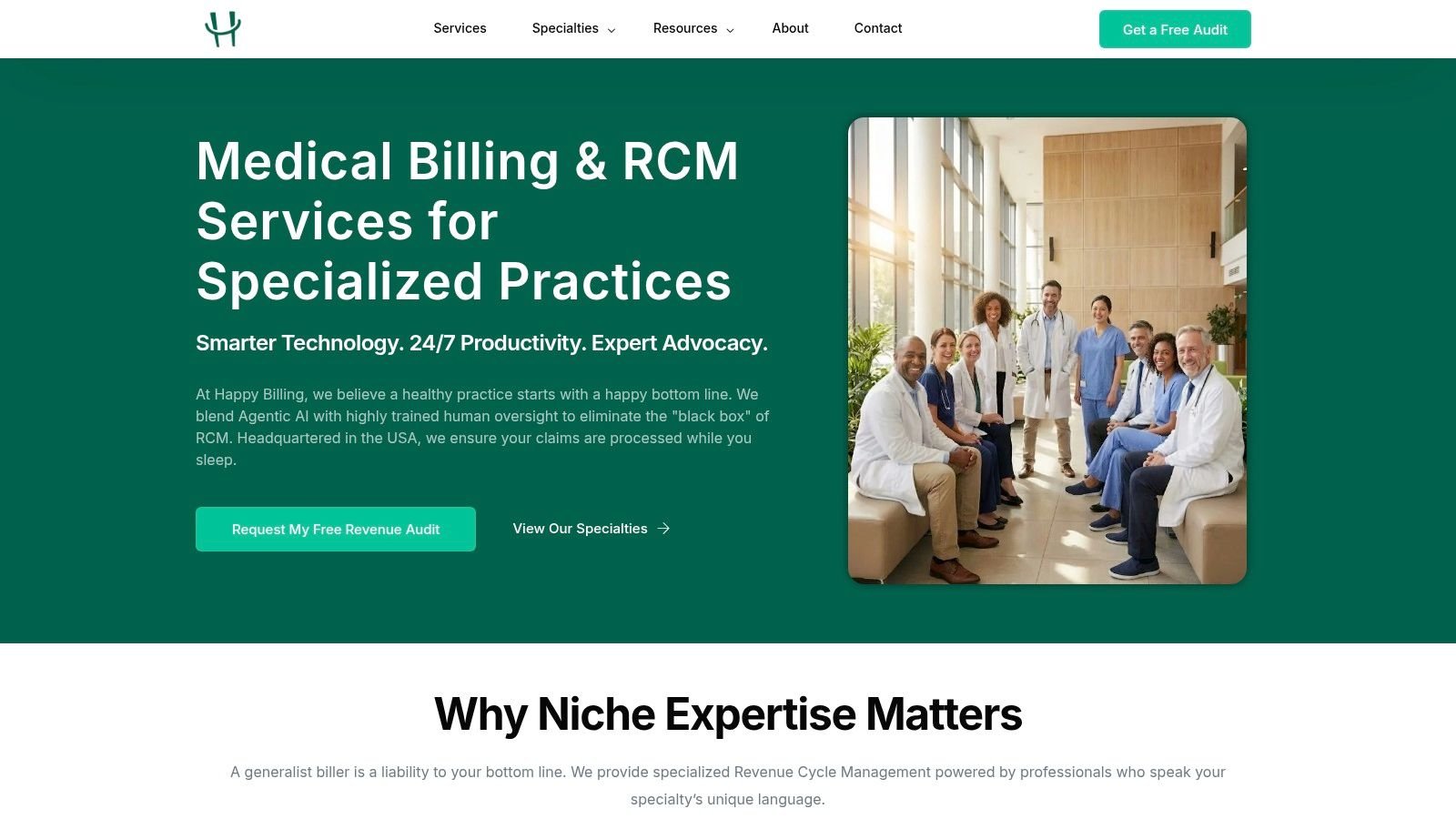
Happy Billing is the best fit in this roundup for independent specialty practices that need tighter revenue cycle control inside the systems they already use. We rank it first because specialty owners usually do not need a giant enterprise vendor. They need a billing partner that can reduce denial volume, protect clean claim performance, and recover money trapped in aging receivables.
Its strongest advantage is practical. Happy Billing works within your current EHR and practice management setup. That matters because system changes often create charge lag, break reporting continuity, and blur responsibility during the first months of a transition. If your goal is cash flow improvement, adding operational disruption is the wrong move.
Best for specialty groups where coding accuracy drives collections
This vendor makes the most sense when your reimbursement depends on coding detail that generalist billers often miss. In anesthesia, payment depends on correct handling of base units, time units, physical status, and modifiers such as QZ and AA, plus concurrency rules. In behavioral health, authorization tracking and CPT selection for codes such as 90791, 90834, 90837, and 90853 directly affect whether visits get paid. In orthopedics, global periods and modifiers 24, 25, 57, 58, 59, and 79 can decide whether follow-up work is reimbursed or written off.
That specialty angle is what owners should screen for first.
Happy Billing pairs AI-based pre-claim checks with human review and coding oversight aligned with AAPC standards. For a specialty practice owner, that is the right model. Automation catches pattern-based errors quickly. Experienced reviewers catch payer logic, documentation mismatch, and specialty-specific issues that software misses.
Here is the standard we use in vendor reviews: if a company cannot explain how it handles your top denial categories, your highest-value CPT codes, and your payer-specific modifier edits, do not hire it.
Happy Billing also covers the full revenue cycle, including registration support, insurance verification, denial management, credentialing, and old A/R recovery. That matters financially because front-end mistakes create back-end write-offs. A vendor that owns both sides has fewer excuses and clearer accountability.
Reporting is another strength. Owners need visibility into collection trends, denial patterns, and workflow bottlenecks before month-end. If you are building an RFP, use this guide on how to choose the best medical billing company to pressure-test what a vendor will own and how performance will be measured.
A few points make Happy Billing especially practical for physician-led groups:
- No forced platform switch: Your team keeps working in the current EHR and PM system, which reduces disruption and protects billing continuity.
- Specialty-focused workflows: It is built for anesthesiology, mental health, cardiology, orthopedics, pediatrics, and other specialties where coding errors quickly become revenue loss.
- End-to-end RCM coverage: The scope includes claims, denials, credentialing, and recovery of aging balances.
- Ongoing operational oversight: U.S. leadership and continuous workflow coverage help prevent queues from stalling after office hours.
If you want a specialty-aligned partner, review its approach across different medical billing specialties and its perspective on the benefits of outsourcing medical billing. The key question is simple. Will this vendor improve clean claims, shorten A/R days, and protect reimbursement in your specialty, or will it just process tasks faster while the same dollars keep leaking out?
2. Ensemble Health Partners
Ensemble Health Partners is a serious contender if you run a large multi-site group or you want one vendor to take over most of the revenue cycle. It's not the best fit for every independent office, but it belongs on this list because some physician owners need enterprise-grade operating discipline more than boutique service.
Ensemble is strongest when the problem is broad. Think patient access issues, charge capture inconsistency, denial follow-up, business office backlog, and reporting fragmentation across locations. If your practice has grown faster than your internal billing structure, a partner like this can impose process where internal teams have been improvising.
Best for larger groups that need structure
For specialty practice owners, the question isn't whether Ensemble is capable. It is. The question is whether you need that level of scale. A cardiology platform, surgical group, or large multi-specialty operation may benefit from a vendor that can standardize front-end and back-end performance across sites and providers.
That matters financially because front-end misses often create the denial later. A missing referral, an eligibility failure, or a prior auth gap can kill reimbursement before coding ever enters the conversation. For procedures where modifier 25, 59, 76, or 77 becomes relevant, your vendor has to connect scheduling, documentation, coding, and payer edits into one operating chain.
If you're evaluating large vendors, this guide on how to choose the best medical billing company is a useful filter for separating polished sales decks from real operational fit.
Larger vendors help when your biggest problem is process fragmentation. They become a poor fit when your biggest problem is specialty nuance and local accountability.
Where it fits and where it doesn't
Ensemble makes sense when your practice wants governance, embedded analytics, and a mature transition process. It makes less sense if you're a smaller owner-operated office that wants direct access, quick decisions, and close specialty attention.
We'd put it on the shortlist for:
- Large physician groups: Especially those with multiple locations or service lines.
- Practices considering full outsourcing: Not just billing, but patient access through back office.
- Organizations that need change management: When internal teams are overloaded and standardization is overdue.
We'd look elsewhere if you're a smaller specialty group trying to fix a specific leakage problem fast.
3. Access Healthcare
Access Healthcare is one of the better options if you want a technology-heavy outsourcing model without ripping out your current systems. That's the appeal. It layers automation and workflow tooling over existing operations instead of insisting on a ground-up rebuild.
For practice owners, that can protect cash flow during onboarding. The less system disruption you create, the lower your risk of charge delays and missed follow-up in the first months of a vendor transition.
Strong choice for process-heavy RCM
Access emphasizes automation across eligibility, coding support, denial workflows, payment posting, and A/R follow-up. That kind of setup helps when your current billing problem is operational drag. Claims sit too long. Denials aren't categorized well. Follow-up work gets touched late. Staff spend too much time on repetitive activity instead of exception management.
In specialties with coding density, that matters. Cardiology claims can involve procedural combinations where bundling and modifier logic shape payment. Behavioral health groups face authorization and frequency-rule pressure from commercial payers. Surgical and pain practices need strong handling around modifiers such as 50, 51, 58, 59, and 78 to avoid leaving money behind or triggering denials.
If you're trying to compare automation-first vendors against fee structures and hidden service costs, read this breakdown of what outsourced medical billing can cost.
What to press on in diligence
We like Access when a group wants scale and technology depth. We push buyers to be strict during the RFP process. Ask how their automation flags payer-specific edits before submission, who reviews exceptions, and how denials are routed by root cause instead of by generic work queue.
Focus your questions here:
- EHR compatibility: Confirm exactly how they connect to your current stack.
- Exception handling: Ask where bots stop and human reviewers take over.
- Specialty workflows: Have them walk through your top ten CPT codes and common denial paths.
- Reporting detail: Require payer-level denial categories, not generic monthly summaries.
Access is a solid option for groups that want scale and systems. It's less compelling if what you really need is highly customized specialty oversight with a smaller-team feel.
4. Omega Healthcare
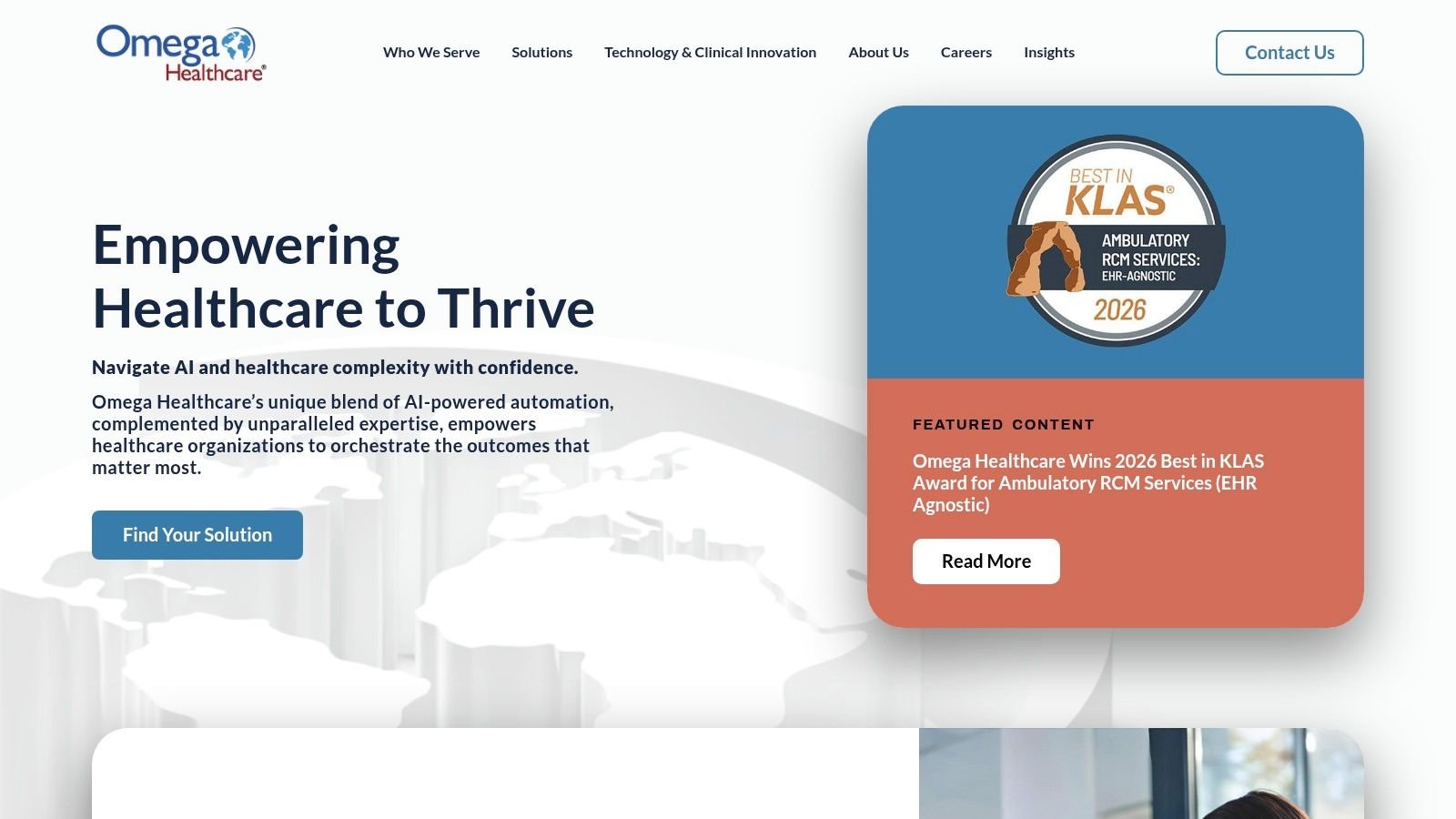
Omega Healthcare belongs in the conversation for multi-site practices and organizations that want a broad operating bench. It offers end-to-end RCM with a blended delivery model and reaches beyond straight billing into clinically enabled support.
That's useful when your practice has both administrative complexity and care-related workflow friction. A simple billing vendor won't solve those problems if your denials start upstream in documentation, utilization, or coordination failures.
Better for scale than for intimacy
Omega makes sense for organizations that value depth, broad specialty support, and a mature global model. We see the fit most often in larger groups, urgent care platforms, behavioral health networks, ASC-focused operations, and other settings where billing needs to scale quickly across locations or service types.
From a financial standpoint, scale only helps if transparency follows it. If you use a blended staffing model, you need clarity on HIPAA controls, supervisory structure, escalation paths, and who owns claim quality. Otherwise, slower fixes and diffuse accountability can stretch A/R even if the vendor has large teams.
Owners should carefully compare outsourcing models. A review of in-house vs outsourced medical billing is useful before committing to a large external operation.
The right question isn't “Do they have enough staff?” It's “Who owns my denial trend, who fixes it, and how fast do they change behavior?”
Questions to ask before signing
Omega is worth evaluating if you need breadth and process maturity. But get specific in contracting.
Ask for:
- Defined onshore oversight: Know who leads your account and where decisions happen.
- Specialty-specific examples: Especially for payer-sensitive areas like behavioral health, ASC billing, and lab work.
- Security detail: Clarify access controls, PHI handling, and data governance.
- Root-cause reporting: You want denial themes tied to action plans, not just aging reports.
If your practice is very small, Omega may be more infrastructure than you need. If you're growing across sites or service lines, it can be a practical option.
5. GeBBS Healthcare Solutions

GeBBS Healthcare Solutions is a strong pick when coding quality and denial management are the center of your revenue problem. Some vendors talk broadly about end-to-end RCM. GeBBS is more compelling when you need sharper back-office execution around coding, A/R, and extended business office support.
That distinction matters. Many practices don't need a wholesale operating overhaul. They need a vendor that can attack claim quality, edit resolution, and stubborn unpaid balances without creating new disruption elsewhere.
Especially useful for coding-heavy specialties
If your practice has complex procedural coding, GeBBS deserves a serious look. Orthopedics, GI, cardiology, pain, and surgery-focused groups often lose revenue through modifier misuse, missed documentation linkage, and underdeveloped denial recovery workflows. CPT coding may be technically correct, but still unpaid because payer edits weren't anticipated or appealed properly.
A strong vendor in this category should be able to discuss modifier 24 during postoperative periods, modifier 25 for separately identifiable E/M work, modifier 59 and the X modifiers for distinct procedural services, and payer-specific rules that affect medical necessity and bundling. That's the level of conversation owners should require.
If your main issue is recoverability and denial pressure, this overview of outsourced revenue cycle management is a practical companion while you compare vendors.
Why GeBBS makes the shortlist
GeBBS is a good option for practices that want modular support. You may not need to outsource everything. You may need coding support, denial management, or EBO coverage that your internal team can't sustain consistently.
Its strengths are usually these:
- Coding support: Helpful for specialties where small documentation gaps create big reimbursement issues.
- Denial focus: Better fit than generic billing shops when appeal and follow-up quality matter.
- Modular outsourcing: Useful if you want targeted help instead of a full takeover.
- Scalable operations: Better for growing groups than for ultra-small solo offices.
We'd rank it higher for mid-sized and larger specialty groups than for small primary care offices. It's a practical revenue protection option when the problem lives in coding depth and A/R cleanup.
6. Coronis Health
Coronis Health is one of the better specialty-focused medical billing outsourcing companies on the market. If you're an independent anesthesia group, behavioral health organization, imaging center, surgery center, or lab, that focus matters more than generic scale.
We've seen specialty practices overpay for broad vendors that never quite learn their workflow. Coronis is more interesting because it starts from service-line familiarity instead of trying to bolt specialty knowledge on later.
Best when specialty billing drives the risk
Anesthesia is the obvious example. If your vendor doesn't understand time-based charging, medical direction, concurrency, physical status, and modifiers like QZ, QX, QK, and AD, the problem won't show up as one dramatic failure. It will show up as recurring underbilling, preventable denials, and slow payer response.
Behavioral health has a different pressure point. Revenue depends heavily on authorizations, visit limits, payer documentation rules, and correct use of common codes such as 90791, 90832, 90834, 90837, and 90853. Imaging and surgery centers have their own bundling, supervision, and place-of-service issues. Coronis is built around those realities.
A specialty vendor should know your workflows before the first onboarding call. If they need weeks to understand your top codes, they're learning on your revenue.
Who should shortlist Coronis
Coronis makes sense for independent specialty groups that want vendor teams aligned to their clinical and billing model. That usually includes:
- Anesthesia practices: Where unit logic and modifier precision directly affect collections.
- Behavioral health groups: Where authorization discipline is the difference between billed and collectible.
- Imaging and surgery centers: Where procedural coding and payer edits are highly specific.
- Labs and other focused service lines: Where generic billing teams often miss workflow nuances.
The tradeoff is breadth. If you run many unrelated specialties under one roof, make sure Coronis can support all of them well and not just the headline service line that drew you in.
7. Medusind

Medusind is a practical option for practices that want specialty experience plus a broader service stack that can include credentialing, payer contracting support, and patient-pay tools. It's especially relevant if your organization spans medical and dental, or if you operate in specialties where workflow precision matters more than generic claim volume.
That combination is why Medusind stays on the shortlist. Some owners need more than billing support. They need help across payer setup, provider enrollment, and patient responsibility collection without hiring several vendors.
Particularly relevant for anesthesia and GI
Medusind has long-standing visibility in anesthesia and gastroenterology. That matters because both specialties can lose revenue in ways owners don't always catch early. In anesthesia, the familiar issues are time capture, modifier accuracy, and payer-specific interpretation. In GI, procedure coding, multiple-service logic, diagnosis support, and screening versus diagnostic distinctions can all affect payment.
Dermatology and urgent care groups can also benefit if they need tighter handling around E/M coding, minor procedures, and modifier use such as 25 and 57. CMS guidance and payer policy language often leave room for error if documentation review is weak or inconsistent.
Where Medusind fits best
We'd consider Medusind in these situations:
- Specialty groups wanting broader support: Billing plus credentialing and contracting can be valuable when growth is creating operational strain.
- Mixed medical or medical-dental organizations: Fewer vendors means fewer handoff failures.
- Practices with patient-pay pressure: Collection tools matter when more responsibility shifts to patients.
- Groups that want flexible engagement: It can be a fit if you want more than simple claim submission.
The key diligence point is reporting. Don't settle for top-line dashboards. Ask to see payer-specific denial views, turnaround expectations, and how thoroughly the team can analyze recurring edit categories. If the reporting is thin, revenue leakage will stay hidden longer than it should.
Top 7 Medical Billing Outsourcing Companies Comparison
| Vendor | Implementation complexity | Resource requirements | Expected outcomes | Ideal use cases | Key advantages |
|---|---|---|---|---|---|
| Happy Billing | Low–Medium, integrates inside existing EHR, minimal migration | Moderate, audit, integration, coordination with practice staff; hybrid AI + human reviewers | High, reported 98%+ first‑pass clean claims; <35 days A/R; documented revenue recoveries | Specialty-focused practices with high-stakes coding (anesthesia, cardiology, behavioral health, orthopedics, pediatrics) | Hybrid agentic AI + human audit, specialty workflows, no EHR migration, strong security and real‑time dashboards |
| Ensemble Health Partners | High, full‑takeover engagements require extensive transition and governance | High, enterprise contracts, embedded analytics, dedicated governance teams | Strong, multi‑year Best in KLAS recognition; performance‑guaranteed models available | Hospitals, health systems and large multi‑specialty groups seeking single‑partner RCM | End‑to‑end RCM at enterprise scale, proven change‑management, recognized outcomes |
| Access Healthcare | Medium–High, automation platform integration and workflow tuning | Medium, Echo automation setup, integrations, human oversight | Moderate–High, marketed cost‑to‑collect improvements; recommend baseline validation | Organizations wanting AI/automation layered onto existing EHR/PM without full replacement | 'Echo' automation platform, AI + human oversight, system‑agnostic integrations |
| Omega Healthcare | Medium–High, global/onshore delivery model and clinical programs require coordination | High, scale, blended onshore/offshore teams, clinically enabled staff (RNs) | Scalable, clinically enabled RCM and care‑coordination outcomes for large operations | Multi‑site groups valuing scale and clinically integrated RCM | Broad specialty coverage, clinical resources (nurse‑led programs), mature global operating model |
| GeBBS Healthcare Solutions | Medium, modular or full outsourcing with AI‑enabled workflows | Medium, scalable coding/denials teams and extended business office support | Strong, focused improvements in coding, denials, A/R when scoped appropriately | Groups needing robust coding, denials management, risk‑adjustment, or scalable back‑office | Coding and denial expertise, modular engagement options, industry recognition |
| Coronis Health | Low–Medium, specialty‑tuned centers of excellence simplify onboarding for focused specialties | Moderate, specialty teams, patient‑pay and collections tools | Targeted, documented revenue lift in specialty areas (e.g., anesthesia) | Independent specialty practices (anesthesia, behavioral health, imaging, surgery centers) | Specialty‑centric workflows, KPI playbooks, patient‑pay tools (text‑to‑pay) |
| Medusind | Medium, supports mixed medical/dental workflows and payer contracting | Medium, national operations with payer contracting and credentialing support | Moderate, specialty‑driven improvements; supports mixed medical/dental collections | Practices with medical + dental lines or deep specialty needs (anesthesia, GI, dermatology) | Deep specialty experience, payer contracting/credentialing, patient‑pay solutions |
Making the Final Decision for Your Practice's Health
You feel a bad billing decision in cash flow before you see it in a report. Deposits slow down. Old A/R grows. Your front desk gets dragged into billing complaints while preventable denials keep repeating.
That is why we tell practice owners to choose a vendor the same way they would judge any other financial operator. Start with outcomes tied to revenue. If a company cannot show how it improves clean claim rate, reduces denial volume, shortens days in A/R, and collects older balances, it does not belong on your shortlist.
Specialty fit decides whether those metrics improve or stall. A generalist may look fine in a sales process and still miss the coding details that drive payment in your field. Psychiatry groups need a team that can control authorization workflows, code psychotherapy services correctly, and catch documentation gaps before claims go out. Anesthesia groups need accurate time unit capture, modifier discipline, and consistent handling of concurrency rules. Orthopedic practices need close control over global periods, postoperative E/M edits, and modifier scrutiny from commercial payers.
Technology fit has direct financial consequences too. If the vendor needs to replace your PM or EHR just to start work, implementation risk goes up and cash disruption usually follows. We prefer partners that can work inside your current stack unless there is a clear return tied to better reporting, faster charge entry, or stronger denial control.
Use a simple RFP and make the vendor answer it in writing:
- Specialty fit: Ask them to walk through your top CPT codes, modifiers, payer edits, and denial trends.
- Core metrics: Require weekly and monthly reporting on clean claim rate, denial rate by category, charge lag, A/R aging, and recovery of older balances.
- Operational ownership: Define who owns coding questions, denials, payer escalations, credentialing dependencies, and monthly review meetings.
- Reporting depth: Ask for root-cause analysis, payer-specific performance, adjustment trends, write-offs, and follow-up status.
- Compliance controls: Confirm how the team applies CMS updates, payer policy changes, and specialty coding rules in daily production.
- Implementation plan: Get dates, staffing assignments, system access steps, and escalation paths before signing.
Then ask one direct question. What will improve in the first 90 days, and how will you prove it?
A good answer includes specific operating targets, named owners, and a reporting cadence. A weak answer usually leads to the same problems you already have, just with a new logo on the invoice.
How do I know if my practice should outsource billing or fix it in-house
Outsource when recurring denials, delayed follow-up, poor coding oversight, or weak reporting are already draining collections. Keep billing in-house only when the issue is contained and fixable, such as a single manager gap, one payer problem, or one broken workflow. We advise owners to decide based on revenue leakage and cash delay, not staff preference.
What should I ask a medical billing outsourcing company before signing
Ask how the team handles your highest-volume CPT codes, common modifiers, payer edits, prior authorizations, and denied claims. Ask who runs implementation, how reporting works, whether they can stay in your current EHR and PM system, and how they update workflows when CMS or commercial payer rules change.
Which specialties benefit most from outsourced medical billing
Specialties with coding complexity, authorization friction, and payer variation usually gain the most. Anesthesia, behavioral health, cardiology, orthopedics, pain management, GI, imaging, and multi-site specialty groups often see the clearest improvement because small billing mistakes in these fields turn into delayed cash and avoidable write-offs.
How long should I give a new billing company before judging results
You should see operating improvement early. Charge lag, responsiveness, denial handling, and reporting discipline should tighten first. Judge the relationship on whether cash flow stabilizes, old A/R starts moving, and repeat denials decline.
Happy Billing is the strongest fit for practices that want specialty-focused RCM, tighter denial prevention, and clear reporting without a forced system change. As noted earlier, an outside audit is the right first step if you want to measure current revenue leakage before signing with any vendor.