Best Medical Billing Company Near Me: Top Picks for 2026

The best medical billing company near you is the one that can prove 98%+ first-pass clean claims and keep days in A/R under 35 if your specialty needs that level of cash-flow control. The right choice is usually not the nearest office, it's the partner that protects your collections, shortens denial cycles, and fits your EHR without forcing a migration.
A mid-sized practice can feel “stable” on paper while denials, slow posting, and weak follow-up drain margin. We've seen owners search for a best medical billing company near me because they want local accountability, but the key financial test is whether a vendor can improve revenue-cycle KPIs, not just answer the phone. For a practice owner, that means looking at specialty fit, denial prevention, and A/R velocity first, then location second. If you're also working on local visibility for your practice or vendor search, optimizing local search for businesses is useful context, but billing performance should still drive the buying decision.
1. Happy Billing
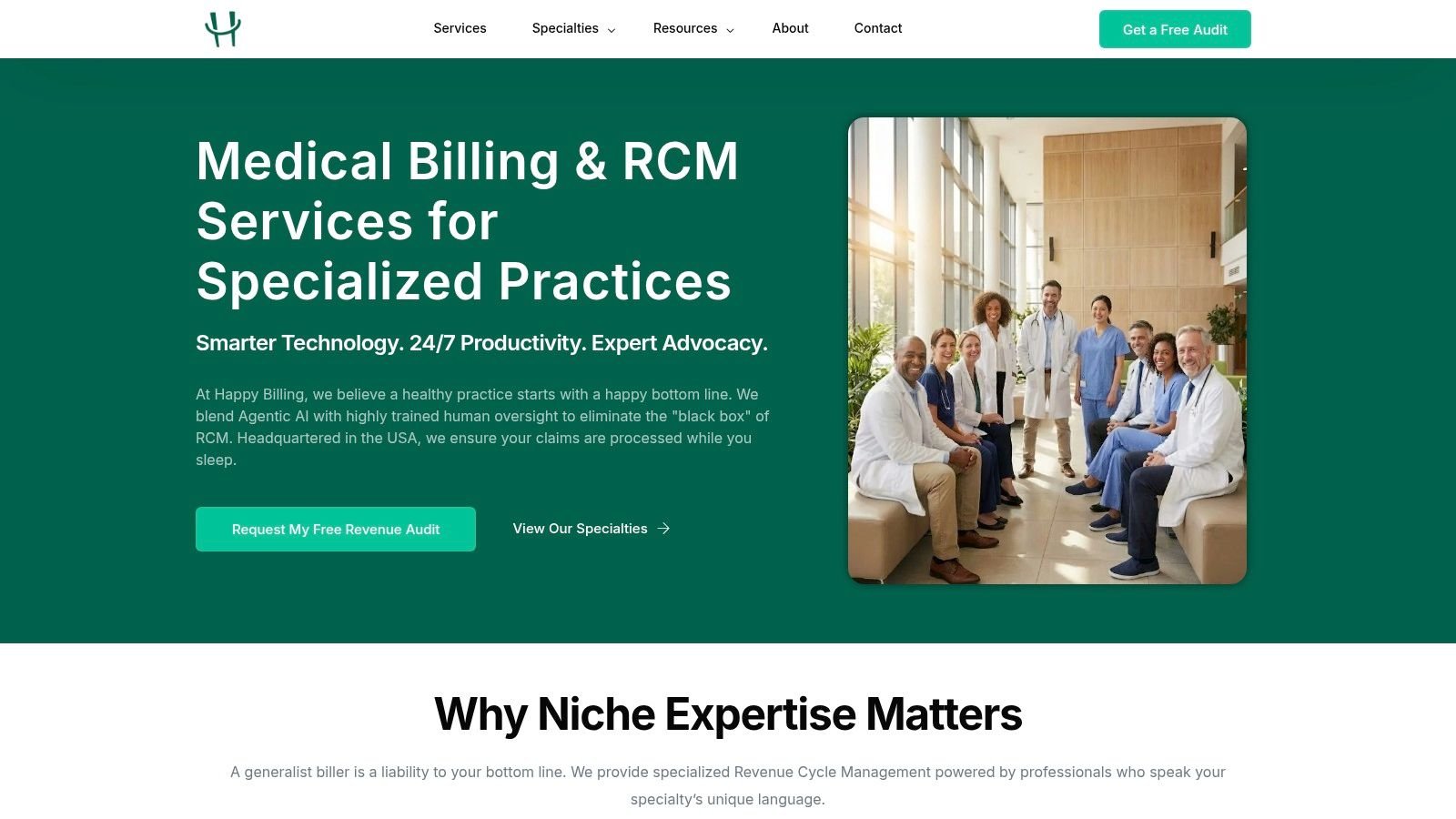
Happy Billing is the strongest fit when a specialty practice needs speed, visibility, and denial control without ripping out its current EHR. It runs inside your existing system, uses a 24/7 follow-the-sun model, and combines agentic AI with senior human auditors so claims keep moving when your internal team is already stretched.
Why it ranks first
The performance story matters here. Happy Billing advertises a 98%+ first-pass clean claim rate and keeps days in A/R under 35, which is exactly the kind of operational proof owners should demand before outsourcing billing. For a cardiology group, anesthesia practice, or behavioral health clinic, that translates into fewer rework cycles, faster reimbursements, and less money stuck in aging buckets.
Practical rule: If a billing partner can't show specialty-specific clean-claim performance, you're buying promises, not cash-flow improvement.
The specialty depth is a key differentiator. Happy Billing builds workflows for anesthesiology, mental and behavioral health, cardiology, orthopedics, pediatrics, and other complex practices, with AAPC-aligned coding standards and specialty-specific logic around base units, modifiers, authorization management, and interventional coding. That matters because the practice owner doesn't lose money from “billing” in the abstract, they lose it from preventable denials tied to the wrong modifier, missing authorization, or incomplete claim follow-up.
What to know before you sign
Happy Billing also keeps the buying process honest with a free revenue audit. That's the right way to price an outsourcing decision, because pricing alone tells you almost nothing without knowing how much leakage is sitting in your A/R.
The trade-off is simple. Pricing isn't published online, so practices need a consult to benchmark expected ROI, and some owners may prefer a fully domestic back office. Still, for high-stakes specialty groups, the combination of transparency, fast claim velocity, and low-disruption implementation makes it the most compelling option in this list. Review their specialty focus at dedicated teams for anesthesiology and start with a complimentary revenue audit if you want to quantify current leakage before you switch.
2. Coronis Health
Coronis Health makes sense for practices that need a deeper specialty bench than a generic billing shop can provide. Its strength is in high-denial areas like anesthesia and behavioral health, where coding nuance and payer follow-up decide whether cash lands quickly or gets stuck.
Where it fits
Coronis has grown through multiple mergers, and that history shows up in its operating model. The firm uses specialty coders, automation, and analytics, and it supports client portals and EHR interoperability across different environments. That can help a multi-site group that wants one partner across varied workflows rather than a boutique team tied to a single platform.
The financial upside is mostly in denial reduction and cleaner handoffs. If your practice struggles with payer-specific edits, missing authorization paths, or specialty-specific follow-up, Coronis is built for those pain points. Owners should still ask how the assigned team handles their exact CPT mix, because anesthesia and behavioral health demand different revenue-cycle controls.
What to watch closely
There are two trade-offs to keep in mind. First, some online user anecdotes mention mixed experiences with offshore resources and responsiveness. Second, pricing is quote-based, so you need a clear proposal before you can compare it against other vendors on total cost of collections.
A practice owner should ask not just “Can they bill our specialty?” but “Can they prove they reduce denials in our payer mix?”
Coronis is a good fit when depth matters more than a flashy software story. If your group wants stronger visibility into billing operations while keeping a specialty-led workflow, it belongs on the shortlist, especially for anesthesia and behavioral health teams that need more than basic claim submission. For a broader checklist of vendor risk factors, see medical billing company red flags before you decide.
3. Ventra Health
Ventra Health is a strong consideration for anesthesia-heavy and hospital-based physician groups that want a mature operating model. It combines coders, client success teams, and the vSight analytics platform to focus on denial prevention, contract optimization, and faster A/R movement.

Why anesthesia groups care
Anesthesia billing lives and dies on precision. Base units, modifiers, and concurrency management are not optional details, they directly affect whether the claim is paid correctly the first time or gets dragged into appeals. Ventra's dedicated anesthesia program and managed-care support make it relevant for groups that want a partner who understands that reality.
The service model is built for transparency. Client success teams and a data platform mean leadership can watch trends rather than wait for a month-end surprise. That helps practice owners compare payers, monitor denial patterns, and pressure-test contract performance.
The trade-offs
Ventra's hospital-based focus can feel enterprise-oriented if you run a very small private practice. That isn't a flaw, but it does mean the fit is better for groups with enough claim volume and complexity to benefit from a structured program.
Bottom line: Ventra is strongest when your billing pain comes from OR-heavy workflows, concurrency issues, or payer negotiations, not from simple claim volume.
Pricing is proposal-based, so the comparison is whether the operational lift offsets the contracted percentage. If your team is already buried in denials, the value is often in the reporting cadence and the specialty-specific process discipline. Owners looking to compare outsourcing costs against performance should also review medical billing outsourcing cost comparison.
4. GeBBS Healthcare Solutions
GeBBS is a better fit for larger groups that need scale, process maturity, and denial-management infrastructure. It serves health systems and physician groups nationwide, with end-to-end billing, coding, and A/R operations backed by AI-enabled workflows.

Why scale matters
A practice owner with multiple locations or broad specialty coverage usually needs more than a biller. You need denial teams, follow-up discipline, and enough operational horsepower to keep old balances from compounding. GeBBS is designed for that kind of workload.
Its broad specialty coverage includes DME/HME, imaging, and ambulatory services, which matters if your revenue mix isn't limited to one cleanly defined specialty. That breadth can stabilize cash flow faster than a smaller vendor that has to learn every edge case on the fly.
The buyer's trade-off
The downside is that big-vendor models can feel less boutique. Experience depends on the assigned team and how tightly your leadership manages the engagement. If your internal staff wants a highly personalized relationship and frequent owner-level interaction, that can be harder to get from a scaled platform.
If your practice is losing money because no one is owning denial root causes, a larger RCM engine can be the right corrective move.
GeBBS belongs on the shortlist when the billing problem is systemic rather than isolated. It's especially relevant for owners who want capacity, structured workflows, and a partner that can absorb volume without losing discipline. If you're comparing service quality, look at medical billing company red flags before signing anything long term.
5. athenahealth
athenahealth is the best-known software-plus-services option on this list, and that's exactly why many independent practices put it under consideration. Its athenaOne Revenue Cycle Services package ties together EHR, practice management, and billing support under one contract.
Why it works for some practices
One vendor for EHR, PM, and billing reduces integration friction. That can save leadership time because your team isn't trying to reconcile multiple dashboards, multiple service desks, and multiple data definitions just to understand what happened to a claim.
Athenahealth's rules engine, centralized support for prior auths, coding, and denials, and performance dashboards are appealing when you want a process-heavy partner that still fits inside a software-first environment. It's especially practical for smaller or mid-sized practices that want a more unified technology stack.
Where the math gets tricky
The pricing model is tied to collections, and that can get expensive as volume grows. The exact percentage isn't published, so you need a proposal before you can tell whether the contract will protect margin or slowly take too much off the top.
Practice-owner filter: If a billing vendor's fee rises faster than the value it creates, your collections improve on paper while your margin shrinks in reality.
Athenahealth is best when the priority is reducing operational complexity, not necessarily squeezing every basis point of cost. If your current problem is fragmented software and weak billing coordination, it can simplify the workflow. If your problem is specialty-specific denial leakage, you'll want to compare it closely with a more specialized RCM partner. For a deeper look at the software-service blend, review revenue cycle management software.
6. CareCloud Concierge
CareCloud Concierge is a practical choice for small-to-mid-size multi-specialty groups that want software and outsourced billing in one stack. It combines practice management, EHR integration, and a back-office billing team so leadership can keep financial data in one environment.
Why owners consider it
The appeal is straightforward. You get full RCM scope, including eligibility, coding, claims, denials, and A/R, without forcing your staff to juggle separate vendors. That can reduce handoff errors and make month-to-month review easier for practice administrators.
Its real-time dashboards help owners track the revenue cycle without waiting for a quarterly recap. For a busy group, that visibility matters more than slick marketing copy, because you can see whether denials are trending in the wrong direction before they become a cash problem.
Where due diligence matters
CareCloud's delivery teams can be distributed, so owners should ask hard questions about SLAs and escalation paths. If the reporting looks good but no one answers when a denial spike hits, the system won't save you.
The pricing model is widely reviewed and typically percentage-based, but final terms vary by specialty, volume, and add-ons. That means the contract comparison should focus on total cost to collect, not just the headline fee.
Rule of thumb: A clean dashboard is only useful if the vendor can turn the numbers into action fast enough to protect cash flow.
CareCloud belongs on the shortlist when you want one platform managing both the technology layer and the billing layer. For practice owners who dislike stitching together separate systems, that can simplify the operating model. If you're comparing vendor structure, revenue cycle management companies is a useful reference point.
7. R1 RCM
R1 RCM is one of the strongest enterprise options for physician groups that need an established, KPI-driven ambulatory RCM partner. It supports health systems and physician groups with EHR-agnostic services and has earned Best in KLAS recognition for ambulatory RCM across multiple consecutive years.
Why it stands out
The major advantage is process engineering at scale. R1 combines patient access, financial clearance, coding, billing, and denials into a structured operating model that works well for large or hospital-affiliated groups.
That matters if your revenue cycle has too many handoffs. Each handoff is a chance for delay, and delay turns into slower reimbursement and more appeals work. R1's governance model is built for organizations that want measurable outcomes and a disciplined operating cadence.
The fit question
The trade-off is size. Smaller private practices may find the enterprise orientation unnecessary or too expensive for their needs. R1 can be the right answer for complex groups, but not every practice needs that much machinery.
A billing vendor should match the complexity of your claims, not just the ambition of your board presentation.
Proposal-based pricing means you'll need to evaluate scope carefully. If your practice runs multiple sites, has a hospital relationship, or needs a more formal governance structure, R1 belongs in the discussion. If you just need specialty-aware billing with tight communication, a more focused partner may fit better. For a broader view of outsourced billing structures, see medical billing outsourcing companies.
Top 7 Medical Billing Companies Near Me, Feature Comparison
| Provider | Implementation complexity | Resource requirements | Expected outcomes | Ideal use cases | Key advantages |
|---|---|---|---|---|---|
| Happy Billing | Low disruption, operates inside existing EHR; audit-first onboarding | Moderate, revenue audit, EHR connectors, 24/7 global back office | Very high clean-claim rates (98%+ first-pass); <35 days A/R; faster collections | Mid-to-large specialty practices with complex procedural coding (anesthesia, cardiology, behavioral health) | Specialty-first AI + human audit, real-time dashboards, no EHR migration |
| Coronis Health | Moderate, integrates with many EHRs; consolidated from niche mergers | Dedicated specialty teams, portals and analytics; quote-based pricing | Improved clean claims and faster reimbursements in high-denial specialties | Practices needing deep specialty expertise (anesthesia, behavioral health), multi-site groups | Centers of Excellence, specialty coders + analytics, broad interoperability |
| Ventra Health | Moderate, anesthesia-focused playbooks and analytics integration | Client success teams, vSight analytics, managed-care negotiation support | Denial prevention, contract optimization, improved A/R velocity for anesthesia | Anesthesiology groups and hospital-based physician services | Strong anesthesia domain expertise and transparent reporting |
| GeBBS Healthcare Solutions | Higher, enterprise onboarding and governance required | Large-scale operations, AI-enabled workflows, dedicated denial teams | Stabilized cash flow and measurable denial reduction at scale | Multi-specialty groups and health systems needing capacity and speed | Scale, process maturity, broad specialty coverage |
| athenahealth (athenaOne RCS) | Low–moderate when using athenaOne; integrated EHR/PM/RCM setup | EHR/PM adoption or integration; percentage-of-collections pricing model | Improved collections, reduced staff workload, benchmarking dashboards | Independent practices wanting a single vendor for software + services | Integrated EHR/PM + RCM, continuous rules updates, robust dashboards |
| CareCloud Concierge | Moderate, combines PM/EHR integration with outsourced back office | Software adoption and concierge billing team; percentage pricing varies | End-to-end RCM visibility and outsourced operational relief | Small-to-mid multi-specialty groups seeking tech + managed billing | One platform for software + services and real-time analytics |
| R1 RCM | High, enterprise-grade deployment, process engineering and governance | Large deployments, KPI-driven programs, EHR-agnostic integration | Measurable KPI improvements and scalable revenue-cycle performance | Multi-site or hospital-affiliated groups requiring mature RCM | Proven at scale, KLAS recognition, strong governance and playbooks |
How to Choose the Right Medical Billing Partner
At a Glance Comparison
Your 10 Point Vetting Checklist
- Verify their first-pass clean claim rate. Ask for the number by specialty, not a generic company average, because specialty-specific performance predicts your cash flow more accurately than a marketing claim.
- Confirm EHR compatibility. If a vendor wants to replace your stack, calculate the hidden cost of disruption before you compare fees.
- Request specialty-specific references. A cardiology group should not be judged against a dermatology workflow, and an anesthesia practice should not accept a generalist benchmark.
- Analyze a sample report. You want to see denial root causes, A/R aging, and collections by payer, not just a polished PDF.
- Ask about modifier and payer-rule expertise. Practices billing CPT 99213, 93000, 64483, 90834, or 36415 can lose money fast if modifiers and payer rules aren't handled correctly.
- Check denial follow-up speed. Claims that sit too long shorten appeal windows and slow cash conversion.
- Review credentialing support. Missing or stale provider enrollment can create preventable write-offs.
- Validate who works your account. The sales team and the delivery team are not the same thing.
- Compare fee structure against collections improvement. If the vendor fee rises but your A/R days don't fall, the contract is weak.
- Request a complimentary revenue audit to benchmark your current performance. That's the fastest way to compare what you think is happening with what your revenue cycle is doing.
Final Takeaway
The best partner is the one with proven specialty expertise, fast turnaround, and clear proof that it improves collections rather than just processing claims. If you run a complex specialty, the right vendor should understand payer behavior, coding nuance, and the operational cost of every denial.
That's why a practice owner should weigh specialty fit ahead of geography. A nearby firm that can't document clean claims, A/R performance, or denial control isn't really the best local option, it's just the closest one. For practices that need dedicated teams for anesthesiology and other specialty-aware workflows, the right choice is the partner that protects revenue every day, not the one with the nearest office.
Frequently Asked Questions
What percentage of collections should a billing company charge?
Recent market guides place outsourcing fees in a range that's usually tied to collections, but the right price depends on specialty complexity, denial workload, and service scope. Owners should compare the fee against improvements in net collections, A/R days, and denial reduction, not just the headline percentage.
Is it better to hire an in-house biller or outsource?
If your practice has simple billing, stable payer behavior, and enough internal oversight, in-house may work. If your team is losing time to denials, credentialing, modifiers, or aging A/R, outsourcing usually gives you faster access to specialty expertise and more consistent follow-up.
What reports should I expect from a billing company?
You should expect clean claim rate, denial rate, A/R aging, net collections, and payer-level reporting. If a vendor can't show those numbers clearly and regularly, they're not giving you enough visibility to manage revenue risk.
How fast should a new billing partner start improving results?
You should see process stability early, but real improvement depends on how messy the old A/R is and how quickly the new vendor can clean up denial work. A solid partner should be able to show progress in claim velocity, follow-up discipline, and reporting clarity without making you wait for guesswork.
If your practice is losing margin to denials, slow posting, or stale A/R, Happy Billing can help you compare your current performance against specialty-specific benchmarks and see where the leak is coming from. Visit Happy Billing to request a revenue audit, review your specialty workflow, and decide whether your billing partner is helping your collections.