Outsourcing Medical Billing: Maximize Revenue in 2026

If your billing team is constantly behind, your A/R is stretching, and denials keep resurfacing for the same reasons, outsourcing medical billing can make sense right now. The question isn't whether a third party can submit claims. It's whether that partner can recover revenue your current process is leaking through missed modifiers, weak denial analysis, and poor specialty execution.
Most practice owners don't start looking at outsourcing because they love vendor management. They start looking because cash gets tight even when the schedule is full. We have seen practices with solid patient volume still struggle because claims aren't clean on first pass, front-desk data errors aren't caught early, and no one can clearly explain why money is aging in A/R. In that situation, outsourcing medical billing is less about administrative relief and more about financial control.
When Does Outsourcing Medical Billing Make Sense
A common pattern looks like this. The physician owner is busy, the administrator is covering too many functions, one experienced biller leaves, and suddenly claim lag grows. Follow-up slips. Payment posting falls behind. Denials start to repeat, especially around eligibility, authorization, modifier use, and documentation gaps.
That's when practices usually ask whether they should hire again or hand revenue cycle work to a specialist.

Outsourcing medical billing means moving all or part of your revenue cycle to a third-party team that handles claim creation, claim submission, payment posting, denial management, and follow-up. For a practice owner, the actual shift is operational. You stop carrying billing as a fragile internal department and start managing it as a revenue function with defined accountability.
We have seen outsourcing make the most sense when the problem is bigger than one employee. If denials keep reappearing, if payers are slowing you down, or if coding complexity has outgrown your internal bandwidth, replacing one biller won't fix the underlying system.
A useful starting point is to review the practical benefits of outsourcing medical billing against your current pain points.
The signs that usually justify a change
- Revenue is arriving too slowly: When payments age out and follow-up becomes reactive, the practice is effectively lending money to payers.
- Denials repeat by pattern: If the same payer issues the same edits on the same services, you have a process problem, not a staffing hiccup.
- Hiring is distracting leadership: Recruiting, training, and retaining billing staff pulls time away from physicians and administrators who should be focused on growth and operations.
- Specialty rules are getting missed: Modifier 25, modifier 59, modifier 24, anesthesia modifiers such as QK, and time-based coding rules can all change reimbursement materially.
Practical rule: Outsource when billing problems are affecting physician compensation, owner distributions, or operating cash. Waiting until payroll pressure shows up usually means the leak has been running for months.
The Core Financial Case for Outsourcing Your Billing
Monday starts with a full schedule, but cash is still tight because last month's claims did not turn into last month's deposits. That gap is the financial case for outsourcing. The decision is not about replacing one salary with one vendor fee. It is about finding where revenue leaks out through claim errors, avoidable denials, undercoded encounters, slow follow-up, and rising A/R days.
According to MGMA-related billing cost data summarized by Transcure, in-house billing costs an average of 13.7% of total collections, compared with 5.4% when outsourced to a specialized partner. That same summary notes outsourced billing firms often charge 4% to 6% of collections, while one U.S.-based billing specialist may cost $45,000 to $75,000 annually. It also reports clean claim rates above 95% for outsourced billing versus a typical in-house range of 85% to 90%, with denial rates 30% to 40% lower than in-house benchmarks.
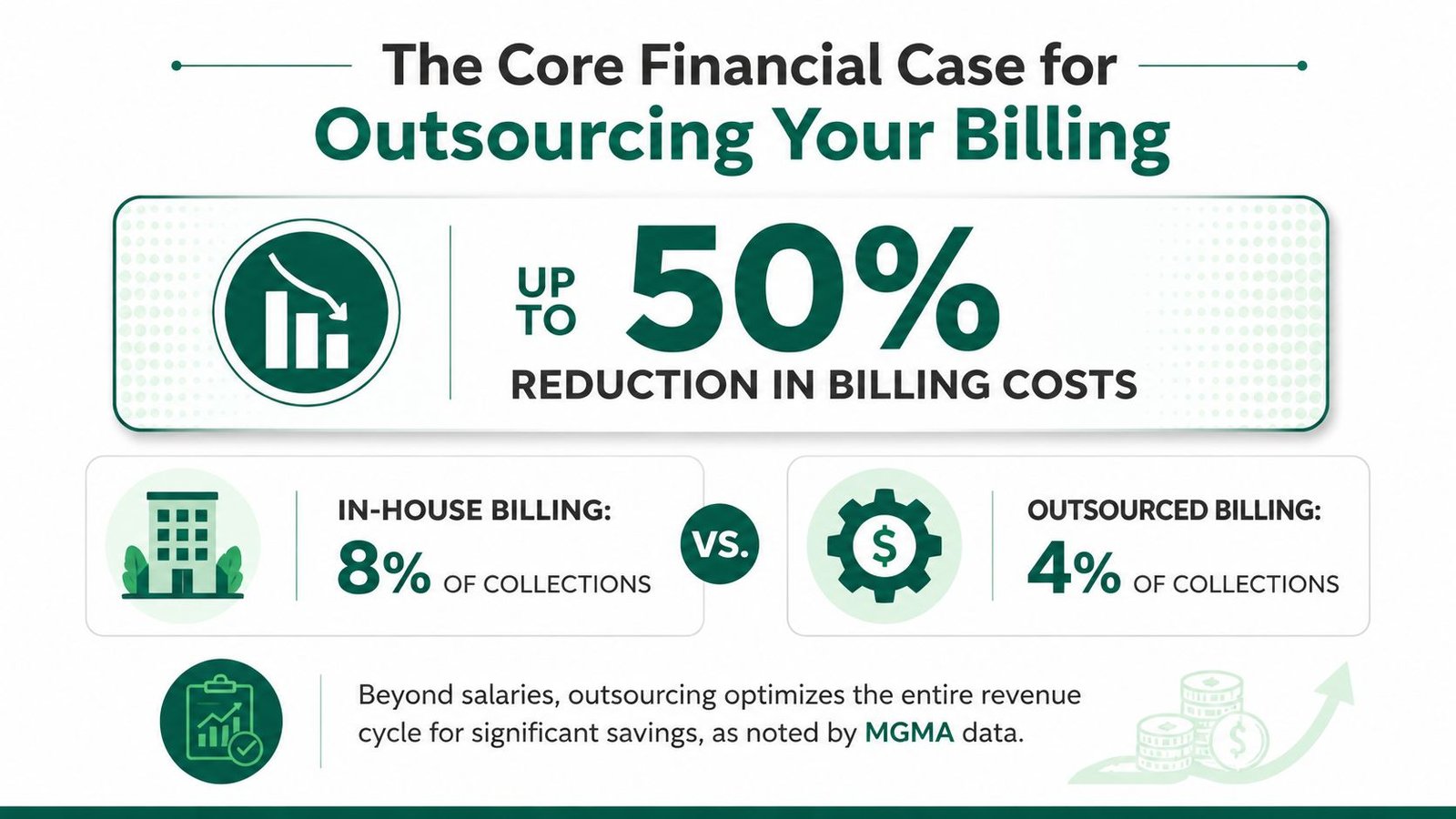
Those percentages matter because revenue cycle problems show up in cash, not in theory.
We have seen practices focus too much on the vendor's fee percentage and miss the larger math. If a billing company charges 6% but cuts denial volume, shortens A/R, and collects more of what you already earned, net revenue improves. If a low-cost vendor posts payments but misses appeals, undercodes specialty procedures, or lets claims sit past timely filing limits, the lower fee becomes expensive.
The strongest financial case usually shows up in four operating metrics:
- Lower A/R days: Faster claim submission and tighter follow-up reduce the lag between date of service and cash in the bank.
- Lower denial rates: Fewer reworked claims means less labor cost and fewer dollars that die in appeals or timely filing write-offs.
- Higher net collection rate: Better coding, modifier use, and payer-specific edits protect reimbursement that should have been collected the first time.
- Lower billing cost as a percent of collections: Variable pricing can be cheaper than carrying fixed staffing, software, training, and management overhead.
Financial forensics matters. A practice should not ask only, "What do you charge?" It should ask, "Where are we losing money now, and can this vendor prove they know how to stop it?"
That review has to go deeper than generic RCM promises. Specialty-specific complexity changes the economics. In multispecialty and procedural practices, errors around modifier 25, modifier 59, diagnosis linkage, global periods, anesthesia time, physical status modifiers P1 through P6, or medical direction modifiers such as QK can reduce payment on otherwise valid claims. We have seen outsourced teams perform well on straight primary care but struggle once payer rules, surgical edits, infusion coding, or anesthesia calculations become more complex. The right partner protects yield per encounter. The wrong one creates hidden write-downs that never show up as an obvious mistake.
For practices evaluating fee structures, this breakdown of what outsourced medical billing costs is useful only after you compare it to your current leakage. A more accurate benchmark is net cash collected after denials, rebills, delayed payments, and staff time spent recovering revenue that should have arrived clean.
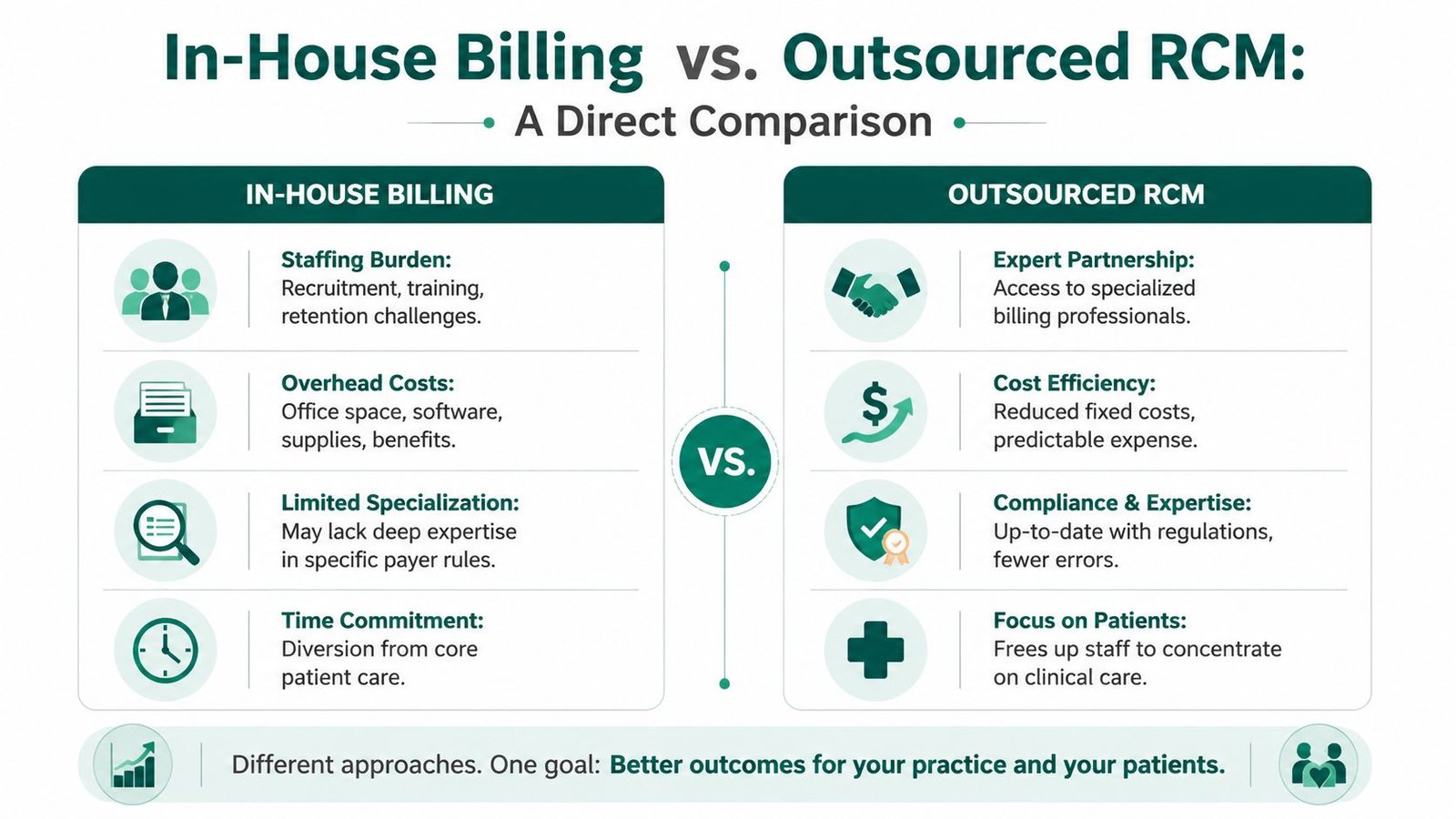
In-House Billing vs Outsourced RCM A Direct Comparison
Most owners already know the emotional case for in-house billing. You can walk down the hall, ask a question, and feel close to the work. That control matters. The problem is that proximity and control aren't the same thing.
An internal team can be strong if you have experienced staff, stable turnover, active oversight, and enough volume to justify better technology. But many independent practices don't have all four at once. One resignation or one payer shift can knock the whole process sideways.
What the numbers say
According to this analysis of in-house versus outsourced billing, in-house billing departments cost an average of $118,000 per year for salaries, software, training, and overhead, while outsourcing the same function reduces that expense to approximately $4,000, a stated 96% reduction in fixed operational costs, with collection rates improving by 15% due to specialized payer expertise.
Those figures are dramatic, but even without taking them as universal for every practice, the strategic point holds. In-house billing is a fixed-cost structure with staffing risk. Outsourced RCM is usually a variable-cost structure tied more closely to performance.
Side-by-side comparison
| Factor | In-House Billing | Outsourced RCM |
|---|---|---|
| Cost structure | Fixed payroll, software, benefits, supervision | Variable fee, usually tied to collections or scope |
| Staffing risk | Hiring, training, PTO coverage, turnover all sit on the practice | Vendor absorbs staffing continuity |
| Specialty depth | Depends on who you can recruit and retain | Strong vendors field specialty-focused teams |
| Technology access | Often limited by budget and implementation bandwidth | Usually includes established workflows and claim-scrubbing tools |
| Payer rule monitoring | Internal staff must keep up with CMS and payer changes | Vendor should manage those updates as part of service |
| Visibility | Can be high if reporting is strong, low if work lives in employee inboxes | Can be excellent if dashboards and root-cause reporting are real |
| Control | Direct supervision, but often uneven process discipline | Less direct supervision, more KPI-based accountability |
A more detailed breakdown is available in this guide to in-house vs outsourced medical billing.
Where in-house still wins
There are cases where keeping billing internal is the right move.
- Stable expert team: If you already have experienced billers with specialty knowledge and low turnover, replacing them may create disruption without enough upside.
- Tight clinical-billing feedback loop: Some practices depend on daily coder-provider communication to resolve documentation issues quickly.
- Strong internal leadership: If someone in your organization owns revenue cycle performance and can manage staff to metrics, in-house can work well.
Where outsourcing usually wins
Outsourcing tends to outperform when complexity exceeds internal capacity.
That's especially true in specialties where claims depend on more than code entry. Think anesthesia time units and concurrency. Think cardiology procedures with bundling and staged services. Think behavioral health authorization tracking tied to session length such as CPT 90837. Think orthopedic global periods where modifier 24 or modifier 79 can determine whether post-op work pays or gets buried in the global package.
If a billing model can't explain why cash is stuck, it isn't giving you control. It's giving you opacity with a familiar face.
Navigating the Risks and Ensuring Compliance
The biggest objection to outsourcing medical billing is usually control. That concern is valid. Some outsourced arrangements create a black box where claims leave your system and you get little more than monthly totals and vague reassurance.
That setup fails practices.
The true risk isn't outsourcing itself. The true risk is outsourcing to a vendor that can't connect coding, front-desk intake, authorization, and denial management into one accountable workflow.
The operational risk owners often miss
One of the clearest warnings comes from this review of outsourced billing problems, which notes that when outsourcing removes daily interaction between clinical staff and billing coders, practices can lose the ability to catch errors at the point of care before claims are submitted. It also notes that few vendors explain how they integrate with front-desk workflows to catch missing information before submission, which leads to recurring denials.
That point matters more than most sales presentations admit. If the front desk misses referral data, if prior authorization isn't documented correctly, or if the provider note doesn't support the billed level, no back-end vendor can fully repair that after the visit.
What to verify before you sign
Ask direct questions about compliance and oversight. Not broad promises. Specific controls.
- HIPAA controls: Request detail on access controls, encryption, breach reporting, and the Business Associate Agreement.
- Workflow integration: Ask how the vendor flags missing demographics, invalid insurance, expired authorization, and documentation defects before claim submission.
- Claim visibility: Require dashboard access or reporting that lets leadership monitor claim status, denial trends, and unresolved payer issues.
- CMS and payer alignment: Make sure the vendor can explain how it handles CMS coding updates, modifier edits, and payer-specific submission rules.
Owner check: If a vendor can't show you how front-end errors are fed back to staff, recurring denials will continue no matter how polished their follow-up team sounds.
Outsourcing should move you from supervising tasks to supervising performance. That only works when the vendor gives you enough visibility to spot problems early and enough discipline to correct them.
Your Vendor Selection Checklist
Most billing vendors know how to sell “fewer denials” and “better cash flow.” Fewer can show you exactly how they diagnose leakage. That's the dividing line between a commodity biller and a real revenue cycle partner.

Ask for denial root-cause analysis, not just appeal stories
A vendor can boast about low denial rates and still leave money on the table. The more useful question is whether they can separate denials by source. Are they tied to coding? Eligibility? Missing prior auth? Front-desk registration? A payer policy change?
This article on selecting a billing vendor makes the point clearly: many providers assume a low denial rate means operational health, but vendors rarely report whether denials stem from systemic coding errors, payer-specific policy changes, or front-desk documentation gaps. Without that analytical layer, practices stay exposed to recurring, unexplained revenue loss.
The checklist that matters
Use this when comparing vendors:
Show me sample reports
Don't accept screenshots with totals only. Ask for denial root-cause reporting, payer mix trends, aging views, and work queue transparency.Explain your specialty coverage
If you're evaluating cardiology, ask how the vendor handles interventional coding, diagnostic studies, and payer bundling logic. If you're evaluating anesthesia, ask about base units, time units, physical status modifiers, and concurrency.Confirm EHR and PM workflow
The vendor should work inside your current system or have a clear, low-friction process. If they need manual exports, duplicate entry, or side spreadsheets, errors multiply.Test communication discipline
Who owns your account? How are unresolved claims escalated? How are front-desk or provider issues fed back into operations?Review contract mechanics
Look at term length, termination language, data ownership, and transition support. A good vendor doesn't trap you to keep the account.Evaluate document control
Billing handoffs often depend on signed enrollment forms, payer paperwork, and internal approvals. In finance and healthcare operations alike, document speed matters. This practical look at how e-signatures help accounting firms is useful because the same operational principle applies here. Faster signatures reduce administrative drag and keep credentialing, contracting, and billing setup from stalling.
A practical place to pressure-test a vendor is this review of medical billing company red flags.
What strong answers sound like
A good vendor answers with process. A weak vendor answers with adjectives.
Strong answer: “We split denials by root cause, payer, CPT family, and intake source, then feed registration and documentation issues back weekly.”
Weak answer: “We work denials aggressively and optimize reimbursement.”
When a vendor can't describe how it prevents a denial before submission, you're buying labor, not strategy.
Why Specialty-Specific Billing Is Required
A specialty practice can stay busy, post strong visit volume, and still lose revenue every week if the billing team misses the coding rules that drive payment on your highest-value services. We have seen this in profitable-looking practices where cash never matched production. The problem was not effort. It was specialty mismatch.
Generic billing gets claims filed. Specialty billing protects reimbursement rate, first-pass yield, and A/R velocity.
The billing details that decide margin
Specialty work is full of small rules with large financial consequences. In anesthesiology, payment depends on base units, time units, physical status modifiers such as P1 through P6, and medical direction logic tied to modifiers like QK. A claim can be accepted and still be paid below contract value if any of those elements are wrong.
Cardiology creates a different set of failure points. Staged procedures, diagnostic testing, NCCI edits, payer bundling behavior, and documentation support for medical necessity all affect whether the practice gets paid in full. For a closer look at those pressure points, this guide to cardiology revenue cycle management is more useful than general billing content because it reflects how revenue is won or lost in that specialty.
Behavioral health and orthopedics show the same pattern. CPT 90837 needs documentation that supports session length and medical necessity. Orthopedic claims often rise or fall on global period logic and correct use of modifiers such as 24, 25, 57, 59, and 79. If a vendor cannot explain where your specialty usually leaks revenue, they will miss underpayments, appeal the wrong denials, or write off claims that should have been recovered.
What to look for in vendor specialty fit
The ultimate test is whether the vendor can perform financial forensics on your revenue cycle.
Ask how they break down denials by payer, code family, provider, and place of service within your specialty. Ask which procedures most often get downcoded or bundled incorrectly. Ask how they identify underpayments against contract terms, not just outright denials. Those answers matter because a practice with a 6% denial rate and a 9% underpayment rate has a larger revenue problem than monthly collections alone would suggest.
We have seen specialty groups improve cash faster by fixing three narrow issues than by replacing the entire billing workflow. Examples include repeated modifier errors on high-value procedures, weak authorization controls for one payer, or missed follow-up on complex secondary claims. That is why specialty knowledge should be evaluated in dollars recovered, A/R days reduced, and net collection rate improvement.
A vendor should be able to discuss your top revenue-producing CPT codes, common denial reasons, payer editing patterns, and documentation weak points without resorting to generic billing language.
That is the standard.
Frequently Asked Questions About Outsourcing
How long does implementation usually take
A well-run transition should feel like a project plan, not a disruption. In our experience, the important pieces are payer enrollment, clearinghouse access, secure system permissions, workflow mapping, and a clean handoff for unresolved A/R. The exact timeline varies by payer responsiveness and credentialing status, but what matters more is whether the vendor has a defined implementation owner and a checklist tied to go-live.
Do we need to let go of our current billing staff
Not always. Many practices keep valuable internal staff and change their role. Someone who knows your providers and patients well may be more useful in front-end financial counseling, authorization support, or as the internal liaison who resolves documentation questions with the outsourced team.
Can we outsource only part of the revenue cycle
Yes. We have seen practices start with aged A/R cleanup, denial follow-up, or a specialty-specific service line that's underperforming. That approach makes sense when leadership wants proof of execution before moving the full billing operation.
How do I know if a vendor will actually improve collections
Ask for process evidence, not promises. You want to see claim edit logic, reporting samples, denial root-cause analysis, specialty knowledge, and a clear explanation of how front-end issues are corrected before they become repeat denials.
If your practice wants a clearer view of where revenue is leaking, Happy Billing can help you evaluate it without forcing a system migration. You can request a free revenue cycle audit to uncover denial patterns, A/R bottlenecks, and specialty-specific billing gaps that are holding back collections.