Outsource Cardiology Medical Billing Services: A Playbook

Monday morning starts with a familiar problem. Friday's cath claims are sitting in review, last month's stress echo denials still need rework, and no one can explain why payments for the same physician vary by payer on what looked like identical visits. In cardiology, that usually points to revenue leakage, not a staff effort issue.
General medical billing workflows miss the places cardiology gets paid or loses money. The misses are rarely dramatic. They show up in wrong or missing modifiers on diagnostic imaging, missed edits tied to multiple procedure reductions, split professional and technical billing errors, weak charge capture on device checks, and documentation gaps that leave interventional claims underpaid. A few missed details across CPT codes such as 93306, 93015, 93458, 92928, or remote monitoring services can drain cash from the practice every week.
I see the same pattern in growing groups. The front end may be solid, physicians may be productive, and claims may still go out daily. Collections lag because the billing team does not work from a cardiology-specific playbook for NCCI edits, modifier 26 and TC use, modifier 59 or XU logic, global service rules, and payer differences between office-based diagnostics and hospital-based interventions.
Outsourcing can fix that, but only if the billing partner knows cardiology at the claim level. A generalist vendor can post payments and work aging. They usually struggle where cardiology margins get protected or lost. For owners and administrators, the practical question is whether the current process catches specialty-specific leakage before it turns into avoidable write-offs. A strong revenue cycle management checklist for physician practices helps frame that review.
When to Outsource Your Cardiology Billing
A new cardiology group finishes a full month of work. The schedule looks strong. Echoes were read, stress tests were supervised, cath cases were done, and device checks kept moving. Then the deposit report lands short because 93306 went out with the wrong component, 93015 was billed without matching documentation support, 93458 sat in edit, and 92928 paid below expectation after a modifier issue no one caught. That is usually the point where owners realize they do not have a staffing problem alone. They have a cardiology revenue problem.
Outsourcing makes sense when the practice keeps losing money in places a general billing workflow does not catch. In cardiology, the leakage points are specific. Modifier 26 and TC errors on diagnostic testing, missed multiple procedure reductions, weak charge capture on remote monitoring, and underworked interventional underpayments can hold back a meaningful share of monthly cash. One missed correction on a high-value cath or PCI claim matters more than dozens of low-dollar office visit edits.
The decision point is control over specialty-specific revenue
The right question is simple. Can the current team prevent cardiology-specific leakage before it turns into avoidable write-offs, refunds, or aged receivables?
I advise practices to outsource when any of these patterns persist for more than a quarter: repeated denials on diagnostic studies, inconsistent payment on procedures that should reimburse predictably, rising days in A/R despite stable volume, or physicians spending time answering coding questions after claims have already failed. At that stage, adding another in-house biller often increases labor cost without fixing the underlying issue.
A capable partner should understand how broader healthcare revenue cycle management works across coding, claim edits, payment posting, denial follow-up, and payer-specific appeals. More important for cardiology, that partner should know where the money is leaking. I would expect them to speak comfortably about split professional and technical billing, NCCI edit logic, modifier 59 or XU use, incident-to limits, and the difference between office diagnostics and hospital-based procedural revenue.
Practical rule: If payment variance keeps showing up on high-value cardiac testing or interventional claims, treat it as a financial control issue, not a temporary billing backlog.
What usually forces the decision
The trigger is rarely one dramatic failure. It is a pattern of preventable misses.
- Diagnostic testing keeps getting reworked: Claims for services such as 93306, 93015, Holter interpretation, or vascular studies are delayed because modifiers, diagnosis links, or professional versus technical components were set up wrong.
- Interventional revenue is inconsistent: Cath and PCI claims may not deny cleanly. They often pay late, pay short, or get stuck in follow-up where no one with cardiology experience is pressing the underpayment.
- Device and remote monitoring charges are not fully captured: Practices perform the work, but billing lags on scheduled transmissions, review time, or supporting documentation tied to those services.
- Leadership cannot isolate leakage by payer or service line: If no one can show whether the problem sits with imaging, device checks, or interventional cases, owners are managing by instinct instead of data.
- Clinical staff is doing revenue rescue work: When physicians or managers spend hours clarifying notes after claims drop, the billing process is already too reactive.
Groups in that position usually benefit from reviewing the benefits of outsourcing medical billing with a narrow cardiology lens. The goal is not convenience. The goal is to stop losing revenue on specialty-specific errors that a generalist team may never see clearly enough to fix.
A Readiness Checklist for Your Practice
Before you evaluate vendors, get honest about whether your practice is operationally ready. Many groups know they have a billing problem, but they can't describe it clearly enough to control the transition. That creates bad vendor decisions.
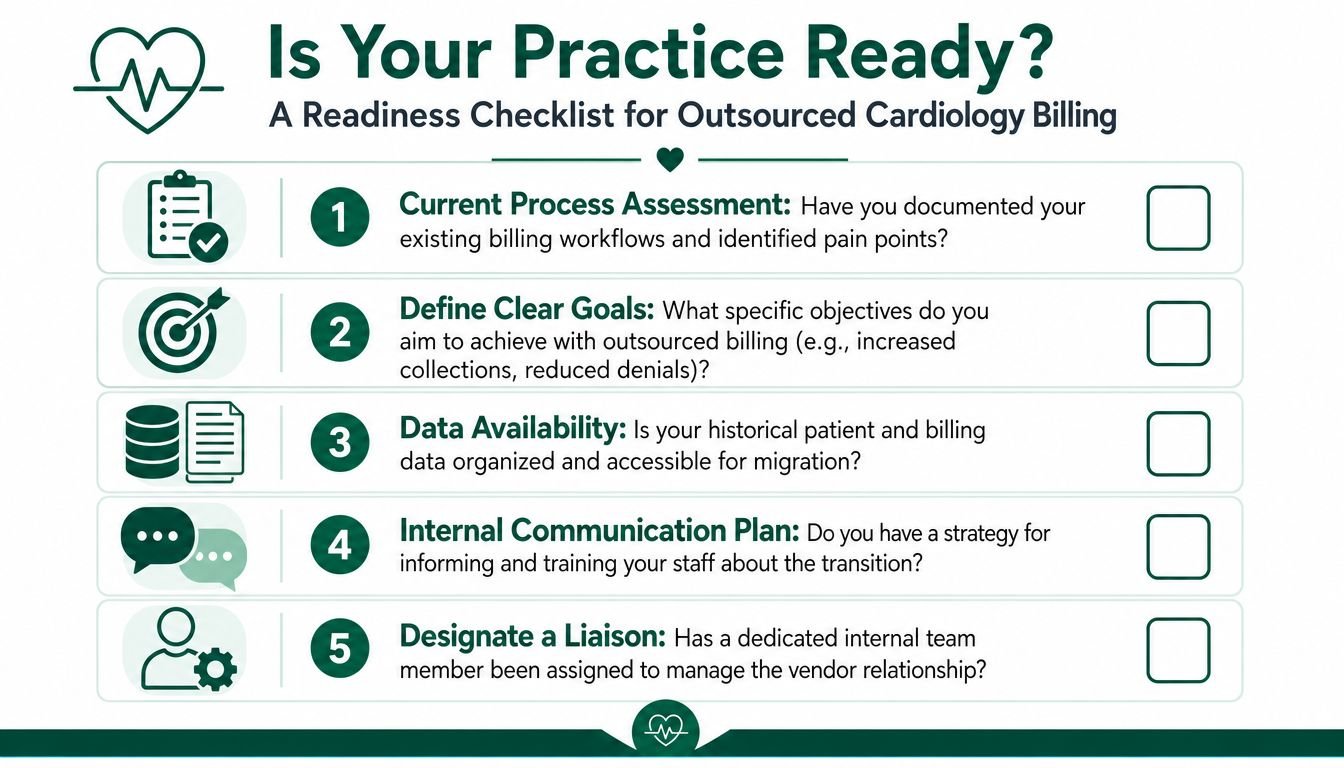
What you need before vendor conversations
Start with your own numbers and workflows. Even if your reporting is imperfect, you need a baseline.
- Denials by payer: Don't settle for a single denial bucket. You need to know which payer is rejecting imaging, device, and procedural claims most often.
- A/R aging by bucket: Look beyond total receivables. The question is whether old balances are sitting unresolved because no one owns the follow-up process.
- Current cost to collect: Include staff time, management oversight, software, clearinghouse costs, and the hidden cost of delayed cash.
- Procedure mix: A practice doing 93306, stress testing, remote monitoring, and interventional work needs a different vendor than a general internal medicine clinic.
- Documentation friction points: Track where physicians are regularly asked to amend notes or add missing details after charges are posted.
If you need a structured way to pressure-test these basics, this revenue cycle management checklist is a practical starting point.
Readiness signals that matter in cardiology
Cardiology transitions fail when the practice underestimates data cleanup. A new partner can't fix what it can't see. If legacy claims, payer setups, fee schedules, and physician workflows are disorganized, the first phase of outsourcing gets consumed by reconstruction work.
Use this short readiness screen:
| Area | What good looks like | What creates risk |
|---|---|---|
| Claim data | Historical claims are accessible and readable | Data is scattered across EHR exports, spreadsheets, and staff memory |
| Payer setup | Contracts and payer contacts are documented | No one can confirm who owns enrollment or escalation paths |
| Charge capture | Providers follow a consistent process | Each physician documents and submits differently |
| Internal ownership | One practice lead manages the vendor relationship | Everyone assumes someone else is handling billing issues |
A practice that can't explain where denials come from usually can't hold a billing vendor accountable either.
One person must own the relationship
Many groups stumble when they sign a contract, then assume the vendor will "take over." That doesn't work in cardiology, where payer edits, documentation patterns, and physician habits all affect payment.
Assign one internal liaison. That person doesn't need to be your best coder. They need authority, consistency, and access to physicians when documentation issues surface. If your team can't even pull a clean denial report today, that's a strong sign you need a free revenue cycle audit before you start comparing proposals.
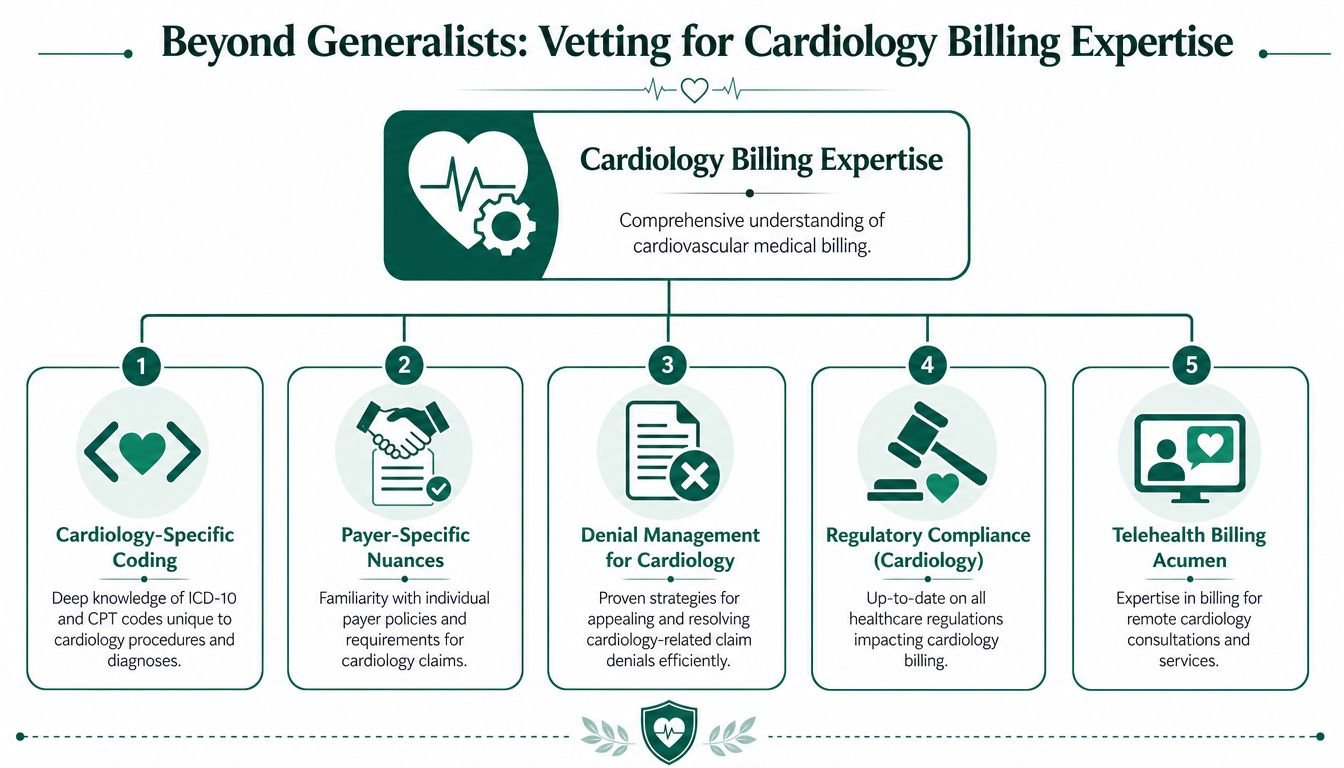
Vetting Partners for True Cardiology Expertise
Most billing companies say they handle cardiology. Far fewer can explain where cardiology revenue leaks.
A generalist can submit a clean office visit claim. That doesn't mean they understand how split billing affects echocardiography, how remote device work should be separated, or how documentation must support high-cost cardiac diagnostics under CMS and payer rules. The difference shows up in money collected, not in promises made during the sales call.
The first test is modifier depth
Ask any prospective partner how they handle split-bill imaging. Then listen carefully.
For cardiology practices performing diagnostic imaging in split-bill scenarios, failing to append Modifier -26 to the interpretation code, such as CPT 93306-26, leads to immediate denials because the payer assumes the global code if the modifier isn't present. That means a 0% collection rate until the claim is re-filed correctly (cardiology modifier guidance).
That isn't a coding trivia question. It's a direct revenue issue. If a hospital bills the technical portion and your physician bills the global code instead of the professional component, your practice doesn't get paid for the interpretation. The claim sits, A/R grows, and staff time gets burned on preventable rework.
A specialist should be able to discuss at least these examples comfortably:
- CPT 93306 with Modifier -26: Professional interpretation in split-bill echo arrangements.
- Modifier -TC: Technical component when the equipment and staff side is billed separately.
- Multiple procedure reduction logic: Especially where imaging and procedures interact in a mixed-service cardiology group.
- Global period awareness: Critical in procedural cardiology where follow-up services can be bundled or separately billable depending on timing and circumstance.
Diagnostic imaging and interventional work leak revenue differently
Generalists often miss the mark in this area. They treat all cardiology claims as if denial prevention is one problem. It isn't.
Data in specialty analysis shows imaging-specific coding errors can account for up to 30% of total denials in mixed cardiology groups, especially when modifier rules and bundled-service requirements are mishandled (specialty leakage analysis). Non-invasive imaging has its own failure points. Interventional cardiology has a different set tied to documentation, global periods, and complex procedural edits.
Ask vendors to explain how they separate these two tracks in reporting. If they only show you one denial dashboard for the whole practice, that's a warning sign. You need service-line visibility, not blended averages.
The partner you want can tell you whether your leakage is happening in echo, stress, remote monitoring, or invasive work before they talk about "overall optimization."
Ask about first-pass performance in cardiology, not in general medicine
Cardiology-specific outsourced billing services achieve a 30% higher first-pass clean claim rate than general billing vendors, and cardiology practices typically face 5–8% revenue loss from denials, coding errors, and missed payments tied to complex procedural coding (cardiology billing challenges). The mechanics matter. Strong partners don't just scrub claims. They run documentation feedback loops so physicians support medical necessity correctly and avoid symptom-based coding when a confirmed diagnosis is required.
That CDI loop matters more in cardiology than many owners realize. A biller who waits until denial stage is already too late.
A serious RFP should ask vendors these questions:
- How do you audit cardiology documentation before denials repeat?
- How do you separate diagnostic imaging denials from interventional denials?
- How do you track modifiers by payer for echo, stress, and device claims?
- What is your process for internal and external coding audits in cardiology?
- How do you update workflows when CMS or payer policies change?
If security and vendor oversight are part of your due diligence, this overview of Expert HIPAA compliance from Titanium Computing is worth reviewing alongside your technical checklist.
Revenue vigilance includes future CMS changes
A true specialist also watches upcoming reimbursement changes that affect your service mix.
CMS updated the 2026 RVU for the technical component of CPT 93296 from 0.60 to 0.95, which creates an approximate 60% payment increase for that code starting in 2026 (cardiac device CPT billing guide). If your group manages cardiovascular implantable electronic devices, the billing partner should already understand the distinction between 93295 and 93296 and when both should be billed separately as distinct documented services.
That is the kind of detail that separates a cardiology billing company from a generic RCM vendor. A generic team focuses on claim submission. A specialty team protects tomorrow's reimbursement as aggressively as today's.
For practices comparing options, this resource on choosing a cardiology billing company is useful because it forces the right questions before contract review.
Estimating ROI and Understanding Pricing Models
Outsourcing isn't cheaper just because a vendor fee looks smaller than payroll. The actual comparison is your total cost of collecting revenue today versus the cost and performance of a specialist partner.
For cardiology practices, outsourcing medical billing can reduce operational costs by up to 50% by eliminating expenses tied to in-house billing staff, software licenses, and ongoing compliance management (cost analysis). That number gets meaningful fast in a specialty where staff must manage imaging edits, interventional coding, denials, appeals, and payer rule changes at the same time.
The three pricing models you'll see
| Model | Where it fits | Main risk |
|---|---|---|
| Percentage of collections | Often works best when the vendor is responsible for broad end-to-end performance | You need clear contract language on what counts as collected revenue |
| Per-claim fee | Can work for stable, low-complexity environments | Cardiology complexity can make a low per-claim price misleading |
| FTE model | Useful for larger groups that want dedicated staffing | You can end up paying for labor without getting outcome accountability |
In cardiology, percentage-based pricing usually aligns incentives better than a flat per-claim structure. A claim for a simple office service and a claim involving advanced diagnostics or procedural follow-up don't create the same work. If your fee model ignores complexity, your vendor may focus on volume rather than recovery.
How to build a practical ROI view
Use your current in-house operation as the benchmark.
Include these categories in your comparison:
- Staffing expense: Salaries, benefits, overtime, turnover, and training time.
- Technology cost: Billing software, clearinghouse fees, reporting tools, and compliance support.
- Management burden: Time physicians or administrators spend chasing unresolved claims.
- Revenue leakage: Write-offs, missed modifiers, underpayments, and appeals that never get worked.
Don't compare vendor cost to payroll alone. Compare vendor cost to the full price of delayed cash and preventable leakage.
For a side-by-side framework, review this guide to outsource medical billing cost. The right question isn't whether outsourcing has a fee. It does. The question is whether your current model costs more than it appears to.
Managing Onboarding and Tracking Performance
Choosing the partner is only half the job. The first months determine whether you get cleaner claims and faster cash flow, or just a new set of status calls.
Specialized cardiology billing vendors reduce Days in A/R by 20–40%, often keep A/R under 35 days, and can recover an additional 5–15% of previously lost revenue through stronger denial management (performance outcomes). Those gains don't happen automatically. They come from disciplined onboarding, clean ownership, and weekly performance review.
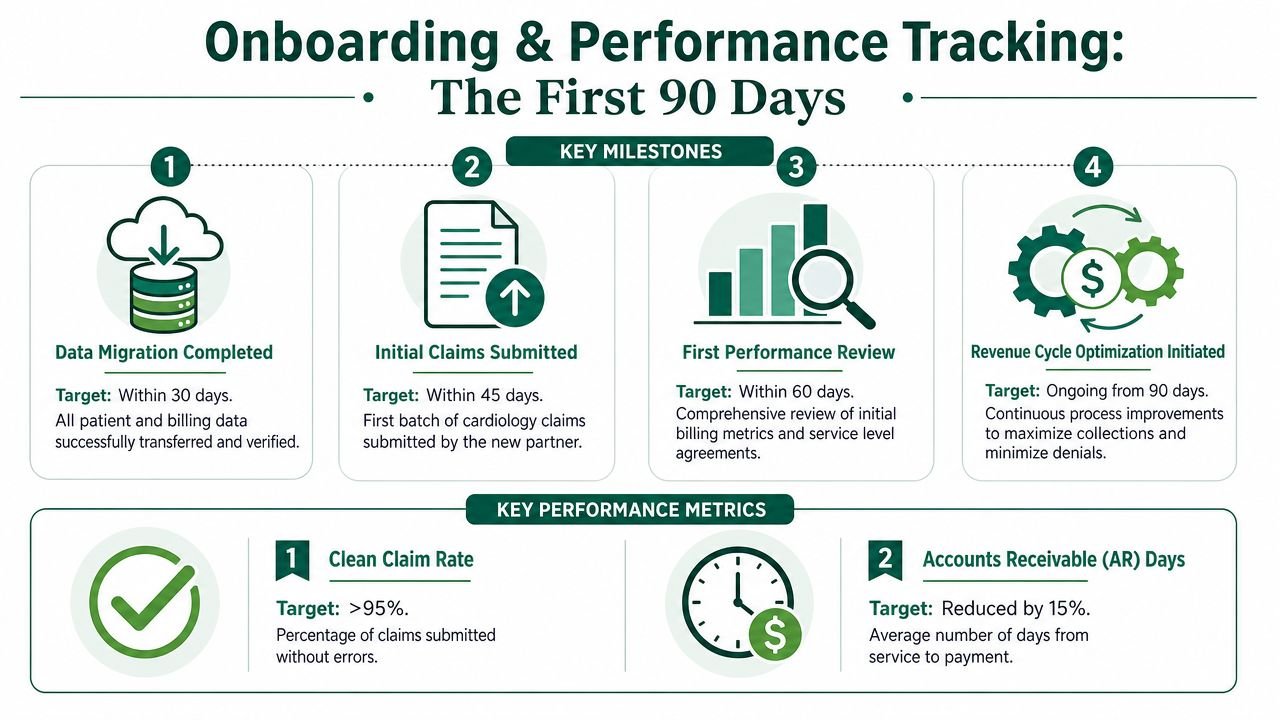
What the first 90 days should look like
The transition should be structured, not improvised. In our experience, strong implementations move in three phases.
Days 1 through 30
The partner should validate payer enrollments, load fee schedules, map charge workflows, and review historical denial patterns. This is also when they should identify documentation gaps tied to services like imaging interpretation, stress test components, and device monitoring.
Days 31 through 60
Claims should begin flowing through the new workflow with active monitoring. Expect edits, but expect them to be visible. If denials appear, the partner should explain root cause by payer and service line, not just say they are "working them."
Days 61 through 90
By this point, you should see trend data, not anecdotes. The team should be able to show whether new claims are cleaner, whether aging buckets are moving, and whether old revenue is being recovered.
The dashboard you should review every week
Owners don't need every billing detail. They do need the right operating view.
Track these metrics weekly:
- Days in A/R: This tells you whether cash is moving or stalling.
- First-pass clean claim rate: A leading indicator of whether front-end and coding workflows are tightening.
- Denial rate: Best viewed by payer and service line, not just as one blended number.
- Net collection performance: The simplest test of whether billed revenue is turning into cash.
A strong partner should also flag where physician documentation affects payment speed. In cardiology, that often shows up when the billing team and providers don't have a tight communication loop. When that loop is weak, coding errors repeat and denial recovery slows.
If your vendor reports totals but can't explain the reason behind each denial cluster, you're watching outputs without controlling process.
What owners should insist on operationally
The best onboarding plans include a short, fixed communication cadence. Not endless meetings. Just accountability.
Use this structure:
| Meeting | Owner |
|---|---|
| Weekly issue review | Billing lead and practice liaison |
| Monthly financial review | Practice leadership and account manager |
| Quarterly strategy review | Leadership, billing operations, and provider stakeholders |
Keep one dashboard. Keep one escalation path. Keep one owner on each side. If you want a benchmark for which metrics matter most, this resource on medical billing KPIs to track is a useful reference point.
Avoiding Common Pitfalls in Billing Partnerships
Many practices think the contract is the finish line. It isn't. Most failed billing partnerships don't collapse because the vendor lacked a website or a sales pitch. They fail because expectations were vague and no one managed the relationship tightly enough.

Three mistakes that cost practices money
- Vague service levels: If the agreement doesn't define reporting frequency, denial ownership, response times, and escalation paths, the practice will spend months arguing about responsibilities.
- No dedicated contact: When account management rotates or issues pass through a generic queue, physician questions and payer problems sit too long.
- No offboarding protection: If the relationship goes badly, you need a contractually clear process for data access, work transfer, and open A/R ownership.
What works better
Put operational requirements in writing before go-live. Require service-line reporting. Require regular denial root-cause review. Require clarity on who handles legacy A/R, underpayments, payer calls, and credentialing-related holds.
One more point matters in cardiology more than practices expect. Communication between physicians and billing cannot be optional. When that connection breaks, documentation issues stay hidden and coding errors repeat. A billing partner should create a simple physician feedback loop, not bury doctors in email.
Frequently Asked Questions
How do I know whether my cardiology practice should outsource now or try to fix billing in-house first?
If your team can identify the exact source of leakage by payer and service line, fix documentation problems quickly, and keep follow-up disciplined, staying in-house may still be workable. If leadership sees recurring denials without a clear root-cause process, outsourcing to a cardiology specialist is usually the cleaner path.
How should an outsourced partner handle old A/R during the transition?
This is one of the most important questions to ask. Practices often fear a 2–3 month cash flow valley during handoff, and there is no data-driven consensus on the ramp-up time for clearing legacy claims versus processing new ones (legacy A/R transition concern). A serious vendor should separate legacy A/R work from new-claim production, define ownership clearly, and show you how aged claims will be prioritized.
What should I ask a cardiology billing vendor on the first call?
Ask them to explain how they bill split professional and technical components for echo work, how they handle remote monitoring code separation, how they report denials by service line, and how they identify documentation deficiencies before they become repeat denials. If they answer in generic RCM language, keep looking.
Will outsourcing reduce control over my revenue cycle?
It can if you outsource blindly. It won't if you keep internal ownership, require transparent reporting, and set a fixed review cadence. The best partnerships give practice owners more visibility than they had before because performance is measured, discussed, and tied to action.
If your cardiology group wants a clearer view of where revenue is leaking, Happy Billing helps practices tighten specialty-specific RCM without forcing a disruptive workflow change. For owners who need a practical starting point, the team can review denial patterns, A/R bottlenecks, and coding leakage across imaging, device, and procedural claims so you can make the outsourcing decision with facts instead of guesswork.