Best Medical Billing Company in Dallas: 2026 Guide

The best medical billing company in Dallas is the one that puts more cash in your account, faster. For physician-owners, the right choice shows up in three numbers: first-pass clean claim rate, days in A/R, and specialty-specific coding accuracy. Everything else is secondary.
That standard matters in Dallas because independent practices do not have room for billing drag. A weak vendor does not just create administrative noise. It cuts owner distributions, slows payroll flexibility, and turns preventable denials into aging receivables. Analysts at ClinicMind's 2026 medical billing statistics roundup found that practices using high-performance RCM services collect more than practices managing billing internally. The takeaway is simple. Billing performance is a profit decision, not a back-office preference.
The costly mistakes are predictable. Modifier 59 gets used where NCCI edits should bundle services. Modifier 25 lacks documentation support. Denials from major Texas payers sit too long and miss appeal deadlines. That is why this guide is built for decision-making, not vendor hype. If you are comparing options, start with a provider-level view of cash flow, coding discipline, and follow-up execution, then review what a strong Dallas medical billing services partner should actually deliver.
Use this list the way an owner should. Ask which company can raise your clean claim rate, shorten A/R, and handle the coding patterns in your specialty without creating disruption inside your existing systems. That is how you choose a billing partner that improves margin instead of just processing claims.
Beyond the Dallas–Fort Worth metroplex, our statewide guide to medical billing services in Texas covers the Texas Prompt Pay Act deadlines (30-day electronic / 45-day paper), BCBS Texas / TMHP / UHC payer landscape, and the 4–9% pricing benchmarks that apply to physician-owned practices across the state.
1. Happy Billing
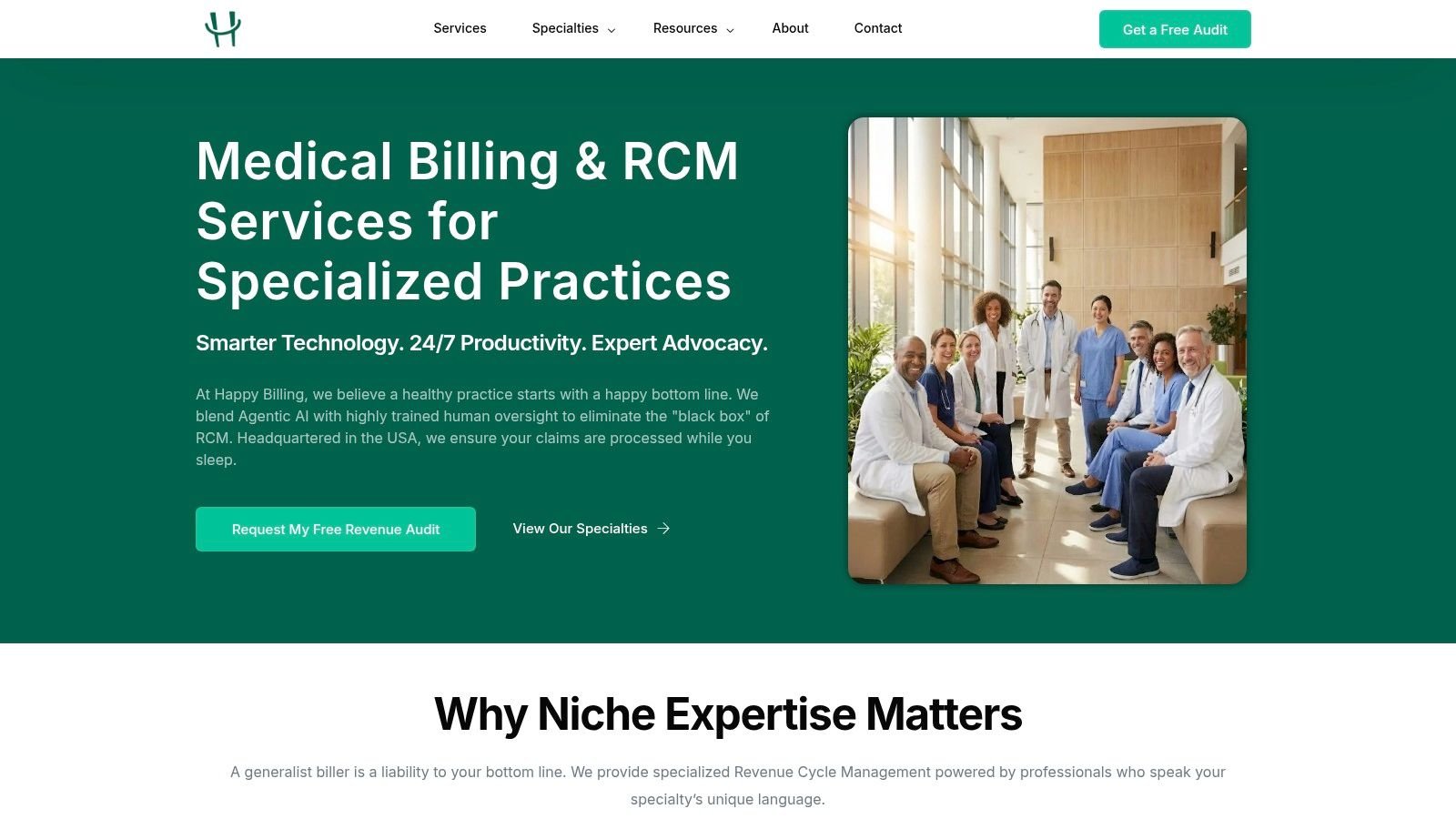
Happy Billing is the strongest choice for most independent physician owners who need specialty depth without ripping out their current systems. It operates inside your existing EHR, which matters because data migration projects often create charge lag, training drag, and short-term payment disruption right when your practice needs stability.
What stands out is the blend of agentic AI and human auditors. That combination fits real-world physician revenue cycles better than software-only billing. For anesthesiology, mental health, cardiology, orthopedics, pediatrics, and multi-specialty groups, billing errors usually don't happen because the staff lacks effort. They happen because payer rules shift, documentation misses a detail, or modifiers such as 24, 25, 57, 59, or XS are applied without enough specialty context.
Why it ranks first
Happy Billing targets a first-pass clean claim rate above 98% and works to keep days in A/R under 35. That puts the focus where physician owners should focus. Speed to cash. Not vanity reporting. If your current vendor keeps talking about claim volume but can't show A/R velocity by payer and denial category, you're not buying revenue cycle management. You're buying claim submission.
Practical rule: If your orthopedics or pain practice is billing global surgical packages, multiple procedure reductions, or postoperative E/M visits, ask how the billing team handles modifier 24, 25, 57, 58, 78, and 79 under CMS rules. That's where profit leaks.
Happy Billing also uses a 24/7 follow-the-sun model with U.S. leadership and a global back office. That model can work well when it's tightly supervised and HIPAA-first, because claims don't sit untouched overnight and denial queues don't idle through weekends. For high-volume practices, that operational tempo matters more than a polished sales deck.
Best fit and trade-offs
For physician owners, the practical value is specialty workflow design. Anesthesiology groups need base units, time units, concurrency, and modifier logic handled correctly. Behavioral health groups need authorization and payer rule discipline. Cardiology practices need accuracy on diagnostic imaging and interventional coding. Orthopedics needs strict control over global periods and reductions.
We also like the transparency angle. Happy Billing offers a detailed look at its Dallas medical billing services, and the company pushes prospects toward a free audit rather than a generic demo.
Pros
- Specialty-focused execution: Strong fit for anesthesiology, behavioral health, cardiology, orthopedics, pediatrics, and other physician-owned specialties.
- Low-friction onboarding: Works inside existing EHR workflows instead of forcing a platform switch.
- Around-the-clock operations: U.S.-led global processing can reduce claim lag and speed denial follow-up.
- Compliance orientation: HIPAA-first workflows, encryption, and AAPC-aligned coding standards support cleaner operations.
Cons
- No public pricing: You'll need a consultation to compare fee structure.
- Not ideal for every preference: Some owners still want fully domestic, on-premises handling and may want to validate data-residency comfort before signing.
Visit Happy Billing.
2. Atlantic RCM

Atlantic RCM is a scale play. If you want one vendor for eligibility, coding, claims, denials, A/R, and credentialing, this is a serious candidate. It's especially relevant for larger independent groups, ASCs, and organizations that need formal process controls documented for compliance reviews.
Its public positioning leans heavily on HIPAA, HITECH, SOC 2, and SSAE-style controls. For owners preparing for payer scrutiny, internal audits, or growth through additional providers, that kind of operational maturity is useful. It also has broad specialty coverage, which helps if your practice includes multiple service lines.
Where owners should look carefully
Atlantic uses offshore delivery centers to keep costs efficient. That's not automatically a problem, but it is something to vet. Recent Dallas-focused analysis argues that many local “top billing company” lists gloss over offshore versus onshore models even though staffing design can affect HIPAA risk and specialty-specific accuracy. It also notes that over 60% of Dallas-listed top billing companies operate offshore back offices, while guides often fail to explain how those teams handle Texas-specific modifiers and specialty workflows, according to UMBS Billing Services' review of staffing-model risk.
Offshore scale only helps if U.S. leadership actively manages payer nuance, modifier logic, and PHI controls.
That issue matters when your revenue depends on specialty detail. Think anesthesia concurrency, orthopedic postoperative rules, or behavioral health authorization management. If you're comparing Atlantic with another vendor, ask who reviews Texas payer edits, who owns escalation, and how your denials are segmented by payer and root cause.
For a broader decision framework, Happy Billing's guide on how to choose the best medical billing company gives owners the right questions to ask.
Pros
- Wide service stack: Billing, coding, denials, credentialing, and A/R under one roof.
- Compliance visibility: Strong fit for groups that want documented controls.
Cons
- Global delivery model: Some owners won't want offshore operations.
- Custom pricing only: Harder to compare quickly.
Visit Atlantic RCM.
3. ASA Management Services
ASA Management Services makes sense for physician owners who want flexibility. Month-to-month engagement and no setup-fee positioning reduce switching risk. If you've been burned by a long contract and weak reporting, that matters.
The company also presents itself like an operator, not just a biller. It talks in KPI language. Clean claims, A/R, collections, denial management, credentialing, and Texas-specific payer problems. That's the right framing for an owner who needs to protect take-home income, not just outsource admin tasks.
Why it deserves a spot
ASA's modular service model is useful for practices that don't need full outsourcing on day one. Maybe your internal team can still handle front-end registration and charge entry, but your denials are stacking up or your old A/R is neglected. A vendor that can plug into the weak point instead of forcing a full rip-and-replace can preserve continuity.
Its emphasis on AAPC-certified coders is also a positive sign. For owners, coding quality isn't abstract. It determines whether modifier 25 is supported on same-day E/M with procedures, whether prolonged care is billed correctly, and whether surgical claims survive payer edits without endless rebilling. If your current team keeps “fixing it on appeal,” you're already too late.
A useful companion read is Happy Billing's piece on medical billing company red flags. It's the checklist I'd use before signing any month-to-month agreement.
Pros
- Low switching friction: Month-to-month model is owner-friendly.
- Texas-aware positioning: Better fit for practices worried about local payer behavior.
- Modular support: You can outsource the broken part first.
Cons
- No public pricing: You'll still need a quote.
- May be too small for some enterprise-style needs: If you want a very large BPO footprint, look harder at capacity.
Visit ASA Management Services.
4. Elite Health RCM
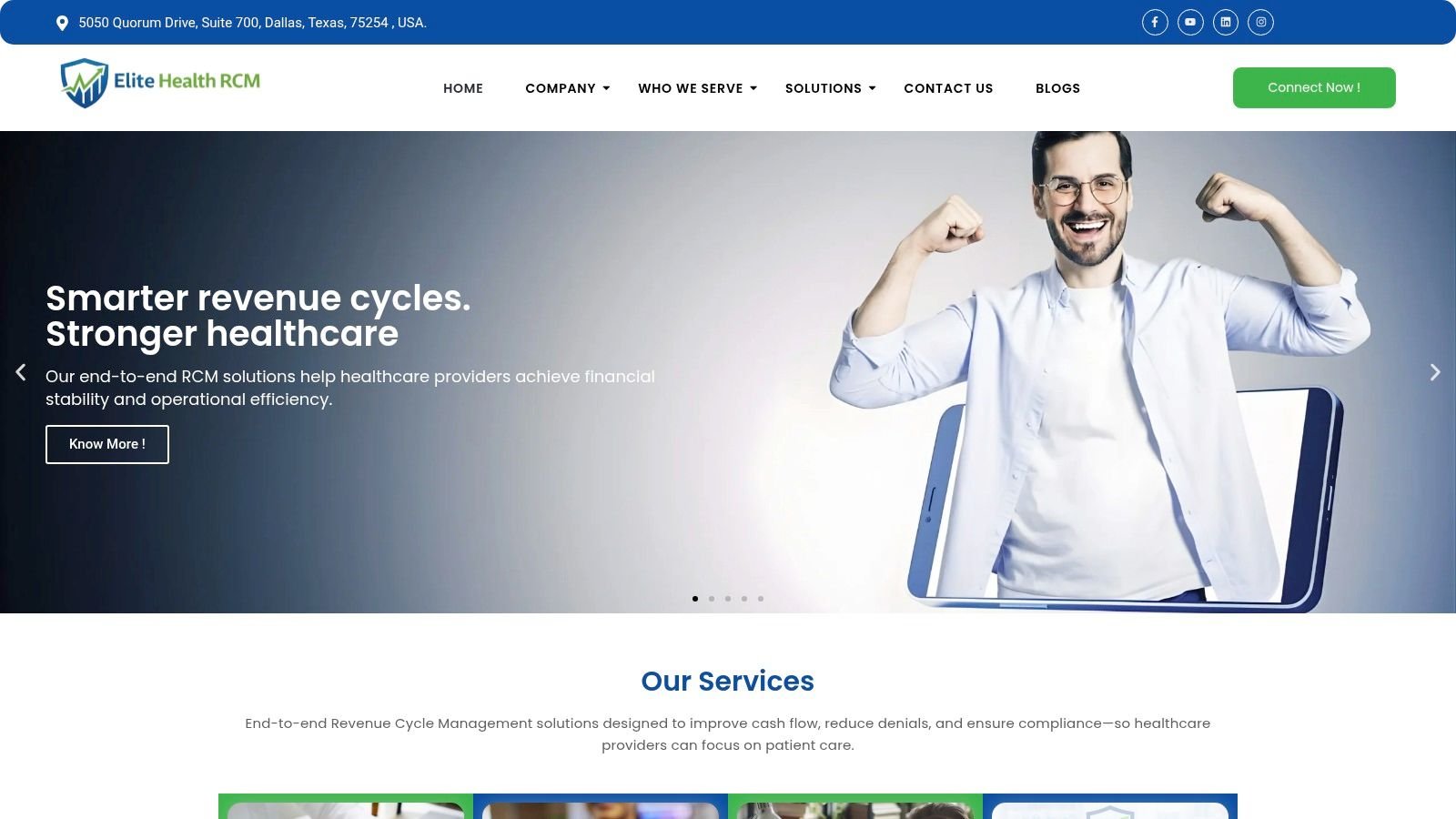
Elite Health RCM is a local Dallas option for owners who want hands-on collaboration and full-cycle support. It covers pre-billing checks, coding, billing, payments, denial management, A/R, and credentialing. That local footprint can help if you want easier communication with a team that understands the Dallas payer environment.
Its strongest message is prevention. That's the right message. The cheapest denial is the one that never happens. Eligibility verification, authorization checks, and front-end claim review are where revenue cycle discipline pays off first.
Who should consider it
This is a practical choice for practices that value local access and don't need a giant national platform. If your office manager wants a direct line to the people touching your claims, a Dallas-based team can be a real advantage. It also fits groups that want to tighten pre-billing controls without changing core operations.
That matters because high clean-claim rates don't tell the whole story in Texas. One Dallas-focused analysis points out that many local guides overemphasize clean claims while ignoring prompt-pay enforcement gaps, underpayments, and A/R velocity. It argues that physician owners need to evaluate AR speed and denial prevention, not just clean-claim marketing, according to Credex Healthcare's review of Texas-specific billing blind spots.
A vendor can boast about claim acceptance and still leave your money trapped in aging buckets.
For a practical outsourcing lens, Happy Billing's article on the benefits of outsourcing medical billing is worth reading before you compare local and national firms.
Pros
- Dallas presence: Easier collaboration for local owners.
- Front-end focus: Better fit for practices with preventable denials.
Cons
- Limited public proof depth: The website doesn't show extensive specialty detail.
- No listed pricing: You'll need a call to compare economics.
Visit Elite Health RCM.
5. Physician's Auditing & Billing
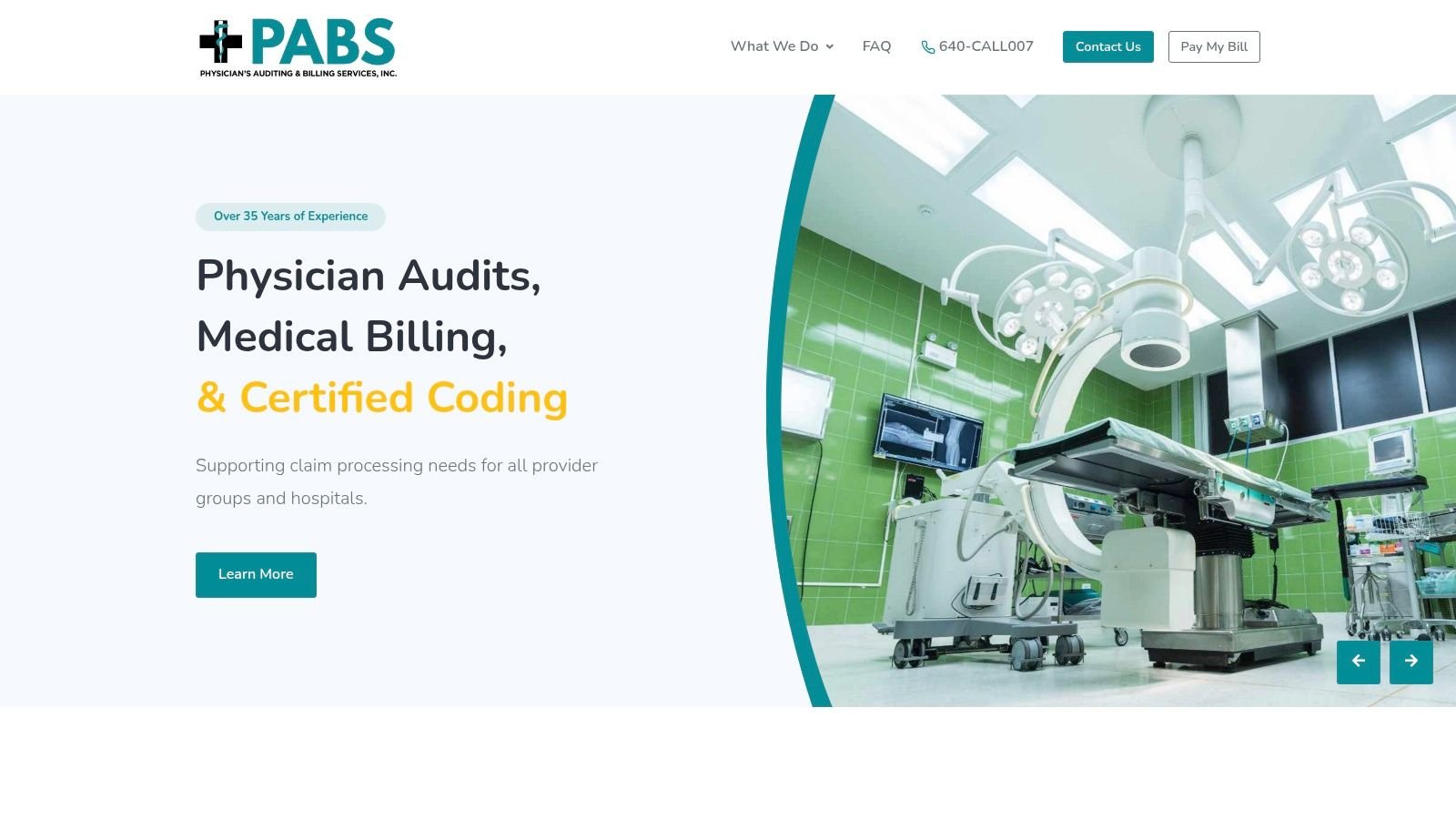
Physician's Auditing & Billing is the compliance-minded option on this list. If your practice is dealing with coding inconsistency, documentation concerns, or recurring payer takebacks, an audit-heavy vendor can be more valuable than a vendor that pushes more claims out the door.
The company combines billing, certified coding, auditing, practice management support, and EMR support. It also highlights HIPAA and HITECH document management. That's useful for physician owners who need stronger process discipline around coding and revenue integrity.
Why this can be the right move
Some practices don't need a flashy AI pitch. They need someone to catch why claims are failing. A group that runs a lot of procedures, incident-to services, or split/shared visits can lose money both ways. Under-code and you give up earned revenue. Over-code and you invite audits, refunds, and payer scrutiny.
Physician's Auditing & Billing also publishes a claim accuracy rate above 98% on its site. That signals a quality orientation, though I'd still ask what “accuracy” means operationally. Is that coding accuracy, clean-claim accuracy, or submission accuracy? Owners should insist on plain-English definitions before signing.
The fit here is strongest for practices that suspect their biggest problem is process rigor, not just volume. If your current denials look random, auditing often uncovers patterns your staff never had time to analyze.
Pros
- Strong audit posture: Good fit for compliance-sensitive practices.
- Local Dallas roots: Helpful for owners who value direct access.
- Coding plus billing: Better than separating those functions when leakage is tied to documentation.
Cons
- Less public specialty detail: You'll need to ask sharper questions by specialty.
- Limited public tech-stack transparency: Important if you want reporting depth.
Visit Physician's Auditing & Billing.
6. Collective RCM
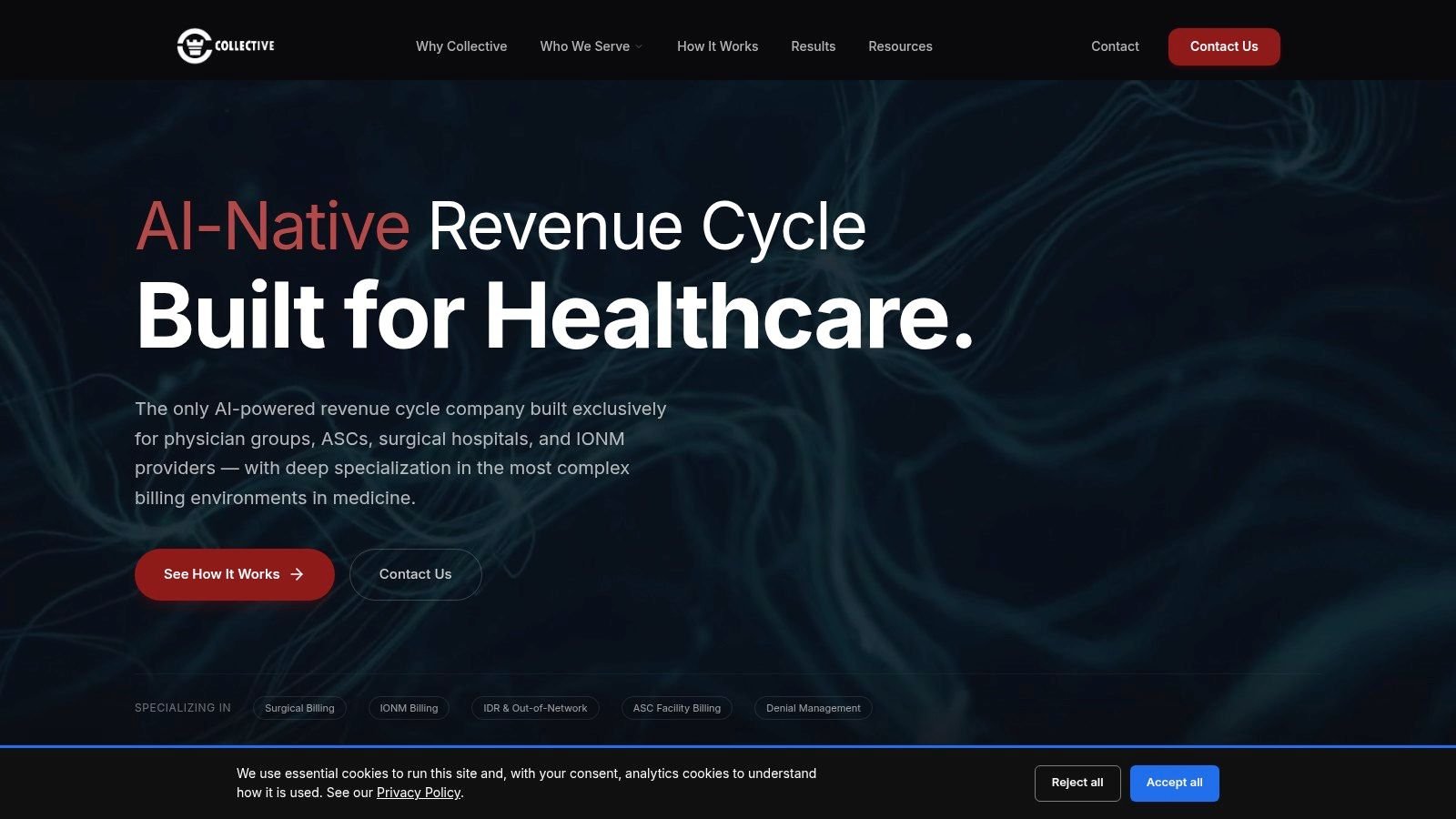
Collective RCM is the most specialized option here for surgical groups, ASCs, spine, orthopedics, pain, and IONM-heavy environments. If your practice lives in out-of-network disputes, IDR, high-acuity procedures, and procedure-heavy payer friction, generalist billing teams often miss too much money.
Its positioning is clear. AI for coding review, denial prediction, and recovery strategy. Deep surgical expertise. Credentialing. Coding audits. OON and IDR support. That package is built for groups where one wrong modifier or one missed appeal can erase margin fast.
Best for surgical complexity
This isn't the best fit for a straightforward primary care office. It is a serious fit for owners dealing with complex procedural billing, multiple procedure reductions, global surgical rules, and payer pushback on high-dollar claims. In those environments, specialty knowledge beats generic billing capacity.
The company's niche focus is also consistent with what we've seen in the field. Orthopedic and pain practices rarely struggle because they submit too few claims. They struggle because payer edits hit coding combinations, postoperative periods are mishandled, or denials aren't worked aggressively enough while the clock is still favorable.
If you're evaluating niche firms against broader vendors, compare them against a market-level framework like Happy Billing's review of top revenue cycle management companies. It helps separate true specialty operators from broad but shallow vendors.
Pros
- Excellent niche alignment: Strong for orthopedics, spine, ASC, pain, and IONM.
- Recovery-oriented: Better fit for practices facing payer resistance and OON complexity.
- AI plus specialty review: A good mix when high-dollar claims need both speed and judgment.
Cons
- Too specialized for some groups: Likely overbuilt for low-complexity practices.
- Likely premium positioning: Expect a consultative sales process.
Visit Collective RCM.
7. Encompass Revenue Solutions
Encompass Revenue Solutions is the practical choice for smaller and mid-sized clinics that want billing plus supporting technology in one relationship. It offers RCM alongside tools like iClaim billing, EMRx, telehealth, patient-pay functions, compliance support, and credentialing. For owners tired of juggling multiple vendors, that simplicity has real value.
This kind of bundle can work well if your biggest issue isn't just denials. It may be fragmented operations. Claims live in one place, patient balances in another, telehealth in another, compliance oversight somewhere else. A more unified stack can reduce operational drag.
Where it fits best
If you're modernizing front office and patient-pay workflows while also outsourcing billing, Encompass is worth a look. The local Dallas presence and direct phone support also make it attractive for owners who want easier access than a national call-center model often provides.
The trade-off is obvious. When a website lists many tools, you need to confirm that specialty billing depth matches the breadth of the platform. If you're a cardiology group billing diagnostic and interventional services, or an orthopedics practice managing surgical packages and reductions, ask for examples of how they handle those workflows under CMS and payer policy rules.
The right bundled vendor saves management time. The wrong one gives you one invoice for several average services.
Pros
- One-vendor convenience: Useful for practices that want tech and billing together.
- Local support: Easier access for Dallas-based clinics.
- Good modernization fit: Helpful when patient-pay and workflow upgrades matter.
Cons
- Specialty depth needs vetting: Don't assume broad tools equal deep coding expertise.
- No public pricing: You'll need a custom proposal.
Visit Encompass Revenue Solutions.
Top 7 Dallas Medical Billing Companies Comparison
| Provider | Implementation complexity | Resource requirements | Expected outcomes | Ideal use cases | Key advantages |
|---|---|---|---|---|---|
| Happy Billing | Low, integrates inside existing EHR with no migrations | Vendor AI + expert human auditors; 24/7 global back office; custom pricing | Very high first‑pass clean rate (98%+); target <35 days in A/R; faster cash flow | Specialty high‑stakes practices (anesthesia, cardiology, mental health, orthopedics, pediatrics) | High accuracy and speed, specialty workflows, real‑time dashboards, strong security |
| Atlantic RCM | Medium, full‑cycle RCM with offshore delivery centers | Offshore staffing to control costs; documented compliance (SOC 2/SSAE‑16, HIPAA) | Scalable billing and compliance readiness; cost‑efficient operations | Practices needing scale and formal security controls (groups, ASCs, hospitals) | Broad service catalog and formal security/compliance controls |
| ASA Management Services | Low–medium, modular services, month‑to‑month engagement | AAPC‑certified coders, KPI reporting; percentage‑of‑collections pricing | High clean‑claim focus and low days‑in‑A/R targets (under ~30 days) | Independent and specialty practices in Texas seeking flexible contracts | Clear performance targets, no long‑term contracts or setup fees |
| Elite Health RCM | Low, local, non‑disruptive onboarding | Local Dallas team with technology emphasis; consultation required for pricing | Improved cash flow and proactive A/R/denial management (limited public metrics) | Dallas practices preferring hands‑on, local collaboration | Local presence and emphasis on clean claims and proactive management |
| Physician's Auditing & Billing | Medium, billing plus ongoing audits and EMR support | Certified coders, continuous audits, HIPAA/HITECH document controls | Published claim accuracy >98%; strong denial collections and follow‑through | Groups wanting audit‑heavy, compliance‑minded RCM support | Rigorous auditing/coding discipline and local headquarters |
| Collective RCM | Medium–high, AI integration and niche surgical workflows | Proprietary AI for claim scrubbing/denial prediction; surgical coding experts; likely premium pricing | AR reduction, out‑of‑network/IDR recovery, improved denial prediction | ASCs, surgical hospitals, orthopedics, spine, IONM and high‑complexity surgical billing | Deep surgical specialization and AI‑driven denial/IDR capabilities |
| Encompass Revenue Solutions | Medium, bundled PM/EHR tools may require platform adoption | Integrated tech stack (iClaim, EMRx, telehealth) plus local support | Simplified vendor management, better visibility into claims and patient‑pay workflows | Small‑to‑mid clinics wanting an all‑in‑one PM/EHR + RCM solution | One vendor for RCM and technology with local phone support |
Your Buyer's Checklist for Selecting a Dallas Billing Partner
A billing company does not improve your practice because it sounds organized on a sales call. It improves your practice when it gets more clean claims out the door, cuts days in A/R, and prevents specialty-specific coding mistakes that drain physician income.
That is the standard. Use it.
Dallas physician owners should screen every vendor against a short list of operating questions tied to margin. If a company cannot explain its process for claim scrubbing, denial follow-up, coding review, and payer escalation in plain language, move on. A polished dashboard does not fix weak execution.
Start with these questions:
- Show specialty competence: How do you handle coding rules, modifier use, payer edits, and documentation gaps in my specialty? Orthopedics, pain, cardiology, GI, and multi-location primary care all break in different places.
- Define the KPIs: What do you report every month for first-pass clean claim rate, denial rate, days in A/R, net collection rate, and aging by payer?
- Assign ownership clearly: Who works denials, who files appeals, who tracks timely filing limits, and who closes the loop with front-desk or clinical staff when documentation causes rejections?
- Explain the staffing model: Is the work handled by a local team, a national team, or a blended model? Who has access to PHI, and how is that access controlled?
- Show implementation discipline: How long does onboarding take, what data do you need from us, and what disruption should my staff expect in the first 30 to 60 days?
Ask for examples, not promises. A strong billing partner should be able to walk you through a denied claim, show how it was corrected, and explain how the same denial is prevented next time. That answer tells you more than a generic pitch deck.
If you run a dental group or a multispecialty practice with a dental service line, your marketing and billing decisions should line up. Growth without clean collections creates busy work, not profit. This playbook for dental practice growth is useful for owners who want patient acquisition and revenue capture to support each other.
Compliance matters, but operations decide whether compliance produces cash. CMS rules, payer policies, and coding standards only help when the billing team applies them correctly and fast. The best Dallas partners do not just submit claims. They control handoffs between scheduling, eligibility, coding, posting, denial management, and patient balance follow-up.
What percentage of collections should I expect to pay for medical billing services in Dallas
Most Dallas billing companies do not publish rates. That is normal. Your real benchmark is return on the fee, not the fee alone.
A lower percentage is a bad deal if denials increase, old A/R sits untouched, or coding errors slow cash. Compare the proposed fee against expected performance in collections, denial control, reporting quality, and specialty accuracy.
How can I measure the ROI of switching medical billing companies
Measure the switch like an investment. Track baseline performance before the transition, then compare it after 60, 90, and 180 days.
Use these metrics:
- Net collections
- First-pass clean claim rate
- Denial rate and appeal recovery
- Days in A/R
- Cash posted by week
- Aging in the over-90-day bucket
If cash arrives faster, aging drops, and more claims pay correctly the first time, the new partner is earning its fee.
Do I have to switch my EHR to work with a new billing company
No. Many billing companies can work inside your current EHR and PM system. That is usually the better choice because it reduces retraining, data migration risk, and front-office disruption.
Ask the question early anyway. Some firms want you on their platform, and that changes cost, timeline, and staff workload.
What's the difference between a local Dallas biller and a national company
Local firms usually offer tighter access, faster communication, and better familiarity with Texas payer habits. National firms often bring broader staffing capacity, longer service hours, and more technology.
Choose based on your bottleneck. If your practice struggles with accountability and physician-owner visibility, local attention helps. If your problem is scale, overflow work, or multi-state complexity, broader infrastructure may be the better fit.
Happy Billing stands out for independent physician owners who want specialty-specific billing support, tighter denial control, and practical implementation without unnecessary platform disruption. As noted earlier, the company also offers a no-pressure audit process. If you are still sorting out infrastructure, security, and hosting questions alongside billing, this guide to SMB cloud hosting compliance is worth reviewing.